
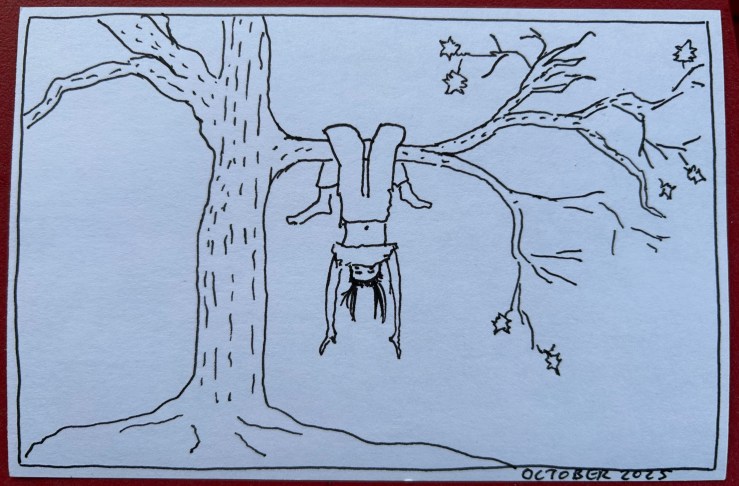
So. Good news. My flash creative nonfiction (CNF) story, How To Mourn Your Mother, will be published in SmokeLong Quarterly in March 2026. I’ve always wanted to publish with SmokeLong; I’m feeling stunned but also full of gratitude and also extremely lucky.
I’ll write more about how many iterations that story went through and how many people contributed to making it the piece it became when it’s published next year. The final version is 800 words. I like working in the compressed form.
Despite writing CNF most, compared with fiction or poetry, this is my first CNF publication. It opens my eligibility to enter the RBC Bronwen Wallace Award for Emerging Writers (BWA). I’ve kept my eye on this Canadian award for years. When I first learned about it, I was ineligible to enter because I was too old. Originally, the award was restricted to writers under the age of 35. In 2021, the age limit was removed. I’m pleased about this. Though I have always written, beginning with little picture books I illustrated and stapled together when I was a kid, and writing poetry (intermittently) since grade five, I didn’t turn intentional efforts toward the craft until I was closing in on my fortieth birthday, realising that if I didn’t begin pursuing my dream of writing a book length work, it wouldn’t happen. Having kids and working a full-time job slowed creative work[1].
For the BWA, I planned to enter the introduction I’ve written for the Long Project, the book length story I’m working on. The introduction, titled, A Marriage: Framed, stands on its own as a complete piece. I’ve sent it out for publication to three different literary magazines since writing it the summer of 2024. I’ve received three rejections. I guess that’s not that many places …but each time I receive a rejection …well, it frays my heart[2].
Reading the guidelines for the BWA again, I discover A Marriage: Framed is too long: 3770 words. The upper limit for the award is 2500 words. Shit.
Dilemma: Do I use another CNF work, or do I work with A Marriage: Framed? I elected to start by cutting the latter to the shorter word count. Here’s my experience:
How I thought it would go:
Reviewing the story with the advantage of emotional distance (it’s been months since I read it last), as well as foresight with how it relates now within the wider context of the unfolding Long Project, a few observations:
- there are many sentences I can tighten up that will read more elegantly…this will reduce words IF I tackle this exercise properly (with deep attention and intention). It does mean sitting with each of the paragraphs and understanding the emotional resonances and layering these in the writing (which I should be doing anyway…I thought I had…it’s clear there is room for improvement). But will it eliminate 1270 words? A challenge for sure…
- The piece plays on the word “framed” in a few ways:
- Structurally: the beginning and ending paragraphs centre the same argument between the husband and the wife, the narrator, culminating in a catalyst that ignites the narrator’s courage to end the marriage. The first paragraph sets up the argument with situation and dialogue and the final paragraph repeats the scene, following it to its logical conclusion. The two paragraphs provide a frame for the rest of the piece, comprised of explorations of i) the different reasons people decide to marry versus the reason this couple decided to marry and ii) snapshots/fragments of the lives the couple shared for 27 years (25 married). An opportunity: the snapshots/fragments could be fleshed out better…[3]
- With imagery: there’s a description of a wall of framed photographs we had in our kitchen, what I coined “The Wedding Wall”, photographs of various family members’ weddings on both sides. I’d intended the wedding wall to be a kind of family tree our girls might see themselves nested in[4]. An opportunity: other images on that wall that I didn’t include in this introduction piece, but plan to write into the Long Project, are photographs I took of each of the girls separately, on different occasions, where they are wearing swim goggles and pulling funny faces at the camera. For some reason, I also hung those photos alongside the wedding photos. I’m beginning to understand my subconscious motivations for doing so. LOL. So, an opportunity to weave this in.
- Framed as in adorned or applied with decoration: wedding dresses and flowers are described…used to support characterizations of family members and signal class differences…not sure if there is opportunity here or whether it could be cut…will see.
- Framed as in fooled or tricked. The husband believed the wife bewitched him into marriage. At present, there’s a subtle nod to such trickery in the piece, it’s not overt. This exploration unfolds through the Long Project…and it’s far from complete; I don’t believe I’ll strangle this into 2500 words. Still, this tension, the emotions of it (irony, betrayal, anger, sorrow) …raw and bleeding…ripe for imbuing any writing with entertaining vitality[5].
- Framed as in made in exact imitation of something valuable with the intention to deceive or defraud: isn’t this what marriage is? The idea of marriage? The fairy tale story of happily ever after? An opportunity: this is not unpacked in the current piece. It could be…and could tie in with the swim goggles bit[6]. Though…not a unique stance.
- Framed as in falsely accused. The argument. Ah yes, the old argument. I was emailing a friend the other day and inadvertently described this as: “one of those jealous puppet arguments dangling from the strings of inadequacy”. This puppet imagery intrigues me…and I feel there’s a place for it here, it’s an opportunity vibrating. In this piece, the argument is the wife being accused of having an affair, a common accusation throughout the relationship. The narrator never did. BUT…that is the surface argument: the heart of it is mistrust. And though mistrust ignites the repeating argument it’s not what ultimately ends the marriage…the couple learned to live with mistrust—such a rude, slippery, all sharp elbows, stinky bedfellow—an illumination does: the wife “sees” a truth. Once seen, it can’t be unseen. If I’m honest, the current composition winds its way along this path, but it’s sloppy. So, another opportunity. [This is not looking good for cutting the piece down to 2500 words…this is what happens when I let my subconscious title my writing pieces.]
- The Long Project integrates movie references…mostly 1980s movies. The Marriage: Framed introduction currently plays with a scene from The Godfather[7]. I really like the pop culture layering in the current introduction BUT it functions well to set up the patterning in the longer work and could be cut to create a shorter piece…it isn’t necessary to the focus of a shorter piece[8]. But I like it and cutting it feels….wrong[9].
- I’m realizing, having written through this off-the -cuff meta-analysis, that I will need to erect a new piece, leveraging the architecture of the original.
So.
How it went:
I’ve cut the story down to 2374 words, an operation that sliced my arteries. I feel like I’m bleeding out. Pretty decent wails composing it. Took me a week of sob writing sessions. I have no idea if the sentences are any good…they are containers of raw pain.
Recap:
- Sentences, as I’ve just written….still need attention (and love)…hope to work on this now…but honestly, I’m struggling with the sorrow this exercise let loose. I might leave it. I don’t know.
- “Framed” word play:
- Essay Frame: Maintained the structure of beginning and ending with the same scene (the old argument).
- Picture Frame: Kept the wedding wall photographs but didn’t have space for the goggle girls. They will make it into the longer work (the Long Project).
- Framed = adorned: Kept in the wedding descriptions.
- Framed = tricked: Man oh man I resisted cracking this connotation open…but it became the new piece’s focal point. And most fascinating, my subconscious offered up clues to where I was heading when I wrote the words here, “raw and bleeding”. LESSON: follow the pain (which often presents as resistance).
- Framed = defraud: Retained only a subtle nod to the idea of wedding/marriage as fairy tale happily ever after. It’s overdone anyway. The Long Project explores this more, and in complex ways, by challenging why the hell we buy into the idea, literally, and, more interesting, what the investment costs us. Individually yes, but also socially and culturally and child developmentally.
- Framed = falsely accused: the new piece retained the false accusation, the puppet argument, as the technique of forward plot momentum, the question the reader (and, evidently the writer who is too often in the dark) seeks to find out through reading (and uh, the process and practice of writing).
- Movie references were stripped out; no room in this focused piece.
- The process of honing the focus as a stand-alone personal essay, forced me to confront the essence of rot at the centre of this marriage[10]. This piece became its own “thing”, branching from the original.
Next, I plan to play with the sentences and make them elegant[11]. I’ve got time. Submissions close December 2nd. If you email me, I’ll send you the story for feedback. I’m still feeling this song.
[1] Though, raising children and tending a large vegetable garden and cooking and preserving all that was growing is certainly creative work. But I’m glad the award recognises “emerging” might happen at any age or stage of life.
[2] I know, I know, rejection is part of the publication business. The business part …sigh. It challenges me. I’m still sensitive about it and it takes me a long while to recover. Meaning, it takes me a while to get back into creative mode and “just be” with art making, not second guessing my abilities, writhing with my inadequacies …time that is costly and wasteful when I really should just be enjoying – in joy – the work. This is why I don’t offer my writing out as often as I should. BUT…I’m finding with writing practice that I’m more confident with applying techniques and working with the gifts arising from the subconscious. This helps. The confidence I mean. It’s fleeting.
[3] Yes, it is often the case when preparing to prune a piece, additional explorative and generative writing must be done…it’s the fractal nature of process…the piece can’t simply be cut down, it must be written out following other paths then pared to an essential essence …and in exploring the shape and trajectory of a shorter piece, its focal lens shifts, refining toward a similar but different pathway through the piece. I’m branching off from the original trunk of work into something related and connected, but different.
[4] Jeeeezuss Christ on a bicycle!
[5] Fuck, am I ready for this?
[6] Am I veering too far into thinking (instead of feeling) territory? Probably.
[7] No, not the scene with the horse head in the bed. The scene where they discuss the thunderbolt. I also reference the same scene in the novel by Mario Puzo, a book I read (and loved) as a teenager.
[8] It seems this is what I’m circling round with the writing of this post …finding a focus for a shorter piece…
[9] I’m learning to pay attention to … how my body feels when confronted with a writing dilemma like this: do I cut this to make a new piece or write a whole different one? But I want to work with this one. Perhaps juvenile, but when I think of it, it kind of feels the way Darth Vader does when he says “I sense something…a presence I’ve not felt since…” ha ha ha.
[10] I hesitate to use the word “rot” …it’s not quite right. In the story, I use the word “infect” with its connotations of disease…this isn’t quite right either. My subconscious titling of this blog post delivers the answer I’m looking for, the imagery offered up with the word branching, a tree. This phrase is what I mean: “the root pain”. I mean, the root pain nourishing a tree’s trunk and all its growing branches. The root emotional and physical pain that ultimately destroyed a relationship, taking decades to finally kill it.
[11] Play, in this instance, may look a lot more like crying while I fiddle shifting words around the page like a kid who doesn’t want to eat their peas.

 Process Peace