A Note: The story, How to Mourn Your Mother, written about in this post, was published in SmokeLong Quarterly in Issue 91, March 2026.
The following is the original blog post from July 2025.
Performed another public reading, this one at Blizzmax Gallery, heart leaping in my mouth.
I sifted through older works to find a piece suitable for the occasion. The event showcases short stories that may be read in under 5 minutes, equating to around 600 to 750 words. And, because the last time I read I selected a work that was dark, I wanted to read something lighter and funnier this time round.
Laughing.
Turns out, I haven’t written “funny” in some time1. Choosing is not so easy…many of my flash stories are sorrow containers…they await my attention to weave light into them. What do I mean by this? I mean humour or beautiful imagery or sensory details…components that gift a reader better pay off for their time and energy sharing my dark.
Also, I seem to have a lot of pieces that are very …how do I say this….poetically artsy…less story, less fun(ny), syntactically gymnastical…intellectual babies whining to be picked up after a failed roly-poly2. And for stories read out loud, some of my writings tax the listener’s ear and mind3.
So, I chose this 747-word creative nonfiction flash, written in 2023, and wanted to report here, for the sake of interest and transparency, how many publication rejections it has collected so far. I discovered I never sent it out! It was entered in a small contest and made it to a shortlist where it garnered positive feedback from two editors I hold in high regard4. The version below incorporates their feedback.
I practiced reading this story to friends the other day and could feel the tug of certain sections that don’t quite “fit”. So, it’s a good piece to practice my heart work. What is heart work? It’s focusing to feel and know the deeper emotions in the piece, then render them with words. Somehow.
I’m hopeful winding my wayward musings in this post might be soothing in the same way Bob Ross’s leisurely guides through painting technique can be. Or, perhaps this doesn’t transfer to the written medium, I’m not sure…I’m resisting the (very strong) urge to hit the delete button here. This exercise (practice) of writing around a story draft helps me see and understand it best. Even when I print out a hard copy and make notations in the margins, cross out lines and rewrite sentences, the revision doesn’t attain the necessary level of attention required for me to write through reflections and become aware of the deeper workings in the story. So…if you’re interested to read through this writing/thinking (writhing? ha ha) process keep going…otherwise quittez ici5.
Below, the red font indicates my thinking and directions towards the rewrite. The restriction of < 750 words is a significant challenge for rendering complexity of emotion, more so for rendering a cascade of different emotions (which is what an experience of grief is)…and the question of whether the piece might be better served as a longer work kind of hovers as possibility (or necessity). Of course, it could become two different pieces…lets’ see where we get with it.
How to Mourn Your Mother6
Originally when I wrote this piece, I was trying to capture mum’s complex personality and also how sad I was when I had to move her from her home into 24-hour long term care because of her advancing dementia. I had an idea for this re-write: to structure the paragraphs as embodying the five stages of grief (denial, anger, bargaining, depression, acceptance). But I caught myself …that’s the “thinking” route. It avoids sitting with the feelings of this piece (signalled by the title I assigned it without much deep thought, duh….what does my mourning feel like?). So, I discarded the idea (reluctantly, but stubbornly). Also, would a reader “feel” the grief I’m exploring if I wrote it that way or would it become just a “telling” of grief? I want to avoid the latter and nurture connection with readers through feeling. So…
[P1] To begin, expand your definition of mourn. A funeral is never a prerequisite, nor is a death. Stretch your mind to the task facing the rack of Mother’s Day cards. Divine their insides. Where is the mother who bakes whole wheat bread but seduces the man you had a crush on? The mother who delights badgering her too-goody-two-shoes daughter but coos about her grace, her intelligence. Where is the mother who sings, Hooray, hooray, the first of May, outdoor fucking starts today!? Re-rack each card.
I have considered adding another example of mum’s character into this first paragraph [P1]….I’m humming and hawing over the too-goody-two-shoes line, whether it could be replaced with something stronger. What I’m trying to do in P1 is introduce the character of the mother and the character of the narrator, but also the differences of their characters and how their relationship vibrates along those tensions.
The syntax in P1, now that I’m reviewing the sentences, works well. I won’t unpack all of the sentences, but, as example, the middle two create the see-saw effect of positive/negative personality quirks, hinging imbalances (signalling tension) on the word “but”:
- Where is the mother who bakes whole wheat bread but seduces the man she knew you had a crush on? (the italicized adds a soupçon of drama, that, if I’m honest, I try to avoid in real life…but in story it’s essential…so, instead of avoiding this history, I’m layering that truth in).
- The mother who delights badgering her too-goody-two-shoes daughter but coos about her grace, her intelligence. (here we get information about the narrator, but through the mother’s point of view). Also get some repetition of sound here: who, too, goody, two, shoes, coos…fun for the ear. Should it do more? [Inner voice: who cares? it feels good. leave it.] Badgering. I love the word and the characterization proliferating from it …but is it the right word?
I notice there’s an opportunity here in P1 to amp up the theme in this piece using repetition – currently, the repetition is implied: “where is the mother” and “[where is] the mother” in these two sentences. But “Where is the mother?” is actually the heart of this piece, the question the loss (grief) circles around. It’s a sudden recognition for me…revealed only through this deeper attention to syntax. The horrible magic trick of dementia is that the person’s “person”–their soul–disappears, yet their body remains. In our culture, the presence of a living body means the person “lives”. But this is a very painful lie…”a person” can die long before their body quits. And yet love survives and lives on–even complicated love–beyond a body, beyond a soul (or both) now gone. Where has the “the mother” gone is the source of grief. But wait…that’s not quite right…the question implies that grief hasn’t quite landed yet….instead it’s the narrator questioning where and when the actual “loss” happened (is happening…in a never ending torturous loop?) I’m drifting …let’s get back on track here.
[P2] When, after a savage thirty-five year marriage she finally leaves your dad, detonating his psychosis landmines—his artful arrangement of family photographs, matchbox, red jerry can in the backyard firepit; his royal unhinged nakedness slapping car bumpers along Highway 33, shouting he is God—and you phone her from 4500 kilometers away to plead she get someone, a paramedic, the police, anyone, to check on him, but instead she says, He’s no longer my problem, pay attention to the clench in your stomach threatening to loosen your bowels, the rubber-band like pressure at your temples, the way your vision blurs. Get comfortable with it.
I’m thinking about P2…I’m not sure what I think…it makes me feel …cringey…avoid, avoid, avoid…come back to it later7. Or never. But this is a moment of loss between the narrator and the mother…it is not the loss of a life in the bodily sense, but it is a loss of “relationships as they knew them”. That is, the relationship between mother and father has changed (separation), but also, relationship between mother and daughter is changing too (shift of responsibility from mother to daughter for a father with mental illness). This piece is too short on space to open this up for deeper exploration, yet the uncanniness, which I hope is achieved by rendering the specificity of the father’s psychotic break, and the mother’s refusal to provide care during the crisis, as well as the daughter’s physiological reactions , all combine to create an emotional sense of, if not outright abandonment, at least a sense of unease. I’m not sure this actually works, but giving it a try.
[P3] Next, ignore the dog turds littering her front hall. She lives with her new partner after all, a man who encouraged the turquoise tattoo of a harp seal occupying the real estate between her left breast and her pants belt. He worked retail in the past but retired to professionally burn through your mother’s limited savings. She guffaws at his witty admonishment to watch out for the “brown flowers”. She giggles when your sister complains he leers from the foot of their guest bed.
I think the writing here is trying to move me through the mother’s cognitive disintegration…and I mean this how I write it: the writing is guiding me. In the initial write, I was just riffing off memories and scenes that offered themselves as I wrote…it’s in the re-write I start to understand the writing is moving me through the slow experience of losing my mother (in this piece, to dementia; in a different piece, perhaps I’ll explore her bipolarism). Coming at P3 with this angle of understanding, I recognise P3 needs to work harder and that perhaps the final two sentences are a distraction technique (for myself), and should be cut.
Side note: introducing additional characters (more than two) in a flash piece is always risky (always exceptions of course) because it diverts valuable sentence space toward extra people not necessarily central to the story, wasting opportunities to build the core relationship and the particular quality of grief being explored between the mother and daughter in this piece. Instead, there is opportunity here to insert the narrator’s sense of …what? Unease/disregulation/confusion/incredulousness/impending doom? Don’t know yet…but needs heart work here. Will revisit. Keep going.
[P4] Notice when she breaks pattern, misses phoning you the first of May to sing Hooray, hooray…
I like this sentence/para. I like how it loops back to the beginning and signals continuing cognitive disintegration as we read forward…a push-me-pull-you movement of energy. I think P3 needs to do a better job transitioning to P4.
[P5, including dialogue] Listen carefully when the policeman calls on a snowy afternoon to explain your mom was picked up without a coat or shoes, completely lost, mere metres beyond her own driveway. He suggests waitlisting her for long term care, then pauses before explaining how shocked his colleagues were at the state of her home, stuffed with hoarded clothing, porcelain teacups, costume jewelry, piles of dog shit, a partner sporting black briefs and nothing else.
Yes, you admit, she’s lived that way for years.
Admire the resignation in your voice.
But is she safe?
Puzzle whether he is asking about your mom, or you.
Try not to cry.
P5 is necessary to the causal chain of story: where is the mother? In P1 the narrator is looking for her mother in greeting cards (good grief) and knows she will never find her among the “typical/normal” mothers displayed there. But we’ve also been set up, by the title and the first lines in P1 that there’s a loss to be mourned. We don’t know what kind of loss and this question pulls the reader into the piece (hopefully).
When we move through the uncanny weirdness in P3 (to be fleshed out), the blunt information in P4 through the scene in P5, we get more information about where the mother is along that slope of decline. P5 shows how and why the mother can no longer care for herself. P5 also shows how it takes an outsider, a policeman, to confirm the mother’s level of decline for the narrator…who, in this para remains oddly disconnected and removed from the action, but is nevertheless affected (but puzzled) i.e., she doesn’t know why she feels like crying, but she does. I’m hoping the narrator’s unease is felt by readers.
[P6] In that long moment waiting for the ink of your signature to dry beneath “Power of Attorney” on a form officially committing your mother to a dementia ward where all the perimeter doors automatically lock and all the interior doors automatically don’t, question the accuracy of the verb “commit” in this context. Is it an antithesis?
[P7] Then, realise you’ve lost Mom in this new place. She drifted away while you negotiated “level of intervention” options, paltry check boxes on flimsy paper. No resuscitation. Checkmark. Consider drawing a happy face in the box instead. Can a happy face be a wish? When you locate your mother in a communal toilet, wearing only her shirt and sweater, the clothes of her bottom half soaked and crumpled in the corner, she will cry, embarrassed, but without the words to express this. Hug her close, let her tears mix with your own on your pressed-together cheeks but suppress your wail when she sobs, I just want to be a person with pants.
I like P6 and P7, the hyper-focus on the moment the narrator enacts Power of Attorney privileges, her interiority and the implied guilt/betrayal ….but is the implication strong enough? I’m not sure yet…thinking….
[P8] After you unload the fifth truckload of clothes, some dresses with the tags still attached, at the Value Village donation drop off, your sister will light up a cigarette in the parking lot, take an orgasmic inhale and turn to the teen shoving the plastic donation bins into the warehouse bowels: Hey kid! Don’t be too rough with that, you’re lookin’ at our inheritance.
Of course I love this paragraph because I love the story/memory of it…it’s also typical of my personality, in life and in writing, to insert a distracting joke when the moment becomes too serious and intense8. Here, this para, as much as I love it, isn’t doing work towards this specific story. It doesn’t add anything. We already know the mother’s hoarding/mental disintegration tendencies from P5 and introducing the sister here, even with the marvellous characterization of her through action and dialogue, doesn’t move towards an answer to the question “where’s the mother?” at all. It has to be cut. And, in its place? A deeper exploration of loss is needed: describe a moment when the narrator actually understands her mother is gone (the mother’s soul has died). This para must embody an emotional wallop the reader/listener feels…all the energy in this piece builds to this para (a crescendo). And do this in less than 50 words. Good luck.
[P9] Finally, walk past the drooling barely breathing wheel chaired bodies lining the hallways as if there’s nothing horrific about it. Find your mother wrapped in a red bath robe layered over 4 or5 shirts and too many gaudy necklaces decorating her neck. Feel grateful she dressed herself today. She remembers the punchline, even laughs, when you prompt, Hooray, hooray…though doesn’t remember your name, or know you’re her daughter. She believes you are a middle-aged volunteer. But listen when she tells you how beautiful you are, how much she loves you. Peel her a fresh clementine. She will think it the most glorious thing. She will call you a magician. Marvel the trick your love lives.
Here, the energy in this piece settles. The grief has shifted from the painful loss (to be developed in P8) into…resignation, perhaps even acceptance: the relationship between mother and daughter resides in small moments of connection shared through appreciation of beauty. Here, the peeling of a clementine. But, as P9 is currently written, it doesn’t quite attain this level of satisfaction. That last line: Marvel the trick your love lives …an enigma. It was the words magician and trick that tipped me off to understanding this piece is about how the mother’s cognitive disintegration has been a slow “disappearing act” and that the narrator’s mourning has not been straight forward or even recognised as mourning. The narrator, by the time we get to P9, has successfully followed the directive provided in the first line in P1: To begin, expand your definition of mourn. But the final line, as written, doesn’t get readers quite there….it needs tweaking …and perhaps a slightly less saccharine resolution…perhaps a line with more ambiguity which is a better reflection of what it is to mourn….and continue to mourn, in this torturous way…waiting for the body to catch up to the loss of personhood and die. Blunt, I know.
The experience of reading this time was easier. I was still nervous, but not so nervous that my stomach flipped the air from my diaphragm, and the projection from my voice. While I was reading I paid very close attention to the energy in the room and could feel it move. I was trying to assess the emotions moving between my writing and the audience, how it was being received. I realized/appreciated/learned, for the first time, how the “emotional energy” is actually the medium I’m trying to work with… the words are simply “the tools” or “the instruments” with which to create a symphony of layered feelings. This is the the high style bar of writing I’m trying to reach. Here’s a graphic of what I mean by the emotional energy:
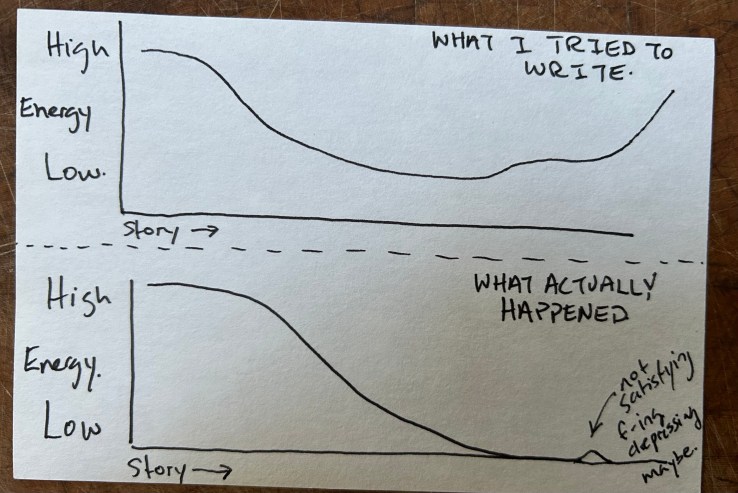
Ah well…more tweaking to the piece needed. Which, maybe is a good thing, because I forfeit offering this for publication in a literary magazine by posting (publishing) the reading here (video below). If these versions in this post are draft, does it still count as “previously published”? I don’t know. Trying to let go of this outcome focus and just be content with the process and joy of art making and sharing. Thank you for your eyeballs (and ears).