I’m out of sorts after a week away from writing routine[1]. I woke Tuesday morning with the robins calling up the dawn (3:30 am…it’s still dark robins)[2].
While away, I managed to reread the essay, published in The Believer, The Sentence is a Lonely Place, by Garielle Lutz[3]. I took new notes and recognised (again) the importance of incorporating music into writing and that I haven’t been as intentional about sound in my writings as I ought to be[4]. Sigh.
My sister asked, “What is it…are you compelled to write?”
We were drinking coffee on her back deck. The conifer covered mass of the Stawamus Chief, its great granite wall, commanded most of the horizon beneath a band of cerulean sky. Floofy seedheads floated the air and mingled among fine lit lines of spider webs threading the treetops, invisible lines cast by the breeze and spinning gold when caught by sunlight. This was after I’d laid down my pen, closed my notebook and folded the screen of my laptop down with what must have been an audible frustration when she found me at her kitchen counter at 6 am.
“No,” I said, “that’s not it. Not exactly…” I struggled to articulate a jumble of thoughts…I’ve been writing(ish) since I was very young, a kid…did she not know this? She’s seven and a half years younger than me, almost a decade between us (certainly a generational difference). Maybe she never saw me writing when we were growing up…or if she did, maybe she was too young to remember; she was twelve when I left home for university[5].
I tried to explain. It’s not that I’m compelled to write, it’s more like writing is …a quest. And not a quest just to finish “a story”. And not a quest just to write beautiful and cohesive sentences one after another, though of course that’s part of it. There is far more …mystery involved. Magic, even. It’s a mystical practice. Language is a layer, a layer of symbols and representations, a barrier between us and the physicality (this is an inadequate word, but it will have to do) of ‘all things’ in our world. Deep attention and presence to physicality helps call up language that can create an intimacy with the objects and experiences and sensations, to re-create a “composed reality” on the page …but words are only ever proximal, they are not reality itself. She nodded …didn’t seem too bored, so I continued.
It’s hard to explain, I said, but the magic happens when, through the process of writing, the words called up are communicating back through the writer/writing, illuminating new/intriguing/curious observations/experiences/sensations sourced from what I sense (believe?) is a collectively shared well (or lake), a shimmering, deeply beautiful wild reality happening in parallel to our experiential reality …a reality not quite, but almost, beyond the limits of human perception…reachable only through the process of writing (or other art mediums). The writer is a translator, of sorts, from that shared mystical layer to the one we live in. As a writer, I cast into this collective subconscious lake and fish out proximations of the beauties there…small beauties of pure elegance and truth in the form of phrases and images that take my breath away. There’s a moral aspect to the writer role too…recognising I can do this (sometimes), I feel I have a duty, a responsibility to the process. This is the quest…a journey of translation. And just like real fishing, there’s a lot of silence and waiting and exercising patience to hook and land beauties to the page[6].
I’m following you, she said, nodding…though I felt I wasn’t convincing and I felt frustrated not being able to explain what I experience and I could tell she believed I’d entered woo-woo territory alongside healing crystals and coloured haloes.
“The trouble is,” I said, “it feels very close to tipping into insanity.”
“Now, you’re just being dramatic,” she said.
~
Another “out of sorts” I’m wrangling with …and I think I’ll wait till I’ve recovered from jet lag and convocation ceremonies (Willa’s is Friday) before focusing on this task next week. The ring structure I’m using as a “form” to write the story into is kind of …not collapsing…but, through the process of writing, rearranging itself. I’m remaining open to these changes, trusting the process (see ‘quest’ above) as opposed to being rigid[7].
Emily, a dear friend and romance writer who I exchange writings with, pointed out that for a reader to care and have compassion for Claire, my story’s narrator and main character, they need to understand the love between Fanboy and Claire to feel its loss later in the story.
“I want to see Fanboy and Claire fall in love. How do they meet? What are they like together as a couple?”
“I don’t think I can write that,” I said. I felt a mixture of inability (am I skilled enough to write those scenes?) and strong resistance (an avoidance to sitting with those powerful experiences of falling in love, that now, can’t be recalled without considerable emotional pain).
She’s right, of course, about getting that information in the story very early on[8]. Focusing at the sentence level, I’ve become blind at the plot level.
“Course you can,” she said, a wrinkle of confusion between her brows.
Maybe these are rookie writer mistakes, embarrassing ones, but I’ve promised fidelity to recording my process here, so[9].
I began writing scenes toward Claire and Fanboy meeting at the Formula One Grand Prix in Montreal. Getting Claire there, in her early twenties, to begin with needed some serious imagination, a story that made me laugh writing it (so that’s good). But I’m over five thousand words into this account and I’ve got Claire dissing Fanboy because she discovers he’s married so they’re not even talking to each other, let alone hopping into bed together (what I thought I was going to write…I even collected a few delicious literary sex scenes to emulate)[10].
Then, one evening, while still trying to sort through this writing predicament, in real life (not the imaginary one I’m making up which is kind of bending my brain to confusion about what is real and what isn’t, what’s memory and what’s made up), my daughter was upstairs on speakerphone with her dad. I couldn’t make out their words; I could hear laughter and joy in my ex-husband’s voice. He was driving home after a good day at the racetrack[11]. I haven’t heard that tone, that side of him, for many years and I miss it. I burst into tears. I still love him, that part of him. Tumultuous love, and grief mixed with incredulous surprise at my reaction, but without any measure of regret for making the decision to leave our marriage, like, zero. Quite the cocktail. This too is what I must learn to write somehow…this love, this loss, this complexity. It explains my reluctance, my fear. Why I said to Emily, “I can’t write that”.
And I’ve been thinking a lot about this since… how humans love multiple people at the same time, love multiple people in different ways, love only certain parts of people…but not who they are entire…and is this a failing? Or is it that we fail by setting expectations that aren’t realistic, that can’t align with the limits of human biological programming or physiology or developmental trajectories or emotional capacities? Is true love a fantasy? Or is true love only fleeting? What is true love? And then I think…love happens in the in-between …it’s relational and moving…something luminous to keep alive, to nurture and feed and grow. I’m learning to embrace its complexity. I’m trying to write it.
Anyway, to put some sort of example to unite the two halves of this half-assed blog post, I’m sharing a response written earlier this week to a prompt to “write something little”. I share it to show how words draw from the lake of subconscious to bubble through my writing and show me my thinking (in this case, a particular slant of grief following that episode of hearing my ex’s voice…the subconscious has hauled out baubled memories related to holding hands and riffing on the “to have and to hold” of marriage vows).
Here it is, transcribed unedited, from my notebook:
It is the little gestures I remember most. How, when you held my hand in yours, raised above our pillowed heads, you squeezed the tiny bones between the knuckles of each finger, a pressure that says I am here, I am holding you. To have and to hold.
Once, when we had been arguing, you walked ahead of me on the street, striding with those long legs of yours so that I had to scurry to keep up. When I reached for your hand, you pulled it away, quick, decisive, punishing. The feathered touch of skin the moment before you did so was cold.
Another time, when the baby got so suddenly sick, trouble breathing through her tiny nose, her throat sputtering, I was struggling with the buttons on my coat, readying to take her to the ER. In my vision—confined to a circle of small focus outlined with black, a consequence of my fear and anxiety the baby might stop breathing—you handed me a fried egg sandwich saying, ‘eat this, you may not get food for a while’.
Your tears and your anger when I told you I was leaving you because you only wanted to have me but not hold me, the way you used to.
~
Hm. A melancholy post. These happen.
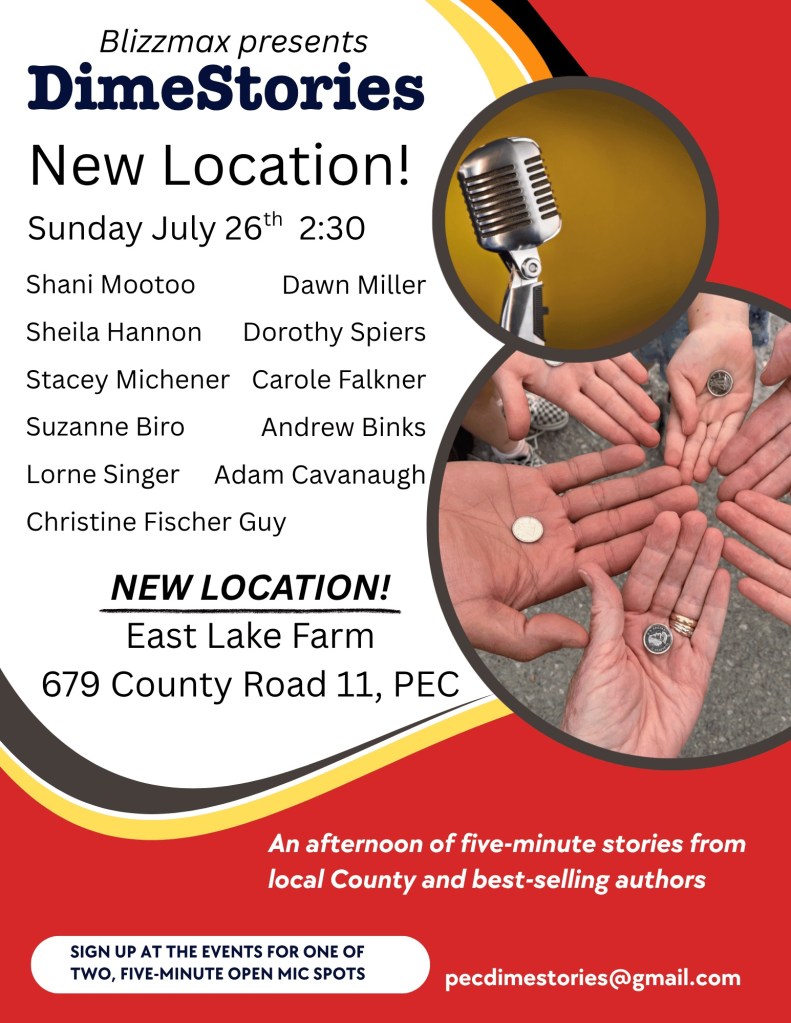
I signed up to be part of a public reading in July (see the poster at the end). I’m nervous about experiencing anxiety when I read …this is outweighed by my curiosity to feel how my current writings land with an audience…the experience shapes my writing. I plan to read an excerpt from the Long Project. I’ll post the video here (if the reading goes well)[12].
[1] Attended Lillian’s convocation ceremony in Victoria and visited my youngest sister and her partner in Squamish. Every trip I vow to keep up writing practice (or at least reading practice). I never manage it. And I tell myself over and over: It’s important to be present and engaged in these moments of living and celebration…let the writing go, take a break, relax. But I remain in the bardo…not writing…feeling anxious about not writing…something like an opaque semi-permeable membrane preventing me from full participation in the current and physical world…a reticence others sense and resent (I don’t blame them). Why this longing to be in a world of imagination? As I write that question, the answer rises easily: it’s safer there…the risk of pain (disappointment, grief, etc.) is far better controlled. Well. We shared fantastic meals and the weather was gorgeous (though cool) and I did practice (some) sentence level creativity.
[2] Weirdly, this does not at all correspond to time change hours.
[3] Thank you Stacey for reminding me about this essay (and printing the hard copy)!
[4] I ask myself: When should I do this? After drafting? Now? Myself answers: Yes (this includes an eye roll). Myself also whines: will I ever finish this project? I’m reminded of that Sesame Street character Don Music who always bangs his head on the piano in frustration when trying to write songs, lamenting he’d never get it, never! This makes me laugh.
[5] From the beginning I changed her diapers and rocked her in the pram, a constant jiggling chore, back and forth, back and forth. She was an intensely colicky baby. In the long project, her character is referred to as The Wailing Baby. She has forbidden me to write about her. You can see how that is unfolding.
[6] ‘Hook’ and ‘Land’…a two-step process: haul the words and imagery from the subconscious (step one) then study and work with them to best showcase their shape and form (step two). I have written about this before. And here too.
[7] Definitely a self-improvement.
[8] Emily’s first romance novel will be published in Germany next year (which makes us laugh…neither of us speak German). I’ve asked her to model her next romance heroine after me and to pair me up with a kind, decidedly virile, intellectual partner who loves poetry and fiction and who will read to me before we fall asleep. Other stipulations: not married to someone else, gainfully employed, healthy (sufficiently fit in body and mind), loves to eat good food, quietly confident, someone who wants to be a partner. I do love the guy she’s writing about now, nick-named the Ancient Mariner. In all seriousness though, Emily has a keen and practiced eye for story components and beauty; she’s an active voting member for the BAFTA awards (has been for 20+ years).
[9] A common refrain from my (now ex-) husband during the years we were together: How can you be so smart and so stupid at the same time?! [insert sheepish shrug-shouldered grin of idiocy.]
[10] A restricted selection: Ian McEwan’s glorious capture of what it is to experience the wonder sex, from his novel, Lessons, “It seemed as if he had been shown a hidden fold in space where there was a catch, a fastener, and that as he released it and peeled away the illusory everyday he saw what had always been there…It was either hilarious or it was tragic, that people should go about their daily business in the conventional way when they knew there was this.” ; the orgasm described in Barbara Gowdy’s short story, Sylvie; the tender innocence captured in Brian Doyle’s short story First Kiss; a vague disconnection during lovemaking described in James Salter’s Light Years; the stupendously orchestrated scene of lovemaking woven with ocean metaphor in Texaco, a novel by Patrick Chamoiseau; and, of course, the romantic love making in the apple shed, described in Hamnet, written by Maggie O’Farrell.
[11] Auto racing (Formula Ford). A good day means nothing mechanical broke, including human bones.
[12] If instead the reading goes very badly and I stop breathing and collapse into a jellyfish I may still post a video…anything for a laugh (wink).