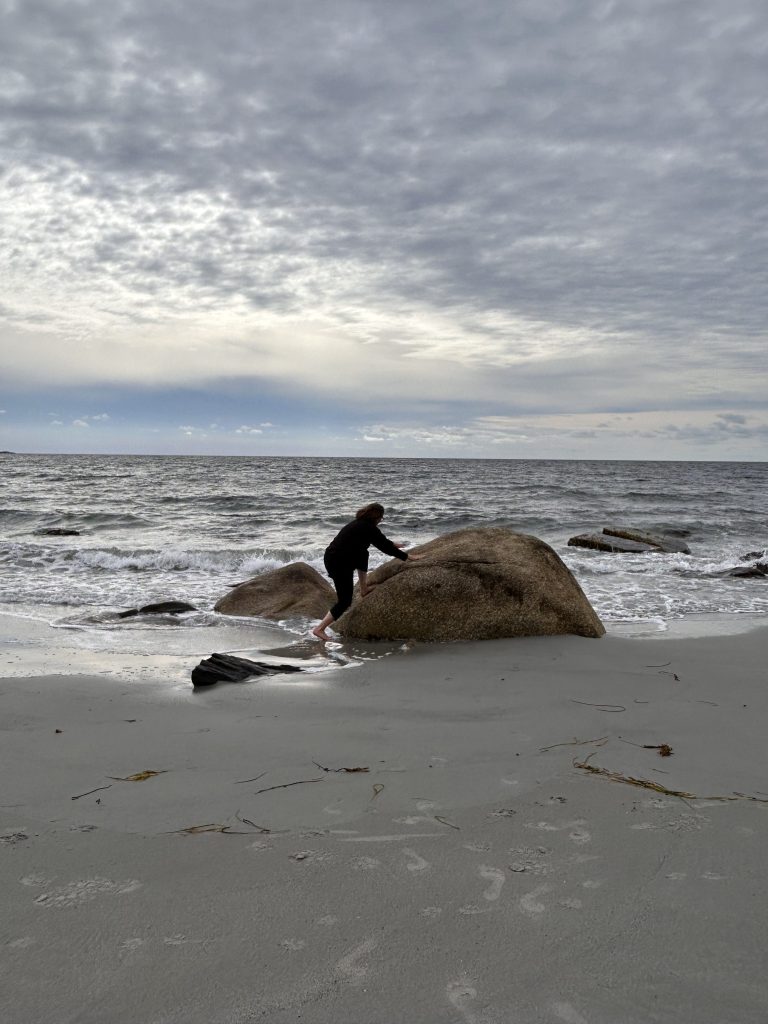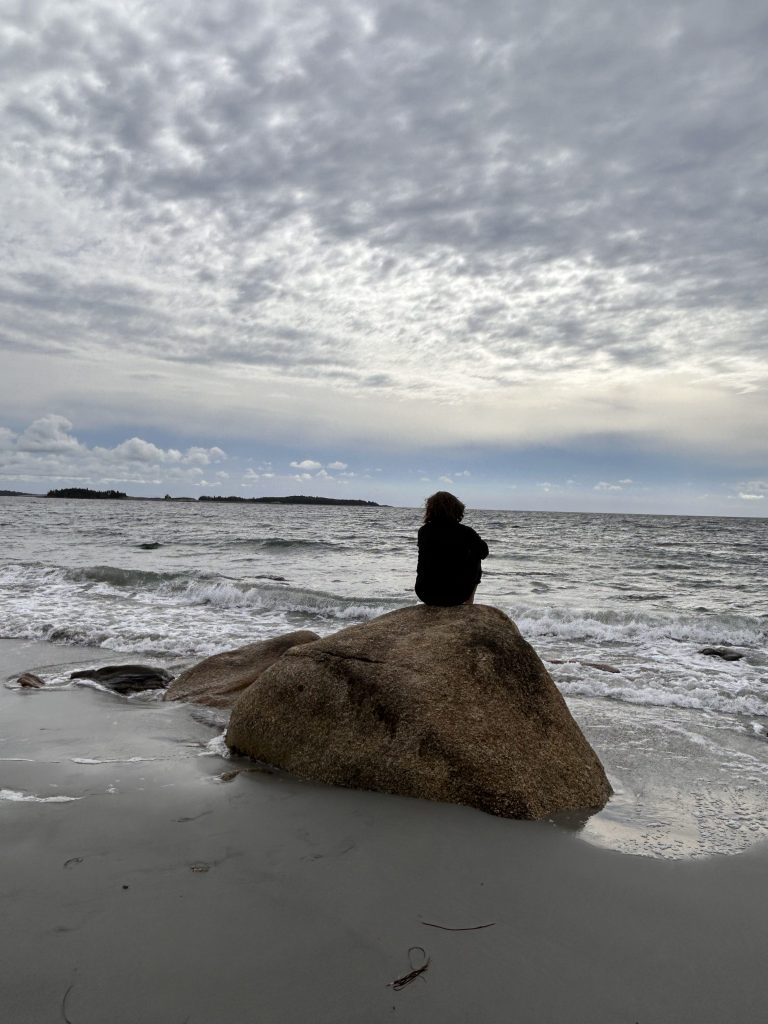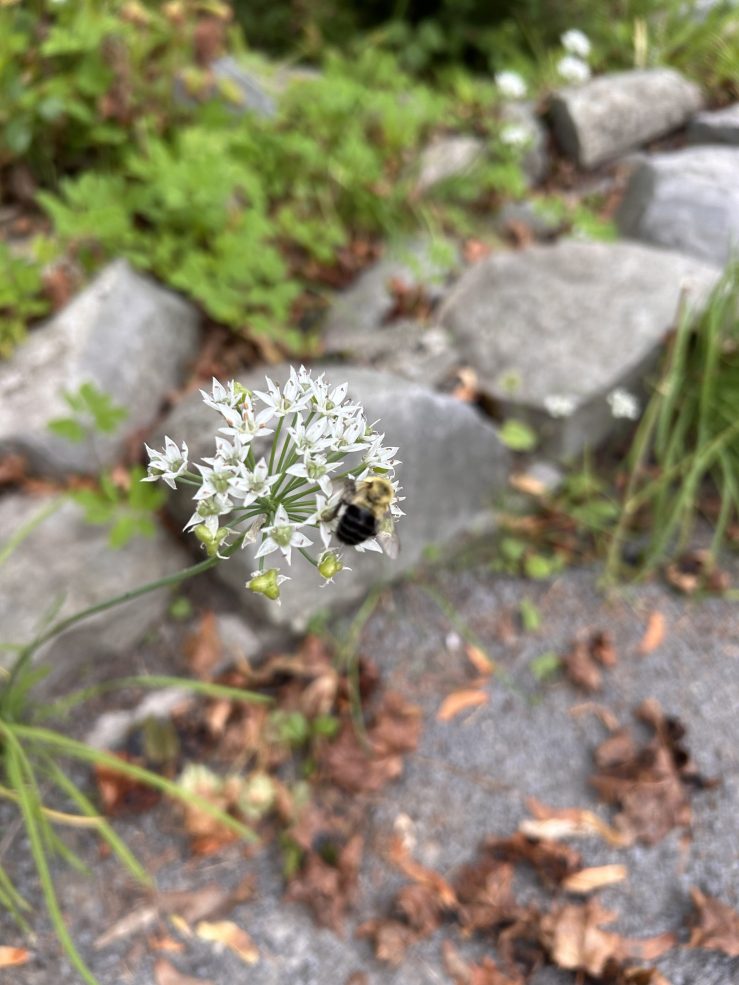
Into The Lake of My Heart 

I’m out of sorts after a week away from writing routine[1]. I woke Tuesday morning with the robins calling up the dawn (3:30 am…it’s still dark robins)[2].  

While away, I managed to reread the essay, published in The Believer, The Sentence is a Lonely Place, by Garielle Lutz[3]. I took new notes and recognised (again) the importance of incorporating music into writing and that I haven’t been as intentional about sound in my writings as I ought to be[4]. Sigh.

My sister asked, “What is it…are you compelled to write?”

We were drinking coffee on her back deck. The conifer covered mass of the Stawamus Chief, its great granite wall, commanded most of the horizon beneath a band of cerulean sky. Floofy seedheads floated the air and mingled among fine lit lines of spider webs threading the treetops, invisible lines cast by the breeze and spinning gold when caught by sunlight. This was after I’d laid down my pen, closed my notebook and folded the screen of my laptop down with what must have been an audible frustration when she found me at her kitchen counter at 6 am. 

“No,” I said, “that’s not it. Not exactly…” I struggled to articulate a jumble of thoughts…I’ve been writing(ish) since I was very young, a kid…did she not know this? She’s seven and a half years younger than me, almost a decade between us (certainly a generational difference). Maybe she never saw me writing when we were growing up…or if she did, maybe she was too young to remember; she was twelve when I left home for university[5].  

I tried to explain. It’s not that I’m compelled to write, it’s more like writing is …a quest. And not a quest just to finish “a story”. And not a quest just to write beautiful and cohesive sentences one after another, though of course that’s part of it. There is far more …mystery involved. Magic, even. It’s a mystical practice. Language is a layer, a layer of symbols and representations, a barrier between us and the physicality (this is an inadequate word, but it will have to do) of ‘all things’ in our world. Deep attention and presence to physicality helps call up language that can create an intimacy with the objects and experiences and sensations, to re-create a “composed reality” on the page …but words are only ever proximal, they are not reality itself. She nodded …didn’t seem too bored, so I continued. 

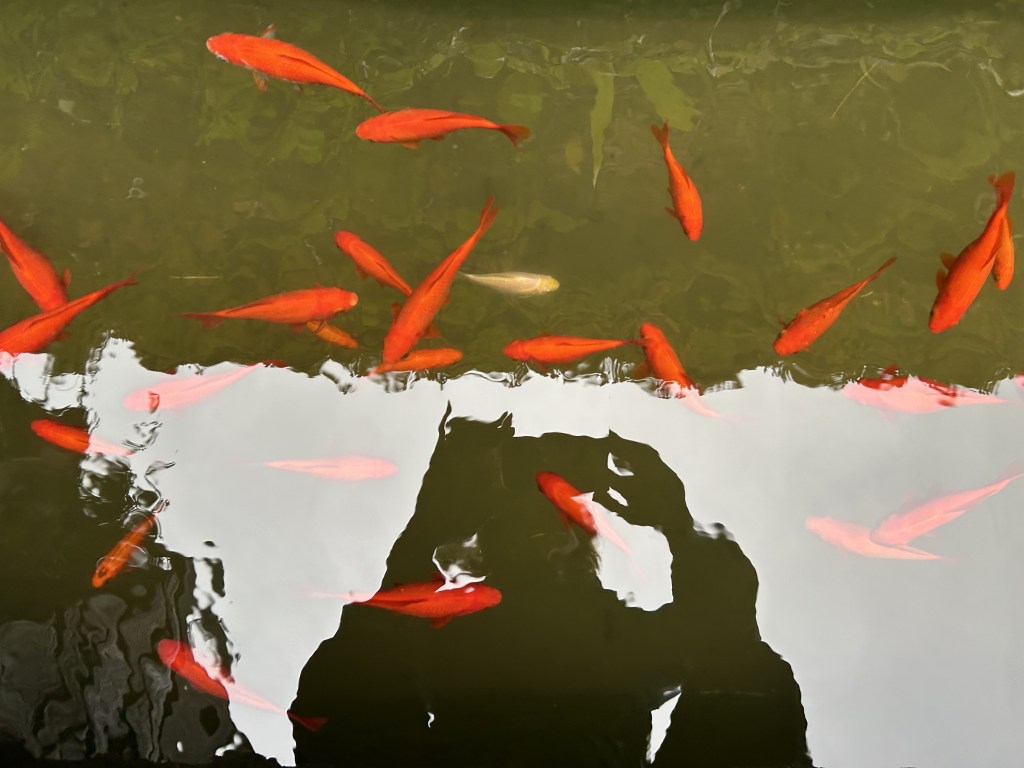
It’s hard to explain, I said, but the magic happens when, through the process of writing, the words called up are communicating back through the writer/writing, illuminating new/intriguing/curious observations/experiences/sensations sourced from what I sense (believe?) is a collectively shared well (or lake), a shimmering, deeply beautiful wild reality happening in parallel to our experiential reality …a reality not quite, but almost, beyond the limits of human perception…reachable only through the process of writing (or other art mediums). The writer is a translator, of sorts, from that shared mystical layer to the one we live in.  As a writer, I cast into this collective subconscious lake and fish out proximations of the beauties there…small beauties of pure elegance and truth in the form of phrases and images that take my breath away. There’s a moral aspect to the writer role too…recognising I can do this (sometimes), I feel I have a duty, a responsibility to the process. This is the quest…a journey of translation. And just like real fishing, there’s a lot of silence and waiting and exercising patience to hook and land beauties to the page[6]

I’m following you, she said, nodding…though I felt I wasn’t convincing and I felt frustrated not being able to explain what I experience and I could tell she believed I’d entered woo-woo territory alongside healing crystals and coloured haloes. 

“The trouble is,” I said, “it feels very close to tipping into insanity.”

“Now, you’re just being dramatic,” she said. 

~

Another “out of sorts” I’m wrangling with …and I think I’ll wait till I’ve recovered from jet lag and convocation ceremonies (Willa’s is Friday) before focusing on this task next week. The ring structure I’m using as a “form” to write the story into is kind of …not collapsing…but, through the process of writing, rearranging itself. I’m remaining open to these changes, trusting the process (see ‘quest’ above) as opposed to being rigid[7]

Emily, a dear friend and romance writer who I exchange writings with, pointed out that for a reader to care and have compassion for Claire, my story’s narrator and main character, they need to understand the love between Fanboy and Claire to feel its loss later in the story. 

“I want to see Fanboy and Claire fall in love. How do they meet?  What are they like together as a couple?”

“I don’t think I can write that,” I said.  I felt a mixture of inability (am I skilled enough to write those scenes?) and strong resistance (an avoidance to sitting with those powerful experiences of falling in love, that now, can’t be recalled without considerable emotional pain). 

She’s right, of course, about getting that information in the story very early on[8]. Focusing at the sentence level, I’ve become blind at the plot level.  

 “Course you can,” she said, a wrinkle of confusion between her brows. 

Maybe these are rookie writer mistakes, embarrassing ones, but I’ve promised fidelity to recording my process here, so[9]

                  I began writing scenes toward Claire and Fanboy meeting at the Formula One Grand Prix in Montreal. Getting Claire there, in her early twenties, to begin with needed some serious imagination, a story that made me laugh writing it (so that’s good). But I’m over five thousand words into this account and I’ve got Claire dissing Fanboy because she discovers he’s married so they’re not even talking to each other, let alone hopping into bed together (what I thought I was going to write…I even collected a few delicious literary sex scenes to emulate)[10]

                  Then, one evening, while still trying to sort through this writing predicament, in real life (not the imaginary one I’m making up which is kind of bending my brain to confusion about what is real and what isn’t, what’s memory and what’s made up), my daughter was upstairs on speakerphone with her dad.  I couldn’t make out their words; I could hear laughter and joy in my ex-husband’s voice. He was driving home after a good day at the racetrack[11]. I haven’t heard that tone, that side of him, for many years and I miss it. I burst into tears. I still love him, that part of him. Tumultuous love, and grief mixed with incredulous surprise at my reaction, but without any measure of regret for making the decision to leave our marriage, like, zero. Quite the cocktail.  This too is what I must learn to write somehow…this love, this loss, this complexity. It explains my reluctance, my fear. Why I said to Emily, “I can’t write that”. 

And I’ve been thinking a lot about this since… how humans love multiple people at the same time, love multiple people in different ways, love only certain parts of people…but not who they are entire…and is this a failing? Or is it that we fail by setting expectations that aren’t realistic, that can’t align with the limits of human biological programming or physiology or developmental trajectories or emotional capacities? Is true love a fantasy? Or is true love only fleeting? What is true love? And then I think…love happens in the in-between …it’s relational and moving…something luminous to keep alive, to nurture and feed and grow. I’m learning to embrace its complexity. I’m trying to write it. 

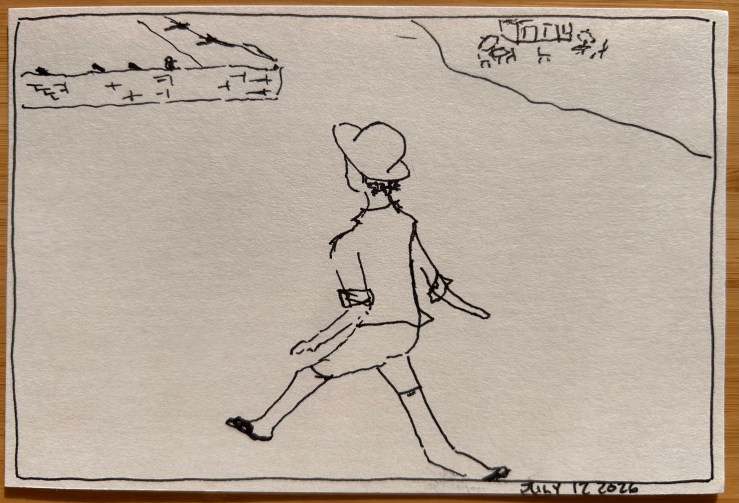
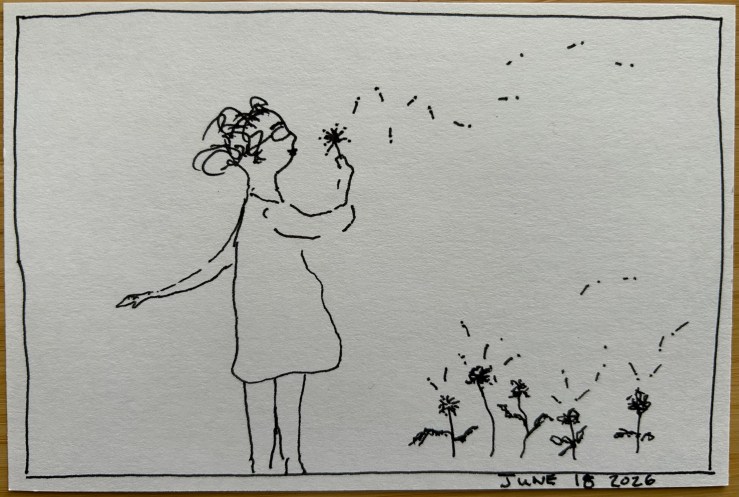
Anyway, to put some sort of example to unite the two halves of this half-assed blog post, I’m sharing a response written earlier this week to a prompt to “write something little”. I share it to show how words draw from the lake of subconscious to bubble through my writing and show me my thinking (in this case, a particular slant of grief following that episode of hearing my ex’s voice…the subconscious has hauled out baubled memories related to holding hands and riffing on the “to have and to hold” of marriage vows). 

Here it is, transcribed unedited, from my notebook:

It is the little gestures I remember most. How, when you held my hand in yours, raised above our pillowed heads, you squeezed the tiny bones between the knuckles of each finger, a pressure that says I am here, I am holding you. To have and to hold. 

Once, when we had been arguing, you walked ahead of me on the street, striding with those long legs of yours so that I had to scurry to keep up. When I reached for your hand, you pulled it away, quick, decisive, punishing. The feathered touch of skin the moment before you did so was cold. 
Another time, when the baby got so suddenly sick, trouble breathing through her tiny nose, her throat sputtering, I was struggling with the buttons on my coat, readying to take her to the ER. In my vision—confined to a circle of small focus outlined with black, a consequence of my fear and anxiety the baby might stop breathing—you handed me a fried egg sandwich saying, ‘eat this, you may not get food for a while’.

Your tears and your anger when I told you I was leaving you because you only wanted to have me but not hold me, the way you used to. 

~

 Hm. A melancholy post. These happen. 

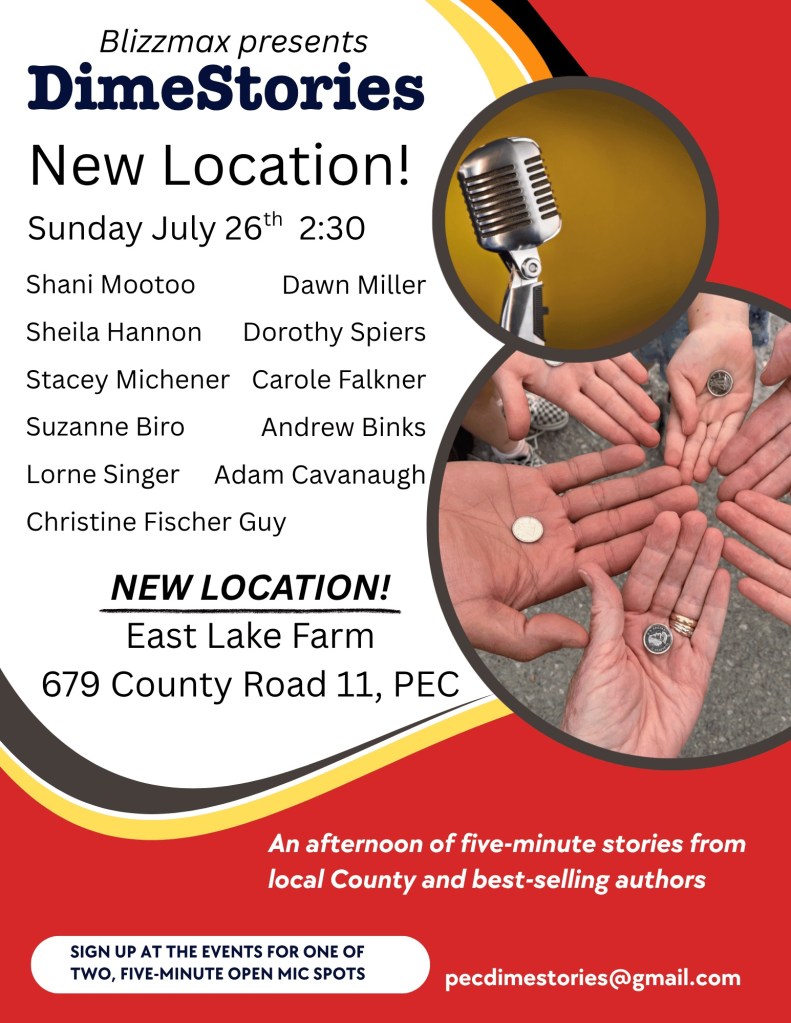
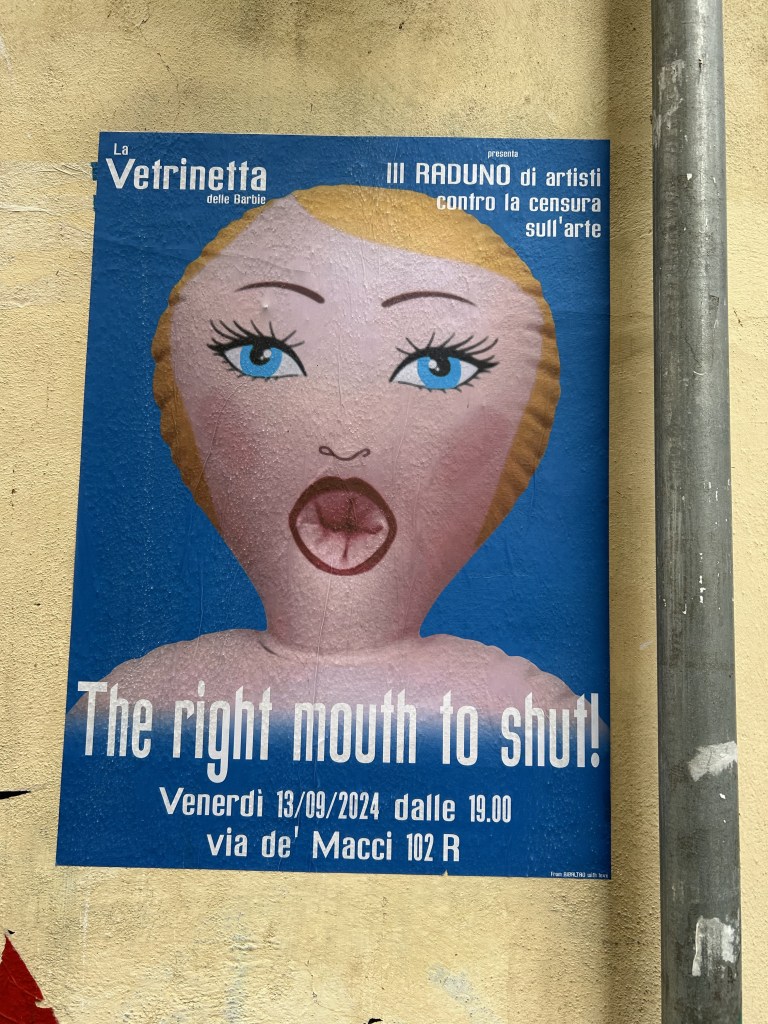
I signed up to be part of a public reading in July (see the poster at the end). I’m nervous about experiencing anxiety when I read …this is outweighed by my curiosity to feel how my current writings land with an audience…the experience shapes my writing. I plan to read an excerpt from the Long Project. I’ll post the video here (if the reading goes well)[12].   

[1] Attended Lillian’s convocation ceremony in Victoria and visited my youngest sister and her partner in Squamish. Every trip I vow to keep up writing practice (or at least reading practice). I never manage it. And I tell myself over and over: It’s important to be present and engaged in these moments of living and celebration…let the writing go, take a break, relax. But I remain in the bardo…not writing…feeling anxious about not writing…something like an opaque semi-permeable membrane preventing me from full participation in the current and physical world…a reticence others sense and resent (I don’t blame them). Why this longing to be in a world of imagination? As I write that question, the answer rises easily: it’s safer there…the risk of pain (disappointment, grief, etc.) is far better controlled.  Well.  We shared fantastic meals and the weather was gorgeous (though cool) and I did practice (some) sentence level creativity. 

[2] Weirdly, this does not at all correspond to time change hours.  

[3] Thank you Stacey for reminding me about this essay (and printing the hard copy)! 

[4] I ask myself: When should I do this?  After drafting? Now? Myself answers: Yes (this includes an eye roll). Myself also whines: will I ever finish this project? I’m reminded of that Sesame Street character Don Music who always bangs his head on the piano in frustration when trying to write songs, lamenting he’d never get it, never! This makes me laugh. 

[5] From the beginning I changed her diapers and rocked her in the pram, a constant jiggling chore, back and forth, back and forth. She was an intensely colicky baby. In the long project, her character is referred to as The Wailing Baby. She has forbidden me to write about her.  You can see how that is unfolding. 
[6] ‘Hook’ and ‘Land’…a two-step process: haul the words and imagery from the subconscious (step one) then study and work with them to best showcase their shape and form (step two). I have written about this before. And here too

[7] Definitely a self-improvement.

[8] Emily’s first romance novel will be published in Germany next year (which makes us laugh…neither of us speak German). I’ve asked her to model her next romance heroine after me and to pair me up with a kind, decidedly virile, intellectual partner who loves poetry and fiction and who will read to me before we fall asleep. Other stipulations: not married to someone else, gainfully employed, healthy (sufficiently fit in body and mind), loves to eat good food, quietly confident, someone who wants to be a partner. I do love the guy she’s writing about now, nick-named the Ancient Mariner. In all seriousness though, Emily has a keen and practiced eye for story components and beauty; she’s an active voting member for the BAFTA awards (has been for 20+ years). 

[9] A common refrain from my (now ex-) husband during the years we were together: How can you be so smart and so stupid at the same time?! [insert sheepish shrug-shouldered grin of idiocy.]

[10] A restricted selection:  Ian McEwan’s glorious capture of what it is to experience the wonder sex,  from his novel, Lessons, “It seemed as if he had been shown a hidden fold in space where there was a catch, a fastener, and that as he released it and peeled away the illusory everyday he saw what had always been there…It was either hilarious or it was tragic, that people should go about their daily business in the conventional way when they knew there was this.” ; the orgasm described in Barbara Gowdy’s short story, Sylvie; the tender innocence captured in Brian Doyle’s short story First Kiss; a vague disconnection during lovemaking described in James Salter’s Light Years; the stupendously orchestrated scene of lovemaking woven with ocean metaphor in Texaco, a novel by Patrick Chamoiseau; and, of course, the romantic love making in the apple shed, described in Hamnet, written by Maggie O’Farrell. 

[11] Auto racing (Formula Ford). A good day means nothing mechanical broke, including human bones. 

[12] If instead the reading goes very badly and I stop breathing and collapse into a jellyfish I may still post a video…anything for a laugh (wink). 

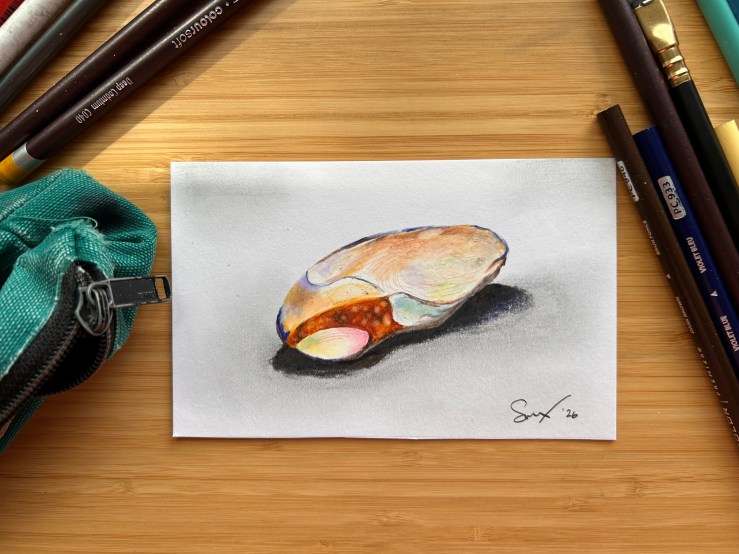
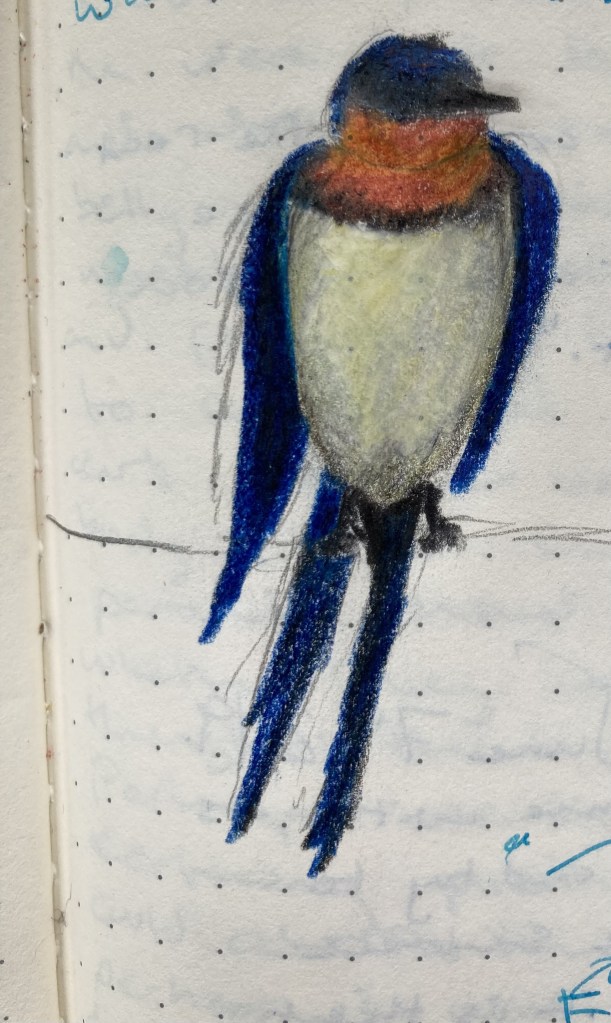
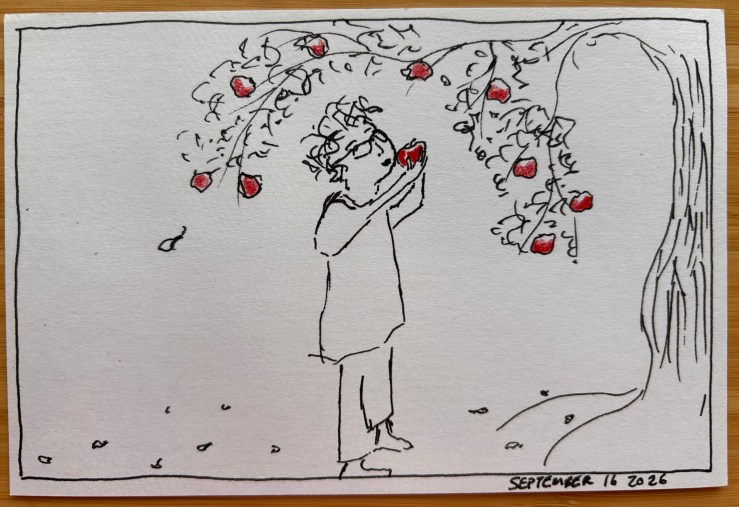
Loving Attention

Pencil crayon, 6×8″

This fear of the blank page, this fear of not having the skill to translate one’s communications between inner world to outward presentation, this fear of lacking creative ability to express beauty, this fear, this paralyzing fear of inadequacy, does it ever go away?  

It doesn’t. At least for me.

I was going to erase that first sentence/paragraph…it wasn’t what I intended to write about today. The whining, it’s tiresome, no? But I would be leaving out one of the more difficult aspects of my writing practice if I did. And here, with these posts, I’ve promised authenticity.

So, my writing process becomes a matter of forcing myself through the exercises of creativity, forcing myself to the habit. The routine feels the same way one feels dressing for the gym: snapping spandex to the waist (a paradox of constriction and freedom of movement), flattening my breasts with a sports bar (not giving in to the inevitable rise of claustrophobia), rooting round for a sweat wicking tank (a clean one), short socks slipped over the toes, the heel, to hug the ankles, bending, crouching, gathering then looping the laces on my sneakers, and finally, the deep (resigned) inhale, then exhale, stepping onto the gym’s rubberized floor, heading toward the weights beneath the coach’s patient gaze. And after the workout? Euphoria.

All that to say, it takes a lot of energy (and time fiddling round “getting dressed”) to do creative work. I think this is why I dance round so many different creative projects…to keep my head in the creative game. When one project seems insurmountable, another can feel feasible. The dangling addiction to euphoria (in writing, it’s when things—words, metaphors, ideas, images, sounds, etc.—come together, surprise me; in drawing or painting or sculpting, it’s when forms, colours, lights, shadows, etc., come together, create something beautiful)[1].

But there’s also an issue of commitment…it seems I have one[2]. Fear of inadequacy is one thing; fear of sharing my creative work with the wider world is something different. (Though, I suspect, related.) I know I’m resisting. I know I’m avoiding. I haven’t been sending my work out for publication[3]. What I don’t understand (yet) is why[4].
So, I’m studying my fear. Not just to understand its origins but to understand how the development of belief systems shade behaviours to come[5]. I suppose we could call belief systems the stories we tell ourselves. I’m studying how those belief systems move, crossing space and time, forming our lives.

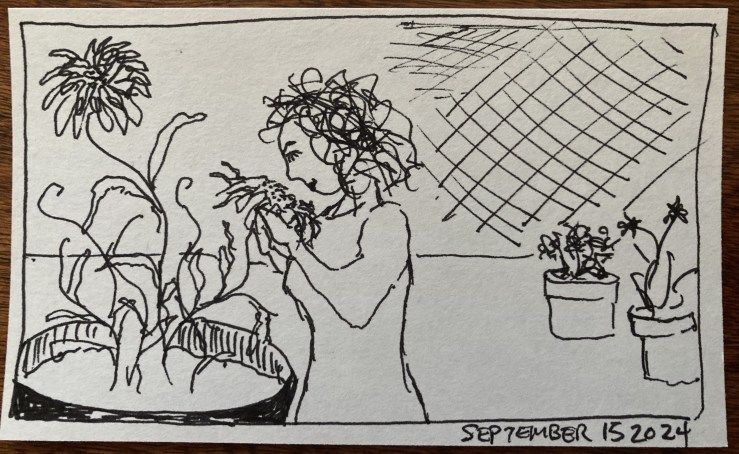
I know it’s my own thinking holding me back. Knowing the issue doesn’t solve the issue. I’m working on it. Working through it is going to take more than spandex. Love helps. Love, really, is the answer to all of it. Loving attention and a devotion to loving attention. Love bends belief systems to become better, beautiful. I’m not being trite here…love is what shapes…art, yes, but also, us. Love shapes humans. And, I imagine, the more than human world too[6]. The betweenness, the relationality, the reciprocity, is important.  

                  And this put to mind a thought I had recently, a floaty thought, connecting the actions of drawing/colouring with recent paragraph development work with Nina Schuyler.  One of the things (of many) that I love about Nina’s breakdown and discussion of sentences is her systematic illumination of how the techniques achieve emotional impact for the reader. I realized the layering approach of sentence structures, both within a sentence, and sentences in relation to one another in a paragraph, is akin to the layering of colours, light and shade, when painting or drawing. The idea brought home for me how a paragraph creates an emotional resonance …a translation of complex emotion(s) layered and transferred to the page. Words, as symbols, representations of “things”, are inadequate in and of themselves to render the emotion… “joy” for example, is too abstract, too far removed from the body-mind sensations and experiences, disconnected from the cascade of memories, desires, wishes, instincts associated with the word, but the sentences and the paragraphs build in tandem to create that wonderful harmonious effect and impact with text.

This is the same way a song is layered with longing or love and attained through tempo, melody, harmony, lyrics, tone, volume, instrument variety etc. Art, including literary art with its intentional, architecturally constructed intercourse, I’m only now appreciating, enables exploration and expression of interiority and exteriority when language might so easily lead us astray.  The foundation of such architecture is loving attention to the heart’s desires, the heart’s revelations…whether that be focusing the beauty of a pomegranate or a pear, or a surprising word, metaphor, or image generated using stream of consciousness writing. Some thoughts anyway…


[1] Cooking, while also creative, follows a shorter, more predictably satisfying arc. At least I get to savour the efforts. Also, sharing them with others remains, despite years of practice and repetition, a magical joy.

[2] A little about me [and married]; I will never allow myself to be owned again.

[3] I have one piece, the introduction section of my longer project, submitted at one literary magazine…I am working to WILL an acceptance there.

[4] I read today, an inspirational maxim (normally I’d eschew), attributed to William Ward (though, chasing these quotes from social media proves an erratic, enigmatic, time swallowing quest), “To place your ideas and dreams before a crowd is to risk their loss” …is this what I’m afraid of, losing my dream?  No longer having a dream? An interesting thought…

[5] This study, which, thankfully, dovetails day job research, integrates stunning intersections across disciplines: epigenetics, early childhood development, neurochemistry, physics, philosophy, psychology, history, anthropology, biology, sociology…

[6] This time last year I read Bruce Chatwin’s The Songlines. It had been part of my sister’s Indigenous Studies curriculum, and I stumbled across it while packing up my own books preparing to move. An interesting read as a window into the sociocultural attitudes re: women and First Nations peoples in the 1980s, an aspect which, unfortunately, may prevent a contemporary reader diving in…I think, all the more reason to read it, but that’s not what I want to highlight.  What sticks with me is the belief system described in the book, how Aboriginal Australians maintain songlines, pathways of knowledge crisscrossing Australia, the sky and the water, also called dreaming tracks, that link stories with features in the environment, by continuing to sing the world into existence through loving attention. (I am paraphrasing a super complex and fascinating world view.)  Here’s a short video describing songlines and the links on the subject beneath the video are excellent.

Pencil crayon, 9×12″

Italy: Reflections on Beauty, Part 1

The Kiss, Francesco Hayez, 1859, oil on canvas, in the Pinacoteca di Brera in Milan. Gorgeous painting and a delight to see in person. It’s kind of emblematic of how Italy makes me feel. The painting is meant to convey, and I’m summarizing here, that as much fun as romantic dalliances are, responsibility and honour lie with one’s allegiance and loyalty to state and country (as symbolized by the youth’s step “up the ladder” of stairs and commitment to an important life of patriotism).

This post is the first in a series of reflections about travels in Italy. I experienced so much beauty to reflect and weave with creative process, there will be one or two additional posts, I’m sure. This first, which began creation on a glorious day devoted to overcoming jetlag and quiet reflection1, (was that yesterday?) is more mish mashed reflection, depicted with photographs as opposed to writing. It needs to be…there is so much, too much, to cover.  

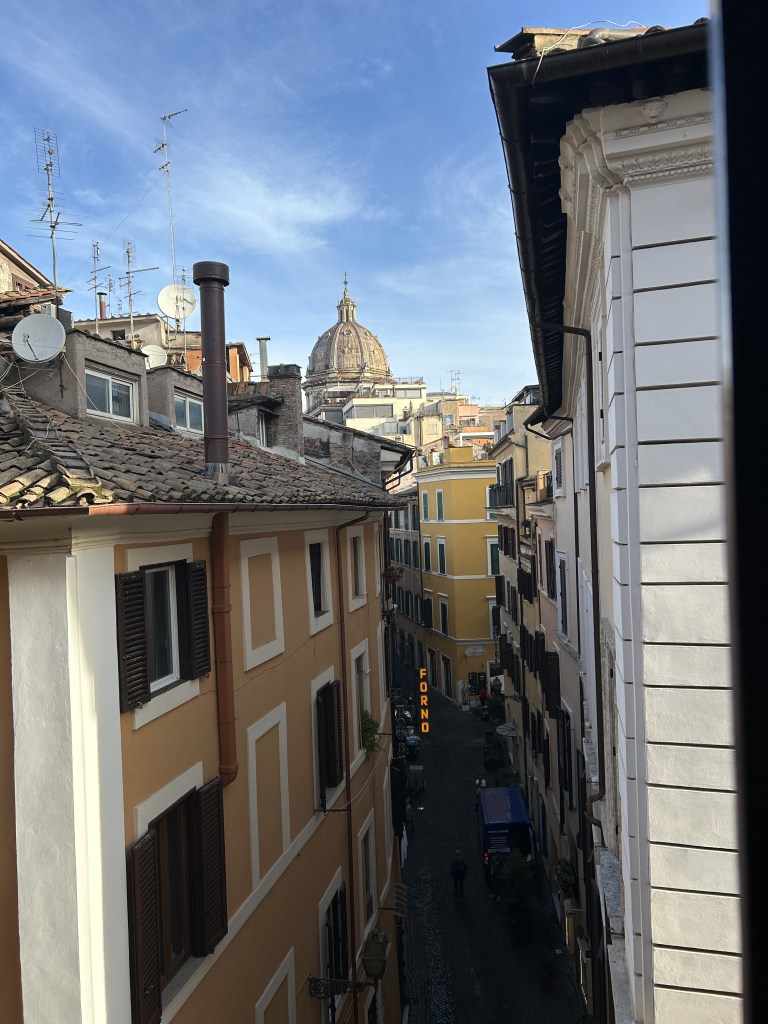
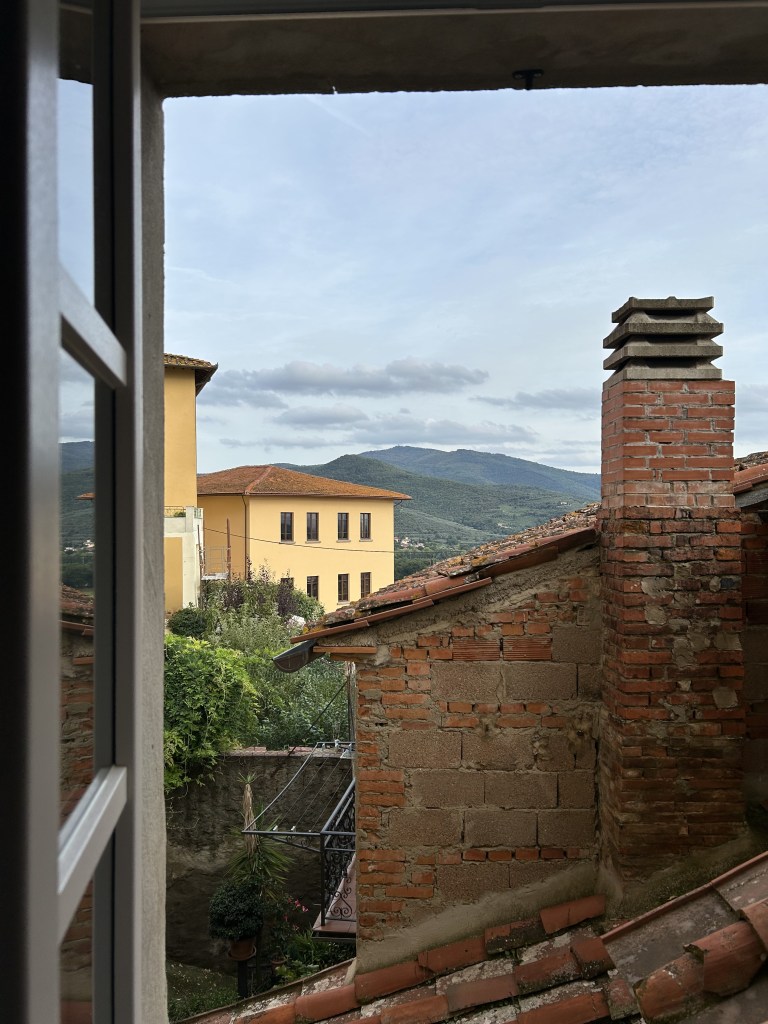
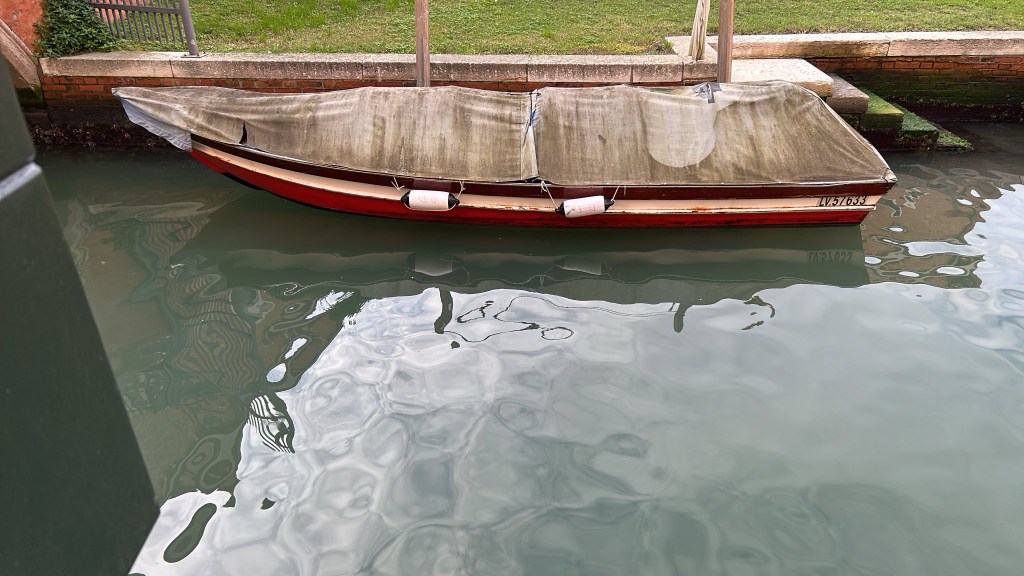
It’s odd, I know, that one of my favourite experiences in Italy is opening windows. It’s not simply the stunning views they open to: neon signed and steel-coloured cobbled streets of Rome, lushly vined and golden hills of Tuscany, neoclassical architecture of Milan, or the watery canals of Venice, but moving through the action of opening each window. The grasp of solid metal handles, negotiating the satisfying arc that releases a latch (often beautifully crafted in and of itself),  feeling the smooth swing of heavy wooden shutters, both inside and out, experiencing the transformation of a view seen through the waves and bubbles of ancient glass to clear and open air—for these windows never have insect screens—and immersing the scents that blow in (freshly baked bread, brittle crush of autumn leaves, rain kicked up dust…there’s a word for this, petrichor, earthy soil, olive oiled bon fire smoke, the honey sweet miracle smell of lime trees, ocean brine, and yes, sewers, garbage, the sour mash of fermenting grape skins and dog shit).  The windows are always set in thick stone walls, some as deep as my arm. When I lean out, I think of all the other people who must have done the same, from the same spot, with the same thoughts, the same impressions, the same appreciations, and I experience a sense of profound connection to the landscape, the people and the history of the place. Deep inhale. Ecstatic exhale.

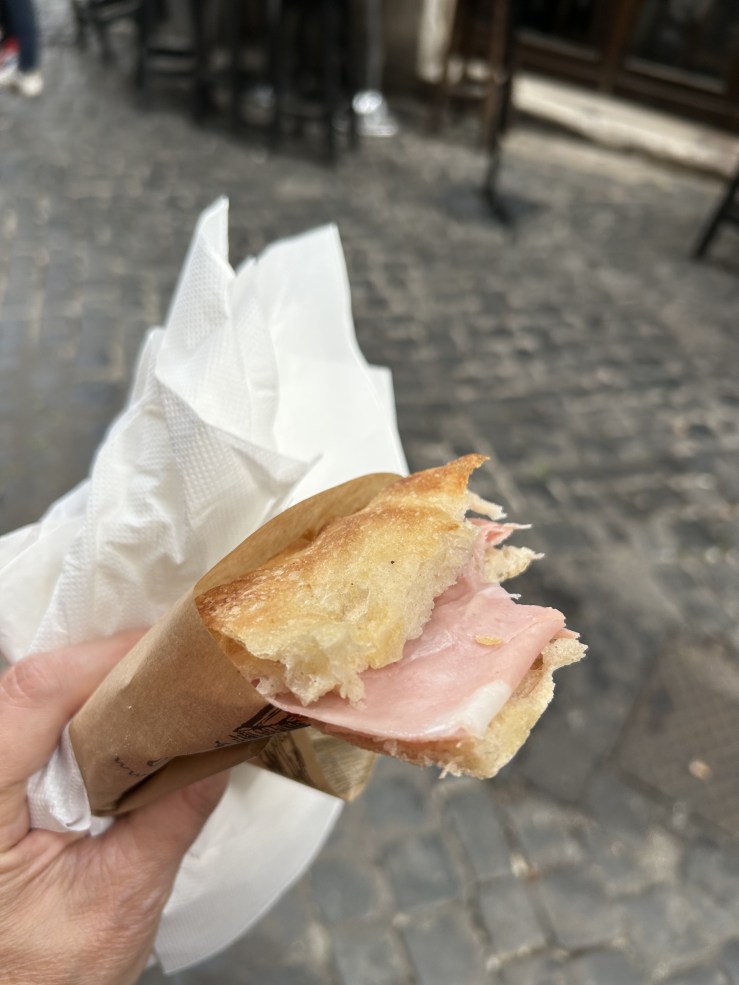
I know it doesn’t look like much but the combo here of pistachio larded mortadella sliced so thinly it was almost transparent, folded round pillows of air and pocketed in pizza bianca…a mouth miracle. Antico Forno Roscioli in Rome.

I ate and ate and ate, ingesting the full but simple flavours of sun ripe tomatoes, grassy olive oil, spongey bread, chewy pasta tossed with loamy truffles, oil cured anchovies, buttery cheeses, hard, salty cheeses, marzipan, hazelnuts and chocolate. I repeatedly experienced the transportive wonder (transporting one to where? …no, this isn’t right…dropping one into a still moment of appreciation of wonder, this is what I mean) when food is accompanied by wine. It’s a dynamic wonder: both the food and the wine change as the meal unfolds, mediated through temperature and air and textures and flavours, combining and recombining differently each moment across the lips, the tongue. How sharing this, at a table laughing with friends, friends who love you, is part of the wonder and absolutely essential to the experience.

I had more than a few episodes of weeping, unexpectedly overcome in certain moments by beauty. 

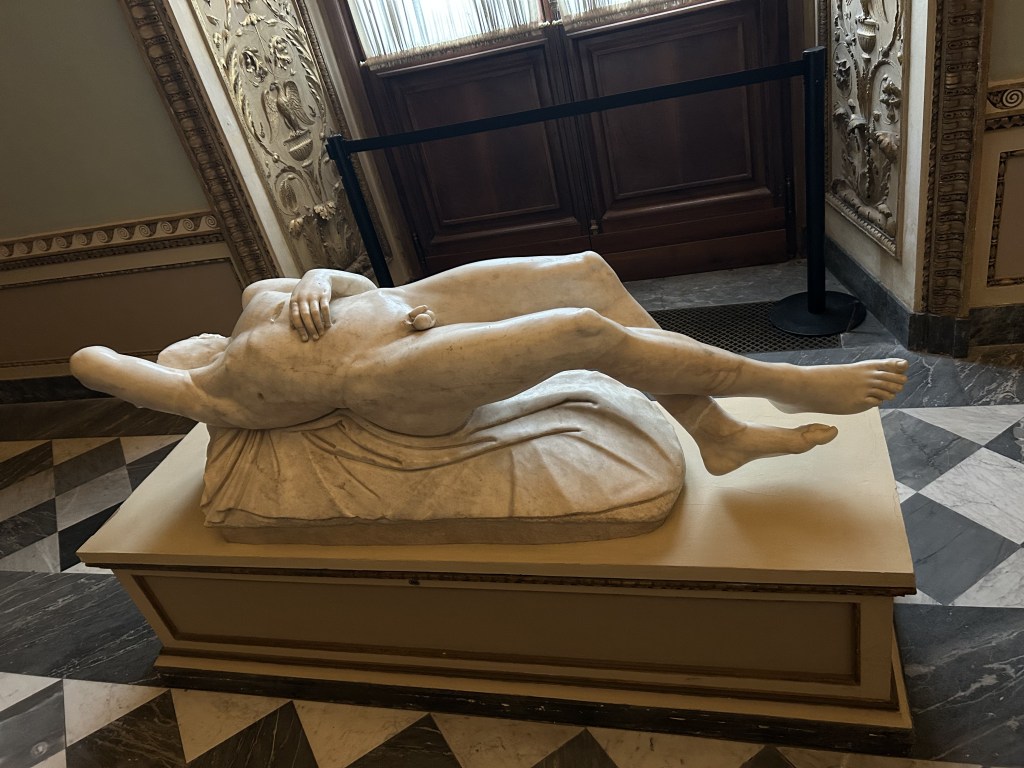
Once, gazing at the carved marble calves and feet of a statue of the fallen son of Niobe in the Uffizi2.

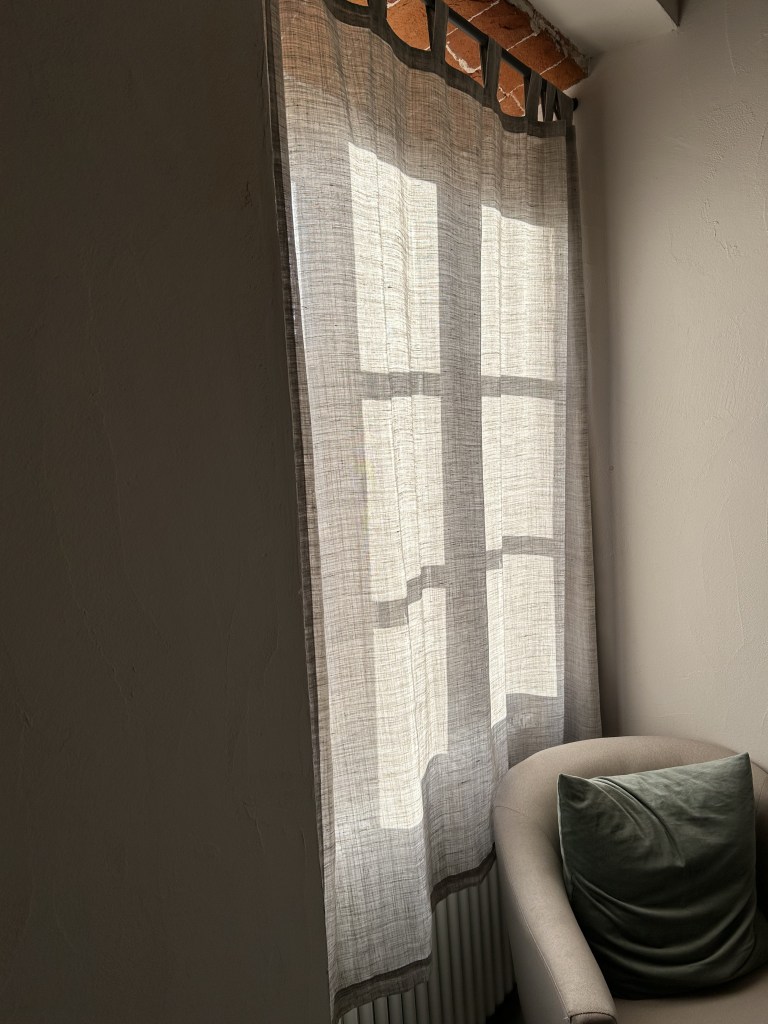
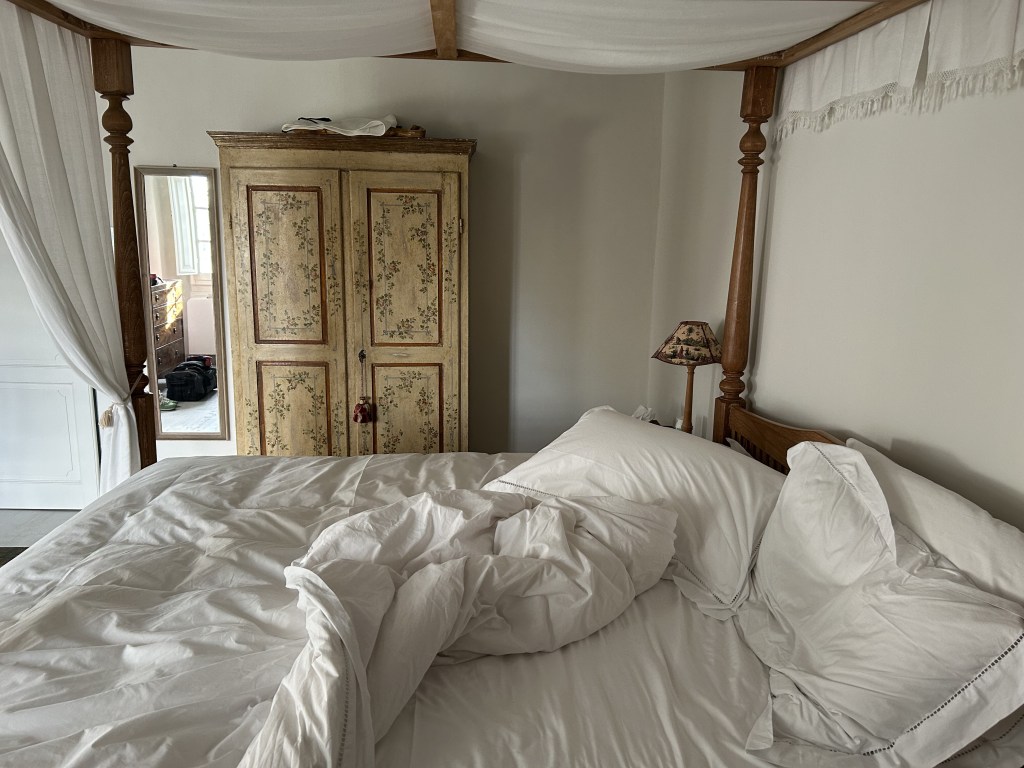
Another, listening to my friend, a concert pianist, practice Bach, Debussy, Chopin, in her gorgeous villa with a magical bed I got to sleep in, the percussions echoing the stone walls while I journaled in my notebook and copied down a poem, Brahms, written by Robert Bly. 

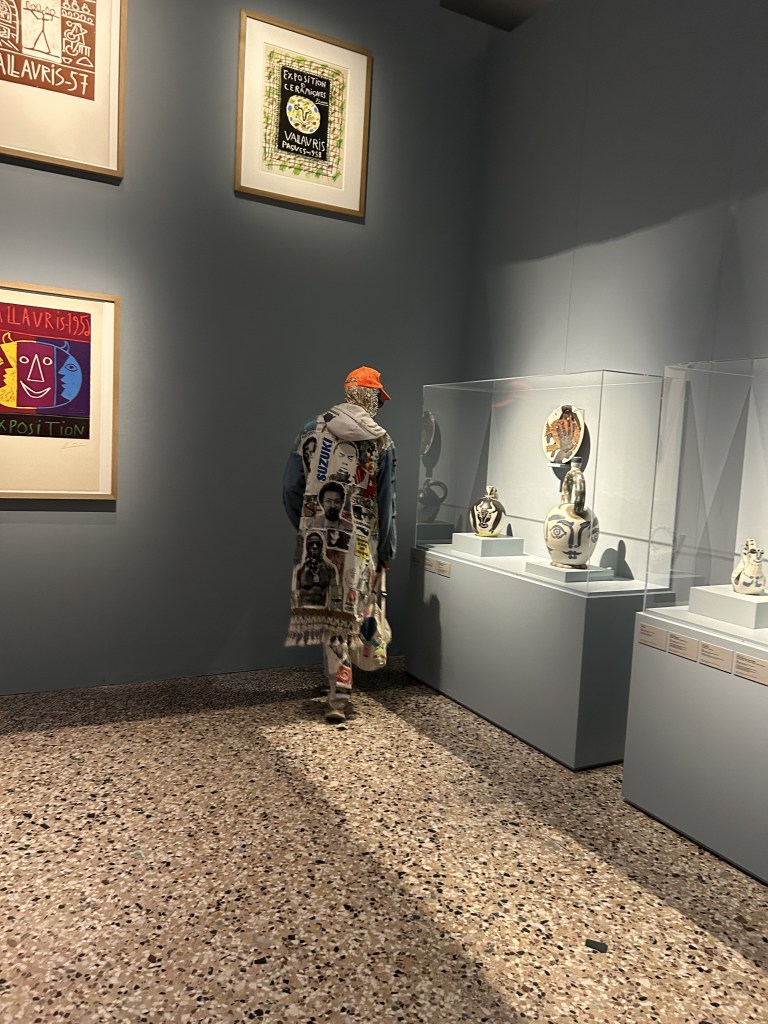
Another, reading poetic words about Picasso’s hands, written by Max Jacob3.

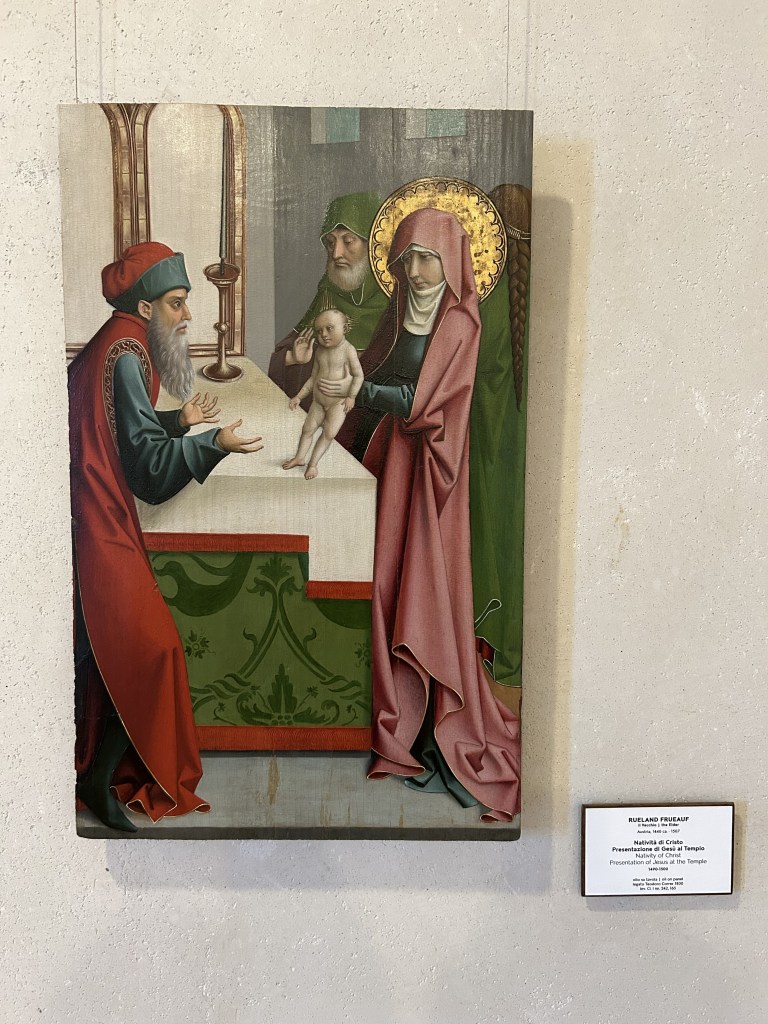
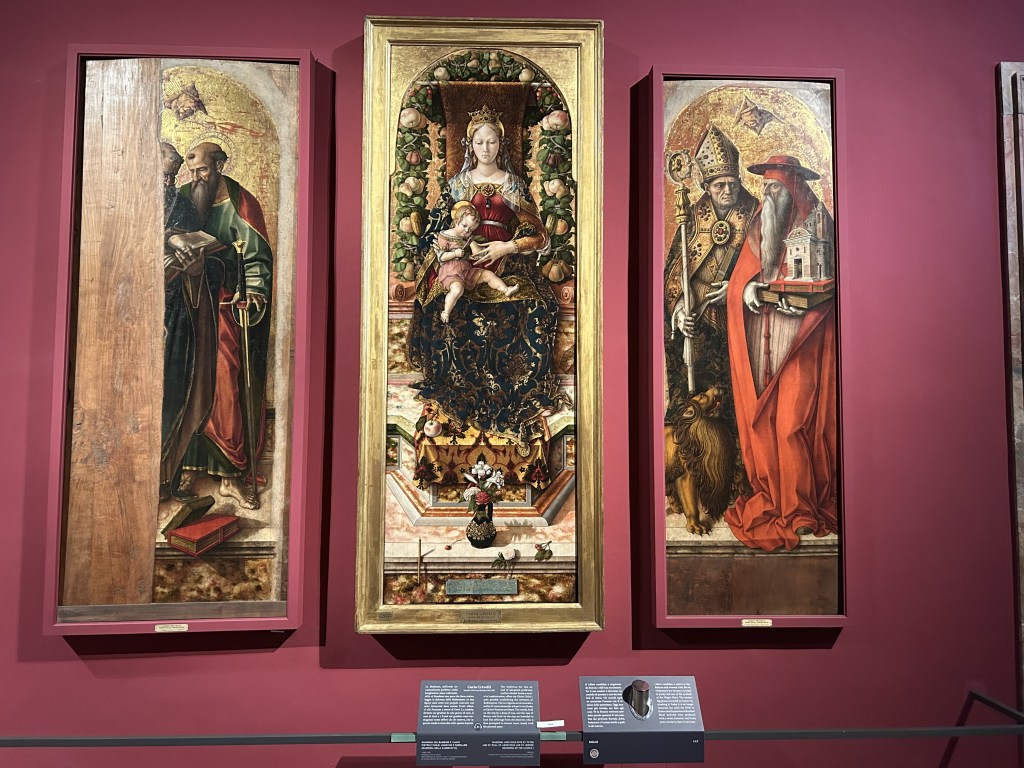
Truly mind-bending was the paradoxical viewing of classical artworks alongside contemporary ones, often in the same day, and once, in the same museum space4. I loved this jangling stimulation. Especially as a necessary counterpoint to the complete saturation (assault?) of the same composition, the same colours, the same story, of the Madonna and Child, over and over and over again. It makes one appreciate anew how dominant that story has been to the exclusion of so many others.

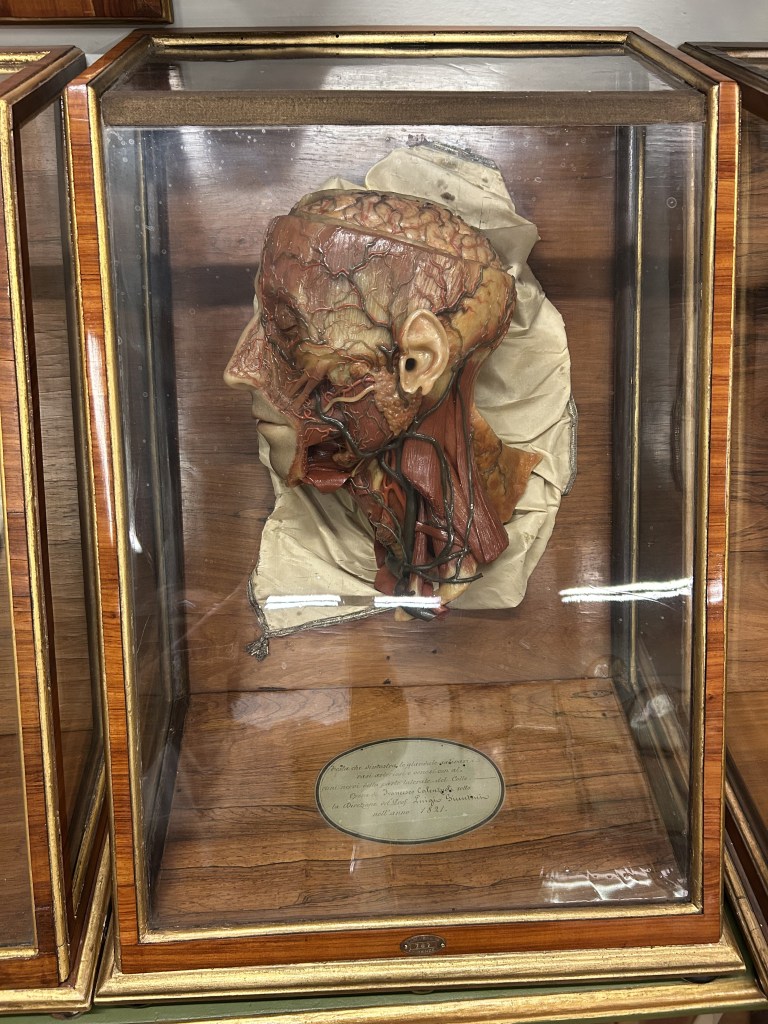
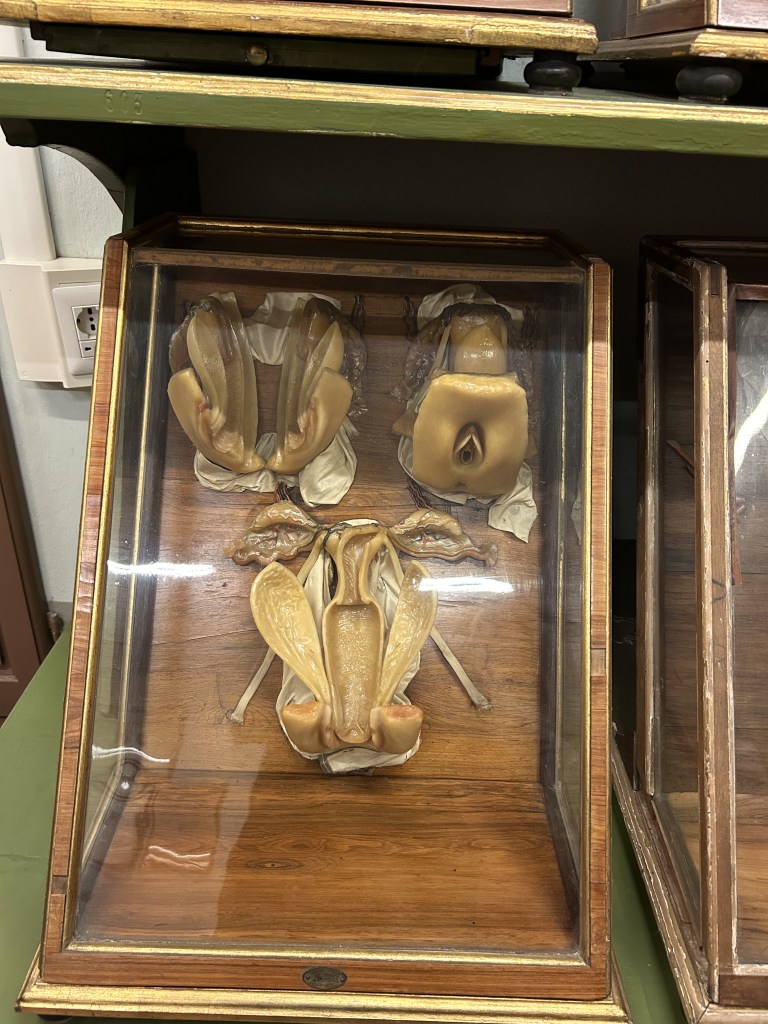
Lillian (daughter #1, studying in Milan this semester), joined me for several different legs of the trip, including Florence, where we toured La Specola, the oldest scientific museum in Europe. I had read about the wax models of fruits there, in a book, years ago, The Land Where Lemons Grow : The Story of Italy and its Citrus Fruit, by Helena Attlee. It was fascinating and absolutely stunning to see the intricate artistry applied using beeswax and pigments to create models of plants and animals and human anatomy to serve as teaching models. The attention and accuracy of detail blew my mind: the brain, the circulatory system, the nervous system, the reproductive systems….all the teeny tiny veins and arteries and lymph nodes meticulously recreated in coloured three dimensional form. For 3 Euros, we joined a tour…in Italian. I didn’t understand most of it. Still, fascinating to see. There were also cute little dioramas of scenes from the plague. Macabre, I know. I explained to Lillian how horrific the smells would have been. Interestingly, this subject paired nicely with the exam she was studying for, European economic history, where, alongside war, disease played a major role5. Anyway, this exhibit brought home the idea that art and science are not separate entities, but rub up alongside each other companionably.

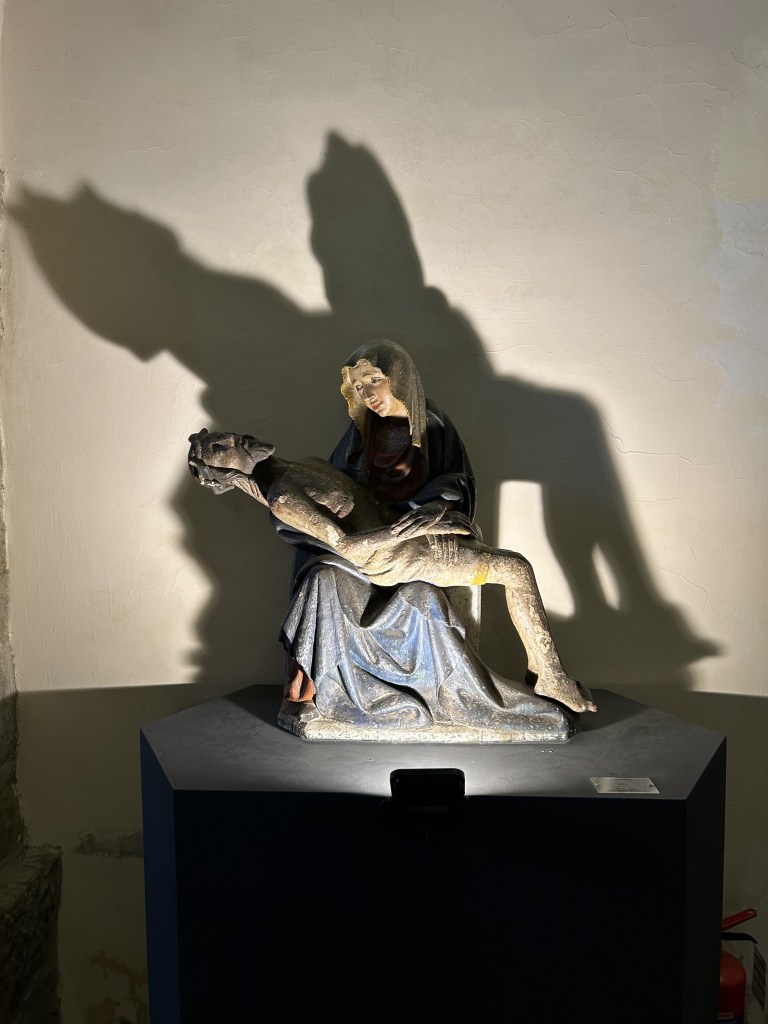
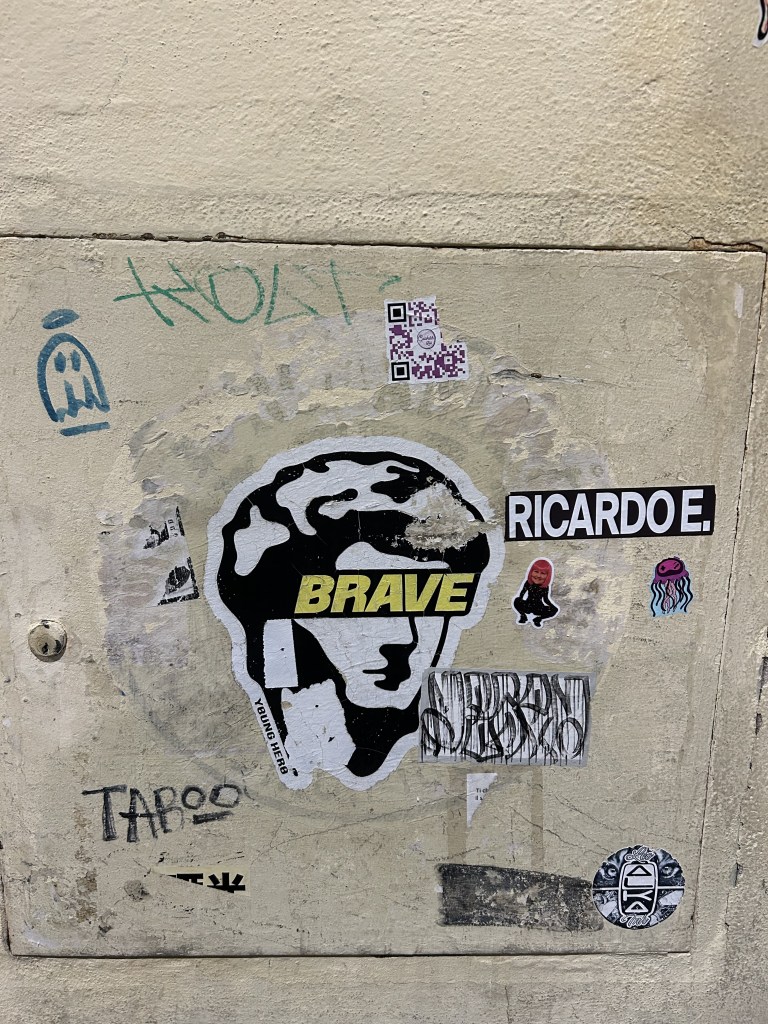
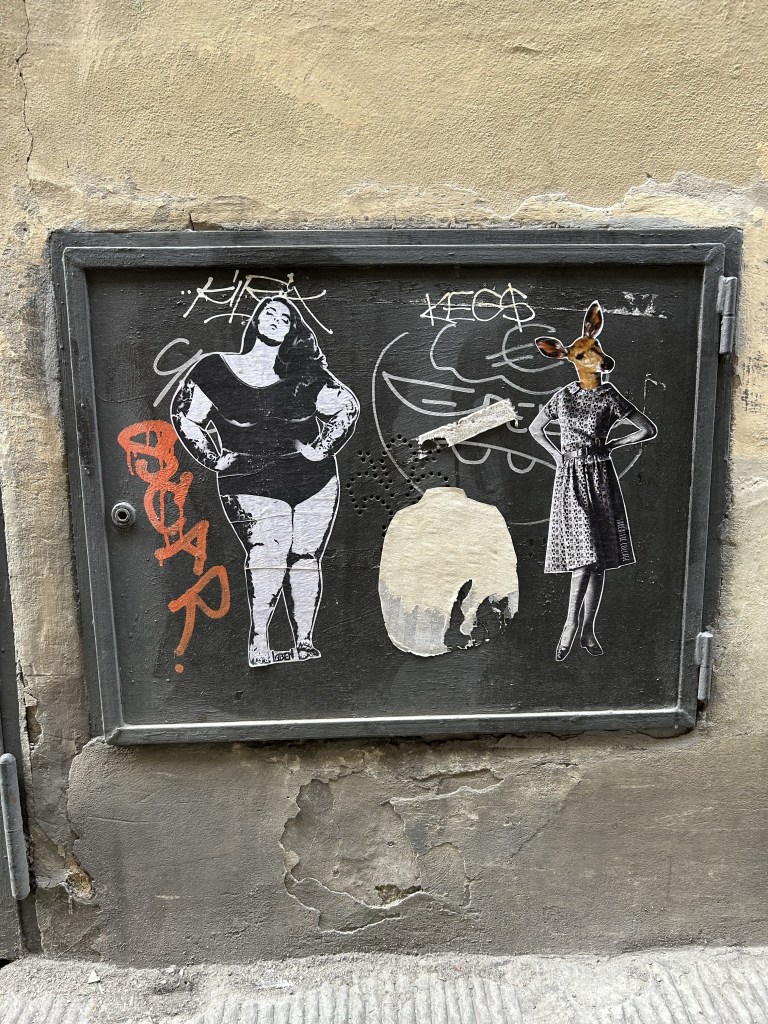
Here’s a selection of “things I saw on the walls in Florence”:

Here’s a picture of a person wearing an outfit that was just as beautiful and could have been part of the Picasso exhibit. We gazed at the same painting for a long time, standing side by side, and I really wanted to tell him how impressed I was with his outfit. But, I was too shy to say so.

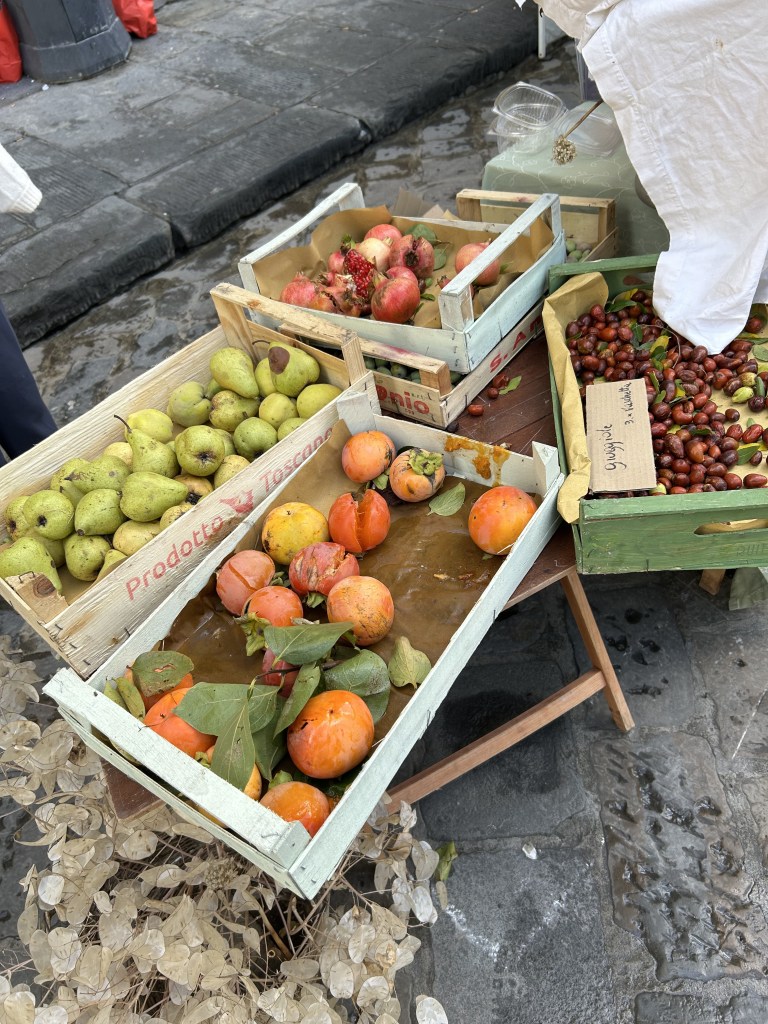
Also, so much beauty in natural form…something I began to miss amidst the cement cities and throngs of people.

It was impossible to write much while I was away…vibrating with so much stimulation, it was difficult to settle into any kind of focused reflection. Just tried to attend, be present and capture and take everything in. Again, I carried my pencil crayons around in my backpack, never once using them. I’ll have to make up a word for this, the act of taking art supplies on a trip but never using them…a botch-batch? non-accoutrements? artfail? I’m too tired, I have no idea. Surrounded by so much beauty and creativity and humanity, I couldn’t help but notice the manufactured green spaces, the cultivated farmlands, the hustle and bustle of humans living densely, compactly, layering upon one another with bricks and mortar and sweat and tears and laughter. I craved the lake and the sky and the horizon of home. Perhaps this is why my favourite part of being in Italy was opening windows.

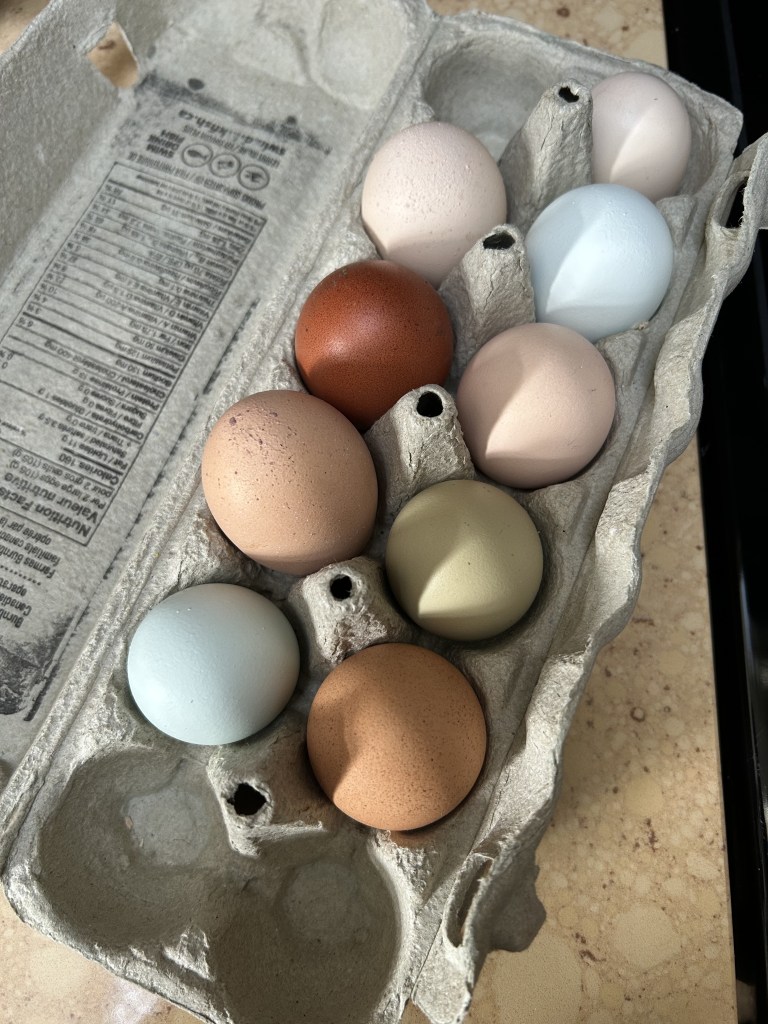
This is the view I crave. And a dear friend stocked my fridge with cheeses and milk and these gorgeous eggs from her sister’s hens for when I returned home…when I opened the carton I teared up again…for these too are beautiful. Also gratitude… for it all.

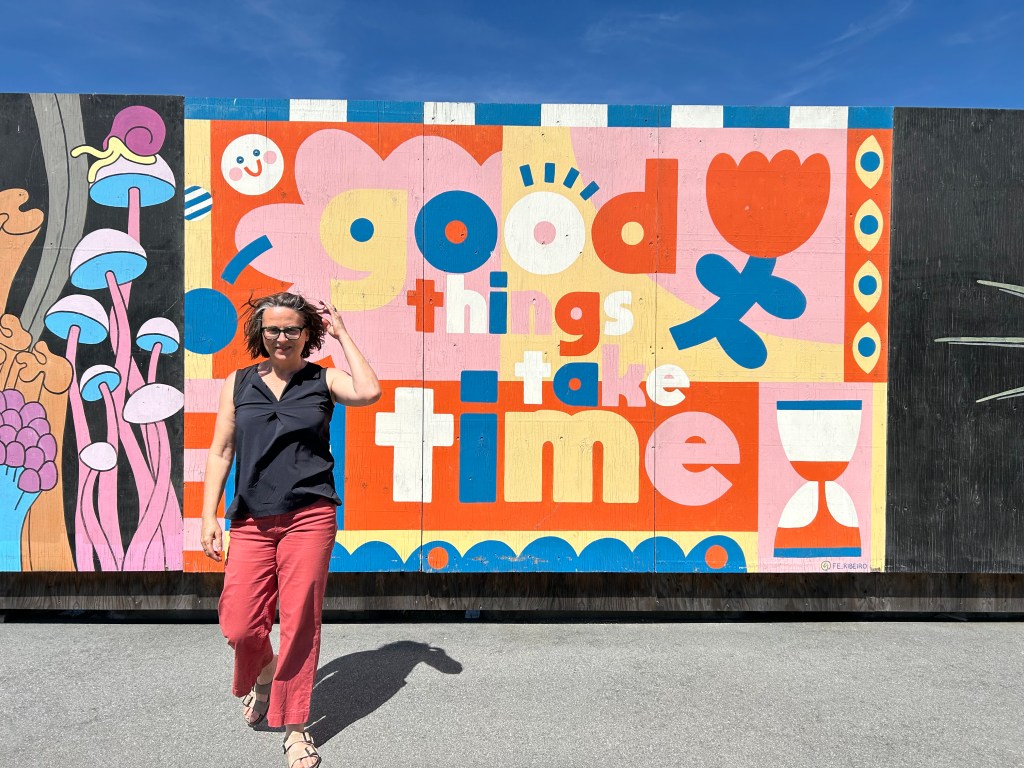
Yours truly.
  1. I returned to work Tuesday, hundreds and hundreds of emails. 807 emails. ↩︎
  2. Dying Niobid, Roman Art, 2nd century CE, the male figure is depicted on the ground in agony, struck by the arrows shot by the sons of Latona. For some reason it was the perfection of the figure’s legs and feet that really moved me. How they’re suspended in the air, as if, were I to reach out to stroke a calf, I might have felt the warmth of life depart the body. ↩︎
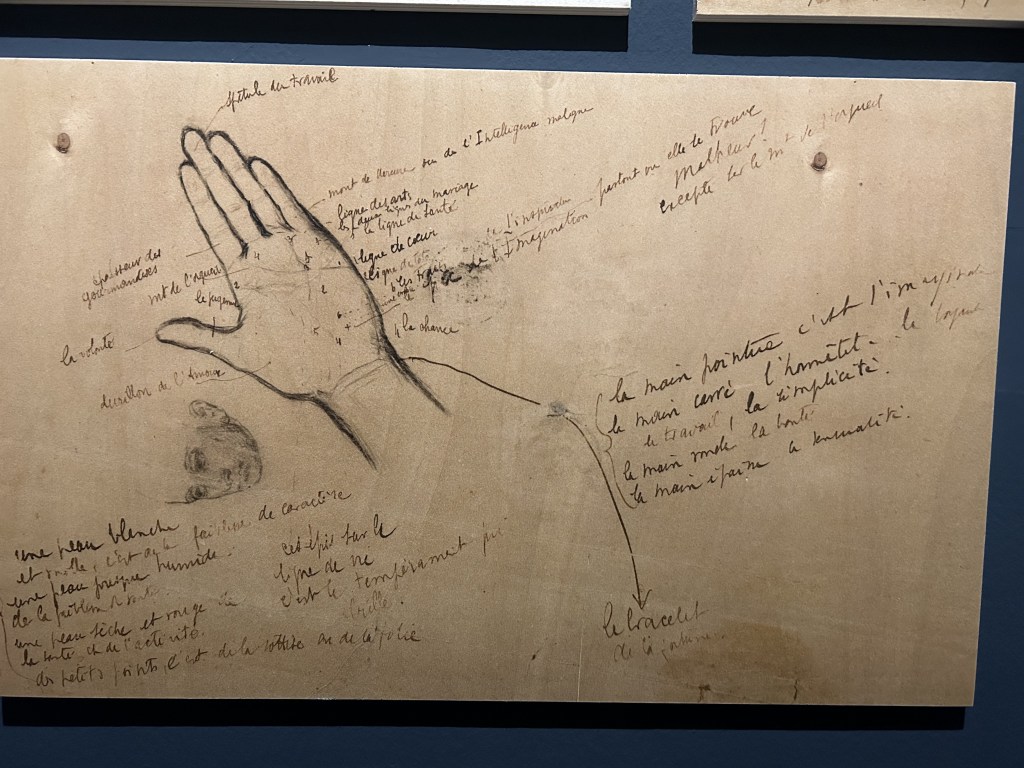
  3. From the Palazzo Reale Picasso exhibition notes: “In support of a palmistry study of Picasso’s hand [1902], the poet notes in a prophetically: It’s like the first spark in a fireworks display/…/This kind of living star is only rarely found in predestined individuals […] Aptitude for all the arts”. I have no idea why this made me cry. ↩︎
  4. These photos were taken from various museums, but the modern icons in conversation with Renaissance works were made by Francesco Vezzoli to create a site-specific exhibition in the Museo Correr in Venice. I was visiting the library museum but my ticket, serendipitously, afforded entry into this museum as well. The blue lady was in the courtyard of the Airbnb in Venice, Involucro Yves Klein, by Elia Alunni Tullini. ↩︎
  5. Plays…considering pharmaceuticals. ↩︎

Sidelines

For a few years, I wrote food columns for community newspapers. Pique Newsmagazine, when we lived in Whistler; the Napanee Guide and Kingston This Week when we moved back to Ontario.  A handful of one-off Canadian publications. Never for the money[i]. Food writing was a lifeline tethering me to taste and flavour and scent and colour and texture, life’s glorious pleasures, at a time when I struggled so deeply with postpartum …was it depression? Certainly severe sleep deprivation, but also the punishing suddenness and baffling inflexibility of a body assuming the mechanistic form of lactation on demand[ii].

In Whistler, Food Columnist came with some perks. A paid pass into restaurants I would never have been able to afford, then, or now. A few foodie special events. And because the food column was really just filler between real estate ads, the editor gave me carte blanche on content and word count[iii].

Once, I got a call on a drizzly weekday afternoon to cover a foie gras tasting. When I arrived, I was stunned to discover the corner of the elegant French-styled dining room was transformed into a buffet (a buffet!!!) of foie gras prepared every way imaginable (pate, parfait, terrine, torchon, melted into risotto, layered atop quince cheese, whipped into mousse and even frozen into ice cream).

At that time, a pound (think the size of a pound—four sticks—of butter) of such richly diseased (forced large) Moulard[iv] duck liver cost a hundred dollars. The table, accented with crystal glasses of honey-coloured Sauternes and goblets of amber Armagnac, groaned beneath the weight of thousands and thousands of dollars’ worth of duck liver. When I think of the word obscene, this is the image that pops in my mind every time. Lifting a glass of Sauternes from the table, I swung my focus to the chef, a classically trained, tall, slim man, transplanted from France, and whispered my fascination-horror. He bowed to me, his expression bursting into a grin of absolute delight, his elegant hands arcing the air above the buffet in the style of Vanna White, and said, “I know! And I didn’t have to pay for any of it!”   I spent the afternoon exercising my French with the farmer couple from Quebec who raised the ducks (and fed their livers) to perfection. Apparently, the ducks will eat whatever you place in front of them, in this case a special diet to imbue the livers with the buttery texture and a golden hue, so it’s not really torturing their livers into a diseased state? And yeah, I sampled as much of the stuff, prepared with textbook precision, I could cram into my mouth.

Another time, another top restaurant, wine pairing dinner. It was the first time I’d left the house solo following baby number two (five months old). I still think I deserve a prize for negotiation skills getting their dad to babysit that evening, but I digress.  There were many other food writers twittering the patio when I arrived.  I knew none of them (such a bumpkin). I did snag a flute of champagne when a silver tray walked by. I was trying to quell the screaming anxiety I felt entering a social situation after months of babied isolation, the fast-descending realisation, like a burning 747, I’d just entered a scene waaaaayyyy out of my league.

While attempting to hold my purse, a clutch (stupid choice, they make purses with straps for a reason), balance my glass of bubbly, ignore the crushing sensation of my toes in heels long neglected, snap my too tight bra into a comfortable position (impossible), a man, quite good looking, gorgeous pale linen oxford button-down, sauntered over and introduced himself. He shook my hand with dry confidence. I always pay attention to handshakes – you can glean a tremendous amount of information about a person from their handshake[v].  He detected my ignorance instantly when he explained he was the editor of Nuvo Magazine. (When one pronounces the word nuvo, one has to draw out the vowels and the finishing ‘w’, layering a hint of upper-class pretention, Neeeeeewwwwww Vooooooowwwww.)

Flustered, I snatched an oyster on the half shell from a silver tray heavied with shaved ice and pearl glistening mollusks. Only then did I perceive I was holding too many things in my hands to parley: champagne, purse, notebook, pen, and now, oyster. Keep in mind, we’re still standing on a patio, glorious soft pink sunset reflecting the mountains’ glaciers. I quickly placed the opalescent shell to my lips and tipped my head back[vi] to deliver the gourmet tid bit to my mouth. Unfortunately, (most unfortunately), the oyster had been shucked improperly and did not release.  The long moment that saw the oyster dangling the air like a blob of snot, my tongue diddling its flesh obscenely, lewdly, before it loosened its shell, was sufficient time for the Nuvo Editor to melt and disappear into the crowd.  

Again, unfortunately, this was not the worst of the evening’s events. Between course five and six (spectacular food btw), I turned to the woman at my left, laughed, and explained how normally, at that exact time, I’d be breastfeeding. This signalled an immediate let down and my milk pooled the front of the exquisite baby blue silk blouse I’d chosen to wear without the foresight to insert protective breast pads.  My editor gave me shit for leaving the dinner early.

 A fond memory. On assignment to interview an organic potato farmer, I drove the flat, fertile, Pemberton valley towards his fields.  Jagged walls of granite, rough new mountains, rose dramatically from the valley floor, their snow-capped peaks spearing a cerulean sky.  Both babies were with me (a detail I felt my editor needn’t know). Willa, a few months old in her bucket seat, and Lillian two and a half, strapped in a car seat. Lillian pointed her pudgy toddler finger out the window and said, “Boootiful mumma.”  

I will never be able to adequately articulate the sensation of gratitude that washed over me at that moment, hearing her words, understanding, witnessing the wonder such a little person recognises and delights in the encompassing beauties of the world. 

And when I sat at the long pine harvest table in the potato farmer’s kitchen, my left arm cradling Willa to breastfeed while my right transcribed notes, Lillian, her little shoulders level with the table top, fisting crayons to paper beside me, the farmer looking rather annoyed I’d brought children with me. I understood then how often the story one is assigned to write is not the story that ought be written. His own young children screamed and giggled, running in and out of the kitchen. His wife hovered in a dark corner and listened attentively to our interview, a toddler hitched to her hips. I was struck by her. She had grey shadows beneath her eyes and her exhaustion stretched her skin shiny at her cheekbones. She looked haunted. And her expression, I knew, matched my own. The farmer’s transition to organic production had come at her urging. It was clear the strain of a circular, balanced agricultural practice and environmental stewardship significantly decreased the economic productivity of their business. One of their children had been diagnosed with autism. The farmer’s wife believed their son’s behaviour far more manageable on a diet free of pesticides. I wanted to interview her, pursue the revealed vein of story, follow it to where it bled, delve deep into the sorrows I detected so clearly, translucent beneath her skin. But I didn’t.  I didn’t follow my heart.

Why these memories today? I’ve been working with a dear friend, helping him to realise his own passion project by exercising my food writing muscles to support the production of his cookbook. Another sideline project I’ve taken on these last months, working as part of a small team (two photographers, a designer, a handful of recipe testers). I’ve discovered my food writing muscles are a little soft …what I had thought would be simple exercise is not. It’s work. I’m struggling to grasp the tone, the angle, my friend, a professional chef and restauranteur six times over, seeks to impart the book. I’m supposed to be ghost writing. I’m supposed to be imbuing the writing with his voice, through his eyes, his sensory experiences. So far, I’m failing. 

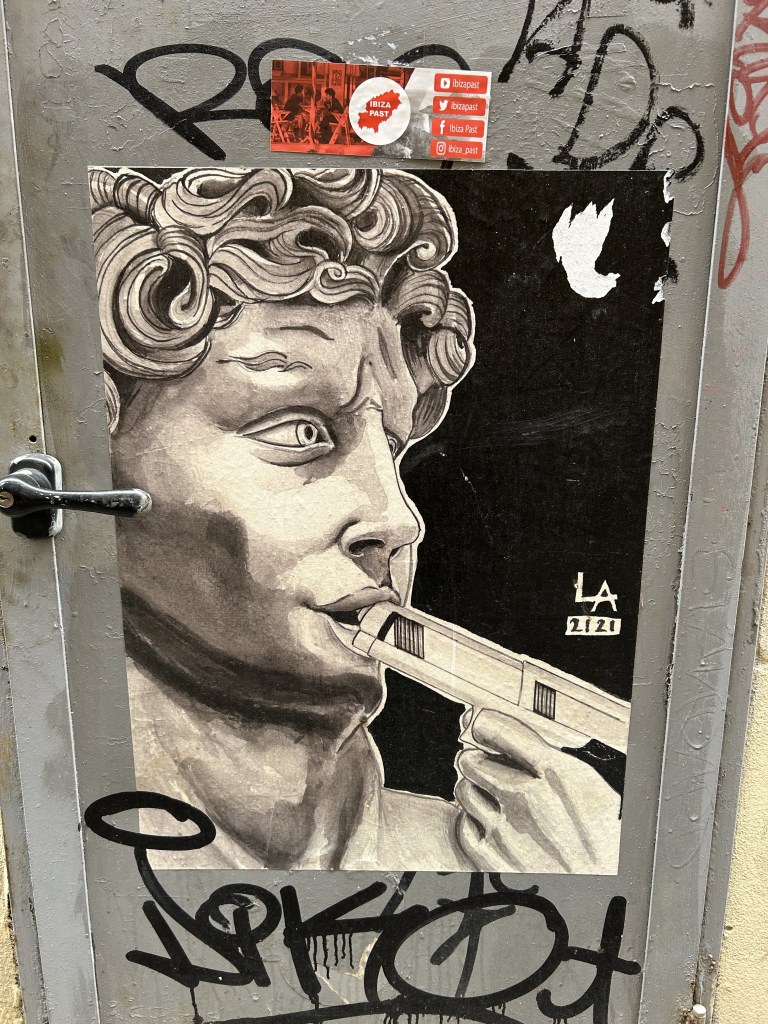
Necessary to stop and appreciate the joy of spontaneous street art.

Tuesday last, I interviewed him again and delighted listening to him speak about food preparation, watching his hands fly and finger the air as he gestured the creation of invisible dishes before him at my own dining table. I wondered, aloud, whether it might be easier if I wrote the content as a witness, imparting my own thoughts regarding his process, his approach. We discussed how my voice would, inevitably, infuse and change the work. It remains undecided. I worry. Next month we all travel to Italy together. To cook.  To drink wine. To see great works of art and architecture.  To move in the rosemary and bonfire scented mellow gold air and splendour of Tuscan autumn. I must believe the writing will come to me.

Writing this post, I realise what always tugged the edges of all my food writing:  it’s less about the food; it’s all about the experience.  The experience of sensual pleasures, but also the joy sharing deliciousness with others. It’s about relationships. Relationships between the land and the weather and the hands that nurture, tend, harvest, wash, prepare, and cook the food. Most importantly, it’s about the relationships between people.  This is what matters. This is what is most beautiful.   

A final side observation for today: I am so sad when peach season ends. Their fuzzy, sunset-blushed fade from market stalls signals the season’s shifting light. But I’ll no longer deny any potent persuasion to sink into the sublime sensual pleasures this world has to offer. Here. Now. Follow where my heart leads. Write it down. Embody my dreams.


[i] I was paid 80 bucks for the weekly column in Whistler, and $25 for the Guide, and nothing for the Kingston This Week because both papers used the same publisher, and I signed print syndication.  

[ii] I breastfed each child 18 months. Have to say, I wasn’t ready to wean Willa when I did but succumbed to social pressures and necessity when I returned to part time work. She wasn’t ready either and toddled around with a baby bottle upended at the corner of her lips, looking like a drunken one-handed sailor with everything she did.

[iii] The editor did insist titling my pieces…headlines I would have chosen differently, but not worth a battle. Or apparently a phone call?  I never asked him to change them (eye roll).

[iv] A cross between Muscovy and Pekin ducks.

[v] I taught the skill of hand shaking to my girls very early on. By eight years of age, they were pros. 

[vi] Orgasm style.  I know oysters themselves are supposed to be an aphrodisiac, but on writing this little vignette here, I think instead it must be witnessing the gestures with which they are eaten that becomes the real turn on. A thought anyway….a delightful one.

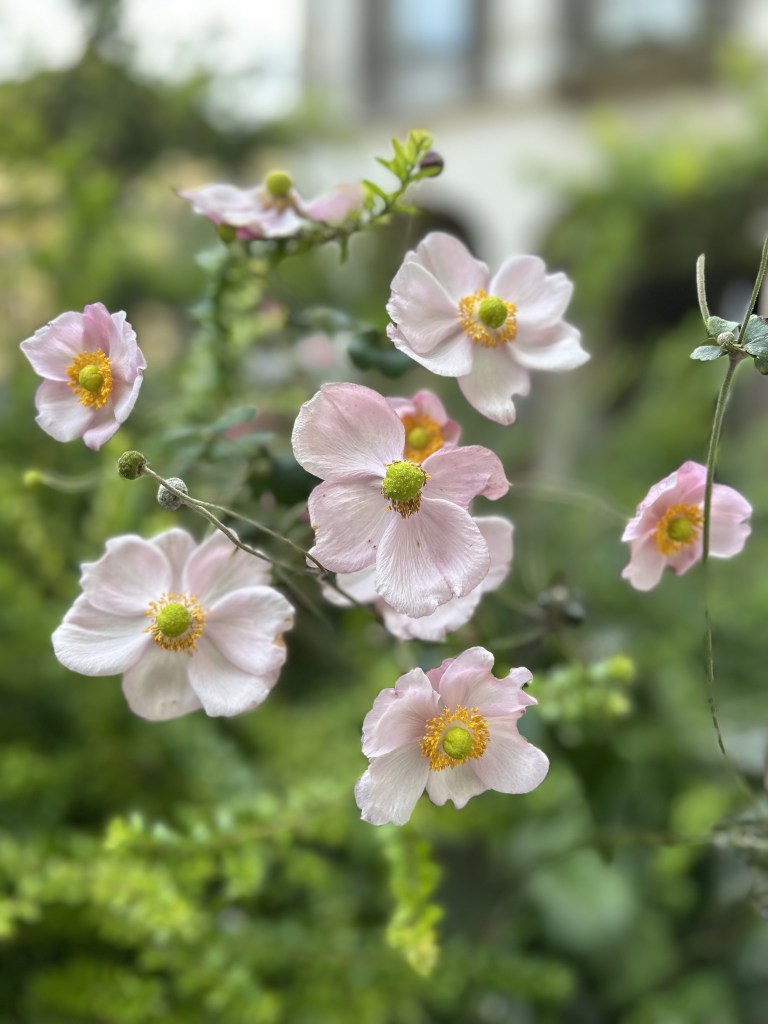
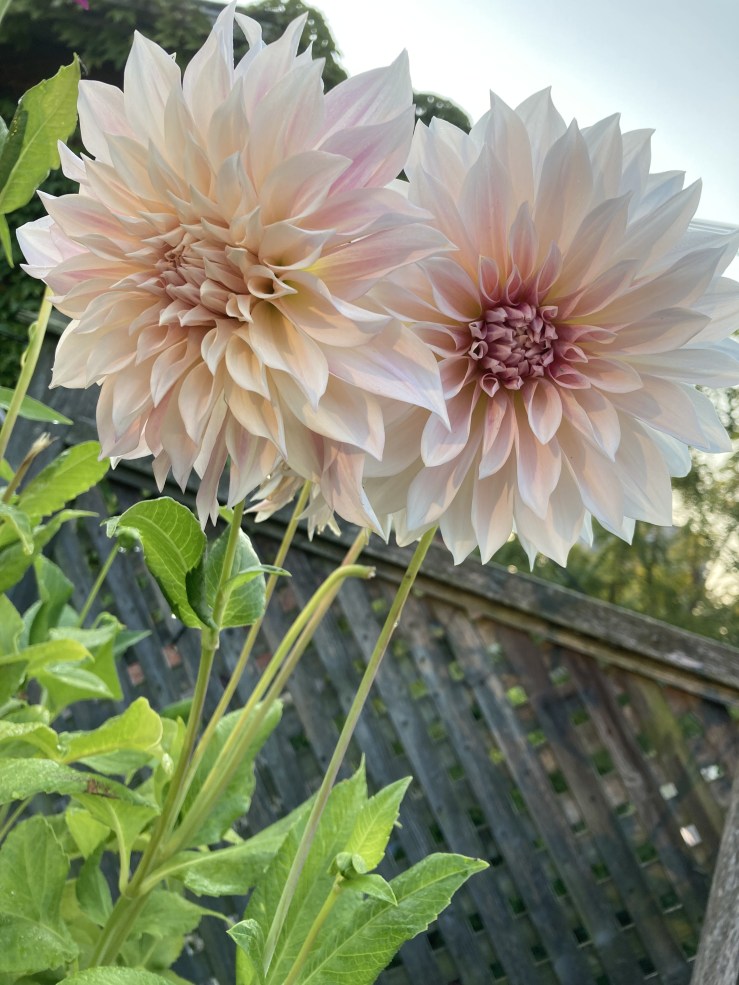
I lifted these dinner plate dahlias from the soil last summer. Boxed them up and stored them in a dark cellar through the winter. In the spring, I planted them on the beautiful terrace garden at my new place and battled the squirrels all summer who continued to believe the tubers would be most delicious each time they dug them up, sampled a tiny bite and spat it out. It’s a small miracle they survived and a massive miracle they live and bloom again. The blossoms are delicate and compact compared with last summer’s riotous overtaking, but retain all their soft, pink petalled beauty. I love them so.

A Fish Out of Water: Syntax

When I went to elementary school in the 70s and 80s, it was vogue, fashioned after curriculum direction in the UK, lessons on grammar and syntax be removed from the curriculum with the belief (not proven with time) the lessons would simply assimilate through reading, exercises in comprehension (meaning making), and natural conversation. 

And a science focused career further limited my exposure to language construction (blunted it more like. Punted any raw, sensual subjectivity, the glorious immersion of being human in a living world, to a cold field of disconnection and distanced objectivity, but I digress). The result: I must always look up the definitions for parts of sentences (adverb (?! yes, it’s true), gerund, participle), the application of verb tenses and rhetorical terms (these never stay in my head, it’s a completely foreign language). I’m only recently (last couple years) conscious of the conceptual gymnastics syntax enables one to perform. 

But my lack of education is not what I want to write about here today. Instead, in the way of shimmery near-rhymes, I want to describe my process learning to use syntax as a way to mine my intuition. This practice (nascent) is cultivating my writing, slowly, slowly, so slowly, making it, if not more beautiful, certainly more textured, possibly (hopefully?) more complex.

Importantly, the practice disciplines thinking. Alters perspectives. Allows the mind to become supple. Open.

There’s a June Jordan quote tacked on the corkboard in front of my writing desk that captures this sentiment so much better, The syntax of a sentence equals the structure of your consciousness.”

By intuition in this context, I mean what the subconscious mind is telling you, learning to trust it knows so much more before your conscious mind does. Responding to writing prompts, I put my pen to paper and let the words fly. In this way, something surprising, often beautiful—an image, a metaphor, a sensory cue—always rises to the surface (usually only at the very end of the exercise). Often, I’m left with a slightly baffling fragment and no clue as to how I might proceed or stick it together with another section of text (and attempts to force it really botch the whole thing up). This is when applying syntactical techniques may be used to open a window for creativity (and intuition) to breeze in.

Here’s what I mean (so floaty in the abstract mind space, my apologies, let’s get grounded). Syntax is simply the arrangement of words and phrases to create [a] well-formed sentence1. I’ve been practicing how to write sentences, gratefully working through exercises posted so generously by Nina Schuyler on her Substack Stunning Sentences.

Nina’s exercises break sentences into their component parts, grammatical and syntactical, and she sequences and names the parts so they may be followed as a template to slot in your own words and thoughts.  I work through Nina’s exercises each week (well, I try to keep up). I’m too shy to post them there (and I don’t always succeed in my attempts, often capturing only 3/4 of the layered pieces that make the whole), but the practice is so helpful to me.

Start with a base clause: grind the meaning of the sentence down to its essentialness, who is this about (subject), where is it taking place (setting) or what is happening (action). And then, by erecting layers of structure (syntax, grammar, rhetorical techniques), complexity of meaning, depth, a resonance imbued with life and rhythm is, architecturally, revealed.

The layers of structure move a reader through the writer’s thinking and meanings using, as Francis Christensen’s 1963 essay, A Generative Rhetoric of the Sentence explains, levels of abstraction or generality, movement (directing the reader’s eye to earlier or later parts in the sentence). Christensen’s theories enriched John Erskine’s. Here’s a quote of Erskine’s that I love, from a 1946 essay, The Craft of Writing, quoted in Building Great Sentences by Brooks Landon:

“What you wish to say is found not in the noun but in what you add to qualify the noun. The noun is only a grappling iron to hitch your mind to the reader’s…The noun, the verb, and the main clause serve merely as a base on which meaning will rise. The modifier is the essential part of any sentence.”  

Circling back to intuition and tying it in with Nina’s exercises, working through the sentence templates (grammatical, syntactical, rhetorical) I am forced to feel my way through the possibilities of how the original thought (could be the stripped down base clause) might expand. From my own free writing, I can select an image, a metaphor, a sensory cue, an action, extract it from my draft and let my intuition, carried through the templates, show me what my mind senses before I really even know.

In a recent post to The Red Hand Files, Nick Cave responded to a question about creativity, being stuck, and art making, which again, explains this better than I can:

“As a songwriter, I have come to understand that the more I try to make art that somehow reflects what I perceive myself to be, or the identity I wish to project upon the world, the more my art resists. Art doesn’t like being told what to do. It doesn’t like me getting in the way. When I attempt to impose my will upon it, the work becomes diminished and art takes its better ideas elsewhere…[Art] insists that we retract our ego, our sense of self, the cosmetics of identity and let it do its thing. We are in service to art, not the other way round.”

Practicing this way is very slow. I sit and think a lot more (imagining) before attempting to fill each sentence component on the page. I switch to pencil for these exercises – there’s a lot of rubbing out, a lot of cross outs too.  It feels a lot more like how I feel when I write poetry…the process of intentional writing I apply to poetry. It taxes the brain, but in a good way, a way that alerts you, wakes you to deeper meanings on offer.

But there is a richness of material being laid down. Suddenly every word (or component) opens so much more potential for something larger, more meaningful, more complex. It shows me what I’m thinking, before I even know myself. And this feels exciting. And pleasurable.  

How classes on reading comprehension were ever severed from syntax instruction I will never fathom. Subject for a different rant.

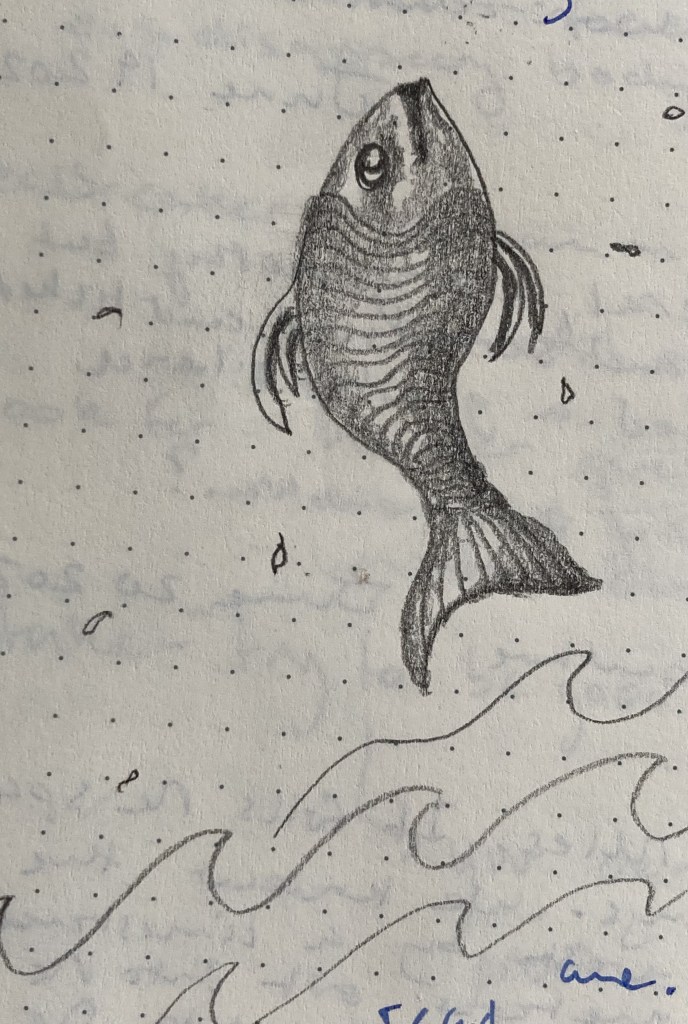
Slowly, slowly, slowly I am learning. No longer gasping for breath, a fish out of water, just a process of learning to swim. And the education, though painful at times, is a joy.

1 Discovered syntax etymology is from the late 16th century, via French or late Latin from Greek suntaxis, from sun- ‘together’ + tassein ‘arrange’. What a delightful riff on the warmth of a sun.  

Filling the Well

My passport was declined the maximum three times at the new scanning kiosks at Canada customs. I left the wave of Canadians passing with ease through the machines to find a customs officer in the flesh, “Where are you coming from?” Looking me up and down, a middle-aged woman travelling alone, he was confused. “Mexico City” I handed him my passport. “And you didn’t travel in Mexico?” “Yes, I did, but not by plane. By bus. And taxis.” “It’s unusual for a Canadian (he paused here but did not say ‘woman’) to travel like that, from Mexico City.”  Given the circumstances (trying to re-enter my country with as little friction as possible), I opted for the simplest, also the most honest, response, I said, “I’m glad to be back.” “I bet” he said.  

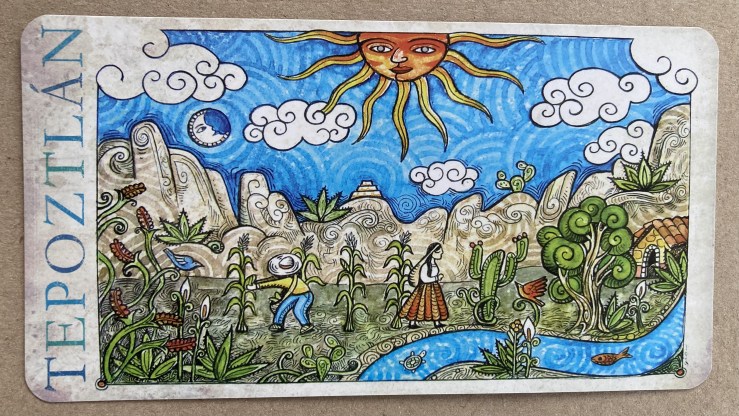
I hadn’t travelled alone; I met my sister in Mexico City. She had flown from the Yukon. We travelled the two weeks together, visiting her favourite places—Mexico City, Tepoztlan, Acapulco. She’d lived and worked a whole decade in Mexico and returned to Canada five years ago. Her Spanish returned fluid, fluent, the moment she landed.  She had asked me to visit so many times when she lived there, but my kids were small, I didn’t have the money, couldn’t secure the time away from work…so many excuses. Even when her partner died suddenly, in a dangerous town just north of the Belizean border where baggies of cocaine wash up on the beach and the people carry machetes and several sport missing limbs, I couldn’t go down there, to help her through that horror. My husband outright forbade it. With good reason, really. This trip was long overdue. And we didn’t have any epic blowouts or even anything more than mild disagreements. Maturity counts for some things.  Acquiescing my movements to the pace of a cigarette smoker helped: walk a little ways, smoke break, walk a little further, smoke break.

Dropping into another culture, another climate (several climates really, because with every move we made the temperature, the way the air moved and touched my skin, the scents on the wind, changed), surrounded by a language I didn’t understand, kickstarted my mind. Thoughts, sensory experiences, sparked and fizzed. Released from the demands of work, of family, of regular life, I settled into being, allowing my tongue to bend around the new language, a different grammar, novel tastes.

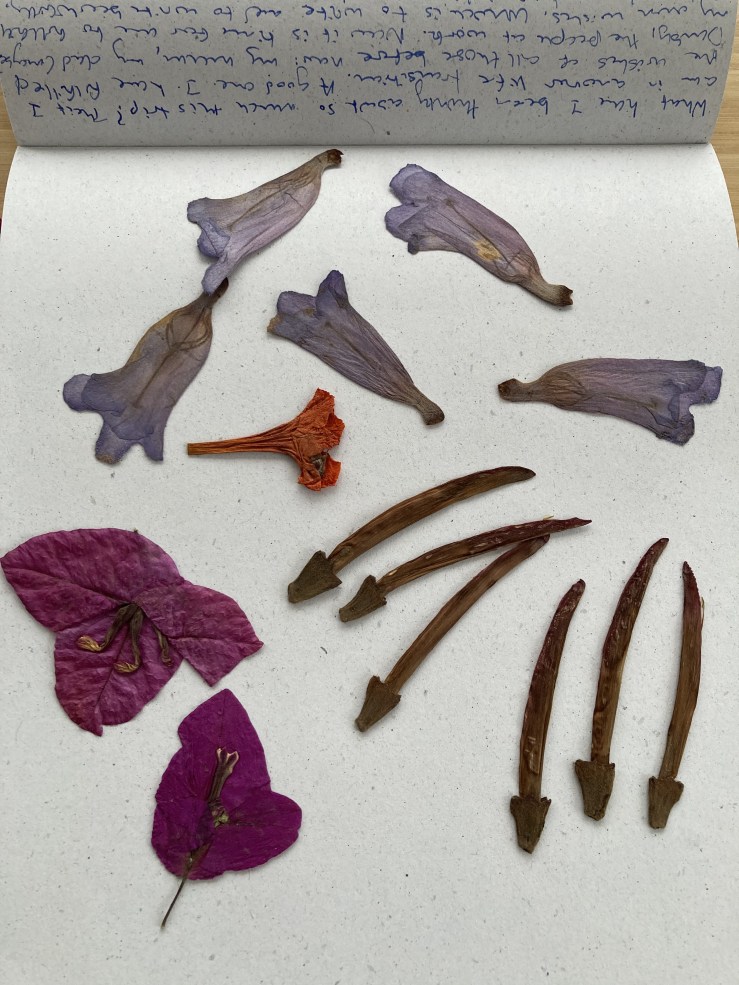
I didn’t write much. Jotted a few fragments, impressions. I collected flowers—Jacarandas from the purple blossoming trees, bougainvillea, frangipani, others I didn’t recognise—pressed them between the pages of my notebook. I carried my pencil crayons but never drew anything. I didn’t quite feel settled enough. We were on the move. There was too much to look at, take in, make meaning of. Everything was fantastically loud: competing car radios, shop front music blasts, horns, bells, the screeching of brakes, the barking of dogs, the crows of roosters, birdsong, people yelling, begging, singing, whistling, babies crying, children laughing, and Mexican style fireworks which really sound just like cannon blasts. They made me jump. Every. Time. One expat suggested the fireworks—long baton-like sticks held in front of a person as if carrying a flag, gun powder stuffed in the top end and lit—as Mexicans reclaiming the fear they’d felt when colonial conquerors landed with their real cannons in centuries passed.  Maybe.   

It felt good to get my brain buzzed. To slow down. To simply feel.

I read four books, two by Mexican author Elena Poniatowska (an émigré from France). Her writing is gorgeous and, I imagine, even better in their original Spanish (the short story collections I read were translated by George Henson and Elizabeth Coonrod Martínez). Here is a good and very recent overview of her life as a writer, from The Washington Post, written by Kevin Sieff.

Amidst the concrete, the gates, the walls frothing barbed wire, shards of glass, the flowered vines spilled forth, the flowers rioted, the birds swooped and sang. In a place where even the laundry hung to dry on the rooftops is caged, there is art on the walls and parades of people celebrating. I spent my time ingesting it all. Feeling full.  

With Gratitude

Hmmm…so many things wrong with this rendering. But I guess, also, so many things right.

On this day of (Canadian) thanksgiving, I want to acknowledge and extend my gratitude to all of you, the readers of my creative work.  Especially here, on this blog, this teensy tiny corner of the digital universe, a place where I slowly work out my thoughts about creative process. You are patient and kind and giving of your time and attention.  You make my writing a conversation. You are the connection I crave. Thank you. 

I have been writing down glimmer dumps, a practice of attention and sensory writing advocated by writer, Pam Houston, and described in detail by Maxima Kahn here.    

I leave two with you here, from the last week, small offerings of gratitude.  

One: 

Driving the rural roads round my place, the trees remain in full leaf but glowing yellow and red in the warm light of mid-afternoon.  With all the rain we’ve had, the lawns and livestock fields shine bright green. Cows in a clumped white herd (Belgian Blues? Charolais? Murray Greys? I wish I knew) on an emerald hillside, but one cow, off in the field on its own, jumped up, rocking in the air, its tail curved up in a smile. It leapt like a young puppy dancing, and I delighted I’d caught a cow mid-joy. 

Two:

As I write, the rain tinkles in the eavestroughs and a whole lot (a flock?) of starlings are singing from their perch atop the pine trees in the backyard…sometimes the song drops suddenly into silence and the whole lot of them lift off, rising through the air, each one morphing into a whole, a murmuration, and I am reminded again how magical the moments in this world can be. 

Celebrating you and your reading!  Cin-cin!

Growing A New Perspective

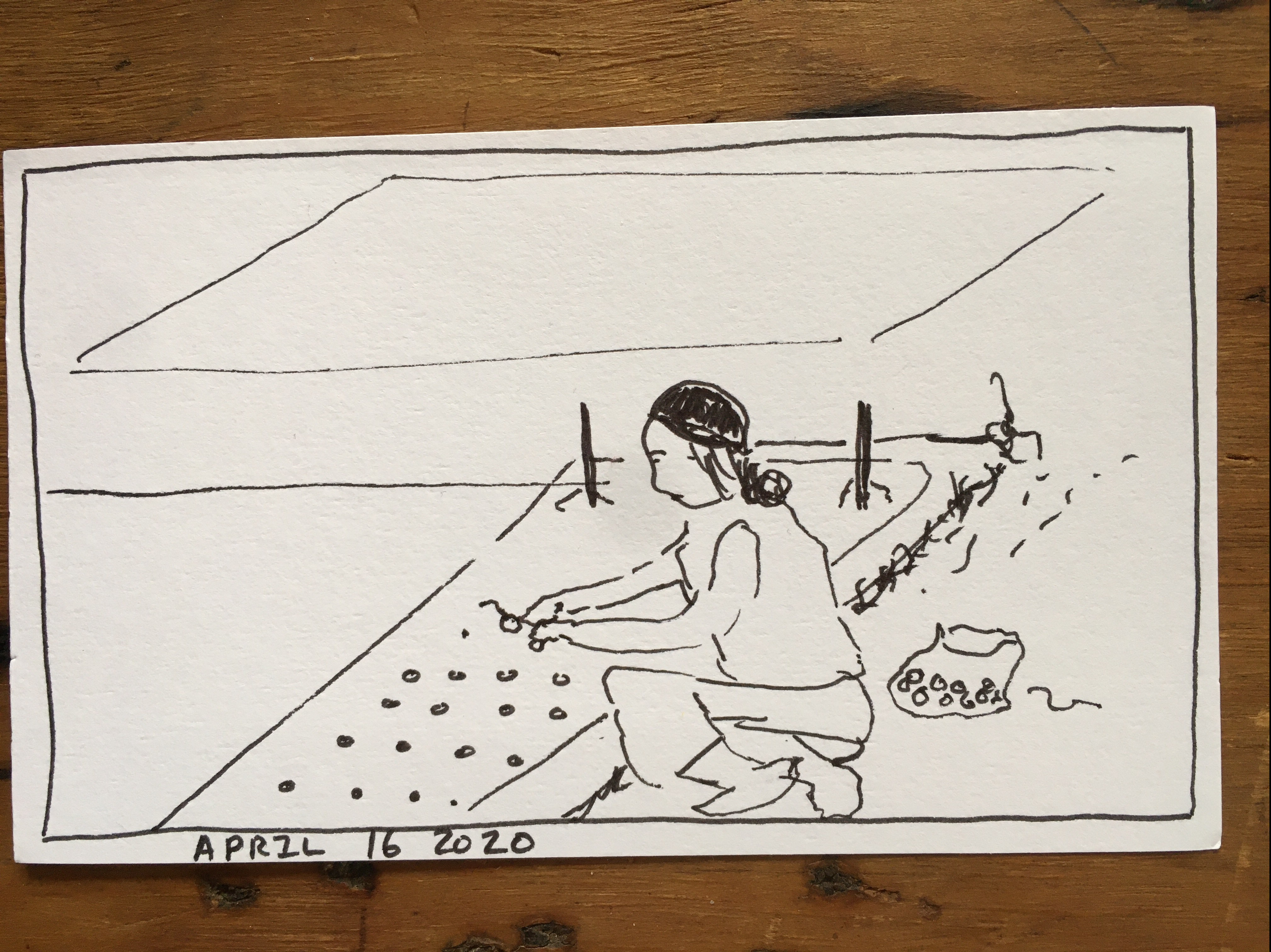
Outside the window, the robins criss-cross the soil of the newly turned vegetable beds, listening for worms beneath.  The recent years, filled with appointments and meetings and what seemed so important, witnessed the plots disintegrating into a weedy mess.  This year, I’m out there again, with this mixed gift of virus-induced-stay-home-time, edging the garden earth against the encroaching lawn.  It’s heavy work but satisfying.  It’s work that can only go at the pace that I can, my legs and arms and back complaining if I do too much at a time.  

And it’s work that unfolds—can only unfold—as the temperature rises.  It can’t all be done at once, but rather moves in a predictable and ancient pattern of seasonal shift; only cold weather seeds can withstand the sudden wet snow squalls, the winds whipping in from the north. The nightshade cousins like it hot, the tomatoes and peppers and eggplants, and it’s a month or more before those seedlings will be planted out.  By that time, we will be harvesting the first lettuce greens and hopefully some sugar snap peas.  Spinach and rhubarb will already have bolted, erecting obscene seed heads into the humid summer air. 

Digging out there, with the grit beneath my fingernails, the worms squirming against the light and the scent of earth wafting round, I can’t help but read the metaphor so blatantly presented about artistic practice.  Yes, I know the comparison has been made before a thousand times over, but when one discovers something for oneself, it retains the fresh surprise of truth. 

For all these veggies to grow, I must work with them, nurturing them in concert with their environment, just as I do my words and sentences when I’m trying to write a piece.  And the thing is, when the first twinned leaves of cotyledons poke through the soil, it’s hard to tell the veggie seedlings form the equally virulent weeds.  One must be patient, observant.  With experience one knows, but it’s seasons of trial and error for the neophyte.  As a writer, I’m still in the spring stage, the early spring stage.  But with continual care, attentiveness and nurturing, what I plant on the page will one day grow, be trained and weeded and shaped into something beautiful for others to consume.  As the writer, I am the only person standing between the garden of a finished piece and the chaos of the word weeds.  How and what will grow is really up to me and will only unfold at the pace that it can, that it will for me alone. No rushing how a plant grows; only solid dedicated care will bring it to fruit.   Writing too.