
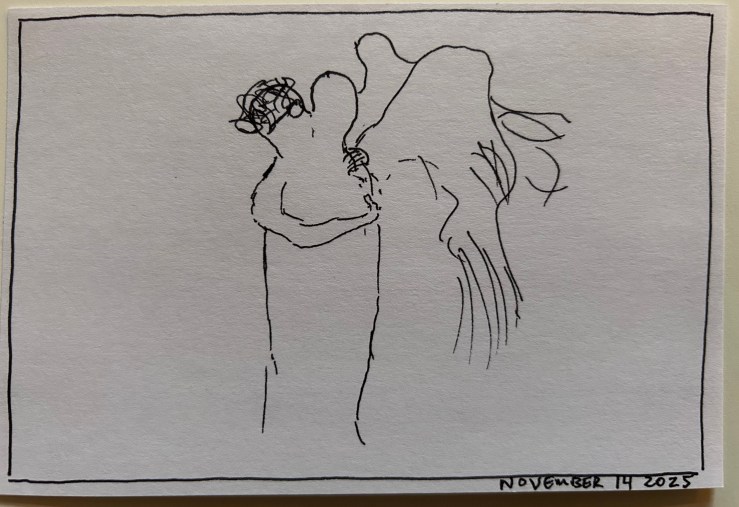
Thank you for your many messages. They guided my approach—which I’ll summarize below—revising A Marriage: Framed (CNF <2500 words) AND showed me to trust my own words and my own process. Your belief helps me believe. A blessing.
There was a lot of tinkering (ink -er-ing) trying to take this story to top level writing technique. I continue to tinker. Top level is…a dream, a ceaseless chase. And yeah, the chase really is a lot of fun [Insert: series of horn blasts and voice signals and Tally-ho! Here we go!].
Last month, I posted my experience pruning A Marriage: Framed, taking it from 3770 to less than 2500 words. The process was fascinating because as I cut the words down, the focal point shifted, a spin that forced the painful emotions at the heart of my 27-year relationship with my ex to surface. Emotions I’d suppressed for decades.
Struggling to understand and move those emotions out of my body onto the page transformed them into “an object” (a writing piece) outside my body that I can interact with and control. I’m less “imprisoned” by my emotions, if that makes sense. I feel almost as if the rewriting of the draft I completed last month was a “therapy” draft. The story moved from being deeply subjective to objective, enabling me to turn to tackling the craft and technical aspects in the writing with a cool(er) and practiced distance[1]. This latter process, I’ve discovered, is essential to move the emotional therapy draft through a series of systematic style techniques so the artifact might approach a work of art.
I wrote about my nascent practice and understanding for how to work with the subconscious as part of creative writing process in a post last March. Today, I want to build on that earlier exploration with some concrete examples because I’m trying to understand and practice tangible methods for working with less tangible materials. Silence. Air. Thoughts. Dreams. I was thinking about how a musician works with the silences between notes to modulate pitch and tone, melody and harmony; how a sculptor carves a block of stone to encase a shape of air. And my mind slid from that image to a memory of being captivated by a sculpture of Leda and the Swan when I was in Italy last fall.
I was rushing through the monumental halls on the second floor of the Library of Saint Mark in Venice in order to see the Mappa Mundi before the gallery closed. Speedwalking past innumerable marble busts, I stopped abruptly, struck by the unique portrayal of the infamous myth, an erotic story about the god Zeus, disguised as a swan, seducing the Spartan Queen Leda. The question about the nature of the seduction, whether coupling between the two was consensual or not, revolves the ages. This specific statue, its image, its energy, has stayed with me because of its beauty, yes, but also its ambiguity …for me, this sculpture is tangible object and emblem of desire-resistance all at once. Leda and the swan are carved to their moment of intercourse and Leda seems, at least to my eyes, both taken by surprise, as if she’s not quite ready to take on a god (she pushes the swan away) and surrendering to her attraction and desire at the same time.

I hadn’t appreciated why this sculpture has enchanted me for more than a year, until today, when, sifting my thoughts for something concrete (well, marble in this case), this memory surfaced. By embracing the complexity of the original myth and removing the layer of Greek mythology, I choose to think of this sculpture as a symbol of unification between spiritual and human worlds. When creative writing, I feel the spiritual world, or divine might be a better word, is a part of (or accessed via) the subconscious. The vibrating energy I can feel as I draft using stream of consciousness writing (read: writing without thinking too much) is intuition. Intuition is much like a tuning fork. I’ll try to explain this shortly.
I’ve missed many of the signposts from the subconscious in my writing drafts—they arrive as words, resonances between words and as sensory images. I’m learning how to identify them and practice how to work with them and preserve them to create a net of story words that communicates something beyond words: feelings, energy, magic. Art.
Here’s an elegant and far more beautiful articulation for what I’m trying to say:
“Story form is an object, a translucent, shimmering thing with words tacked to the surface of its swirling involutions. The words glitter with their own reflective colouration; in them you see the momentary reflections of other words. Wires as thin as gossamer connect the words with more words on distant parts of the structure where they set up new colonies with flags, banners, replicas, and maps of the whole. Spin the form and the same words appear in flashes, the eye registers their rhythmic insistence[2]. It is wonderful and miraculous to watch.”
Excerpt from the essay, Anatomy of the Short Story, in The Erotics of Restraint, by Douglas Glover.
Tune Up Techniques
My revision was guided by generous writers and readers who offered their love and attention and time to enhance my piece. I’ve said it before; creatives work in community. I’ll write more about that in December. My learnings I write here derive collective wisdoms of too many people to name. Thank you.
Ideally, or shall I say, if this were easier, I might have started revising the Macro aspects of the piece—story, plot, characters, setting, points of view—then moved to the more Micro levels of paragraphs, sentences, rhetorical devices, syntax, diction.
But that’s not how it worked in practice.
There were the metaphors and the patterns and the desire-resistance tensions and the images that slid to occupy both macro and micro levels and, most important, all the space vibrating between. That’s the art object space, the space of Leda-swan. It’s an easy space to get lost in and an easy space to miss.
My tune up process was messy, not linear. Nor did it happen in steps, though describing the process here necessitates a sequential recounting. Revising was pressured by the word count cap, 2500 words max. The restriction served the writing in many ways by forcing disciplined compression (of words, sentences, images and ideas).
The process felt like persistent twisting, moving around and up and down and through the piece, working to understand my intentions and meanings, then shifting sections here and there, and tweaking here and there, and slowly, slowly, slowly, the piece contracted round an essential essence of tight emotional communication, complete with shimmery swirly resonances, into story art (ish…I’m still practicing).
Working with Vibrations
Ok, first, two indispensable applications I think I’ve failed to post on this blog, probably because my use of them is so integrated with my writing process I’ve neglected to emphasise my reliance on them[3]:
- Word Hippo (thesaurus, word tools, etc.)
- Online Etymology Dictionary – I love how they write on their site (my bolding), “Etymonline aims to weave together words and the past, answer common questions, and sow seeds of serendipity.” Sowing seeds of serendipity is exactly why and how I use this site. It’s a creativity generator.
Choosing the right word requires deep attention to what it is I want to say (what I intend a sentence to mean), the connotations I intend to (try to) control in readers’ minds, but also how I wish to communicate it. Choosing whether the flavour of communication should be sweet or bitter, whether the texture of communication should be hard or soft, whether the sense of communication might be cold or hot.
Here’s an example. In the original longer draft, I had an entire paragraph describing the situation where the husband explains he won’t allow his wife to attend the funeral of her friend’s dad. When I cut that paragraph down to convey its essential meaning in one sentence, I wrote, “[He] embargoed my attendance at a male friend’s dad’s funeral believing my intent was seduction.”
Ok, that word embargoed practically leaps off the page with melodrama and elevated (snobby) language. Instinctually I disliked it, but it captured the essence of meaning I was after, which was restriction or “not permitted”. The vibration of my distaste of the word (in this context), even though it had the right meaning, signalled—and I should explain, this feeling is super subtle, very easy to ignore if I’m not paying attention—there might be a deeper meaning.
I sat with the word quietly and patiently and questioned it, exploring its alternative meanings. The idea of ownership surfaced to consciousness …which is a concept I’m exploring in the larger piece. The subconscious offered “embargoed” up…but the flavour (snobby) and timing of it wasn’t right…I didn’t want to introduce the idea of ownership so early in the piece (this sentence comes in at paragraph two). I wanted “ownership” as a concept to build slowly through the piece, mimicking the way the wife experienced this revelation over time.
So, I fiddled with it. I ended up using the word “barred” because it conveys the meaning of “not permitted” and extends it into an implied image (physical bars) introducing the connotation of “prison” without it being overt. It’s also a soft, quiet word in the mouth, so a reader might glide past, carrying its meanings without tripping on them (embargoed is practically a foot stuck out in front of a running reader). The sentence became, “[He] barred me attending the funeral of my male friend’s dad believing I intended seduction.[4]”
This is what I mean when I describe intuition as a tuning fork. It’s the vibrating intuition that guides which words and phrases bring the meaning and feeling and senses and sounds to coalesce in tune with the piece as a whole.
Another example, this time at the sentence level. In the therapy draft I wrote:
The kind of love that made me bump into walls, sliding glass doors and fail to recall what street to turn down to return to my own student house. The kind of love that made me forget to eat, made my skin glow, made me sing greetings to strangers.
I liked the repetition of “kind of love” because of the rhythm it introduces as well as the way it draws attention to the listed descriptions and also, the super subtle question injected by those words “kind” and “of” placed side by side, implying “sort of” …as in, this is the way the wife loved but was it a sort of love? A half in/half out love? I know, tenuous.
Also, “made my skin glow”…vibrated (intuition tuning fork struck)…what did I mean by this? I meant our lovemaking made my skin glow. An opportunity to align that idea with the larger story, which does circle and explore sex. Compression, and playing with the sound and syntax, reshaped it to:
A colliding into walls, strike sliding glass doors kind of love, amnesiac love, missed meals, abandoned panties kind of love that made my skin glow.
Working with energy
I wanted the reader to feel the same crescendo of energy and collision-like impact as I had experienced with the real event. So, I needed to recreate it. For this story, I wanted to begin with a quiet energy of curiosity that moved, incrementally, to build momentum through the piece toward a detonating end. The best way to describe this is by comparing it with music. This tune, You Look Like Trouble, by Lisa LeBlanc, embodies the energy arc I was after for my piece (and I’ve drawn what I mean in the graphic below).

But how did I do that? Well, I practiced what Summer Brennan refers to as the controlled release of energy by considering the way energy builds up and is released. I felt my way through this intuitively, and my attempt to describe it here is underdeveloped. Mostly, I feel, it was a conscious effort to pace story events, laying out the information that keeps a reader interested and curious and engaged, building on story events so they acquire more and more meaning, modulating sentence length and sound to align with intended meaning as I went (as described above). Layering information.
But also, this short piece is intense. More than one reader described it as a run instead of a walk. As the tension ratchets up with information layers (about who these characters are, their behaviours individually and in relationship), I deployed a technique I use often in my writing (and uh, life), the use of parentheticals and narrator intrusions to break the tension and release the energy.
Here’s an example of this technique: This tragedy seemed particularly attractive (saviour complex? Fuck. Maybe.).[5]
Working with Metaphors and Imagery
I think of metaphor and imagery as working with dream. For me, this is the most prominent language the subconscious surfaces in my creative writings. The therapy draft revealed many. I adore working with metaphor and image and I avoid letting any go…I feel they’re a kind of magic, the spirit world made manifest with text on a page. But the therapy draft made visible, perhaps for the first time, my subconscious tendency to insert a metaphor or an image as an avoidance technique. Instead of forcing myself to move deeper into painful experiences, I throw up a metaphor and skate right past it. Once this was pointed out to me (thank you Barbara!), I could see where I’d done it, soft bodied ego protecting itself. So, I spent some quality time with my pain and worked to describe it clearly, straightforwardly, in scene.
Quite naturally, after I’d rewritten those pain sections, the imagery refined throughout the piece and miracle of miracles, the ones that remained hung together associatively. In this story it’s repeated imagery of sunlight and storm. I worked to sprinkle this imagery through the piece, augmenting associatiions with words resonating the same sounds and meanings, and tried to follow the energy arc by beginning with sunlight and ending with a lightening strike.
And I tried to get some beautiful sentences in. There are a few I really like. Playing with sentences had me waking in the middle of the night to puzzle them through. Here’s one that didn’t make it into the piece, but I leave it here for your pleasure and song.
And what is love? Laughter donning roller skates, heedless of the hill[6].
[1] It’s important I make a distinction here. Even though I’m bandying the terms “objective” and “distanced” and “cold” and “systematic”, which raises “scientific method” connotations, the process for moving into technical tune up MUST (MUST!) retain an open heart and keen attention to the body warming when the vibrations of instinct ping. The process is slow and methodical. I know I’m on the right track when I’m delighting in the discoveries (the right words slip into the right place; the sounds; most of all, when unexpected injections of humour are revealed).
[2] I love the way the movement, “Spin the form”, resonates with the words “colonies” and “replica” and “maps” in the previous sentence to deliver an image (implied) of a spinning globe, a twirling world, disco ball like with those flashes.
[3] I used to use a visual thesaurus as well, but default to word hippo these days. Before that I used a heavy hardbacked Oxford thesaurus I “borrowed” from my housemate in second year university. Sorry Jeff, it’s still on my bookshelf.
[4] Also shifted words around to improve difficulty comprehending “male friend’s dad’s funeral”. Thanks Stacey! We decided the passive might be okay in this instance, a sacrifice for clarity.
[5] I am fretting over the punctuation here. I think this is right.
[6] I woke at 1:16 am thinking this question: and what is love? In half sleep, the words/image (as one) arrived: laughter, roller skates. After a trip to the toilet, more words: back to the hill. Later that day I played around with the words a bit to come up with this line…a line I’m happily hooked on because it feeds me, nurtures me, continues to shimmer. Sparkle. Delight.
Leda does love him. She shares his dreams.

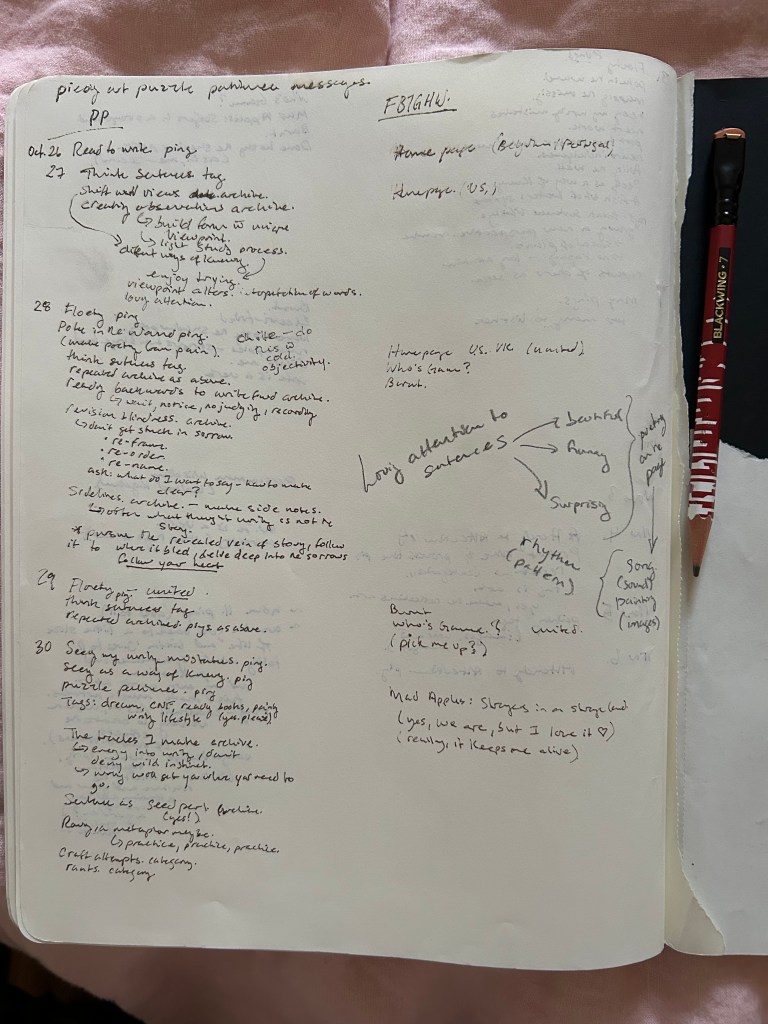

 Process Peace