
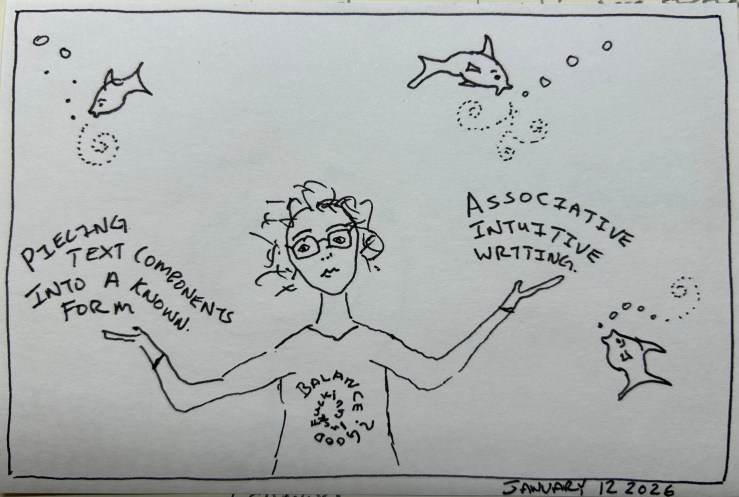
You know that feeling, feeling that you know? The tingly intuition sense of certainty locking into place? I carried a little stack of 40 blank cards around my apartment for a few days, moving them from the coffee table to the kitchen counter to the shelf in the bathroom to the dresser to the desk and back to the table, trying to figure out the parts of my long project.
Holy batman, long post BUT it includes an epiphany (one that I can’t believe I have the balls to pursue) and living proof my funny voice (what I often refer to as my audacious voice) has returned to the project at hand (such a fucking relief!!)[1]. So, if nothing else, an entertaining read. At least, in the manner of witnessing a writer slide the rails of insanity[2].
The last few blog posts I’ve lamented the challenges I’ve had getting back into writing the long project (LP)[3]. For many weeks, I’ve had an overwhelming urge to sketch the story by placing the different events along a narrative timeline. And though I toyed with the task in my head (constant thinking!), I got as far as drawing a long line on a piece of blank paper and plotting the first and the last scenes at their respective ends.
Something held me back from adding more information. I fiddled with the idea of whether to add scenes or ideas or theme-based chunks of text…and each time I sat to the task, I was tempted to draw a second and even a third story line and I couldn’t see how I might line things up without drawing a tangled mess.
I’m back to writing LP content, so that’s good. But I couldn’t shake the feeling I’m at a point in the process of this project where I need to have some sort of structure to hang the story on.
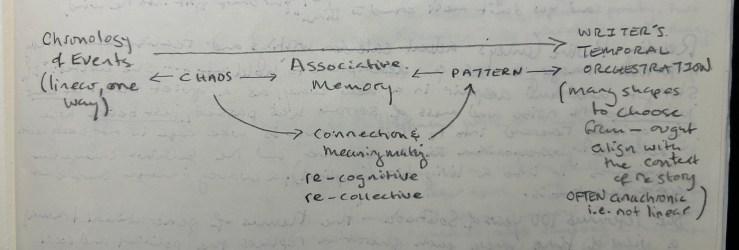
I argued in my head a lot because I’ve committed to a process to write this story associatively, following Nabokov’s ideas for memoir writing. I wrote about that in an earlier post. In my head, I argue a lot with Nabokov. What does this look like? Caspian harvested beluga caviar indulging a 7-11 freezer burned fish stick. Interestingly, in that Nabokov post, I drew the narrative form I felt I was beginning to follow: a corkscrew of associations winding round a central linear narrative spine. Here’s that pic again:

Since then, I’ve been praying my associative writing, with its magical ability to raise glittering flecks of illumination from the silt of memory will offer a thematic pathway (yellow brick road) for a book. After all, we only read from the front of a book to the back of it…we read in a straight line, even if the components in the book (chunks of scene/memory/thought/etc.) wander back and forth rendering decades past or speculative futures.
In the fall, when I rewrote the draft introduction of the long project, editing it to a much shorter creative nonfiction piece (~3700 words down to <2500),the frame and narrative arc of the LP revealed itself clearly in the shorter piece: I know where the story starts and ends and I kind of know what the whole thing is about and what I want to say. But I’m struggling with the arrangement of the associative writings. Most worrying? I can sense the temptation of the comfortable possibility of continuing associative writing, like, forever…
Strategic sequencing is what I need to figure out[4].
Holy batman this has been a long intro to get to this point!
So, there I was, somewhat sulky over the holidays[5], and I was reading a beautiful slip of a book, Three Rings a Tale of Exile, Narrative, and Fate, by Daniel Mendelsohn, and I hit upon this line at the end of his third paragraph which made my spine tingle: “The only way to get to the center of my story was by means of elaborate detours to distant peripheries.” Yes. This is exactly how it feels writing my own…
Then, for a few pages, he describes experiencing “a crisis of some kind, even a kind of breakdown” where he was unable to write for several years. This too resonates. Then, when he takes up writing again (a memoir), he admits, “the book was difficult to write: so difficult that there were many occasions I thought of abandoning it. I was baffled, balked…the story I wanted to tell kept changing shape, shifting away from me, slipping from my grasp…what I can only call narrative despair.” I sensed a kindred spirit here. Mendelsohn then explains his project was four years of writing and 600 manuscript pages in, and yet he still “had no idea how to organise the story.[6]” Suddenly, I caught his narrative despair, like a virus. I felt rather dizzy. Feverish even.
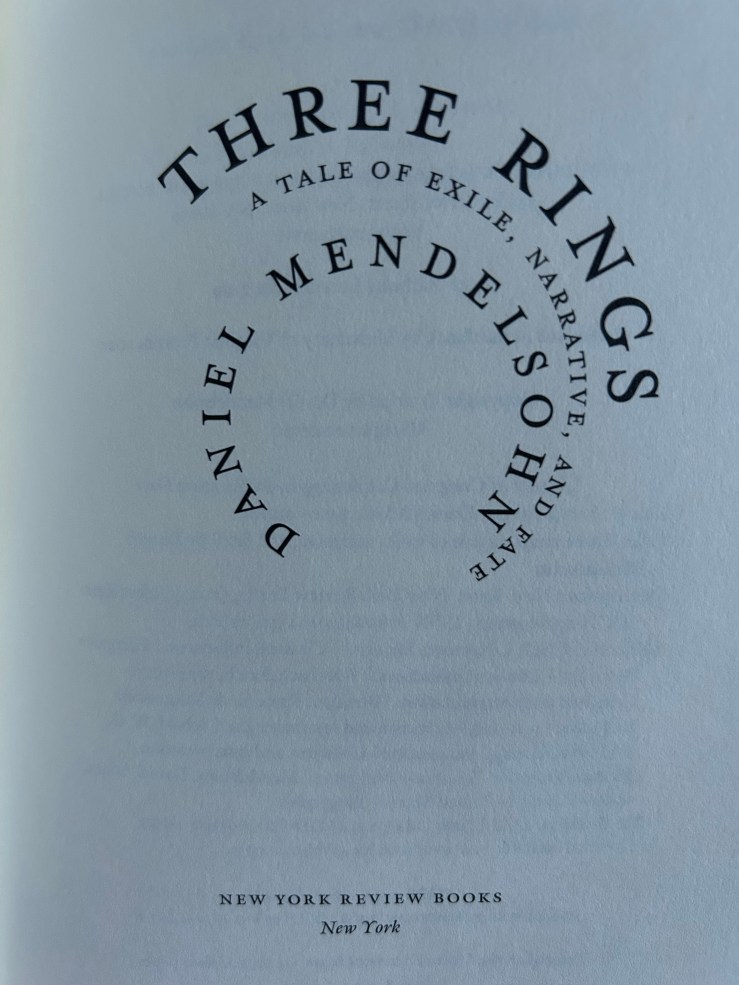
And then, just as Mendelsohn experiences the sudden recognition of “the right structure” for his book—ring composition—I sat up, electricity dancing my veins, realising it’s the form for my own LP story. With this lightning bolt of recognition, I continued to read to understand this ancient storytelling technique and the voice in my head, that fish stick voice, was like, No no no no no no NO….wtf?! You’re choosing the most complicated challenging form to write your first ever novel length work!? Are you fucking crazy[7]?
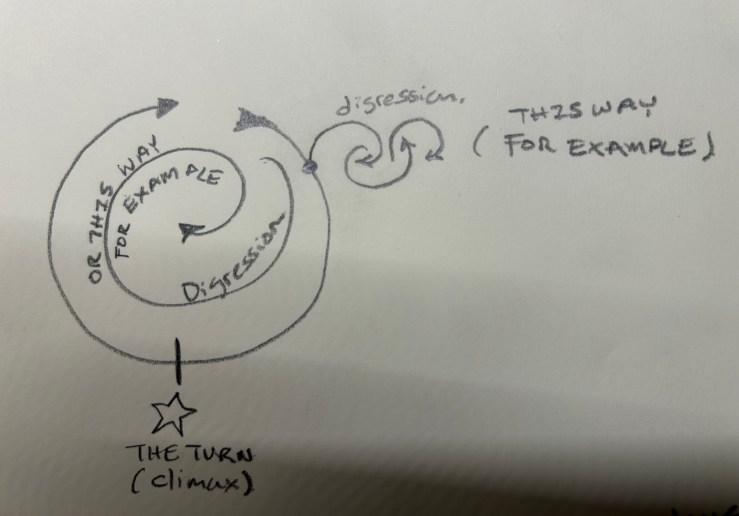
Ring composition[8]: a “technique…the insertion within one story of other stories, the flash backward or forward in time in order to give depth and complexity to the primary narrative…[though] the narrative appears to meander away into a digression (the point of departure from the main narrative being marked by a formulaic line or stock scene)… the ostensible straying, turns out in the end to be a circle, since the narration will return to the precise point in the action from which it had strayed, that return marked by the repetition of the very formulaic line or scene that had indicated the point of departure.”
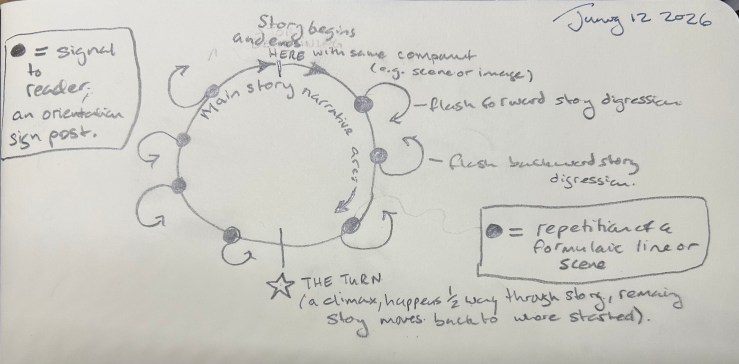
It gets more complicated: “The material encompassed by such rings could be single self-contained digression or a more elaborate series of interlocked narratives, each nested within another of Chinese boxes or Russian dolls.” (See my own drawing of a spiral round a spine above and imagine turning that spiral toward you and looking at it from the front instead of the side, with the spine becoming a circle and the digressions the spiral, it would look like this:
And now that we’re embarking on this spirited roller coaster ride (the Fun Coaster! The Inanity Insanity Ride!), those digressions? There’s a pattern to them! Of course there is. A chiastic pattern (chi is the twenty second letter of the Greek alphabet and Plato explained it as two bands that form the soul of the world crossing each other like the letter Χ[9]). A symmetrical mirror pattern that can look like this:
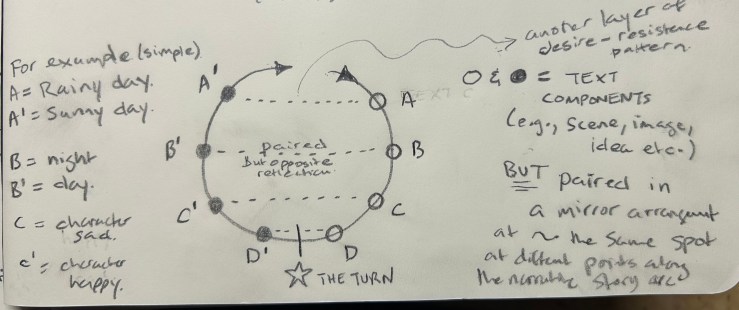
And with this illumination, it was suddenly brought home to me in a way I hadn’t appreciated until that moment that, in a novel length work of art, there can only be about 35 to 50 story components TOTAL (this includes the main narrative throughline and all those story digressions)[10].
Holy batman, that is a MAJOR restriction!
I spent several days trying to make sense of this new puzzle in the context of the LP….I drew a circle and started to plot bits of the story on it. I discovered the turn, which is the point of climax (see the diagram above), was not what I thought it was (the middle point shifted and the new “turn” felt like a puzzle piece slipping into place). But then I got stuck again…and my head was actually starting to ache with the effort (I think I was clenching my jaw with concentration).
I cut up card stock into forty little squares, and I walked around my apartment holding the stack but afraid to mark them up, even with pencil, so suspicious of my process. It was too forced, too contrived. What would Nabokov say? Get cooked fish stick, you’re not worth the sawdust in your guts!
Holy paranoia batman!
Then, last Sunday afternoon, as I was writing my way through a particularly graphic baby delivery scene (Willa), a line floated to me, a voice I recognised as my own, but one I have struggled to access and pin down to the page for …years. This is the line: Who fucked who to fuck you?
I tried to ignore it. I mean, the profanity alone. Shocking. But the line persisted, circling my head and began looping to that tune Who Are You? from the Who, so I abandoned writing the delivery room blood and guts and switched over to the LP “archive file” to at least get it down[11]. Once I wrote the line, it was if I’d turned on a tap, the words flowed out of me fast and easy. Here’s what I wrote:
Who fucked who to fuck you? By which, of course, I mean me. It could be the latest Dr Seuss! This line could be hummed to that fantastic tune sung by The Who. Do you really want to know? Who are you? Whoooo fucked who to-hu fuck youuuu?
But.
This default, my collapsed wails into trauma victimhood, though, at least partially accurate, is…too simple. For the sake of this story, let’s start there shall we?
Let me introduce you to my parents.
This is Camilla. She lives in the dementia ward of a long-term care home where the doors to the outside are always locked and the doors on the inside never are. I avoid peeing when I visit ‘cause I worry another zombied octogenarian will shuffle in on me hovering the toilet seat with my pants pulled round my knees and maybe a small squeak of a turd sucked shy back into the dark hole from whence it poked its nose (Suzanne, how rude! I can hear my mother’s voice in my head, how she would say, How rude! with her posh English accent—put on, of course, because she was, is (!), a Kiwi— her eyes wide with feigned shock before she burst out laughing, huge gulping guffaws of laughter that would double us both over. She always loved a good shit joke. But punchlines aren’t for the demented).
Camilla still dresses herself, albeit in several floral print shirts at once, layered one over the other, along with several strings of plastic baubled costume jewelleried necklaces wound round her neck, executioner style, and, often, also her wrists (maybe more S & M). Really, she resembles a human enchilada at the rough end of a coming out party.
Camilla refuses to disrobe for her bath, even when the bowel movement moves down her slipped diaper leg. By special (read: pleading) request, the one male nurse, José, supports the personal support workers on staff with this task. He arrives on Reception Three (this is the name of the dementia ward…not sure what everyone is celebrating, certainly not any return of memory. In mum’s case, a small blessing) and coaxes mum into the room with the pressure washers and the institutional lift tub.
This is how José performs the miracle of his namesake: on arrival, he stands just inside the corner, perhaps diagonally across the common room from my mother. The common room has a TV that occupies the better part of one wall, flanked by a number of drooling bodies in wheelchairs gathered round, as if the TV were a communal bonfire. The Sound of Music movie plays on loop and it’s easy to imagine all the female support staff singing, How do you solve a problem like Camilla? (Aside from jiggering her milligrams of Seroquel to anesthetize her “agitations” (read: uncooperative argumentative escalations and attempts to bite staff forearms), which, secretly, I believe is Camilla’s way of exercising her agency under these—tragic, there’s no better word really—circumstances.)
José, standing there at the corner—picture a thin, balding man with a penchant for camp, sporting hospital scrubs—tilts his chin towards his chest, slightly, tosses his imaginary Fabio hair, and puckers his lips into a sexy little pout, focusing on my mother with—unmistakable—a smoldering gaze. If she doesn’t notice him right away, (though, she usually does), he’ll hop and dance his feet a wee bit until his sneakers squeaking the linoleum get her attention. Then, he’ll point at her and sidle across the room, a dashing flirt, almost singing, “Camillaaaaaa! I’ve been waiting to meet you alllllllll my liiiiiiife!”
Camilla is never surprised. It’s as if she expects it, this man’s instant attraction, even though, in her mind, she’s never met him before this moment.
“Camilla,” says José, adding in all sorts of vowels, Cuhmeeeeelaaaaahhhh, bowing to take her elbow, sometimes lifting the back of her hand to his lips, his gaze downcast yet conspiratorial, “would you like to have… a bath? A bath, with me?”
Julie Andrews twirls around in a dress made out of neolithic curtains and Christopher Plummer has just lifted my mother from her vinyl protected, shit smeared throne. And when José steers Camilla through the cement-rich arch of the institutional bathroom, she leans her body into his and, with an accented stage whisper pregnant with naughty glee, she says, “Ohhhhhhh, I’ve never done THIS before!”
And all her children want to scream, “shut Von Trapp!”
This is George, my dad. He lives in a building which only last week made the national news, winning the prize for the address with the most police dispatch calls in the city. The second prize address attained less than half the number of calls compared with the first. So, if dad’s building were a horse you bet on at the racetrack, your pockets are now lined with pure gold! The news story was rather conservative in its reporting. Only a glancing reference to the feces in the hallways, the blood-spattered walls, the fetus found in the stairwell. Really, the building is far more colourful. When you go there, it’s super interactive, the elevator stench alone is thoroughbred. It’s a good reminder that no matter how much I accessorize with champagne, BMWs and flights to Europe, this kind of genetic origin story sticks like shit on a shovel.
George had his leg amputated last year which makes it sound, when I explain it to people, as if he had elective cosmetic surgery. I’m sad to report the veins in his body are growing the stalagmite and stalactite formations of fatty substances, cholesterol, calcium and cellular waste products in all the blue caves threading his body. I’m sad to report that, even though the leg that was sawed off burned away to a crispy whisp in the hospital incinerator (in sin, er, rate her), George still suffers the bloated pain in the ghost of his foot. I’m sad to report that his one-bedroom subsidized apartment is stuffed with furniture, boxes of paper, bags of clothes, carpets layered one on top of the other, bookshelves bending under a groaning weight, a baby grand piano, a framed Chagall print and a computer monitor with a hiss of wires hooked up to one of those automatic digital photograph rotation gizmos cycling through a few family pictures, but mostly photos of his girlfriend, Lisa, who passed away a couple of years ago, but look, there she is in her wheelchair smoking a cigarette, her one foot—she’s an amputee too, well, she was—encased in a utilitarian tennis shoe, and there she is again with her bare breasted nipples perking for the camera, and there she is again, cigarette dangling from her mouth, petting their pet cat, ingeniously named Pussy, and there she is again, at least I assume it’s her 1970s style bush failing to hide a pronounced clitoris I really didn’t need to see today, and hot on the heels of that gem, a benign photo of my own two daughters standing beside their toboggans, aged six and eight.
When I visit George, he turns to me from his spot on his sofa, the sofa he rarely leaves these days, even to go to the toilet (there are plastic pee bottles, mostly full, lined up along the sofa’s base) and he looks like that gorgeous Italian composer Giuseppe Verdi (George listens to opera on the radio all day, loudly) with his overgrown grey beard and grey haystacks of hair cresting a halo of waves round his head and his eyes full of dignity, almost commanding a dark sense of respect, it’s his expression that gets me. His god damned nobility amidst this bed bugged infested life, it threatens to unhinge me completely[12].
~
So. Fish stick realizes she’s been living a double life, or, at least trying to shed herself of this shame…she’s got class baggage. Tightly packed baggage. Nabokov, disgusted, strides away abandoning the blinis and crème fraiche fish stick uses to dress up her intellect. Everyone is exhausted.
Holy batman. Just. Batman…holy hole hole.
Not everyone will find those draft paras about my parents funny. And a whole book written with that voice demands too much of a reader. It’s tedious. The material I’m approaching with this project is often …dark. Rendered without a way to make it funny or entertaining, I’d need to package the book with a cute little envelope containing a cyanide pill.
I waffled about posting these parent paragraphs…but I need to practice letting this voice out for a walk. I need to practice letting this aspect of myself be seen. It’s part of who I am. And if people don’t like it (translation: don’t like me), it’s fine. Don’t read me; no one is holding your eyeballs to this fire.
It’s clear these paras are very much in the “digression story” category of my ring composition …and could serve as the signal to a reader that we’re playing in the sidelines.
Writing this way, associatively with an eye towards filling in a form (ring composition) to elevate meaning and a reader’s ‘felt’ satisfaction is, like Monet’s lilies, entirely impressionistic—the meaning of blocks of text change, depending on the context and sequence of presentation. Placement matters because the space between carries meaning, communicates reverberations that are felt and sensed rather than “read”.
Holy batman let’s wrap this up.
I carried the little stack of 40 cards around my apartment for a few days, moving them from the coffee table to the kitchen counter to the shelf in the bathroom to the dresser to the desk and back to the table. They’re still blank. I’ve sketched a few events onto the ring diagram I’ve started, written down a few ideas about inversions, reflections, involutions, and I’ve discovered this is how it’s gonna go…the sections will continue their slow reveal. No predetermined path will be suddenly illuminated. It’s a puzzle I’m trying to piece together, following my tingly intuition sense it will all lock into place. Like that feeling that you know, you know that feeling.
[1] Really, you have no idea what a relief it is to be able to infuse my writing with comic relief. Last month, a reader of the blog said my writing is funny and I replied, “Really? I thought I’d lost my sense of humour.” Because I have felt this. A lot. And often.
[2] I upset the apple cart…my enthusiasm…hard to keep it opaque. Blushing, of course. On the flip side, these lopsided conversations force me to question my reason on the regular. Is it only my imagination a meeting of minds float and connect through the ether?
[3] A book length work exploring marriage, parenting, love and the pain of love’s loss. Also, the pain of love bent through wounds and its reverberating effects.
[4] I’m ready to connect the dots. And I’m …loose about it…no pressure to perform; table-talk welcome.
[5] The girls were not with me at xmas, Lillian spent the holiday with my sister in Squamish and Willa, though she visited the week before, shared xmas with her partner Nadine’s family this year. I thought I would be fine with this, but I ended up feeling really sad. I’ve noticed my thoughts spiral my belief I failed to create a “happy family” (Tolstoy’s line rings here like a little bell). And my grief is often mourning the loss of a wish, the fantasy in my head, something that was never real (or even realistically attainable) to begin with. I KNOW this is flawed thinking. Ironically, this is what the LP explores too, my intense desire to create a happy family. I hosted xmas dinner for my brother, his family, and another sister and the food was fantastic, so I wasn’t alone.
[6] Man oh man…when I read that I felt a rising panic about my own project. Here’s why: I’m planning a year-long sabbatical this year. I’m hoping to begin it in May. My plan is to dedicate concentrated time toward the LP. I keep talking myself down from having any expectation about what I might accomplish in a year’s worth of focused time. I’m chill. All cool. But my gawd, if I don’t have a bloody manuscript at the end of it, I’m going to fucking freak. And when I read Mendelsohn having 600 pages of tangled mess after four years…well…I can’t afford that time or investment of money (I’m funding my own sabbatical). So. A plan is good; a date is great. You have my full attention now.
[7] I’ve been accused of this before; you’re not the only one with skin in the game.
[8] IMPORTANT: there are no rules…only signposts, guidelines. There’s no need to adhere to an established script. Keep it loose. (These notes are more for me than for you.)
[9] An aside: when I went back to school to do a master’s degree, I hadn’t practiced any math for at least sixteen years and there I was, first semester, in graduate level biostatistics. A pass for the course was 70% and, if failed, students were chucked out of the program. The week before the mid-term I realised how out of my depth I was, drowning in long form equations I couldn’t puzzle (one question would take me 5 hours to figure out, the exam was to have several and was restricted to two hours). I realised the very real possibility I might fail out of the degree. I was having breakfast with my family, and I cried into my oatmeal, great heaving sobs. The girls, then in grade one and grade three, had never witnessed such a spectacle before. This made me cry more. To his credit, my then-husband said: So, you fail; all you can do is try your best. And, you haven’t failed yet. In the exam (hellish), I was calm and collected and when I raised my head from my paper three quarters of the way through, I noticed several students crying over their exams. I was grateful I’d lost my shit the week before and not during the exam. I passed the mid-term BUT I credit the second half of the course, units focusing the chi-squared or 
[10] Think: if each chunk of story bit is ~2000 words, then 35 story bits adds up to 70, 000 words. 70k to 100k words is the typical length of a novel. And I’m not writing another Odyssey, I’m not! [Fish stick wrings hands pleadingly.]
[11] A file I’ve been keeping for years as the container for all the mish mash bits of the LP…if there is ever an entry needed for “the most fucked filing system known to humanity”, a photograph of my scrivener file will be perfect.
[12] When Nyree, my sister, read this draft, she took a long haul of her cigarette, said, “the cat’s name was not Pussy, it was Yowl.” I thought, isn’t this the same thing? But I explained I changed the name to protect the cat’s identity.

 Process Peace
[…] wrote last month about coming to the idea of applying a ring structure for my long project. I’ve continued to […]
LikeLike