Tune(s) Up

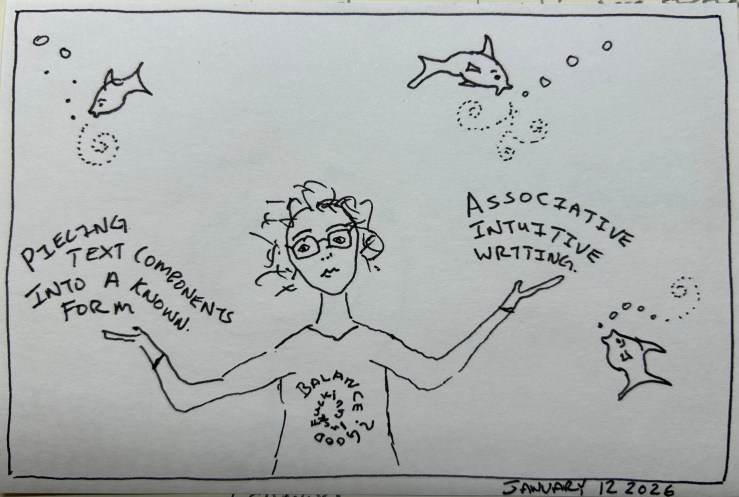
Thank you for your many messages. They guided my approach—which I’ll summarize below—revising A Marriage: Framed (CNF <2500 words) AND showed me to trust my own words and my own process. Your belief helps me believe. A blessing.

There was a lot of tinkering (ink -er-ing) trying to take this story to top level writing technique. I continue to tinker. Top level is…a dream, a ceaseless chase. And yeah, the chase really is a lot of fun [Insert: series of horn blasts and voice signals and Tally-ho! Here we go!].  

Last month, I posted my experience pruning A Marriage: Framed, taking it from 3770 to less than 2500 words. The process was fascinating because as I cut the words down, the focal point shifted, a spin that forced the painful emotions at the heart of my 27-year relationship with my ex to surface. Emotions I’d suppressed for decades.

Struggling to understand and move those emotions out of my body onto the page transformed them into “an object” (a writing piece) outside my body that I can interact with and control. I’m less “imprisoned” by my emotions, if that makes sense. I feel almost as if the rewriting of the draft I completed last month was a “therapy” draft. The story moved from being deeply subjective to objective, enabling me to turn to tackling the craft and technical aspects in the writing with a cool(er) and practiced distance[1]. This latter process, I’ve discovered, is essential to move the emotional therapy draft through a series of systematic style techniques so the artifact might approach a work of art. 

I wrote about my nascent practice and understanding for how to work with the subconscious as part of creative writing process in a post last March. Today, I want to build on that earlier exploration with some concrete examples because I’m trying to understand and practice tangible methods for working with less tangible materials. Silence. Air. Thoughts. Dreams.  I was thinking about how a musician works with the silences between notes to modulate pitch and tone, melody and harmony; how a sculptor carves a block of stone to encase a shape of air.  And my mind slid from that image to a memory of being captivated by a sculpture of Leda and the Swan when I was in Italy last fall.

I was rushing through the monumental halls on the second floor of the Library of Saint Mark in Venice in order to see the Mappa Mundi before the gallery closed. Speedwalking past innumerable marble busts, I stopped abruptly, struck by the unique portrayal of the infamous myth, an erotic story about the god Zeus, disguised as a swan, seducing the Spartan Queen Leda. The question about the nature of the seduction, whether coupling between the two was consensual or not, revolves the ages. This specific statue, its image, its energy, has stayed with me because of its beauty, yes, but also its ambiguity …for me, this sculpture is tangible object and emblem of desire-resistance all at once. Leda and the swan are carved to their moment of intercourse and Leda seems, at least to my eyes, both taken by surprise, as if she’s not quite ready to take on a god (she pushes the swan away) and surrendering to her attraction and desire at the same time.  

Roman variant of a possible Attic original of the mid 1st century BC Giovanni Grimani collection, 1587

I hadn’t appreciated why this sculpture has enchanted me for more than a year, until today, when, sifting my thoughts for something concrete (well, marble in this case), this memory surfaced. By embracing the complexity of the original myth and removing the layer of Greek mythology, I choose to think of this sculpture as a symbol of unification between spiritual and human worlds. When creative writing, I feel the spiritual world, or divine might be a better word, is a part of (or accessed via) the subconscious. The vibrating energy I can feel as I draft using stream of consciousness writing (read: writing without thinking too much) is intuition. Intuition is much like a tuning fork. I’ll try to explain this shortly.  

I’ve missed many of the signposts from the subconscious in my writing drafts—they arrive as words, resonances between words and as sensory images. I’m learning how to identify them and practice how to work with them and preserve them to create a net of story words that communicates something beyond words: feelings, energy, magic. Art.

Here’s an elegant and far more beautiful articulation for what I’m trying to say:

“Story form is an object, a translucent, shimmering thing with words tacked to the surface of its swirling involutions. The words glitter with their own reflective colouration; in them you see the momentary reflections of other words. Wires as thin as gossamer connect the words with more words on distant parts of the structure where they set up new colonies with flags, banners, replicas, and maps of the whole. Spin the form and the same words appear in flashes, the eye registers their rhythmic insistence[2]. It is wonderful and miraculous to watch.”

Excerpt from the essay, Anatomy of the Short Story, in The Erotics of Restraint, by Douglas Glover.

 Tune Up Techniques

My revision was guided by generous writers and readers who offered their love and attention and time to enhance my piece. I’ve said it before; creatives work in community. I’ll write more about that in December. My learnings I write here derive collective wisdoms of too many people to name.  Thank you.

Ideally, or shall I say, if this were easier, I might have started revising the Macro aspects of the piece—story, plot, characters, setting, points of view—then moved to the more Micro levels of paragraphs, sentences, rhetorical devices, syntax, diction.

But that’s not how it worked in practice.

There were the metaphors and the patterns and the desire-resistance tensions and the images that slid to occupy both macro and micro levels and, most important, all the space vibrating between. That’s the art object space, the space of Leda-swan. It’s an easy space to get lost in and an easy space to miss.

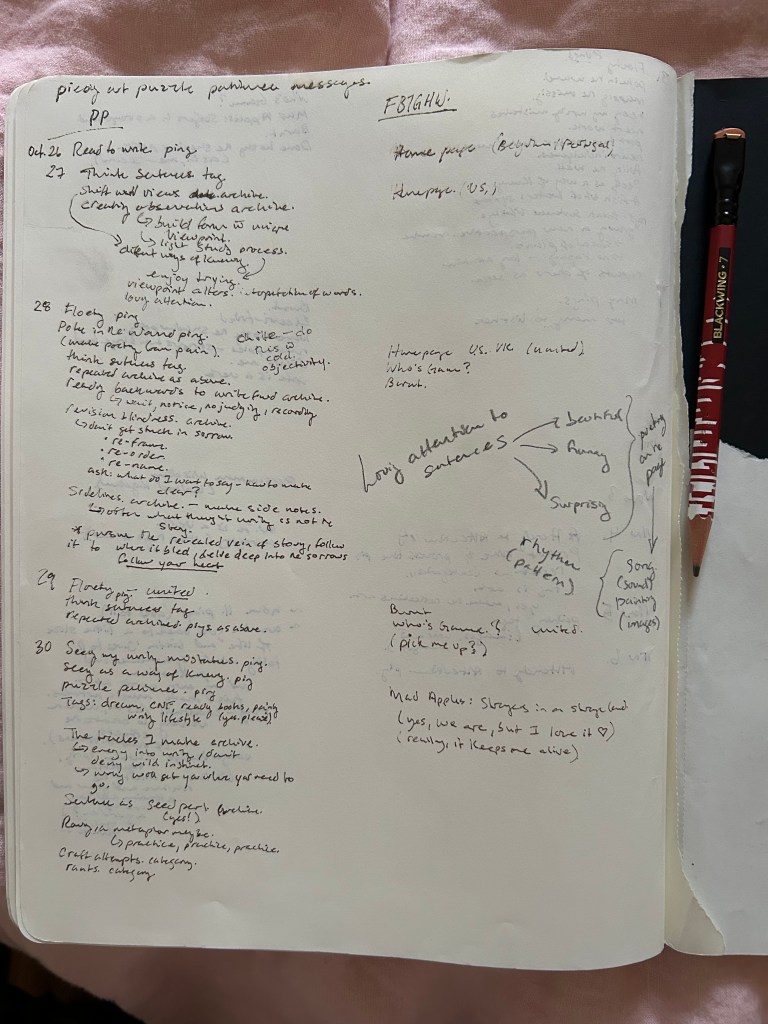
My tune up process was messy, not linear. Nor did it happen in steps, though describing the process here necessitates a sequential recounting. Revising was pressured by the word count cap, 2500 words max. The restriction served the writing in many ways by forcing disciplined compression (of words, sentences, images and ideas).

The process felt like persistent twisting, moving around and up and down and through the piece, working to understand my intentions and meanings, then shifting sections here and there, and tweaking here and there, and slowly, slowly, slowly, the piece contracted round an essential essence of tight emotional communication, complete with shimmery swirly resonances, into story art (ish…I’m still practicing).

Working with Vibrations

Ok, first, two indispensable applications I think I’ve failed to post on this blog, probably because my use of them is so integrated with my writing process I’ve neglected to emphasise my reliance on them[3]:

  • Word Hippo (thesaurus, word tools, etc.)
  • Online Etymology Dictionary – I love how they write on their site (my bolding),  “Etymonline aims to weave together words and the past, answer common questions, and sow seeds of serendipity. Sowing seeds of serendipity is exactly why and how I use this site. It’s a creativity generator.

Choosing the right word requires deep attention to what it is I want to say (what I intend a sentence to mean), the connotations I intend to (try to) control in readers’ minds, but also how I wish to communicate it. Choosing whether the flavour of communication should be sweet or bitter, whether the texture of communication should be hard or soft, whether the sense of communication might be cold or hot.

Here’s an example. In the original longer draft, I had an entire paragraph describing the situation where the husband explains he won’t allow his wife to attend the funeral of her friend’s dad. When I cut that paragraph down to convey its essential meaning in one sentence, I wrote, “[He] embargoed my attendance at a male friend’s dad’s funeral believing my intent was seduction.”

Ok, that word embargoed practically leaps off the page with melodrama and elevated (snobby) language. Instinctually I disliked it, but it captured the essence of meaning I was after, which was restriction or “not permitted”. The vibration of my distaste of the word (in this context), even though it had the right meaning, signalled—and I should explain, this feeling is super subtle, very easy to ignore if I’m not paying attention—there might be a deeper meaning.

I sat with the word quietly and patiently and questioned it, exploring its alternative meanings. The idea of ownership surfaced to consciousness …which is a concept I’m exploring in the larger piece. The subconscious offered “embargoed” up…but the flavour (snobby) and timing of it wasn’t right…I didn’t want to introduce the idea of ownership so early in the piece (this sentence comes in at paragraph two). I wanted “ownership” as a concept to build slowly through the piece, mimicking the way the wife experienced this revelation over time.

So, I fiddled with it. I ended up using the word “barred” because it conveys the meaning of “not permitted” and extends it into an implied image (physical bars) introducing the connotation of “prison” without it being overt. It’s also a soft, quiet word in the mouth, so a reader might glide past, carrying its meanings without tripping on them (embargoed is practically a foot stuck out in front of a running reader). The sentence became, “[He] barred me attending the funeral of my male friend’s dad believing I intended seduction.[4]

This is what I mean when I describe intuition as a tuning fork. It’s the vibrating intuition that guides which words and phrases bring the meaning and feeling and senses and sounds to coalesce in tune with the piece as a whole.

Another example, this time at the sentence level. In the therapy draft I wrote:

The kind of love that made me bump into walls, sliding glass doors and fail to recall what street to turn down to return to my own student house. The kind of love that made me forget to eat, made my skin glow, made me sing greetings to strangers.

I liked the repetition of “kind of love” because of the rhythm it introduces as well as the way it draws attention to the listed descriptions and also, the super subtle question injected by those words “kind” and “of” placed side by side, implying “sort of” …as in, this is the way the wife loved but was it a sort of love? A half in/half out love? I know, tenuous.

Also, “made my skin glow”…vibrated (intuition tuning fork struck)…what did I mean by this? I meant our lovemaking made my skin glow. An opportunity to align that idea with the larger story, which does circle and explore sex. Compression, and playing with the sound and syntax, reshaped it to:   

A colliding into walls, strike sliding glass doors kind of love, amnesiac love, missed meals, abandoned panties kind of love that made my skin glow.    

Working with energy

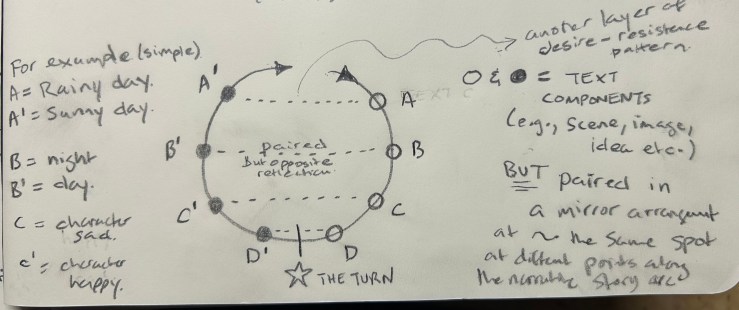
I wanted the reader to feel the same crescendo of energy and collision-like impact as I had experienced with the real event. So, I needed to recreate it. For this story, I wanted to begin with a quiet energy of curiosity that moved, incrementally, to build momentum through the piece toward a detonating end.   The best way to describe this is by comparing it with music. This tune,  You Look Like Trouble, by Lisa LeBlanc, embodies the energy arc I was after for my piece (and I’ve drawn what I mean in the graphic below).

But how did I do that? Well, I practiced what Summer Brennan refers to as the controlled release of energy by considering the way energy builds up and is released. I felt my way through this intuitively, and my attempt to describe it here is underdeveloped. Mostly, I feel, it was a conscious effort to pace story events, laying out the information that keeps a reader interested and curious and engaged, building on story events so they acquire more and more meaning, modulating sentence length and sound to align with intended meaning as I went (as described above). Layering information.

But also, this short piece is intense. More than one reader described it as a run instead of a walk. As the tension ratchets up with information layers (about who these characters are, their behaviours individually and in relationship), I deployed a technique I use often in my writing (and uh, life), the use of parentheticals and narrator intrusions to break the tension and release the energy.   

Here’s an example of this technique: This tragedy seemed particularly attractive (saviour complex? Fuck. Maybe.).[5]

Working with Metaphors and Imagery

I think of metaphor and imagery as working with dream. For me, this is the most prominent language the subconscious surfaces in my creative writings. The therapy draft revealed many. I adore working with metaphor and image and I avoid letting any go…I feel they’re a kind of magic, the spirit world made manifest with text on a page. But the therapy draft made visible, perhaps for the first time, my subconscious tendency to insert a metaphor or an image as an avoidance technique. Instead of forcing myself to move deeper into painful experiences, I throw up a metaphor and skate right past it. Once this was pointed out to me (thank you Barbara!), I could see where I’d done it, soft bodied ego protecting itself. So, I spent some quality time with my pain and worked to describe it clearly, straightforwardly, in scene.

Quite naturally, after I’d rewritten those pain sections, the imagery refined throughout the piece and miracle of miracles, the ones that remained hung together associatively. In this story it’s repeated imagery of sunlight and storm. I worked to sprinkle this imagery through the piece, augmenting associatiions with words resonating the same sounds and meanings, and tried to follow the energy arc by beginning with sunlight and ending with a lightening strike.   

And I tried to get some beautiful sentences in. There are a few I really like. Playing with sentences had me waking in the middle of the night to puzzle them through. Here’s one that didn’t make it into the piece, but I leave it here for your pleasure and song.

And what is love? Laughter donning roller skates, heedless of the hill[6].


[1] It’s important I make a distinction here. Even though I’m bandying the terms “objective” and “distanced” and “cold” and “systematic”, which raises “scientific method” connotations, the process for moving into technical tune up MUST (MUST!) retain an open heart and keen attention to the body warming when the vibrations of instinct ping. The process is slow and methodical. I know I’m on the right track when I’m delighting in the discoveries (the right words slip into the right place; the sounds; most of all, when unexpected injections of humour are revealed).

[2] I love the way the movement, “Spin the form”, resonates with the words “colonies” and “replica” and “maps” in the previous sentence to deliver an image (implied) of a spinning globe, a twirling world, disco ball like with those flashes.

[3] I used to use a visual thesaurus as well, but default to word hippo these days. Before that I used a heavy hardbacked Oxford thesaurus I “borrowed” from my housemate in second year university. Sorry Jeff, it’s still on my bookshelf.

[4] Also shifted words around to improve difficulty comprehending “male friend’s dad’s funeral”. Thanks Stacey! We decided the passive might be okay in this instance, a sacrifice for clarity.

[5] I am fretting over the punctuation here. I think this is right.

[6] I woke at 1:16 am thinking this question: and what is love? In half sleep, the words/image (as one) arrived: laughter, roller skates. After a trip to the toilet, more words: back to the hill. Later that day I played around with the words a bit to come up with this line…a line I’m happily hooked on because it feeds me, nurtures me, continues to shimmer. Sparkle. Delight.

Leda does love him. She shares his dreams.

Being Batty

Three a.m. I woke to a whispering. A rhythmic pulse of shushing fabric trawled me from dreams forgotten. The apartment was hot. I don’t have air conditioning.  I prefer not having it; I’ve always disliked the assault of hot humidity when leaving an air-conditioned building. The ceiling fan above the bed is quiet and sufficient (except when daughter #1 visits and, sharing my bed[1], whinges about hellfires and my inept ill-considered concern for guests: Just get one of those portable units you stick in the window! It’s ridiculous!). I prefer screened windows open to natural night sounds and breezes. The chords of storms. The stroll-bys of marijuana, tobacco. When I woke, I lazily surmised the beating shadow flittering round the ceiling fan was a bat. A big one[2].

My immediate concern was that the bat would eat the apricot jam I’d made earlier in the evening and left, mostly jarred, save the small bowl uncovered, to cool on the countertop. This lot of jam, made with Niagara apricots and summer clover honey, was the second batch of apricot jam I’d made. I’d fucked up the first lot and I’d done it stupidly, using a candy thermometer to tell me when the sugar reached “the right temperature” instead of relying on my senses (taste, touch, scent) to signal I should have removed the jam from the heat when it bubbled ambrosial[3]. Instead, I ended up with a stiff, dark, apricot paste and what I’m now serving as a variation of membrillo (quince “cheese”). No doubt someone Spanish made this same mistake, though probably absorbed by lovemaking in a back room instead of forcing a scientific bead to the mercury and allowing the sugar to boil past the soft state to paste. Served with great fanfare (yes, this helps with resurrections) and Manchego, it’s an impressive combination.

I’m a bit of a perfectionist. As a child, my father bought me beautiful tubes of artist acrylics so I might paint a good-sized canvas he intended to gift as a wedding present. I painted a grade five rendition of the view from our rented bungalow on the lake. And I fucked up the waves. The foamy crests were ugly little blobs of titanium white over a scraping of ultramarine and phthalo green. The figures of my siblings and I, playing on an ancient swing set, were cartoony flat renditions, garishly accented with slashes of primary colour. When I presented the painting to my father, he said it wasn’t good enough and I’d have to try again. He was also annoyed he’d need to purchase a second canvas[4].

Oh right, the bat!

I ripped the duvet from the foot of the bed and, crouching beneath it, sweated and cursed I didn’t have a partner to share this Chiroptera[5] inspired nocturnal inconvenience, and I stretched my arm out, thin-skinned, vampire vulnerable, and turned on the light. The shadow disappeared. I shone a flashlight into the dark corners of the bedroom, behind the massive wall mirror, the picture frames, the paintings, the gorgeously tiled fireplace with its stopped-up chimney—had it entered there? suddenly I was far less enchanted by the architectural beauty and romance of the fireplace—and surmised the bat had left the bedroom. I clicked the door shut and leapt back in bed, pulling the sheet over my head (I hadn’t looked under the bed or the dresser…surely bats fly higher up instead of lower down[6]) and forced myself to sleep in the sauna. The bat returned. We played peek-a-boo until dawn. It became invisible in any light.

A jazz singer, a marriage counsellor and a soon-to-be-divorcée run into a bat…

Guests for dinner that evening included Chantal who has a most marvellous singing voice, and writes songs and composes music, and Peter, who was my marriage counsellor for ten years before he retired. Since leaving my marriage, he has become a dear friend[7]. Peter is really a poet and enthralled by Dante’s Divine Comedy. Once, to my delight, as I had not heard it before, he recounted the Arthurian legend of the Green Knight. Prophetic in many ways.  

A jazz singer, a poet and a writer run into a bat…    

But wait, what did we eat[8]? This is important because pleasure is important. Pleasure feeds the soul. And the conversations that feed the mind, the threads of politics, philosophy, the meaning of dreams, the ways of creativity, the dissolution of relationships due to disability—humans in mismatched states of disempowerment, development, drive, desire, death (ha!)—weaving frustrations, a few glistening tears, giggling, sorrow, grief and laughter, ignite best over a long drawn out meal, al fresco to begin and ending with mellow flames spluttering softly in the pools of melted wax atop candle stubs in the dining room.

We ate: a block of my apricot inspired membrillo with a wedge of sharp Manchego; slick, salty olive oil preserved Italian anchovies served with sweet butter on sliced sourdough I’d baked that morning (the trick for these snacks, one I’m smitten by since discovering their salt-sea-fat combo when I travelled to Italy last year, is layering an anchovy fillet atop a voluminous smear of good sweet butter…no skimping! – must be a good sized shelf of butter, like a plank, to shuttle the fish on the bread to the pirate of your tongue); toasted almonds; salmon roasted with butter and fresh thyme; a warm salad of quinoa with market vegetables (corn, zucchini, red and yellow peppers, red onion) and, because I can’t help but gild the lily, a ball of creamy burrata torn into bite sized pieces.  

The bat reappeared during dessert[9]. It swooped through the chandelier passing back and forth between the kitchen and the living room. Earlier in the conversation, Peter explained how, for decades, he’d been tasked by his mother and aunt to rid their cottage of bats when they made their annual indoor appearance at some point in the first two weeks of August. I handed him a wastepaper basket, tasking him, at aged seventy-six, again. Of course, accompanying the meal, there had been a good amount of wine. When Peter chose the ricketiest chair in my apartment to stand on to reach the bat—it  was resting on the stained glass window in the living room after we’d exhausted it trying to catch it mid-air (Chantal was armed with a laundry basket)—the chair skittered beneath him, he lost his balance and fell, scraping a good section of skin from the top of his right arm[10].  

Turns out when you leave a marriage, a first aid kit isn’t one of things you pack. Probably because the wound, in that instance, is permanent; no amount of plaster or gauze can soak up the blood sacrificed.

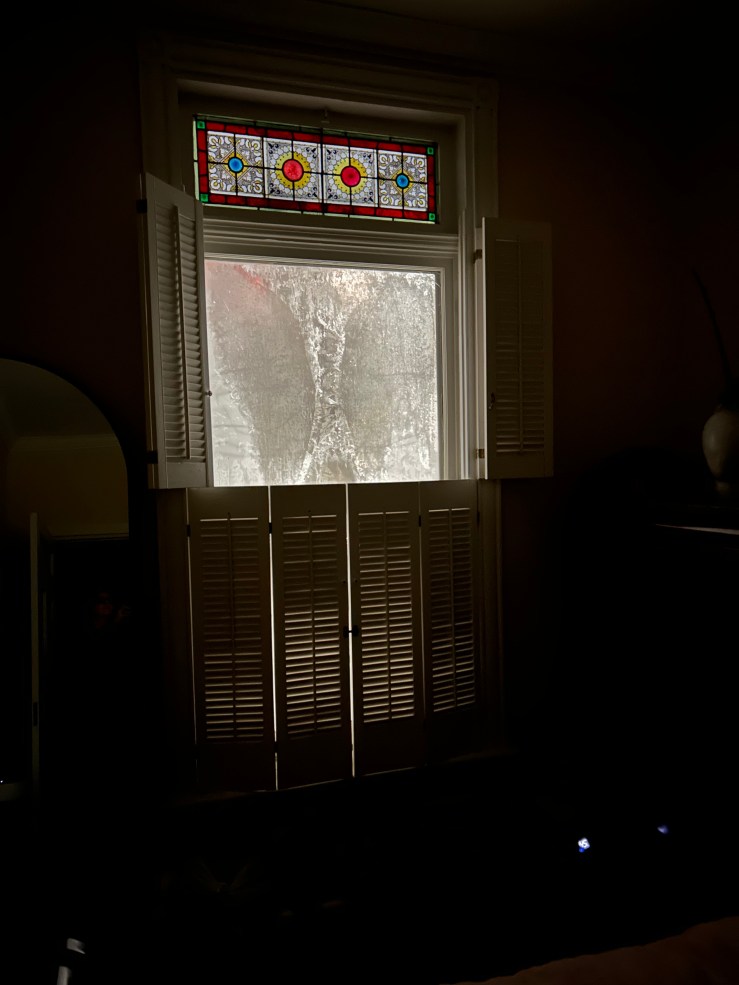
Chantal, imploring me with her eyes, suggested everyone should go home and Peter should attend to his wound properly. This was sensible advice. But the bat hung upside down on a blue square of coloured glass above the sofa. There was a long moment of shifting glances sliding the triangular space between us: pleading, earnest, insisting. I retrieved the step stool from the pantry and Peter, the torn skin of his arm open and raw but no longer bleeding, trapped the bat in the wastepaper basket and handed it down to Chantal’s waiting arms (she had been steadying the step stool)[11].

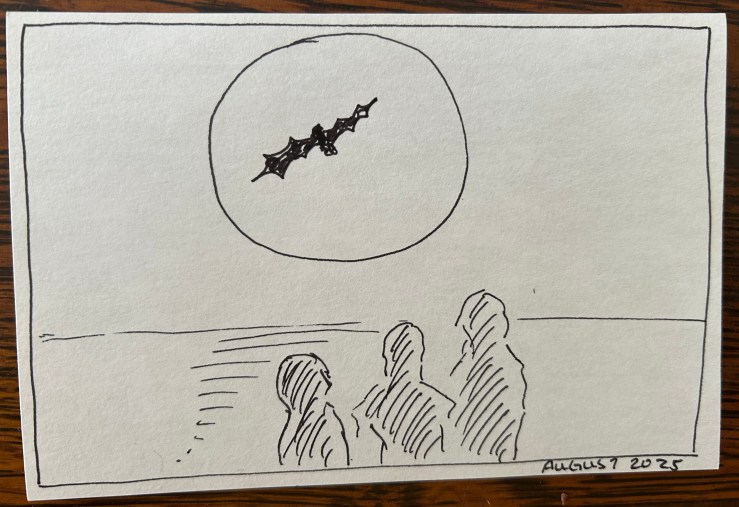
We walked the bat two blocks down to the lake and released it beneath the orange light of a massive apricot moon hovering the horizon.

Speaking of “try again”, one of my creative nonfiction flash stories has been accepted for publication in Lost Balloon, date TBD. The piece accepted, titled, Measures, is one I reworked many many times. I wrote about my approach to re-drafting it as part of an earlier blog post. I also read the piece at a public reading and used the experience of reading it—what I felt from audience reactions—to re-craft it[12].

Preparing for another public reading this month, I read a short story, The Point of Departure, to Chantal, to practice, but also so that she could help me with my performance, my delivery. I’ve re-written this piece a number of times too and have written about its revision process here.

Chantal made the astute observation that an audience needs time to absorb the imagery and ideas of a written piece…pauses and silences help.  Written composition can (should?) incorporate “resting” components as a mental break for the reader, the same way music and song are composed.  After reading the piece to her, she complimented it and then expressed a good deal of frustration about the work being too short….”it needs to open out, be explored. Don’t waste it on a short art piece.” I explained the flash form …that I liked the compression and ambiguity flash pieces force. We argued back and forth (cordially). She, explaining how invested she is in the husband and wife characters, wanting to know what happens and what happened to them, saying this is only the first chapter of something longer; me, explaining that the same story is being explored in the long project, but that it can co-exist in this form, as a flash piece. We agreed to disagree. I’m pleased to know her interest in the characters is so strong.

And though Chantal provided excellent stage directions for improving my public reading, the following video confirms I’ll need to try try again.  I was nervous again and it was another very hot day and I had forgotten my water (again) and I stumbled through and my back was hurting and I’d taken some Tylenol for the pain which left me decidedly stoned and and and…  

The title is missing from the video, but it is, The Point of Departure.


[1] With its wool mattress topper? No, it’s not hot at all. Ha ha ha ha!

[2] Later, I identified the species as the ingeniously named Big Brown Bat.

[3] It seems I’m presented with this lesson over and over and over again. Sigh.

[4] My sister, Nyree, when I recount this memory over lime margaritas last week, remembers differently: YOU were the one, Suzanne, who refused to accept the first painting, wailing about how it wasn’t good enough, NOT dad! The truth, like all truths, lies somewhere along the spectrum between these two memories. I do recall it was the boy next door, five years older than me, who, with patience and kindness, sensing how I was in love with him, taught me how to blend colours directly on the canvas to great effect.  Painting two sufficed as a wedding gift.   

[5] a name of Greek origin meaning “hand-wing” – isn’t that beautiful?

[6] Logic in the wee hours of morning is…non-existent.

[7] It’s not as linear as the sentence implies. And it sounds like the punchline to a pretty good joke about Peter not being a very good marriage counsellor, but the reality is that I credit him for helping me to stay in the marriage for as long as I did, which, ultimately, was best for our daughters (my primary concern). The long project explores and unpacks my decisions, trying to understand the source of witchery that hijacked my brain. Some people call these hormones.  It’s a long story and I’m learning how to write it.

[8] I can hear Nyree’s voice, a line from the movie The Couch Trip: “DO we eat it, or DID we eat it?” in reference to a plated something that looks like vomit. The whole quote, she confirms through text, is a scene where Dan Akroyd’s unhinged character, posing as a renowned therapist (he’s really an escaped patient from a psychiatric ward), is hosting a radio call-in show. A woman caller says, “my husband comes home, no matter what it is, he says, ‘Do we eat it or did we eat it?’ I think he’s learned it in the army, I’m ready to bury an axe in his head!!!” Akroyd answers, trying to get a word in, “Ok. Well…if you…look at it like…zip it up lady! For starters…stop cooking for him!”

[9] The ingeniously named Gooseberry Fool.

[10] “Just a flesh wound!” Peter lamented his “old man skin”, calling it friable. Indeed, it bled badly and looked like it had been fried.

[11] For added entertainment, our bat trapping was not unlike this visual (though, I think with slightly less swearing. Maybe.)

[12] I have recently learned that the use of an m-dash is a dead giveaway for having used AI to generate written content. Also, the semi-colon. I don’t use AI for any of my creative writing. I do use it for professional work. I have a lot of opinions about AI …maybe one day I will write about them but presently I can’t be bothered. Basically, an essay would boil down to: AI will not become a sentient being; humans will become (already are?) machines…a far more dangerous and destructive force.  This opinion is neither unique or new.

Heart Play with a Pause

A Note: The story in this post is accepted for publication in SmokeLong Quarterly and will appear in March 2026. As part of the publication agreement, I’ve granted SmokeLong Quarterly First World Electronic Rights to How to Mourn Your Mother, (hereafter referred to as The Story) for the period of six months starting with the publication of The Story in SmokeLong Quarterly, during which time The Story may not appear elsewhere.

I explained in my cover letter to SmokeLong that I had posted earlier drafts and a recording of me reading this story and I offered to remove it for the time when SmokeLong will publish it. They accepted the story with these conditions which is very generous and progressive of them. And, as I have had accepted stories declined for posting them in draft form on this blog before, I’m removing much of this post’s content earlier, (the draft writing and thinking exercise, and the video of me reading it at a public reading) for the next year or so. I’ll repost again in September 2026.

Once published, I’ll link the published story and accompanying audio in this post and here.

The following is a portion of the original blog post from July 2025.

Performed another public reading, this one at Blizzmax Gallery, heart leaping in my mouth.

I sifted through older works to find a piece suitable for the occasion. The event showcases short stories that may be read in under 5 minutes, equating to around 600 to 750 words. And, because the last time I read I selected a work that was dark, I wanted to read something lighter and funnier this time round.

Laughing.

Turns out, I haven’t written “funny” in some time1. Choosing is not so easy…many of my flash stories are sorrow containers…they await my attention to weave light into them. What do I mean by this? I mean humour or beautiful imagery or sensory details…components that gift a reader better pay off for their time and energy sharing my dark.

Also, I seem to have a lot of pieces that are very …how do I say this….poetically artsy…less story, less fun(ny), syntactically gymnastical…intellectual babies whining to be picked up after a failed roly-poly2. And for stories read out loud, some of my writings tax the listener’s ear and mind3.

So, I chose this 747-word creative nonfiction flash, written in 2023, and wanted to report here, for the sake of interest and transparency, how many publication rejections it has collected so far. I discovered I never sent it out! It was entered in a small contest and made it to a shortlist where it garnered positive feedback from two editors I hold in high regard4. The version below incorporates their feedback.

I practiced reading this story to friends the other day and could feel the tug of certain sections that don’t quite “fit”. So, it’s a good piece to practice my heart work. What is heart work? It’s focusing to feel and know the deeper emotions in the piece, then render them with words. Somehow.

I’m hopeful winding my wayward musings in this post might be soothing in the same way Bob Ross’s leisurely guides through painting technique can be. Or, perhaps this doesn’t transfer to the written medium, I’m not sure…I’m resisting the (very strong) urge to hit the delete button here. This exercise (practice) of writing around a story draft helps me see and understand it best. Even when I print out a hard copy and make notations in the margins, cross out lines and rewrite sentences, the revision doesn’t attain the necessary level of attention required for me to write through reflections and become aware of the deeper workings in the story. So…if you’re interested to read through this writing/thinking (writhing? ha ha) process keep going…otherwise quittez ici5.

  1. Well…I did write a very short piece (for friends, for a laugh) about the door in the my kitchen separating my apartment from the bedroom of the young guy who rents the apartment adjacent. The door is dubbed the Sex Door. It’s pretty active; I quell jealousies. The piece I wrote is called Door Play and I think it actually wins the world record for Fastest Literary Magazine Rejection Ever at under 2 hours!!! Wait, I’m wrong. I considered reading this at the public reading…but I really don’t think I can read the word coming (and emulate the necessary vocals), at least in that context (smirk). Is it spelled come or cum (?): a funny read I didn’t write. ↩︎
  2. Just so we’re clear: this is me, not you. And the long project is a counterpoint, it’s all story and basically puts the ass in class, chokes on the word literary and throws up a right mess, but with a few poetic lines ha ha ha. But, I like it. ↩︎
  3. I know, I know (!)…I’ll curb these tendencies. I’m trying to improve sound toward song. And I’m getting better at knowing I’m enough without the window dressing. Sort of. ↩︎
  4. I completely forgot this. ↩︎
  5. Wait, are you leaving? ↩︎
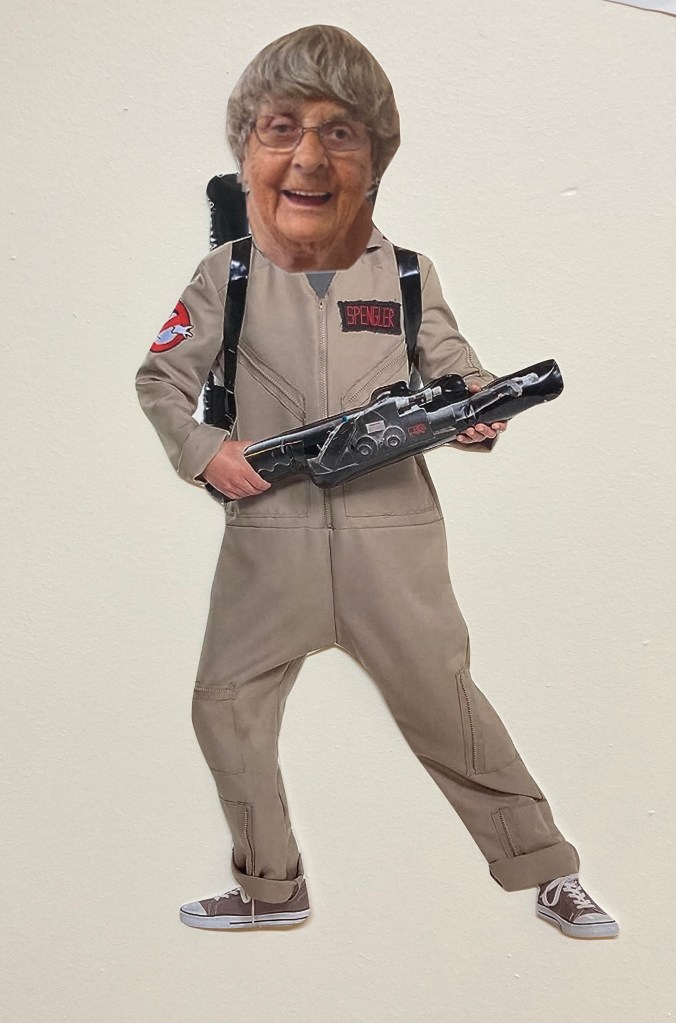
My mum, Camilla–my nickname for her, and the name my kids call her, is Nuddy (a little riff on Nutty I think…I’ve called her this since elementary school). All four of us (siblings) adopted different nicknames for mum: Mills, Cam, and Pong. This pic cracks us all up. Even Nuddy.

A Kiss of Life

Poems float to me again. This hasn’t happened in a number of years. I’ve had phrases arrive but then it’s like the valve shuts off and word flow stops. If I force a phrase toward a poem, I butcher it. Poems feel ethereal, fragile. I choose the word float intentionally…it’s as if the words butterfly by, out the corner of my eye, or rather, my ear. I think I hear them instead of see them. Perhaps this varies because sometimes I visualize an image. I’ll have to pay closer attention to this experience to describe the process accurately here. Regardless, if not caught and written to the page the poem keeps moving and leaves me behind. 

So, three poems in the last two weeks or so. The relief accompanying them, that they float to me at all, is palpable; I hadn’t realised how much I miss them. These latest poems arrived when I felt most depleted, when I was most physically and emotionally exhausted…not so much in a state that I’d given up, more that I’d given in…surrendered. I worry about this. How to invite the conditions of open receiving without the physical and emotional exhaustion[1]? I don’t know.

The following poem arrived during a lunch break last week…the first lines always feel the strongest, the most tangible, then I wrote the lines spooling from there until I could tell I was twisting my own meaning into them.  Instead of forcing my own thoughts into the piece, and because I needed to return to the office, I left it alone. A couple of days later, an image, tangentially related, kept entering my mind when I thought about the piece. I interpreted this as a sign the two aspects/concepts wanted to be woven together in the one poem.  I completed the following draft over the weekend[2].

Here’s where it gets interesting. This poem, I discovered, also communicates information about my long form writing project (and process) I hadn’t quite understood prior to writing the poem. I’ll try to explain.  Last month I printed out the long form project (a book length work, very much in progress) and promised myself I’d read it. I haven’t. Instead, energized by the idea of working physically with pen and highlighters and paper instead of messing around in digital files on my computer, I used index cards to list different scenes associated with different characters. One side of each card listed scenes from the distant past, the other side listed scenes from a recent past. The long form project is, for the most part, creative nonfiction with several people. Sitting there, looking at all the characters on the desk in front in me, I realised I don’t have a card for myself[3]. One could (I have) dismiss this discovery, subsume the idea I’m the persona, the narrator, in this work, so, naturally, I’ll find my way into each of the scenes…somehow.  But I’m fooling myself. Sitting there with all the cards on the desk I realised (duh) two things. One, this project is more about my own experiences and thoughts and reflections, and these aspects aren’t integrated (much) in the current draft[4].  Two, the voice I wish to narrate this project requires what I refer to as my audacious voice …and that voice my friends has taken a fucking vacation.  And despair, despondency, desperation—all the dis- words of negation—set in fast. I put the project aside. Again.

Then this poem floated to the page with its battle cry of a title and emphatic last line to confirm, with a flood of relief, my audacious self will revive.


[1] I’ve also received poems in states of extreme emotion.

[2] It’s important to express my gratitude here. In my last blog post I’d lamented missing the spring chorus of frogs I don’t hear living in the city. A few days after publishing that post, a friend messaged to offer me his cottage for the weekend. Serendipity. I spent the glorious gift of a solo weekend in the woods reading (The Forty Rules of Love by Eilf Shafak, a romance toggling back and forth between Rumi, a chorus of characters, multiple POVs, in the 1200s, and a current day woman who falls in love with a writer (who is writing about the relationship between Rumi and Shams of Tabriz, also Sufism) then leaves her “perfect” marriage of twenty years for true love.) It rained most of the weekend which was also a gift because it provided the excuse to lounge in the screened in porch (which felt like a treehouse) and just read (and sleep) instead of canoeing my way round the lake. Unfortunately, I only heard a single peeper and a bullfrog; mating season suspended at this point of spring becoming summer. Instead, I endured the chainsaw to the eardrum that is the “song” Waterloo by ABBA blasting from a cottage across the lake. The universe does have a sense of humour. I prefer this song. I did enjoy the loons and the whip-poor-will night calls and the rose-breasted grosbeak’s day song. I did not manage to see those birds (I really wanted to see the rose-breasted grosbeak as I haven’t before) but did trace the phoebes and vireos amidst the wet leaves.  

[3] When I first wrote this sentence I inadvertently wrote “cared” instead of “card”.  

[4] The crazy thing is, I know I’ve discovered this before and even written about it here…and here…and then, I guess, I just…forget?  Frustrating …and embarrassing…but also, human. Process is not linear and, apparently, the learning doesn’t build upwards from any previous achieved foundation….the whole thing seems more like dancing across quicksand.

Writing a Narrative Helix

I listen to a lot of different podcasts about writing.  I’m particularly drawn to detailed craft discussions, conversations about process, and talks about how ideas make it to the page.  Often, by way of a podcast, I’m introduced to a writer I haven’t read yet. This is how I came to the work of Lidia Yuknavitch, author of The Chronology of Water and Verge, among others. You can listen to her fantastic interviews with David Naimon on Between the Covers or with Brendan O’Meara on the Creative Nonfiction Podcast. She also has presented a TED Talk The Beauty of Being a Misfit

Lidia has created a space for writing workshops called Corporeal Writing and generously offers a free intensive 90-minute online session on the Narrative Helix form.  This is an example of a number of Write Now intensives offered online through the website.  I watched the narrative helix video and came to understand the form (two completely different strands of writing, one a themed list of the writer’s choosing, and a second narrative story delivered in short chunks of prose, then interspersed by selections from the [unrelated/maybe related] list…it sounds more complicated than it is…the video of course is much better.  Watch it.). I was intrigued to learn the value of using a different, structured way to enter and write difficult emotional material. 

So, I tried it. And it’s working.  I’ve completed a draft and it’s 7400 words.  I’m aiming to edit it down to 3000 if I can.  But I wanted to write here about the process and experience of working through the exercise.  The list was easy to come up with and populate: 1980s movies.  For the story aspect, I used a photograph from around that time as my jumping off point and a stream of consciousness approach to write everything and anything that popped into my head about each person in the picture.  This was interesting. My thoughts tumbled freely and the memories surfaced easily. The approach also suited my restricted writing schedule…these days only an hour each morning.  But, an hour of solid writing can generate a lot of material, especially if I’m not editing the writing as I work.  

In the video, Lidia discusses how the two narrative strands twist round each other to create a resonance between them (and become a helix).  I didn’t quite believe this would happen…but it did.  When I started writing I wasn’t sure where the project was taking me, I just followed the steps.  Now, after the first draft, I see the repeated imagery (knives) and can question its appearance (I won’t spoil the reason, but it has now become the focus of the essay, the thesis statement, if that makes sense). I’m looking forward to going back and crafting the piece, collaging it together, to carry a reader through my story.  Somehow, the exercise has helped me to understand how the pieces and process work together. I’ve challenged myself further and have signed up for one of the Corporeal Writing online courses…more to come.  

Exhuming Plot: Just Ask

I used to sit down and write a short story in an evening, tinker with it through the week, prepare it for submission and send it out to literary magazines.  Only one of the week-longs has been published; the rest are sticky with rejections. Some encouraging personal rejections from editors lets me know there’s possibility on the horizon. 

So, these last years (yes, years), I’ve dedicated myself to the study of creative writing craft and practice.  I’m better at the studying part. I continue to write every day, but the complexity of understanding and applying the layers of what goes into the making of a great story is daunting: word precision; grammatical sentence variation; paragraphing; elucidating the wonderful complexities of human beings through character development; the importance of setting as metaphor; tension and movement (that winding thread of impossible-not-to-follow suspense we writers gift our readers in its many guises of plot).  

So far, I suck at writing plot. Funny thing: I can tell a story verbally, stringing along my listeners through crescendos to a climactic punchline and raucous laughter, but I can’t do it on the page.  It’s not the same thing.  It reads like a limerick: I know an old man from Nantucket…

Another aspect of writing practice I’ve learned…no, I am learning: I should suspend working on craft aspects of my story until all the generative writing (read: stream of consciousness, letting it all flow out, write to explore, write to open up) is complete.  I make the mistake of thinking I am done my “first story draft”—my “generative writing”—over and over and over and over and over again.  An absence of plot is a good indication more generative writing is to be done.  Even I get bored by my characters not doing much of anything, you know, looking out the window and sighing deeply.  

Two fantastic resources (shining guiding lights) for how to exhume plot from the heavy toil soil of drafts:Alexander Chee and Elizabeth Jarrett Andrew’s book, Living Revision: A Writer’s Craft as Spiritual Practice.  

I’ve been working through Andrew’s Living Revision exercises on a short story I rewrote [again] in July. I was actually sailing through the exercises, exhuming some pretty interesting discoveries (like, my own memories and emotions—yes, I cried several times through these exercises—that are driving this story). Kudos to Andrew’s methods for helping me get that far. But I got stuck, petrified (in the stone sense), on page 101 (of 288) when tasked to write an “expansion draft”.  

I found myself rewriting the same paragraphs of the story, and I did this without any copy and paste…it seemed I couldn’t expand anything, couldn’t go any deeper.  I wondered whether I should just quit the project for a while and try something new (which feels like admitting defeat).

Then, last week, I listened to a podcast, Between The Covers and a craft talk with Alexander Chee and Tin House called, “From First Draft to Plot”.  Chee explained his own experiences, through twenty years of teaching creative writing, how emerging writers (yes, after 6 years, more?, of part-time-squeeze-writing-into-my-busy-life I am only just deserving of the title, “emerging writer”) have not developed the skills (yet) to query the scenes they have written.  

Chee explains there are many implications in student’s draft scenes that have not been dealt with…unmet implications the writer is ignoring.  His advice: ask questions of your scenes, such as, how did the character end up there? Why? Where is this character from?  What was their schooling like?  Chee says, “to build a story and a plot is the process of interrogating the scene, again and again with questions and each time you get answers, push back further and further into the story as far as you can go.”

Of course, most of this additional writing never makes it into the story, but instead becomes the skeleton, the subtext, the backstory the writer must know, know on instinct, know on a sub-conscious level, in order to puppet master their story to life.  

So….I’m writing questions.  I’m writing answers.  I’m going deeper.  Write On.