Italy: Reflections on Beauty, Part 1

The Kiss, Francesco Hayez, 1859, oil on canvas, in the Pinacoteca di Brera in Milan. Gorgeous painting and a delight to see in person. It’s kind of emblematic of how Italy makes me feel. The painting is meant to convey, and I’m summarizing here, that as much fun as romantic dalliances are, responsibility and honour lie with one’s allegiance and loyalty to state and country (as symbolized by the youth’s step “up the ladder” of stairs and commitment to an important life of patriotism).

This post is the first in a series of reflections about travels in Italy. I experienced so much beauty to reflect and weave with creative process, there will be one or two additional posts, I’m sure. This first, which began creation on a glorious day devoted to overcoming jetlag and quiet reflection1, (was that yesterday?) is more mish mashed reflection, depicted with photographs as opposed to writing. It needs to be…there is so much, too much, to cover.  

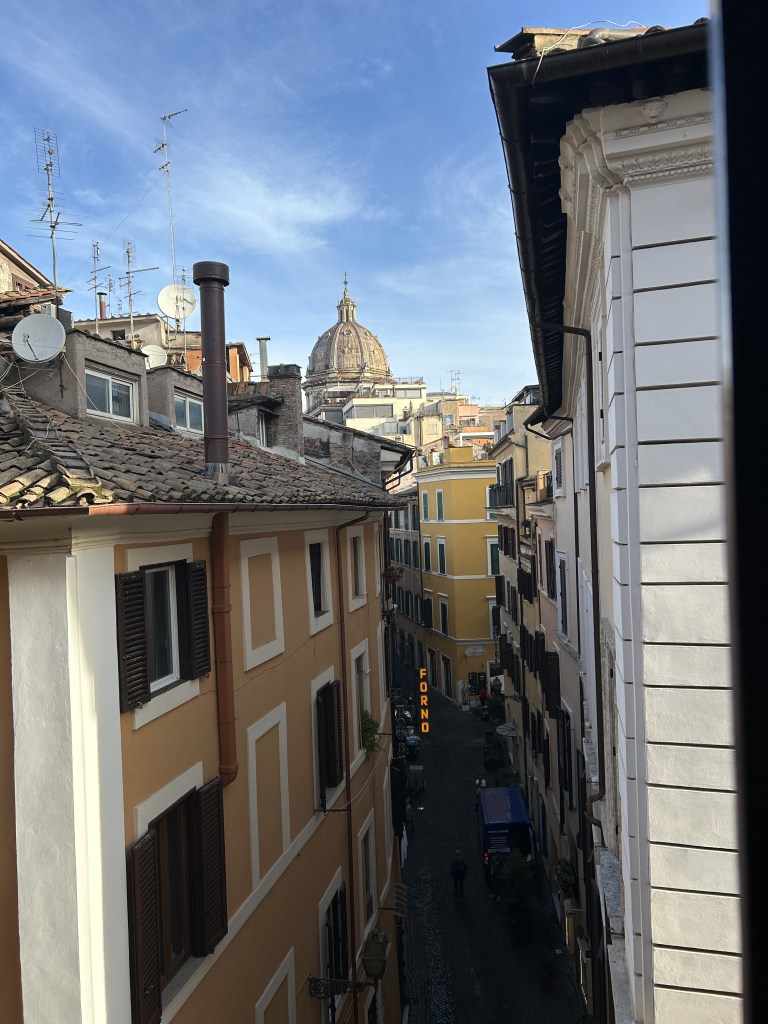
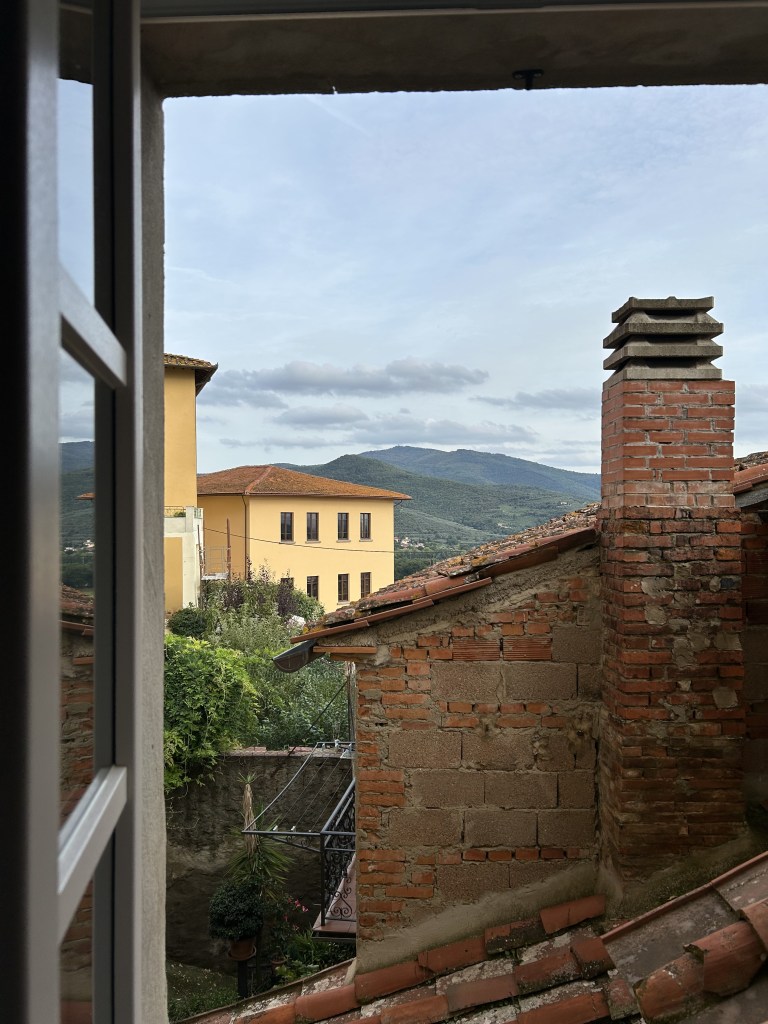
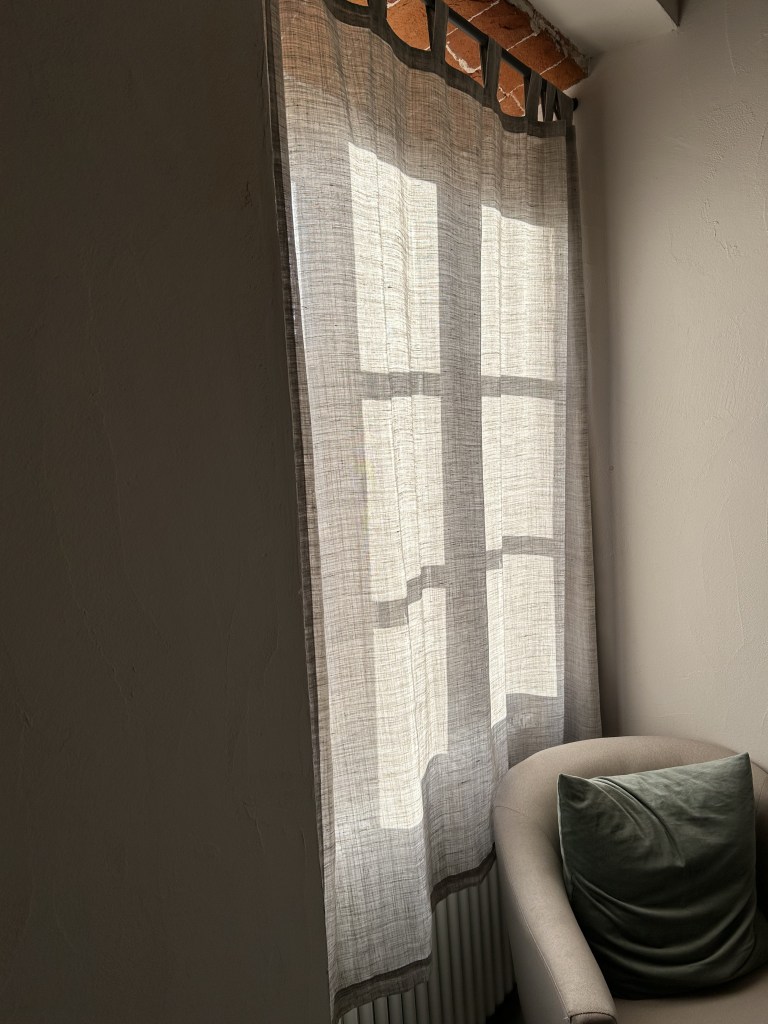
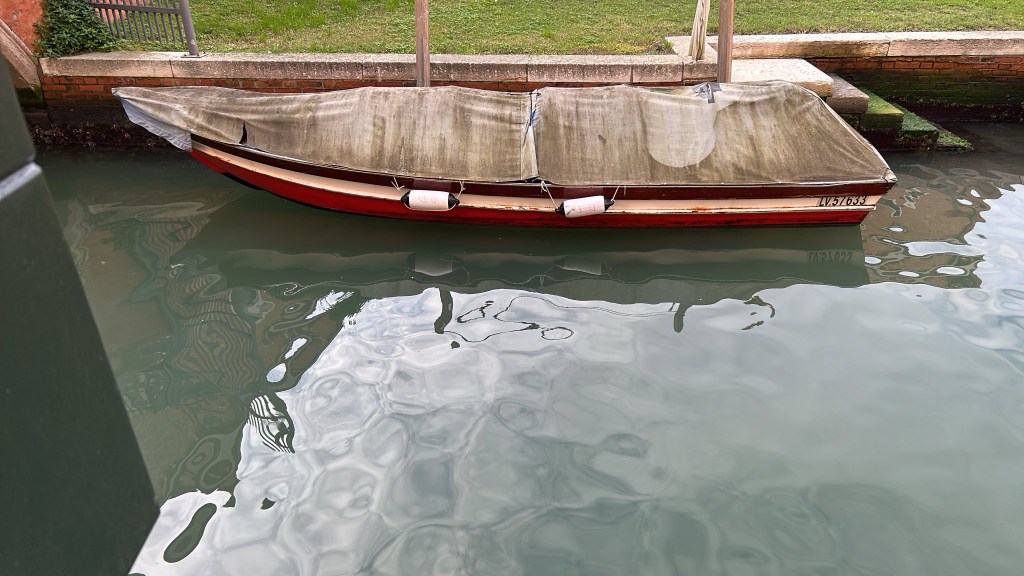
It’s odd, I know, that one of my favourite experiences in Italy is opening windows. It’s not simply the stunning views they open to: neon signed and steel-coloured cobbled streets of Rome, lushly vined and golden hills of Tuscany, neoclassical architecture of Milan, or the watery canals of Venice, but moving through the action of opening each window. The grasp of solid metal handles, negotiating the satisfying arc that releases a latch (often beautifully crafted in and of itself),  feeling the smooth swing of heavy wooden shutters, both inside and out, experiencing the transformation of a view seen through the waves and bubbles of ancient glass to clear and open air—for these windows never have insect screens—and immersing the scents that blow in (freshly baked bread, brittle crush of autumn leaves, rain kicked up dust…there’s a word for this, petrichor, earthy soil, olive oiled bon fire smoke, the honey sweet miracle smell of lime trees, ocean brine, and yes, sewers, garbage, the sour mash of fermenting grape skins and dog shit).  The windows are always set in thick stone walls, some as deep as my arm. When I lean out, I think of all the other people who must have done the same, from the same spot, with the same thoughts, the same impressions, the same appreciations, and I experience a sense of profound connection to the landscape, the people and the history of the place. Deep inhale. Ecstatic exhale.

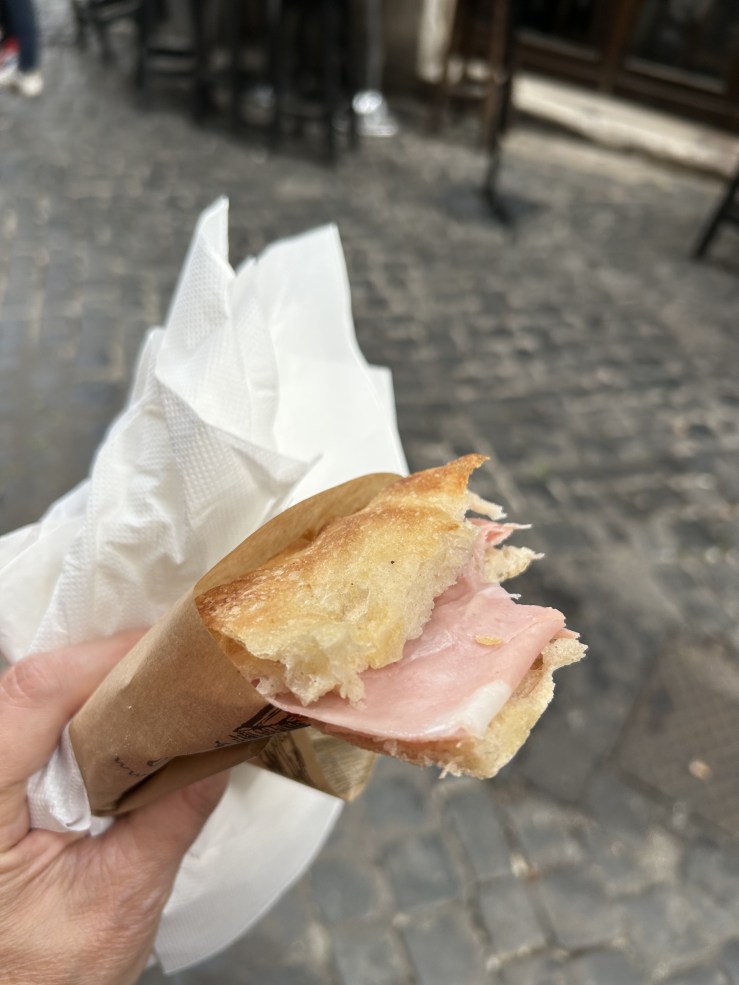
I know it doesn’t look like much but the combo here of pistachio larded mortadella sliced so thinly it was almost transparent, folded round pillows of air and pocketed in pizza bianca…a mouth miracle. Antico Forno Roscioli in Rome.
I ate and ate and ate, ingesting the full but simple flavours of sun ripe tomatoes, grassy olive oil, spongey bread, chewy pasta tossed with loamy truffles, oil cured anchovies, buttery cheeses, hard, salty cheeses, marzipan, hazelnuts and chocolate. I repeatedly experienced the transportive wonder (transporting one to where? …no, this isn’t right…dropping one into a still moment of appreciation of wonder, this is what I mean) when food is accompanied by wine. It’s a dynamic wonder: both the food and the wine change as the meal unfolds, mediated through temperature and air and textures and flavours, combining and recombining differently each moment across the lips, the tongue. How sharing this, at a table laughing with friends, friends who love you, is part of the wonder and absolutely essential to the experience.

I had more than a few episodes of weeping, unexpectedly overcome in certain moments by beauty. 

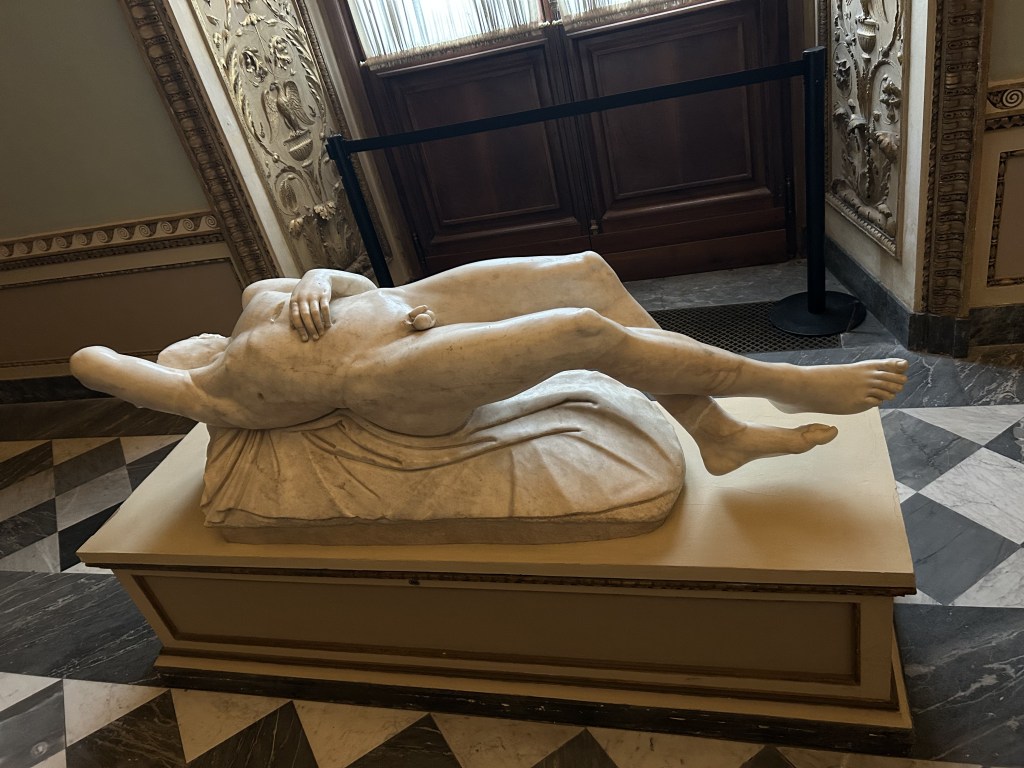
Once, gazing at the carved marble calves and feet of a statue of the fallen son of Niobe in the Uffizi2.

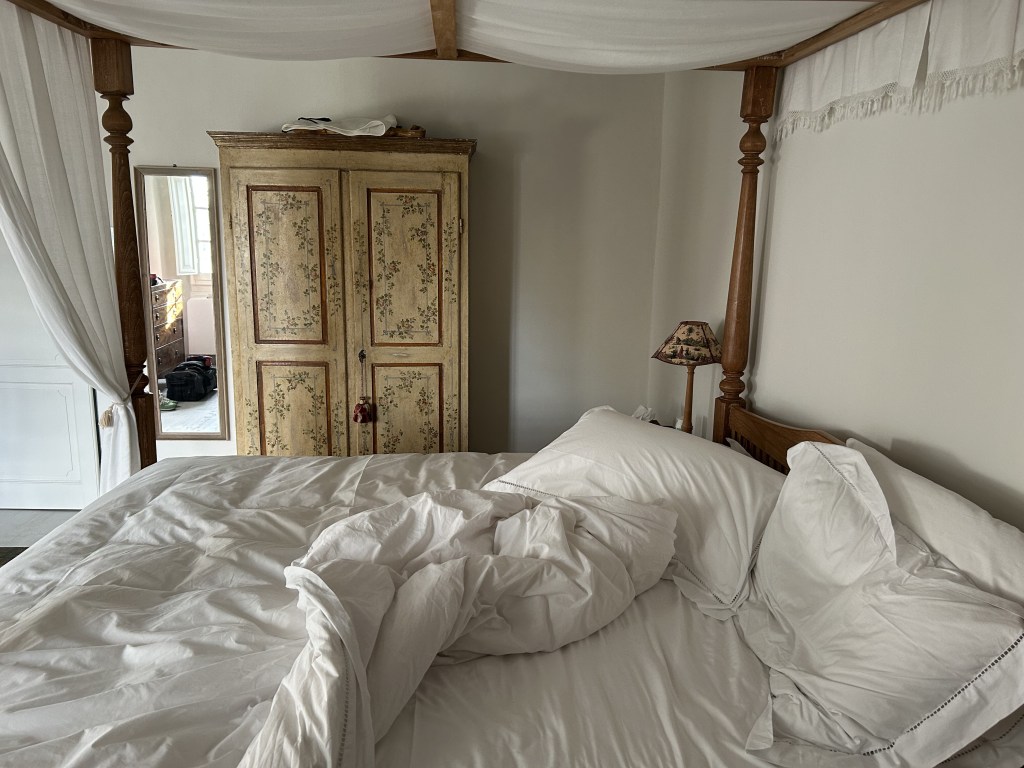
Another, listening to my friend, a concert pianist, practice Bach, Debussy, Chopin, in her gorgeous villa with a magical bed I got to sleep in, the percussions echoing the stone walls while I journaled in my notebook and copied down a poem, Brahms, written by Robert Bly. 

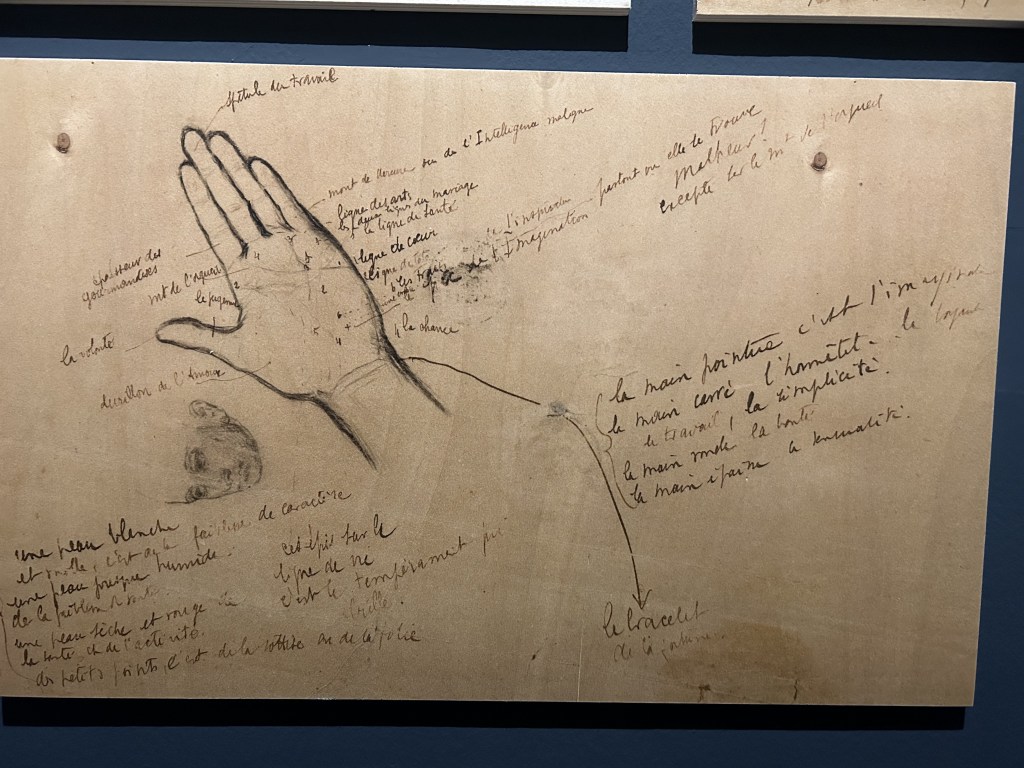
Another, reading poetic words about Picasso’s hands, written by Max Jacob3.

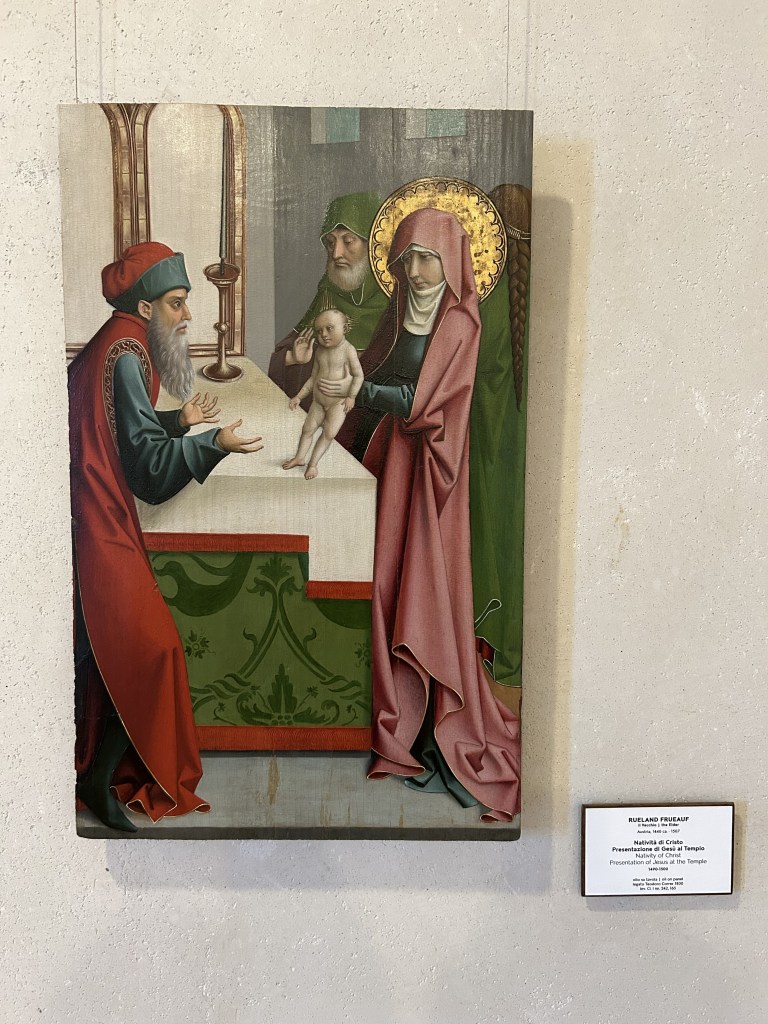
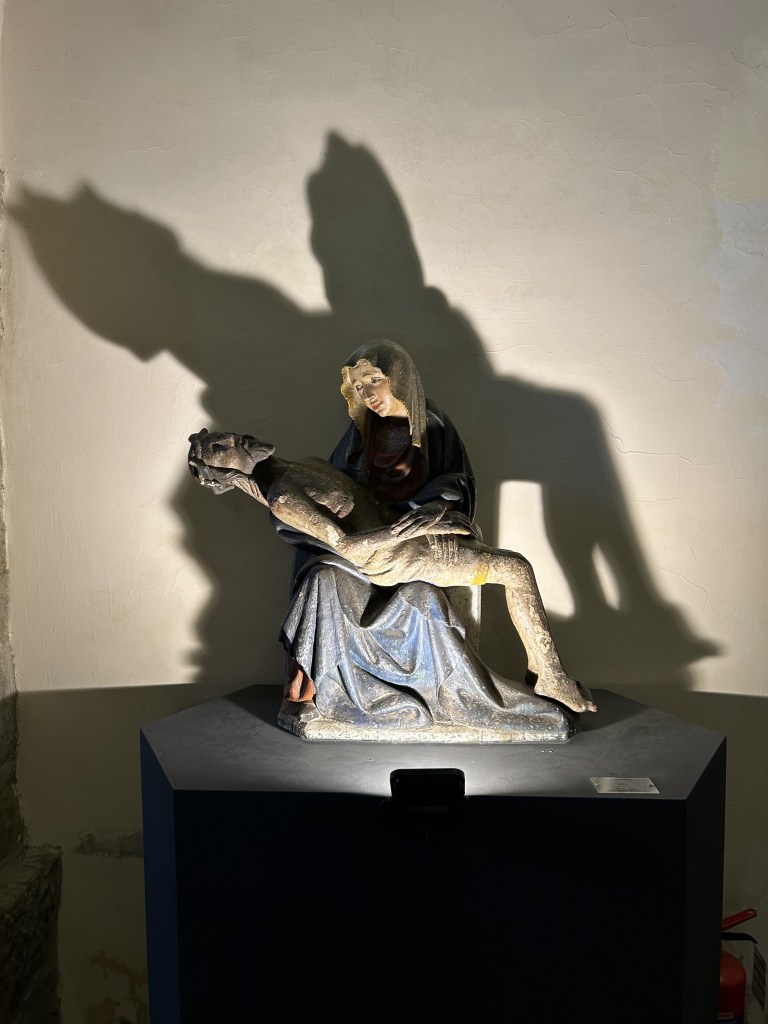
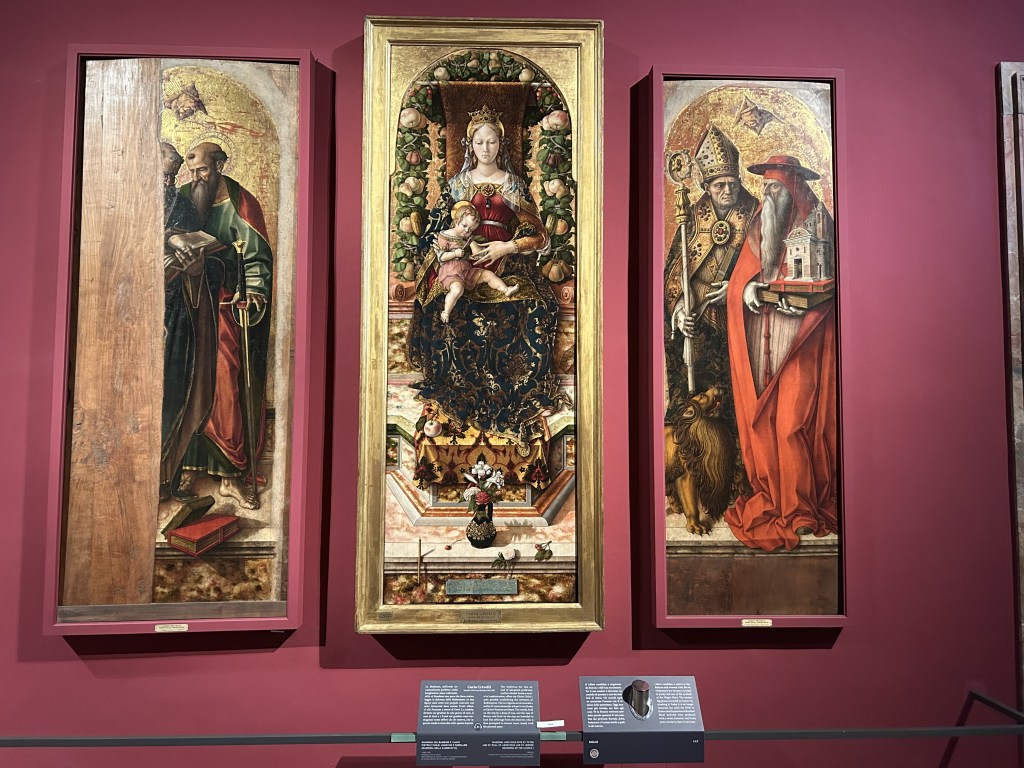
Truly mind-bending was the paradoxical viewing of classical artworks alongside contemporary ones, often in the same day, and once, in the same museum space4. I loved this jangling stimulation. Especially as a necessary counterpoint to the complete saturation (assault?) of the same composition, the same colours, the same story, of the Madonna and Child, over and over and over again. It makes one appreciate anew how dominant that story has been to the exclusion of so many others.

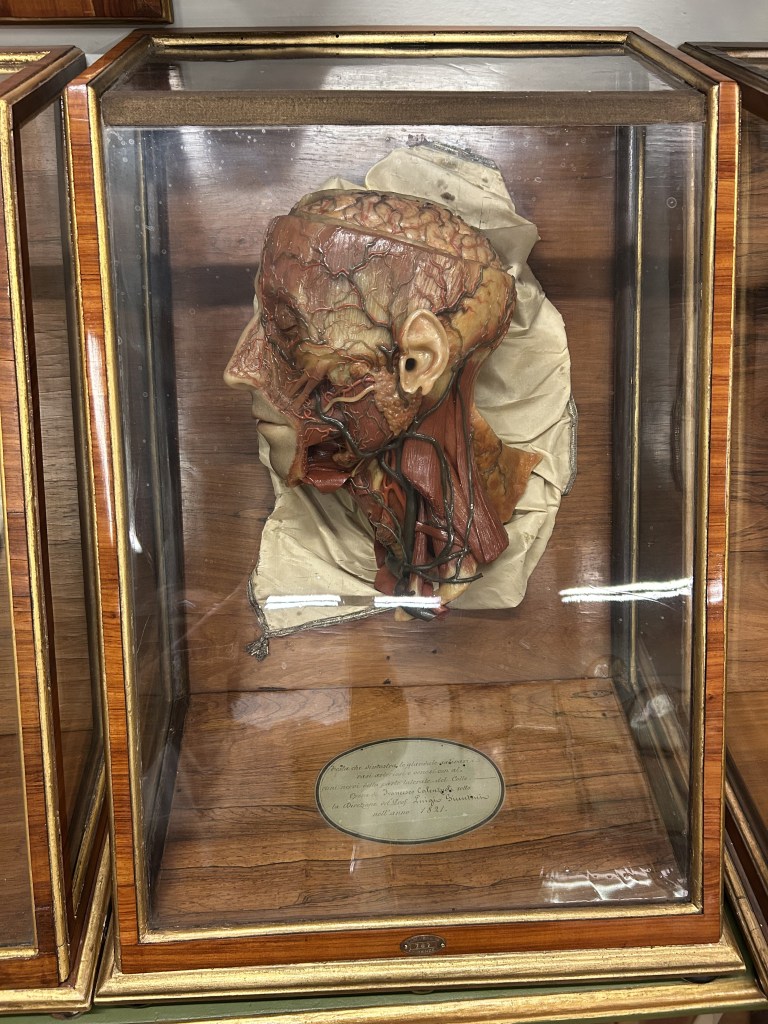
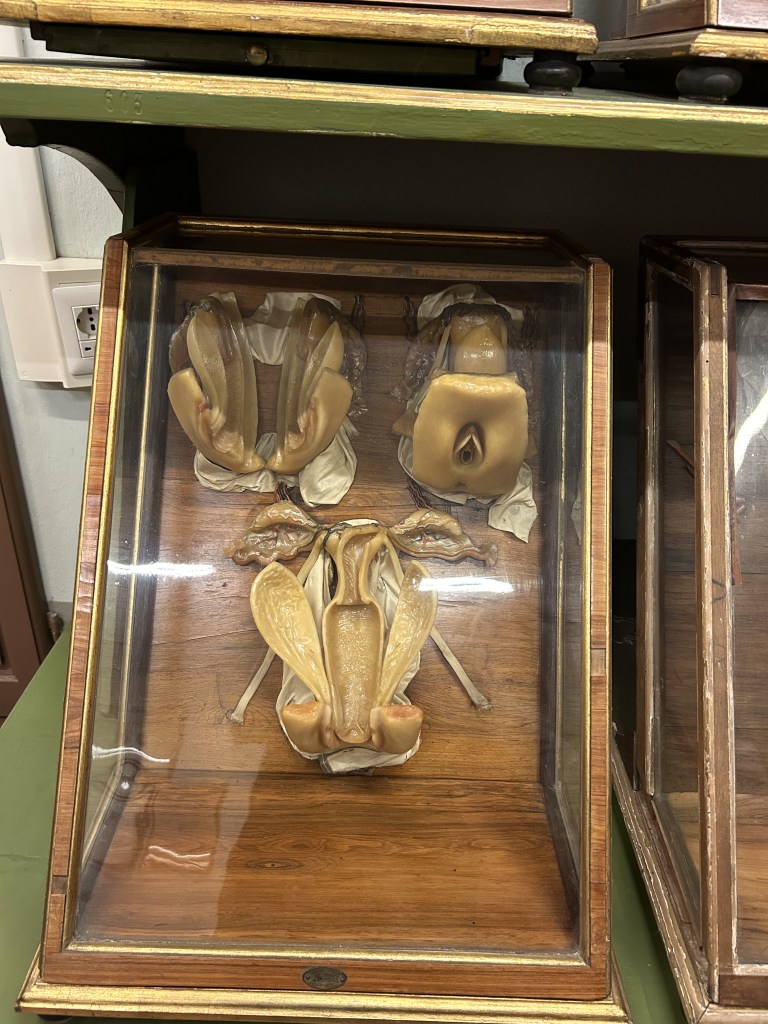
Lillian (daughter #1, studying in Milan this semester), joined me for several different legs of the trip, including Florence, where we toured La Specola, the oldest scientific museum in Europe. I had read about the wax models of fruits there, in a book, years ago, The Land Where Lemons Grow : The Story of Italy and its Citrus Fruit, by Helena Attlee. It was fascinating and absolutely stunning to see the intricate artistry applied using beeswax and pigments to create models of plants and animals and human anatomy to serve as teaching models. The attention and accuracy of detail blew my mind: the brain, the circulatory system, the nervous system, the reproductive systems….all the teeny tiny veins and arteries and lymph nodes meticulously recreated in coloured three dimensional form. For 3 Euros, we joined a tour…in Italian. I didn’t understand most of it. Still, fascinating to see. There were also cute little dioramas of scenes from the plague. Macabre, I know. I explained to Lillian how horrific the smells would have been. Interestingly, this subject paired nicely with the exam she was studying for, European economic history, where, alongside war, disease played a major role5. Anyway, this exhibit brought home the idea that art and science are not separate entities, but rub up alongside each other companionably.

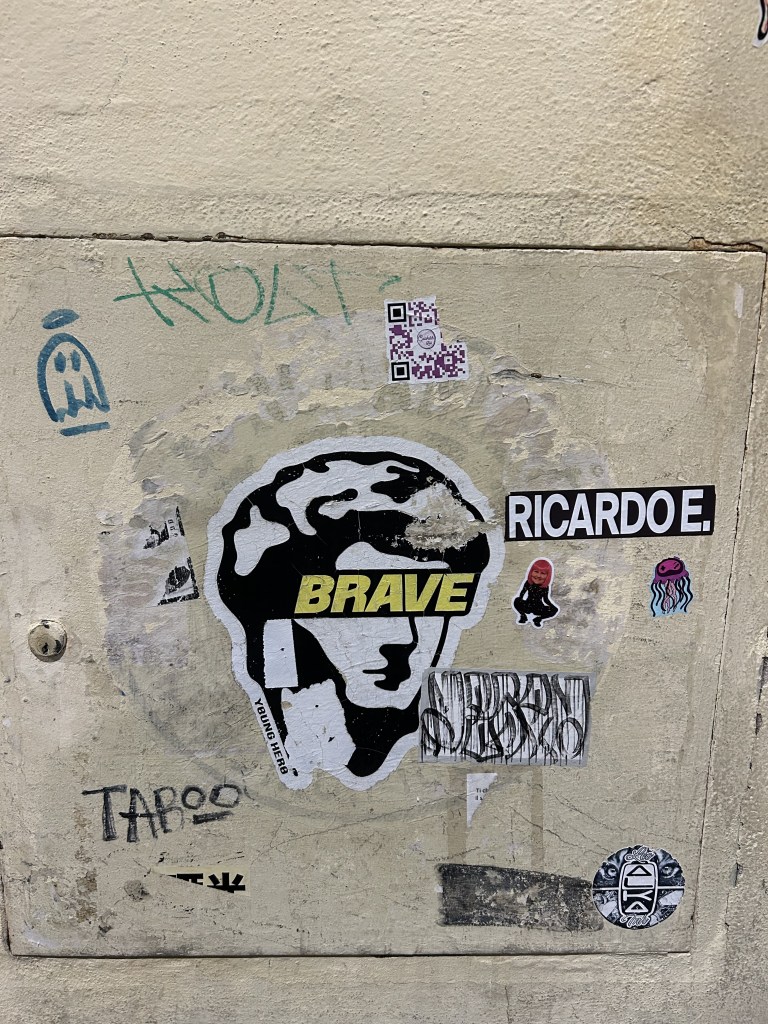
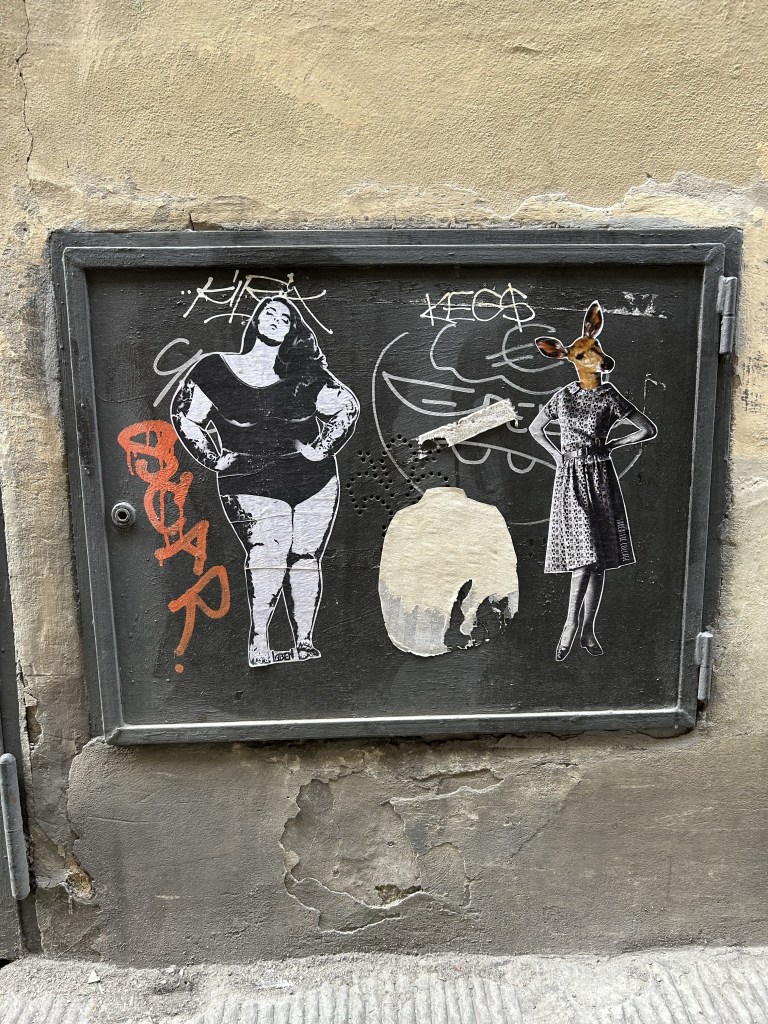
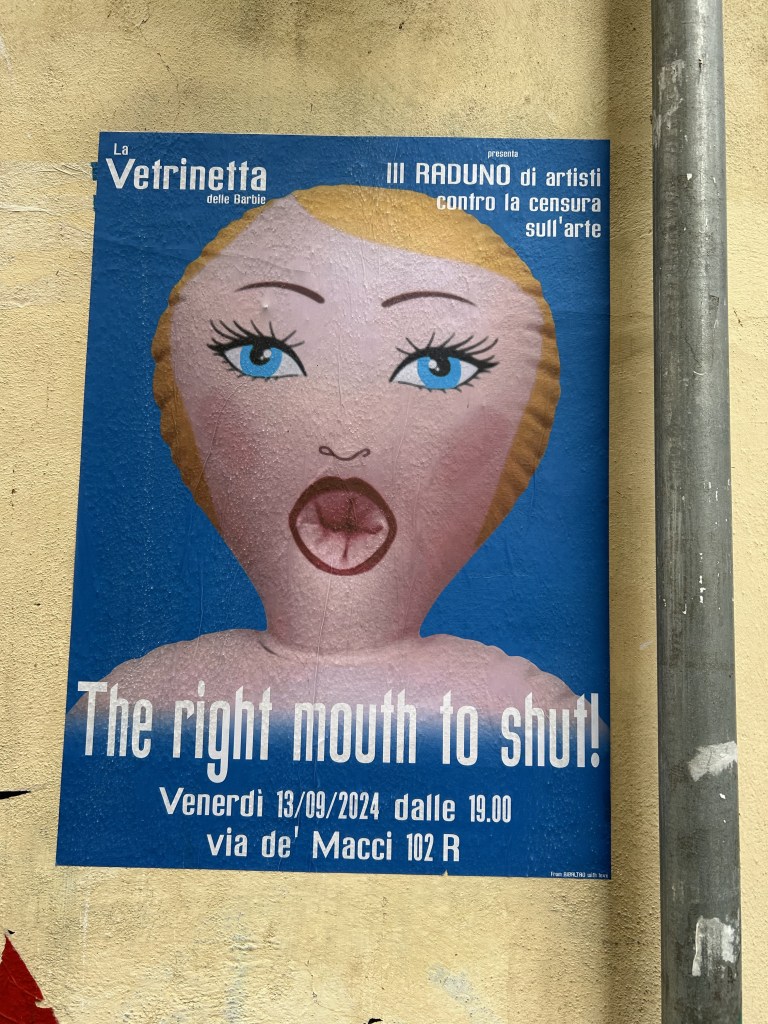
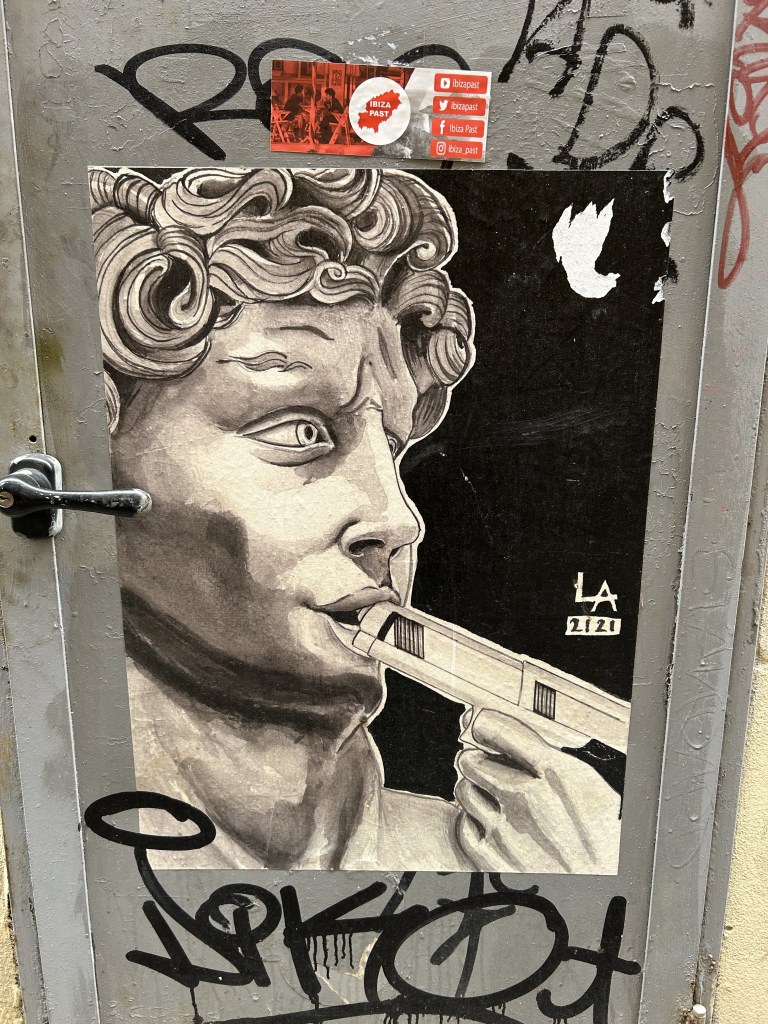
Here’s a selection of “things I saw on the walls in Florence”:

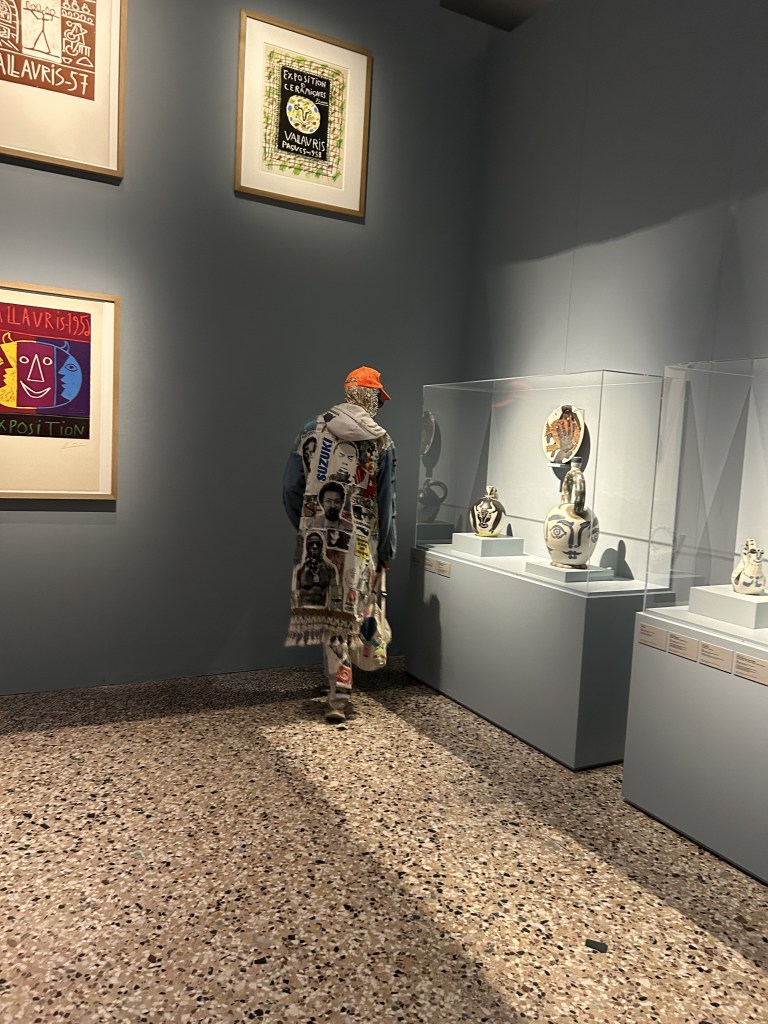
Here’s a picture of a person wearing an outfit that was just as beautiful and could have been part of the Picasso exhibit. We gazed at the same painting for a long time, standing side by side, and I really wanted to tell him how impressed I was with his outfit. But, I was too shy to say so.

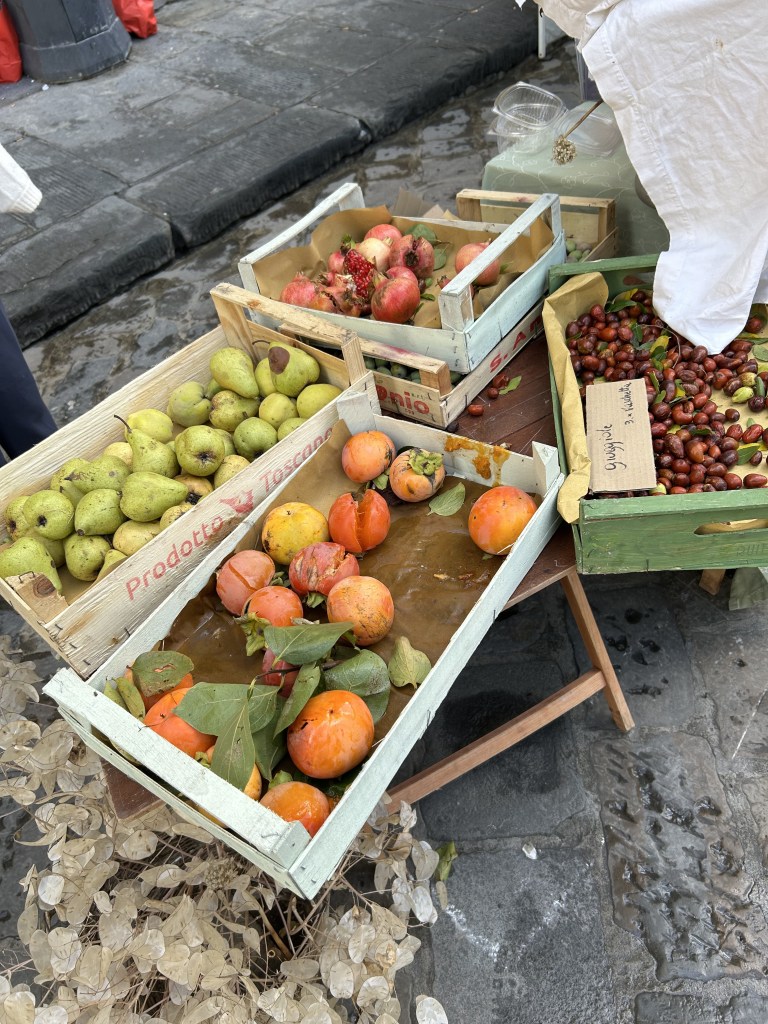
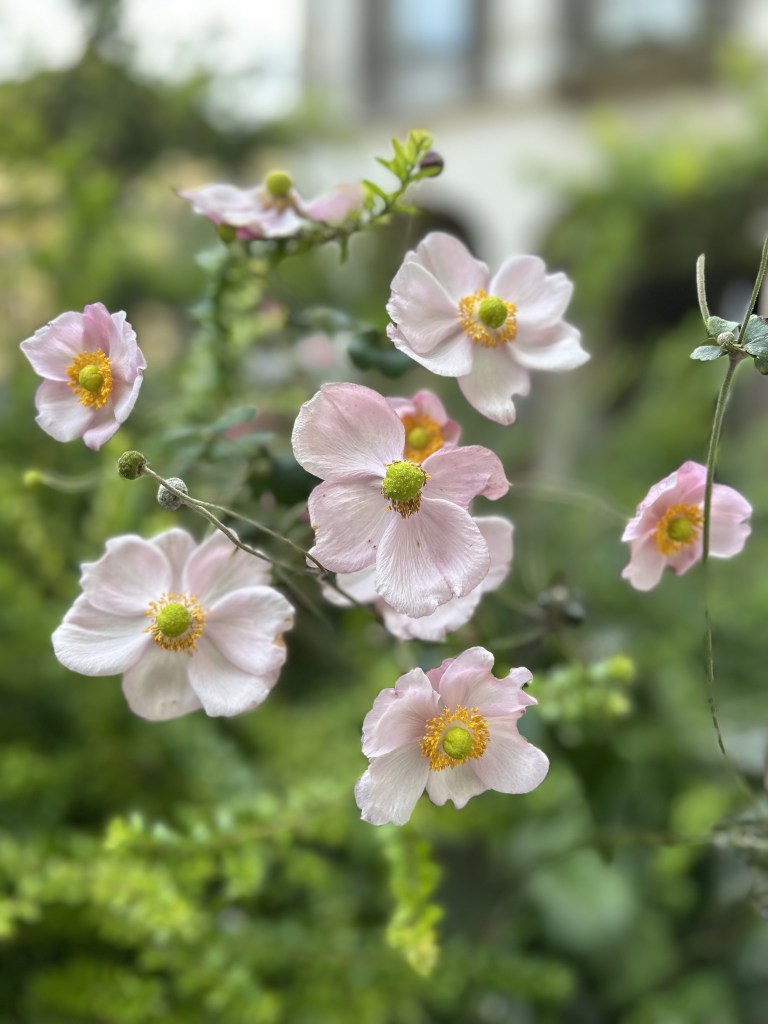
Also, so much beauty in natural form…something I began to miss amidst the cement cities and throngs of people.

It was impossible to write much while I was away…vibrating with so much stimulation, it was difficult to settle into any kind of focused reflection. Just tried to attend, be present and capture and take everything in. Again, I carried my pencil crayons around in my backpack, never once using them. I’ll have to make up a word for this, the act of taking art supplies on a trip but never using them…a botch-batch? non-accoutrements? artfail? I’m too tired, I have no idea. Surrounded by so much beauty and creativity and humanity, I couldn’t help but notice the manufactured green spaces, the cultivated farmlands, the hustle and bustle of humans living densely, compactly, layering upon one another with bricks and mortar and sweat and tears and laughter. I craved the lake and the sky and the horizon of home. Perhaps this is why my favourite part of being in Italy was opening windows.

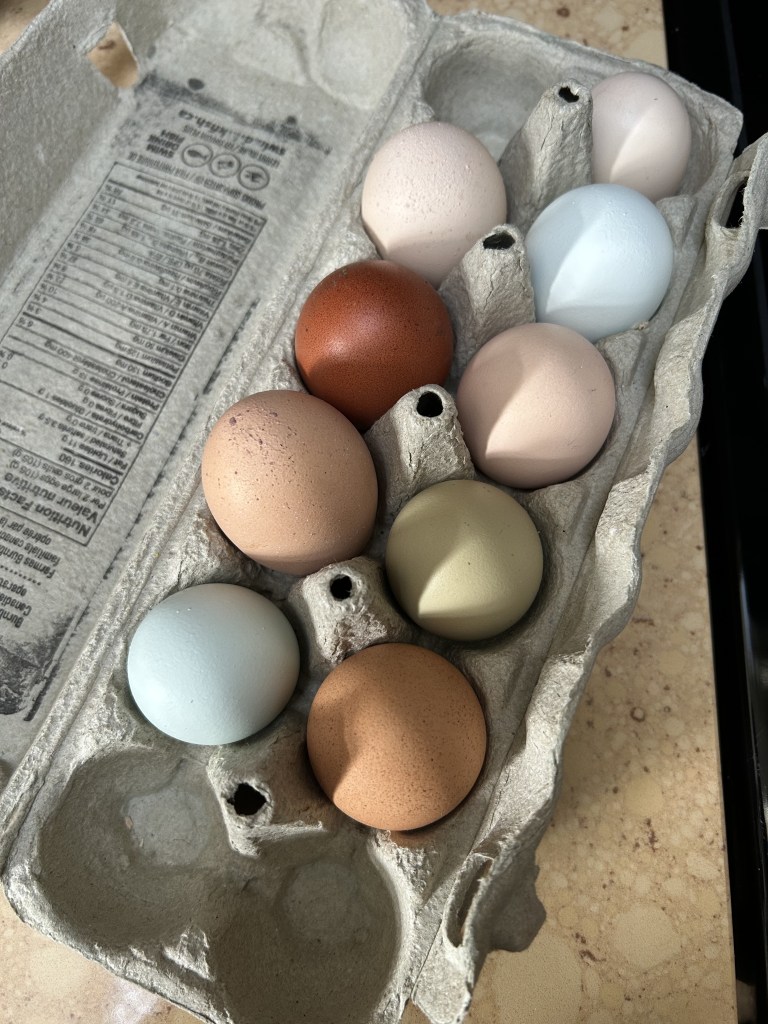
This is the view I crave. And a dear friend stocked my fridge with cheeses and milk and these gorgeous eggs from her sister’s hens for when I returned home…when I opened the carton I teared up again…for these too are beautiful. Also gratitude… for it all.

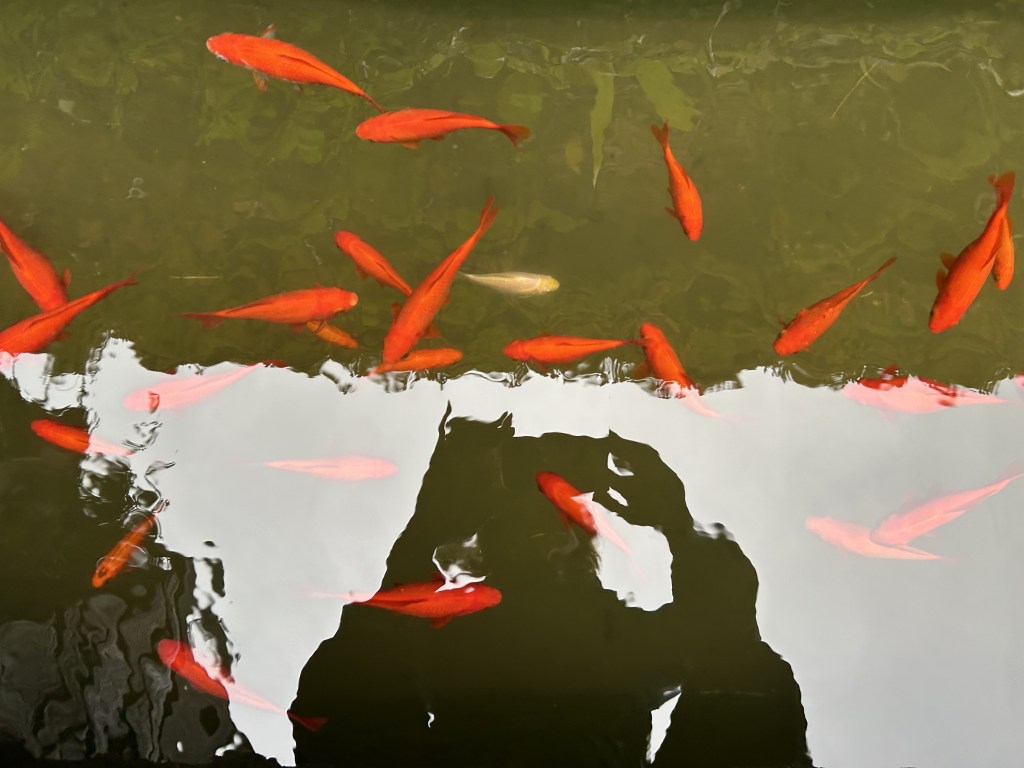
Yours truly.
  1. I returned to work Tuesday, hundreds and hundreds of emails. 807 emails. ↩︎
  2. Dying Niobid, Roman Art, 2nd century CE, the male figure is depicted on the ground in agony, struck by the arrows shot by the sons of Latona. For some reason it was the perfection of the figure’s legs and feet that really moved me. How they’re suspended in the air, as if, were I to reach out to stroke a calf, I might have felt the warmth of life depart the body. ↩︎
  3. From the Palazzo Reale Picasso exhibition notes: “In support of a palmistry study of Picasso’s hand [1902], the poet notes in a prophetically: It’s like the first spark in a fireworks display/…/This kind of living star is only rarely found in predestined individuals […] Aptitude for all the arts”. I have no idea why this made me cry. ↩︎
  4. These photos were taken from various museums, but the modern icons in conversation with Renaissance works were made by Francesco Vezzoli to create a site-specific exhibition in the Museo Correr in Venice. I was visiting the library museum but my ticket, serendipitously, afforded entry into this museum as well. The blue lady was in the courtyard of the Airbnb in Venice, Involucro Yves Klein, by Elia Alunni Tullini. ↩︎
  5. Plays…considering pharmaceuticals. ↩︎

Floetry [1]

Rising to the challenge of learning new tricks, I’ve taught myself to split logs with an axe. [Insert vinyl record scratch – wait…what? Connecting chopping wood with creative writing? Can it be done? Can she do it? Yes. Yes, she can.]

We’ll bounce back to the axe. First, let’s chew over energy. I’m referring to the energy[2] transferred between writer and reader via words.

But that’s not exactly what I mean, not quite right.

Pause. Think.

I mean the deeper sense (yes, that’s it) moving beneath (between?) the words, infusing the communication with vibrating vitality that travels, magically, across time and space to touch a reader right in the feels[3]. This is the goal. It’s fucking elusive.

Poetry is good at it, yes. We know it when we read it, receiving the energy as a hit to the heart, a pinch in the gut, the diaphragm kicking up an exhale, tearspill from the eyeballs, etc. Songs, and music too, deliver emotions beyond words. But to create that infusion of energy as a writer?  Well, that’s a whole different thing.

Gonna try and unpack the what/how here. Actually, I only get as far as trying to describe what this is like…I suspect the figuring out how to do it is a lifelong quest.

I’ve managed this feat of transference a handful of times. Always by accident [read: I have no idea what I’m doing…I just know when I’ve done it…some of the time]. The first time was in grade six when the teacher, Mr Pritchard[4], asked me to read my creative writing assignment aloud to the class. As I read—a passage filled to the brim with beauty and love and flowers and shell necklaces and turquoise seas and gorgeous Tahitian women with naked breasts—I felt a hush descend in the classroom. I felt every ear tuned to my voice, felt the beauty travel from within my body outwards to all the other kids who had stopped squirming at their desks and listened, captivated. It was a magical moment. But, tinged with shame I’m afraid because I’d plagiarised (ish) – I lifted the scene straight from the 1984 film, Mutiny on the Bounty, with Mel Gibson (who, yes, I swooned for in grade 6) and Anthony Hopkins (who terrified me). I’d transcribed the scene depicting the tall ship making landfall, the radiant “Natives” canoing the surf to greet the voyage weary sailors, shower them with strings of orchids, promises of paradise. Despite “stealing” the imagery, I felt the energy my writing created and its impact, and with these, the promise of its power…

Other times I’ve managed this feat: after reading my work at a poetry reading strangers approached me and I sensed they wanted to touch me, though they didn’t dare (so strange); in a message of condolence to a friend following his father’s death (a friend I have great admiration for and, at one time, was deeply attracted to…does this matter? It may); impressed in various email exchanges; sometimes in texts…actually, texts often have a lot of energy coiled within them, a kerpow sort of split and splintering humour I adore.

Some observations for when the energy transfer actually works (because yes, this is for posterity, so, be honest[5]): I have to be in the act of free writing, meaning, I can’t be directing the writing with my thinking (brain must be put on pause); I have to be relaxed; I have to be thinking about the person I’m writing to, or about, (or specific people)…not an abstract concept of “audience”; I have to be calm and unrushed but also focused; I have to “turn off” any questioning, i.e., second-guessing (the inner critic must be silenced).  The feeling, when this is all flowing—because all these conditions must be met at once, simultaneously—is that the energy moves through the body onto the page. Where does it originate?  This is a great mystery – from within? From without? Both? When it’s all flowing and the energy infuses the words…it feels… effortless.

And immensely satisfying.

Back to chopping wood. Though I have lived in at least two houses heated by woodstove, I’ve never been the person wielding the axe (or the splitter; I’m always the stacker and I’m afraid of chain saws or any loud power tools).  The woodstove at this house is not for heating, it’s more of a vanity woodstove, ha ha, but damnit I wanted a fire. The logs, beautifully stacked just outside in the breezeway, were too big to wedge in the stove. Plus, I needed kindling.  An axe lay at the ready, propped against the pile. When I first grasped the handle[6], I envisioned its blade wedged in the flesh of my foot, arterial blood spurting all over the place (I’ve cut the dickens out of my finger[7]).  Not a good way to start. I raised the blade and tried to keep my eyes from shutting when I brought it down on a propped-up log. My body was tense and that tension transferred to the wood. The bit (of the blade) bounced wildly off the log’s end. Somehow, after repeated attempts and ricochets, I bruised the shit out of my fingers (not sure how that happened but it did).  My initial swings were tentative (weak, timid). Slowly, I managed to figure out how to get the bit to bite the wood. But then I got the blade stuck and spent way too long, swearing a blue streak, extricating it.  I got increasingly frustrated and yes, I wanted to cry. Maybe I did cry.  But I wanted a fire! Frustrated and spent and not giving a shit anymore, I mustered a strength that began in the soles of my feet, travelled like a wave up my legs, through my torso, along my arms, the length of the axe’s handle. I raised that goddamned axe high above my head, creating a lever of beauty embracing momentum, gravity, tracing an arc, letting it fall to bite its mark on the log’s end, splitting it instantly, the two pieces of wood flying apart with an edifying crack.  Physics! (I shouted out loud). Once I got the movement and the attitude down, I’ve been able to split logs with ease.  Key: the energy must travel, as a wave, through the body, through the axe, to the wood. When the movement flows this way, the log splits without effort. Brute strength is unnecessary, even counterproductive; energy moves with elegance. Exactly the same way it can flow through writing.

Now all I have to do is figure out “the movement” that invites the energy to move through…

Speaking of quantum physics (we are, aren’t we?), in a recent workshop I was challenged to write a flash narrative integrating quantum physics. In workshop, my piece was one of fifteen to “win” feedback from a SmokeLong senior editor (who knows, maybe only eight of us entered). To be clear, this piece DID NOT (at all) succeed in the energy transfer thingy I’ve been writing about here, but it was fun and quick to write and, following some, ahem, contest overseer requests to change the original piece and make it more appropriate for a general reading audience[8], I submitted it, for fun, to the Quantum Shorts competition. It’s up, for a short time (till March?) on their website for reading.

Let’s end on a far more eloquent description of the energy travelling through words (gawd Suzanne, an axe?! How crude.) with the last section of a poem titled, The Other Tiger, written by Jorge Luis Borges:

We shall seek a third tiger. This
Will be like those others a shape
Of my dreaming, a system of words
A man makes and not the vertebrate tiger
That, beyond the mythologies
Is treading the earth. I know well enough
That something lays on me this quest
Undefined, senseless and ancient, and I go on
Seeking through the afternoon time
The other tiger, that which is not in verse.

[From Dreamtigers, by Jorge Luis Borges, translated by Harold Morland]


[1] Such a great song by Floetic.

[2] Do I mean emotion? The energy of emotion?   I’m still thinking about this, whether they are one and the same or whether they are similar yet texturally different…still, something that moves, that has momentum, sharing that etymological root (Latin movere “move, set in motion; Sanskrit kama-muta “moved by love”). Certainly relational, not necessarily a bidirectional relation, pluridimensional.  

[3] This is not a new idea. Not even close. Here’s Rumi’s continuing commemoration through mille-fold Instagram and FB unicorned affirmation posts, “Words are a pretext. It is the inner bond that draws one person to another, not words.”

[4] An aside: Mr. Pritchard—my mother, with kiwi candor, called him Mr. Prick Hard (Mum! You can’t say that!  Don’t worry zanny, he can’t understand my accent! But mum, you’re speaking English!)—was an evangelical Christian. I delighted asking him to explain what I postured to be a genetic impossibility, all of us descendants of Adam and Eve, I mean come on, we’d all have, like, six eyes and no legs. Or maybe six legs and no eyes, more like. I think this must have been after my reading aloud to the class, I’m sure I was never called on again…anyway, I was disappointed he didn’t oblige an argument, simply told me to take my seat.  

[5] Line from the movie The Princess Bride, a torture scene, but whatevs.  

[6] New learning: an axe has all sorts of parts to it, many named, incidentally, after parts of the body: belly, throat, shoulder, butt, cheek, beard etc. See here, but then, check out the website landing page – hilarious, depicting a stunning combination of free flowing alcohol, people weaving around wearing animal masks while winging axes at targets chalked on a plank wall.  What could go wrong?  Oh, there’s pizza too.  All good.

[7] This one’s for you Ny, a classic Saturday Night Live skit with Dan Aykroyd impersonating Julia Child – the quote comes in at the 1:50 mark but the whole skit is a great laugh. Anyway, this is how I envisioned my newbie axe wielding would go.

[8] I was asked to remove the swearing. So, I changed ‘fucking’ to ‘flaming’, removed ‘fucking’ from the footnotes, (it appears I am addicted to using footnotes – is it irritating? Let me know) and changed ‘fucker’ to ‘boneshaker’ which I like even better because of its loose allusion to oral sex. Which, incidentally, the contest people didn’t ask me to clean up for a general audience and I delight that it hangs out there to tease some unsuspecting general audience member. Ha ha.

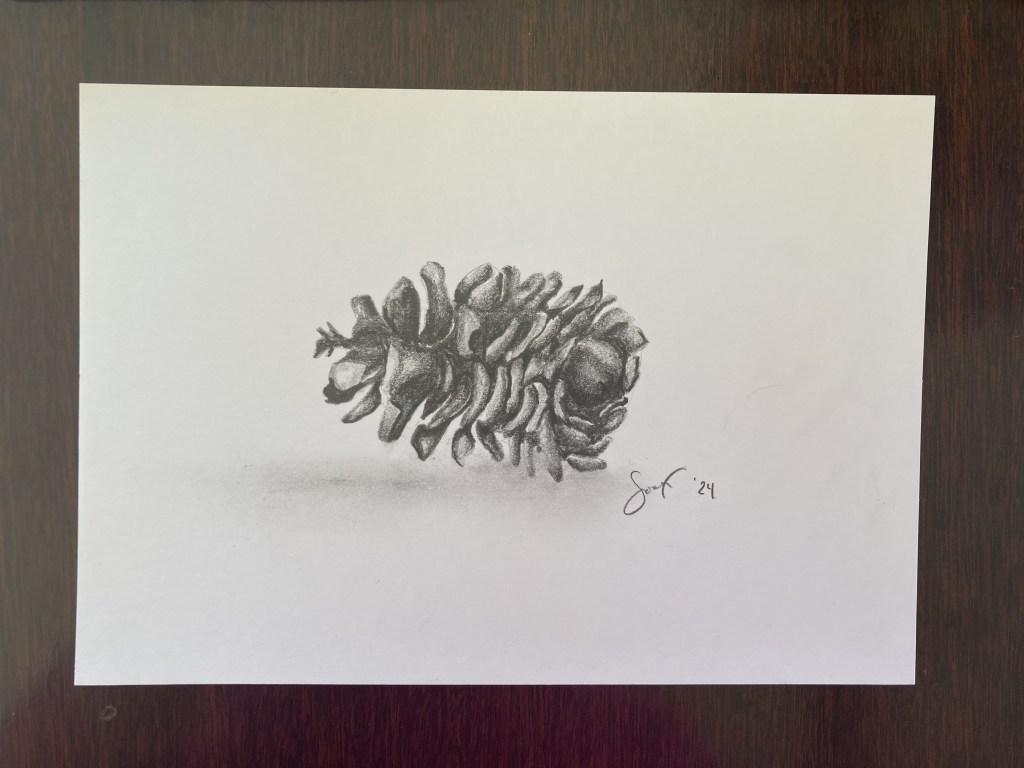
[9] I’m trying to slow down. It’s been …an emotional few months. To help calm myself, I’m practicing drawing these small beauties, found thingies picked up on walks. Feels good. I listen to music, gorgeous song, when I draw. I have always signed artwork with Soux, a spelling I claimed as a young teen, exercising some initial sense of autonomy I lost along the way (though, high school friends still address me using this spelling).

Shifting World Views & Learning Different Ways of Knowing

In the past, a shift in how I viewed the world happened quite literally. I travelled to New Zealand over twenty-five years ago and discovered a large world map with New Zealand at its centre. Up until that point, my education and experiences about what the earth looked like and where the continents were located in relation to one another was depicted with two views (remember, this is before Google maps). The first was on a globe whose axis tilted away from my body and fastened to a stand. The attached points of axis bisected the north and southern poles, focusing spinning attention to the northern hemisphere (Europe, Russia (USSR), North America, half the world’s oceans). If I had to find New Zealand, the country where my mother was born, I needed to bend upside down to see it.

The other world view was a flat, two-dimensional map, the sort that gets tacked up on bedroom walls or ceremonially unrolled to obscure the chalkboard at the front of classrooms.  On these maps the Americas (North and South) are rendered on the left-hand side and Europe, Africa, Russia, Asia, Australia (and New Zealand) on the right-hand side.  The Pacific Ocean is split (so one doesn’t quite appreciate how vast it is) and the Atlantic Ocean takes over the middle ground.

On the map I discovered in New Zealand so many years ago, the two tiny islands commanded the middle space and suddenly I appreciated how far away the country really is from most of the other continents, floating there in a large blue pool (the Pacific Ocean). In the NZ maps I was stunned to discover how close Russia and Alaska are to each other (the western tip of Cape Prince of Wales in Alaska is 88.5 kilometers (55 miles) from the Southern point of Cape Dezhnev in Russia – if I were driving this distance across the Bering Strait, it would take me less than an hour!). And with this realization my mind moved through a reshuffling of Cold War history and Canada’s shared responsibility with the US for continental air defense through NORAD (North American Air Defense Command).

Of course, with Google maps available at our fingertips these days, my naive view of geography and related epiphany is outdated. My point is that I had accepted these two views of the world “presented” to me without questioning the perspective (and possible motives) of their presentations. I’ll get back to this thought shortly.

Another map and another example. This time focusing on the north-east region of North America (Ontario, Quebec, the Atlantic provinces, the states along the eastern seaboard, the southern shores of the great lakes, lining the Mississippi River and other confluences and tributaries – the water here is important). This map, a map free of border lines (province, state, or country), depicted the diversity of Indigenous languages with coloured circles of concentration. Sometimes the colours overlapped, indicating mixed languages in regions, but on that map (a simplified version from the picture below), it was instantly clear how Indigenous languages mirrored waterways (water being an essential human resource). Again, I experienced a mind-bending reshuffling to appreciate how cultures depend and thrive in relation to land and water. But also, how superficial country (province and state) borders are. Crayon lines drawn by Kings and Queens, heads of state. Crayon lines our loved ones fight for and die on. Crayon lines that shift and move, depending on which resource they’re circling, gold, uranium, olive groves, copper, waterfalls, coal, legislation, policy, justice, freedom, the list goes on.

From Native Land Digital https://native-land.ca/

What does this have to do with creative writing practice?  Well, a lot actually.  It’s a bit of a conceptual leap, yes, but bear with me.  The way we carve categories in the world around us, be they continents, countries, or the way we name the world with words, impacts the way we “see” the world, how our perceptions are influenced.  Words matter – they determine how we think.

These quotes from a recently published piece by Christine Kenneally in the

Scientific American November 2023 Issue:

“Culture shapes language because what matters to a culture often becomes embedded in its language, sometimes as words and sometimes codified in its grammar. Yet it is also true that in varying ways a language may shape the attention and thoughts of its speakers. Language and culture form a feedback loop, or rather they form many, many feedback loops.”

“…the more we ask empirical questions about language and its many loops in all the world’s languages, the more we will know about the diverse ways there are to think like a human.”

I need to reread David Abram’s astounding book The Spell of the Sensuous which explores similar ideas, comparing Western language development to Indigenous ones.  A review of the book written by Émile H. Wayne offers this distillation:

“When our ways of thinking and knowing are rooted in the actual soil of our actual communities…we are called out into the world where we meet, in every bodily sense, the consequences of our own actions. Non-human nature becomes present, aware, vocal, integral to our being. We find ourselves living not in the midst of our abstractions – nation-states, linguistic group, political party – but as members of a living, breathing, often suffering, body of relations.”

For these reasons (and others – this post is too long already), I have started to learn Anishinaabemowin with the Kingston Indigenous Language Nest. I would like to better understand how Indigenous Peoples of the land on which I learn and live name and view the world. I want to expand my worldview.

I would be remiss if I failed to name an additional world view shift I am making. This month, I made the very difficult but courageous decision to leave my marriage. Quite simply, I want to be independent. This is the language I have been using. I do not feel I am leaving my husband…we are bound to one another through our children and the life we have created together, both in the past and the one we create in the future. Our relationship shifts – it is my hope we remain friends who love each other. It is a painful separation. I am blessed to be surrounded by people who love and hold me, keep me floating. Writing my way through is helping. Also art. And songs. And lifting the Dahlias from the soil to overwinter. I’m not sure what garden they will be planted in next year, but they are waiting in the dark. Kind of like me.

I have been learning names of animals in the Anishinaabemowin classes I began. We learn as children do, with songs and games. It’s fun. The other night, I discovered a gray tree frog in my kitchen. It’s the first time in close to twenty years of living in this house that I have found a frog within. Agoozimakakii is the Ojibway (a dialect of Anishinaabemowin) word for tree frog. Phonetically it is pronounced: ah-goh-say-mah-kah-ki. Today I am leaving this house, this home…when I looked up the spiritual meaning of finding a tree frog in one’s house, I discover it’s “a symbol of transformation…In some Native American traditions, the frog is seen as a guide who can help individuals transition between different stages of life.”

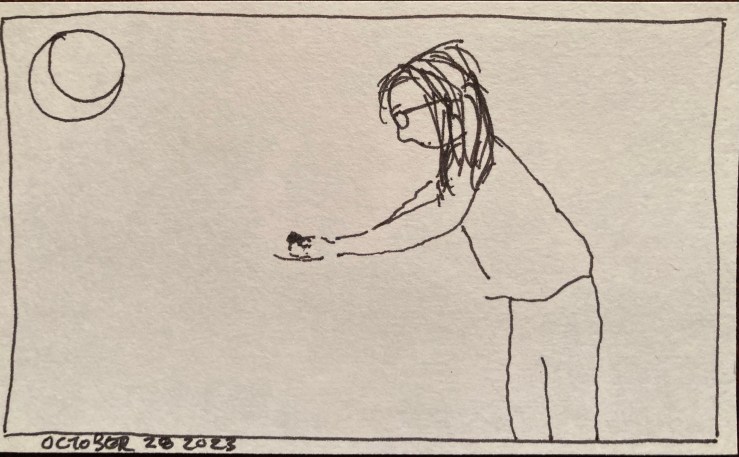
I had a hard time catching the poor wee thing, the heart shaped tree frog slightly smaller than the palm of my hand. She was fast and strong, and she hopped from my hands several times, landing with splats on the linoleum.  Finally, I cupped her in my palms and placed her back outside under our exquisite moon, its light making our skins glow.

I have opened the borders of my soul with these moves, these shifts, expanding my view of the world with new perspectives. I aim for Mino Bimaadiziwin, an Anishinaabemowin phrase meaning “to live the good life” in a wholistic sense – “the intelligence of the mind is inspired and informed from the intelligence of the heart.” It is terrifying, but also, feels exactly right.

Be brave – Aakode’ewin. In the Anishinaabe language, this word literally means “state of having a fearless heart.” So, this is how I step into this new-to-me kaleidoscopic landscape and learn to name the world.

A Fish Out of Water: Syntax

When I went to elementary school in the 70s and 80s, it was vogue, fashioned after curriculum direction in the UK, lessons on grammar and syntax be removed from the curriculum with the belief (not proven with time) the lessons would simply assimilate through reading, exercises in comprehension (meaning making), and natural conversation. 

And a science focused career further limited my exposure to language construction (blunted it more like. Punted any raw, sensual subjectivity, the glorious immersion of being human in a living world, to a cold field of disconnection and distanced objectivity, but I digress). The result: I must always look up the definitions for parts of sentences (adverb (?! yes, it’s true), gerund, participle), the application of verb tenses and rhetorical terms (these never stay in my head, it’s a completely foreign language). I’m only recently (last couple years) conscious of the conceptual gymnastics syntax enables one to perform. 

But my lack of education is not what I want to write about here today. Instead, in the way of shimmery near-rhymes, I want to describe my process learning to use syntax as a way to mine my intuition. This practice (nascent) is cultivating my writing, slowly, slowly, so slowly, making it, if not more beautiful, certainly more textured, possibly (hopefully?) more complex.

Importantly, the practice disciplines thinking. Alters perspectives. Allows the mind to become supple. Open.

There’s a June Jordan quote tacked on the corkboard in front of my writing desk that captures this sentiment so much better, The syntax of a sentence equals the structure of your consciousness.”

By intuition in this context, I mean what the subconscious mind is telling you, learning to trust it knows so much more before your conscious mind does. Responding to writing prompts, I put my pen to paper and let the words fly. In this way, something surprising, often beautiful—an image, a metaphor, a sensory cue—always rises to the surface (usually only at the very end of the exercise). Often, I’m left with a slightly baffling fragment and no clue as to how I might proceed or stick it together with another section of text (and attempts to force it really botch the whole thing up). This is when applying syntactical techniques may be used to open a window for creativity (and intuition) to breeze in.

Here’s what I mean (so floaty in the abstract mind space, my apologies, let’s get grounded). Syntax is simply the arrangement of words and phrases to create [a] well-formed sentence1. I’ve been practicing how to write sentences, gratefully working through exercises posted so generously by Nina Schuyler on her Substack Stunning Sentences.

Nina’s exercises break sentences into their component parts, grammatical and syntactical, and she sequences and names the parts so they may be followed as a template to slot in your own words and thoughts.  I work through Nina’s exercises each week (well, I try to keep up). I’m too shy to post them there (and I don’t always succeed in my attempts, often capturing only 3/4 of the layered pieces that make the whole), but the practice is so helpful to me.

Start with a base clause: grind the meaning of the sentence down to its essentialness, who is this about (subject), where is it taking place (setting) or what is happening (action). And then, by erecting layers of structure (syntax, grammar, rhetorical techniques), complexity of meaning, depth, a resonance imbued with life and rhythm is, architecturally, revealed.

The layers of structure move a reader through the writer’s thinking and meanings using, as Francis Christensen’s 1963 essay, A Generative Rhetoric of the Sentence explains, levels of abstraction or generality, movement (directing the reader’s eye to earlier or later parts in the sentence). Christensen’s theories enriched John Erskine’s. Here’s a quote of Erskine’s that I love, from a 1946 essay, The Craft of Writing, quoted in Building Great Sentences by Brooks Landon:

“What you wish to say is found not in the noun but in what you add to qualify the noun. The noun is only a grappling iron to hitch your mind to the reader’s…The noun, the verb, and the main clause serve merely as a base on which meaning will rise. The modifier is the essential part of any sentence.”  

Circling back to intuition and tying it in with Nina’s exercises, working through the sentence templates (grammatical, syntactical, rhetorical) I am forced to feel my way through the possibilities of how the original thought (could be the stripped down base clause) might expand. From my own free writing, I can select an image, a metaphor, a sensory cue, an action, extract it from my draft and let my intuition, carried through the templates, show me what my mind senses before I really even know.

In a recent post to The Red Hand Files, Nick Cave responded to a question about creativity, being stuck, and art making, which again, explains this better than I can:

“As a songwriter, I have come to understand that the more I try to make art that somehow reflects what I perceive myself to be, or the identity I wish to project upon the world, the more my art resists. Art doesn’t like being told what to do. It doesn’t like me getting in the way. When I attempt to impose my will upon it, the work becomes diminished and art takes its better ideas elsewhere…[Art] insists that we retract our ego, our sense of self, the cosmetics of identity and let it do its thing. We are in service to art, not the other way round.”

Practicing this way is very slow. I sit and think a lot more (imagining) before attempting to fill each sentence component on the page. I switch to pencil for these exercises – there’s a lot of rubbing out, a lot of cross outs too.  It feels a lot more like how I feel when I write poetry…the process of intentional writing I apply to poetry. It taxes the brain, but in a good way, a way that alerts you, wakes you to deeper meanings on offer.

But there is a richness of material being laid down. Suddenly every word (or component) opens so much more potential for something larger, more meaningful, more complex. It shows me what I’m thinking, before I even know myself. And this feels exciting. And pleasurable.  

How classes on reading comprehension were ever severed from syntax instruction I will never fathom. Subject for a different rant.

Slowly, slowly, slowly I am learning. No longer gasping for breath, a fish out of water, just a process of learning to swim. And the education, though painful at times, is a joy.

1 Discovered syntax etymology is from the late 16th century, via French or late Latin from Greek suntaxis, from sun- ‘together’ + tassein ‘arrange’. What a delightful riff on the warmth of a sun.  

Creating Observations

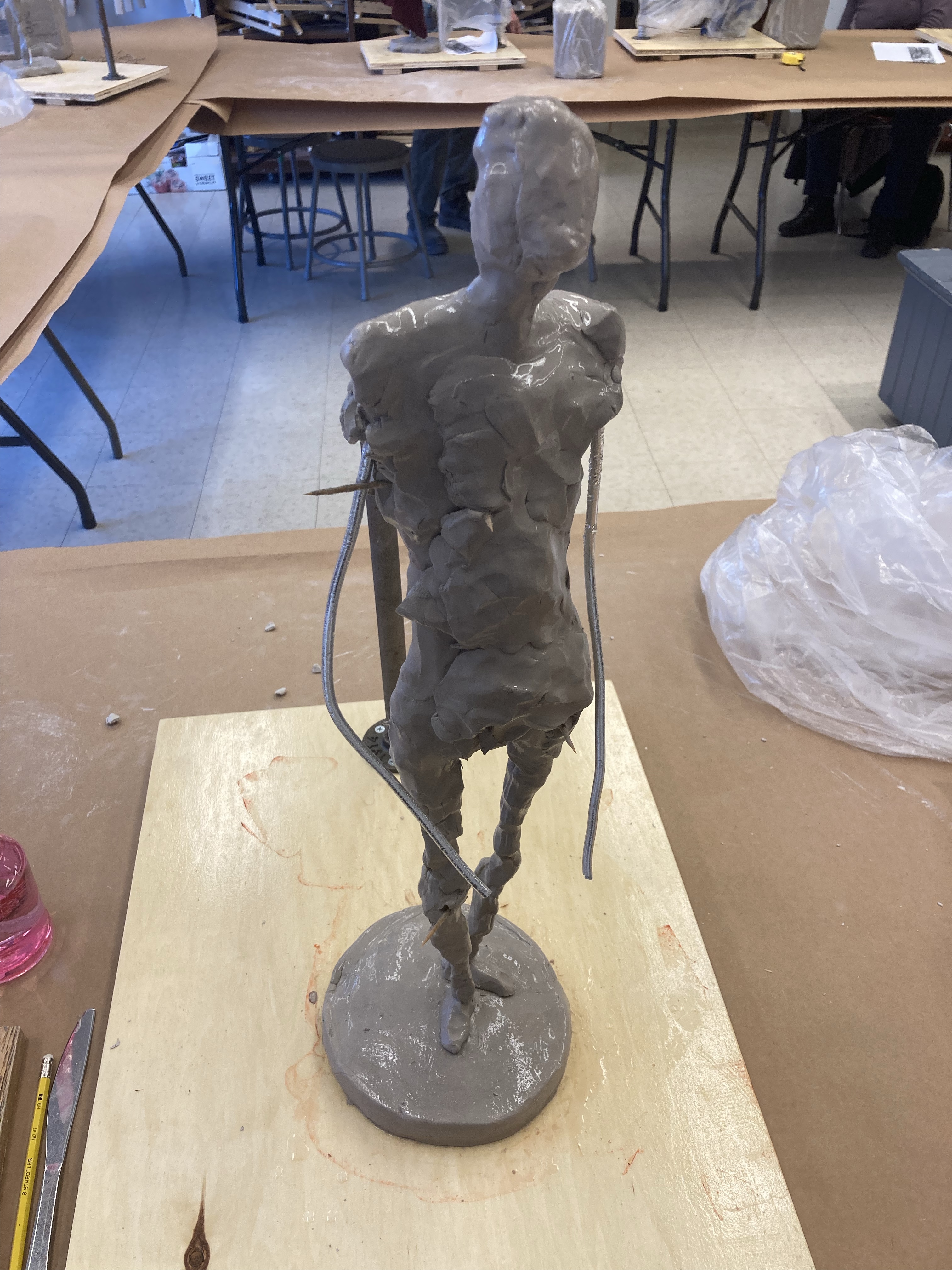
I’m in the middle of a 4-week human figure sculpture class. I love the way the cool clay yields to my fingers, the weight of it.  I love the way it feels wet, but dries to a chalky powder on my hands, leaving prints against my thighs when I accidentally wipe them there. I like to challenge my creativity using different mediums; I always discover deeper awareness for my writing practice this way. 

This is a class in observation.  We are creating “a study” of the human figure, in clay, using an armature (a stick like human figure made of bendy wires). There is a nude model instructed to maintain the “study posture”, but to rotate every 7-10 minutes.  The study pose is a contrapposto, or counterpose, where the body appears to be in mid-step with a slight twist of the torso that signals a certain vitality to a finished sculpture. The model’s timed rotations mean students never stick to rendering one view but must rotate armatures to match the model’s stance, building out only the three-dimensional form from their unique viewpoint in the room.  

At the end of this class (which, due to covid-19 has been a bit bumpy with some classes cancelled and rescheduled), we will destroy our works by pulling the clay from the armature to be stored in a plastic bagged blob. The forced breaks, shifting viewpoints, and the fact that the finished product is nothing more than the end of a “study” process, has made me feel a light creative freedom.  

I’m delighted working in the small class, listening to the murmurings of conversation, the shushing hiss of spray bottles and overplayed classical tunes.  To be in the moment of “trying” for no other joy but to try. It is a focused peace.    

In sculpting, I’m working to render gesture, observing the live, three-dimensional form, and attempting to replicate a scaled down version with my hands. I’m assessing volume and shape, curves and hollows, the points of bones and how the softness of body, muscles, skin, drapes over them. Expression is captured in the stance and gesture of how the body stands in place. 

In drawings, gesture is captured in the line. A move from rendering “the study” from three-dimensions to two. A line can capture energy, a subject’s vitality, by how it is it rendered on paper – thin and fast, thick and slow, etc. 

But the experience of observation captured on the page through writing transfers the three-dimensional world (even four or five dimensional if we start to add things like emotion and interior thoughts) into flat words on a blank page. Words are abstract symbols of representation.  Each word sparks connotations and connections unique to our own experiences and interpretations.  I guess this is why reading another’s words can feel so magically transportive. Just as my viewpoint of the art class model rotates on a platform in the middle of the sculpture class, my experiential viewpoint alters the interpretation of words. I witness – eyewitness – the object or the sensory experience – I interpret it (my own way) and render it into words to be able to convey my interpretative experience through writing.  And if that sensory experience, imagery, or idea is understood and resonates with the reader, there is a frisson of recognition and pleasure in sharing these experiences and thoughts across time and space. 

But getting the words to come through…not so easy.

Some observations from the last week:

I saw a porcupine. I thought it was a beaver at first because the animal was so round with a paddle like tail but as I passed (quickly – I was road cycling) – I realised the tail was not so big but rather narrow and flat– the animal was approaching the base of a large old oak with, I believed, an intention to climb it.  It was mid-day. The sun was high and bright but the wind, blowing east, blew strong against my direction of travel, stole the warm huffing of my exhalations fast past my ears. But how to describe the porcupine’s unrushed perambulation?  Its roly-poly demeanor? The animal wobbled. 

And a swan, bending its neck, s-like, to its back, its wings, still folded, raised and what?  Trembling? Quivering?  Shivering…yes, shivered and fluffed. 

A friend’s high-pitched reaction to one of my questions. A squeak. 

The dairy farm’s manure and powdered milk smell that makes me want to gag. 

The scent of pine sap needling the shade when I passed beneath their feathery boughs. 

The friendly waves from motorcyclists as they passed me cycling.  Is this a thing?  Are we in solidarity somehow, riding through the fresh air with bodies exposed to the spring? Not just one, but three different motorcyclists at different points along my route. One even when they must have seen me gagging for breath on a long uphill. Maybe that is why they waved.  For encouragement?  I waved back regardless.

This is the process of art making: observing the world with loving attention, transferring that loving view as a gift for the viewer/reader to share in that joy and delight.   

Ta-da! I can read [to write]!

I have always had an incredibly difficult time trying to slow myself down when I read (or even re-read), to try to understand how a writer composes a work. I’m swept up in the magic of narrative, tumbling through the telling with joyful abandon and left feathering metaphors and symbols — those precious darts of meaning making — like I’m playing pin the tail on the donkey instead of aiming for a bull’s eye.  I had sort of given up on trying to teach myself to read as a writer.  I figured I just couldn’t do it…I couldn’t slow myself down enough.  And I told myself if I understood the magic, I wouldn’t be able to create any of my own.   

Over the holiday, I stumbled across Douglas Glover’s (DG) essays and lectures about reading at Numéro Cinq, a discontinued but still available online literary magazine. He applies a systematic approach to reading [to understand writing composition], whereby one suspends meaning making (just parking interpretation for a wee while) and analyzes the text as static data…and only using the text on the page…no lifting off into wonderment (bewilderment?) as to what the author might have thought or meant.  Instead, stick to the words (and most importantly, the order with which they are placed) on the page.  

For example, in his reading rubric, the first step is to “start by simply looking at the physical story, see how long it is” and he means, count the words, the pages and the paragraphs and the line breaks.  “see if it is divided into sections and how that division is accomplished technically (simple line breaks, numbers, chapter heads, etc.)”. In fact, there is a lot of counting in his approach to reading.  There is also a lot of bird’s eye view assessment of a story, whereby one zooms out from the work and tries to understand how much text might be devoted to back story, where aspects of a story command a greater amount of text, at what point—half-way through? A paragraph at the very end?—the climax of the story is revealed.  Do lines of dialogue permeate the piece or are they confined to one section?  How much dialogue in relation to other aspects? Using different coloured pens and highlighters helps me to see how chunks of different parts of text are placed on the page. I started to be able to tease the technical aspects of a story apart.  By analysing them I started to “see” the writer’s choices; the gossamer of the magical whole is pulled away and slowly revealed. 

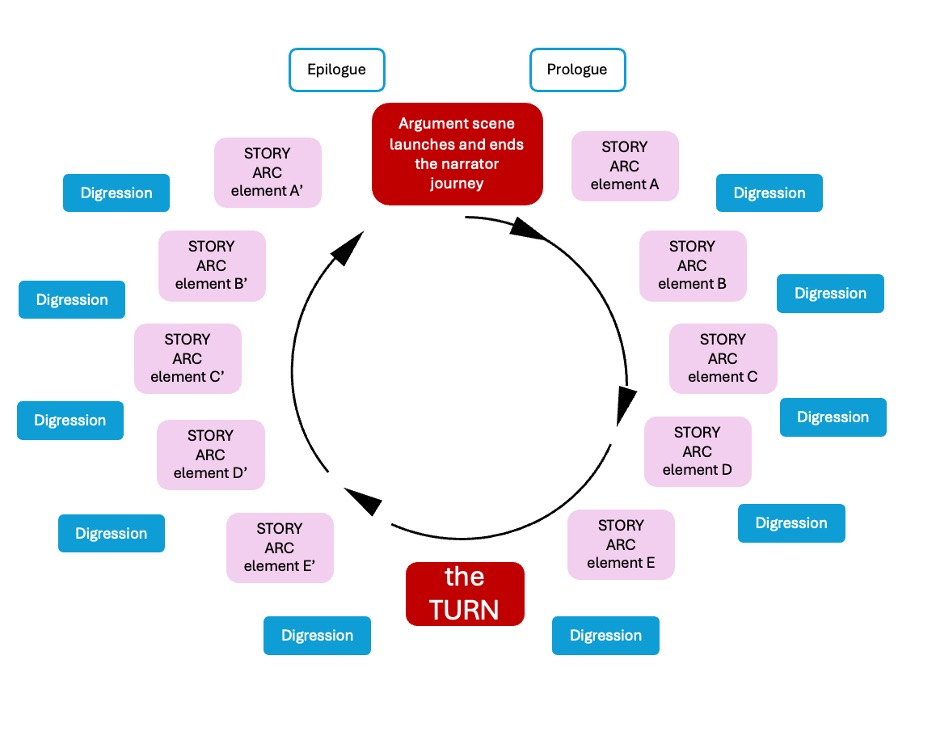
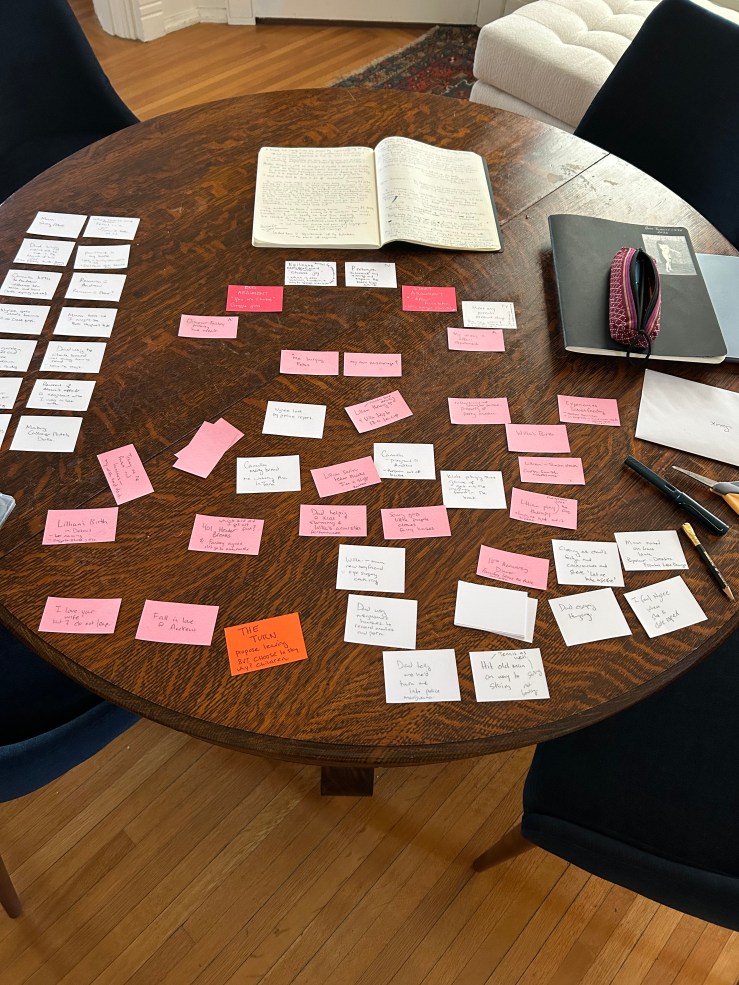
DG also uses diagrams and graphs…something I do in my day job all the time but had never thought to apply to analyzing stories.  George Saunders also does this for story analysis.   I love drawing diagrams and suddenly I’m able to understand composition from a different perspective.  Here’s a few of my recent messy assessment diagrams: 

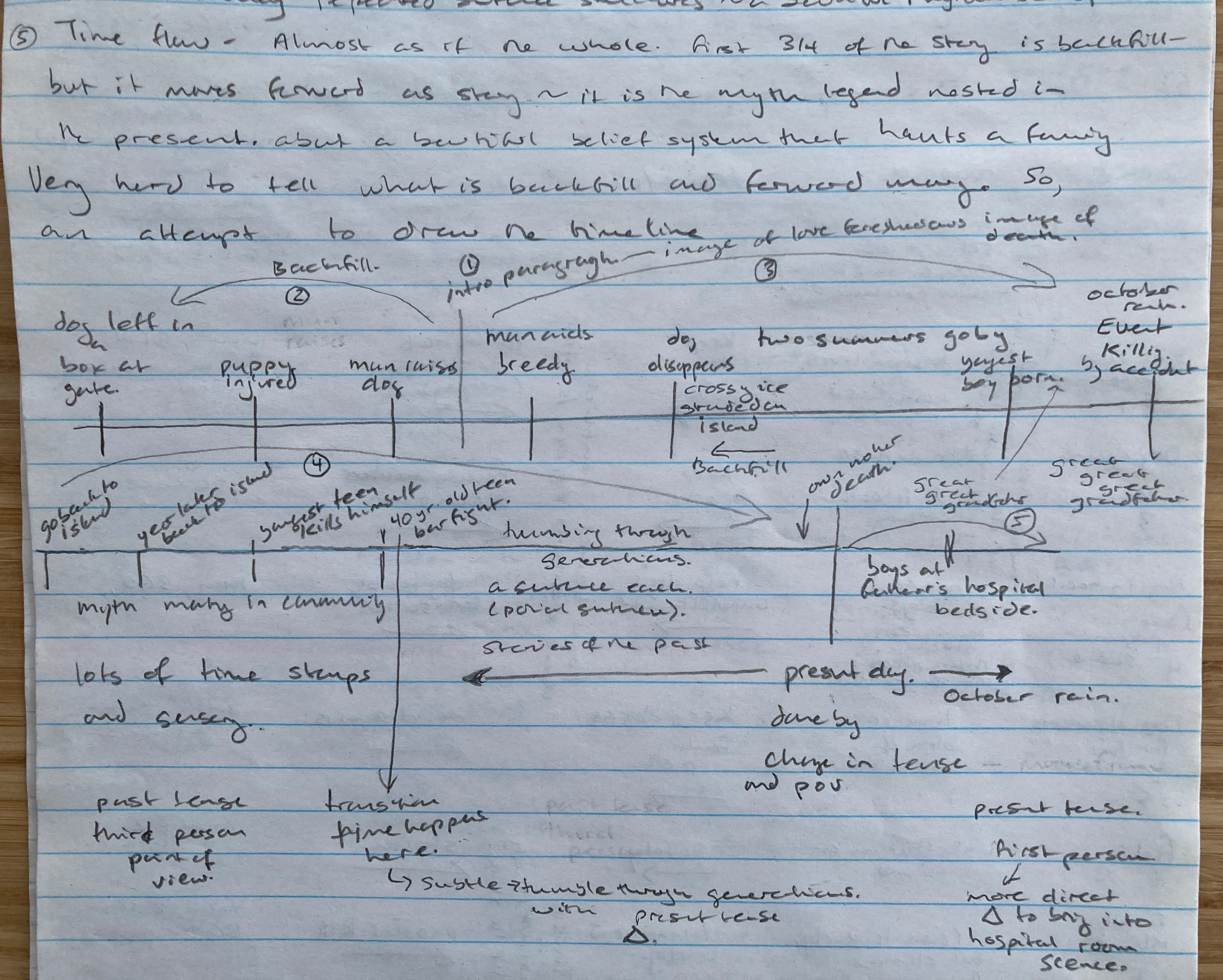
A time flow analysis – depiction of the time flow of actual story events along timeline compared with the series of events relayed in the narrative timeline (not the same!). The circled numbers represent the narrative timeline; the line represents the historical timeline.
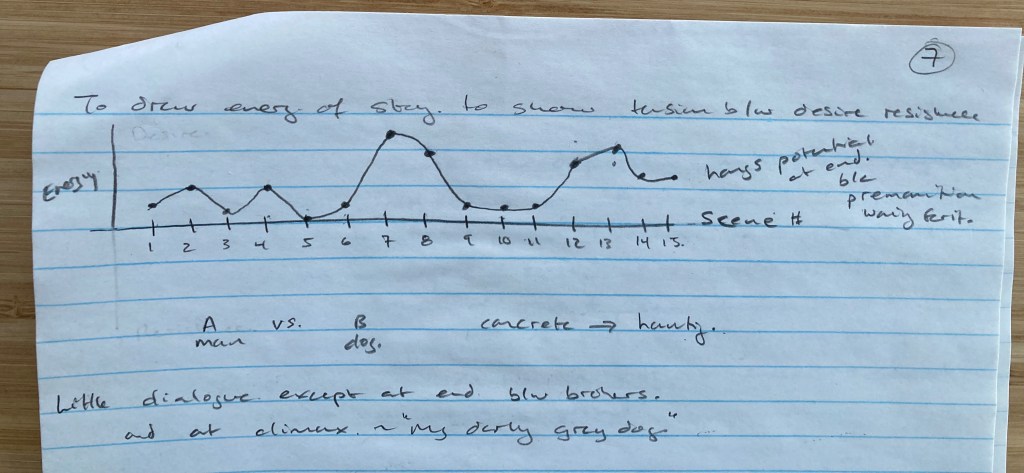
A little graph to illustrate the energy in the story by scene.
A desire and resistance analysis to understand the dynamics of the story.

I have used DG’s reading rubric to work through three short stories. I have chosen stories just by picking ones I love and by picking ones I think might be very different:

I have started to record examples of things in a technical notebook. I have learned more working through these analyses than through any other craft exercise. It’s fun! I plan to allow myself the joy of working through a few more story analyses and then (gulp) I’m going to try applying different forms in my own writing. Scary, but these learnings have provided new writing confidence…at least, a method I might use to attack my shitty drafts and revise them to be better.   For those of you working with creative nonfiction/essay, there’s a reading rubric for this too.  

Because I am a researcher in my day job, this method…this systematic approach… specifically suspending meaning making to analyze text the same way one approaches research data (quantitative and qualitative), brought the whole thing home for me.  

Go Deeper

Last week, writer Lauren Groff tweeted this: “Recently, at every single class visit, some new writer asks me why short stories are so depressing and I usually just fumble an answer about how stories need conflict and tend to be written in a minor key (as opposed to the novel’s span of keys). But honestly, I don’t know.”

This intrigued me.  Of course, twitter is not the right medium for a conversation…it can’t contain the nuance, gesture and tone tools enacted through speech.  These tools we use (and need) to properly grasp and share meaning. Short stories incorporate these tools through craft. And though twitter can promote expansion by provoking further questions: what does depressing mean? Do students ask this question implying depressing stories are no good?  What does Lauren Groff mean by minor key? And, how lovely is that, describing a novel as a span of keys? But on twitter, debate is polarised, appreciation of nuance is non-existent, and rhetoric lands heavy.   

Lauren Groff’s recent story Wind, published in the New Yorker, is a stunning short story that is most definitely “not happy”. The story could serve as the very definition of “not happy”. But I would not call it depressing. The story holds a horrible truth up to the light and makes us (the reader) see and experience its facets of terror and violence and love. (And yes, these constructs frequently share the same bed.) Calling it depressing is an indication the reader has not engaged in the deeper work of questioning our reactions to the story. For stories, written as works of art, are tiny calls to action. Even if that action is a way to tip our minds toward different ways of thinking. Or feeling. Even for a moment.

Lauren Groff’s story Wind is a call to action: to be an active witness to violence against women. The story provokes the question: is witnessing enough?  And goes on to answer that question: absolutely not. The story raises a mirror to show us our participation as simple witness: participation through non action; participation through acceptance. And yes, that makes us feel depressed. But here’s the thing, the story is told through the eyes of a child. This ratchets up the emotional tone, and the fear is visceral. But this point of view does more work: it forces the reader into an innocent perspective…signalling a chance to learn, to experience—to change our minds. And the brilliance of this short story (although, like a diamond, her story’s brilliance has so many facets), is that the narrator begins from the point of view of an adult remembering an episode in her childhood…so…the story is inviting us, as adults, to engage deeper consideration, but from a compassionate stance…an understanding that even as adults, our knowledge in this issue is underdeveloped. We are given a chance to expand our thinking.  And this may never be named “depressing”.  

Narratively, stories do need conflict. Otherwise, they don’t really move and might be better represented as a sculpture. Or a photograph.  I believe Lauren Groff hit upon the answer herself by inserting a music analogy. Think of how many sad songs (lyrics) are layered over beautiful music?  This is what art is.  And what it does.  It uses a medium to move us. To tilt our minds. To help us experience a point of view outside our own. It becomes so much more satisfying when it explores complexity by creating a “thing” that we too can explore and experience a symphony of meaning. 

Like Lauren Groff’s students, I am learning. And when a story strikes us as depressing, it is a little poke of a reminder to ask ourselves why we react this way? Deeper reading of “depressing” short stories helps us hear that minor key. Helps us understand how it fits into the larger song of our lives. And love.   

Writing a Narrative Helix

I listen to a lot of different podcasts about writing.  I’m particularly drawn to detailed craft discussions, conversations about process, and talks about how ideas make it to the page.  Often, by way of a podcast, I’m introduced to a writer I haven’t read yet. This is how I came to the work of Lidia Yuknavitch, author of The Chronology of Water and Verge, among others. You can listen to her fantastic interviews with David Naimon on Between the Covers or with Brendan O’Meara on the Creative Nonfiction Podcast. She also has presented a TED Talk The Beauty of Being a Misfit

Lidia has created a space for writing workshops called Corporeal Writing and generously offers a free intensive 90-minute online session on the Narrative Helix form.  This is an example of a number of Write Now intensives offered online through the website.  I watched the narrative helix video and came to understand the form (two completely different strands of writing, one a themed list of the writer’s choosing, and a second narrative story delivered in short chunks of prose, then interspersed by selections from the [unrelated/maybe related] list…it sounds more complicated than it is…the video of course is much better.  Watch it.). I was intrigued to learn the value of using a different, structured way to enter and write difficult emotional material. 

So, I tried it. And it’s working.  I’ve completed a draft and it’s 7400 words.  I’m aiming to edit it down to 3000 if I can.  But I wanted to write here about the process and experience of working through the exercise.  The list was easy to come up with and populate: 1980s movies.  For the story aspect, I used a photograph from around that time as my jumping off point and a stream of consciousness approach to write everything and anything that popped into my head about each person in the picture.  This was interesting. My thoughts tumbled freely and the memories surfaced easily. The approach also suited my restricted writing schedule…these days only an hour each morning.  But, an hour of solid writing can generate a lot of material, especially if I’m not editing the writing as I work.  

In the video, Lidia discusses how the two narrative strands twist round each other to create a resonance between them (and become a helix).  I didn’t quite believe this would happen…but it did.  When I started writing I wasn’t sure where the project was taking me, I just followed the steps.  Now, after the first draft, I see the repeated imagery (knives) and can question its appearance (I won’t spoil the reason, but it has now become the focus of the essay, the thesis statement, if that makes sense). I’m looking forward to going back and crafting the piece, collaging it together, to carry a reader through my story.  Somehow, the exercise has helped me to understand how the pieces and process work together. I’ve challenged myself further and have signed up for one of the Corporeal Writing online courses…more to come.  

Broken into Beauty

Within the span of weeks, society’s scaffolds have fallen away as nations kneel before the new coronavirus.  No one wants to talk or read about Covid-19, but at the same time it’s all we can talk and read about.  The sudden brokenness, for me, has cracked open a different way of thinking about my own creative writing.  

Each morning I wake there is a moment, while still suspended by sleep, I forget the new realities: isolating at home; the essentialness—and shortage—of masks and gloves; the importance of physical distances between people. As the bliss of sleep-induced amnesia evaporates, the realisation crashes in: the world we moved in no longer exists.

As a public health professional, these last weeks commanded almost all my waking hours.  Creative writing practice was impossible; there was neither time nor peace of mind to do it. Remarkably, the guilt that normally accompanies a break in practice (and eclipses better thoughts) didn’t happen. Instead, it has been a relaxed fall into inevitability; there is no controlling the uncontrollable. I feel resigned.  I feel forgiven. 

So, when I returned to my writings the other day, for solace, to begin with, I reviewed the writings of the last half year with openness and possibility.  Only in this way, was I able to see how much of my writing practice circles round a central theme. What I had taken to be sperate, disparate ideas, are really pieces of something whole… something I haven’t quite figured out yet, but clearly, I’m moving toward (or through).  It feels like an epiphany.  It feels like I’m on the right path, even though I don’t know where it’s going.  

It has also changed my world view. For the first time, I feel optimistic about how, when the virus crawling continents relaxes its grip on our communities, the world might put itself back together differently.  Perhaps in a way that is healing to the earth.  Perhaps in a way that is inclusive and fair.  It is up to us to imagine it and build it.  For the first time, in a long time, I feel it’s possible to do so.    

While dealing with the stress of sudden change, I couldn’t write or draw so one evening moulded bee’s wax into this little sculpture. The smell of honey wafts up from between your fingers working with bee’s wax, it’s lovely. I call this little piece, Horny Lady.

Exhuming Plot: Just Ask

I used to sit down and write a short story in an evening, tinker with it through the week, prepare it for submission and send it out to literary magazines.  Only one of the week-longs has been published; the rest are sticky with rejections. Some encouraging personal rejections from editors lets me know there’s possibility on the horizon. 

So, these last years (yes, years), I’ve dedicated myself to the study of creative writing craft and practice.  I’m better at the studying part. I continue to write every day, but the complexity of understanding and applying the layers of what goes into the making of a great story is daunting: word precision; grammatical sentence variation; paragraphing; elucidating the wonderful complexities of human beings through character development; the importance of setting as metaphor; tension and movement (that winding thread of impossible-not-to-follow suspense we writers gift our readers in its many guises of plot).  

So far, I suck at writing plot. Funny thing: I can tell a story verbally, stringing along my listeners through crescendos to a climactic punchline and raucous laughter, but I can’t do it on the page.  It’s not the same thing.  It reads like a limerick: I know an old man from Nantucket…

Another aspect of writing practice I’ve learned…no, I am learning: I should suspend working on craft aspects of my story until all the generative writing (read: stream of consciousness, letting it all flow out, write to explore, write to open up) is complete.  I make the mistake of thinking I am done my “first story draft”—my “generative writing”—over and over and over and over and over again.  An absence of plot is a good indication more generative writing is to be done.  Even I get bored by my characters not doing much of anything, you know, looking out the window and sighing deeply.  

Two fantastic resources (shining guiding lights) for how to exhume plot from the heavy toil soil of drafts:Alexander Chee and Elizabeth Jarrett Andrew’s book, Living Revision: A Writer’s Craft as Spiritual Practice.  

I’ve been working through Andrew’s Living Revision exercises on a short story I rewrote [again] in July. I was actually sailing through the exercises, exhuming some pretty interesting discoveries (like, my own memories and emotions—yes, I cried several times through these exercises—that are driving this story). Kudos to Andrew’s methods for helping me get that far. But I got stuck, petrified (in the stone sense), on page 101 (of 288) when tasked to write an “expansion draft”.  

I found myself rewriting the same paragraphs of the story, and I did this without any copy and paste…it seemed I couldn’t expand anything, couldn’t go any deeper.  I wondered whether I should just quit the project for a while and try something new (which feels like admitting defeat).

Then, last week, I listened to a podcast, Between The Covers and a craft talk with Alexander Chee and Tin House called, “From First Draft to Plot”.  Chee explained his own experiences, through twenty years of teaching creative writing, how emerging writers (yes, after 6 years, more?, of part-time-squeeze-writing-into-my-busy-life I am only just deserving of the title, “emerging writer”) have not developed the skills (yet) to query the scenes they have written.  

Chee explains there are many implications in student’s draft scenes that have not been dealt with…unmet implications the writer is ignoring.  His advice: ask questions of your scenes, such as, how did the character end up there? Why? Where is this character from?  What was their schooling like?  Chee says, “to build a story and a plot is the process of interrogating the scene, again and again with questions and each time you get answers, push back further and further into the story as far as you can go.”

Of course, most of this additional writing never makes it into the story, but instead becomes the skeleton, the subtext, the backstory the writer must know, know on instinct, know on a sub-conscious level, in order to puppet master their story to life.  

So….I’m writing questions.  I’m writing answers.  I’m going deeper.  Write On.