Killing the Phantom

Okay. I’ve scrapped much of what I drafted for this post. Instead, I’m pasting in a few extracts of random jottings, conversations, and responses to writing prompts in the last month or so[1]. Some chaotic thoughts, shredded remnants of what I’d originally intended to write, follow. And this is a long post, so grab a mug of something and settle in.   

Ready?  These are drafts [she wailed loudly to cover up her delicate vulnerability ha ha]! Fuck it, here goes.

In response to a prompt to write 400 words about the origin of my name (558 words):

My name, my first name, Suzanne, means Lily or Rose, an unintentional connection when naming my own two daughters: the eldest with the name of Lillian, the younger with the middle name of Rose. All of us blossoming.

My own mother chose my name, naming me after her favourite cousin of many. I do not know what made Suzanne my mother’s favourite cousin, but I imagine it might be because Suzanne was kind, that perhaps, unlike the other twiggy branches of the family tree—even the trunk of my mum’s own mother—banished mum when she fell pregnant out of wedlock. She was forced to endure the pregnancy in secret, to endure the betrayal alone, to endure the abandonment of the man she had loved not just with her body but also her soul to create the wee soul swimming in the womb of her body.

Mum was sent to hide her pregnancy on a remote farm where the five kids who lived there threw rocks at her while the farmwife, their own mother, watched and said nothing. Perhaps she encouraged her children in the methods of this stoning. This stonewalling.  

To name is to categorize. Bastard. Whore. Slut. And the name stuck. Not on the outside of mum’s skin but worming deep in her mind, free floating the very cells of amniotic fluid the foetus hiccupped down and in, down and into their own cells. This is the way of water. It trickles incremental with the power to erode granite. Walls of stone.

Suzanne, when I met her in New Zealand, visiting when I was twenty-three, was a gentle quiet soul. She kept a canary in a cage in her kitchen who she spoke with each morning, coaxing his song. His name was Bird. He was who he was. Plain and simple and straightforward and beautiful. I marveled the amazing synchronicity of Suzanne’s movements when one day she stepped into the garden with a pair of scissors glinting the dawn. She clipped a stem with a few leaves of milkweed, brought this inside and placed it in an open mason jar. She held the jar up, a jewel in the light, to show me the chrysalis hanging the fork between leaf and stem. The chrysalis was chartreuse with a tiny necklace of gold, specks of dark between the golden granules. A monarch chrysalis, she said. But of course, I knew, for my mother too, continents and oceans and seasons and days and nights across the planet also brought monarch chrysalides inside and kept them in open mason jars to marvel the wondrous metamorphosis, the miracle of worm become butterfly.

As the butterfly formed, cocooned within, the chrysalis darkened to black. Then it cracked, splitting open from gold shoulders down to tip, the walls of the chrysalis transparent as glass, smashed open with the power of wings within. And the butterfly unfolded to hang beneath a milkweed leaf, to dry its wet wings to a powder coated blaze of fire colour. When it started exercising, fanning for flight, my mother and Suzanne stepped into their gardens with their wide-open jars to witness the transformation that is flight. That is freedom. And the flowers blossomed all round. And in this way, I learned how we and everything in this world are all connected. And not just by how we are named[2].   

One paragraph’s worth of writing toward the long project (386 words):

The condom broke. This is how I imagine it years later from the benign safety of a different generation. A generation—only a couple of decades—where, when the condom broke, sliding out from my own slippery insides to reveal its terrifying tatters dripping loosened semen on the insides of my thighs, a Sunday morning I recall, I looked up my physician’s name in the phone book and called his house and his daughter, who I knew was in grade three, answered, and he took an inordinately long time to come to the phone, probably summoned from mowing the lawn or some other mundane morning task, while I waited, dripping the vestiges of lovemaking onto the coffee table in my eighteen year-old boyfriend’s living room, the marble chess pieces strewn round my naked ass where they’d been knocked sideways to the floor, knight to queen (!), which was, I realise with hindsight, probably better categorized as fucking instead of lovemaking, fun fucking where, even when the marble bishop stabbed my spine’s base, my voice climbed the heights to climax fast and shuddering, and, when my doctor who had been my doctor since almost before memory, finally answered his telephone, I, ever polite, apologised for disturbing his personal peace and calmly, rationally, explained my situation, omitting, of course, the unnecessary details of the coffee table, the chess board, its marble pieces gone flying,  but supplying the dates of my last period, a riveting estimation of my ovulation window and talked through a risk benefit analysis of heading to the hospital emergency to request a morning after pill, a pill I knew from friends’ experiences of bleeding a hemorrhaging volume of blood down the shower drain, the running water drowning the sounds of wailing hearts and cramp pain, I really preferred to avoid, but only slightly less than an unwanted pregnancy at age nineteen (I would be entering university in the fall), my physician and I agreed, I might forego it. This time.  He reminded me I ought get back on The Pill. I’d used oral contraceptives since aged sixteen and discontinued them by aged seventeen, deciding they “made me squirrely”, and not in the sexy way. Condoms would have to do. But, alone as a contraceptive with wildly rambunctious sex (gawd that feels good!), they were risky[3].

Random lines from notebooks[4]:

  • I don’t want to be a whore; I want to be a whore and so much more. (2025)
  • If I were to create an avatar, I’d give myself a unicorn horn. I wouldn’t necessarily strap it to my forehead. (2019)
  • Internalized misogyny – IM – good nickname for a dildo. (2024)

In a coffee shop:

“Suzanne, stop flirting with the barista.”

“I’m not flirting with him; he’d know if I was flirting with him.” [Young Irish barista blushes bright pink.]

Speaking with a friend:

Me: “Well, she is a widow…”

Friend: “Yeah, but she isn’t a failure; a death is different than a divorce.[5]

Sentence practice in paragraph form, playing with narrative distance[6]:

Camilla is holding her sorrow in, squaring her shoulders, dreaming not of the lovemaking that landed her here, discussing “the solution” over tea with her mother and G’s father, his stern eyebrows, not of the electricity that sparked her lips when she first kissed G at the back of the lab, thinking not of the fetus hiccupping the amniotic fluid bubbly within her, the baby who has not yet quickened. It shouldn’t be a conversation between four people. It doesn’t matter if the fifth person, the baby, might also have a voice. She hadn’t really heard G, when he said the condom broke. He turned away. He hadn’t met her eyes. He’d reminded her of a sheep, caught in the barb wire of a fence.  The roundness of his naked shoulders, the muscles rolling beneath the heat of her palms, the dry sweet scent of crushed straw beneath, the way his body slipped so easily, becoming part of her own, his moist breath huffing the whorl of her ear, how two bodies become one, she’s not remembering it now. There are rules, love does not govern them, the laws and the systems and society’s expectations and the differences for men, for women—any notion love might prevail or triumph to hold a creation together. The baby will be born, surrendered to another family, and Camilla’s own development arrested there, at age twenty-three, the moment she’ll never forgive herself for, the pain of giving her baby away, the heart beating at the center of her liquid addiction[7].

I’m sure I’ve written this before: it often happens a particular piece of writing lands below my eyeballs at the perfect time. I mean, at the perfect time to teach me something I need to learn, at the perfect time I might finally be able to understand a work of writing or perceive it differently from a previous reading, at the perfect time to crack my eggy thinking open.

This time it was Professions for Women, an abbreviated version of a talk Virginia Woolf gave to a branch of the National Society for Women’s Service on January 21, 1931. To add a little context to this inter-war period date, two million women in the UK had replaced men in traditionally male jobs during WWI and they had only secured the right to vote in 1928, three years before Woolf delivered her speech. These facts feel like distant history, but this is not at all long ago.

A synchronicity: also read The Prime of Miss Jean Brodie with book club this month, set in the inter-war period, though, written in 1961 from a woman’s perspective and of women experiences and I laughed out loud a lot while reading it. Muriel Spark writes funny. An exploration of the fine line between nurturing and grooming; how thought and action might be manipulated. The creeping insidiousness of fascist and/or religious ideologies into malleable minds, how might it be achieved[8]?  

Why this little history lesson?  I was struck by the optimism and agency of women, the possibilities and independence, Woolf  commented on, opening to them at that time, women in their prime (!)…and struck… in a kind of devastating way, [here, I crave a distracting paragraph about waves of feminism, or better, gender and sex politics, or best, something raunchily erotic about how much I enjoy sex[9]] because I feel we’re falling—failing—backwards. [Huh, this subject is also an avoidance, a path too easily followed.]

Okay, [wince], here it is (took paras and pages to get here): because reading Woolf’s speech, I recognized how, in my own marriage, I was (am?)—embarrassingly so[10] —what Woolf named the Angel in the House. I was (am?) that selfless, sacrificial woman whose sole purpose in life is to soothe, flatter, and comfort men, but also …everyone else, other than myself, while raising a family with efficiency. And my experience of being that woman was to become invisible. It is partly what I’m exploring through the writing of the long project. A small part; I’m far more interested in how experiences of shame, betrayal, cruelty shape…not just a life, but relationships. And not just within a lifetime but crossing generations.  How legacies of pain endure and continue to shape…behaviours, choices, how and who we love. Also, thought. But wait, what “Jean Brodie” groomed me to be the Angel when I was born into a generation and country where women experience more choice and more access and more autonomy and more agency than any other historically?  These ideas are related; I’m exploring them, using my life as the sacrificial lamb (and suddenly I’m thinking of mint sauce).   

Most recent writing of the long project, evidenced by the extracted examples of writing practice above, has been attempting to write the story of how, in the 1960s, my mum “surrendered” (this is the wording used at the time) two different babies for adoption. Two different fathers. Two different countries with different sets of laws. I have two brothers in addition to the one I grew up with[11].

Each time I’ve tried to enter and write the scenes circling mum’s experiences, I slide into writing my own instead. I’ve allowed myself to drift, trusting the process of writing, following where it takes me. I’m both bewildered and grateful to report the imagery arising out of these seeming tangents bring to light very strong images to crack open my thinking about mum’s stories (the bishop!). But the writing has been very slow and very hard to sit with and real work to get it to the page. I’ve been trying to understand why[12]. And Woolf’s speech calls out and answers my pained confusion[13].

“Killing the Angel in the House was part of the occupation of a woman writer.”

Woolf ‘s speech talks about how she managed to kill The Angel. And I believed I’d killed her too[14]. But Woolf continues her thinking, naming the Angel differently, accurately, as The Phantom. And I’m going to mash up some of her sentences here, which I’m sure is a very grave sin, to elucidate my own understanding…think of it in the same way as rap sampling:

It is far harder to kill a phantom than a reality. She was always creeping back when I thought I had despatched her. Though I flatter myself that I killed her in the end, the struggle was severe; it took much time… To speak without figure she [the woman writer] had thought of something, something about the body, about the passions which it was unfitting for her as a woman to say… The consciousness of…the truth about her passions had roused her from her artist’s state of unconsciousness. She could write no more. The trance was over. Her imagination could work no longer… women writers…are impeded by the extreme conventionality… control the extreme severity with which… freedom… [is]condemn[ed] in women… telling the truth about my own experiences as a body… The obstacles against her are still immensely powerful–and yet they are very difficult to define. Outwardly, what is simpler than to write books? Outwardly, what obstacles are there for a woman rather than for a man? Inwardly, I think, the case is very different; she has still many ghosts to fight, many prejudices to overcome. Indeed it will be a long time still, I think, before a woman can sit down to write a book without finding a phantom to be slain…

So…my Writing Resistance…it’s this haunting…the phantom in my bones, it’s the air I’m breathing, it’s part of me…this belief that what I write, the experience of being a woman, a mother, a daughter, a wife, cannot be said, or is uninteresting, or has no value. As Wool says, “the aims for which we are fighting, for which we are doing battle with these formidable obstaclesmust be perpetually questioned and examined.”  I’m interested to learn how my beliefs settled into my cells, forming my selves, and influencing all the choices I make in this one precious life[15].


[1] Why? Because I think it’s important to show one another our first draft writings…it’s a nakedness to be sure …my thinking is naked and vulnerable, not to mention my writing skill level (uh, shallow) BUT I find in these first draft writings, they’re authentic, real…something from the collective subconscious has washed through my body of embedded experiences and sprinkled the page with tiny glittering tidings, the shells of ideas, memories, feelings I can pick up and pocket to explore with deeper curiosity.  I’ll try to signal these vibrations I feel from my drafty writings using footnotes.  The collection selected to post here illuminates how my thinking is circling around similar ideas as I struggle to fold them into being a part of the long project (book length work in progress).

[2] This piece was lightly edited when I transcribed it from my notebook where it was written by hand. I’m still stunned by how it unfolded to these images, these resonances, written in a fast flurry of < 30 minutes. The vibrations, for me, emanate from the words “stone” and “wall” signalled by the repetition…but also the metamorphosis …an encasement (cage), a transformation, a freedom. The metamorphosis is both literal (butterfly) and metaphoric (what is hinted at with the baby in the womb and the cells and the genetic legacies being gulped there…but also…that caged canary…what is he doing there? Random thought: canary in the coal mine…).

[3] The vibration here comes at me as if it the text flashed pink neon: the bishop chess piece, piercing the narrator’s spine. This image appeared in the quick writing, it’s not a specific memory at all…but it’s one of those glittering grains illuminating a pathway, a gift straight from the subconscious, a guide toward something brewing in the larger work.  My mum’s experience of giving two babies up for adoption in the 1960s is not the central subject or theme of the long project at all. But it’s helping to form those ideas, and her history is part of it all …this blog post reveals more to me about what it is I’m exploring. Glad you’re here along for the ride. Really.  I need hand holding. And encouragement, however tenuous it may be.

[4] I like how these lines hang together. No pun intended.

[5] This was meant as a joke; we laughed hard because many women (and not men) have made me feel like I’ve failed a most important task: marriage. And note, I have/do/trying to squash… felt/feel/feeling like a failure (IM at work).

[6] Practicing with Nina Schuyler using a paragraph and sentences from Rita Bullwinkel’s novel Headshot.

[7] With this last sentence, Nina said to be cautious here with this level of narrative distance…ask myself, have I lifted too far out of the story and summarised too much, given away too much, when this might be better as information meted out with scene and story? And I understood, in a way I hadn’t quite grasped before, how this is also another way of exploring the difference between showing and telling…and how that choice can be deliberate to move the story along, or drop into a moment of character or narrator reflection, or create authorial intrusions, or create a clue as to what might be coming later in the story  … many techniques to be employed by this method…and I think I often default doing this, pulling myself out of story to this high level bird’s eye view summary, especially when the scene or the subject matter might require sitting with emotional discomfort, getting it onto the page…and this means I cheapen the experience for a reader, when it’s much more exciting or entertaining  to get in close and personal…to experience together. Still, I love this movement, playing with psychic distance, that it can be done across sentences within the same paragraph.

[8] Monstrous recognition this pattern of history is repeating.

[9] And I must clarify something here: when I write about misogyny, sexism, the patriarchy, feminism, etc. I am NOT writing against men, and certainly not an individual or specific man. I LOVE MEN. I am writing about ideas and ideologies and I’m far more interested in how these ideas shape human lives and human relationships. It’s difficult to write and talk about these ideas because the shrill voice of the masses are salivating and ready to burn the witch at the stake or tar and feather the feminist or accuse her of becoming a raving lesbian, as if this were something bad, or a hairy man hater …we need to talk about these ideas outside the confines of categories. They’re interesting. [edited out: a long diatribe repeating the same idea and without any academic level of feminist theory because I’m a neophyte in this respect.]

[10] One of my dearest and oldest friends when I announced I’d left my marriage, said, “we couldn’t understand it, you were like some goddamned Little House on The Prairie woman out there [on the farm].”  This hurt of course….the collective “we” …how much had my life been discussed?…but also, the truth of it – I verily (ha ha) believed, stupidly, I could do it all: raise my children well and healthy; grow my own food; develop a professional career; maintain a creative art practice; be a kind and supportive partner; be a dutiful daughter-in-law; be an honourable daughter and sibling. Maybe I was able to do it all, at least for a little while. Like, three to five minutes?

[11] And our family reunited with both brothers …and the most fascinating discovery for me has been that despite being raised in three different countries, in three different families, we share the same ways of moving our arms and hands when we speak, the same way we place our bodies in space. I love that gesture is something inherited. Unfortunately, we also share the same addictive tendencies to alcohol …or perhaps this is simply a symptom of living with pain of similar origin…

[12] Skip this extra-long footnote if you don’t want to read my whining. No? Fine then. I’ve also been tired and sensitive and overwhelmed and vulnerable and weepy this last month worrying about my job. After five years of remote and hybrid working, the Secretary of Cabinet announced all public servants will be required to report to their headquarter office (a new term btw to skirt the possibility staff might satisfy their required in-office days at a ministry building closer to where they live). The decision significantly impacts people who struggle to balance raising children or caring for elderly parents with their workdays, roles more often shouldered by women. The decision unnecessarily costs the tax-payer with the sudden and inane administrative burden to, one, fit workers into offices that can’t accommodate all staff five days a week (much real estate was sold off since the pandemic), and two, adjudicate the thousands of requests for alternative work arrangements flooding managers and directors inboxes, decimating, possibly even arresting regular duties re: policy making. There are close to 70, 000 public servants in Ontario and the announcement has us all whipping a hurricane of negativity and competition (not to mention a turbid froth of distraction). On the heels of several disappointments since spring (three colleagues sparkling with intelligence, kind and dedicated mentors, have left their jobs; weathering the policy oppression tentacles from the south successfully supressing equity focused language and progress in the north (I feel this personally, as an erosion), my “professional” role feels fucking flattened.

AND (worst) my story, Measures, accepted for publication…was later declined. The editor requested confirmation the story was unpublished. I confirmed yes, the version on offer was unpublished, but, I explained, earlier drafts of the story have been posted, and broadcast on my personal blog (this one). So, they chose not to publish it.  Cue the loud whining: really what I want to do is read books and sit and think and write all day long…well, with breaks to feast and f…make love.

[13] There is much in Woolf’s speech that resonates for me; this post can’t contain it. Never mind. I’ll revisit her ideas and imagery about the unconscious in the future.

[14] The decision to end a marriage of twenty-five years, a relationship of twenty-seven, is…fucking hard. Ultimately, what gave me the courage to make the leap was a moment, a strike of lightening moment, when I understood with utmost clarity [insert the scent of burning ozone], that if I wanted to continue to grow my creative writing practice, I would have to leave. If I stayed, my writing practice would have been undermined and suppressed.  It is hard for me to reconcile but my writing was perceived as threatening and seditious.

Awake, I see, there is no way to unsee.

As Woolf explains, “I turned upon her [the Angel] and caught her by the throat. I did my best to kill her…Had I not killed her she would have killed me. She would have plucked the heart out of my writing.”

My divorce certificate arrived last week. I’m proud we managed this in just under two years following my decision to leave. I made concessions. I’m proud of this too. Money has never been my motivating factor; pleasure is (wink). Oh, and joy. Really, my lodestar is love.  

[15] It is hilarious to me how Woolf writes about what she decided to do with the money earned from her first “professional” publication: “I bought a Persian cat with the proceeds.” After much deliberation and speaking with Lillian and Willa about the possibility I might have to live in their garden sheds when I retire, I have decided to buy myself a year off work, a self-funded sabbatical, so that I can experience what it is like to focus on my own creative work. Also, with no expectations of output from the year. Simply the ability to focus without my mind divided across professional policy work and artistic practice.  My leave of absence request has yet to be approved, but the wheels are in motion. I plan for my leave to begin spring 2026. It feels absolutely right.
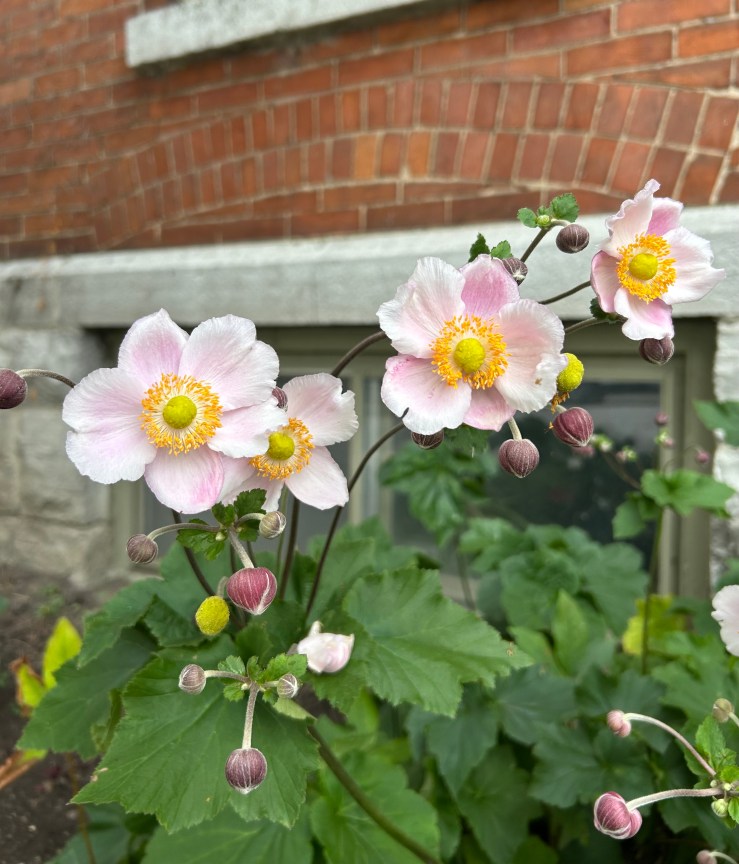
Japanese anemones outside the apartment this week.

Get’n Fun Back in Funktional

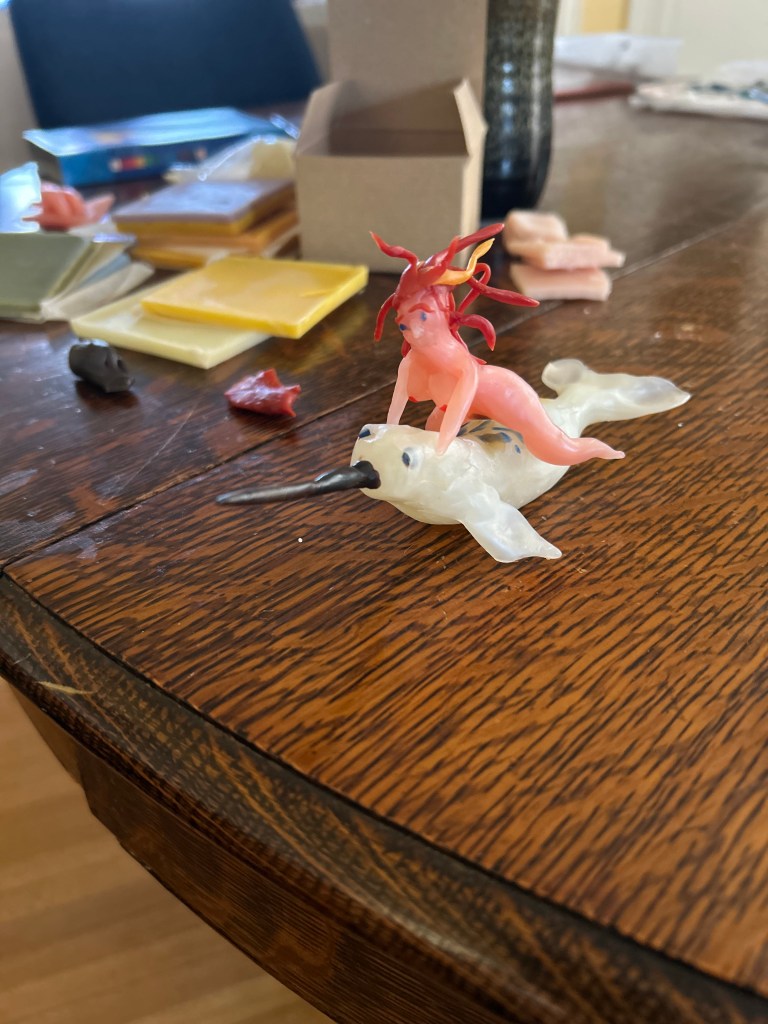
Woman riding a Narwhal. She arrived in my mind seven years ago through the invitational creative exercise of active imagination1. Swimming and flipping and delighting in a dark indigo sea dotted with chunks of luminous ice, while the “I” of me observed, the narwhal appeared. In my dreamy inner-mind dialogue with the image, the narwhal chided me (yes, less criticism, it was delivered more softly, with humour) for how I’ve forgotten how to swim and encouraged me to explore the depths. Then, some truly frightening images floated from the ink-blue dark, half rotted faces of people I love and other shadows swirled, threatening to reveal themselves. I was instantly frightened. Then, up popped the narwhal, splashing through the shadows to explain I needn’t be afraid, the water will catch me, they (?) will not let me fall2. I started to cry. Not pretendingly. In reality. Tears rolled my cheeks but I remained suspended in active imagination so I asked, can I learn to swim again? The narwhal laughed, and said, of course! The water is in you always! The water is in you! Yes, the narwal was emphatic. How? How do I learn? The narwhal flipped and turned amidst the sea ice, one coordinated muscle arcing. It’s words echoed over and over as I surfaced from dream to consciousness: Let go! Let go! It’s fun to let go!

A few days later3, the narwhal appeared again and I asked the image why it had come. It answered: To navigate the depths, to help me go deeper. The narwhal dove fast then, it’s dapple grey skin deepening to a green glowy sheen. The image shifted to show a girl riding the narwhal, holding tight as it dragged her fast and swift beneath the surface. The narwhal’s horn pierced the depths effortlessly. What else do you have to tell me? The narwhal replied, It’s fun, it’s fun to pierce the depths, don’t be afraid! I wondered if I’d be able to breathe and the narwhal actually laughed, almost scoffed and, voice deadpan, Of course you’ll be able to breathe.

I wanted to capture the image, but I didn’t feel I’d be able to render it well enough drawing or painting. Instead, I opted to model it using beeswax, investing a tiny fortune in different colours4. And when the beeswax arrived, I stuck the little packets in a box with a bunch of other art supplies where they waited, patiently, for my creative hands. Turns out, the time for that was last month, seven years (!) after the narwhal and the rider arrived in my mind’s eye. In Jung’s approach, creating a tangible representation of image–out of the subconscious dream world and into this one–is an essential part of the process5. Reflecting on the little model I created, (a little more cartoony than I’d like, also, in the original image, the rider was a young girl in a red dress, in the hand modelling she became a woman nude), it kinda aligns with last month’s post about fishing the subconscious for emotion and feelings…I think, no, I feel (that’s better), I’m finally ready to explore those depths with the curiosity and joy and play required for the task6.

Another creative practice serendipity: a friend from bookclub asked me to guest instruct her grade twelve creative writing class. She explained they were covering a unit about creating characters. She warned they were a quiet and shy bunch, a cohort having suffered crucial social development years in pandemic isolation. My goal was to get the students reading their own writing aloud–even it it was just a favourite word–by the end of the class. And to have fun.

And it was fun! We co-created characters, listing various gestures and personality quirks, super powers and pet peeves, desires and obsessions as they were called out. We wrote the list on blank sheets of paper, passing the papers round the classroom after each prompt so that no character “belonged” to any one writer. Instead, iterative dimensions of character layered upon what had been written on each paper offered to hand. We shared some of the character creations aloud. Then, lists of descriptions completed, we crumpled the papers into balls and threw them round the room, followed by a mad dash to pick one up as “an assigned character” to write about. The final writing prompt was: what does this character’s best (or) worst day look like? (Or, if a writer felt inspired to write something else, that was encouraged too.) We wrote together for ten minutes while instrumental music played7. Afterwards, we went round the room and everyone shared their favourite line they wrote, then, several students volunteered to read their drafts entire. The pieces were lovely…full of energy and humour and sensory details. We laughed a lot.

Last month I wrote a poem about being a Canadian tourist in Mexico. I visited Mexico two years ago. That poem’s been cooking since then. I’ve tucked it aside for now, to let it breathe on its own for a bit before I go back and fiddle with it. I read it to a friend who said, Just. Don’t touch it!

Turning again towards long project writing I realized I’ve spent time practicing at the sentence level with shorter pieces … and I have no idea where to begin at the story level for a longer work. I was reminded of Nina Schuyler‘s descriptive analogy of writing process. How, at the sentence level, you’re working at ground level, but then you have to climb a mountain to get a better bird’s eye view of the paragraph level, then the chapter level, then the whole story level. And in writing any creative work, you run up and down that mountain, tweaking and refining over and over and over again, until there is a synergy of sounds and symbols and patterns energizing a wholistic work of art. I feel like I just laced up a stiff new pair of hiking boots on badly blistered heels in the base camp parking lot.

Last month I received three rejections from literary magazines. Two for a short creative nonfiction piece and one for the introductory chapter/essay to the long form project. I know I’m not supposed to say so–that it’s all a part of writing practice, that I “need a thicker shell”–but the rejection breaks my heart8.

When I’m sad I always turn to reading. Pat Schneider’s Writing Alone and With Others, as well as any essay written by Ursula K. Le Guin, always offer a grounding, resetting perspective about what really matters: love of creative work. The process. Running up and down the mountain. For fun. By way of Pat Schneider, I’m introduced to this wisdom, a consolation, about submitting creative writing for publication from Marge Piercy, “Never say ‘submit’! Say offer.” Yes, absolutely right. So, let’s end here with one of her poems:
For the young who want to

By Marge Piercy

Talent is what they say
you have after the novel
is published and favorably
reviewed. Beforehand what
you have is a tedious
delusion, a hobby like knitting.

Work is what you have done
after the play is produced
and the audience claps.
Before that friends keep asking
when you are planning to go
out and get a job.

Genius is what they know you
had after the third volume
of remarkable poems. Earlier
they accuse you of withdrawing,
ask why you don’t have a baby,
call you a bum.

The reason people want M.F.A.’s,
take workshops with fancy names
when all you can really
learn is a few techniques,
typing instructions and some-
body else’s mannerisms

is that every artist lacks
a license to hang on the wall
like your optician, your vet
proving you may be a clumsy sadist
whose fillings fall into the stew
but you’re certified a dentist.

The real writer is one
who really writes. Talent
is an invention like phlogiston
after the fact of fire.
Work is its own cure. You have to
like it better than being loved.

That line about a tedious delusion, a hobby like knitting, makes me laugh. And though I agree with the final line, I feel you have to love the work AND you have to infuse the work with your love. This is the way love swims the Möbius loop to pierce the heart of a reader.


  1. I try to practice active imagination semi-regularly. Here’s a quick guide to explain the Jungian technique for fishing the subconscious. A few years ago, exercising my mind this way, I found it relatively easy to descend into a floaty state, meditating somewhere between dream and wakefulness. The images, most often animals (a bluebird, a spider, like Charlotte in E. B. White’s classic, a bee, a butterfly, a tortoise, the narwhal, etc.) surfaced and I was able to dialogue with them. It has been more challenging to succeed with the exercise lately (the last year or two?). Often I fall asleep. A sure sign rest is needed. More worrying is that I can’t get past the chatter brain of thoughts being expressed in words…I can’t seem to summon the images as easily. ↩︎
  2. I know it seems like I’ve rather lost my mind, conversing with the images therein…but, ha ha, isn’t that kind of the point? My own mind, carved and chiseled by culture, by categorization in language form, so easily manipulates, obfuscates …these exercises are meant to transcend those boundaries and restrictions as a gateway to creativity. Besides, it’s kinda fun. Except for the scary rotting face images…a risk I’m willing to take in the comfort of my home. ↩︎
  3. 10 days – I checked my dream/active imagination journal. The narwhal images appeared in June 2018. ↩︎
  4. Beeswax is really wonderful to work with on a small scale. The wax warms in your hand to become malleable and releases a honey scent with a hint of camphor. As the wax cools to room temperature, it hardens again. ↩︎
  5. And really, isn’t this what creative writing is too? ↩︎
  6. She wrote pleadingly. ↩︎
  7. The character I had was a horse thief able to communicate telepathically with horses, but alas, addicted to maple syrup and always had sticky hands. ↩︎
  8. This, on top of continuing violence and injustice and ecological destruction…and this f’ing winter that drags on ….and that living in the city I won’t hear the spring peepers calling from the flooded fields…threatens a dark funk I won’t be able to pull myself from…finding and sharing beauty and joy and love and a fantastic funk song and love of writing in community is the only antidote. ↩︎

Missing Your Missives

I’m learning to work with my subconscious[1] for creative writing. My ability to do this…no, that’s not quite right, I mean my ability to control this—with attention and technique and love—is a recent accomplishment[2]. Gonna use this post to unpack and articulate my two-phase process (and celebrate my progress to a nascent phase two, because man oh man, it’s been a long time coming. Years!).

Phase One: Fish into the subconscious to dredge its messages to consciousness

The most interesting writing** I generate arises four ways. Sometimes these methods overlap with one another. Note a couple of these approaches apply some sort of restriction/constraint to the writing process[3]:

  1. Swiftly written stream of consciousness writing in response to a prompt (i.e., write to the line blah blah… or, write an answer to blah blah question…or, write the scene between character A and B when…). Swiftly written means timed (short, < 15 minutes, though I have stretched drafting to < 30 minutes)
  2. Using another piece of writing, a sentence’s or a poem’s, syntax or rhetorical device or structural form, as a template with which to slot in my own words, images and thoughts.
  3. A line or an image that floats to me when I’m relaxed and engaged in another task (e.g., walking (exercising in general actually), showering, washing dishes, staring out the window, lying in bed[4]).
  4. From dreams[5].

For me, applying a restriction when writing provokes my brain to think sideways. By this I mean punts me off my comfortable (well-trodden) neural pathways and avoid my default “thinking/meaning making” mode. The restriction stimulates “dreaming/imagining” mode (which is the natural state for #3 and #4 in the above list[6]).

**What do I mean by interesting writing? Here are some recent examples:

TypeGenerative methodExample pulled from breezy drafts written in the last month
Image< 12 minute response to a writing promptA woman dragging her carcass of a body on the back of a smile, marionette strings with which her dead weights were held up
ImageDreamA massive black bear sitting on a stony shore, calm grey lake water, catching shiny silver fish. Then it’s holding an infant, and I hear rather than watch the bear’s jaws crunch through the baby’s neck and my thought is, ‘Ah well, I guess that’s done.’
Thought or IdeaFloater while exercisingPeople often use water words and imagery when they talk about the subconscious (e.g., stream, flow, ocean of awareness, diving deeper, swimming below the surface)
Comparison< 15 minute response to a writing promptWe’re taught to read…26 letters in the English alphabet and the millions of words they generate…but we’re never taught to read each other …and though we’re never taught, we do read these betweens (facial expressions, gestures, vocal tone, etc.), read them better than words sometimes.
MetaphorUsing a sentence by Peter Orner as a templateWe started up, as you do lying to yourself: in the net of a valid excuse.[7]
Analogy (ish)Stream of consciousness journaling when too tired before bed (not in the list above, but also, kind of a restriction …or imposed handicap)I am a broken heart. It’s just sometimes I believe you can mend it. It’s the belief that destroys me.
Surprising wordUsing a sentence by Jonathon Keats as a templateTympanic   (I know! I swear this word dropped from the universe onto the page…I wasn’t even sure it was a real word. I looked it up later. It is.)

Now, ideally, I should be able to write this way for longer periods with practice and without the necessary restrictions to provoke the interesting writing. But the truth is, I’m really challenged with this. Many writers can access the subconscious more easily …it’s a state that seems more natural for them.

A thought: the challenge accessing the subconscious might be the reason many artists and writers use alcohol or drugs—the inhibition substances enable—to create art. Substances lower the socio-cultural pressure gates, sanctioning a more permeable membrane between consciousness and subconsciousness. It’s a delicate balance to manage and risk of addiction is…high (no pun intended), so not an ideal pathway.

Substance use also alleviates deep emotional pain, a pain all humans endure to some degree…I’ll come back to this shortly.

So, there’s phase one. And I can confidently claim creating writing drafts that surface magical subconscious gifts. What I’ve been stumped by, until recently, is how to work with the gifted images to integrate them into a completed piece (story or poem).

Here’s my default strategy in a nutshell. The other week I was walking with a writer friend, discussing writing. Not for the first time, she said, “I have to tell you, I noticed it in your writing way back then, and you continue to do it: you overthink your writing,” we were wading a substantial snowbank and it interrupted her train of thought, “You need to….”  here her voice trailed off to silence. Cliffhanger!!! Trying to keep my desperation in check, cough cough, swiping the snow from my legs, I asked, “More emotion? More feeling?”  Yes, she said.

Truth is, I was flummoxed. Wasn’t I doing this already? Actually, no.[8]

Now, I’ve read enough craft essays at this point to understand there’s a chasm wide difference between applying a technical move to integrate emotion and the sublime skill of layering emotion in a piece to create a work of art. This is the same difference I can taste in dishes and desserts that are technically proficient but nevertheless lack a quality I swear to gawd I can sense on my tongue: dishes cooked without love. What does this taste like? Flat.

Here are fragments I’ve cherry picked  and pasted together to serve my own understanding and purpose (is this allowed? probably not) from Jeanette Winterson’s brilliant essay, The Semiotics of Sex, from her collection, Art Objects, Essays on Ecstasy and Effrontery:

“…it is worth remembering that the conventional mind is its own prison…Literature…packs in it supplies of energy and emotion that all of us need…Learning to read is a skill that marshals the entire resources of body and mind…I mean the ability to engage with a text as you would another human being…The love between you offers an alternative paradigm; a complete and fully realised vision in a chaotic unrealized world. Art is the realisation of complex emotion.”  

I won’t go into it here, and I’m loathe to kind of even talk about it, but I must for the sake of Phase Two. Much of the work with my therapist involves me learning to feel emotion in my body. Those deep emotions mentioned earlier that many people resort to drugs or alcohol to suppress or annihilate? Turns out I use high level thinking and analysis as a (socially acceptable) way to bypass feeling anything too deeply. Joy is acceptable and, no doubt, I’m exuberant, especially after a martini. But pain?  Oh, I’ll cognitize the fuck out of it.  Once I understood this, I asked my therapist, failing to mute a whiney earnest wretchedness, am I disabled?

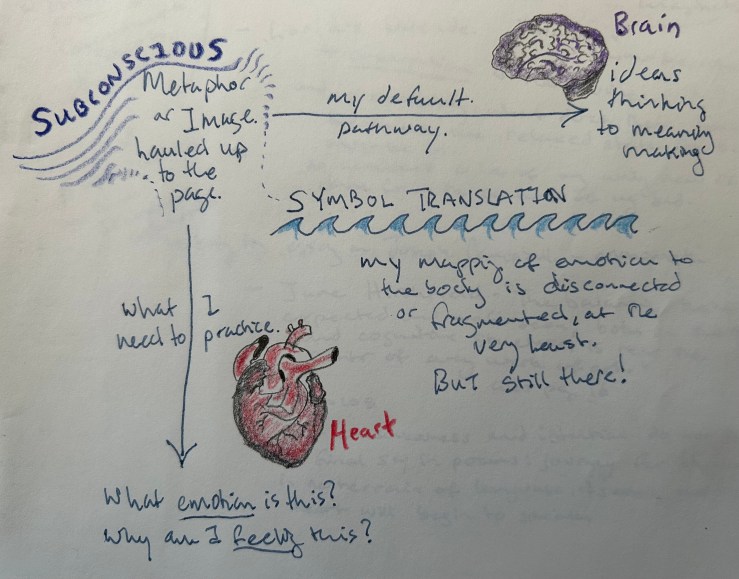
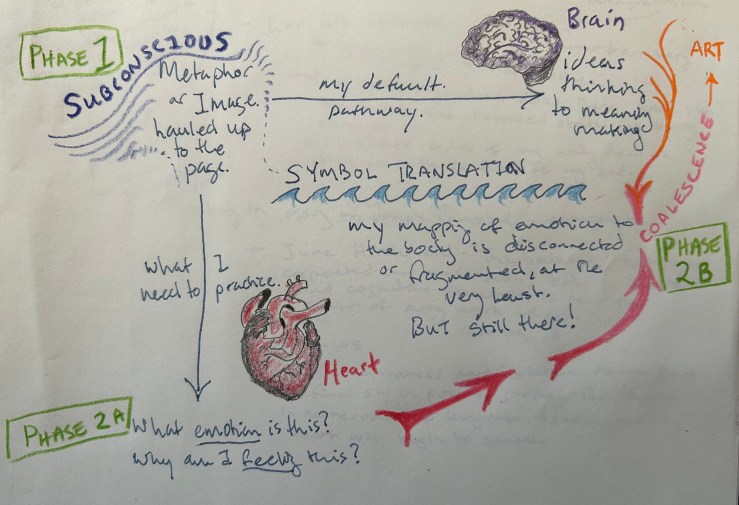
Here’s a drawing of my own creative writing issue process I figured out with my therapist[9]:

Phase Two: Switch from horizontal to vertical symbol translation and FEEL it goddamnit

This is less…concrete…than Phase One because I’m only just beginning to understand and practice writing this way. Here’s how I worked it out.

A few months ago, I posted a creative writing piece in progress, Measures, and used orange text inserts denoting my analysis and thinking about the images and surprising words that came through the breezy drafting bits (but, I note, not the ‘idea’ driven bits).

Originally, the piece was generated as a response to a writing prompt—but not timed—leaving me ample opportunity to twist a narrative around an idea. Which I did. That draft, despite the lack of constraints, held a few scarce subconscious breadcrumbs that I didn’t recognise at the time. I have many many drafts like this (soft whimper).

When I was preparing to read Measures at a public reading, I collaged the original draft together with other fragments of writing I’d done using constraints. I was rushing the edits (a self-imposed constraint). As I collaged, I could sense parts of the text vibrating some energy. I know, weird, but that’s the best way I can explain it.  Those vibrating bits, I recognise now, signal subconscious missives. Maybe other people feel this differently, perhaps it’s simply noticing or a feeling of curiosity. However they’re identified, they’re the bits I have to attend to with care and devotion…a kind of nurturing love.

Phase 2 A

So, what does this look like in practice? It’s leaning into the feelings and emotions arising from the vibrating images and surprising words or metaphors. Instead of staying with surface logic, descend into the body, slow down, notice, INVITE the complex emotions swimming around my insides[10]. Name them – here’s a handy emotion wheel as reference. Map them (i.e., in the body – gut? heart? lungs? heat? cold? tension?).  

For me this requires undisturbed focus best achieved comfortably propped up with pillows in bed. Because this is deeply discomforting work. Feeling sorrow, fear, shame, pain, anything deeply conflictual…it’s only with intentional effort that I sink into these feelings and pinpoint which ones adhere to the piece of creative writing I’m working with. The initial emotion identification process is much less writing and far more, well, active attention to feeling[11].  

Once complex emotions are recognised, named and mapped, the task becomes layering the cascade of emotion into the piece. Because it isn’t just one emotion, it’s the movement from one (or several) emotion to the next. Emotion doesn’t just arise out of nowhere, it’s a relational reaction; it’s the energy of the between (often between people, but can also be between perception, say, a scent, and memory, or between animals and humans, or between landscape and humans…the list goes on…the important bit is that the emotion arises out of relationship).  This is the experience, the relationship energy, I want my reader to feel. I’m creating an experience of complex emotion and I’m communicating, to borrow Winterson’s line, with text as I would another human being. It’s an intimacy.

Phase 2 B

How to do that? Here’s where it gets interesting. As a kid, I used to love those puzzles of what appeared to be hundreds of coloured dots on a page but when concentrated on a certain way and intentionally altering the angle of focus, the two-dimensional field of dots coalesced and popped what appeared as a three-dimensional image. Suddenly a 3D stag was running at me from the page[12]. The optical illusion puzzles are called  Autostereograms (yes, I had to look this up).

The 3D puzzle is analogous to the process I used to layer complex emotional change into my working draft. Here’s an attempt to clarify my process (I’m still working on this….in a few months I might completely change my thinking, but for now, this works):

  1. the effect of the movement of feelings in the piece is like seeing/feeling the 3D image
  2. the subconscious missives in the form of images, metaphors, surprising words etc. are the dots
  3. The intellectual meaning or the question the draft might be revolving around is like the 2D field of dots   
  4. the success of the story is proportional to the elegance with which a writer can layer all these aspects together, the coalescing of components – that movement from 2D to 3D….which, I suspect, is sensed and felt by the reader as opposed to through the mechanism of critical analysis.
  5. How is this done? By blending technical aspects (don’t let them take over!) with subconscious/dream aspects (the signposts of emotional energy)
  6. achieving the elegance of coalescing is the practice

So, this was how I approached the rewrite of Measures, a 905-word creative nonfiction piece. It’s my first intentional emotion blending attempt. When I was puzzling to layer the emotional movements in the piece, a specific line surfaced from the depths as I wrote and fiddled with the syntax (a subconscious gift!) and I burst into tears. A couple of friendly readers, though not all, experienced the same at the same paragraph in the piece. I’ve submitted the story to a few places for publication, waiting for submission windows to open at others…but really, reader reaction means, for me, the writing sings.


[1] I noticed I use the word subconscious as opposed to unconscious. I use subconscious to refer to information just below conscious awareness. But unconscious kind of means that too, though I think of unconscious information as deeper, more inaccessible. Like, my body doesn’t need to think about breathing or my heart beating to keep it upright (most of the time…falling in love or stubbing my bare toe on a concrete parking block changes all that, at least for a short moment). I admit, I took another deep dive into the differences and theories of mind conceptualizing unconscious and subconscious. Short synopsis: originally, the two words were used interchangeably as part of psychological theory. At some point, “unconscious” became synonymous with scientific rigour, while “subconscious” was significantly downgraded (ha ha, no pun intended) to parlance related to woo woo pseudoscientific pursuits, like, you know, tarot cards and ouija boards. So, there’s a classist-type interpretation of the two words. But, in other contexts, subconscious and unconscious refer to different levels of information below our conscious awareness, the former being slightly more accessible than the latter.   Accessibility is thought to be achieved through intentional reflection practices, talk therapies, etc.  [Here’s two whole paragraphs on this subject deleted. You’re welcome.]

[2] Okay, control is probably too strong a word here because the process of working this way, working with a subconscious (and yes, with the switch to using the indefinite article I’m proposing the subconscious is not mine alone, but rather a collective and fluid energy we all swim in…who’s woo woo now? ha ha ha) retains a high degree of mystery and hangs in dreamlike suspension (hang and suspension redundant? no, here dreamlike suspension is a thing, a state of being, maybe even a place).

[3] Though a word count cap is, technically, a restriction, I’ve found this insufficient for accessing the subconscious.  Fewer words in a piece forces grammatical and syntactical discipline. Also, an efficiency of imparting information. But I can still think my way to a finished piece without layering in emotional heat (this is explored in Phase Two). This might also be why fragments written in emails and texts can sometimes fish out unexpected images, words….certainly humour bits I wouldn’t have thought of intentionally except for the challenge to provide a witty reply.  

[4] Best, for me anyway, if not listening to a podcast or distracted by any visual media. Music seems to be okay, though floaty lines are heavily influenced by lyrics so this is a risk…it’s best if I’m not distracted at all. For the last year and a half or so, I’ve eschewed most media, including film, shows, news, in order to nurture and invite….access?…subconscious messaging.  Also, ‘cause I just need the quiet.

[5] I keep a dream journal. I have since 2018 and kicking myself for not starting earlier. BUT – this is hard for me…I rarely remember my dreams …must apply intentional effort to remember them. When I wake, they’re dissolving very very fast. And if I wake in the night, too often I think, oh, I’ll write that down in the morning. Of course, by then, it’s long gone. Despite the dream journal an arm’s length from my pillow, I fail to reach my hand out in the dark. I remember my dreams better when I’m on vacation (I take this to mean that it’s only when I’m relaxed and rested that I’m really able to dialogue with dreams…work-life is too energy taxing. It’s a frustration for sure).

[6] Dreaming may not be “a restriction” per se – but could argue “not being awake” is.

[7] I love this line – it’s got two people in it, a narrator who is lying to themselves and colluding with the reader on this (reader senses the inclusion and also wants to know why), plus the metaphor “net” surfaces connotations of “caught in a trap” of a valid excuse. The reader senses the push-me pull-you tension of an excuse that is likely not valid or at the very least is a trap….but see? Here I have veered off into super analytical mode, ultra meaning making….I run the risk of using my usual approach and creating a “thought up” story as opposed to a “dreamed up” one.  I feel the sentence would be a great first line of a story….ripe for using the timed write method to see what else will surface in a more dream-like way…get more text from the subconscious to the page before meddling with it.

[8] This blog is, I know, ultra thought concept driven. I don’t count the posts I write here as my “creative writing” work. Here, I’m exercising (exorcising?) my analytical tendencies …with the faint hope this will make space in my brain (and body) to allow the dreamwork to happen.

[9] Another friend, when I showed her this drawing explaining my thinking behind it, said, “wait, you drew a model of your analysis of your overthinking?” I erupted gales. A sense of humour is also an acceptable coping strategy for managing deep emotional pain. Subject for another post, this one is too long. Hopefully you’re still with me.

[10] You have no idea how difficult this is. I’m working on it.

[11] Am I also researching epigenetic biological embedding of experiences, relational neurobiology and the ontogenesis of shame, internalised oppression and morality? You betcha. [my gawd, she really is f-ing nutty nut bar]. Don’t worry, I do all of this half-assed.

[12] An AI generated overview of how to “see” the stag –  Parallel (or wall-eyed) method: Focus your eyes as if looking at a point behind the image, not directly at the image itself; Cross-eyed method: Try to cross your eyes slightly to focus on a point beyond the image. Not gonna touch the AI grenade here…except to opine that feelings and emotions are often beyond words and language (why we need dreams and art as translation mechanisms) and I don’t believe AI will learn to fish the subconscious the way humans can hone their ability to.

Sidelines

For a few years, I wrote food columns for community newspapers. Pique Newsmagazine, when we lived in Whistler; the Napanee Guide and Kingston This Week when we moved back to Ontario.  A handful of one-off Canadian publications. Never for the money[i]. Food writing was a lifeline tethering me to taste and flavour and scent and colour and texture, life’s glorious pleasures, at a time when I struggled so deeply with postpartum …was it depression? Certainly severe sleep deprivation, but also the punishing suddenness and baffling inflexibility of a body assuming the mechanistic form of lactation on demand[ii].

In Whistler, Food Columnist came with some perks. A paid pass into restaurants I would never have been able to afford, then, or now. A few foodie special events. And because the food column was really just filler between real estate ads, the editor gave me carte blanche on content and word count[iii].

Once, I got a call on a drizzly weekday afternoon to cover a foie gras tasting. When I arrived, I was stunned to discover the corner of the elegant French-styled dining room was transformed into a buffet (a buffet!!!) of foie gras prepared every way imaginable (pate, parfait, terrine, torchon, melted into risotto, layered atop quince cheese, whipped into mousse and even frozen into ice cream).

At that time, a pound (think the size of a pound—four sticks—of butter) of such richly diseased (forced large) Moulard[iv] duck liver cost a hundred dollars. The table, accented with crystal glasses of honey-coloured Sauternes and goblets of amber Armagnac, groaned beneath the weight of thousands and thousands of dollars’ worth of duck liver. When I think of the word obscene, this is the image that pops in my mind every time. Lifting a glass of Sauternes from the table, I swung my focus to the chef, a classically trained, tall, slim man, transplanted from France, and whispered my fascination-horror. He bowed to me, his expression bursting into a grin of absolute delight, his elegant hands arcing the air above the buffet in the style of Vanna White, and said, “I know! And I didn’t have to pay for any of it!”   I spent the afternoon exercising my French with the farmer couple from Quebec who raised the ducks (and fed their livers) to perfection. Apparently, the ducks will eat whatever you place in front of them, in this case a special diet to imbue the livers with the buttery texture and a golden hue, so it’s not really torturing their livers into a diseased state? And yeah, I sampled as much of the stuff, prepared with textbook precision, I could cram into my mouth.

Another time, another top restaurant, wine pairing dinner. It was the first time I’d left the house solo following baby number two (five months old). I still think I deserve a prize for negotiation skills getting their dad to babysit that evening, but I digress.  There were many other food writers twittering the patio when I arrived.  I knew none of them (such a bumpkin). I did snag a flute of champagne when a silver tray walked by. I was trying to quell the screaming anxiety I felt entering a social situation after months of babied isolation, the fast-descending realisation, like a burning 747, I’d just entered a scene waaaaayyyy out of my league.

While attempting to hold my purse, a clutch (stupid choice, they make purses with straps for a reason), balance my glass of bubbly, ignore the crushing sensation of my toes in heels long neglected, snap my too tight bra into a comfortable position (impossible), a man, quite good looking, gorgeous pale linen oxford button-down, sauntered over and introduced himself. He shook my hand with dry confidence. I always pay attention to handshakes – you can glean a tremendous amount of information about a person from their handshake[v].  He detected my ignorance instantly when he explained he was the editor of Nuvo Magazine. (When one pronounces the word nuvo, one has to draw out the vowels and the finishing ‘w’, layering a hint of upper-class pretention, Neeeeeewwwwww Vooooooowwwww.)

Flustered, I snatched an oyster on the half shell from a silver tray heavied with shaved ice and pearl glistening mollusks. Only then did I perceive I was holding too many things in my hands to parley: champagne, purse, notebook, pen, and now, oyster. Keep in mind, we’re still standing on a patio, glorious soft pink sunset reflecting the mountains’ glaciers. I quickly placed the opalescent shell to my lips and tipped my head back[vi] to deliver the gourmet tid bit to my mouth. Unfortunately, (most unfortunately), the oyster had been shucked improperly and did not release.  The long moment that saw the oyster dangling the air like a blob of snot, my tongue diddling its flesh obscenely, lewdly, before it loosened its shell, was sufficient time for the Nuvo Editor to melt and disappear into the crowd.  

Again, unfortunately, this was not the worst of the evening’s events. Between course five and six (spectacular food btw), I turned to the woman at my left, laughed, and explained how normally, at that exact time, I’d be breastfeeding. This signalled an immediate let down and my milk pooled the front of the exquisite baby blue silk blouse I’d chosen to wear without the foresight to insert protective breast pads.  My editor gave me shit for leaving the dinner early.

 A fond memory. On assignment to interview an organic potato farmer, I drove the flat, fertile, Pemberton valley towards his fields.  Jagged walls of granite, rough new mountains, rose dramatically from the valley floor, their snow-capped peaks spearing a cerulean sky.  Both babies were with me (a detail I felt my editor needn’t know). Willa, a few months old in her bucket seat, and Lillian two and a half, strapped in a car seat. Lillian pointed her pudgy toddler finger out the window and said, “Boootiful mumma.”  

I will never be able to adequately articulate the sensation of gratitude that washed over me at that moment, hearing her words, understanding, witnessing the wonder such a little person recognises and delights in the encompassing beauties of the world. 

And when I sat at the long pine harvest table in the potato farmer’s kitchen, my left arm cradling Willa to breastfeed while my right transcribed notes, Lillian, her little shoulders level with the table top, fisting crayons to paper beside me, the farmer looking rather annoyed I’d brought children with me. I understood then how often the story one is assigned to write is not the story that ought be written. His own young children screamed and giggled, running in and out of the kitchen. His wife hovered in a dark corner and listened attentively to our interview, a toddler hitched to her hips. I was struck by her. She had grey shadows beneath her eyes and her exhaustion stretched her skin shiny at her cheekbones. She looked haunted. And her expression, I knew, matched my own. The farmer’s transition to organic production had come at her urging. It was clear the strain of a circular, balanced agricultural practice and environmental stewardship significantly decreased the economic productivity of their business. One of their children had been diagnosed with autism. The farmer’s wife believed their son’s behaviour far more manageable on a diet free of pesticides. I wanted to interview her, pursue the revealed vein of story, follow it to where it bled, delve deep into the sorrows I detected so clearly, translucent beneath her skin. But I didn’t.  I didn’t follow my heart.

Why these memories today? I’ve been working with a dear friend, helping him to realise his own passion project by exercising my food writing muscles to support the production of his cookbook. Another sideline project I’ve taken on these last months, working as part of a small team (two photographers, a designer, a handful of recipe testers). I’ve discovered my food writing muscles are a little soft …what I had thought would be simple exercise is not. It’s work. I’m struggling to grasp the tone, the angle, my friend, a professional chef and restauranteur six times over, seeks to impart the book. I’m supposed to be ghost writing. I’m supposed to be imbuing the writing with his voice, through his eyes, his sensory experiences. So far, I’m failing. 

Necessary to stop and appreciate the joy of spontaneous street art.

Tuesday last, I interviewed him again and delighted listening to him speak about food preparation, watching his hands fly and finger the air as he gestured the creation of invisible dishes before him at my own dining table. I wondered, aloud, whether it might be easier if I wrote the content as a witness, imparting my own thoughts regarding his process, his approach. We discussed how my voice would, inevitably, infuse and change the work. It remains undecided. I worry. Next month we all travel to Italy together. To cook.  To drink wine. To see great works of art and architecture.  To move in the rosemary and bonfire scented mellow gold air and splendour of Tuscan autumn. I must believe the writing will come to me.

Writing this post, I realise what always tugged the edges of all my food writing:  it’s less about the food; it’s all about the experience.  The experience of sensual pleasures, but also the joy sharing deliciousness with others. It’s about relationships. Relationships between the land and the weather and the hands that nurture, tend, harvest, wash, prepare, and cook the food. Most importantly, it’s about the relationships between people.  This is what matters. This is what is most beautiful.   

A final side observation for today: I am so sad when peach season ends. Their fuzzy, sunset-blushed fade from market stalls signals the season’s shifting light. But I’ll no longer deny any potent persuasion to sink into the sublime sensual pleasures this world has to offer. Here. Now. Follow where my heart leads. Write it down. Embody my dreams.


[i] I was paid 80 bucks for the weekly column in Whistler, and $25 for the Guide, and nothing for the Kingston This Week because both papers used the same publisher, and I signed print syndication.  

[ii] I breastfed each child 18 months. Have to say, I wasn’t ready to wean Willa when I did but succumbed to social pressures and necessity when I returned to part time work. She wasn’t ready either and toddled around with a baby bottle upended at the corner of her lips, looking like a drunken one-handed sailor with everything she did.

[iii] The editor did insist titling my pieces…headlines I would have chosen differently, but not worth a battle. Or apparently a phone call?  I never asked him to change them (eye roll).

[iv] A cross between Muscovy and Pekin ducks.

[v] I taught the skill of hand shaking to my girls very early on. By eight years of age, they were pros. 

[vi] Orgasm style.  I know oysters themselves are supposed to be an aphrodisiac, but on writing this little vignette here, I think instead it must be witnessing the gestures with which they are eaten that becomes the real turn on. A thought anyway….a delightful one.

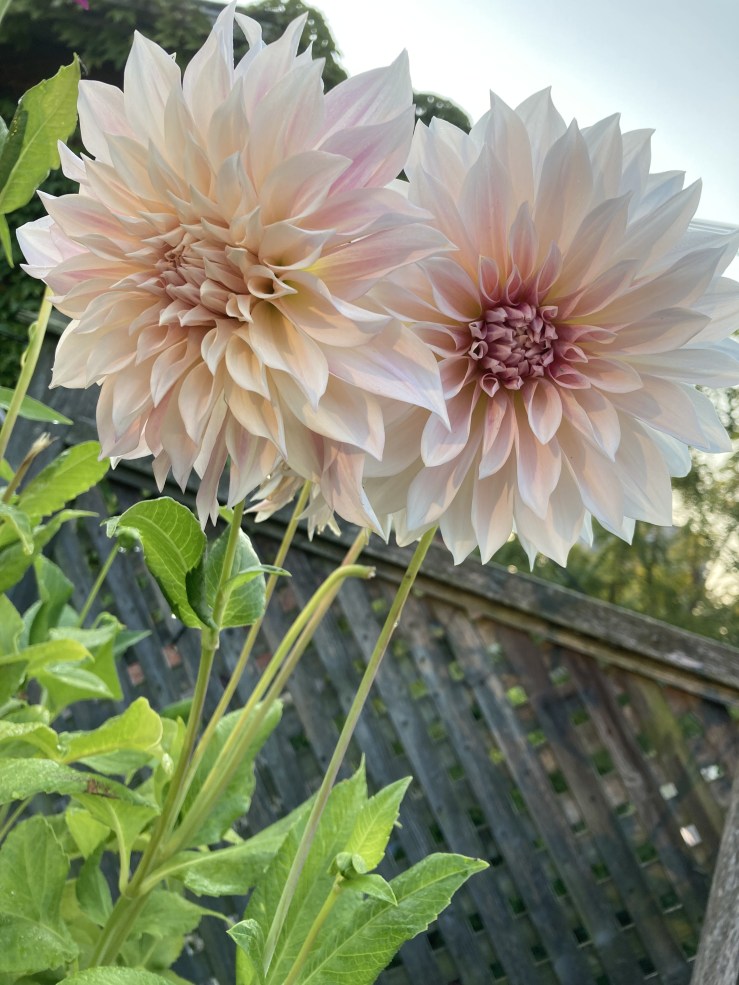
I lifted these dinner plate dahlias from the soil last summer. Boxed them up and stored them in a dark cellar through the winter. In the spring, I planted them on the beautiful terrace garden at my new place and battled the squirrels all summer who continued to believe the tubers would be most delicious each time they dug them up, sampled a tiny bite and spat it out. It’s a small miracle they survived and a massive miracle they live and bloom again. The blossoms are delicate and compact compared with last summer’s riotous overtaking, but retain all their soft, pink petalled beauty. I love them so.

Like Miss Stress

Up and down. Up and down.

I think the best sound in the whole wide world is laughter. I was going to narrow down to toddler laughter which bubbles up and out of little people bodies as the best of champagnes, but really, it’s any laughter expressing unreserved joy.   

I’ve been crying a lot.  I used to worry that if I ever started crying, I wouldn’t be able to stop. If I opened the sluice gate, an ocean of tears might wash me away. So, I didn’t cry. At least, not often and never deeply. But now I do. Grief feels soggy. Heavy. The way a body feels waterlogged after a full day of lake swimming, skin sponging the tang of seaweed, fish scales. I’ve felt, at times, as I move through these days, that I’m sunk beneath a wobbly surface. Laughter pulls me up splashing. Up and down; the way life moves.

Grief, like creativity, is a process. Six months post leaving my marriage I’m …still processing. But the grief—which doesn’t erupt a monstrous geyser in the way I feared, instead[1], it’s discreet weepings I indulge then pack up and away, get on with the day—has illuminated my writings.  Allowing myself to cry has also allowed myself to see and understand some of the reasons I’ve resisted revising my own pieces…I wasn’t ready to see the pain I (unknowingly) layered there. By pain I guess I mean sorrow…regret…shame. Seeing it now feels…embarrassing. It’s so obvious. Like, decades of obvious.

Crying improved my (re)vision; laughter, goddammit, is gonna help me process embarrassment. Kind of feels like answering the front door in the nude. Would I do this? Maybe. It’s important to push my creative practice from its pillowed comfort towards the perilous shadows. The only way I’ll learn and grow.

A recent Saturday afternoon found me staring down the barrel of a good cry. I was going to write too…I seem to be able to do both these things at the same time, a curious dexterity that won’t earn me any trophies.  A friend texted she was running a creativity workshop, something to do with comedy. Few people showed up, would I join her?  I read the text through watery shimmers and worked to compose a polite decline. But my hands refused to send the message. My fingers deleted my crafted decline three times before I twigged I wasn’t entering the right response. So, I typed I’d put a game face on and be there.

The workshop included drama and improv games, the kind of theatrical exercises that involve the whole body and breath work and screaming out your chosen name[2]. The kind of exercises that, had the bartender offered to give me a public enema instead, I would have enthusiastically accepted[3]. I will say that I traded an afternoon of crying for laughter (and embarrassment) and I had a lot of fun. Unfortunately, some of this was caught on camera, which I leave here for your enjoyment with the caveat that I look much better when I let my hair down and sport moonbeams. I even ended the afternoon singing a karaoke song[4]. Invitations: can’t fault an old broad for sounding boundaries[5][6].

It started as a low laugh, skipped stones tingling my throat, expanding rings with every exhalation, a laughter that brought the rain clouds down, had me surfing the troughs to the crests[7].

Keen eyes will note I am the ONLY one laughing in this most bizarre of situations. For context: the woman with the tambourine is performing interpretive dance while the woman on stage sings a parody of Snow White’s (in Snow White’s voice) feelings of oppression from society just because she leads a polyamorous life living with seven very short men. The workshop was in the Royal Tavern, one of Ontario’s oldest bars, dating back to before Confederation, once owned, for a short time, by Canada’s first Prime Minister, John A. Macdonald, a man purported to drink from a water glass filled with spirits when he stood to speak in Parliament. Having stood on the stage, I kinda get his methods.

[1] Ok. Not entirely true. I did experience some epic wailing sessions. Interestingly, the worst of them brought on by reading a most beautiful passage in the novel Foster, written by Claire Keegan, where the little girl protagonist gazes across a field topped with dozens of flitting white butterflies. The scene hauled up an image of my own (no longer) vegetable garden, the golden light of late August lighting up the cabbage moths like confetti, hovering the flower blossoms, circling the globes of fire red tomatoes. The grief took me then, a clenched fist to the stomach that had me gasping for breath and buckled my body. I mourn losing the garden.

[2] Aloura. I have no idea why that one popped from my mouth. Desperation I assume.

[3] Probably exactly what you need Biro, such a tight ass.

[4] Yes, of course this was after two IPAs, the only way to really get the pickle out of Miss Stress’s bum. I sang Journey’s song, Lovin’, Touchin’, Squeezin’, which I must assure you retains only surface significance with its glancing reference to crying. This was the first time I sang karaoke…I hit a few flat notes in the first phrases (dreadful, but the show must go on) and managed to warm up and belt out the sense of revenge the song requires to really hit it home.  I dislike the too many na-na-na-na-nas at the end and left the stage long before those were completed.  People had more patience in the 70s.

[5] Come on Super Man, put those old phone booths to use; Kérd a számomat.

[6] This is a sure-to-make-you-laugh piece, Who The Hell Was Mr. Saxobeat Anyway?, written by Josh Baines.

[7] I’ve returned to working on my longer form project, pulling out old sections of writings, collaging them together, stitching in some humour and even exploring my dark. Feels good to be moving again. Recent epiphany: I’m actually living the life I’ve always dreamed of …like, right now. So, resolve to stop crying and get on with shit. Embrace joy.

Greeting when the Shadow Knocks

Certainly not as beautiful as Dante’s Dream , but for all that I love, drawn on my birthday.

This is a long read. Self-indulgent. I couldn’t help it. Some footnotes to keep the reader interested. Hopefully.

In 2019 I attended a writing workshop at Omega in Rhinebeck, New York (I write about that here). Several workshops ran in parallel, taking the better part of each day. The week I was there, an inordinate number of white women wore flowing, white, loose, muslin tunics with all their hair tucked up and disappeared beneath white turbans: the Kundalini yoga uniform. No one used the words “cultural appropriation”.  I didn’t either.[1] Out loud. In the evenings, round robin sessions were offered where people might try other workshop topics. Yes, I tried the Kundalini session. It’s not for me[2]. But one must remain open to new ideas, stretch the mind, (and the body), and so it was I found myself one evening in a session with a celebrity psychic medium. It was an interesting session[3], but something the facilitator said really stuck with me: “Everyone can do this [be a spirit communicator – really?], it just demands a lot of practice, and the practice is paying attention, first, of course, but also trying NOT to make meaning out of the images and senses you are receiving, just report them as you receive them”. Like, if you’re a celebrity psychic medium, don’t puzzle the images together – that’s for the detectives looking to solve cold cases or the families who are trying to communicate with deceased loved ones. Huh. Okay.

But for writing, we need to make meaning of the images and the words and phrases that flow from them.  The trick is not to solve the puzzle too soon.

With writing, I practice letting the images and even the silly ideas make it to the page. The result is that I now have a lot of blousy first drafts and half formed ideas lying around waiting for revision at some point (which feels like some distant sunrise cresting a dark horizon)[4].

It occurred to me[5], riffing off of last month’s post about writing and energy (slaps forehead), that what I need to practice more intentionally is READING the energy in my own writing. My own writings are trying to tell me something. The story is communicating through me (just as the energy to split wood effortlessly using an axe must travel through the body)…maybe I’m just the filter the story moves through to be born. I’m sure I’ve read this before…it’s only now I’m understanding it pragmatically.

So, with a spirit of nakedness, I’m using a recent response to a writing prompt[6] as a way to work through how I’m trying to read the energy in my own writing….while remaining sufficiently loose in interpretation and open to other ideas (before locking the story meaning down, aka, solving the puzzle).  This is a first stab at explaining this process…

I wrote the piece in a quick, mostly relaxed, twenty-five-minute burst before I had to go to work.  I have retained all the spelling mistakes, the lazy repetitions, the character name of Jo spelled two different ways, as well as the story’s devolution into stream of consciousness writing. I thought I would have time that week to fix it up before posting it to my workshop group. I didn’t. I posted it as is with the caveat about its devolution into imagery and all else.

And here’s the interesting thing—and why I’m choosing to write about this process here—when people responded to the piece in the workshop, each one indicated they had connected [more? best?] with the stream of consciousness sections: the writings that arrived subconsciously, those aspects of my shadow self, frolicking forth from dream territory.  Hmmm. A sign like that can’t be ignored. 

This post will necessarily be long to show my process. First, the piece unmarked, followed by the piece again with my thoughts and interjections marked in BLUE about what the writing might be trying to communicate through me.

The Red River swelled beyond its banks again, as it did every year. This year it attained new waterline records, bursting the city’s levies, its fluid tongue flicking the sand bags right and left like a prize fighter spitting chicklets in a fight to champion the world.  

Mary and Joe arrived in separate vehicles, she a canoe, he a kayak. Mary tied the canoe to a lilac; Jo roped the kayak to iron railing leading up the front steps, now submerged. Each used their own spare key, twisting the front door lock a foot above the waterline. Each shouldered the door against the heavy water to enter their daughter’s split level. The house in the chichi neighbourhood had promised a view of the river. In this respect, it had overdelivered.   

“She picked the wrong week to travel to Los Angeles.”

Mary sighed. She hadn’t wanted to start clean-up efforts with an argument. She stood in a foot of cold water that pressed against her knee-high rubber boots. Sloshing across the kitchen, her rubber pants rustled loudly as she fought to stay upright. The linoleum was slippery wavering beneath so much grey water, dotted here and there with soggy receipts and plastic bags ballooned into jelly fish. She and Jo rarely saw each other. They confined their spite to Thanksgiving and Christmas dinner tables. Without grandchildren, and now without their son-in-law (sandbagger), or their snooty daughters-in-law (good riddance), those dinners sunk before any plates graced the table.

Jo continued, “I thought she was in California.”

Not unusual, such misinterpretations.  For too many years Mary excused these oversights, chalking them up to hearing loss.  Too many rock concerts. Too many engines revved to screaming in the garage.  After the divorce, she’d faced, brutally, what she hadn’t wanted to: he just didn’t give a shit. Content if given a hot meal every evening, if potato chips were snack ready, if clean underwear stacked in the dresser drawer, Jo cruised life. He erupted a stormy passion when things didn’t go his way. The family vibrated his tensions, always on the Joe program. And his own children just hadn’t been interesting enough for him.

“No, she’s in France, Anjou. Ville-sous-Anjou, like the pear.”

Mary’s heart sunk then realising the fridge, out of power now for three days, the vegetable crisper beneath the water line, would have to be dealt with. A rotten job (inwards she laughed, bitterly).  She scanned the kitchen trying to remember where Lizzie kept the box of garbage bags, spray containers of cleaners, a mop bucket Mary might use to bail water. Where the hell could she bail the water to when the waterline lapped the window ledges, the river kept swelling? It was hopeless.

“This is hopeless,” said Jo. “Didn’t I warn her not to buy waterfront?”

Mary let his question hang, snuffing the old argument before it ignited. Doomsday prophecies, climate change, the water rising to take us all, tidbits he scraped from the internet, scrubbed, polished and hurled at listeners as if they were his own. Millionaires blasted the skin of the earth, their arcs of triumph going limp when they descended, backwards. In the end the laws of gravity, of inevitability, drown us all.

“I mean these days?” he pushed, “what the hell was she thinking?”

“Hell” said Mary.

She watched the look of confusion cloud Jo’s face. Honestly, he was so slow sometimes, she was glad she’d chosen not to see the end of the world with him. Yet here they were, sporting galoshes and yellow rain pants, knee deep in water wavering and rolling optical illusions.   

Insert distraction that momentarily reconnects this couple – Saxophone – a boy playing their favourite song perched on the roof next door  – the song they danced to at the engineering formal in fourth year – blue moon

Things floating: paper receipts, plastic bags, loose photographs (wedding?) – flood of pressure water build up – breaking banks – crashing shores, people waiting to be recused in the crooks of trees. Cars and boats and whole tree trunks, chesterfield, the deer, it’s snout bobbing above the waterline, antlers rotating with the spinning current, it’s bony legs and knees hoofing helplessly the fluidity, as if were running, running, pulling the belief of Santa’s sleigh, soaring the cold milky way vacuum, light years ahead, or behind.  

From its path, the river would always find a way, seeping up through the layers of sedimentary rock, cracking the limestone shelves, eroding the granite walls salt shaker – grains of salt, crystals messenger feels like a warning shouldn’t ignore.

Deer swept along in it torrent, spinning, the antlers whirlpool, their legs kicking, trying to find a purchase as the reindeer of santas  sleigh try to paw at the stars.  Muddy – silt that when this all drained away they would excavate the kitchen tiles as one might an archeological dig, looking for the mystery they believed buried there, but only finding shards of animal bones, and indeterminate rock.

Here it is again, with my own thought interjections in BLUE and peer feedback noted in ORANGE (with permission). I’ve focused peer attention to the subconscious elements they honed in on (they provided lots of fantastic grammar, spelling and rearrangement suggestions; I have not supplied those here).  

The Red River

swelled beyond its banks again, as it did every year. This year it attained new waterline records, bursting the city’s levies, its fluid tongue

Mary and Joe

arrived in separate vehicles, she a canoe, he a kayak. Mary tied the canoe to a lilac; Jo roped the kayak to iron railing leading up the front steps, now submerged.

Each used their own spare key, twisting the front door lock a foot above the waterline. Each shouldered

the door against the heavy water to enter their daughter’s split level. The house in the chichi neighbourhood had promised a view of the river. In this respect, it had overdelivered.

“She picked the wrong week to travel to Los Angeles.”

Mary sighed. She hadn’t wanted to start clean-up efforts with an argument. She stood in a foot of cold water that pressed against her knee-high rubber boots. Sloshing across the kitchen, her rubber pants rustled loudly as she fought to stay upright. The linoleum was slippery wavering beneath so much grey water, dotted here and there with soggy receipts and plastic bags ballooned into jelly fish. She and Jo rarely saw each other. They confined their spite to Thanksgiving and Christmas dinner tables. Without grandchildren, and now without their son-in-law (sandbagger)

or their snooty daughters-in-law (good riddance), those dinners sunk before any plates graced the table.

Jo continued, “I thought she was in California.”

Not unusual, such misinterpretations.  For too many years Mary excused these oversights, chalking them up to hearing loss.  Too many rock concerts. Too many engines revved to screaming in the garage.  After the divorce, she’d faced, brutally, what she hadn’t wanted to: he just didn’t give a shit

Content if given a hot meal every evening, if potato chips were snack ready, if clean underwear stacked in the dresser drawer, Jo cruised life  

He erupted a stormy passion when things didn’t go his way. The family vibrated his tensions, always on the Joe program. And his own children just hadn’t been interesting enough for him.

“No, she’s in France, Anjou. Ville-sous-Anjou, like the pear.”

Mary’s heart sunk then realising the fridge, out of power now for three days, the vegetable crisper beneath the water line, would have to be dealt with. A rotten job (inwards she laughed, bitterly)

She scanned the kitchen trying to remember where Lizzie kept the box of garbage bags, spray containers of cleaners, a mop bucket Mary might use to bail water. Where the hell could she bail the water to when the waterline lapped the window ledges, the river kept swelling? It was hopeless.

“This is hopeless,” said Jo. “Didn’t I warn her not to buy waterfront?”

Mary let his question hang, snuffing the old argument before it ignited.

Doomsday prophecies, climate change, the water rising to take us all, tidbits he scraped from the internet, scrubbed, polished and hurled at listeners as if they were his own. Millionaires blasted the skin of the earth

their arcs of triumph going limp when they descended, backwards. In the end the laws of gravity, of inevitability, drown us all.

“I mean these days?” he pushed, “what the hell was she thinking?”

“Hell” said Mary.

She watched the look of confusion cloud Jo’s face

Honestly, he was so slow sometimes, she was glad she’d chosen not to see the end of the world with him. Yet here they were, sporting galoshes and yellow rain pants, knee deep in water wavering and rolling optical illusions.

Insert distraction that momentarily reconnects this couple – Saxophone

– a boy playing their favourite song perched on the roof next door  – the song they danced to at the engineering formal in fourth year – blue moon

Things floating: paper receipts, plastic bags, loose photographs (wedding?)

– flood of pressure

water build up – breaking banks

– crashing shores, people waiting to be recused

in the crooks of trees

Cars and boats and whole tree trunks, chesterfield

the deer, it’s snout bobbing above the waterline, antlers rotating with the spinning current, it’s bony legs and knees hoofing helplessly the fluidity, as if were running, running,

pulling the belief of Santa’s sleigh, soaring the cold milky way vacuum, light years ahead, or behind.

From its path, the river would always find a way, seeping up through the layers of sedimentary rock, cracking the limestone shelves, eroding the granite walls

salt shaker – grains of salt, crystals messenger feels like a warning shouldn’t ignore.

Deer swept along in it torrent, spinning, the antlers whirlpool, their legs kicking, trying to find a purchase as the reindeer of santas  sleigh try to paw at the stars.  Muddy – silt that when this all drained away they would excavate the kitchen tiles as one might an archeological dig, looking for the mystery they believed buried there, but only finding shards of animal bones, and indeterminate rock.


[1] I was captivated by this and couldn’t help but wonder how many might be pocketing jade eggs up their yahoos.  Yeah, it’s a thing.

[2] I nearly fucking died trying to do all that rapid breathing while pulling “my foundation” tightly into my core. I worked up a sweat doing it too! I was far more fascinated by the English woman on stage facilitating the session (white muslin tunic, no hair, white turban). She had the poshest English accent I’d heard outside an Oxford quadrangle and she was looking daggers at her partner as her staccatoed breaths pumped the mic clipped at her breast. He was a much younger, absolutely gorgeous (and shirtless) Caribbean man with shining dark skin and dreadlocks, and he was racing after their daughter, probably six or seven years old (small white muslin tunic, wild hair, white turban an unravelling ribbon), trying to catch her as she screamed her way round all the seated hyperventilators (us) and literally crawled up the walls to run along the windowsills.  This delighted me no end.

[3] We were put in small groups and sat cross legged on the floor. We stared for a few minutes at a photograph of a well-dressed woman with haunting eyes seated on a white couch, then “reported” what we received. Having spent the whole wonderful week drawing and writing, I was feeling pretty relaxed, so I started, “I dunno, I see a baby’s rattle, a red sports car and an empty cradle.”  The curly blond-haired woman sitting across from me, wearing an I-love-NY cropped t-shirt with its neck scissored wide so that it slipped to expose one of her pudgy shoulders and a purple bra strap, goggled at me and said “Whoooooaaaaaaa!!!!”  I laughed hysterically by how easily I’d convinced her of something from my imagination. Though, it transpired the photo was of a wealthy woman whose husband had kidnapped their infant daughter, the pair never to be seen again. I didn’t think much of this at the time, more interested in getting an ice cream before the shop closed for the night.

[4] I am terribly undisciplined when it comes to revision…if I’m honest it’s because I have been afraid of the demons I’ll see there. I’m working on this.  

[5] I am a slow learner.

[6] spin three different digital “wheels of fortune”, one for setting, one for characters and one for narrative point of view, then spit out a story <800 words. I got: a flooded kitchen, a divorced couple, and close third person. I resisted drafting a story given my recent separation and walking away from a kitchen I designed and adored and fed so many wonderful people in.  I’m trying not to be materialistic, but I can’t help grieving the kitchen loss.  Of course, this comes through in the writing, the marriage breakdown, and it feels…shitty. And I kind of feel like an asshole. I’m working on this, greeting my shadow self. Next month, I’m moving to an apartment downtown Kingston, a block behind the central library and walking distance to the university libraries. Despite this fantastic access to knowledge, I’ve prioritised packing boxes and boxes of books, tearily packaging them up these February Sunday afternoons at the farm. A dreadful process. I don’t know how I’ll fit all the books in the apartment.  Maybe I’ll sleep on them, hoping to absorb their wisdom through my skin.

[7] I’ve noticed a pattern in my own thinking when I’m trying to read the vibrating word energy I feel there, and I’m wrestling with this discovery too: first, I read and respond through a “heart break” lens (unfortunately) – my interpretation is clouded by past hurts and sorrows. It usually takes me a day to work through this. Next, I’m able to flip 180 degrees on the initial interpretation and consider its opposing possibilities. Finally, after pleasurable reflection time, I settle into the relief and wonder and gratitude of multiple puzzle pieces dropping into place.

Thank you for reading.

Sounds Off

I very nearly botched the possibility of any relationship with my now husband the first time he asked me out, replying to his tentative request to take me to dinner with an audible exasperation—I’m embarrassed to say it, but an almost-admonishment— “What took you so long?!”

Much later he told me how, in the dead seconds of silence that followed my blurt, he very nearly turned heel and walked away (a fuck that, if there ever was one). My reaction stopped him cold.  I can only think he must have caught the note of elation in my voice, noticed the sparkle of mischief in my eyes, the play blossoming my grin.

Some context for my blunder: Months earlier he’d attempted to ask me out but our conversation was interrupted, and, despite an alluring notoriety with women, he was timid with me. His notoriety prevented me from asking him out. Not only that, but his notoriety also made me mistrust him…he was too attractive, too confident. I resorted to using a tactic I’ve come to refer to as ‘the mixed barb’, an unexpected, lightly teasing, droll divulgence, testing him against himself.  Communicating this way—a skill sharpened in a childhood home where moods shifted precipitously from rainbows to menace—has served me well, personally and professionally. Quick jabs shaded with humour fast reveal the contours of people’s personalities, offer a glimpse of their shadow selves, delineate boundaries, expose what they’re willing to put up with – and what I really mean when I say that is, testing whether they’ll put up with me.

Though this works well face-to-face where intonation and gesture, pitch, and facial expressions shoulder the palanquin carrying my royal intentions, I’ve discovered the strategy collapses in my writing. For example, my royal intentions from that last sentence was meant to be read with layered notes of self-deprecation, irony and superciliousness. Did I fail there?  Likely.

George Orwell suggested, “A thing is funny when—in some way that is not actually offensive or frightening—it upsets the established order. Every joke is a tiny revolution.”[1] For speaking and writing more information is needed to furnish a joke, but also, words in general. “An alteration in tone or pitch can be the difference between …fighting words and a statement of love, using the identical phrase, such as “You’re really something,” a completely meaningless statement without a tone or context to support it.”[2]

Peter Elbow explains vocal variety thoroughly when asking us to “Consider how many musical resources of intonation or prosody we can use when we talk. There is pitch (low to high); volume (soft to loud); speed (slow to fast); accent (yes or no); intensity (relaxed to tense); timbre (breathy, shrill, nasal, and many more); pausing (long and short). Note that these are not binary items, for in each case there is a full continuum between extremes (e.g., between low and height, slow and fast). There are glides and jumps. Also, there are patterned sequences. For example, tune is a pattern of pitches; rhythm is a pattern of slow and fast and accent. We change meanings by using subtle or not so subtle pauses or small intensifications or lengthenings of a syllable. Combinations of all of these make a rich palate we all use to paint meaning.”[3]

Robert Pinsky simplifies this beautifully: “It is almost as if we sing to each other all day.”[4]

But how to get the audible features of speech to the written page?  I suspect the answer to this question requires a lifetime of exploration. Perhaps it’s even THE ANSWER to writing well (musically, entertainingly, clearly, compassionately, provocatively, etc.). Robert Frost thought so, “The tone-of-voice element is the unbroken flow on which the others are carried along like sticks and leaves and flowers.”[5] So, today’s post is simply this quest’s beginning.   

More Frost: “What we do get in life and miss so often in literature is the sentence sounds that underlie the words. Words in themselves do not convey meaning, and to [prove] this… take the example of two people who are talking on the other side of a closed door, whose voices can be heard but whose words cannot be distinguished. Even though the words do not carry, the sound of them does, and the listener can catch the meaning of the conversation. This is because every meaning has a particular sound-posture; or, to put it in another way, the sense of every meaning has a particular sound which each individual is instinctively familiar with and without at all being conscious of the exact words that are being used is able to understand the thought, idea, or emotion that is being conveyed.”[5]

One way to get audible intonations to the page is to write in directions for how the reader ought interpret the words. 

  1. “There are warning flags along the wrack line: sharks – swim at your own risk. The threat is actually minimal, basking sharks being liable to give you little more than a bump on the knee, but the effect of the signs is still an odd one. There are no barriers, the water is open, creating the sense of a curiously lackadaisical approach to public safety. Danger, but do what you want, we’re not the police.”
  2. ‘Fair enough,’ she nods, and while her tone is light Alice feels she can detect the faintest note of mockery. ‘Mustn’t be bitter with my litter.’ Fair enough’, this stock phrase, its cringing detachment. The sudden removal of camaraderie and Alice clawing after it.”
  3. “The boys cluster like geese. One of them, wet-lipped with a tongue piercing, asks Min what she’s doing selling ice cream on such a chilly day. What’s a nice girl like you doing in a truck like this.

A whole story might revolve around the differences between what is said and what is meant. Here’s the first paragraph of a micro story written by SJ Sindum, Mother, published in The Cincinnati Review (again, colour coding mine):

“My mother tells me to be careful. I’m twelve years old, and we’ve just moved to a city outside of Boston. We live in an apartment complex that my white fiancé, twenty years later when we visit, will call “shit housing.” I walk to school every day, a two-mile stroll along a busy road, and my mother tells me to be careful. What she means is, keep your head down, keep walking, don’t talk to anyone, I’m sorry.

Each paragraph of Sindum’s story ends with similarly directed subtext, stretching implied intonation with deeper emotional resonance. A good example of Charles Baxter’s comparison of subtext to “the ghosts moaning from beneath the floor.”

“Reading is telepathy (literally “feeling from afar”). A writer’s magical transference of thoughts, ideas, and emotions—the context, text, and subtext— to the reader across space and time.”[6]

And I want to slide that observation (riffed from a more beautifully written version by Terrance Hayes (see the footnote)), alongside another stunner: “Meanings are not in words, they are in people.”[7]

So, another (ongoing) lesson for me: lavish sprinkling of humour in my writing, without judicious written expansion to convey my specific thoughts, ideas or emotions, fails to cue and direct the reader to my intended meaning, whether a playful poke in the ribs, the softening of a chiding remark, or taking the piss out (as my mum used to say, meaning, to bring someone down from their [self-perceived] lofty position). Unless the reader is intimately familiar with my quirky (snarky, often cynical, occasionally lewd) sense of humour voiced in person, my written inflection is flipped on its back. Wrestler style.


[1] George Orwell: ‘Funny, but not Vulgar’ First published: Leader. — GB, London. — July 28, 1945.

[2] Baxter, Charles. The Art of Subtext: Beyond Plot. Graywolf Press, 2007.

[3] Elbow, Peter, “5. Intonation: A Virtue for Writing Found at the Root of Everyday Speech” (2010). Emeritus Faculty Author Gallery. 34. Retrieved from https://scholarworks.umass.edu/emeritus_sw/34

[4] Pinsky, Robert. The Sounds of Poetry: A Brief Guide. Farrar, Straus and Giroux, 1998.

[5] Robert Frost on ‘The Sound of Sense’ and on ‘Sentence Sounds’ https://udallasclassics.org/wp-content/uploads/maurer_files/Frost.pdf

[6] I love these beautiful lines by Terrance Hayes from the preface of his book, Watch Your Language, “Reading is a mix of telepathy and time travel. It’s a magical transference of information, knowledge, and mystery: the context, text, and subtext of a reader’s life.”  But I’ve stolen those sentences, fiddled the words and ideas and repurposed them to my own ends here. Not as elegant as Haye’s sentences, to be sure, but landing a slightly different meaning.

Hayes, Terrance. Watch Your Language: Visual and Literary Reflections on a Century of American Poetry. Penguin Books, an Imprint of Penguin Random House LLC, 2023. 

[7] Elbow, Peter, ‘Intonation: A Virtue for Writing at the Root of Everyday Speech’, Vernacular Eloquence: What Speech Can Bring to Writing. New York, 2012.

A Fish Out of Water: Syntax

When I went to elementary school in the 70s and 80s, it was vogue, fashioned after curriculum direction in the UK, lessons on grammar and syntax be removed from the curriculum with the belief (not proven with time) the lessons would simply assimilate through reading, exercises in comprehension (meaning making), and natural conversation. 

And a science focused career further limited my exposure to language construction (blunted it more like. Punted any raw, sensual subjectivity, the glorious immersion of being human in a living world, to a cold field of disconnection and distanced objectivity, but I digress). The result: I must always look up the definitions for parts of sentences (adverb (?! yes, it’s true), gerund, participle), the application of verb tenses and rhetorical terms (these never stay in my head, it’s a completely foreign language). I’m only recently (last couple years) conscious of the conceptual gymnastics syntax enables one to perform. 

But my lack of education is not what I want to write about here today. Instead, in the way of shimmery near-rhymes, I want to describe my process learning to use syntax as a way to mine my intuition. This practice (nascent) is cultivating my writing, slowly, slowly, so slowly, making it, if not more beautiful, certainly more textured, possibly (hopefully?) more complex.

Importantly, the practice disciplines thinking. Alters perspectives. Allows the mind to become supple. Open.

There’s a June Jordan quote tacked on the corkboard in front of my writing desk that captures this sentiment so much better, The syntax of a sentence equals the structure of your consciousness.”

By intuition in this context, I mean what the subconscious mind is telling you, learning to trust it knows so much more before your conscious mind does. Responding to writing prompts, I put my pen to paper and let the words fly. In this way, something surprising, often beautiful—an image, a metaphor, a sensory cue—always rises to the surface (usually only at the very end of the exercise). Often, I’m left with a slightly baffling fragment and no clue as to how I might proceed or stick it together with another section of text (and attempts to force it really botch the whole thing up). This is when applying syntactical techniques may be used to open a window for creativity (and intuition) to breeze in.

Here’s what I mean (so floaty in the abstract mind space, my apologies, let’s get grounded). Syntax is simply the arrangement of words and phrases to create [a] well-formed sentence1. I’ve been practicing how to write sentences, gratefully working through exercises posted so generously by Nina Schuyler on her Substack Stunning Sentences.

Nina’s exercises break sentences into their component parts, grammatical and syntactical, and she sequences and names the parts so they may be followed as a template to slot in your own words and thoughts.  I work through Nina’s exercises each week (well, I try to keep up). I’m too shy to post them there (and I don’t always succeed in my attempts, often capturing only 3/4 of the layered pieces that make the whole), but the practice is so helpful to me.

Start with a base clause: grind the meaning of the sentence down to its essentialness, who is this about (subject), where is it taking place (setting) or what is happening (action). And then, by erecting layers of structure (syntax, grammar, rhetorical techniques), complexity of meaning, depth, a resonance imbued with life and rhythm is, architecturally, revealed.

The layers of structure move a reader through the writer’s thinking and meanings using, as Francis Christensen’s 1963 essay, A Generative Rhetoric of the Sentence explains, levels of abstraction or generality, movement (directing the reader’s eye to earlier or later parts in the sentence). Christensen’s theories enriched John Erskine’s. Here’s a quote of Erskine’s that I love, from a 1946 essay, The Craft of Writing, quoted in Building Great Sentences by Brooks Landon:

“What you wish to say is found not in the noun but in what you add to qualify the noun. The noun is only a grappling iron to hitch your mind to the reader’s…The noun, the verb, and the main clause serve merely as a base on which meaning will rise. The modifier is the essential part of any sentence.”  

Circling back to intuition and tying it in with Nina’s exercises, working through the sentence templates (grammatical, syntactical, rhetorical) I am forced to feel my way through the possibilities of how the original thought (could be the stripped down base clause) might expand. From my own free writing, I can select an image, a metaphor, a sensory cue, an action, extract it from my draft and let my intuition, carried through the templates, show me what my mind senses before I really even know.

In a recent post to The Red Hand Files, Nick Cave responded to a question about creativity, being stuck, and art making, which again, explains this better than I can:

“As a songwriter, I have come to understand that the more I try to make art that somehow reflects what I perceive myself to be, or the identity I wish to project upon the world, the more my art resists. Art doesn’t like being told what to do. It doesn’t like me getting in the way. When I attempt to impose my will upon it, the work becomes diminished and art takes its better ideas elsewhere…[Art] insists that we retract our ego, our sense of self, the cosmetics of identity and let it do its thing. We are in service to art, not the other way round.”

Practicing this way is very slow. I sit and think a lot more (imagining) before attempting to fill each sentence component on the page. I switch to pencil for these exercises – there’s a lot of rubbing out, a lot of cross outs too.  It feels a lot more like how I feel when I write poetry…the process of intentional writing I apply to poetry. It taxes the brain, but in a good way, a way that alerts you, wakes you to deeper meanings on offer.

But there is a richness of material being laid down. Suddenly every word (or component) opens so much more potential for something larger, more meaningful, more complex. It shows me what I’m thinking, before I even know myself. And this feels exciting. And pleasurable.  

How classes on reading comprehension were ever severed from syntax instruction I will never fathom. Subject for a different rant.

Slowly, slowly, slowly I am learning. No longer gasping for breath, a fish out of water, just a process of learning to swim. And the education, though painful at times, is a joy.

1 Discovered syntax etymology is from the late 16th century, via French or late Latin from Greek suntaxis, from sun- ‘together’ + tassein ‘arrange’. What a delightful riff on the warmth of a sun.  

Rowing: a metaphor maybe

This summer has been a difficult one for me. We moved my mum into a long-term care home. She didn’t want to go. Mum has followed a slow cognitive decline over several years but a fall early in the spring of 2020 broke a couple of her ribs. The subsequent pain medications prescribed, coupled with the social isolation of the pandemic, contributed to a rapid decline. When she walked out her front door this past spring, snow still on the ground, wearing slippers and no coat, she was lost before she reached the end of her own driveway.  

With reluctance, I enforced my power of attorney, signing the papers committing her to long-term care.  

It felt—no, it feels—like I’ve served her a terrible injustice.  

There is a heavy pain in my chest, something that feels ancient. Some mornings I wake from dreams with my cheeks wet with tears, my lips contorted to a grimace. I realised ‘ve been grieving mum’s loss—the person she used to be who is no longer—for years, but without the ritualistic significance of a funeral. Corporeally she survives. But mum is gone. 

It’s hard to talk about mum with people who do not know her. She was not the mom you might have conjured between the first paragraph and this one. She was plagued by sorrows and suffered severe self-doubt. She was incredibly funny but also unbelievably cruel. She weathered storms of emotion from the bottom of emptied liquor bottles; on, then off, then on, then off the wagon in the years I was growing up.  

I will write about these complications one day.  How painful this love is. But not today. Composing these lines I feel a tightening round my forehead, my ears feel stuffed, and the call through the dusk from the crickets is muffled, far off. It’s like I’m underwater. There’s a pressure in my body alerting me to stop writing.  

Writing has been incredibly difficult this summer.

This wasn’t what I was going to write here today.  

I have written other posts, one for June, one for July, that, thankfully, I postponed publishing.  Age provides some wisdom, I guess.  And patience.  So, I broke the promise I made to myself to publish here once a month. It’s better this way. 

I was going to write about how I decided to take up recreational rowing this summer.  How I hadn’t been in a rowing shell since I was in high school, over thirty years ago.  How I used to love it. How the opportunity to learn to scull (two oars instead of one, which is called sweep…yeah, I didn’t know that either) summer evenings on the lake sounded like a great idea.  And it has been. In many ways. How the single racing shells are light and fast, only millimeters thick, slicing the water’s surface, skimming above the weeds. 

The hardest part is balancing the boat when you move your body from the top of the stroke, “the catch”, through the stroke, keeping the blades on the oars square when you pull through the water, your bum scooting backwards on a wheeled seat atop runners, then, feathering the blade fast at the end of the stroke when you lift it from the water by pushing down. Repeat, repeat, repeat. 

The boats tip frequently, but I’ve managed to keep mine from flipping so far.  I have had a few close calls, performing truly inelegant air punches and contorting my body into stiff shapes to counterbalance the slippery tipping point.  I was going to write about how I command myself, out loud, out there on the lake, to keep it the fuck together, to keep my wrists even and my stomach tight, to breathe out when I pull the lake water with the force of my oars.   

I was going to write about the spectacular silence of the boat’s glide when the oars clear the water and the boat remains poised, perfectly balanced, and my body moves without my thinking. It happens so infrequently and only improves with practice. 

I was going to write how the coaches, young people, motor up beside me, nod at my technique, say, just keep doing what you’re doing. I was going to write that there’s a metaphor about writing somewhere in here, but I won’t. And yeah, so what if I tip?  But the bay where we practice is shallow and the weeds sub-surface are thick and million fingered and the water snakes nose along among the geese and ducks and, sometimes, a bevy of swans.  

I stay stiff and tight and fucking serious in my rowing scull, muscling myself against tipping.

The youth rowers practice a short distance off.  The sun pools the horizon streaking ribbons of mauve and peach across the sky.  And one young boy removes his feet from the foot stops, unfurls his body from sitting and stands up tall on his seat rails, his toes holding his oars in place while he laughs and wobbles with complete control.  

And I laugh at the stupidity of myself. How I’ve lost my sense of play.  How stiff and tight and fucking serious I’ve been about my mum. And my writing. 

How I shouldn’t be so afraid of swimming with water snakes. Or crying. 

Be clear: what am I thinking?

It seems ridiculous I am only discovering now, closing in on 50 years of age, that my thoughts—how I am thinking/feeling, what I am thinking/feeling, speculating why I might think/feel this or that way—are not entirely well-defined, even to me, before I render them in words and sentences on the page.  What results are sentences that are unclear, and worse, the sentiments propping up the words are completely elusive for a reader.  

Let’s move from the abstract to the concrete…a place I am wholly uncomfortable in, it seems, given the frequency I dwell and wallow in the abstract.   

Here’s a short paragraph I wrote recently in response to a writing prompt: 

The promise of bread. All the flour and nuts and seeds were dumped in while the cries and thuds of my siblings wrestling for the swing floated from the back yard. The honeyed water splashed my chin. And then we added time. That most crucial ingredient for growth. 

When I wrote these sentences, I let my mind wander freely and captured the thoughts that bubbled up and, loyally, doggedly, transcribed them to the page, moving swiftly from one sentence to the next.  

And I think this is a good way to generate material. But it’s not enough. 

There are too many ideas or emotions crammed into the same space, tangled into the same sentence, instead of a deliberate, focused rendering of singular ideas or emotions, one after the other to guide myself and a reader along a path of discovery through my mind.  

My mistake with that paragraph, well, mistakes, there are a few:

  • that I thought the paragraph was finished 
  • that I imagined the paragraph communicated my thoughts, when really, my words simply list the images and actions, presenting them as some dreamlike sequence without attaching my thoughts and feelings
  • that I didn’t question what I mean by “time being the most crucial ingredient for growth”…that sounds really interesting but I just kind of plop it there on the page as if I’m tossing scraps over my should to a begging dog. What do I really mean when I write that?  Am I so condescending/inconsiderate of my readers that I just leave that hanging there, a completely ambiguous, no, amorphous phrase? Ugh abstraction again.  What I mean is, am I treating readers like a begging dog with these half-assed declarations, expecting them to “get it” and hang on my every word?
  • I haven’t worked through this paragraph to even know what it is I mean, what there is “to get”, let alone communicate that “idea/sentiment/feeling” clearly and effectively to readers  
  • Too often I believe beauty is sufficient in creative writing and understanding only secondary …except, shit, that’s not what I believe at all.  Understanding, a shared understanding between writer and reader is paramount, it’s the whole point. 

This is where revision starts. Re vision. Writing a first draft, I’ve cast out into the ocean of my subconscious, and I’ve hooked something, these sentences, these words, but I can’t land them as they are.  They must be studied, queried, and then, once I have a sense of what it is I am trying to say, I need to craft a sentence that is true and clear, in addition to beautiful, to communicate that thought to a reader.  

I’ve been studying sentences.  Not so much the grammatical construction of sentences, though syntax is definitely part of it, but more the conceptual constructions, how thoughts are layered, one after the other, using the form of a sentence, to communicate ideas or emotions to a reader.  

Take the first part of that second sentence above: 

All the flour and nuts and seeds were dumped in…

Some questions and additions for clarification: 

All the flour?  All the flour for the bread or all the flour in the house, and does it matter? It does, depending on the effect I want to create.  In this writing piece I don’t want to imply it was the last of the flour in the house, this is not a story about want…well, maybe it is, but it is not about hunger in that sense. Be specific:

My mother fisted whole wheat flour into a yellow plastic bowl big enough to bathe a new baby in. She added a small handful of white flour—to make sure the loaves would rise above the status of a brick in the oven—walnut,  sunflower and poppy seeds were dumped in…

Taking the time to add these clarifying details, I’m both delighted and horrified to discover more subconscious imagery bubbling to the surface.  Where did that new baby come from? And what about that riff, obviously related, that riff on “a bun in the oven” with the addition of brick in the oven (a word that won’t make the final cut but has surfaced to provide more here, in the discovery and writing process). And what the hell is the word “status” doing there? 

And that was the easy part of one sentence in that paragraph.    

What do I mean when I state, The promise of bread?  How do bread and promises come together?  Or, why have I put them together here?  Do I mean that baking always holds a promise?  I like how the sentence (or is it a fragment?) sounds, but what the hell do I mean? 

This blog post is too long already, but I hope you get the idea of how I’m working to make my writing…well, my thinking (my sloppy thinking!!!)  better. And my writing too.   

Here are some images of my completed sculpture right before the form was destroyed, the clay pulled from the support and returned to the plastic bag to be used to make something entirely different another day. It was a good lesson and a lot of fun. Thank you and credit to my good friend and colleague, JB, for the photographs.