

I’m learning to work with my subconscious[1] for creative writing. My ability to do this…no, that’s not quite right, I mean my ability to control this—with attention and technique and love—is a recent accomplishment[2]. Gonna use this post to unpack and articulate my two-phase process (and celebrate my progress to a nascent phase two, because man oh man, it’s been a long time coming. Years!).
Phase One: Fish into the subconscious to dredge its messages to consciousness
The most interesting writing** I generate arises four ways. Sometimes these methods overlap with one another. Note a couple of these approaches apply some sort of restriction/constraint to the writing process[3]:
- Swiftly written stream of consciousness writing in response to a prompt (i.e., write to the line blah blah… or, write an answer to blah blah question…or, write the scene between character A and B when…). Swiftly written means timed (short, < 15 minutes, though I have stretched drafting to < 30 minutes)
- Using another piece of writing, a sentence’s or a poem’s, syntax or rhetorical device or structural form, as a template with which to slot in my own words, images and thoughts.
- A line or an image that floats to me when I’m relaxed and engaged in another task (e.g., walking (exercising in general actually), showering, washing dishes, staring out the window, lying in bed[4]).
- From dreams[5].
For me, applying a restriction when writing provokes my brain to think sideways. By this I mean punts me off my comfortable (well-trodden) neural pathways and avoid my default “thinking/meaning making” mode. The restriction stimulates “dreaming/imagining” mode (which is the natural state for #3 and #4 in the above list[6]).
**What do I mean by interesting writing? Here are some recent examples:
| Type | Generative method | Example pulled from breezy drafts written in the last month |
| Image | < 12 minute response to a writing prompt | A woman dragging her carcass of a body on the back of a smile, marionette strings with which her dead weights were held up |
| Image | Dream | A massive black bear sitting on a stony shore, calm grey lake water, catching shiny silver fish. Then it’s holding an infant, and I hear rather than watch the bear’s jaws crunch through the baby’s neck and my thought is, ‘Ah well, I guess that’s done.’ |
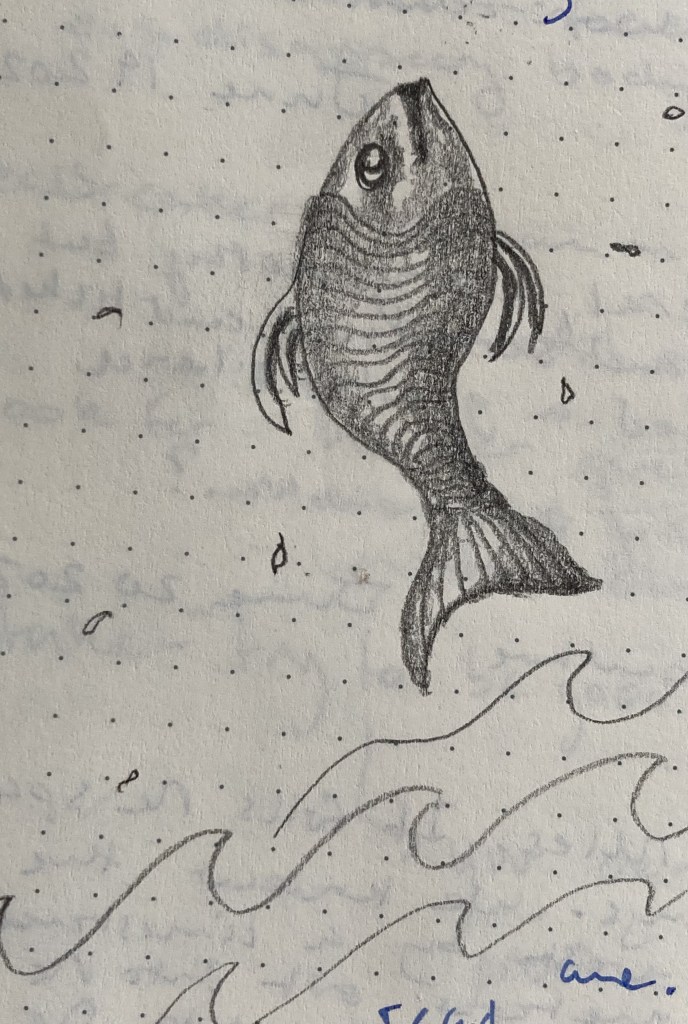
| Thought or Idea | Floater while exercising | People often use water words and imagery when they talk about the subconscious (e.g., stream, flow, ocean of awareness, diving deeper, swimming below the surface) |
| Comparison | < 15 minute response to a writing prompt | We’re taught to read…26 letters in the English alphabet and the millions of words they generate…but we’re never taught to read each other …and though we’re never taught, we do read these betweens (facial expressions, gestures, vocal tone, etc.), read them better than words sometimes. |
| Metaphor | Using a sentence by Peter Orner as a template | We started up, as you do lying to yourself: in the net of a valid excuse.[7] |
| Analogy (ish) | Stream of consciousness journaling when too tired before bed (not in the list above, but also, kind of a restriction …or imposed handicap) | I am a broken heart. It’s just sometimes I believe you can mend it. It’s the belief that destroys me. |
| Surprising word | Using a sentence by Jonathon Keats as a template | Tympanic (I know! I swear this word dropped from the universe onto the page…I wasn’t even sure it was a real word. I looked it up later. It is.) |
Now, ideally, I should be able to write this way for longer periods with practice and without the necessary restrictions to provoke the interesting writing. But the truth is, I’m really challenged with this. Many writers can access the subconscious more easily …it’s a state that seems more natural for them.
A thought: the challenge accessing the subconscious might be the reason many artists and writers use alcohol or drugs—the inhibition substances enable—to create art. Substances lower the socio-cultural pressure gates, sanctioning a more permeable membrane between consciousness and subconsciousness. It’s a delicate balance to manage and risk of addiction is…high (no pun intended), so not an ideal pathway.
Substance use also alleviates deep emotional pain, a pain all humans endure to some degree…I’ll come back to this shortly.
So, there’s phase one. And I can confidently claim creating writing drafts that surface magical subconscious gifts. What I’ve been stumped by, until recently, is how to work with the gifted images to integrate them into a completed piece (story or poem).
Here’s my default strategy in a nutshell. The other week I was walking with a writer friend, discussing writing. Not for the first time, she said, “I have to tell you, I noticed it in your writing way back then, and you continue to do it: you overthink your writing,” we were wading a substantial snowbank and it interrupted her train of thought, “You need to….” here her voice trailed off to silence. Cliffhanger!!! Trying to keep my desperation in check, cough cough, swiping the snow from my legs, I asked, “More emotion? More feeling?” Yes, she said.
Truth is, I was flummoxed. Wasn’t I doing this already? Actually, no.[8]
Now, I’ve read enough craft essays at this point to understand there’s a chasm wide difference between applying a technical move to integrate emotion and the sublime skill of layering emotion in a piece to create a work of art. This is the same difference I can taste in dishes and desserts that are technically proficient but nevertheless lack a quality I swear to gawd I can sense on my tongue: dishes cooked without love. What does this taste like? Flat.
Here are fragments I’ve cherry picked and pasted together to serve my own understanding and purpose (is this allowed? probably not) from Jeanette Winterson’s brilliant essay, The Semiotics of Sex, from her collection, Art Objects, Essays on Ecstasy and Effrontery:
“…it is worth remembering that the conventional mind is its own prison…Literature…packs in it supplies of energy and emotion that all of us need…Learning to read is a skill that marshals the entire resources of body and mind…I mean the ability to engage with a text as you would another human being…The love between you offers an alternative paradigm; a complete and fully realised vision in a chaotic unrealized world. Art is the realisation of complex emotion.”
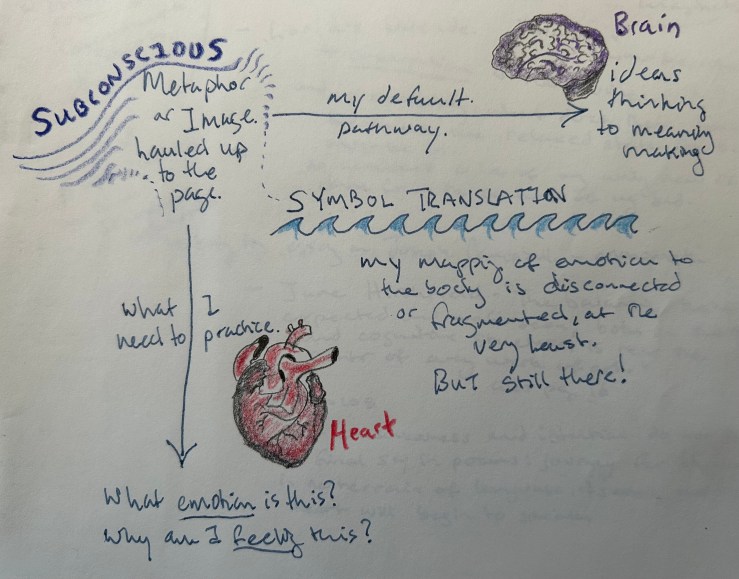
I won’t go into it here, and I’m loathe to kind of even talk about it, but I must for the sake of Phase Two. Much of the work with my therapist involves me learning to feel emotion in my body. Those deep emotions mentioned earlier that many people resort to drugs or alcohol to suppress or annihilate? Turns out I use high level thinking and analysis as a (socially acceptable) way to bypass feeling anything too deeply. Joy is acceptable and, no doubt, I’m exuberant, especially after a martini. But pain? Oh, I’ll cognitize the fuck out of it. Once I understood this, I asked my therapist, failing to mute a whiney earnest wretchedness, am I disabled?
Here’s a drawing of my own creative writing issue process I figured out with my therapist[9]:
Phase Two: Switch from horizontal to vertical symbol translation and FEEL it goddamnit
This is less…concrete…than Phase One because I’m only just beginning to understand and practice writing this way. Here’s how I worked it out.
A few months ago, I posted a creative writing piece in progress, Measures, and used orange text inserts denoting my analysis and thinking about the images and surprising words that came through the breezy drafting bits (but, I note, not the ‘idea’ driven bits).
Originally, the piece was generated as a response to a writing prompt—but not timed—leaving me ample opportunity to twist a narrative around an idea. Which I did. That draft, despite the lack of constraints, held a few scarce subconscious breadcrumbs that I didn’t recognise at the time. I have many many drafts like this (soft whimper).
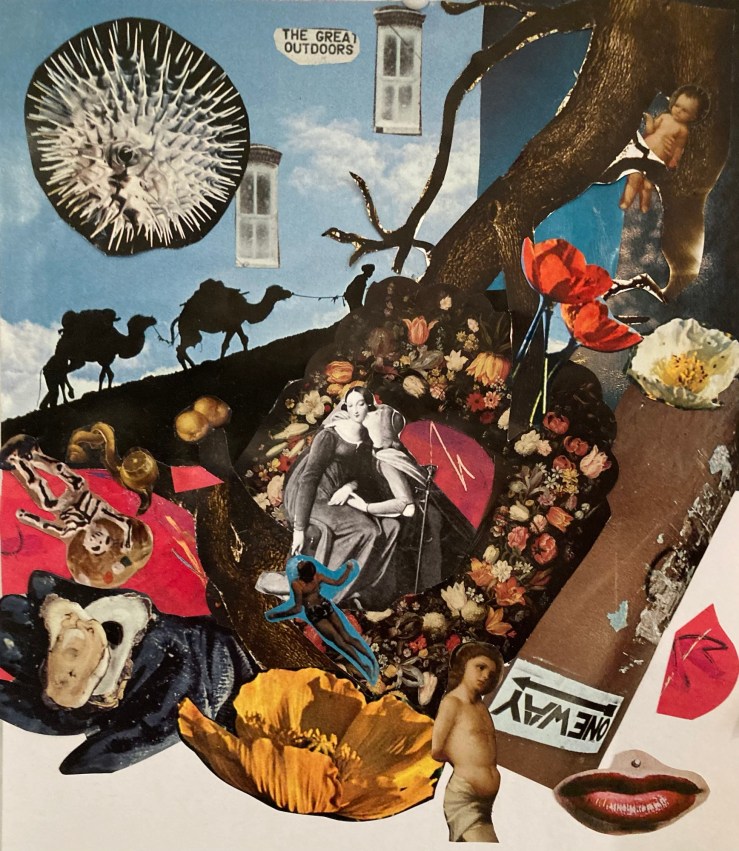
When I was preparing to read Measures at a public reading, I collaged the original draft together with other fragments of writing I’d done using constraints. I was rushing the edits (a self-imposed constraint). As I collaged, I could sense parts of the text vibrating some energy. I know, weird, but that’s the best way I can explain it. Those vibrating bits, I recognise now, signal subconscious missives. Maybe other people feel this differently, perhaps it’s simply noticing or a feeling of curiosity. However they’re identified, they’re the bits I have to attend to with care and devotion…a kind of nurturing love.
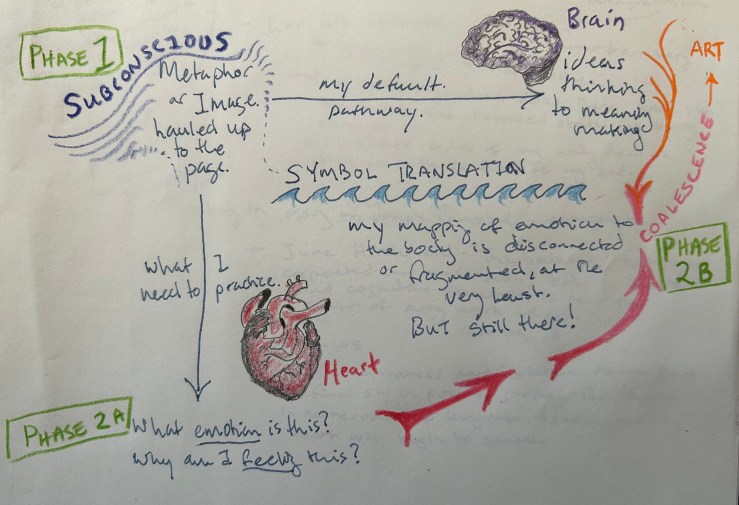
Phase 2 A
So, what does this look like in practice? It’s leaning into the feelings and emotions arising from the vibrating images and surprising words or metaphors. Instead of staying with surface logic, descend into the body, slow down, notice, INVITE the complex emotions swimming around my insides[10]. Name them – here’s a handy emotion wheel as reference. Map them (i.e., in the body – gut? heart? lungs? heat? cold? tension?).
For me this requires undisturbed focus best achieved comfortably propped up with pillows in bed. Because this is deeply discomforting work. Feeling sorrow, fear, shame, pain, anything deeply conflictual…it’s only with intentional effort that I sink into these feelings and pinpoint which ones adhere to the piece of creative writing I’m working with. The initial emotion identification process is much less writing and far more, well, active attention to feeling[11].
Once complex emotions are recognised, named and mapped, the task becomes layering the cascade of emotion into the piece. Because it isn’t just one emotion, it’s the movement from one (or several) emotion to the next. Emotion doesn’t just arise out of nowhere, it’s a relational reaction; it’s the energy of the between (often between people, but can also be between perception, say, a scent, and memory, or between animals and humans, or between landscape and humans…the list goes on…the important bit is that the emotion arises out of relationship). This is the experience, the relationship energy, I want my reader to feel. I’m creating an experience of complex emotion and I’m communicating, to borrow Winterson’s line, with text as I would another human being. It’s an intimacy.
Phase 2 B
How to do that? Here’s where it gets interesting. As a kid, I used to love those puzzles of what appeared to be hundreds of coloured dots on a page but when concentrated on a certain way and intentionally altering the angle of focus, the two-dimensional field of dots coalesced and popped what appeared as a three-dimensional image. Suddenly a 3D stag was running at me from the page[12]. The optical illusion puzzles are called Autostereograms (yes, I had to look this up).
The 3D puzzle is analogous to the process I used to layer complex emotional change into my working draft. Here’s an attempt to clarify my process (I’m still working on this….in a few months I might completely change my thinking, but for now, this works):
- the effect of the movement of feelings in the piece is like seeing/feeling the 3D image
- the subconscious missives in the form of images, metaphors, surprising words etc. are the dots
- The intellectual meaning or the question the draft might be revolving around is like the 2D field of dots
- the success of the story is proportional to the elegance with which a writer can layer all these aspects together, the coalescing of components – that movement from 2D to 3D….which, I suspect, is sensed and felt by the reader as opposed to through the mechanism of critical analysis.
- How is this done? By blending technical aspects (don’t let them take over!) with subconscious/dream aspects (the signposts of emotional energy)
- achieving the elegance of coalescing is the practice
So, this was how I approached the rewrite of Measures, a 905-word creative nonfiction piece. It’s my first intentional emotion blending attempt. When I was puzzling to layer the emotional movements in the piece, a specific line surfaced from the depths as I wrote and fiddled with the syntax (a subconscious gift!) and I burst into tears. A couple of friendly readers, though not all, experienced the same at the same paragraph in the piece. I’ve submitted the story to a few places for publication, waiting for submission windows to open at others…but really, reader reaction means, for me, the writing sings.
[1] I noticed I use the word subconscious as opposed to unconscious. I use subconscious to refer to information just below conscious awareness. But unconscious kind of means that too, though I think of unconscious information as deeper, more inaccessible. Like, my body doesn’t need to think about breathing or my heart beating to keep it upright (most of the time…falling in love or stubbing my bare toe on a concrete parking block changes all that, at least for a short moment). I admit, I took another deep dive into the differences and theories of mind conceptualizing unconscious and subconscious. Short synopsis: originally, the two words were used interchangeably as part of psychological theory. At some point, “unconscious” became synonymous with scientific rigour, while “subconscious” was significantly downgraded (ha ha, no pun intended) to parlance related to woo woo pseudoscientific pursuits, like, you know, tarot cards and ouija boards. So, there’s a classist-type interpretation of the two words. But, in other contexts, subconscious and unconscious refer to different levels of information below our conscious awareness, the former being slightly more accessible than the latter. Accessibility is thought to be achieved through intentional reflection practices, talk therapies, etc. [Here’s two whole paragraphs on this subject deleted. You’re welcome.]
[2] Okay, control is probably too strong a word here because the process of working this way, working with a subconscious (and yes, with the switch to using the indefinite article I’m proposing the subconscious is not mine alone, but rather a collective and fluid energy we all swim in…who’s woo woo now? ha ha ha) retains a high degree of mystery and hangs in dreamlike suspension (hang and suspension redundant? no, here dreamlike suspension is a thing, a state of being, maybe even a place).
[3] Though a word count cap is, technically, a restriction, I’ve found this insufficient for accessing the subconscious. Fewer words in a piece forces grammatical and syntactical discipline. Also, an efficiency of imparting information. But I can still think my way to a finished piece without layering in emotional heat (this is explored in Phase Two). This might also be why fragments written in emails and texts can sometimes fish out unexpected images, words….certainly humour bits I wouldn’t have thought of intentionally except for the challenge to provide a witty reply.
[4] Best, for me anyway, if not listening to a podcast or distracted by any visual media. Music seems to be okay, though floaty lines are heavily influenced by lyrics so this is a risk…it’s best if I’m not distracted at all. For the last year and a half or so, I’ve eschewed most media, including film, shows, news, in order to nurture and invite….access?…subconscious messaging. Also, ‘cause I just need the quiet.
[5] I keep a dream journal. I have since 2018 and kicking myself for not starting earlier. BUT – this is hard for me…I rarely remember my dreams …must apply intentional effort to remember them. When I wake, they’re dissolving very very fast. And if I wake in the night, too often I think, oh, I’ll write that down in the morning. Of course, by then, it’s long gone. Despite the dream journal an arm’s length from my pillow, I fail to reach my hand out in the dark. I remember my dreams better when I’m on vacation (I take this to mean that it’s only when I’m relaxed and rested that I’m really able to dialogue with dreams…work-life is too energy taxing. It’s a frustration for sure).
[6] Dreaming may not be “a restriction” per se – but could argue “not being awake” is.
[7] I love this line – it’s got two people in it, a narrator who is lying to themselves and colluding with the reader on this (reader senses the inclusion and also wants to know why), plus the metaphor “net” surfaces connotations of “caught in a trap” of a valid excuse. The reader senses the push-me pull-you tension of an excuse that is likely not valid or at the very least is a trap….but see? Here I have veered off into super analytical mode, ultra meaning making….I run the risk of using my usual approach and creating a “thought up” story as opposed to a “dreamed up” one. I feel the sentence would be a great first line of a story….ripe for using the timed write method to see what else will surface in a more dream-like way…get more text from the subconscious to the page before meddling with it.
[8] This blog is, I know, ultra thought concept driven. I don’t count the posts I write here as my “creative writing” work. Here, I’m exercising (exorcising?) my analytical tendencies …with the faint hope this will make space in my brain (and body) to allow the dreamwork to happen.
[9] Another friend, when I showed her this drawing explaining my thinking behind it, said, “wait, you drew a model of your analysis of your overthinking?” I erupted gales. A sense of humour is also an acceptable coping strategy for managing deep emotional pain. Subject for another post, this one is too long. Hopefully you’re still with me.
[10] You have no idea how difficult this is. I’m working on it.
[11] Am I also researching epigenetic biological embedding of experiences, relational neurobiology and the ontogenesis of shame, internalised oppression and morality? You betcha. [my gawd, she really is f-ing nutty nut bar]. Don’t worry, I do all of this half-assed.
[12] An AI generated overview of how to “see” the stag – Parallel (or wall-eyed) method: Focus your eyes as if looking at a point behind the image, not directly at the image itself; Cross-eyed method: Try to cross your eyes slightly to focus on a point beyond the image. Not gonna touch the AI grenade here…except to opine that feelings and emotions are often beyond words and language (why we need dreams and art as translation mechanisms) and I don’t believe AI will learn to fish the subconscious the way humans can hone their ability to.





 Process Peace