Tune(s) Up

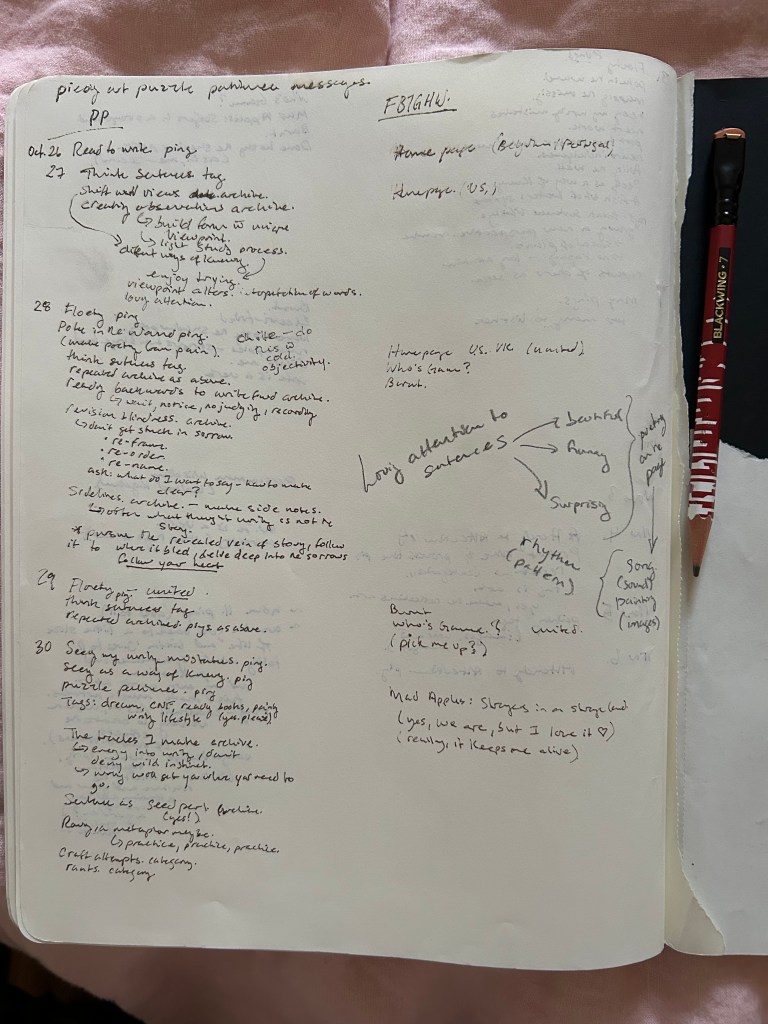
Thank you for your many messages. They guided my approach—which I’ll summarize below—revising A Marriage: Framed (CNF <2500 words) AND showed me to trust my own words and my own process. Your belief helps me believe. A blessing.

There was a lot of tinkering (ink -er-ing) trying to take this story to top level writing technique. I continue to tinker. Top level is…a dream, a ceaseless chase. And yeah, the chase really is a lot of fun [Insert: series of horn blasts and voice signals and Tally-ho! Here we go!].  

Last month, I posted my experience pruning A Marriage: Framed, taking it from 3770 to less than 2500 words. The process was fascinating because as I cut the words down, the focal point shifted, a spin that forced the painful emotions at the heart of my 27-year relationship with my ex to surface. Emotions I’d suppressed for decades.

Struggling to understand and move those emotions out of my body onto the page transformed them into “an object” (a writing piece) outside my body that I can interact with and control. I’m less “imprisoned” by my emotions, if that makes sense. I feel almost as if the rewriting of the draft I completed last month was a “therapy” draft. The story moved from being deeply subjective to objective, enabling me to turn to tackling the craft and technical aspects in the writing with a cool(er) and practiced distance[1]. This latter process, I’ve discovered, is essential to move the emotional therapy draft through a series of systematic style techniques so the artifact might approach a work of art. 

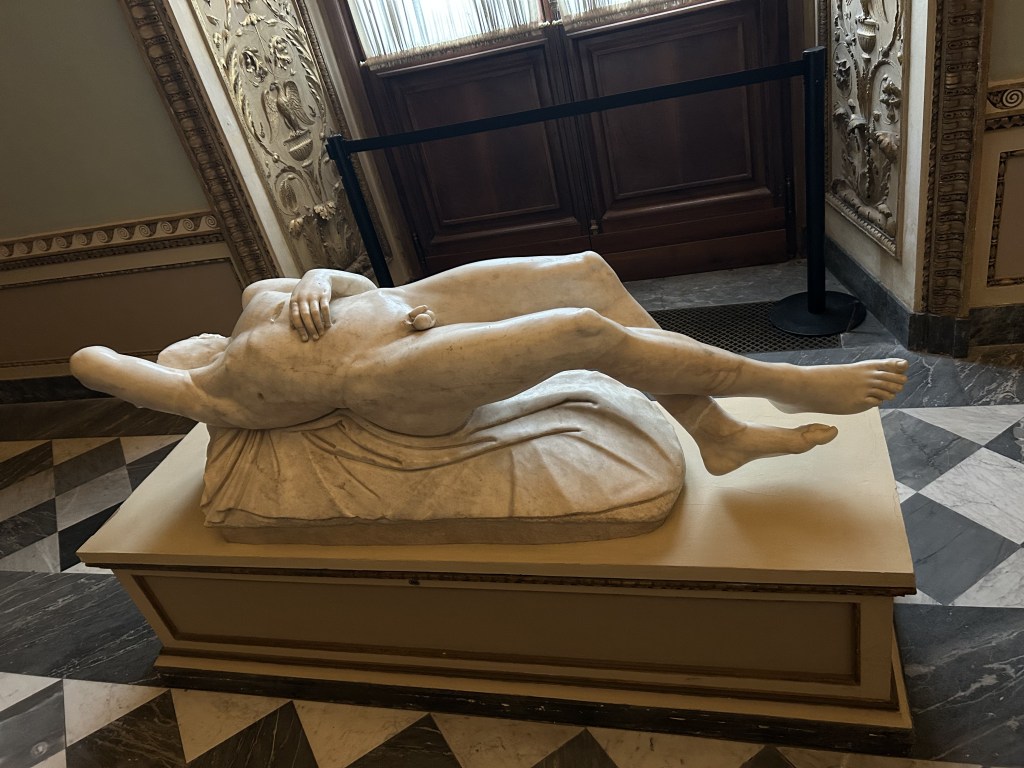
I wrote about my nascent practice and understanding for how to work with the subconscious as part of creative writing process in a post last March. Today, I want to build on that earlier exploration with some concrete examples because I’m trying to understand and practice tangible methods for working with less tangible materials. Silence. Air. Thoughts. Dreams.  I was thinking about how a musician works with the silences between notes to modulate pitch and tone, melody and harmony; how a sculptor carves a block of stone to encase a shape of air.  And my mind slid from that image to a memory of being captivated by a sculpture of Leda and the Swan when I was in Italy last fall.

I was rushing through the monumental halls on the second floor of the Library of Saint Mark in Venice in order to see the Mappa Mundi before the gallery closed. Speedwalking past innumerable marble busts, I stopped abruptly, struck by the unique portrayal of the infamous myth, an erotic story about the god Zeus, disguised as a swan, seducing the Spartan Queen Leda. The question about the nature of the seduction, whether coupling between the two was consensual or not, revolves the ages. This specific statue, its image, its energy, has stayed with me because of its beauty, yes, but also its ambiguity …for me, this sculpture is tangible object and emblem of desire-resistance all at once. Leda and the swan are carved to their moment of intercourse and Leda seems, at least to my eyes, both taken by surprise, as if she’s not quite ready to take on a god (she pushes the swan away) and surrendering to her attraction and desire at the same time.  

Roman variant of a possible Attic original of the mid 1st century BC Giovanni Grimani collection, 1587

I hadn’t appreciated why this sculpture has enchanted me for more than a year, until today, when, sifting my thoughts for something concrete (well, marble in this case), this memory surfaced. By embracing the complexity of the original myth and removing the layer of Greek mythology, I choose to think of this sculpture as a symbol of unification between spiritual and human worlds. When creative writing, I feel the spiritual world, or divine might be a better word, is a part of (or accessed via) the subconscious. The vibrating energy I can feel as I draft using stream of consciousness writing (read: writing without thinking too much) is intuition. Intuition is much like a tuning fork. I’ll try to explain this shortly.  

I’ve missed many of the signposts from the subconscious in my writing drafts—they arrive as words, resonances between words and as sensory images. I’m learning how to identify them and practice how to work with them and preserve them to create a net of story words that communicates something beyond words: feelings, energy, magic. Art.

Here’s an elegant and far more beautiful articulation for what I’m trying to say:

“Story form is an object, a translucent, shimmering thing with words tacked to the surface of its swirling involutions. The words glitter with their own reflective colouration; in them you see the momentary reflections of other words. Wires as thin as gossamer connect the words with more words on distant parts of the structure where they set up new colonies with flags, banners, replicas, and maps of the whole. Spin the form and the same words appear in flashes, the eye registers their rhythmic insistence[2]. It is wonderful and miraculous to watch.”

Excerpt from the essay, Anatomy of the Short Story, in The Erotics of Restraint, by Douglas Glover.

 Tune Up Techniques

My revision was guided by generous writers and readers who offered their love and attention and time to enhance my piece. I’ve said it before; creatives work in community. I’ll write more about that in December. My learnings I write here derive collective wisdoms of too many people to name.  Thank you.

Ideally, or shall I say, if this were easier, I might have started revising the Macro aspects of the piece—story, plot, characters, setting, points of view—then moved to the more Micro levels of paragraphs, sentences, rhetorical devices, syntax, diction.

But that’s not how it worked in practice.

There were the metaphors and the patterns and the desire-resistance tensions and the images that slid to occupy both macro and micro levels and, most important, all the space vibrating between. That’s the art object space, the space of Leda-swan. It’s an easy space to get lost in and an easy space to miss.

My tune up process was messy, not linear. Nor did it happen in steps, though describing the process here necessitates a sequential recounting. Revising was pressured by the word count cap, 2500 words max. The restriction served the writing in many ways by forcing disciplined compression (of words, sentences, images and ideas).

The process felt like persistent twisting, moving around and up and down and through the piece, working to understand my intentions and meanings, then shifting sections here and there, and tweaking here and there, and slowly, slowly, slowly, the piece contracted round an essential essence of tight emotional communication, complete with shimmery swirly resonances, into story art (ish…I’m still practicing).

Working with Vibrations

Ok, first, two indispensable applications I think I’ve failed to post on this blog, probably because my use of them is so integrated with my writing process I’ve neglected to emphasise my reliance on them[3]:

  • Word Hippo (thesaurus, word tools, etc.)
  • Online Etymology Dictionary – I love how they write on their site (my bolding),  “Etymonline aims to weave together words and the past, answer common questions, and sow seeds of serendipity. Sowing seeds of serendipity is exactly why and how I use this site. It’s a creativity generator.

Choosing the right word requires deep attention to what it is I want to say (what I intend a sentence to mean), the connotations I intend to (try to) control in readers’ minds, but also how I wish to communicate it. Choosing whether the flavour of communication should be sweet or bitter, whether the texture of communication should be hard or soft, whether the sense of communication might be cold or hot.

Here’s an example. In the original longer draft, I had an entire paragraph describing the situation where the husband explains he won’t allow his wife to attend the funeral of her friend’s dad. When I cut that paragraph down to convey its essential meaning in one sentence, I wrote, “[He] embargoed my attendance at a male friend’s dad’s funeral believing my intent was seduction.”

Ok, that word embargoed practically leaps off the page with melodrama and elevated (snobby) language. Instinctually I disliked it, but it captured the essence of meaning I was after, which was restriction or “not permitted”. The vibration of my distaste of the word (in this context), even though it had the right meaning, signalled—and I should explain, this feeling is super subtle, very easy to ignore if I’m not paying attention—there might be a deeper meaning.

I sat with the word quietly and patiently and questioned it, exploring its alternative meanings. The idea of ownership surfaced to consciousness …which is a concept I’m exploring in the larger piece. The subconscious offered “embargoed” up…but the flavour (snobby) and timing of it wasn’t right…I didn’t want to introduce the idea of ownership so early in the piece (this sentence comes in at paragraph two). I wanted “ownership” as a concept to build slowly through the piece, mimicking the way the wife experienced this revelation over time.

So, I fiddled with it. I ended up using the word “barred” because it conveys the meaning of “not permitted” and extends it into an implied image (physical bars) introducing the connotation of “prison” without it being overt. It’s also a soft, quiet word in the mouth, so a reader might glide past, carrying its meanings without tripping on them (embargoed is practically a foot stuck out in front of a running reader). The sentence became, “[He] barred me attending the funeral of my male friend’s dad believing I intended seduction.[4]

This is what I mean when I describe intuition as a tuning fork. It’s the vibrating intuition that guides which words and phrases bring the meaning and feeling and senses and sounds to coalesce in tune with the piece as a whole.

Another example, this time at the sentence level. In the therapy draft I wrote:

The kind of love that made me bump into walls, sliding glass doors and fail to recall what street to turn down to return to my own student house. The kind of love that made me forget to eat, made my skin glow, made me sing greetings to strangers.

I liked the repetition of “kind of love” because of the rhythm it introduces as well as the way it draws attention to the listed descriptions and also, the super subtle question injected by those words “kind” and “of” placed side by side, implying “sort of” …as in, this is the way the wife loved but was it a sort of love? A half in/half out love? I know, tenuous.

Also, “made my skin glow”…vibrated (intuition tuning fork struck)…what did I mean by this? I meant our lovemaking made my skin glow. An opportunity to align that idea with the larger story, which does circle and explore sex. Compression, and playing with the sound and syntax, reshaped it to:   

A colliding into walls, strike sliding glass doors kind of love, amnesiac love, missed meals, abandoned panties kind of love that made my skin glow.    

Working with energy

I wanted the reader to feel the same crescendo of energy and collision-like impact as I had experienced with the real event. So, I needed to recreate it. For this story, I wanted to begin with a quiet energy of curiosity that moved, incrementally, to build momentum through the piece toward a detonating end.   The best way to describe this is by comparing it with music. This tune,  You Look Like Trouble, by Lisa LeBlanc, embodies the energy arc I was after for my piece (and I’ve drawn what I mean in the graphic below).

But how did I do that? Well, I practiced what Summer Brennan refers to as the controlled release of energy by considering the way energy builds up and is released. I felt my way through this intuitively, and my attempt to describe it here is underdeveloped. Mostly, I feel, it was a conscious effort to pace story events, laying out the information that keeps a reader interested and curious and engaged, building on story events so they acquire more and more meaning, modulating sentence length and sound to align with intended meaning as I went (as described above). Layering information.

But also, this short piece is intense. More than one reader described it as a run instead of a walk. As the tension ratchets up with information layers (about who these characters are, their behaviours individually and in relationship), I deployed a technique I use often in my writing (and uh, life), the use of parentheticals and narrator intrusions to break the tension and release the energy.   

Here’s an example of this technique: This tragedy seemed particularly attractive (saviour complex? Fuck. Maybe.).[5]

Working with Metaphors and Imagery

I think of metaphor and imagery as working with dream. For me, this is the most prominent language the subconscious surfaces in my creative writings. The therapy draft revealed many. I adore working with metaphor and image and I avoid letting any go…I feel they’re a kind of magic, the spirit world made manifest with text on a page. But the therapy draft made visible, perhaps for the first time, my subconscious tendency to insert a metaphor or an image as an avoidance technique. Instead of forcing myself to move deeper into painful experiences, I throw up a metaphor and skate right past it. Once this was pointed out to me (thank you Barbara!), I could see where I’d done it, soft bodied ego protecting itself. So, I spent some quality time with my pain and worked to describe it clearly, straightforwardly, in scene.

Quite naturally, after I’d rewritten those pain sections, the imagery refined throughout the piece and miracle of miracles, the ones that remained hung together associatively. In this story it’s repeated imagery of sunlight and storm. I worked to sprinkle this imagery through the piece, augmenting associatiions with words resonating the same sounds and meanings, and tried to follow the energy arc by beginning with sunlight and ending with a lightening strike.   

And I tried to get some beautiful sentences in. There are a few I really like. Playing with sentences had me waking in the middle of the night to puzzle them through. Here’s one that didn’t make it into the piece, but I leave it here for your pleasure and song.

And what is love? Laughter donning roller skates, heedless of the hill[6].


[1] It’s important I make a distinction here. Even though I’m bandying the terms “objective” and “distanced” and “cold” and “systematic”, which raises “scientific method” connotations, the process for moving into technical tune up MUST (MUST!) retain an open heart and keen attention to the body warming when the vibrations of instinct ping. The process is slow and methodical. I know I’m on the right track when I’m delighting in the discoveries (the right words slip into the right place; the sounds; most of all, when unexpected injections of humour are revealed).

[2] I love the way the movement, “Spin the form”, resonates with the words “colonies” and “replica” and “maps” in the previous sentence to deliver an image (implied) of a spinning globe, a twirling world, disco ball like with those flashes.

[3] I used to use a visual thesaurus as well, but default to word hippo these days. Before that I used a heavy hardbacked Oxford thesaurus I “borrowed” from my housemate in second year university. Sorry Jeff, it’s still on my bookshelf.

[4] Also shifted words around to improve difficulty comprehending “male friend’s dad’s funeral”. Thanks Stacey! We decided the passive might be okay in this instance, a sacrifice for clarity.

[5] I am fretting over the punctuation here. I think this is right.

[6] I woke at 1:16 am thinking this question: and what is love? In half sleep, the words/image (as one) arrived: laughter, roller skates. After a trip to the toilet, more words: back to the hill. Later that day I played around with the words a bit to come up with this line…a line I’m happily hooked on because it feeds me, nurtures me, continues to shimmer. Sparkle. Delight.

Leda does love him. She shares his dreams.

Killing the Phantom

Okay. I’ve scrapped much of what I drafted for this post. Instead, I’m pasting in a few extracts of random jottings, conversations, and responses to writing prompts in the last month or so[1]. Some chaotic thoughts, shredded remnants of what I’d originally intended to write, follow. And this is a long post, so grab a mug of something and settle in.   

Ready?  These are drafts [she wailed loudly to cover up her delicate vulnerability ha ha]! Fuck it, here goes.

In response to a prompt to write 400 words about the origin of my name (558 words):

My name, my first name, Suzanne, means Lily or Rose, an unintentional connection when naming my own two daughters: the eldest with the name of Lillian, the younger with the middle name of Rose. All of us blossoming.

My own mother chose my name, naming me after her favourite cousin of many. I do not know what made Suzanne my mother’s favourite cousin, but I imagine it might be because Suzanne was kind, that perhaps, unlike the other twiggy branches of the family tree—even the trunk of my mum’s own mother—banished mum when she fell pregnant out of wedlock. She was forced to endure the pregnancy in secret, to endure the betrayal alone, to endure the abandonment of the man she had loved not just with her body but also her soul to create the wee soul swimming in the womb of her body.

Mum was sent to hide her pregnancy on a remote farm where the five kids who lived there threw rocks at her while the farmwife, their own mother, watched and said nothing. Perhaps she encouraged her children in the methods of this stoning. This stonewalling.  

To name is to categorize. Bastard. Whore. Slut. And the name stuck. Not on the outside of mum’s skin but worming deep in her mind, free floating the very cells of amniotic fluid the foetus hiccupped down and in, down and into their own cells. This is the way of water. It trickles incremental with the power to erode granite. Walls of stone.

Suzanne, when I met her in New Zealand, visiting when I was twenty-three, was a gentle quiet soul. She kept a canary in a cage in her kitchen who she spoke with each morning, coaxing his song. His name was Bird. He was who he was. Plain and simple and straightforward and beautiful. I marveled the amazing synchronicity of Suzanne’s movements when one day she stepped into the garden with a pair of scissors glinting the dawn. She clipped a stem with a few leaves of milkweed, brought this inside and placed it in an open mason jar. She held the jar up, a jewel in the light, to show me the chrysalis hanging the fork between leaf and stem. The chrysalis was chartreuse with a tiny necklace of gold, specks of dark between the golden granules. A monarch chrysalis, she said. But of course, I knew, for my mother too, continents and oceans and seasons and days and nights across the planet also brought monarch chrysalides inside and kept them in open mason jars to marvel the wondrous metamorphosis, the miracle of worm become butterfly.

As the butterfly formed, cocooned within, the chrysalis darkened to black. Then it cracked, splitting open from gold shoulders down to tip, the walls of the chrysalis transparent as glass, smashed open with the power of wings within. And the butterfly unfolded to hang beneath a milkweed leaf, to dry its wet wings to a powder coated blaze of fire colour. When it started exercising, fanning for flight, my mother and Suzanne stepped into their gardens with their wide-open jars to witness the transformation that is flight. That is freedom. And the flowers blossomed all round. And in this way, I learned how we and everything in this world are all connected. And not just by how we are named[2].   

One paragraph’s worth of writing toward the long project (386 words):

The condom broke. This is how I imagine it years later from the benign safety of a different generation. A generation—only a couple of decades—where, when the condom broke, sliding out from my own slippery insides to reveal its terrifying tatters dripping loosened semen on the insides of my thighs, a Sunday morning I recall, I looked up my physician’s name in the phone book and called his house and his daughter, who I knew was in grade three, answered, and he took an inordinately long time to come to the phone, probably summoned from mowing the lawn or some other mundane morning task, while I waited, dripping the vestiges of lovemaking onto the coffee table in my eighteen year-old boyfriend’s living room, the marble chess pieces strewn round my naked ass where they’d been knocked sideways to the floor, knight to queen (!), which was, I realise with hindsight, probably better categorized as fucking instead of lovemaking, fun fucking where, even when the marble bishop stabbed my spine’s base, my voice climbed the heights to climax fast and shuddering, and, when my doctor who had been my doctor since almost before memory, finally answered his telephone, I, ever polite, apologised for disturbing his personal peace and calmly, rationally, explained my situation, omitting, of course, the unnecessary details of the coffee table, the chess board, its marble pieces gone flying,  but supplying the dates of my last period, a riveting estimation of my ovulation window and talked through a risk benefit analysis of heading to the hospital emergency to request a morning after pill, a pill I knew from friends’ experiences of bleeding a hemorrhaging volume of blood down the shower drain, the running water drowning the sounds of wailing hearts and cramp pain, I really preferred to avoid, but only slightly less than an unwanted pregnancy at age nineteen (I would be entering university in the fall), my physician and I agreed, I might forego it. This time.  He reminded me I ought get back on The Pill. I’d used oral contraceptives since aged sixteen and discontinued them by aged seventeen, deciding they “made me squirrely”, and not in the sexy way. Condoms would have to do. But, alone as a contraceptive with wildly rambunctious sex (gawd that feels good!), they were risky[3].

Random lines from notebooks[4]:

  • I don’t want to be a whore; I want to be a whore and so much more. (2025)
  • If I were to create an avatar, I’d give myself a unicorn horn. I wouldn’t necessarily strap it to my forehead. (2019)
  • Internalized misogyny – IM – good nickname for a dildo. (2024)

In a coffee shop:

“Suzanne, stop flirting with the barista.”

“I’m not flirting with him; he’d know if I was flirting with him.” [Young Irish barista blushes bright pink.]

Speaking with a friend:

Me: “Well, she is a widow…”

Friend: “Yeah, but she isn’t a failure; a death is different than a divorce.[5]

Sentence practice in paragraph form, playing with narrative distance[6]:

Camilla is holding her sorrow in, squaring her shoulders, dreaming not of the lovemaking that landed her here, discussing “the solution” over tea with her mother and G’s father, his stern eyebrows, not of the electricity that sparked her lips when she first kissed G at the back of the lab, thinking not of the fetus hiccupping the amniotic fluid bubbly within her, the baby who has not yet quickened. It shouldn’t be a conversation between four people. It doesn’t matter if the fifth person, the baby, might also have a voice. She hadn’t really heard G, when he said the condom broke. He turned away. He hadn’t met her eyes. He’d reminded her of a sheep, caught in the barb wire of a fence.  The roundness of his naked shoulders, the muscles rolling beneath the heat of her palms, the dry sweet scent of crushed straw beneath, the way his body slipped so easily, becoming part of her own, his moist breath huffing the whorl of her ear, how two bodies become one, she’s not remembering it now. There are rules, love does not govern them, the laws and the systems and society’s expectations and the differences for men, for women—any notion love might prevail or triumph to hold a creation together. The baby will be born, surrendered to another family, and Camilla’s own development arrested there, at age twenty-three, the moment she’ll never forgive herself for, the pain of giving her baby away, the heart beating at the center of her liquid addiction[7].

I’m sure I’ve written this before: it often happens a particular piece of writing lands below my eyeballs at the perfect time. I mean, at the perfect time to teach me something I need to learn, at the perfect time I might finally be able to understand a work of writing or perceive it differently from a previous reading, at the perfect time to crack my eggy thinking open.

This time it was Professions for Women, an abbreviated version of a talk Virginia Woolf gave to a branch of the National Society for Women’s Service on January 21, 1931. To add a little context to this inter-war period date, two million women in the UK had replaced men in traditionally male jobs during WWI and they had only secured the right to vote in 1928, three years before Woolf delivered her speech. These facts feel like distant history, but this is not at all long ago.

A synchronicity: also read The Prime of Miss Jean Brodie with book club this month, set in the inter-war period, though, written in 1961 from a woman’s perspective and of women experiences and I laughed out loud a lot while reading it. Muriel Spark writes funny. An exploration of the fine line between nurturing and grooming; how thought and action might be manipulated. The creeping insidiousness of fascist and/or religious ideologies into malleable minds, how might it be achieved[8]?  

Why this little history lesson?  I was struck by the optimism and agency of women, the possibilities and independence, Woolf  commented on, opening to them at that time, women in their prime (!)…and struck… in a kind of devastating way, [here, I crave a distracting paragraph about waves of feminism, or better, gender and sex politics, or best, something raunchily erotic about how much I enjoy sex[9]] because I feel we’re falling—failing—backwards. [Huh, this subject is also an avoidance, a path too easily followed.]

Okay, [wince], here it is (took paras and pages to get here): because reading Woolf’s speech, I recognized how, in my own marriage, I was (am?)—embarrassingly so[10] —what Woolf named the Angel in the House. I was (am?) that selfless, sacrificial woman whose sole purpose in life is to soothe, flatter, and comfort men, but also …everyone else, other than myself, while raising a family with efficiency. And my experience of being that woman was to become invisible. It is partly what I’m exploring through the writing of the long project. A small part; I’m far more interested in how experiences of shame, betrayal, cruelty shape…not just a life, but relationships. And not just within a lifetime but crossing generations.  How legacies of pain endure and continue to shape…behaviours, choices, how and who we love. Also, thought. But wait, what “Jean Brodie” groomed me to be the Angel when I was born into a generation and country where women experience more choice and more access and more autonomy and more agency than any other historically?  These ideas are related; I’m exploring them, using my life as the sacrificial lamb (and suddenly I’m thinking of mint sauce).   

Most recent writing of the long project, evidenced by the extracted examples of writing practice above, has been attempting to write the story of how, in the 1960s, my mum “surrendered” (this is the wording used at the time) two different babies for adoption. Two different fathers. Two different countries with different sets of laws. I have two brothers in addition to the one I grew up with[11].

Each time I’ve tried to enter and write the scenes circling mum’s experiences, I slide into writing my own instead. I’ve allowed myself to drift, trusting the process of writing, following where it takes me. I’m both bewildered and grateful to report the imagery arising out of these seeming tangents bring to light very strong images to crack open my thinking about mum’s stories (the bishop!). But the writing has been very slow and very hard to sit with and real work to get it to the page. I’ve been trying to understand why[12]. And Woolf’s speech calls out and answers my pained confusion[13].

“Killing the Angel in the House was part of the occupation of a woman writer.”

Woolf ‘s speech talks about how she managed to kill The Angel. And I believed I’d killed her too[14]. But Woolf continues her thinking, naming the Angel differently, accurately, as The Phantom. And I’m going to mash up some of her sentences here, which I’m sure is a very grave sin, to elucidate my own understanding…think of it in the same way as rap sampling:

It is far harder to kill a phantom than a reality. She was always creeping back when I thought I had despatched her. Though I flatter myself that I killed her in the end, the struggle was severe; it took much time… To speak without figure she [the woman writer] had thought of something, something about the body, about the passions which it was unfitting for her as a woman to say… The consciousness of…the truth about her passions had roused her from her artist’s state of unconsciousness. She could write no more. The trance was over. Her imagination could work no longer… women writers…are impeded by the extreme conventionality… control the extreme severity with which… freedom… [is]condemn[ed] in women… telling the truth about my own experiences as a body… The obstacles against her are still immensely powerful–and yet they are very difficult to define. Outwardly, what is simpler than to write books? Outwardly, what obstacles are there for a woman rather than for a man? Inwardly, I think, the case is very different; she has still many ghosts to fight, many prejudices to overcome. Indeed it will be a long time still, I think, before a woman can sit down to write a book without finding a phantom to be slain…

So…my Writing Resistance…it’s this haunting…the phantom in my bones, it’s the air I’m breathing, it’s part of me…this belief that what I write, the experience of being a woman, a mother, a daughter, a wife, cannot be said, or is uninteresting, or has no value. As Wool says, “the aims for which we are fighting, for which we are doing battle with these formidable obstaclesmust be perpetually questioned and examined.”  I’m interested to learn how my beliefs settled into my cells, forming my selves, and influencing all the choices I make in this one precious life[15].


[1] Why? Because I think it’s important to show one another our first draft writings…it’s a nakedness to be sure …my thinking is naked and vulnerable, not to mention my writing skill level (uh, shallow) BUT I find in these first draft writings, they’re authentic, real…something from the collective subconscious has washed through my body of embedded experiences and sprinkled the page with tiny glittering tidings, the shells of ideas, memories, feelings I can pick up and pocket to explore with deeper curiosity.  I’ll try to signal these vibrations I feel from my drafty writings using footnotes.  The collection selected to post here illuminates how my thinking is circling around similar ideas as I struggle to fold them into being a part of the long project (book length work in progress).

[2] This piece was lightly edited when I transcribed it from my notebook where it was written by hand. I’m still stunned by how it unfolded to these images, these resonances, written in a fast flurry of < 30 minutes. The vibrations, for me, emanate from the words “stone” and “wall” signalled by the repetition…but also the metamorphosis …an encasement (cage), a transformation, a freedom. The metamorphosis is both literal (butterfly) and metaphoric (what is hinted at with the baby in the womb and the cells and the genetic legacies being gulped there…but also…that caged canary…what is he doing there? Random thought: canary in the coal mine…).

[3] The vibration here comes at me as if it the text flashed pink neon: the bishop chess piece, piercing the narrator’s spine. This image appeared in the quick writing, it’s not a specific memory at all…but it’s one of those glittering grains illuminating a pathway, a gift straight from the subconscious, a guide toward something brewing in the larger work.  My mum’s experience of giving two babies up for adoption in the 1960s is not the central subject or theme of the long project at all. But it’s helping to form those ideas, and her history is part of it all …this blog post reveals more to me about what it is I’m exploring. Glad you’re here along for the ride. Really.  I need hand holding. And encouragement, however tenuous it may be.

[4] I like how these lines hang together. No pun intended.

[5] This was meant as a joke; we laughed hard because many women (and not men) have made me feel like I’ve failed a most important task: marriage. And note, I have/do/trying to squash… felt/feel/feeling like a failure (IM at work).

[6] Practicing with Nina Schuyler using a paragraph and sentences from Rita Bullwinkel’s novel Headshot.

[7] With this last sentence, Nina said to be cautious here with this level of narrative distance…ask myself, have I lifted too far out of the story and summarised too much, given away too much, when this might be better as information meted out with scene and story? And I understood, in a way I hadn’t quite grasped before, how this is also another way of exploring the difference between showing and telling…and how that choice can be deliberate to move the story along, or drop into a moment of character or narrator reflection, or create authorial intrusions, or create a clue as to what might be coming later in the story  … many techniques to be employed by this method…and I think I often default doing this, pulling myself out of story to this high level bird’s eye view summary, especially when the scene or the subject matter might require sitting with emotional discomfort, getting it onto the page…and this means I cheapen the experience for a reader, when it’s much more exciting or entertaining  to get in close and personal…to experience together. Still, I love this movement, playing with psychic distance, that it can be done across sentences within the same paragraph.

[8] Monstrous recognition this pattern of history is repeating.

[9] And I must clarify something here: when I write about misogyny, sexism, the patriarchy, feminism, etc. I am NOT writing against men, and certainly not an individual or specific man. I LOVE MEN. I am writing about ideas and ideologies and I’m far more interested in how these ideas shape human lives and human relationships. It’s difficult to write and talk about these ideas because the shrill voice of the masses are salivating and ready to burn the witch at the stake or tar and feather the feminist or accuse her of becoming a raving lesbian, as if this were something bad, or a hairy man hater …we need to talk about these ideas outside the confines of categories. They’re interesting. [edited out: a long diatribe repeating the same idea and without any academic level of feminist theory because I’m a neophyte in this respect.]

[10] One of my dearest and oldest friends when I announced I’d left my marriage, said, “we couldn’t understand it, you were like some goddamned Little House on The Prairie woman out there [on the farm].”  This hurt of course….the collective “we” …how much had my life been discussed?…but also, the truth of it – I verily (ha ha) believed, stupidly, I could do it all: raise my children well and healthy; grow my own food; develop a professional career; maintain a creative art practice; be a kind and supportive partner; be a dutiful daughter-in-law; be an honourable daughter and sibling. Maybe I was able to do it all, at least for a little while. Like, three to five minutes?

[11] And our family reunited with both brothers …and the most fascinating discovery for me has been that despite being raised in three different countries, in three different families, we share the same ways of moving our arms and hands when we speak, the same way we place our bodies in space. I love that gesture is something inherited. Unfortunately, we also share the same addictive tendencies to alcohol …or perhaps this is simply a symptom of living with pain of similar origin…

[12] Skip this extra-long footnote if you don’t want to read my whining. No? Fine then. I’ve also been tired and sensitive and overwhelmed and vulnerable and weepy this last month worrying about my job. After five years of remote and hybrid working, the Secretary of Cabinet announced all public servants will be required to report to their headquarter office (a new term btw to skirt the possibility staff might satisfy their required in-office days at a ministry building closer to where they live). The decision significantly impacts people who struggle to balance raising children or caring for elderly parents with their workdays, roles more often shouldered by women. The decision unnecessarily costs the tax-payer with the sudden and inane administrative burden to, one, fit workers into offices that can’t accommodate all staff five days a week (much real estate was sold off since the pandemic), and two, adjudicate the thousands of requests for alternative work arrangements flooding managers and directors inboxes, decimating, possibly even arresting regular duties re: policy making. There are close to 70, 000 public servants in Ontario and the announcement has us all whipping a hurricane of negativity and competition (not to mention a turbid froth of distraction). On the heels of several disappointments since spring (three colleagues sparkling with intelligence, kind and dedicated mentors, have left their jobs; weathering the policy oppression tentacles from the south successfully supressing equity focused language and progress in the north (I feel this personally, as an erosion), my “professional” role feels fucking flattened.

AND (worst) my story, Measures, accepted for publication…was later declined. The editor requested confirmation the story was unpublished. I confirmed yes, the version on offer was unpublished, but, I explained, earlier drafts of the story have been posted, and broadcast on my personal blog (this one). So, they chose not to publish it.  Cue the loud whining: really what I want to do is read books and sit and think and write all day long…well, with breaks to feast and f…make love.

[13] There is much in Woolf’s speech that resonates for me; this post can’t contain it. Never mind. I’ll revisit her ideas and imagery about the unconscious in the future.

[14] The decision to end a marriage of twenty-five years, a relationship of twenty-seven, is…fucking hard. Ultimately, what gave me the courage to make the leap was a moment, a strike of lightening moment, when I understood with utmost clarity [insert the scent of burning ozone], that if I wanted to continue to grow my creative writing practice, I would have to leave. If I stayed, my writing practice would have been undermined and suppressed.  It is hard for me to reconcile but my writing was perceived as threatening and seditious.

Awake, I see, there is no way to unsee.

As Woolf explains, “I turned upon her [the Angel] and caught her by the throat. I did my best to kill her…Had I not killed her she would have killed me. She would have plucked the heart out of my writing.”

My divorce certificate arrived last week. I’m proud we managed this in just under two years following my decision to leave. I made concessions. I’m proud of this too. Money has never been my motivating factor; pleasure is (wink). Oh, and joy. Really, my lodestar is love.  

[15] It is hilarious to me how Woolf writes about what she decided to do with the money earned from her first “professional” publication: “I bought a Persian cat with the proceeds.” After much deliberation and speaking with Lillian and Willa about the possibility I might have to live in their garden sheds when I retire, I have decided to buy myself a year off work, a self-funded sabbatical, so that I can experience what it is like to focus on my own creative work. Also, with no expectations of output from the year. Simply the ability to focus without my mind divided across professional policy work and artistic practice.  My leave of absence request has yet to be approved, but the wheels are in motion. I plan for my leave to begin spring 2026. It feels absolutely right.

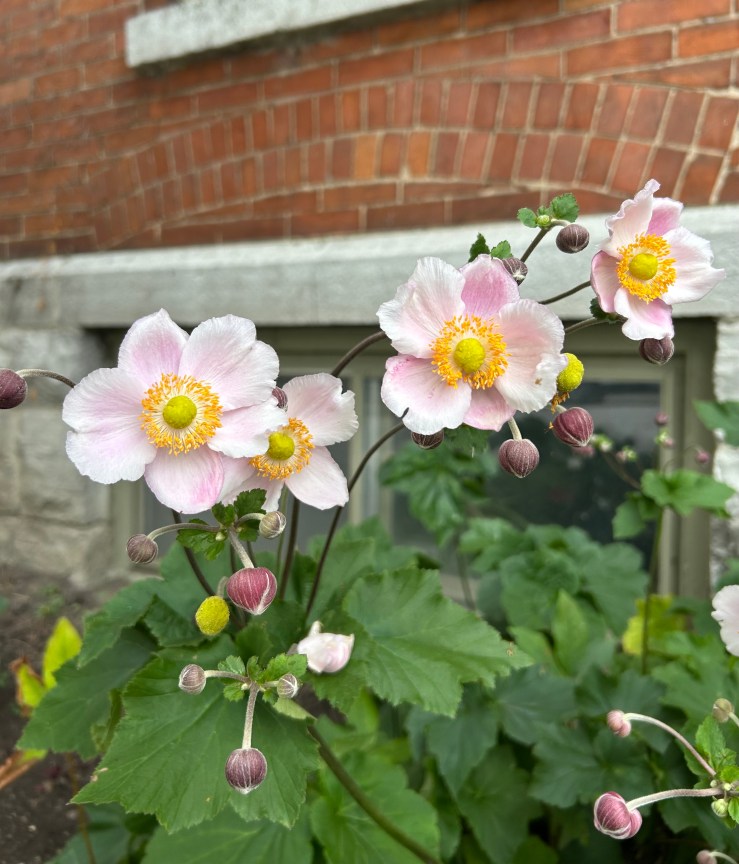
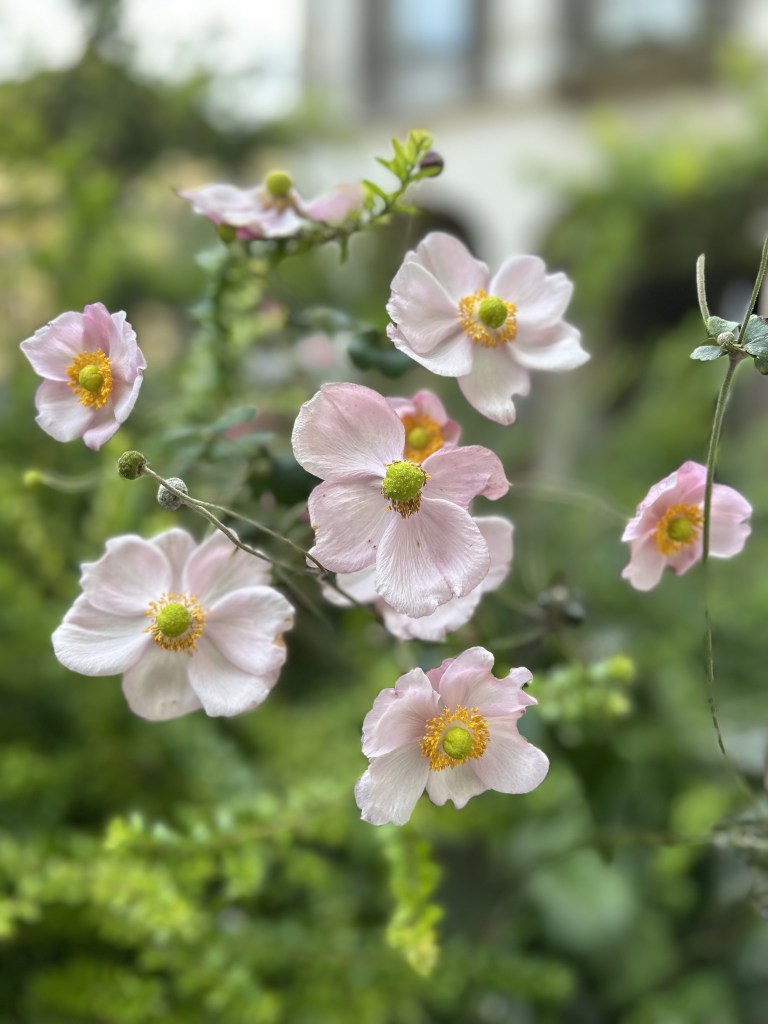
Japanese anemones outside the apartment this week.

Neuroindulgence

Quick preview: this is a long post, steering (dragging?) you, dear reader, through personal memories and thoughts related to books I’ve read, coupled with an embarrassing but brief writing draft, followed by tottering, slipshod connections toward a conclusion I’ve reached before. I can’t promise return on investment. But there’s repeating reference to naked breasts. Female ones, even. So.  

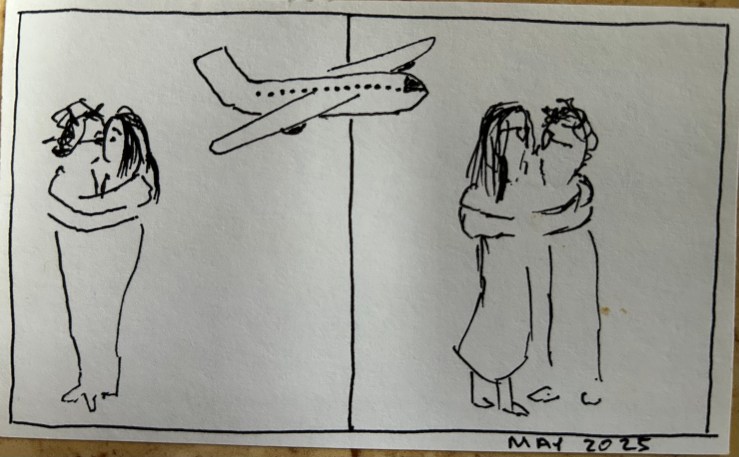
Home now after two weeks away. One week in BC moving daughter number one from Victoria to Vancouver for a summer internship, followed by a week working in Toronto, staying with daughter number two. A delightful day in the middle where I hugged one daughter in the morning and the other in the evening. Trees fluffy with spring blossom. Out west, the sweet scent of budding Black Cottonwood mingled with brine. In Toronto, Eastern Red Buds branched hot pink; spent and ragged-edged magnolias flowered the sidewalks.  Despite the beauty, spending time with the girls, the relief it’s finally spring, travel disrupted my writing routine, making me edgy and irritable. This morning I’m up at 5, determined to recoup the energy and time necessary for the task[1].

And though I didn’t write while away, I read. I’m mid-way through deep reading an essay I’ve intended to analyse for years, The Fourth State of Matter by Jo Ann Beard. It’s one of several pieces of writing I pulled for the trip, selecting a diversity of works to understand their structural elements and track emotional movements therein[2]. I’m trying to slow my reading sufficiently to understand where and why and how my water works turn on, where sentences spark to fan the embers of my humour, igniting laughter[3]. I thought I’d start with pieces that elicited obvious emotional reaction for me when I first read them.  As always, I underestimated the time such close reading requires, hence my half-way point through the analysis of Beard’s essay. The folder of works I carried across the country and back remained unopened, mostly. And as always, I picked up books along the way…

An interesting observation: I had completely forgotten Beard’s essay is about a school shooting. Like, completely forgotten!!! Instead, the lingering images and feelings I retained from the essay were how the narrator loves and cares for her dying dog. I remembered she carries the aged collie up and down stairs and endlessly washes soiled blankets to place fresh, dried ones beneath the incontinent animal. It’s the love and devotion and grief and longing captured in those images that I remembered[4].

And that got me thinking about the selective and specific memories of book length works my brain holds onto. Is there a pattern to them? Are they all images?  Are they predominantly feelings? What makes them memorable for me?

This brief sample list is poor representation of my rapacious yet superficial reading habit; I read widely but not deeply[5]. I’m working to improve deeper reading. Now, I always read with a pencil in hand, underlining passages, scribbling notes in the margins, extracting sentences, passages, into various notebooks, feathering pages with coloured post-it flags.  And, if I’m honest, it’s only when I write through analysis, i.e., not think through it, that I really get a sense of the mechanics and the magic, hence the indulgent footnote #4 (it’s more for me than for you ha ha).  

This list is the “top of mind” list …I’ve limited myself here deliberately. See? this is me not going to my bookshelf to divine more of my memories conjured off their spines.  The clumsy imprecise rendering here is also deliberate…these are the fuzzy bits retained. Sometimes the only bits. Maybe this betrays a sieve-like brain …or worse, a brain-like sieve.  

  • Like Water for Chocolate by Laura Esquivel – scene at the dinner table where the protagonist, forbade by her mother to declare her love to a young man who we know loves her back but is betrothed to her eldest sister, cooks her unrequited passion into a spectacular dinner of dishes, including rose petals (!), the whole family share. But it’s the middle sister who “eats” the cooked in love, becoming so consumed with heat and lust and passion, she rushes from the dining room, somehow loses all her clothes in the process, runs across a field in the dark and her naked body, hair streaming wildly, is hoisted by welcoming arms onto a horse ridden by a passing _______ …can’t remember this detail …soldier? Bandit?  Some kind of handsome outlaw anyway. He happens to be riding by with his gang. This scene makes me feel…envy.
  • Love in the Time of Cholera by Gabriel Garcia Marquez – the protagonist (though, maybe this is a side character?) goes out of his way to eat asparagus every day so that he may smell its telltale odorous byproducts every time he pees. Oh, and a pet parrot that blurts out inappropriate phrases (swearing?) and lives half in and half outside the house[6].
  • The World According to Garp by John Irving – Garp frying onions, building the mirepoix, to make spaghetti sauce which attracts a woman neighbour to his door, inside his house and eventually into an extra-marital affair[7].  Sigh. It always starts with an onion.
  • The Brief Wondrous Life of Oscar Wao by Junot Diaz – the mother’s sly smile, her wig askew after she fakes a fall and injury, a smile like a tiger’s smile (I likely have this detail wrong) after successfully tricking and luring her teen daughter back to her on a boardwalk in a very public place.
  • The English Patient by Michael Ondaatje – when the beautiful Sikh bomb diffuser shows the nurse a wall mural in an ancient church. Lots of candles[8].
  • All The Light We Cannot See by Anthony Doerr – spectacular book! I loved it. But I mostly retain an image of seashells sparkling on the walls of a seashore cave that is fast filling with the tide? Good grief.  
  • Anna Karenina by Leo Tolstoy – Vasilly scything the wheat fields alongside the peasants. Amazed I remember the character’s name. I love this scene…the movement of all the people, men and women, working together as they harvest their way up the hill of wheat (or is it down?). Vasilly’s satisfaction with working his body this way. Seem to recall he’s depressed a lot, how his physical exertion is a balm.
  • For Whom The Bell Tolls by Ernest Hemingway – a side character’s name, Pilar, and characters hiding out in arid, treeless, boulder strewn mountainside cliffs….waiting….waiting …waiting.
  • Industry of Souls by Martin Booth – this is my favourite novel…I’ve read it several times…I don’t know why it endures as a favourite…perhaps it’s the structure, a gentle moving back and forth in time as the protagonist, a man in his eighties, must decide whether to stay or leave Russia, whether to return to England. I love how the character moves around the small village he lives in, saying goodbye to all the friends he has made (for some reason, an image of golden light and lazy bees rises in my mind’s eye here). The visits tip the protagonist’s memories and readers follow his thoughts back in time to when he is a prisoner in the gulag, Siberian labour camps.  A few scenes stick out in memory: one where the male prisoners are found by female prisoners and they pair off in various semi-private mine shafts to make love; another when the prisoners dig a mammoth from the permafrost and eat it; and the most enduring clear image of a man who decides to take his own life by stripping down and sitting down in a snowbank to freeze to death (this happens at a train station).  
  • The Prince of Tides by Pat Conroy – the scene where the mother character takes her children to a clothing store and they’re crammed in one of the back change room stalls where they overhear the storekeeper women making fun of the mother with nasty comments about the beautiful magnolia (?) flower she wears in her hair…it’s the bit where the mother’s face falls, she’s humiliated but endures this in silence…it’s an image, I feel, connecting to the fall from innocence…this scene always makes me cry.
  • The Grapes of Wrath by John Steinbeck – travelling in cattle cars across great deserted and desert-like fields, tumble weed bumbling by yes, but the scene I remember is the one where the young woman (who lost a newborn?) unbuttons her blouse to breastfeed an old man who lays on a roadside, slowly dying[9].
  • The Good Earth by Pearl S. Buck – the scene where the wife of the landowner/farmer pauses the hard work of crop raising to breastfeed between rows of plants, her milk gushing forth and spilling all over the soil …weirdly, this memory is retained because I felt the author had no clue about breastfeeding, describing the milk letdown as happening from one breast at a time.

Okay. I remember others but I’ll resist (more) self-indulgence and stop here.

Reviewing the list I didn’t really see a pattern, in any technical sense. Sure, could boil these down to “imagery” but they don’t quite slot into that category (asparagus pee?). But yesterday, thinking about Beard’s essay and the dog who can’t help but pee inside, I suddenly connected it to a short piece of writing I drafted earlier this week in response to a writing prompt. Perhaps reading Beard’s essay was a subconscious nudge to write this response, drafted during a12 minute timed write. I’ve transcribed it here, resisting the incredible urge to edit it. The writing prompt was, “write about shame”:

Probably most of us walk around with shame ballooning inside our bodies…a water balloon weighing us down, threatening to burst and make a horrible puddled mess, one shame bursting on the next. And I don’t want to talk about my big shames tonight so maybe a simple story about a little one. I used to wet the bed when I was little. But not so little this might be acceptable. I was well into my grade two year and still failing to rise from deep sleep to get to the toilet in time. The shame would wake me though, wet and warm, gathering at the back of my thighs and knees, pooling beneath my buttocks. My mother trained me not to wake her so I changed the sheets on my bed in the dark, remembering to layer a thick bath towel folded in case it might happen again.

I went to my first sleep over in grade two. It was spring because my friend and I were allowed to sleep in the camper pop up in her driveway. Of course my mother had phoned my friend’s mother before I arrived because I could read the curiosity and the pity on my friend’s face. I’d chosen to wear my favourite pajamas, Little Dollies I think they were called, a pair of short bloomer-like shorts with an A-line tank top, frilly bits round the hem. My mother had instructed me to wear a diaper. Cloth in those days. She’d pinned it to fit me before I’d left home then folded it in my bag till I’d need it at night time. At night time I changed in the bathroom, dragging the thick diaper cloth up the length of my legs to rest at the hips. The safety pins were capped in pink and they jutted visible beneath my pajama bottoms. When I met my friend in the hallway she looked me up and down. No words passed between us but it was pity I read, again, on her face. My shame coloured my cheeks red.

The next week, when we played barbies, she and her sister stole my red barbie boots, knowing I would never argue for my rights to them, the shame a lever they now knew how to pull.   

Soooo…reviewing my remembered novel scenes after connecting my writing response with scenes from Beard’s essay, closer scrutiny does reveal a pattern…but a pattern unique to me[10]. The scenes in the list evoke an emotion (or series of emotions in relation to one another) that ties in with my own emotional experiences …and they are less literal connection, more emotional resonance, pinging off in ways also unique to me.

The process of identifying the emotional resonance between these remembered scenes and my own experiences, is analogous to reading through my own draft writings to gather fragments where I detect emotional vibration/heat, and learning to thread them together, piecing them in a way that leads a reader through the repetitive rise and cascade of my personal emotional experience.  I have come to this conclusion before, but writing through these scene memories in this post, I’ve progressed a key learning: how and what a reader connects to and remembers is as unique as a fingerprint. Before now, I’ve understood this theoretically; now I understand it practically. My job, as a writer, then, is to infuse my writing with as much emotional authenticity as I can, knowing it will touch every reader differently and never knowing, or ever being able to truly predict or guide, how or why. This eases my anxiety about connection. Somewhat.

Thank you for reading.


[1] I’m trying to make peace with my energy levels declining with age …or is it that day job work siphons too much from me?  I don’t know.  I haven’t risen for 5 am writing practice for over a year, slipping my wake up to 6, then 6:30 am, believing I’ll get to what I need to in the quiet evenings. But I don’t. I’m knackered by then and/or I continue trying to fit it all in, experiences I mean, by attending webinars, learning a language, volunteering and meeting friends…all essential to living a good life, yes, but leaving too little room for creative work. So, 5 am wake up begins again. Creative work is priority.
[2] Writing I carried across Canada and back, in addition to Beard’s essay: Report from the Bahamas by June Jordan (have done a deep dive on this one in the past, warrants another); Consider the Lobster by David Foster Wallace (I was delighted to discover his judicious-footnote-use – a compadre); The Race Goes to the Swiftest by Barry Lopez (in my packing haste I thought this was his essay about sexual abuse, but no, that essay is Sliver of Sky; The Shawl by Cynthia Ozick; Two Hearts by Brian Doyle; Onion Heart by Rupert Dastur; Triangle by Larry Brown; A Story About The Body by Robert Hass; a Substack post, American Letters 5: Swim to Shore by Alexander Chee; pages 14-18 of Midnight’s Chicken by Ella Risbridger. Listing these here, I realise my idiocy, believing I might bend time to accommodate such deep study in only a week of vacation while moving Lillian between apartments, visiting my sister and her partner in Squamish, and my uncle in long term care, not to mention the time change and travel days. Still, carrying writing around…there’s a comfort in it, a sense of optimism, of potential, the eternal hope it will just absorb through my skin.

[3] I always return to Douglas Glover’s rubrics for structural analysis, as well as his emotion writing exercise. Really, DG’s words are never far from my mind.

[4] The essay is an exploration, and I would go so far as to say “an artifact”, of the experience and impact of trauma. An essay composed of fragments, culling moments from across a swath of time, laid out non-linearly with subtle-to-the-extreme time stamps—accomplished technically using brief switches in point of view and super brief tense changes. The use of mostly present tense despite different time points, creates the sense of disorientation and disconnection for the reader. The form mimics the experience of what it feels like when life as you know it is blown to pieces. Trauma is ever-present even when it happened long ago. It’s a stunning work of art.

I burst into tears with this scene: when the narrator, post-shooting event, directs a stranger to the classroom where the chalk writing of one of the dead remains on the chalkboard. The stranger loses her composure seeing the chalkboard, but that’s not where I cry…I cry reading the subsequent scene (accomplished simply with a new sentence) when the narrator returns to the empty classroom, “an hour later”, the stranger gone, and notices the smudge of palm prints on the chalkboard, “I can see where she laid her hands carefully, where the numbers are ghostly and blurred.”. Again, the form (this time the use of an image) delivers the meaningful impact: an image of loss …a body and soul once present has been erased…the image depicts the intimacy of the relationship the stranger shared with the person who wrote on the chalkboard before being killed, now reduced to a word, “ghostly” …there was connection through touch, through relationship, and the smudge is the image of the stranger’s hands attempting to re-touch, to re-connect with the body and the relationship now disappeared. Life, joy, love: fragile, vulnerable and ephemeral as a prof’s chalk writing. An image of deadline in its most literal sense.  Devastating. Also, spectacularly beautiful and precise. When I read writing like this, I suppress the wailing urge to toss the pages to the air, collapse in a foetal position and give up. But here I am, still writing.

[5] I ought confess that for the first year and a bit after leaving…a partner of 27 years, the home we built together, a garden I loved… I had trouble reading…concentrating, focusing, was very difficult…of course I read, but in snippets…and shorter works…it’s only in the last few months I’m regaining my reading stamina.     

[6] I also remember part of the first line of this book, a handy phrase to trot out when literary types play that game at dinner parties where they test whether you are sufficiently read if you dare to suggest you might also be a creative writer.  Bitter almonds seem to satisfy them. Oh, and unrequited love. A pervasive literary (and life) theme it seems. A secret password of sorts. That parrot technique is a great idea.

[7] I first read Garp as a teenager and this scene of him cooking spaghetti sauce—my absolute and enduring favorite food, despite all the wonderful things I’ve had the opportunity to taste—fixed a desire to love a man who would cook for me and love me back the same way (but without the affairs). I’m still hoping for such a man. Like Garp, he will also have to be a writer I think, as well as a spectacular lover. An aside: last week I pilfered my copy of The World According to Garp from Willa’s bookshelf and delighted reading a good chunk of it on the train home to Kingston.  And I hadn’t appreciated at all when I first read the book way back when, how much of it is about writing and becoming a writer. Reading it again is a delight. There’s a line comparing writing a novel to long distance running which particularly resonates (like Garp, I also ran cross country in high school; it’s endurance).

[8] I adore Ondaatje’s writing …but I admit, for this specific scene, I think the movie version scores higher for the romance factor.

[9] Remembering this scene, I wonder if it also imprinted on Irving’s mind, serving as the model of a similar, though far more sexualised scene, in The World According to Garp. I think so.

[10] Thank you, Captain Obvious (eye roll). My ex-husband always complained I was slow…perhaps this is what he meant.

Get’n Fun Back in Funktional

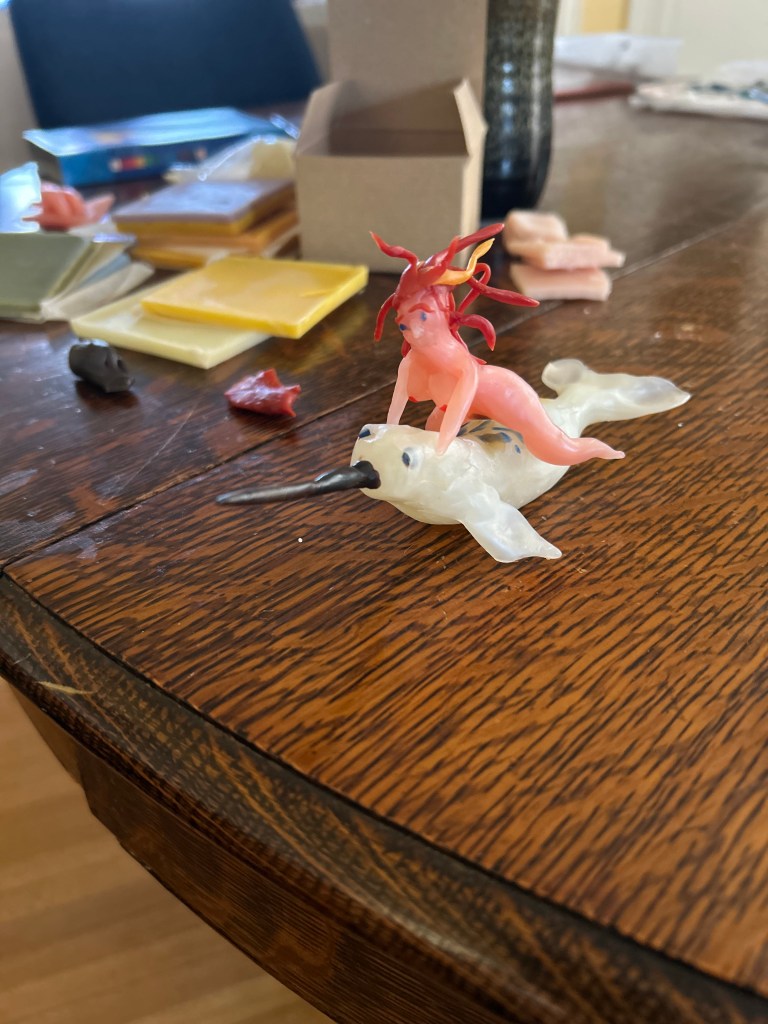
Woman riding a Narwhal. She arrived in my mind seven years ago through the invitational creative exercise of active imagination1. Swimming and flipping and delighting in a dark indigo sea dotted with chunks of luminous ice, while the “I” of me observed, the narwhal appeared. In my dreamy inner-mind dialogue with the image, the narwhal chided me (yes, less criticism, it was delivered more softly, with humour) for how I’ve forgotten how to swim and encouraged me to explore the depths. Then, some truly frightening images floated from the ink-blue dark, half rotted faces of people I love and other shadows swirled, threatening to reveal themselves. I was instantly frightened. Then, up popped the narwhal, splashing through the shadows to explain I needn’t be afraid, the water will catch me, they (?) will not let me fall2. I started to cry. Not pretendingly. In reality. Tears rolled my cheeks but I remained suspended in active imagination so I asked, can I learn to swim again? The narwhal laughed, and said, of course! The water is in you always! The water is in you! Yes, the narwal was emphatic. How? How do I learn? The narwhal flipped and turned amidst the sea ice, one coordinated muscle arcing. It’s words echoed over and over as I surfaced from dream to consciousness: Let go! Let go! It’s fun to let go!

A few days later3, the narwhal appeared again and I asked the image why it had come. It answered: To navigate the depths, to help me go deeper. The narwhal dove fast then, it’s dapple grey skin deepening to a green glowy sheen. The image shifted to show a girl riding the narwhal, holding tight as it dragged her fast and swift beneath the surface. The narwhal’s horn pierced the depths effortlessly. What else do you have to tell me? The narwhal replied, It’s fun, it’s fun to pierce the depths, don’t be afraid! I wondered if I’d be able to breathe and the narwhal actually laughed, almost scoffed and, voice deadpan, Of course you’ll be able to breathe.

I wanted to capture the image, but I didn’t feel I’d be able to render it well enough drawing or painting. Instead, I opted to model it using beeswax, investing a tiny fortune in different colours4. And when the beeswax arrived, I stuck the little packets in a box with a bunch of other art supplies where they waited, patiently, for my creative hands. Turns out, the time for that was last month, seven years (!) after the narwhal and the rider arrived in my mind’s eye. In Jung’s approach, creating a tangible representation of image–out of the subconscious dream world and into this one–is an essential part of the process5. Reflecting on the little model I created, (a little more cartoony than I’d like, also, in the original image, the rider was a young girl in a red dress, in the hand modelling she became a woman nude), it kinda aligns with last month’s post about fishing the subconscious for emotion and feelings…I think, no, I feel (that’s better), I’m finally ready to explore those depths with the curiosity and joy and play required for the task6.

Another creative practice serendipity: a friend from bookclub asked me to guest instruct her grade twelve creative writing class. She explained they were covering a unit about creating characters. She warned they were a quiet and shy bunch, a cohort having suffered crucial social development years in pandemic isolation. My goal was to get the students reading their own writing aloud–even it it was just a favourite word–by the end of the class. And to have fun.

And it was fun! We co-created characters, listing various gestures and personality quirks, super powers and pet peeves, desires and obsessions as they were called out. We wrote the list on blank sheets of paper, passing the papers round the classroom after each prompt so that no character “belonged” to any one writer. Instead, iterative dimensions of character layered upon what had been written on each paper offered to hand. We shared some of the character creations aloud. Then, lists of descriptions completed, we crumpled the papers into balls and threw them round the room, followed by a mad dash to pick one up as “an assigned character” to write about. The final writing prompt was: what does this character’s best (or) worst day look like? (Or, if a writer felt inspired to write something else, that was encouraged too.) We wrote together for ten minutes while instrumental music played7. Afterwards, we went round the room and everyone shared their favourite line they wrote, then, several students volunteered to read their drafts entire. The pieces were lovely…full of energy and humour and sensory details. We laughed a lot.

Last month I wrote a poem about being a Canadian tourist in Mexico. I visited Mexico two years ago. That poem’s been cooking since then. I’ve tucked it aside for now, to let it breathe on its own for a bit before I go back and fiddle with it. I read it to a friend who said, Just. Don’t touch it!

Turning again towards long project writing I realized I’ve spent time practicing at the sentence level with shorter pieces … and I have no idea where to begin at the story level for a longer work. I was reminded of Nina Schuyler‘s descriptive analogy of writing process. How, at the sentence level, you’re working at ground level, but then you have to climb a mountain to get a better bird’s eye view of the paragraph level, then the chapter level, then the whole story level. And in writing any creative work, you run up and down that mountain, tweaking and refining over and over and over again, until there is a synergy of sounds and symbols and patterns energizing a wholistic work of art. I feel like I just laced up a stiff new pair of hiking boots on badly blistered heels in the base camp parking lot.

Last month I received three rejections from literary magazines. Two for a short creative nonfiction piece and one for the introductory chapter/essay to the long form project. I know I’m not supposed to say so–that it’s all a part of writing practice, that I “need a thicker shell”–but the rejection breaks my heart8.

When I’m sad I always turn to reading. Pat Schneider’s Writing Alone and With Others, as well as any essay written by Ursula K. Le Guin, always offer a grounding, resetting perspective about what really matters: love of creative work. The process. Running up and down the mountain. For fun. By way of Pat Schneider, I’m introduced to this wisdom, a consolation, about submitting creative writing for publication from Marge Piercy, “Never say ‘submit’! Say offer.” Yes, absolutely right. So, let’s end here with one of her poems:

For the young who want to

By Marge Piercy

Talent is what they say
you have after the novel
is published and favorably
reviewed. Beforehand what
you have is a tedious
delusion, a hobby like knitting.

Work is what you have done
after the play is produced
and the audience claps.
Before that friends keep asking
when you are planning to go
out and get a job.

Genius is what they know you
had after the third volume
of remarkable poems. Earlier
they accuse you of withdrawing,
ask why you don’t have a baby,
call you a bum.

The reason people want M.F.A.’s,
take workshops with fancy names
when all you can really
learn is a few techniques,
typing instructions and some-
body else’s mannerisms

is that every artist lacks
a license to hang on the wall
like your optician, your vet
proving you may be a clumsy sadist
whose fillings fall into the stew
but you’re certified a dentist.

The real writer is one
who really writes. Talent
is an invention like phlogiston
after the fact of fire.
Work is its own cure. You have to
like it better than being loved.

That line about a tedious delusion, a hobby like knitting, makes me laugh. And though I agree with the final line, I feel you have to love the work AND you have to infuse the work with your love. This is the way love swims the Möbius loop to pierce the heart of a reader.


  1. I try to practice active imagination semi-regularly. Here’s a quick guide to explain the Jungian technique for fishing the subconscious. A few years ago, exercising my mind this way, I found it relatively easy to descend into a floaty state, meditating somewhere between dream and wakefulness. The images, most often animals (a bluebird, a spider, like Charlotte in E. B. White’s classic, a bee, a butterfly, a tortoise, the narwhal, etc.) surfaced and I was able to dialogue with them. It has been more challenging to succeed with the exercise lately (the last year or two?). Often I fall asleep. A sure sign rest is needed. More worrying is that I can’t get past the chatter brain of thoughts being expressed in words…I can’t seem to summon the images as easily. ↩︎
  2. I know it seems like I’ve rather lost my mind, conversing with the images therein…but, ha ha, isn’t that kind of the point? My own mind, carved and chiseled by culture, by categorization in language form, so easily manipulates, obfuscates …these exercises are meant to transcend those boundaries and restrictions as a gateway to creativity. Besides, it’s kinda fun. Except for the scary rotting face images…a risk I’m willing to take in the comfort of my home. ↩︎
  3. 10 days – I checked my dream/active imagination journal. The narwhal images appeared in June 2018. ↩︎
  4. Beeswax is really wonderful to work with on a small scale. The wax warms in your hand to become malleable and releases a honey scent with a hint of camphor. As the wax cools to room temperature, it hardens again. ↩︎
  5. And really, isn’t this what creative writing is too? ↩︎
  6. She wrote pleadingly. ↩︎
  7. The character I had was a horse thief able to communicate telepathically with horses, but alas, addicted to maple syrup and always had sticky hands. ↩︎
  8. This, on top of continuing violence and injustice and ecological destruction…and this f’ing winter that drags on ….and that living in the city I won’t hear the spring peepers calling from the flooded fields…threatens a dark funk I won’t be able to pull myself from…finding and sharing beauty and joy and love and a fantastic funk song and love of writing in community is the only antidote. ↩︎

Missing Your Missives

I’m learning to work with my subconscious[1] for creative writing. My ability to do this…no, that’s not quite right, I mean my ability to control this—with attention and technique and love—is a recent accomplishment[2]. Gonna use this post to unpack and articulate my two-phase process (and celebrate my progress to a nascent phase two, because man oh man, it’s been a long time coming. Years!).

Phase One: Fish into the subconscious to dredge its messages to consciousness

The most interesting writing** I generate arises four ways. Sometimes these methods overlap with one another. Note a couple of these approaches apply some sort of restriction/constraint to the writing process[3]:

  1. Swiftly written stream of consciousness writing in response to a prompt (i.e., write to the line blah blah… or, write an answer to blah blah question…or, write the scene between character A and B when…). Swiftly written means timed (short, < 15 minutes, though I have stretched drafting to < 30 minutes)
  2. Using another piece of writing, a sentence’s or a poem’s, syntax or rhetorical device or structural form, as a template with which to slot in my own words, images and thoughts.
  3. A line or an image that floats to me when I’m relaxed and engaged in another task (e.g., walking (exercising in general actually), showering, washing dishes, staring out the window, lying in bed[4]).
  4. From dreams[5].

For me, applying a restriction when writing provokes my brain to think sideways. By this I mean punts me off my comfortable (well-trodden) neural pathways and avoid my default “thinking/meaning making” mode. The restriction stimulates “dreaming/imagining” mode (which is the natural state for #3 and #4 in the above list[6]).

**What do I mean by interesting writing? Here are some recent examples:

TypeGenerative methodExample pulled from breezy drafts written in the last month
Image< 12 minute response to a writing promptA woman dragging her carcass of a body on the back of a smile, marionette strings with which her dead weights were held up
ImageDreamA massive black bear sitting on a stony shore, calm grey lake water, catching shiny silver fish. Then it’s holding an infant, and I hear rather than watch the bear’s jaws crunch through the baby’s neck and my thought is, ‘Ah well, I guess that’s done.’
Thought or IdeaFloater while exercisingPeople often use water words and imagery when they talk about the subconscious (e.g., stream, flow, ocean of awareness, diving deeper, swimming below the surface)
Comparison< 15 minute response to a writing promptWe’re taught to read…26 letters in the English alphabet and the millions of words they generate…but we’re never taught to read each other …and though we’re never taught, we do read these betweens (facial expressions, gestures, vocal tone, etc.), read them better than words sometimes.
MetaphorUsing a sentence by Peter Orner as a templateWe started up, as you do lying to yourself: in the net of a valid excuse.[7]
Analogy (ish)Stream of consciousness journaling when too tired before bed (not in the list above, but also, kind of a restriction …or imposed handicap)I am a broken heart. It’s just sometimes I believe you can mend it. It’s the belief that destroys me.
Surprising wordUsing a sentence by Jonathon Keats as a templateTympanic   (I know! I swear this word dropped from the universe onto the page…I wasn’t even sure it was a real word. I looked it up later. It is.)

Now, ideally, I should be able to write this way for longer periods with practice and without the necessary restrictions to provoke the interesting writing. But the truth is, I’m really challenged with this. Many writers can access the subconscious more easily …it’s a state that seems more natural for them.

A thought: the challenge accessing the subconscious might be the reason many artists and writers use alcohol or drugs—the inhibition substances enable—to create art. Substances lower the socio-cultural pressure gates, sanctioning a more permeable membrane between consciousness and subconsciousness. It’s a delicate balance to manage and risk of addiction is…high (no pun intended), so not an ideal pathway.

Substance use also alleviates deep emotional pain, a pain all humans endure to some degree…I’ll come back to this shortly.

So, there’s phase one. And I can confidently claim creating writing drafts that surface magical subconscious gifts. What I’ve been stumped by, until recently, is how to work with the gifted images to integrate them into a completed piece (story or poem).

Here’s my default strategy in a nutshell. The other week I was walking with a writer friend, discussing writing. Not for the first time, she said, “I have to tell you, I noticed it in your writing way back then, and you continue to do it: you overthink your writing,” we were wading a substantial snowbank and it interrupted her train of thought, “You need to….”  here her voice trailed off to silence. Cliffhanger!!! Trying to keep my desperation in check, cough cough, swiping the snow from my legs, I asked, “More emotion? More feeling?”  Yes, she said.

Truth is, I was flummoxed. Wasn’t I doing this already? Actually, no.[8]

Now, I’ve read enough craft essays at this point to understand there’s a chasm wide difference between applying a technical move to integrate emotion and the sublime skill of layering emotion in a piece to create a work of art. This is the same difference I can taste in dishes and desserts that are technically proficient but nevertheless lack a quality I swear to gawd I can sense on my tongue: dishes cooked without love. What does this taste like? Flat.

Here are fragments I’ve cherry picked  and pasted together to serve my own understanding and purpose (is this allowed? probably not) from Jeanette Winterson’s brilliant essay, The Semiotics of Sex, from her collection, Art Objects, Essays on Ecstasy and Effrontery:

“…it is worth remembering that the conventional mind is its own prison…Literature…packs in it supplies of energy and emotion that all of us need…Learning to read is a skill that marshals the entire resources of body and mind…I mean the ability to engage with a text as you would another human being…The love between you offers an alternative paradigm; a complete and fully realised vision in a chaotic unrealized world. Art is the realisation of complex emotion.”  

I won’t go into it here, and I’m loathe to kind of even talk about it, but I must for the sake of Phase Two. Much of the work with my therapist involves me learning to feel emotion in my body. Those deep emotions mentioned earlier that many people resort to drugs or alcohol to suppress or annihilate? Turns out I use high level thinking and analysis as a (socially acceptable) way to bypass feeling anything too deeply. Joy is acceptable and, no doubt, I’m exuberant, especially after a martini. But pain?  Oh, I’ll cognitize the fuck out of it.  Once I understood this, I asked my therapist, failing to mute a whiney earnest wretchedness, am I disabled?

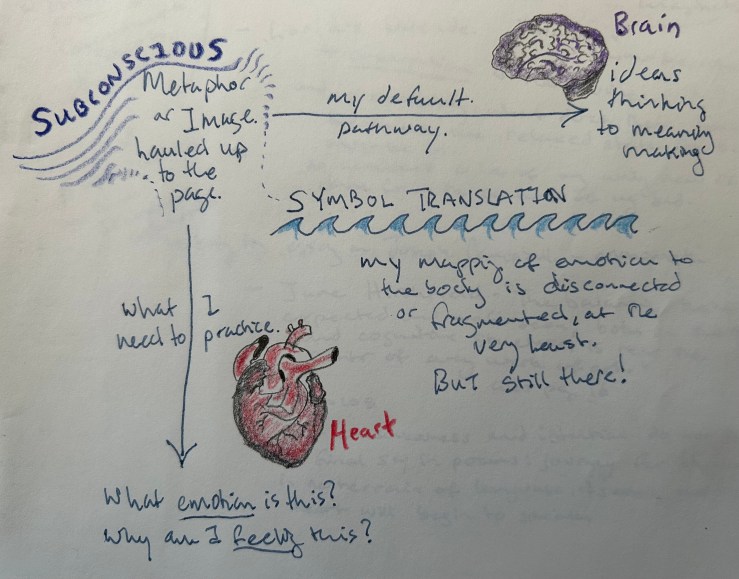
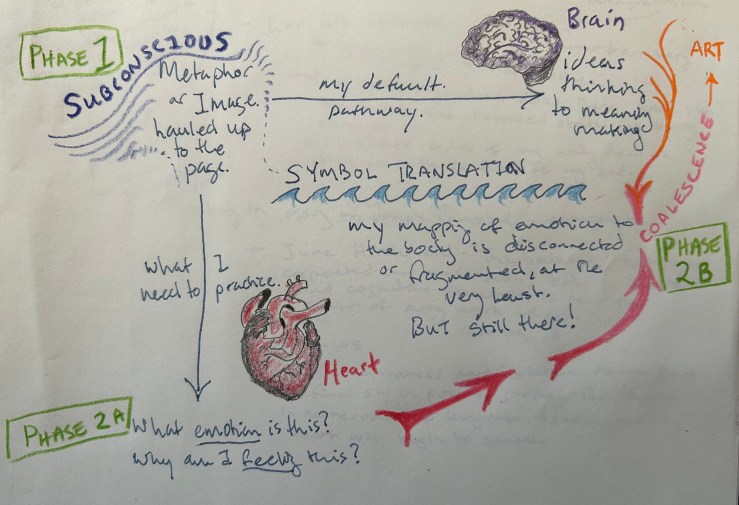
Here’s a drawing of my own creative writing issue process I figured out with my therapist[9]:

Phase Two: Switch from horizontal to vertical symbol translation and FEEL it goddamnit

This is less…concrete…than Phase One because I’m only just beginning to understand and practice writing this way. Here’s how I worked it out.

A few months ago, I posted a creative writing piece in progress, Measures, and used orange text inserts denoting my analysis and thinking about the images and surprising words that came through the breezy drafting bits (but, I note, not the ‘idea’ driven bits).

Originally, the piece was generated as a response to a writing prompt—but not timed—leaving me ample opportunity to twist a narrative around an idea. Which I did. That draft, despite the lack of constraints, held a few scarce subconscious breadcrumbs that I didn’t recognise at the time. I have many many drafts like this (soft whimper).

When I was preparing to read Measures at a public reading, I collaged the original draft together with other fragments of writing I’d done using constraints. I was rushing the edits (a self-imposed constraint). As I collaged, I could sense parts of the text vibrating some energy. I know, weird, but that’s the best way I can explain it.  Those vibrating bits, I recognise now, signal subconscious missives. Maybe other people feel this differently, perhaps it’s simply noticing or a feeling of curiosity. However they’re identified, they’re the bits I have to attend to with care and devotion…a kind of nurturing love.

Phase 2 A

So, what does this look like in practice? It’s leaning into the feelings and emotions arising from the vibrating images and surprising words or metaphors. Instead of staying with surface logic, descend into the body, slow down, notice, INVITE the complex emotions swimming around my insides[10]. Name them – here’s a handy emotion wheel as reference. Map them (i.e., in the body – gut? heart? lungs? heat? cold? tension?).  

For me this requires undisturbed focus best achieved comfortably propped up with pillows in bed. Because this is deeply discomforting work. Feeling sorrow, fear, shame, pain, anything deeply conflictual…it’s only with intentional effort that I sink into these feelings and pinpoint which ones adhere to the piece of creative writing I’m working with. The initial emotion identification process is much less writing and far more, well, active attention to feeling[11].  

Once complex emotions are recognised, named and mapped, the task becomes layering the cascade of emotion into the piece. Because it isn’t just one emotion, it’s the movement from one (or several) emotion to the next. Emotion doesn’t just arise out of nowhere, it’s a relational reaction; it’s the energy of the between (often between people, but can also be between perception, say, a scent, and memory, or between animals and humans, or between landscape and humans…the list goes on…the important bit is that the emotion arises out of relationship).  This is the experience, the relationship energy, I want my reader to feel. I’m creating an experience of complex emotion and I’m communicating, to borrow Winterson’s line, with text as I would another human being. It’s an intimacy.

Phase 2 B

How to do that? Here’s where it gets interesting. As a kid, I used to love those puzzles of what appeared to be hundreds of coloured dots on a page but when concentrated on a certain way and intentionally altering the angle of focus, the two-dimensional field of dots coalesced and popped what appeared as a three-dimensional image. Suddenly a 3D stag was running at me from the page[12]. The optical illusion puzzles are called  Autostereograms (yes, I had to look this up).

The 3D puzzle is analogous to the process I used to layer complex emotional change into my working draft. Here’s an attempt to clarify my process (I’m still working on this….in a few months I might completely change my thinking, but for now, this works):

  1. the effect of the movement of feelings in the piece is like seeing/feeling the 3D image
  2. the subconscious missives in the form of images, metaphors, surprising words etc. are the dots
  3. The intellectual meaning or the question the draft might be revolving around is like the 2D field of dots   
  4. the success of the story is proportional to the elegance with which a writer can layer all these aspects together, the coalescing of components – that movement from 2D to 3D….which, I suspect, is sensed and felt by the reader as opposed to through the mechanism of critical analysis.
  5. How is this done? By blending technical aspects (don’t let them take over!) with subconscious/dream aspects (the signposts of emotional energy)
  6. achieving the elegance of coalescing is the practice

So, this was how I approached the rewrite of Measures, a 905-word creative nonfiction piece. It’s my first intentional emotion blending attempt. When I was puzzling to layer the emotional movements in the piece, a specific line surfaced from the depths as I wrote and fiddled with the syntax (a subconscious gift!) and I burst into tears. A couple of friendly readers, though not all, experienced the same at the same paragraph in the piece. I’ve submitted the story to a few places for publication, waiting for submission windows to open at others…but really, reader reaction means, for me, the writing sings.


[1] I noticed I use the word subconscious as opposed to unconscious. I use subconscious to refer to information just below conscious awareness. But unconscious kind of means that too, though I think of unconscious information as deeper, more inaccessible. Like, my body doesn’t need to think about breathing or my heart beating to keep it upright (most of the time…falling in love or stubbing my bare toe on a concrete parking block changes all that, at least for a short moment). I admit, I took another deep dive into the differences and theories of mind conceptualizing unconscious and subconscious. Short synopsis: originally, the two words were used interchangeably as part of psychological theory. At some point, “unconscious” became synonymous with scientific rigour, while “subconscious” was significantly downgraded (ha ha, no pun intended) to parlance related to woo woo pseudoscientific pursuits, like, you know, tarot cards and ouija boards. So, there’s a classist-type interpretation of the two words. But, in other contexts, subconscious and unconscious refer to different levels of information below our conscious awareness, the former being slightly more accessible than the latter.   Accessibility is thought to be achieved through intentional reflection practices, talk therapies, etc.  [Here’s two whole paragraphs on this subject deleted. You’re welcome.]

[2] Okay, control is probably too strong a word here because the process of working this way, working with a subconscious (and yes, with the switch to using the indefinite article I’m proposing the subconscious is not mine alone, but rather a collective and fluid energy we all swim in…who’s woo woo now? ha ha ha) retains a high degree of mystery and hangs in dreamlike suspension (hang and suspension redundant? no, here dreamlike suspension is a thing, a state of being, maybe even a place).

[3] Though a word count cap is, technically, a restriction, I’ve found this insufficient for accessing the subconscious.  Fewer words in a piece forces grammatical and syntactical discipline. Also, an efficiency of imparting information. But I can still think my way to a finished piece without layering in emotional heat (this is explored in Phase Two). This might also be why fragments written in emails and texts can sometimes fish out unexpected images, words….certainly humour bits I wouldn’t have thought of intentionally except for the challenge to provide a witty reply.  

[4] Best, for me anyway, if not listening to a podcast or distracted by any visual media. Music seems to be okay, though floaty lines are heavily influenced by lyrics so this is a risk…it’s best if I’m not distracted at all. For the last year and a half or so, I’ve eschewed most media, including film, shows, news, in order to nurture and invite….access?…subconscious messaging.  Also, ‘cause I just need the quiet.

[5] I keep a dream journal. I have since 2018 and kicking myself for not starting earlier. BUT – this is hard for me…I rarely remember my dreams …must apply intentional effort to remember them. When I wake, they’re dissolving very very fast. And if I wake in the night, too often I think, oh, I’ll write that down in the morning. Of course, by then, it’s long gone. Despite the dream journal an arm’s length from my pillow, I fail to reach my hand out in the dark. I remember my dreams better when I’m on vacation (I take this to mean that it’s only when I’m relaxed and rested that I’m really able to dialogue with dreams…work-life is too energy taxing. It’s a frustration for sure).

[6] Dreaming may not be “a restriction” per se – but could argue “not being awake” is.

[7] I love this line – it’s got two people in it, a narrator who is lying to themselves and colluding with the reader on this (reader senses the inclusion and also wants to know why), plus the metaphor “net” surfaces connotations of “caught in a trap” of a valid excuse. The reader senses the push-me pull-you tension of an excuse that is likely not valid or at the very least is a trap….but see? Here I have veered off into super analytical mode, ultra meaning making….I run the risk of using my usual approach and creating a “thought up” story as opposed to a “dreamed up” one.  I feel the sentence would be a great first line of a story….ripe for using the timed write method to see what else will surface in a more dream-like way…get more text from the subconscious to the page before meddling with it.

[8] This blog is, I know, ultra thought concept driven. I don’t count the posts I write here as my “creative writing” work. Here, I’m exercising (exorcising?) my analytical tendencies …with the faint hope this will make space in my brain (and body) to allow the dreamwork to happen.

[9] Another friend, when I showed her this drawing explaining my thinking behind it, said, “wait, you drew a model of your analysis of your overthinking?” I erupted gales. A sense of humour is also an acceptable coping strategy for managing deep emotional pain. Subject for another post, this one is too long. Hopefully you’re still with me.

[10] You have no idea how difficult this is. I’m working on it.

[11] Am I also researching epigenetic biological embedding of experiences, relational neurobiology and the ontogenesis of shame, internalised oppression and morality? You betcha. [my gawd, she really is f-ing nutty nut bar]. Don’t worry, I do all of this half-assed.

[12] An AI generated overview of how to “see” the stag –  Parallel (or wall-eyed) method: Focus your eyes as if looking at a point behind the image, not directly at the image itself; Cross-eyed method: Try to cross your eyes slightly to focus on a point beyond the image. Not gonna touch the AI grenade here…except to opine that feelings and emotions are often beyond words and language (why we need dreams and art as translation mechanisms) and I don’t believe AI will learn to fish the subconscious the way humans can hone their ability to.

A Collaboration

“I like the way we make our dreams happen.” Lori Richards

I’m delighting in the astonishing culmination of a collaborative art venture with my friend, artist, Lori Richards. Our creative works—Lori’s paintings  and my writing—are exhibiting together for a short time at Wall Space Gallery in Ottawa. She generously invited me to write prose poem (like) pieces towards her paintings and I leapt at the opportunity[1].

The vernissage (new word for me, it means a preview of an art exhibition) was last weekend but we dreamed the idea—a wish—to combine and show our art works many many years ago. The exhibit is called Seedbed.

Lori and I walk together almost every week.  As our feet pound the leaf and petalled paths, the sidewalks, the pavement or the snow, we recount, gesturing to the winds, drawing models in the air with our fingers, the celebrations, the frustrations, the lamentations and the longings of creative process. Despite working in different mediums, our practices are very much aligned. Lori is a professional artist. She has been, and continues to be, a steady champion of my creative writing as I squeeze it in as best I can round my day job[2].

Leaping is the right description for the approach I used for Seedbed. I’ve written ad nauseum (emphasis on nausea) about how crippled I am when it comes to pushing my creative writing out into the world (submitting for publication). I didn’t have this issue in the past…it developed over the last few years …I don’t really know what it’s about, but I feel like I’m about to break through my own barriers[3]. I think I’ve been saying that for a year or so. Sigh.

For this project, writing prose poem-ish pieces for each of Lori’s seventeen different paintings, I wanted to practice less preciousness with my writing. And I wanted to experience (force myself) to let go of them as is. I created a few rules for myself to keep the creativity light and fun:

  • Gaze at the painting, but only for a short time
  • Use stream of consciousness writing (I wrote freehand for most of these in my notebook, and the pieces, as they were being written, often included arrows and connecting lines)
  • Adhere to first instincts (as in, whatever words or images pop up, write them down and don’t tinker very much or at all)
  • As soon as a piece feels finished, send it to Lori as “done”

This phase of development and creation worked relatively well, though I was surprised by the writing emerging. The pieces are whimsical and, in several cases, nonsensical. But, adhering to my own rules, I let them be.

Do look at the paintings at the gallery website – my reproduction here fails (dreadfully) to capture the vibrancy of colours.

There was only one pairing of works where the process was reversed, where my writing inspired Lori’s painting. Interestingly, (or maybe the better word is fortuitously), this became the title pairing in the exhibition: Lori’s seedbed painting and a breathy paragraph of my own that floated to me the week I made the decision to leave my marriage. Though Lori thinks of the Seedbed series as beginning January 2024, I feel it began closer to the creation of that garden focused paragraph in the fall of 2023. It was then Lori created her first “bed painting” (several paintings in Seedbed include an image of a bed). This first painting felt (feels) emblematic for me, for what I was/am moving through. That painting now hangs in my bedroom.

It has been wonderful experiencing the generative iterations of the series since. There have been additional bed paintings created beyond the exhibition submissions…they continue.  I feel magically connected—in a way I can’t articulate—with each painting as they appear. The closest I can come to explaining my feelings is with the word blossoming.

And I wasn’t nervous in the days or hours leading up to the vernissage. The gallery’s curator displayed the works beautifully. She and the staff also produced a lovely brochure of a selection of paintings with their ekphrastic accompaniments. Both Lori and I were expected to speak briefly about our process and collaboration, and I planned to read two very short pieces[4]. But when I arrived at the gallery a cold panic sloshed in my stomach[5]. The gallery space filled quickly, bodies tumbling inside from the frozen February afternoon. I’m told there were 80 people but they all sort of blurred together blobbing round while I smiled and nodded and prayed the wine I was drinking would kick in. It didn’t.

When it was my turn to speak, I accepted the microphone with grace. I stumbled on the word ekphrastic (it is very hard to say)….garbled gravel in my mouth…my heart thrashed against my rib cage and leapt the base of my throat, but then, deep breath, pause. Reading my own words, my body calmed and settled from the very first sentence. My voice steadied and held. I’m told I was poised. I wish I could say I recovered soon after the short performance, but I felt rather sick with the adrenalin hangover for the remainder of the day and into the evening.

Still, it has been an accomplishment. And a progression. In the days since, I’ve felt delighted with the experience. And (perhaps?) even a little awe for the courage it took to leap.  


[1] Ekphrasis is a written description, real or imagined, of a work of art. Another dear friend, Barbara Ponomareff, who I met years ago when I offered to carpool us to a wonderful (and remote) writer’s retreat, has published several exquisite ekphrastic works in The Ekphrastic Review.

[2] I’m blessed with continuing encouragement from so many people; you know who you are, I sing your adorations for sticking around, thank you.

[3] Intend to write about “next level writing” in the March blog post, so, stay tuned. Also, I promise to curtail the whining and actually get some pieces submitted.

[4] Another dear friend, also a weekly creative-conversation-while-walking companion, Carolyn Smart, very kindly suggested which work to read. And I’m tickled to learn that painting, Pink Room with Moon, sold to another Canadian poet on the strength of an Instagram promotional post even before the show was launched. So many collaborators throughout the whole process… why do we ever believe we work in isolation?

[5] Threatened a colonic…wholly inelegant I know. Vomiting might have  been preferable. But the body chooses its own exit strategies. I managed to keep uh everything intact (emphasis on in).

Seedbed introduction (Lori in the background and Tiffany, gallery curator, to the let).
Seedbed reading
Pink Room with Moon reading

Loving Attention

Pencil crayon, 6×8″

This fear of the blank page, this fear of not having the skill to translate one’s communications between inner world to outward presentation, this fear of lacking creative ability to express beauty, this fear, this paralyzing fear of inadequacy, does it ever go away?  

It doesn’t. At least for me.

I was going to erase that first sentence/paragraph…it wasn’t what I intended to write about today. The whining, it’s tiresome, no? But I would be leaving out one of the more difficult aspects of my writing practice if I did. And here, with these posts, I’ve promised authenticity.

So, my writing process becomes a matter of forcing myself through the exercises of creativity, forcing myself to the habit. The routine feels the same way one feels dressing for the gym: snapping spandex to the waist (a paradox of constriction and freedom of movement), flattening my breasts with a sports bar (not giving in to the inevitable rise of claustrophobia), rooting round for a sweat wicking tank (a clean one), short socks slipped over the toes, the heel, to hug the ankles, bending, crouching, gathering then looping the laces on my sneakers, and finally, the deep (resigned) inhale, then exhale, stepping onto the gym’s rubberized floor, heading toward the weights beneath the coach’s patient gaze. And after the workout? Euphoria.

All that to say, it takes a lot of energy (and time fiddling round “getting dressed”) to do creative work. I think this is why I dance round so many different creative projects…to keep my head in the creative game. When one project seems insurmountable, another can feel feasible. The dangling addiction to euphoria (in writing, it’s when things—words, metaphors, ideas, images, sounds, etc.—come together, surprise me; in drawing or painting or sculpting, it’s when forms, colours, lights, shadows, etc., come together, create something beautiful)[1].

But there’s also an issue of commitment…it seems I have one[2]. Fear of inadequacy is one thing; fear of sharing my creative work with the wider world is something different. (Though, I suspect, related.) I know I’m resisting. I know I’m avoiding. I haven’t been sending my work out for publication[3]. What I don’t understand (yet) is why[4].

So, I’m studying my fear. Not just to understand its origins but to understand how the development of belief systems shade behaviours to come[5]. I suppose we could call belief systems the stories we tell ourselves. I’m studying how those belief systems move, crossing space and time, forming our lives.

I know it’s my own thinking holding me back. Knowing the issue doesn’t solve the issue. I’m working on it. Working through it is going to take more than spandex. Love helps. Love, really, is the answer to all of it. Loving attention and a devotion to loving attention. Love bends belief systems to become better, beautiful. I’m not being trite here…love is what shapes…art, yes, but also, us. Love shapes humans. And, I imagine, the more than human world too[6]. The betweenness, the relationality, the reciprocity, is important.  

                  And this put to mind a thought I had recently, a floaty thought, connecting the actions of drawing/colouring with recent paragraph development work with Nina Schuyler.  One of the things (of many) that I love about Nina’s breakdown and discussion of sentences is her systematic illumination of how the techniques achieve emotional impact for the reader. I realized the layering approach of sentence structures, both within a sentence, and sentences in relation to one another in a paragraph, is akin to the layering of colours, light and shade, when painting or drawing. The idea brought home for me how a paragraph creates an emotional resonance …a translation of complex emotion(s) layered and transferred to the page. Words, as symbols, representations of “things”, are inadequate in and of themselves to render the emotion… “joy” for example, is too abstract, too far removed from the body-mind sensations and experiences, disconnected from the cascade of memories, desires, wishes, instincts associated with the word, but the sentences and the paragraphs build in tandem to create that wonderful harmonious effect and impact with text.

This is the same way a song is layered with longing or love and attained through tempo, melody, harmony, lyrics, tone, volume, instrument variety etc. Art, including literary art with its intentional, architecturally constructed intercourse, I’m only now appreciating, enables exploration and expression of interiority and exteriority when language might so easily lead us astray.  The foundation of such architecture is loving attention to the heart’s desires, the heart’s revelations…whether that be focusing the beauty of a pomegranate or a pear, or a surprising word, metaphor, or image generated using stream of consciousness writing. Some thoughts anyway…


[1] Cooking, while also creative, follows a shorter, more predictably satisfying arc. At least I get to savour the efforts. Also, sharing them with others remains, despite years of practice and repetition, a magical joy.

[2] A little about me [and married]; I will never allow myself to be owned again.

[3] I have one piece, the introduction section of my longer project, submitted at one literary magazine…I am working to WILL an acceptance there.

[4] I read today, an inspirational maxim (normally I’d eschew), attributed to William Ward (though, chasing these quotes from social media proves an erratic, enigmatic, time swallowing quest), “To place your ideas and dreams before a crowd is to risk their loss” …is this what I’m afraid of, losing my dream?  No longer having a dream? An interesting thought…

[5] This study, which, thankfully, dovetails day job research, integrates stunning intersections across disciplines: epigenetics, early childhood development, neurochemistry, physics, philosophy, psychology, history, anthropology, biology, sociology…

[6] This time last year I read Bruce Chatwin’s The Songlines. It had been part of my sister’s Indigenous Studies curriculum, and I stumbled across it while packing up my own books preparing to move. An interesting read as a window into the sociocultural attitudes re: women and First Nations peoples in the 1980s, an aspect which, unfortunately, may prevent a contemporary reader diving in…I think, all the more reason to read it, but that’s not what I want to highlight.  What sticks with me is the belief system described in the book, how Aboriginal Australians maintain songlines, pathways of knowledge crisscrossing Australia, the sky and the water, also called dreaming tracks, that link stories with features in the environment, by continuing to sing the world into existence through loving attention. (I am paraphrasing a super complex and fascinating world view.)  Here’s a short video describing songlines and the links on the subject beneath the video are excellent.

Pencil crayon, 9×12″

Italy: Reflections on Beauty, Part 1

The Kiss, Francesco Hayez, 1859, oil on canvas, in the Pinacoteca di Brera in Milan. Gorgeous painting and a delight to see in person. It’s kind of emblematic of how Italy makes me feel. The painting is meant to convey, and I’m summarizing here, that as much fun as romantic dalliances are, responsibility and honour lie with one’s allegiance and loyalty to state and country (as symbolized by the youth’s step “up the ladder” of stairs and commitment to an important life of patriotism).

This post is the first in a series of reflections about travels in Italy. I experienced so much beauty to reflect and weave with creative process, there will be one or two additional posts, I’m sure. This first, which began creation on a glorious day devoted to overcoming jetlag and quiet reflection1, (was that yesterday?) is more mish mashed reflection, depicted with photographs as opposed to writing. It needs to be…there is so much, too much, to cover.  

It’s odd, I know, that one of my favourite experiences in Italy is opening windows. It’s not simply the stunning views they open to: neon signed and steel-coloured cobbled streets of Rome, lushly vined and golden hills of Tuscany, neoclassical architecture of Milan, or the watery canals of Venice, but moving through the action of opening each window. The grasp of solid metal handles, negotiating the satisfying arc that releases a latch (often beautifully crafted in and of itself),  feeling the smooth swing of heavy wooden shutters, both inside and out, experiencing the transformation of a view seen through the waves and bubbles of ancient glass to clear and open air—for these windows never have insect screens—and immersing the scents that blow in (freshly baked bread, brittle crush of autumn leaves, rain kicked up dust…there’s a word for this, petrichor, earthy soil, olive oiled bon fire smoke, the honey sweet miracle smell of lime trees, ocean brine, and yes, sewers, garbage, the sour mash of fermenting grape skins and dog shit).  The windows are always set in thick stone walls, some as deep as my arm. When I lean out, I think of all the other people who must have done the same, from the same spot, with the same thoughts, the same impressions, the same appreciations, and I experience a sense of profound connection to the landscape, the people and the history of the place. Deep inhale. Ecstatic exhale.

I know it doesn’t look like much but the combo here of pistachio larded mortadella sliced so thinly it was almost transparent, folded round pillows of air and pocketed in pizza bianca…a mouth miracle. Antico Forno Roscioli in Rome.

I ate and ate and ate, ingesting the full but simple flavours of sun ripe tomatoes, grassy olive oil, spongey bread, chewy pasta tossed with loamy truffles, oil cured anchovies, buttery cheeses, hard, salty cheeses, marzipan, hazelnuts and chocolate. I repeatedly experienced the transportive wonder (transporting one to where? …no, this isn’t right…dropping one into a still moment of appreciation of wonder, this is what I mean) when food is accompanied by wine. It’s a dynamic wonder: both the food and the wine change as the meal unfolds, mediated through temperature and air and textures and flavours, combining and recombining differently each moment across the lips, the tongue. How sharing this, at a table laughing with friends, friends who love you, is part of the wonder and absolutely essential to the experience.

I had more than a few episodes of weeping, unexpectedly overcome in certain moments by beauty. 

Once, gazing at the carved marble calves and feet of a statue of the fallen son of Niobe in the Uffizi2.

Another, listening to my friend, a concert pianist, practice Bach, Debussy, Chopin, in her gorgeous villa with a magical bed I got to sleep in, the percussions echoing the stone walls while I journaled in my notebook and copied down a poem, Brahms, written by Robert Bly. 

Another, reading poetic words about Picasso’s hands, written by Max Jacob3.

Truly mind-bending was the paradoxical viewing of classical artworks alongside contemporary ones, often in the same day, and once, in the same museum space4. I loved this jangling stimulation. Especially as a necessary counterpoint to the complete saturation (assault?) of the same composition, the same colours, the same story, of the Madonna and Child, over and over and over again. It makes one appreciate anew how dominant that story has been to the exclusion of so many others.

Lillian (daughter #1, studying in Milan this semester), joined me for several different legs of the trip, including Florence, where we toured La Specola, the oldest scientific museum in Europe. I had read about the wax models of fruits there, in a book, years ago, The Land Where Lemons Grow : The Story of Italy and its Citrus Fruit, by Helena Attlee. It was fascinating and absolutely stunning to see the intricate artistry applied using beeswax and pigments to create models of plants and animals and human anatomy to serve as teaching models. The attention and accuracy of detail blew my mind: the brain, the circulatory system, the nervous system, the reproductive systems….all the teeny tiny veins and arteries and lymph nodes meticulously recreated in coloured three dimensional form. For 3 Euros, we joined a tour…in Italian. I didn’t understand most of it. Still, fascinating to see. There were also cute little dioramas of scenes from the plague. Macabre, I know. I explained to Lillian how horrific the smells would have been. Interestingly, this subject paired nicely with the exam she was studying for, European economic history, where, alongside war, disease played a major role5. Anyway, this exhibit brought home the idea that art and science are not separate entities, but rub up alongside each other companionably.

Here’s a selection of “things I saw on the walls in Florence”:

Here’s a picture of a person wearing an outfit that was just as beautiful and could have been part of the Picasso exhibit. We gazed at the same painting for a long time, standing side by side, and I really wanted to tell him how impressed I was with his outfit. But, I was too shy to say so.

Also, so much beauty in natural form…something I began to miss amidst the cement cities and throngs of people.

It was impossible to write much while I was away…vibrating with so much stimulation, it was difficult to settle into any kind of focused reflection. Just tried to attend, be present and capture and take everything in. Again, I carried my pencil crayons around in my backpack, never once using them. I’ll have to make up a word for this, the act of taking art supplies on a trip but never using them…a botch-batch? non-accoutrements? artfail? I’m too tired, I have no idea. Surrounded by so much beauty and creativity and humanity, I couldn’t help but notice the manufactured green spaces, the cultivated farmlands, the hustle and bustle of humans living densely, compactly, layering upon one another with bricks and mortar and sweat and tears and laughter. I craved the lake and the sky and the horizon of home. Perhaps this is why my favourite part of being in Italy was opening windows.

This is the view I crave. And a dear friend stocked my fridge with cheeses and milk and these gorgeous eggs from her sister’s hens for when I returned home…when I opened the carton I teared up again…for these too are beautiful. Also gratitude… for it all.

Yours truly.
  1. I returned to work Tuesday, hundreds and hundreds of emails. 807 emails. ↩︎
  2. Dying Niobid, Roman Art, 2nd century CE, the male figure is depicted on the ground in agony, struck by the arrows shot by the sons of Latona. For some reason it was the perfection of the figure’s legs and feet that really moved me. How they’re suspended in the air, as if, were I to reach out to stroke a calf, I might have felt the warmth of life depart the body. ↩︎
  3. From the Palazzo Reale Picasso exhibition notes: “In support of a palmistry study of Picasso’s hand [1902], the poet notes in a prophetically: It’s like the first spark in a fireworks display/…/This kind of living star is only rarely found in predestined individuals […] Aptitude for all the arts”. I have no idea why this made me cry. ↩︎
  4. These photos were taken from various museums, but the modern icons in conversation with Renaissance works were made by Francesco Vezzoli to create a site-specific exhibition in the Museo Correr in Venice. I was visiting the library museum but my ticket, serendipitously, afforded entry into this museum as well. The blue lady was in the courtyard of the Airbnb in Venice, Involucro Yves Klein, by Elia Alunni Tullini. ↩︎
  5. Plays…considering pharmaceuticals. ↩︎

Noughts & Crosses

My mum, a New Zealander, always referred to the game of tic-tac-toe as noughts and crosses. She allowed (encouraged) us kids to draw the 3×3 grids with a blue ball point pen on the soles of her bare feet (size 9, ample space). An aside: the ubiquitous Bic pens of North America are called biros in NZ and the UK (No relation on my Hungarian side, unfortunately. Though my relatives had owned vineyards in Hungary and vacation homes in Trieste, all was lost in WWII. I digress…I’ve been reading Nabokov’s glorious memoir Speak Memory—its White Russian émigrée-ness, a crude comparison to my own father’s flight to freedom following the Hungarian uprising, I know, but I make it anyway, romantic that I am—is rubbing off on me, chalk powder lifted from the pale wing of a lambent moth).  

Our ball point pen plays afforded mum a relatively undisturbed, albeit tickly toed, mug of tea (tankard shaped, insides furred with tannin scales the way she preferred, “don’t wash my cup!”), with a cigarette we eyed as the orange embered ring sucked ever closer toward its filter, horizontal ash cylinder elongating and sagging before she flicked it, a moment before gravity might claim it, into a dusky glass ashtray. Likely she was reading the latest library copy of a true crime book. Not aloud. Though I longed for her to read to us, she rarely did. Once I learned to read—late, I admit to my mortification (my maternal grandmother berated my incompetence, publicly)—I read all sorts of picture books and novels to my younger siblings, delighting how my affected accents, particularly the ‘v’ pronunciation of any ‘w’ (mimicking our Hungarian Nana’s voice) in Roald Dahl’s Witches, transfixed them.  Through the dining room’s picture window, we listened to the lake waves heaving ice sheets to hills along the limestone shore, the scrapes and wind moans as the water worked its way, churning through its six-year replenishment cycle.  (There is an explanatory purpose to this dendritic pathway of recollections, I promise.) Inside, we vied to place our O and X marks in a horizontal, vertical, or diagonal row on the pink spongey under pads of mum’s feet and be crowned ‘the winner’ (an additive aspiration as opposed to elimination rounds: three strikes and you’re out[1]).

It often happens the book I most need to read winds its way to me at exactly the right moment. And so it has been with Speak Memory. I had (again) tied myself in knots and was very cross indeed, attempting to force my long project (book length work) into a structure that just wasn’t working. Maybe I’ve posted the disconnected threads of this creative work here already, too lazy to check, so here it is again: a series of pop culture refences used to hang two different story lines on, weaved (somehow? this part was really screwing with my head), periodically interjected with commentary from a cast of [internal] characters (who seem to keep growing in number). The first storyline, a recollection of past events relayed chronologically, wasn’t working at all – how the hell do I narrow down which scenes to relay? The second storyline, recent events relayed with reverse chronology (and totally taking over the narrative) also wasn’t working because the cinematic renderings felt puerile. Mountains of frustration and angst. Flip flop to working on other things. Flip flop. Flip flop.

Reading grounds me. And I read this elegant passage from Chapter One of Speak Memory that must be transcribed here—lengthy, I know, but any attempted summary would cheapen it. I’ve highlighted the last sentence because it was this line that launched an epiphany regarding my own project and what I’ll try to convey with the remainder of this post:

“But let me see. I had an even earlier association with that war. One afternoon at the beginning of the same year, in our St. Petersburg house, I was led down from the nursery into my father’s study to say how-do-you-do to a friend of the family, General Kuropatkin. His thickset, uniform-encased body creaking slightly, he spread out to amuse me a handful of matches, on the divan where he was sitting, placed ten of them end to end to make a horizontal line, and said, “This is the sea in calm weather.” Then he tipped up each pair so as to turn the straight line into a zigzag—and that was “a stormy sea.” He scrambled the matches and was about to do, I hoped, a better trick when we were interrupted. His aide-de-camp was shown in and said something to him. With a Russian, flustered grunt, Kuropatkin heavily rose from his seat, the loose matches jumping off the divan as his weight left it. That day, he had been ordered to assume supreme command of the Russian Army in the Far East.

                  This incident had a special sequel fifteen years later, when at a certain point of my father’s flight from Bolshevik-held St. Petersburg to southern Russia he was accosted while crossing a bridge, by an old man who looked like a gray-bearded peasant in a sheepskin coat. He asked my father for a light. The next moment each recognized the other. I hope old Kuropatkin, in his rustic disguise, managed to evade Soviet imprisonment, but that is not the point. What pleases me is the evolution of the match theme: those magic ones he had shown me had been trifled with and mislaid, and his armies had also vanished, and everything had fallen through, like my toy trains that, in the winter of 1904-05, in Wiesbaden, I tried to run over frozen puddles in the grounds of the Hotel Oranien. The following of such thematic designs through one’s life should be, I think, the true purpose of autobiography.

Reading the two scenes at two points of time hinged (beautifully balanced) on a matchstick …how do I explain this? It gave me permission (and a concrete example) to think about my own family stories in a completely different way, approaching the writing through connections and associations without a need to be nailed to chronology (more cosmology).

Then I went for a walk with a friend, windmilling my arms ecstatically as I explained (she’s very patient) my intention to (re)enter my writings with this Nabokovian lens to search for thematic emblems or symbols connecting my memories across space and time. She stopped walking, turned toward me with trance-like calm, placed her palms on my shoulders, and with uncanny clairvoyance, suggested the theme I might be chasing[2]. Of course. Yes! Of course. I felt the knowing satisfaction one gets having accomplished a particularly tricky play in a game or solving a riddle or a math equation or when an errant puzzle piece clicks into place[3].

With a deeper understanding of what I’m exploring and using an associative approach I re-wrote the introduction of the long-form project (the 12th time? more?). And it unfolded easily.  The writing slipped into place[4]. Naturally.  Organically. The “story” skips across space and time, mimicking, I imagine, connections between neurons and the way sensory information shunts emotional layers in and out of memory. It’s a natural shape—neuronal axon connections between dendrites in the brain—the same shape as tree branches or root systems, the same shape as alveoli and bronchioles in the lungs, the same shape of tributaries and rivers, the same shape the wind carves rock into canyons.  

And then, writing the introduction by following associations and matching up different thoughts and experiences across time and space (match!), I felt the appearance and associated meaning of the (yet to be written) closing section. And voila, a “frame’, two goal posts materialising from the mind’s mists with a great wide-open field of play ripe for exploration and elucidation between.  

The writing of the intro also handed, like the passing of a baton to the next runner in a relay, an associative anchor to serve for the next section. Then a second anchor followed that…the blossoming orientation reveals itself faster than my writing can keep up. And I’m suddenly cautious, mindful I don’t want to trip into the trap of crushing ideas to shape what I think might be the meaning (I too often do). I want to relax into the magic of associative process…which is almost all feeling…a pleasurable groping in the dark.   Instead of checking boxes in a tic-tac-toe line, it’s necessary to transcend the grid and attend to the curvy swervy intersections as they sift loose the matrix and settle into place.  A long game to be sure, more adventure I’d say.  But a deep pleasure chasing after nebulous meanings and satisfaction when they unite, wet inked, pen in hand.  

I note, writing…the actual act of writing, is the only way to journey there[5].

Here’s a diagram of the structure I’m feeling my way through (it looks more complicated than it is).

It’s like a spiral of discrete associative sections, circling a central axis of a theme. I think of it as less of a spiral though, more like a spring (coiled in tension…it’s the emotional tensions that will pull a reader through…at least, that’s my thought process at the moment).

The thing is, there are so many ways one moves back through the coffers of memory. Teasing experiences from the mind…the events shimmer and change, scuttling light and shadow through the prism (prison?) of one’s mood.  The whole adventure requires slow and curious study to progress the writing with a cool (and open) (and loving) mind.

I would have written it’s serendipitous Nick Cave’s missive today hits a parallel mark, but I suspect there’s less coincidence[6] in these things than we believe: “To write a song requires a reckoning. We roll up our sleeves and through rigorous application encounter the disastrous and mortifying condition of our interior selves. We exert poetic order upon the turmoil and chaos. We hew and hone and bring structure to the stricken heart; we codify our weary souls, giving form to the blues.”[7]

I’ll close by plucking my own curated associations from Nabokov’s closing paragraphs and lines in Speak Memory, found poem-like, manipulating his words into a malleable sculpture to meet my mind’s own bends[8]:

“Laid out on the last limit of the past and on the verge of the present, it remains in my memory merely as a geometrical design…what I really remember about this neutrally blooming design, is its clever thematic connection…it was most satisfying to make out…something in a scrambled picture…that the finder cannot unsee once it has been seen.”

It’s hard to believe in magic. No, that’s not quite right. It’s hard to maintain faith in magic. But it’s there. It requires a practiced (and constantly practicing) eye (and the writing hand(s)) to feel it, coax it forth, recognise it. And though I trip often, injure myself repeatedly in the never-to-be-won plays of this writing game, it’s no fun sulking on the bench. Put me in coach, it’s all fun and games, until I lose an eye. Play on.


[1] An empty threat; I’ll never extend a third feeler.

[2] She’s done this before on at least one other crisis occasion, becoming a human divining rod to deliver the universe’s elegant solution when I’ve missed its crystal clear, often repeating, simple message.

[3] Carolyn, you’re right, I do tend to write the same things three or more times in a row. But I can’t cut them. I just can’t. Sigh.

[4] I can’t help but relay the observation that when I’m writing this way, I completely fall outside time (disastrously sometimes, arriving to work late and later, and, more recently, as I’m transitioning into writing more at nighttime to avoid this, discovering hours have slipped me by. Hours!)

[5] Filtering, almost entirely it seems, through the subconscious.  

[6] I mean, the word coincidence alone hints at the associative pattern with the nuance of a ball-peen hammer striking one’s thumb numb.

[7] Nick Cave Red Hand Files Issue #297

[8] Sorry Nabokov, hope you’re not rolling in your grave.

Diagramming process, here’s a drawing of the dendritic (associative) pathway of this blog post. Importantly, I drew this AFTER I wrote this post, not before. For writing this post, I came up with the title first (this is often the case….a single line to begin the writing) and wrote from there, the images and memories and my recent readings all being pulled into place around the vague theme of “games”. This was, no doubt, spurred on by another quote of Nabokov’s I’ve been wrestling with (having trouble with his word deception) about his observation related to the way insects use mimicry to avoid detection and how this relates to art: “I discovered in nature the nonutilitarian delights that I sought in art. Both were a form of magic, both were a game of intricate enchantment and deception.”

Feedback Balancing Act

I’ve been working on a particular short story for a little over a year[1]. The generative draft, written last June, was in response to a prompt to create a flash work[2] centered around a haunting without mentioning the haunting itself. The haunting was not to be an entity but a manifestation of a pain.

My first draft was 449 words. I was delighted with it, despite a threatening tension, a shadow I could feel but not quite understand. The story was, and continues to be, set on a cold beach point where a stranger died by suicide (the haunting, a driver who launched his car into the winter lake), and where, two days later, a couple stand. It’s the couple’s anniversary yet the wife decides it’s the time and place to end their strained marriage. The story’s initial title was Eagle-Eyed[3].

Before I launch into the exploration of the most recent feedback for this evolving short story, I thought it might be interesting to provide a breakdown of the various iterations it has moved through since[4].  This, I hope, will provide readers (and remind myself!)  a sense of how a story might be shaped and reshaped towards a state where it may enter the world of publications[5].  It also serves as a pathway I’m following into self-confidence with my own writing. I won’t share the actual work in progress here because it negates publication elsewhere…hopefully this won’t stultify this post; I’d loath to be thought of as boring.

I know, the chart is tiny tiny. Formatting is an issue. I’ve reposted the same chart below with the ugly formatting at the very end of this post for easier reading if clicking on this pic doesn’t enlarge the text sufficiently.

The most recent draft of this story was completed earlier this month, July 2nd. It has lengthened to 741-words. I felt good about the piece. What I mean when I say this is that I felt my way through understanding what the story was trying to tell me it was about, waiting for meaning to reveal itself instead of shoehorning it into “an idea”.  I also worked (and played) to apply technical devices to illuminate the layers of meaning as I came to understand them. More often than not, the writing already held these hints, I just hadn’t “seen” it…it really has been a process of feeling my way as opposed to knowing or thinking my way through the crafting. I’m following instinct more than anything else.

I shared the story with a dear writer friend of mine, B, requesting she let me know what feelings came up for her when she read the piece. Also, whether there were any points in the story she found confusing or made her lift out of reading. The same morning, I submitted the story for formal post-workshop feedback with a writer/editor, Matt, in the UK.   

I received generous feedback from both writers. Both indulged line by line attention and considerations. Both suggested places to cut (B, always sharp, pinpoints my rococo tendencies and gently asks whether they are needed). Both were encouraging. But here’s the thing…each interpreted the story differently: B understood the story as I had intended, reading the layered resonance in the piece, and most importantly, feeling it (she described the story as a bomb about to go off); Matt responded to the surface level of the piece.

A few observations upon receiving discordant feedback. Instead of descending into the pits of despair and not knowing what steps to take next (a year ago, I would have crumpled), I received the feedback with genuine curiosity. This alone is massive progress in my own creative development. I’m confident in this particular story and I’m comfortable knowing it isn’t quite there yet[6]. Also, I’m better at accepting the idea that I don’t have control about how others read my work. It’s likely a good thing there are multiple interpretations. It keeps it interesting. I know my writing won’t appeal to everybody. Nor should it. It’s enough to know it succeeds touching even just one person.

All feedback is helpful for stretching the brain and provoking multiplicities. It’s probably best to remove my pretension: words like inveiglement, my grammar gaffs, my chicken-livered metaphors[7].

I respect honesty above all else. Even when it confirms one’s greatest fears about character (or any other aspects of story: dialogue, silent spaces, conflict, emotional resonance, imagery, setting, sensory elements…the list is endless. Magical-fantasy-surrealistic-dream. Endless!). And, you know, for one who reads me so deeply, intimately, I’d jump into the burning lava throat of a volcano[8]. I’ll take what I can get.


[1] I’m sure these posts confirm my shambolic writing practice, but in case they don’t, I admit I’m usually working on several pieces in parallel, flip flopping between them the way a hook landed fish jumps to stay alive.

[2] A fiction or nonfiction narrative under 1000 words.

[3] Sometimes I feel like marching up to my past self, gripping her by the shoulders and shaking her violently to wake up!  For the benefit of readers who don’t know details of my personal life, I left my own marriage last October, the week of our twenty-fifth wedding anniversary (note: this story was written 4-5 months before then). Instead of being angry with my past self, I’m learning to be kinder, gentler. Learning takes so many forms, and I don’t know how to read them all. All I can be is committed to learning, operating from the point I am, in any moment, with the limited toolbox I carry and an open heart. I’m stunned to discover my body’s prescient talents …and how long it takes my mind to catch up…this is only one instance of many.  I think about this a lot…

[4] May 2023-May 2024 I participated in the SmokeLong community workshop, generating 64 unique flash pieces. I’ve attempted to revise only a few of the pieces due to lack of time and yes, personal resistance-to-revision issues I continue to wrestle with.  I made the difficult decision to withdraw from the community because I need to focus time on the writings I’ve already created, the works awaiting my attention (and devotion).

[5] And the state of publication is simply one point in time, catching a flying fluttering work and nailing the specimen to a velvety spot to keep it still (or dead)…I’m beginning to sense that all works continue in dynamic states and might be changed or altered or built upon over and over and over again…interpretation alone splinters the smashed glass casing of any publication and the work travels on and on through the hearts and minds of others…wow, a little too artsy Biro, reel it in.

[6] In answer to my request for points of confusion, B was curious about this question and hadn’t considered it before, but once posed she entered the work with this lens.  And yes, she pointed out the story was quite confusing with time, shifting back and forth (through 5 shifts in time!). In a 750-word work this demands (taxes?) a lot of cognitive effort for the reader. So, the questions I’m now working through: is this expectation for the reader to follow the complex time shifts worth it? Does the time shift add another level of meaning to the story? If yes, what is that meaning? I don’t know…still thinking. If no, I need to rework the piece and remove some time shifts and support a smoother reading.

[7] Almost resisted the urge to write chicken liveried, but, alas, there it is, coddled in a footnote because the image of chickens dressed up in royal red and gold uniforms makes me laugh. I’m a cheap thrill.

[8] As long as I have a Mai Tai in my hand.

In drawing this series of maple seeds, I coloured in from top to bottom and the same process of moving from thinking to feeling can be seen here. The colouring of the top seed is more clunky, more self-conscious…by the time I got to colouring the bottom seed, I’d moved through the (somewhat ineffective) attempt to copy what I was looking at and instead coloured in the way I was feeling, with the result that the final seed looks (to me) to be more relaxed and natural. And representative of its subject. Maybe I’m overthinking this. Wouldn’t be the first time.
Date and a few detailsNumber of reviewers providing feedback with flavour of feedbackMy own thoughts and feelings  at the timeFocus of revision as a result
June 25, 2023 449 words Title: Eagle-Eyed• 5 reviewers •Consensus on excellent use of dialogue to depict tension-filled relationship between husband and wife characters.
•Confusion about the setting and story as a crime scene – readers interpret the story as a wife preparing  to murder her husband by the lake
 I actually thought the piece was pretty clever and then when I got the feedback I realised I had almost completely buried the suicide so  the story was confusing to readers. Readers are picking up on some buried  anger which is…interesting.Need to layer the suicide  aspects in with less subtlety. Need to layer in the wife character’s contemplation about marital relationship with more clarity.
August 8, 2023 495 words Title changed to Point of Departure – this remains the working title in subsequent iterations• 2 reviewers •Unsubstantial feedback (i.e., it’s great!) huh – send it out and see what happens, crapshoot but whatevs Submitted to two publications: Vestal Review and Had Most writers in the flash community carpet bomb submissions, sending a single work to thirty or even fifty publications at once, praying for a hit and fluffing their bylines along the way…for me, this defeats the purpose and makes me feel like the whole publication enterprise is a waste of time (I mean, are these writers reading all those literary publications? Not possible).  Feeling demoralised.  And yet, when I read others’ works in publications I respect, I’m inspired and awed in a way I would love my work to be counted among them.Submissions rejected – not at publishing level (that matters to me). Yet. Shelved. Then, in the ensuing months, thinking about the story tucked  safely in the back of my mind, I come to realise what it was trying to tell me.  The blunt life events I’m moving through illuminate this of course. I start to piece the concepts of suicide and marriage together…but nascent, vague, shadowy and disorganised thoughts… I don’t get it. Revisions attempt to tease these thoughts apart and layer them in the story somehow.
January 16, 2024 587 words•7 reviewers
•Consensus on beauty of language, along with the need to rearrange sentence structures (shorten them).
•Readers agree about the reason for tension in relationship (this was added in this revision), they interpret this as valid and feels real •Readers understand the wife character intends to end her marriage, but reviewers concerned it is too  subtle and might be mistaken for her character contemplating her own suicide…lots of suggestions for how to fix this. •Suggestion to remove a jarring image of car sex between husband and wife •
I’m really committed to keeping the subtlety in the piece ….I like its feeling of ambiguity…I’m pleased most reviewers (6 of the 7) “get” what I’m trying to communicate: the wife decides to leave the marriage (as opposed to thinking about taking her own life). I have to think more about this…I’m also really attached to the last line that I feel resonates: ”a good place to end a life.” Agree about removing the sex image. Makes me contemplate what deeper aspect the story is trying to tell me …I don’t know.Came back to revising this piece in June 2024…thinking more deliberately about the “ending a life” pattern in the story. Redrafted with intention to submit for formal feedback from Matt Kendrick following a workshop with him. Worked at the sentence level to play with tempo and insert rhythmic variation.