
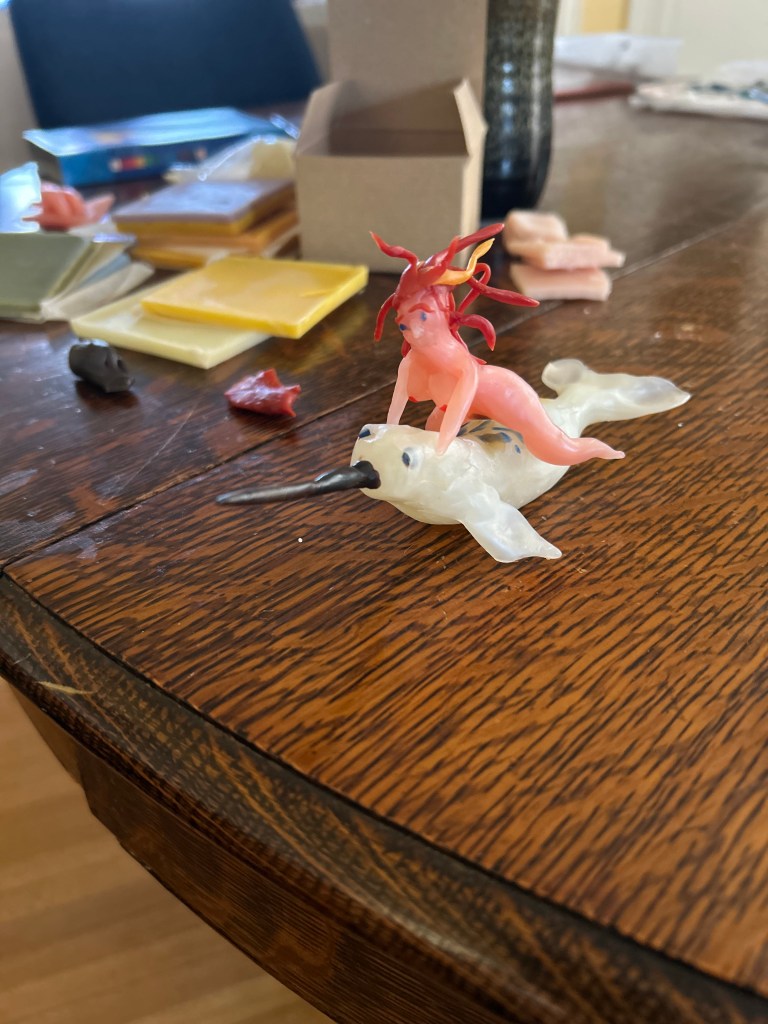


Woman riding a Narwhal. She arrived in my mind seven years ago through the invitational creative exercise of active imagination1. Swimming and flipping and delighting in a dark indigo sea dotted with chunks of luminous ice, while the “I” of me observed, the narwhal appeared. In my dreamy inner-mind dialogue with the image, the narwhal chided me (yes, less criticism, it was delivered more softly, with humour) for how I’ve forgotten how to swim and encouraged me to explore the depths. Then, some truly frightening images floated from the ink-blue dark, half rotted faces of people I love and other shadows swirled, threatening to reveal themselves. I was instantly frightened. Then, up popped the narwhal, splashing through the shadows to explain I needn’t be afraid, the water will catch me, they (?) will not let me fall2. I started to cry. Not pretendingly. In reality. Tears rolled my cheeks but I remained suspended in active imagination so I asked, can I learn to swim again? The narwhal laughed, and said, of course! The water is in you always! The water is in you! Yes, the narwal was emphatic. How? How do I learn? The narwhal flipped and turned amidst the sea ice, one coordinated muscle arcing. It’s words echoed over and over as I surfaced from dream to consciousness: Let go! Let go! It’s fun to let go!
A few days later3, the narwhal appeared again and I asked the image why it had come. It answered: To navigate the depths, to help me go deeper. The narwhal dove fast then, it’s dapple grey skin deepening to a green glowy sheen. The image shifted to show a girl riding the narwhal, holding tight as it dragged her fast and swift beneath the surface. The narwhal’s horn pierced the depths effortlessly. What else do you have to tell me? The narwhal replied, It’s fun, it’s fun to pierce the depths, don’t be afraid! I wondered if I’d be able to breathe and the narwhal actually laughed, almost scoffed and, voice deadpan, Of course you’ll be able to breathe.
I wanted to capture the image, but I didn’t feel I’d be able to render it well enough drawing or painting. Instead, I opted to model it using beeswax, investing a tiny fortune in different colours4. And when the beeswax arrived, I stuck the little packets in a box with a bunch of other art supplies where they waited, patiently, for my creative hands. Turns out, the time for that was last month, seven years (!) after the narwhal and the rider arrived in my mind’s eye. In Jung’s approach, creating a tangible representation of image–out of the subconscious dream world and into this one–is an essential part of the process5. Reflecting on the little model I created, (a little more cartoony than I’d like, also, in the original image, the rider was a young girl in a red dress, in the hand modelling she became a woman nude), it kinda aligns with last month’s post about fishing the subconscious for emotion and feelings…I think, no, I feel (that’s better), I’m finally ready to explore those depths with the curiosity and joy and play required for the task6.
Another creative practice serendipity: a friend from bookclub asked me to guest instruct her grade twelve creative writing class. She explained they were covering a unit about creating characters. She warned they were a quiet and shy bunch, a cohort having suffered crucial social development years in pandemic isolation. My goal was to get the students reading their own writing aloud–even it it was just a favourite word–by the end of the class. And to have fun.
And it was fun! We co-created characters, listing various gestures and personality quirks, super powers and pet peeves, desires and obsessions as they were called out. We wrote the list on blank sheets of paper, passing the papers round the classroom after each prompt so that no character “belonged” to any one writer. Instead, iterative dimensions of character layered upon what had been written on each paper offered to hand. We shared some of the character creations aloud. Then, lists of descriptions completed, we crumpled the papers into balls and threw them round the room, followed by a mad dash to pick one up as “an assigned character” to write about. The final writing prompt was: what does this character’s best (or) worst day look like? (Or, if a writer felt inspired to write something else, that was encouraged too.) We wrote together for ten minutes while instrumental music played7. Afterwards, we went round the room and everyone shared their favourite line they wrote, then, several students volunteered to read their drafts entire. The pieces were lovely…full of energy and humour and sensory details. We laughed a lot.
Last month I wrote a poem about being a Canadian tourist in Mexico. I visited Mexico two years ago. That poem’s been cooking since then. I’ve tucked it aside for now, to let it breathe on its own for a bit before I go back and fiddle with it. I read it to a friend who said, Just. Don’t touch it!

Turning again towards long project writing I realized I’ve spent time practicing at the sentence level with shorter pieces … and I have no idea where to begin at the story level for a longer work. I was reminded of Nina Schuyler‘s descriptive analogy of writing process. How, at the sentence level, you’re working at ground level, but then you have to climb a mountain to get a better bird’s eye view of the paragraph level, then the chapter level, then the whole story level. And in writing any creative work, you run up and down that mountain, tweaking and refining over and over and over again, until there is a synergy of sounds and symbols and patterns energizing a wholistic work of art. I feel like I just laced up a stiff new pair of hiking boots on badly blistered heels in the base camp parking lot.
Last month I received three rejections from literary magazines. Two for a short creative nonfiction piece and one for the introductory chapter/essay to the long form project. I know I’m not supposed to say so–that it’s all a part of writing practice, that I “need a thicker shell”–but the rejection breaks my heart8.
When I’m sad I always turn to reading. Pat Schneider’s Writing Alone and With Others, as well as any essay written by Ursula K. Le Guin, always offer a grounding, resetting perspective about what really matters: love of creative work. The process. Running up and down the mountain. For fun. By way of Pat Schneider, I’m introduced to this wisdom, a consolation, about submitting creative writing for publication from Marge Piercy, “Never say ‘submit’! Say offer.” Yes, absolutely right. So, let’s end here with one of her poems:
For the young who want to

By Marge Piercy

Talent is what they say
you have after the novel
is published and favorably
reviewed. Beforehand what
you have is a tedious
delusion, a hobby like knitting.

Work is what you have done
after the play is produced
and the audience claps.
Before that friends keep asking
when you are planning to go
out and get a job.

Genius is what they know you
had after the third volume
of remarkable poems. Earlier
they accuse you of withdrawing,
ask why you don’t have a baby,
call you a bum.

The reason people want M.F.A.’s,
take workshops with fancy names
when all you can really
learn is a few techniques,
typing instructions and some-
body else’s mannerisms

is that every artist lacks
a license to hang on the wall
like your optician, your vet
proving you may be a clumsy sadist
whose fillings fall into the stew
but you’re certified a dentist.

The real writer is one
who really writes. Talent
is an invention like phlogiston
after the fact of fire.
Work is its own cure. You have to
like it better than being loved.
That line about a tedious delusion, a hobby like knitting, makes me laugh. And though I agree with the final line, I feel you have to love the work AND you have to infuse the work with your love. This is the way love swims the Möbius loop to pierce the heart of a reader.
- I try to practice active imagination semi-regularly. Here’s a quick guide to explain the Jungian technique for fishing the subconscious. A few years ago, exercising my mind this way, I found it relatively easy to descend into a floaty state, meditating somewhere between dream and wakefulness. The images, most often animals (a bluebird, a spider, like Charlotte in E. B. White’s classic, a bee, a butterfly, a tortoise, the narwhal, etc.) surfaced and I was able to dialogue with them. It has been more challenging to succeed with the exercise lately (the last year or two?). Often I fall asleep. A sure sign rest is needed. More worrying is that I can’t get past the chatter brain of thoughts being expressed in words…I can’t seem to summon the images as easily. ↩︎
- I know it seems like I’ve rather lost my mind, conversing with the images therein…but, ha ha, isn’t that kind of the point? My own mind, carved and chiseled by culture, by categorization in language form, so easily manipulates, obfuscates …these exercises are meant to transcend those boundaries and restrictions as a gateway to creativity. Besides, it’s kinda fun. Except for the scary rotting face images…a risk I’m willing to take in the comfort of my home. ↩︎
- 10 days – I checked my dream/active imagination journal. The narwhal images appeared in June 2018. ↩︎
- Beeswax is really wonderful to work with on a small scale. The wax warms in your hand to become malleable and releases a honey scent with a hint of camphor. As the wax cools to room temperature, it hardens again. ↩︎
- And really, isn’t this what creative writing is too? ↩︎
- She wrote pleadingly. ↩︎
- The character I had was a horse thief able to communicate telepathically with horses, but alas, addicted to maple syrup and always had sticky hands. ↩︎
- This, on top of continuing violence and injustice and ecological destruction…and this f’ing winter that drags on ….and that living in the city I won’t hear the spring peepers calling from the flooded fields…threatens a dark funk I won’t be able to pull myself from…finding and sharing beauty and joy and love and a fantastic funk song and love of writing in community is the only antidote. ↩︎

 Process Peace