Looking, Seeing

I know that if I’m to make any sort of progress with any of my creativity projects, I have to push myself to get uncomfortable.  Last week, I went to a life drawing class.  It was terrifying.  The last time I tried to draw a figure from a live model was in high school, thirty years ago.  
There was a piece in Narrative Magazine recently, written by Kirsten Valdez Quade, reflecting about the best way to approach drawing from still life or model: “Draw what you see, not what you think you see.”  

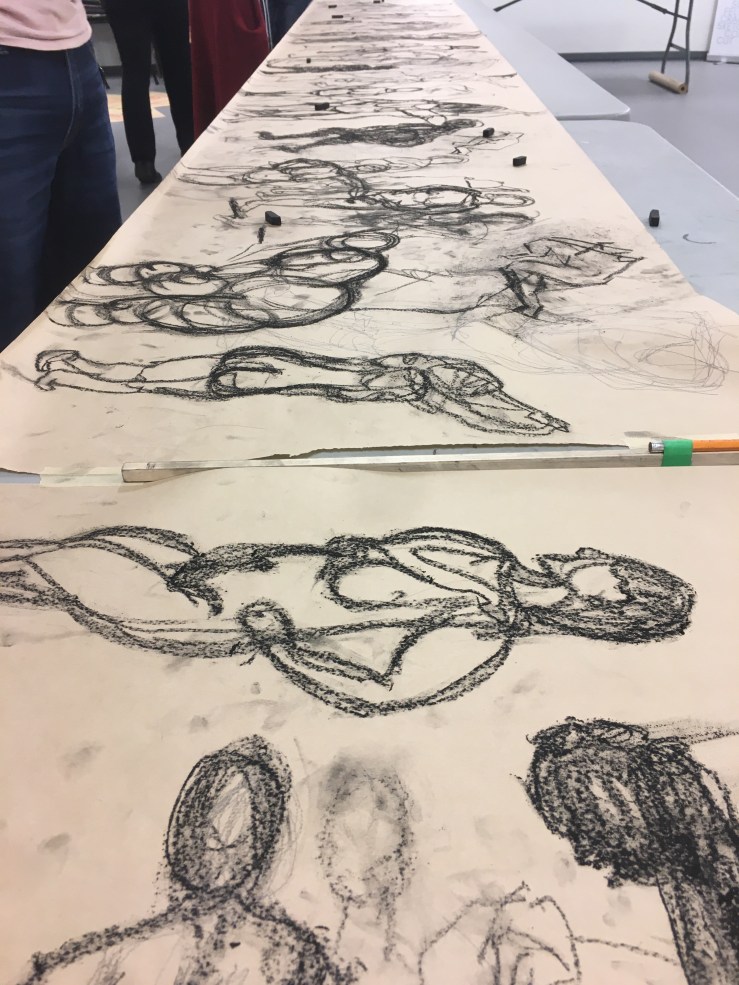
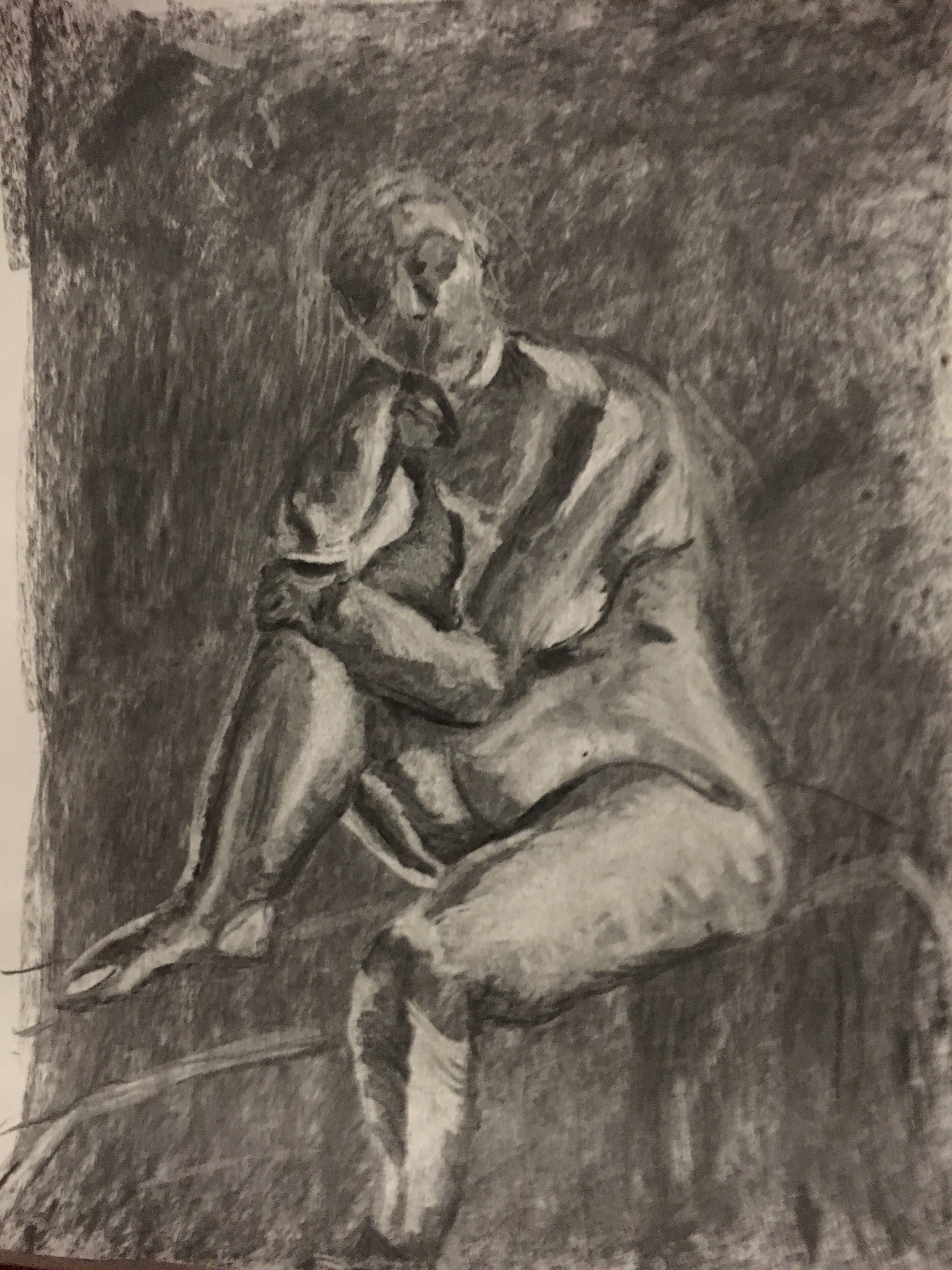
This is much harder than I had thought it would be.  Throughout the three-hour class I kept reminding myself to look at the nude model not as “a person”, but a series of connected shapes, a composite of lights and shadows, lines and angles stringing together, a build-up of spaces between limbs and body. But I kept having to remind myself to lift my chin, consciously, intentionally, to look at the shapes and spaces of the figure in front of me and try to transcribe them to paper.  Often, I found I was relying on my own internal representation of what I was seeing, on memory that was miserably inaccurate.  And also, idealised.  My mind kept thinking about the person, wondering about personality, character, wondering at the courage of a person who will remove all clothing and strike a pose while fifteen pairs of eyes rove along their curves.  Slowly, slowly, by really “looking”, I began to see muscles and the angles bones make at the knees, the elbows. I began to see the beautiful wing-shapes at the base of the neck, the stunning ridged curve of the spine. 

The instructor used several fantastic exercises to get the class to “draw what we see, not what we think we see”:  we drew with a stick (a participant was sent outside to retrieve them!) and black ink; we drew with our non-dominant hands; we drew with both hands at once; we drew the figure in under a minute; we built our own drawings on top of what other participants had already sketched out; we used a variety of different drawing materials; we dusted our faces and hands with charcoal.  It was fun.  

And I thought about how these lessons transfer to writing. Too often I’m thinking about the whole of “a story” or “a poem”.  So, just like refraining from looking at “the figure”, I can practice slowing down and honing the pieces of a story or poem—the words, the sentences, the actions in a scene, the emotions in a character, how the story moves, the arc and shape of that movement from beginning to end—these things will come together to make a whole. And there are plenty of exercises to practice each of these.  Part of the practice is just letting go.  Letting the pieces of a story or poem speak for themselves instead of trying to control them.  

“To see—and to see properly, without interference of preconceived ideas…is the writer’s central responsibility.”

Kirsten Valdez Quade

Kirsten Valdez Quade explains the value of this drawing lesson to writing: “To see—and to see properly, without interference of preconceived ideas…is the writer’s central responsibility.” And perfection is not to be strived for, because there is so much beauty in the roughly sketched (both drawing and writing). How much gesture can be summed up in a minimal line? How much “personality” captured in the angle of the head? How much weight of the body is conveyed through a juxtaposition of shadows and highlights?

Writing is another form of still life, one that moves from internal to external, through time, through imagination, through space…as writers we have to question ourselves all the time: how am I seeing? how am I looking? Let the mind’s eye loose…and see, really look, at what materializes out of the dark spaces of not knowing.
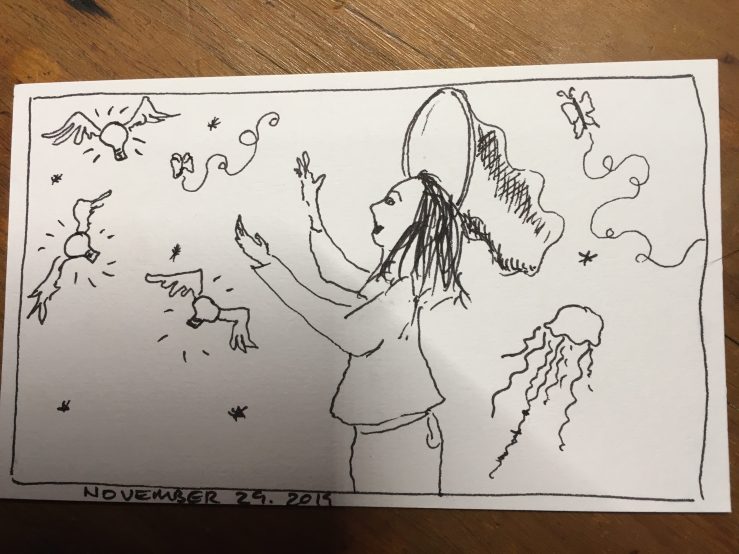
Idea Catcher

Sometimes I imagine ideas are the energy of the universe, that ideas float around, ready to be harvested and processed.  Songwriters often speak about “catching a song” and writers describe the experience of a poem or phrase as “falling onto the page”. What if “inspiration” truly is as easy as breathing in, sucking in all those ideas hovering around like dusty moths [1]? 

But ideas are only the starting point.  For ideas to become something more, they cycle through ideation, then innovation, through development to actualization…and the process, even though it’s cyclical, isn’t linear…ideas move and shift through multiple iterations before they become “something” [2]. But I’m getting ahead of myself. 

First, it’s important to manage ideas.  Running around, filling my butterfly net of a brain with too many ideas, my mind chatters and hums.  It’s noisy. And I’m an idea hoarder; I collect them like little museum pieces.  Where? Well, a number of places…scraps of paper, a tiny notebook in my handbag, but mostly digitally, using Evernote.  I’m pretty disciplined about moving ideas into this digital space.  And there they sit.  Trapped. They aren’t moving from the idea stage at all because I’m not working to build on them.  

I often wonder if the digital space, one that keeps much of our process invisible, might hinder our creative progress [3]?  In the digital space, i.e., my computer, ideas can be tagged and searched and filed, but I’m the one performing these actions, controlling the associations as I enter information in.  The digital space with its linear and algorithmic filing system makes it difficult (impossible?) to pull back and notice patterns, WITNESS how thoughts or interests change over time, mirror the curvy shape-shifting necessary to discover surprises or explore tangents.

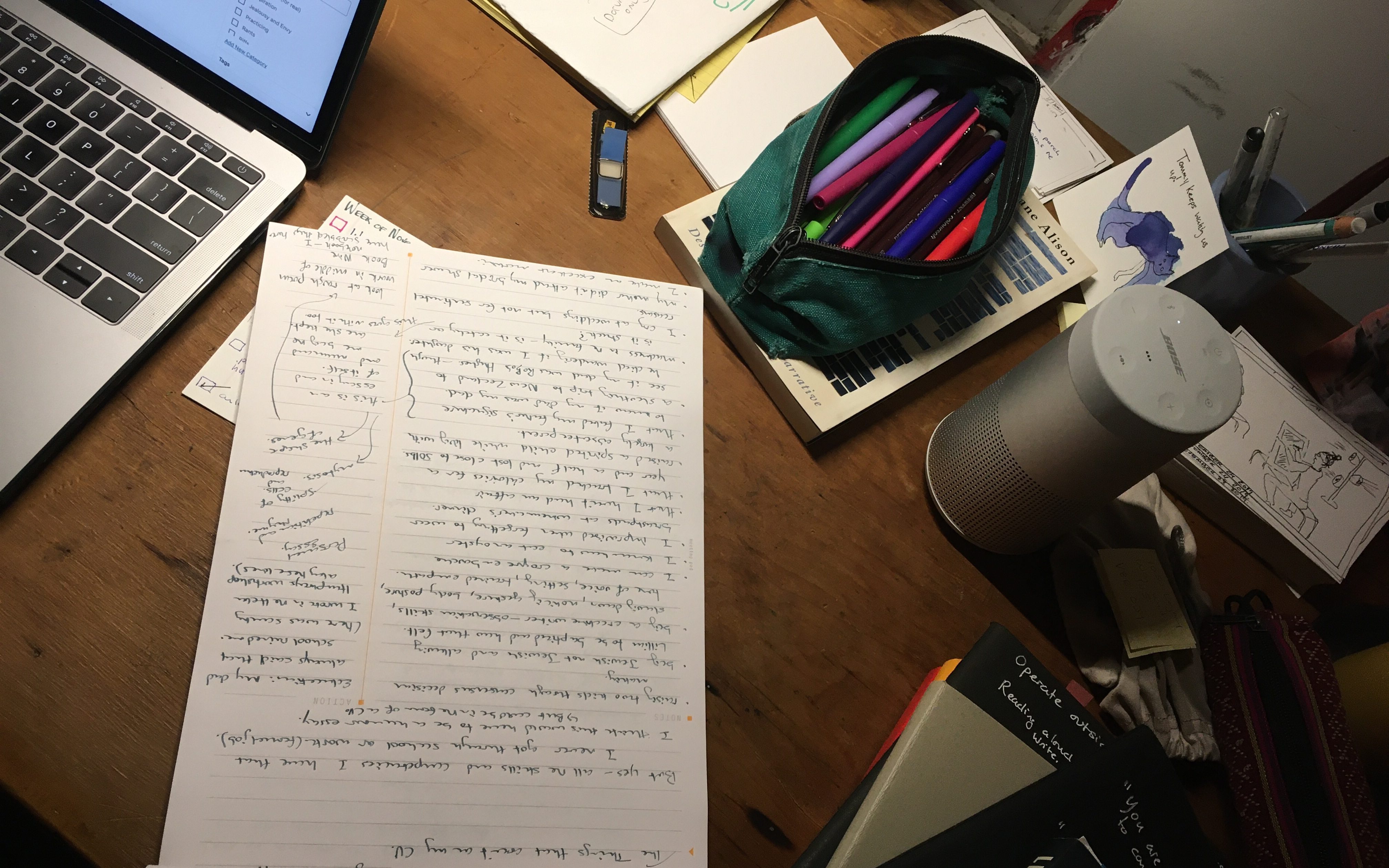
I tried a method for tracking ideas, proposed by Vancouver writer Elliot Chan in this great 8.5 minute video. He suggests keeping ideas in a notebook, a new idea for each page. The hardest part of this exercise for me was buying a notebook I felt comfortable enough to leave blank (wasted?!) pages in [4]. Following Elliot’s method, I went through my extensive “ideas” files on my computer and transcribed them into a notebook, one fresh idea per page.

Working through this process I learned some interesting things that, for me personally, are quite amazing: 

  1. I don’t have “just ideas”. The files revealed I’ve been doing quite a lot of thinking.  I was able to write MANY related thoughts as I transcribed into my new “ideas” notebook, quite literally filling the pages beneath my initial ideas.  Hmmmm.
  2. Relatedly, I discovered I have a lot of ideas repeating…over time. I have been entering similar thoughts about the same subjects…a lot…a pattern started to reveal itself!
  3. Instead of feeling like I have too many ideas, once they got transcribed into a notebook—a physical object I can hold and flip through—the list of ideas coalesced into just 11 or so!  Amazing!  And not so daunting, from a working perspective…maybe.
  4. Most importantly, I could start to freehand and draw connecting lines that curved up and around the page…connecting associations that became visible because they were located in the same physical space….not locked under different file names or digital tags.     

And just as important as managing ideas…it’s important to let some go. I freed those jellyfish moths; they float away for the taking.  Or not.  

[1] inner critic notes: What? Like a vacuum cleaner?

[2] for some reason, when I picture what an idea might look like, I think they must be light and nebulous, with glass-like transparency, not unlike the way jellyfish float through the oceans, ephemeral, solid and not solid at the same time.  Visible and not visible…and then only for someone who might be looking in the right way, at the right time, slant-wise, out of the corner their eye, to receive them. They are gifts, aren’t they?

[3] I don’t know the answer to this. It would make a good debate topic (another idea!)

[4] I bought one on sale for 9 bucks that looks physically different from all my other notebooks but still has great paper that’s a pleasure to write on.