Word follow: Creativity

‘I suffer as always from the fear of putting down the first line. It is amazing the terrors, the magics, the prayers, the straightening shyness that assails one’

John Steinbeck, Journal of a Novel: The East of Eden Letters

I’ve returned from a week and a half vacation in B.C.  Of course, I brought my notebooks, my computer, and some select drawing materials, believing I would have the much needed down time in order to create or work on expanding the draft of a short story I’m working on.  That didn’t happen.  The time change—even moving as little as three hours towards the sunsets—made me feel nauseous and exhausted.  Wonderful visits with family and friends filled the days.  The artistic practice routine I’ve guarded and carved at home, dissolved. I let it. Instead, I welcomed the laughter, delicious food and wine, the spectacular mountain views. It’s all essential.    

Two weeks not practicing makes it hard to face a blank page. Like any exercise, I need to build back my muscles.  Habits help.  I’d be dishonest if I didn’t admit the tailspin of self-doubt and anxiety (again?! still?!)  about my artistic abilities or my lack of productivity. It’s a comfort knowing most artists feel this way. Most creatives? And then, I wondered, why?  

I attended a lecture at Queen’s University this week, a PhD student in the education department exploring how the concept of “creativity” is incorporated and has influenced the Ontario curriculum since the 1880s to now (no small feat) (1).  His research demonstrated the word “creative” doesn’t enter common usage until the 1950s or so, an etymological fact that surprised me. The original use of the word, according to the Oxford English Dictionary, and a theological reference the student managed to track down, deviates from the modern definition we bandy about and follows an interesting progression through the next few hundred years. 

In the 1640s, creativity was associated with “creationism” and the divine (read: God) ability to make all things, all of “creation”.   This older concept of creativity became associated with the idea of a “God – given gift” and that association then became linked with “genius” and “ingenuity”.  Read: reserved only for the special, “chosen”, few (and, historically, almost exclusively white males in Europe). Genius was reserved for those bestowed (by God) with the creative power and understood to be an innate gift, not something one might learn (through practice, for example). The tiny tinsel ring of recognition bells might be ringing in your mind….

From there, the concept of creativity grew and changed.  But slowly.  It wasn’t until the later 1800s that it slipped under a conceptual definition that was more inclusive, through the founding father of kindergarten, Fridrich Froebel, a German educator.  He believed all humans are creative (not just geniuses) and ought to be left and encouraged, through play and exploration, to cultivate individual creativity.  This seems closer to what we aspire to (and believe?) these days, but artists are still assaulted by imposter syndrome and fear…what happened?   

Froebel’s ideas managed to influence curriculum development and implementation as far from Germany as Ontario, but in the early 1900s, it was believed too free and difficult to control alongside more traditional approaches to education.  Two world wars with Germany on the opposite side did the conceptual definition no favours.  It fell to the wayside. I wonder if it is any coincidence the surrealism, expressionism, cubist and art deco movements grew out of this time, following on the heels of impressionism?  Did those artists as children attend kindergartens where they were free to explore their creativity?  

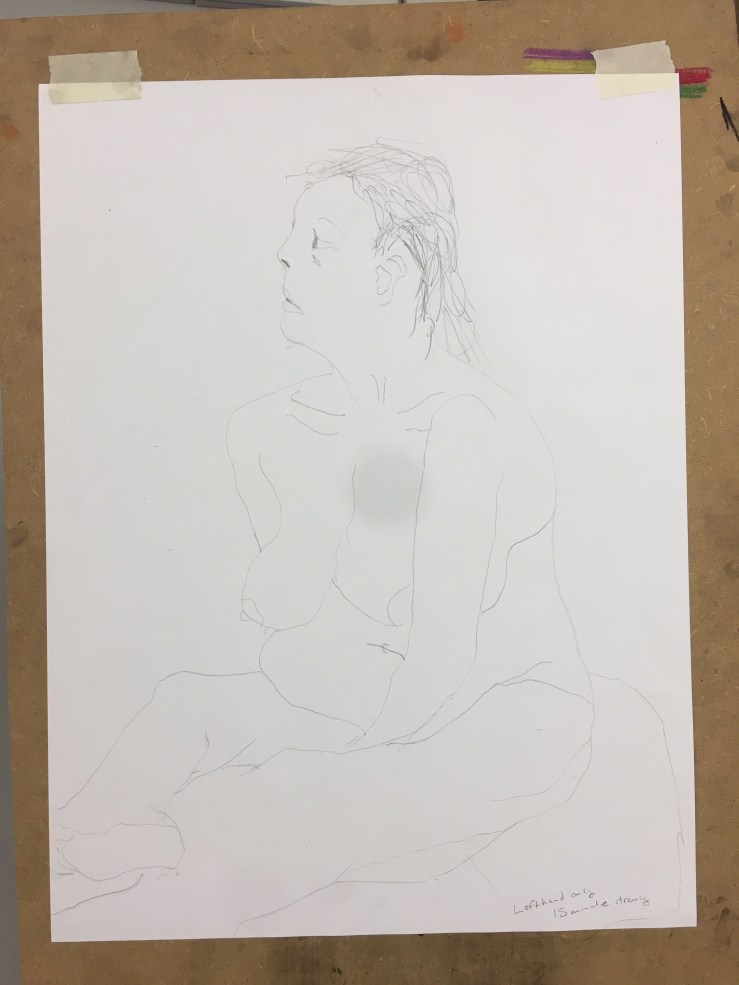
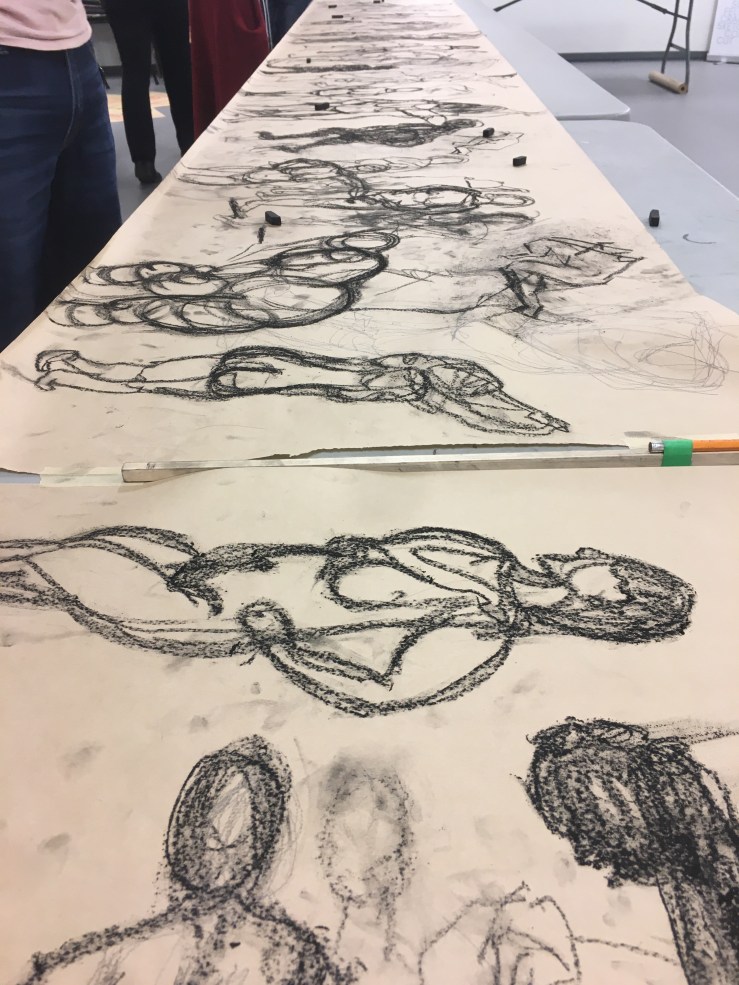
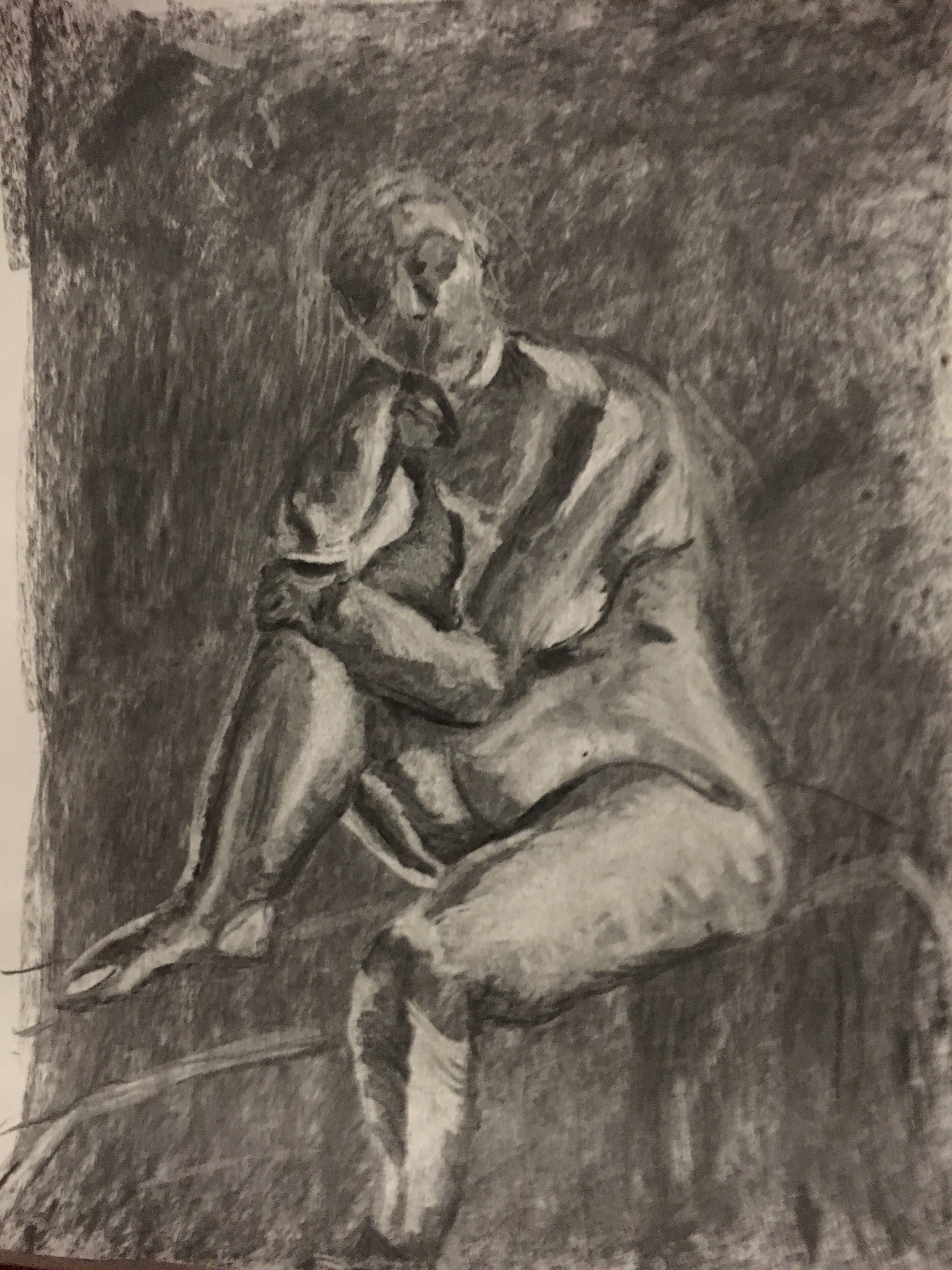
Warm up life drawing exercises

J. P. Guilford, a psychologist, peppered his learning theories with “creativity” and the word took hold, sticking through a common usage from the 1950s onwards.  Guilford’s conceptual definition broke creativity into component parts: as a problem that could be solved.  In this way, creativity was recognized as a set of skills that might be taught.  By the 1980s, curriculum had teased art making, “creating”, into a progression of increasingly complex building blocks (and why, perhaps, creative making is widely encouraged in primary schools, and then subtly, through omission, discouraged in secondary schools in favour of learning that supports social efficiency skills (those that will get you a job).  This is my era of formative schooling and it makes me question whether my dogged pursuit of “learning to write” by searching and reading so many (too many) books on writing (instead of just getting down to the paper and practicing and exploring more freely, in the Froebel manner) is hindering my progress.  I think it is.  

More recently, the concept of creativity has embraced and shifted into the idea of creativity as social power: through creativity we are able to reform or revolutionize the world.  I don’t know about you, but I feel an intense pressure to use my art toward the greater good.  The pressure is immense.  It can be, and has been, paralyzing.  

The variety of conceptual legacies continue to percolate and bubble our modern sociocultural beliefs about what the definition of “creativity” is.  Presently, we draw and squeeze together all five ideas. By looking backwards, following this etymological roller coaster, I’m beginning to understand the lenses I allow to cloud my artistic practice.  If knowledge is power, then at least I can face the blank page with a little less reservation.  

(1) Trevor Strong
I see you there, in the dark: thank you.

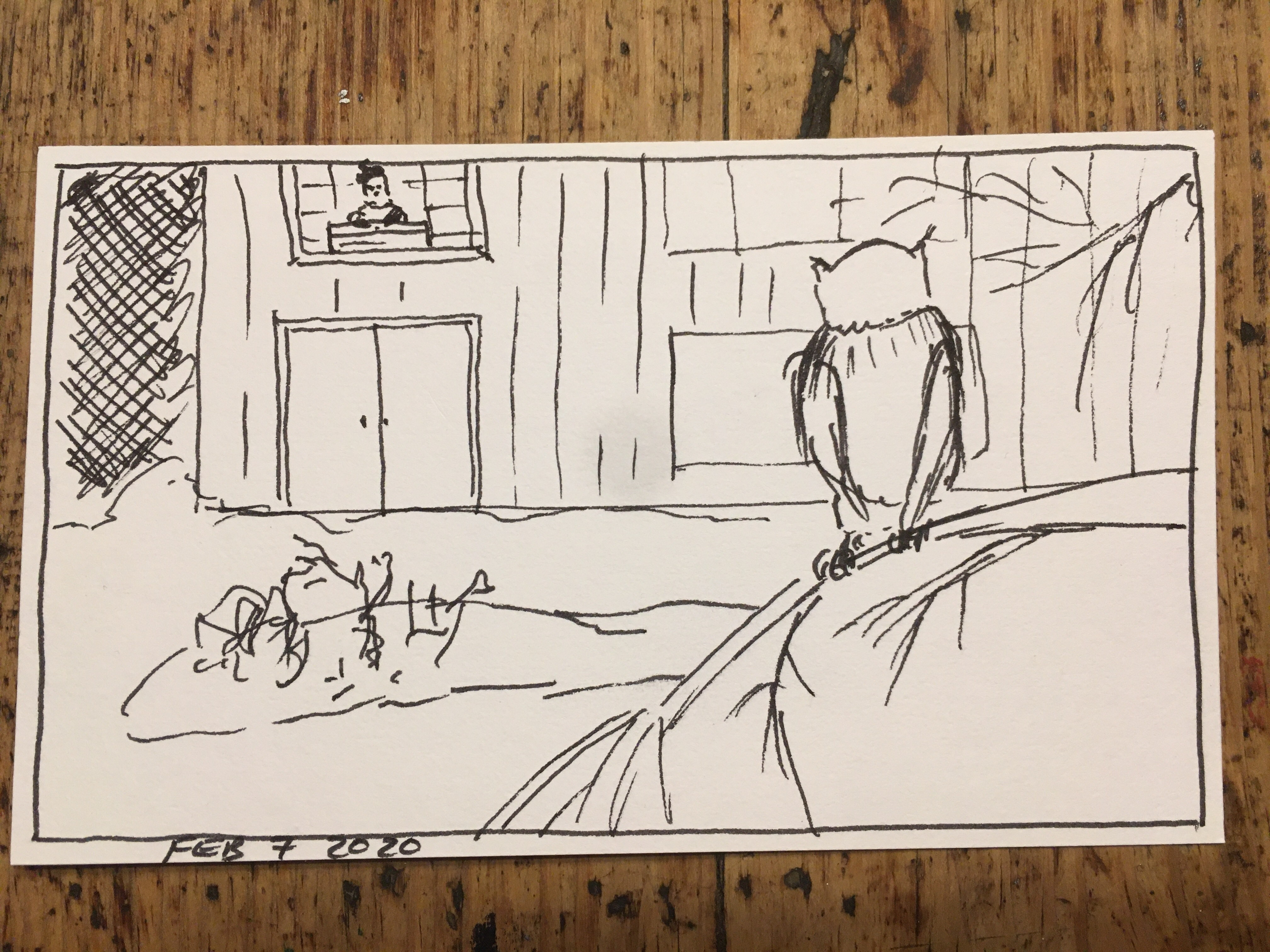
Early morning writing—this last week or so—I’ve heard an owl hooting from somewhere close in the backyard.  It’s wonderful listening to its song of wisdom calling out from the dark. 

A common cultural impression of the writing life is that it’s a lonely, solitary endeavor. I guess the hours of actual writing can be like that (though, I like the solitary time…I don’t find it isolating in the least). But this is a myth. Really, there is too much encouragement and inspiration offered from fellow creators to be discounted.  

In this same week of listening to the owl’s song, I’ve had wonderful email correspondences about creative process with a playwright, a poet, a concert pianist, and four other writers (four!).  A songwriter shared one of his songs via digital file; a film maker one of his films via FB messenger (the wonders of social media). What gifts!! I walked and talked with an artist (painter), a weekly routine that has become essential, not just for discussing artistic pursuits, but for nourishing my soul and my heart and our friendship. I’ve sat and discussed process with another dear friend while she knit a rainbow-striped heel into a wool sock the colour of an ocean in a storm.  

Also, always, inspiration and encouragement from poems I’ve stumbled across and words gleaned from others’ meanderings in books.  This week: Ross Gay’s beautiful collection of tiny essays, The Book of Delights, poems by Laura Gilpin and Bukowski, and a collection of fables edited by Rawi Hage, Lisa Moore and Madeleine Thien

Flip to the acknowledgements section of any book and you will see there are paragraphs (pages!) of people to thank for their contribution to the pages one holds in one’s hands.  The songs calling out from the dark.  

One does not glide to glory without a supportive wind.  The creators and makers (all of you – mechanics, gardeners, bread bakers, chefs etc.) I know, and continue to meet while pursuing my art, expand this glistening net[work] to enrich my life beyond the beyond.  I know I’m blessed by your words and thoughts and I’m grateful your gifts help my own writing to swoop and soar on beating wings.  

By Hand

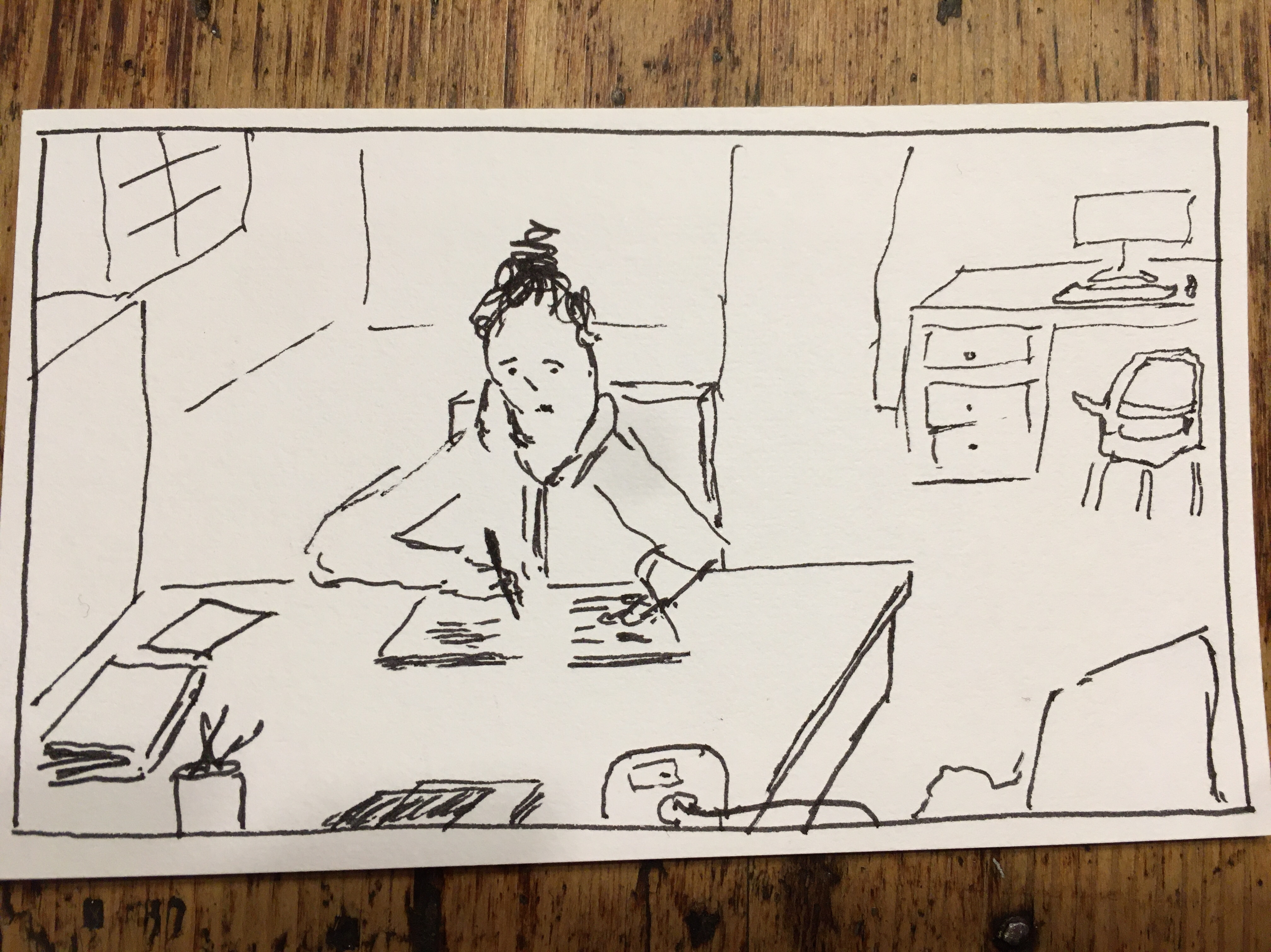
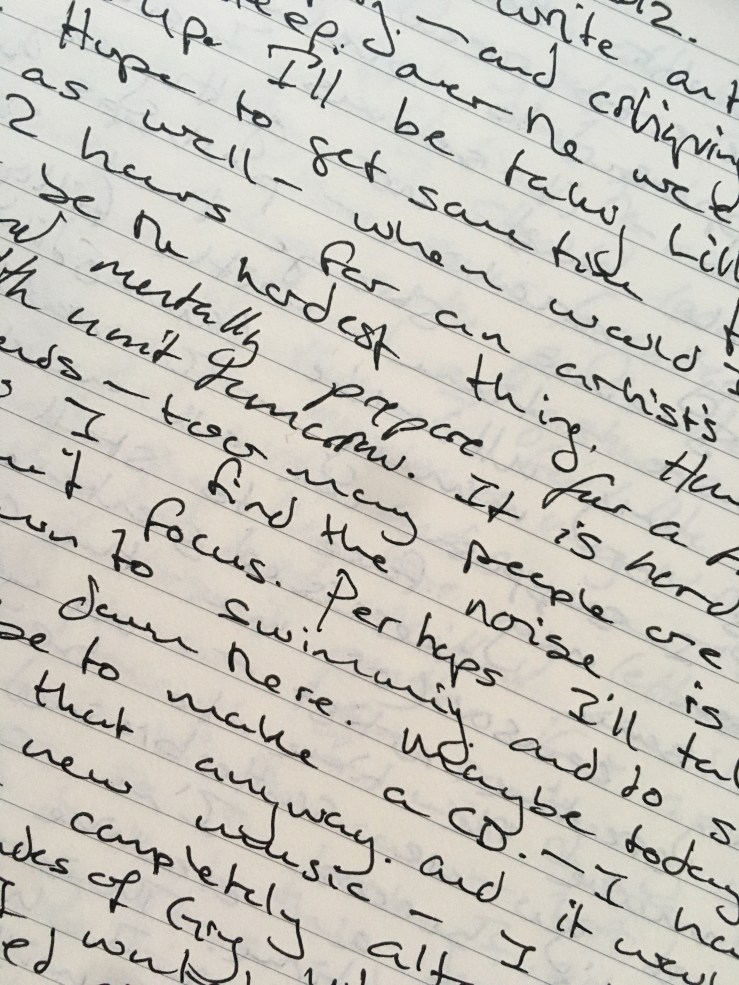
I like to write by hand.  It took a while to build up the muscles in my fingers and my hand when I first started out because different muscles are being used compared to typing on a keyboard.  I was never very fast on keyboards anyway.  When I first started writing seriously, in a notebook, my hand cramped and the letters were large and loopy. Still, legible.

In high school, when my friends signed up for typing class (in those days it was on a typewriter), my father, who rarely weighed in on such matters, ordered: you will not take typing, you will take law. Turns out you can teach yourself to type fairly quickly…but it looks ugly…and I stare at the letter keys instead of the screen, dancing my hands backwards and forwards in what I’m sure is a most inefficient pattern. Ah well.  

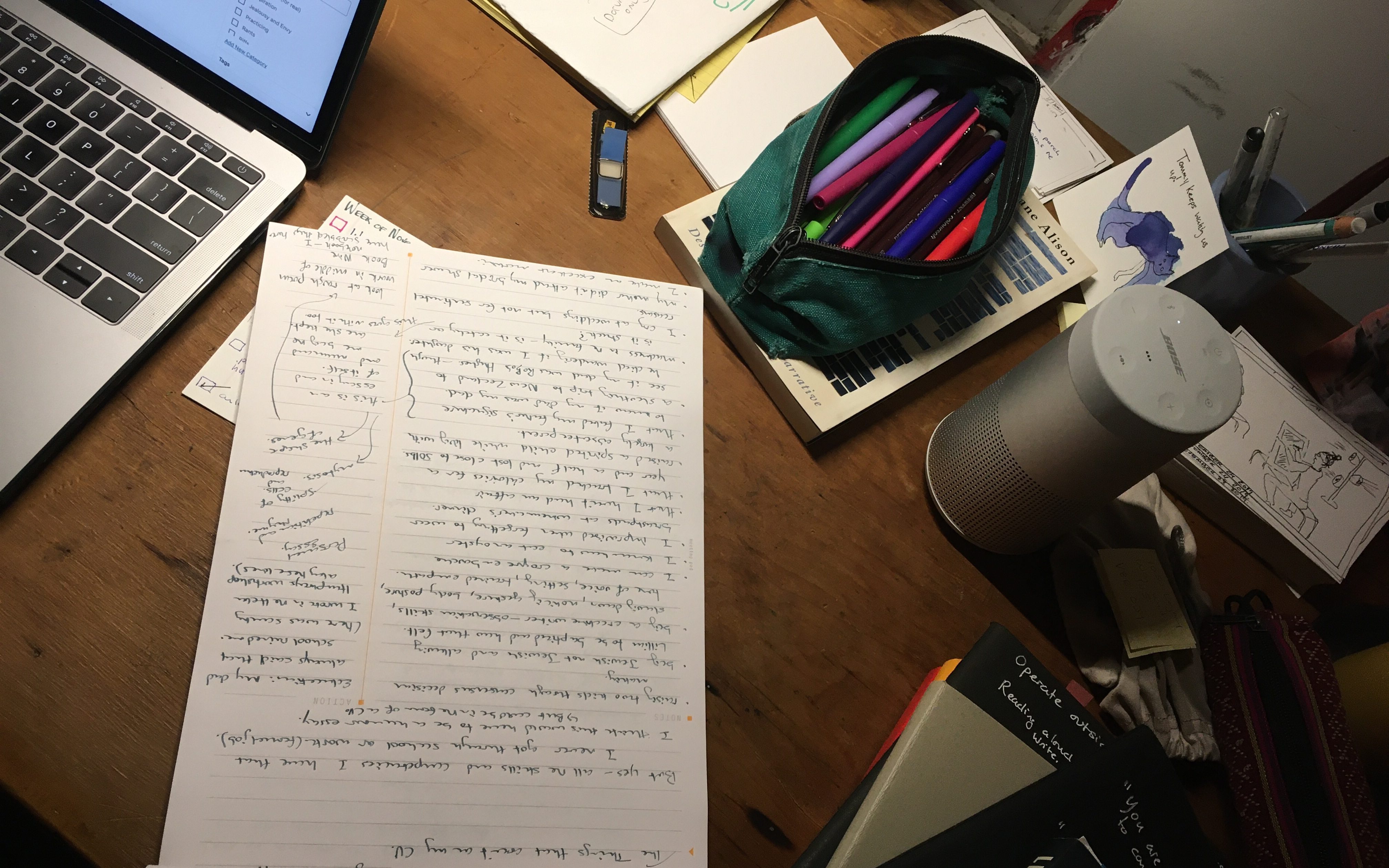
Writing by hand is freeing in a way that typing on a keyboard isn’t.  A screen is a bordered two-dimensional space, whereas working with a physical page of paper, though still flat, I can draw arrows and pictures and write sideways or backwards or upside down, cramming words into a tiny shape in a margin, or expanding letters into a material emphasis. And there’s the advantage of seeing your progress: the pages slowly fill, front to back, and a page becomes a pile of pages and soon, a filled notebook.  It’s satisfying in a way that an icon of a file on your desktop could never be.  

But there’s another distinction I don’t quite understand, and it’s instinctual: writing by hand helps me to think differently as I create.  It’s as if my thinking is more three (even four?) dimensional.  On the computer, the sentences wind one after another linearly.  And the delete key gets more of a workout than my penned cross-outs.  I’m more forgiving of my “wrong direction thoughts” when I write by hand.  But that’s good, because often there’s something bubbling up from the subconscious when we write, and it might appear in the margins or beneath a cross-out line but can never recover the fatal depression of the delete key.  

Writing by hand is similar to drawing in many ways. 

Writing by hand matches the speed of my thoughts…I can transcribe my thinking more easily by hand. 

My husband’s uncle wrote a number of books, all by hand (transcription services were expensive, so one didn’t waste the money on a product that wasn’t quite finished).  He used a large room and placed his handwritten papers on tables around the room, physically shuffled them from corner to corner and often used scissors to cut and stick paragraphs into place with scotch tape.  I wonder if this physical immersion in one’s work enables you to know your work, your process and your progress differently.  Only one way to find out I guess…

William Faulkner disregarded his wife’s wishes and outlined his novel, A Fable (1954), on the walls of his study, handwriting directly on the paint!

Here’s a picture of Joseph Heller’s handwritten outline of his novel Catch 22

A Shaky Devotion

Sometimes, the right words of encouragement arrive at the point when you most need them. 

In writing workshops, when pressed to write (without thinking too much) in response to creative writing prompts, my writing reveals some beautiful phrases that retain spontaneous energy and emotional authenticity, the magic every writer wishes for. I believe in these small beauties…they embody a promise: I can produce good work.  

I’ve been trying to cultivate the same playfulness, the letting go, in my regular writing practice.  For the first few years, it seemed easy (easier?). But, the more I study the craft, the more I practice and revise, the more I read and read to understand the deeper aspects of literary technique…well, the harder it is, it seems for me, to echo the spirited performance on the page.   

I’ve contracted, what Philip Pullman so accurately diagnoses in his essay, Heinrich von Kleist: “On the Marionette Theatre”, subtitled, Grace Lost and Regained, a “self-consciousness” in my writing.  Through knowledge, I’ve lost the “wonderful freedom and expressiveness—the natural grace—[children] bring to such things as painting [writing]”.  I’m verklempt.

And I’ve been lamenting and grieving the loss…mourning I will never regain my original (and beautiful and spontaneous) innocence. 

I’m stuck in the gap perfectly articulated by Ira Glass

“What nobody tells people who are beginners — and I really wish someone had told this to me . . . is that all of us who do creative work, we get into it because we have good taste.

But there is this gap. For the first couple years you make stuff, and it’s just not that good. It’s trying to be good, it has potential, but it’s not. But your taste, the thing that got you into the game, is still killer. And your taste is why your work disappoints you. A lot of people never get past this phase. They quit.

Most people I know who do interesting, creative work went through years of this. We know our work doesn’t have this special thing that we want it to have. We all go through this. And if you are just starting out or you are still in this phase, you gotta know it’s normal and the most important thing you can do is do a lot of work. Put yourself on a deadline so that every week you will finish one story.

Ira Glass

It is only by going through a volume of work that you will close that gap, and your work will be as good as your ambitions. And I took longer to figure out how to do this than anyone I’ve ever met. It’s gonna take awhile. It’s normal to take awhile. You’ve just gotta fight your way through.”

Philip Pullman’s essay intensifies Glass’s gap to illuminate my short-sighted grief over the loss of childish creative abandon: “if we want the wisdom that comes with experience, we have to leave the innocence behind.”  

What is most encouraging though, and has lifted a weight from my shoulders I hadn’t realised I was carrying, Pullman explains, “ …eventually, after great study and toil…[there] will be better, deeper, truer, more aware, in every way richer than…[what one] could achieve [as] a child.”

And then this in my email inbox (there’s no mistaking serendipity), Robert McKee’s latest update about the reality of writing story:

“No matter your chosen medium, remember this: it will take you ten years to master your art…It takes many years of work, but the disciplined writer knows that given determination and study, the puzzle of story yields.” 

Robert McKee

Prescription: keep working. 

Searching for [the] write words

“Words are the wings both intellect and imagination fly on.”

Ursula K. Le Guin, Words Are My Matter: Writings About Life and Books, 2000-2016, with a Journal of a Writer’s Week

I think about words a lot. Words are the atomic unit of writing.  I obsess about how to cram an experience, capture the essence of something, get to the elemental idea of a thought, into as few words as possible [1].  Or better, one perfect word, e.g., laconic. 

This week I stumbled upon [2] a wonderful art project, Leaning Out of Windows, a multi-year collaboration between artists at Emily Carr and physicists at the University of British Columbia “to open new pathways for the possibility of a much richer understanding of the human experience than can be attained separately”.  I was fascinated to see the words, shared by both disciplines, in a photo of a concept map (one of several products of the art project), created by Ingrid Koenig, mirror the messiness of the creation/discovery/exploratory process. 

In her latest book, Essays One, Lydia Davis counsels attentiveness to abstract words, often they disguise a real thing, such as “a herd, a seed, a rodent, a goat”. “Know what that concrete thing is.”  This is interesting, from a writing perspective for a number of obvious reasons…but also, if I were to review my own writing—notorious for tracts of conceptual thoughts and reflections, and rife with abstract words—I might discover some underlying feeling, my soul speaking through some imaginative space of authenticity that I need to divine [3].  

Winston Churchill’s essay, The Scaffolding of Rhetoric, lists “the continual employment of the best possible word” as the most important “element in the technique of rhetoric”. [A word] “must in each case absolutely express the full meaning of the speaker.  It will leave no room for alternatives.”  In this way, poets are masters of language.  

But it’s daunting, isn’t it, to find the right word?  The best I can hope for is recognition, in my own writing, for when a word is imperfect.  That my brain catches the signal there’s more to be unearthed, more digging to be done. Refinement needed.  The ripple of a misplaced word in the still waters of a sentence has the potential to wash out the larger piece.  I take heart with this quote from Philip Pullman, in Daemon Voices: On Stories and Storytelling “If you want to write something perfect, go for a haiku.” And this one too: “But you just try to do better next time.”

[1] inner critic notes: well, you failed with that loquacious sentence, didn’t you?!

[2] I read about it.  The show is on in Vancouver later this month for those of you lucky enough to be close to that city.  I will have to settle with reading about it and looking at the few pictures of the exhibition posted on the web.  

[3] might be a good exercise to try …exorcise to try? 

Read to write

Returned to work after a week and half off over the holidays.  I had planned to paint and to draw and write and read with all that time.  I didn’t paint. I didn’t draw (with the exception of the daily index card drawings). I did some writing, but it was “thoughts jotted down in my notebook with no particular purpose” kind of writing.  Nothing serious.  But I read. I always read.

Writers of books are readers first, last and always.

Bernardine Evaristo

With the roll over into the new decade, I’ve reflected using the lens of a decade instead of my usual day or week-long filter that, too often, chalks up another failure to produce something. The ten year lens is far kinder. I’ve accomplished much in the last decade to be proud of.

I won’t list the books I have read in this time, but what is interesting is the type of reader I have become. I have become a reader who writes. A reader who writes reads differently. I read more slowly now, I savour words and sentences. I re-read paragraphs. I copy sentences out of books into my own notebooks. I admire. I read books on writing craft. I read literary magazines, discovering new ones all the time, and through that process, discover new writers. And yes, often the green eyed monster of envy enters my heart. But I am deeply inspired by writers. I want to be friends with the authors. I imagine the conversations we would share over a meal, the questions I would ask about their myriad composition choices. I read poetry, creative non-fiction and fiction, cartwheeling gleefully between genres. I read works that refuse categorization, that explode into a fireworks display of writing possibilities. I have to believe reading is making my own writing better.

I have always been a late bloomer. Slow. Methodical. Last week, a dear friend told me I’m being too hard on myself. I’m forced to hold the thought up to the light, explore its many facets. Maybe I should be measuring my progress in decades as opposed to days.

Here’s a pretty cool infographic depicting the length of time different authors took to write their books (please ignore the fact it’s an ink ad). It’s a comfort to know The Catcher in the Rye took 10 years to write; not so much comfort to learn The Lord of The Rings trilogy took 16 years to write….I would have thought longer. And of course, the shiny examples of books produced in hours or days. Shit. I will never be among their company. But it’s okay.

Cheers to the next decade! Clink clink!

Rabbit holes and Wormholes

Wrestling “time” again this week [1].  I have only myself to blame, climbing into the ring with too many opponents under the guise of some super woman with a cape that’s quickly fraying.  

I’ve hit another bad patch of resistance in my writing.  These weekly posts are beginning to highlight patterns of behaviour I’m good at ignoring.  Example? When creativity becomes difficult, I make myself so busy I can’t face it.  Spirals of dark descending and self-loathing [2].   I’m trying to work through it. This is process too. 

Deep breath. Look outwards for inspiration and it will find you.  Fill you.  This week a few superb finds as I let myself fall down the rabbit hole into the warren of the internet:

Brevity’s nonfiction blog [3] featured a most beautiful visual essay created by Nina Gaby.  I love how her essay looks on the page with muted pastels and transparent paper bits that make the whole thing feel ephemeral.  And I love her sense of humour and play that rolls off the type-written statements like we’re sharing a laugh together.  I love that she loves James Brown. 

On her own website, a gallery of Nina Gaby’s artwork is well worth the visit: soft folds of porcelain with a variety of media.  Inspiring. Gorgeous.

Roving over Nina Gaby’s visual essay, I come across her suggestion #6: Read Brian Doyle’s “Playfullnessless”. So, a few clicks later I’m reading a piece by a writer who always makes me cry and laugh.  Brian Doyle passed away (too young!) a few years ago and I discovered it’s possible to mourn the loss of someone you have never met or known in real life.  I miss his writings.  And here, a piece I hadn’t come across before, fresh and new and fun, published on Welcome Table Press (with several more inspiring works on the essay form).  

I start to question why I’m trying (essaying) to write fiction when non-fiction would be so much the better fit for working through my shit.  Brian Doyle makes a good case. 

And on the Welcome Table Press I follow the link in a red banner on the top of the webpage to (un)common sense, a digital chapbook|for times that try one’s soul.  The universe is listening! And I descend into reading…and I’ve moved through an invisible wormhole, from feeling dark to feeling better.  

I’m also reading Kyo Maclear’s gorgeous memoir Birds Art Life and it is full of passages I wish I could tear off and eat and embody [4].  Passages like this one: 

“I understand.  I understand getting stuck.  I understand wanting to make a change while circling around the same neural cage.  I understand that sometimes, when you are at a stage of life when you have given yourself over to mothering and daughtering and you get to keep very little of yourself, it can be hard to live with open doors.  Yet in an effort to hoard solitude and keep people out, there is a risk that all you end up doing is fencing yourself in.”

Kyo Maclear, Birds Art Life (page 47)

[1] Can I start a paragraph with a gerund?

[2] annoying analyst notes: don’t worry, not THAT bad.  It just feels good to write these lines.  A colleague at work suggested it’s the shortening daylight and that I should get a lamp to sit in front of.  Good idea…

[3] I regularly read this blog/online lit mag and it’s always fulfilling, inspiring.  I suggest subscribing if you don’t already.  It’s free!! 

[4] inner critic notes: ok, that’s really weird.  

Spin cycle

This week, I’ve hit another wall in my writing.  It’s happened before in exactly the same way:  I’m working at a good clip, revising a short story I’ve been working on, fiction, working through revision exercises, feeling like I’m finally making some progress. But then, the exercises require a complete re-draft of the story.  Not a re-working of the existing writing, but a complete re-write, starting with a blank sheet of paper.  And I stop.  I feel like I can’t fit it in.  

And then my brain enters a shitty spin cycle:  my writing isn’t good enough, how can I start again?  Won’t it be the same shit?  Why can’t I just write it in chunks?  I don’t have time!  And when I make time, I sit paralysed in front of the computer and it takes a monumental effort to just try and walk around my inner critic and start typing. 

A recent portrait of my inner critic

The brick wall of course is that the task is too big to fit my regular practice of writing for an hour and a half each morning.  The task demands an unbroken stretch of time, an unbroken stretch of thinking and writing.  But I don’t have unbroken time.  I have fragmented time.  It’s all I have. 

And the mind spin continues. Just write it!  If you were a real writer, you would have written it already!  No one is going to be interested in this.  You’re trying too hard. Why bother? 

Why bother indeed.  And a small voice calls from somewhere deep in my mind’s recesses –   bother because I’m interested whether I can write this story.  Bother because I’m curious about where it’s going. Bother because art is a process, an unfolding.  Bother just because…well, why not?  

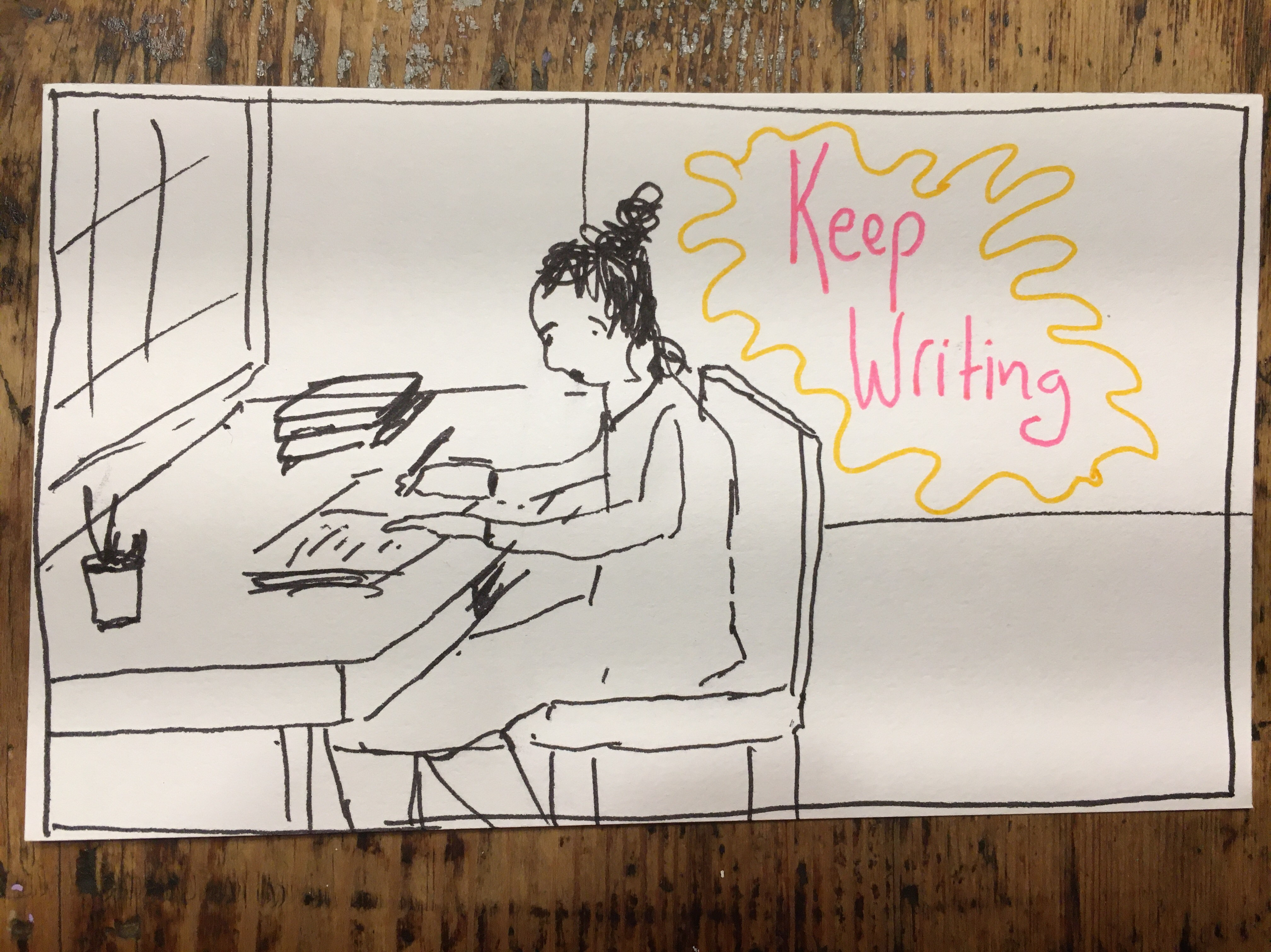
And so, I keep writing. 

Looking, Seeing

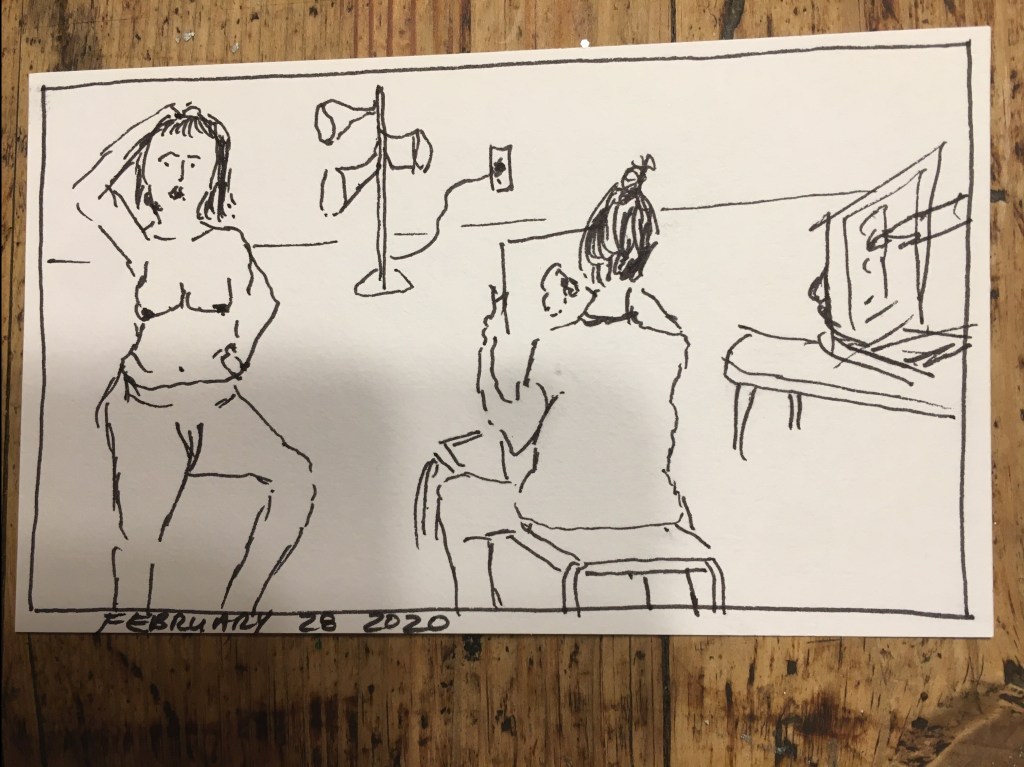
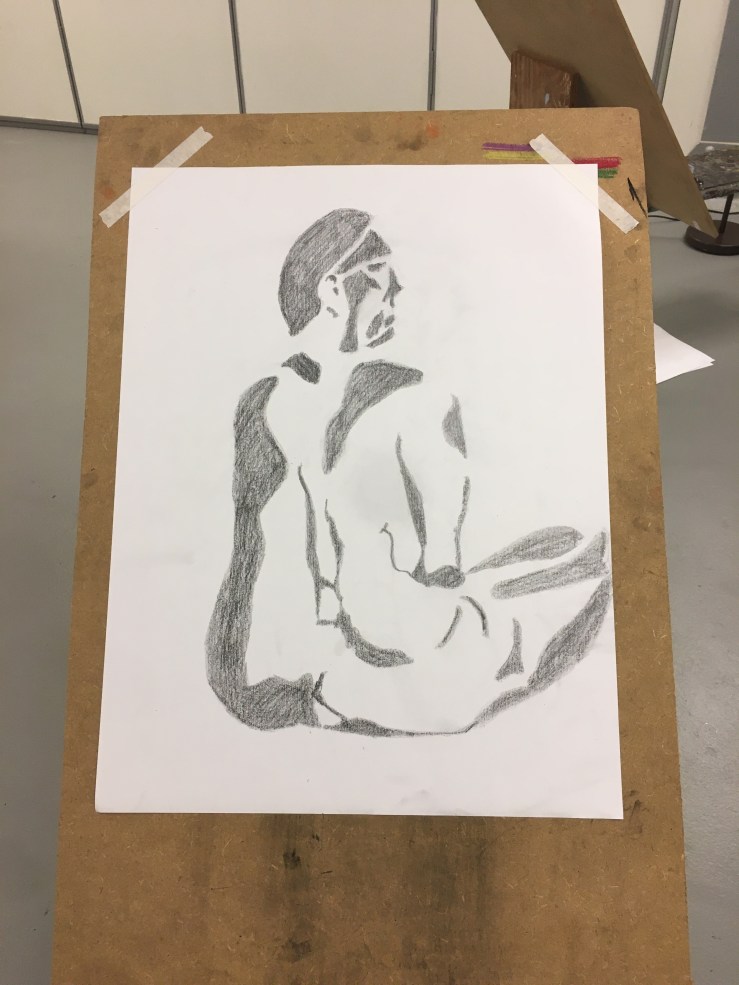
I know that if I’m to make any sort of progress with any of my creativity projects, I have to push myself to get uncomfortable.  Last week, I went to a life drawing class.  It was terrifying.  The last time I tried to draw a figure from a live model was in high school, thirty years ago.  

There was a piece in Narrative Magazine recently, written by Kirsten Valdez Quade, reflecting about the best way to approach drawing from still life or model: “Draw what you see, not what you think you see.”  

This is much harder than I had thought it would be.  Throughout the three-hour class I kept reminding myself to look at the nude model not as “a person”, but a series of connected shapes, a composite of lights and shadows, lines and angles stringing together, a build-up of spaces between limbs and body. But I kept having to remind myself to lift my chin, consciously, intentionally, to look at the shapes and spaces of the figure in front of me and try to transcribe them to paper.  Often, I found I was relying on my own internal representation of what I was seeing, on memory that was miserably inaccurate.  And also, idealised.  My mind kept thinking about the person, wondering about personality, character, wondering at the courage of a person who will remove all clothing and strike a pose while fifteen pairs of eyes rove along their curves.  Slowly, slowly, by really “looking”, I began to see muscles and the angles bones make at the knees, the elbows. I began to see the beautiful wing-shapes at the base of the neck, the stunning ridged curve of the spine. 

The instructor used several fantastic exercises to get the class to “draw what we see, not what we think we see”:  we drew with a stick (a participant was sent outside to retrieve them!) and black ink; we drew with our non-dominant hands; we drew with both hands at once; we drew the figure in under a minute; we built our own drawings on top of what other participants had already sketched out; we used a variety of different drawing materials; we dusted our faces and hands with charcoal.  It was fun.  

And I thought about how these lessons transfer to writing. Too often I’m thinking about the whole of “a story” or “a poem”.  So, just like refraining from looking at “the figure”, I can practice slowing down and honing the pieces of a story or poem—the words, the sentences, the actions in a scene, the emotions in a character, how the story moves, the arc and shape of that movement from beginning to end—these things will come together to make a whole. And there are plenty of exercises to practice each of these.  Part of the practice is just letting go.  Letting the pieces of a story or poem speak for themselves instead of trying to control them.  

“To see—and to see properly, without interference of preconceived ideas…is the writer’s central responsibility.”

Kirsten Valdez Quade

Kirsten Valdez Quade explains the value of this drawing lesson to writing: “To see—and to see properly, without interference of preconceived ideas…is the writer’s central responsibility.” And perfection is not to be strived for, because there is so much beauty in the roughly sketched (both drawing and writing). How much gesture can be summed up in a minimal line? How much “personality” captured in the angle of the head? How much weight of the body is conveyed through a juxtaposition of shadows and highlights?

Writing is another form of still life, one that moves from internal to external, through time, through imagination, through space…as writers we have to question ourselves all the time: how am I seeing? how am I looking? Let the mind’s eye loose…and see, really look, at what materializes out of the dark spaces of not knowing.

Idea Catcher

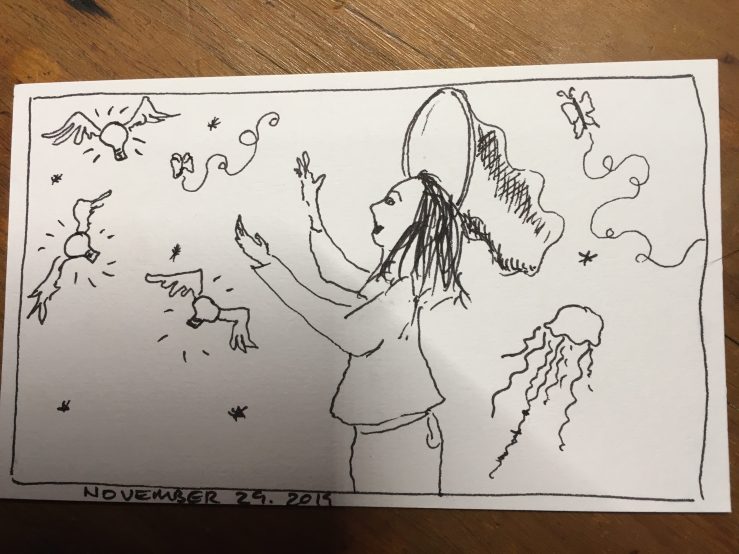
Sometimes I imagine ideas are the energy of the universe, that ideas float around, ready to be harvested and processed.  Songwriters often speak about “catching a song” and writers describe the experience of a poem or phrase as “falling onto the page”. What if “inspiration” truly is as easy as breathing in, sucking in all those ideas hovering around like dusty moths [1]? 

But ideas are only the starting point.  For ideas to become something more, they cycle through ideation, then innovation, through development to actualization…and the process, even though it’s cyclical, isn’t linear…ideas move and shift through multiple iterations before they become “something” [2]. But I’m getting ahead of myself. 

First, it’s important to manage ideas.  Running around, filling my butterfly net of a brain with too many ideas, my mind chatters and hums.  It’s noisy. And I’m an idea hoarder; I collect them like little museum pieces.  Where? Well, a number of places…scraps of paper, a tiny notebook in my handbag, but mostly digitally, using Evernote.  I’m pretty disciplined about moving ideas into this digital space.  And there they sit.  Trapped. They aren’t moving from the idea stage at all because I’m not working to build on them.  

I often wonder if the digital space, one that keeps much of our process invisible, might hinder our creative progress [3]?  In the digital space, i.e., my computer, ideas can be tagged and searched and filed, but I’m the one performing these actions, controlling the associations as I enter information in.  The digital space with its linear and algorithmic filing system makes it difficult (impossible?) to pull back and notice patterns, WITNESS how thoughts or interests change over time, mirror the curvy shape-shifting necessary to discover surprises or explore tangents.

I tried a method for tracking ideas, proposed by Vancouver writer Elliot Chan in this great 8.5 minute video. He suggests keeping ideas in a notebook, a new idea for each page. The hardest part of this exercise for me was buying a notebook I felt comfortable enough to leave blank (wasted?!) pages in [4]. Following Elliot’s method, I went through my extensive “ideas” files on my computer and transcribed them into a notebook, one fresh idea per page.

Working through this process I learned some interesting things that, for me personally, are quite amazing: 

  1. I don’t have “just ideas”. The files revealed I’ve been doing quite a lot of thinking.  I was able to write MANY related thoughts as I transcribed into my new “ideas” notebook, quite literally filling the pages beneath my initial ideas.  Hmmmm.
  2. Relatedly, I discovered I have a lot of ideas repeating…over time. I have been entering similar thoughts about the same subjects…a lot…a pattern started to reveal itself!
  3. Instead of feeling like I have too many ideas, once they got transcribed into a notebook—a physical object I can hold and flip through—the list of ideas coalesced into just 11 or so!  Amazing!  And not so daunting, from a working perspective…maybe.
  4. Most importantly, I could start to freehand and draw connecting lines that curved up and around the page…connecting associations that became visible because they were located in the same physical space….not locked under different file names or digital tags.     

And just as important as managing ideas…it’s important to let some go. I freed those jellyfish moths; they float away for the taking.  Or not.  

[1] inner critic notes: What? Like a vacuum cleaner?

[2] for some reason, when I picture what an idea might look like, I think they must be light and nebulous, with glass-like transparency, not unlike the way jellyfish float through the oceans, ephemeral, solid and not solid at the same time.  Visible and not visible…and then only for someone who might be looking in the right way, at the right time, slant-wise, out of the corner their eye, to receive them. They are gifts, aren’t they?

[3] I don’t know the answer to this. It would make a good debate topic (another idea!)

[4] I bought one on sale for 9 bucks that looks physically different from all my other notebooks but still has great paper that’s a pleasure to write on.