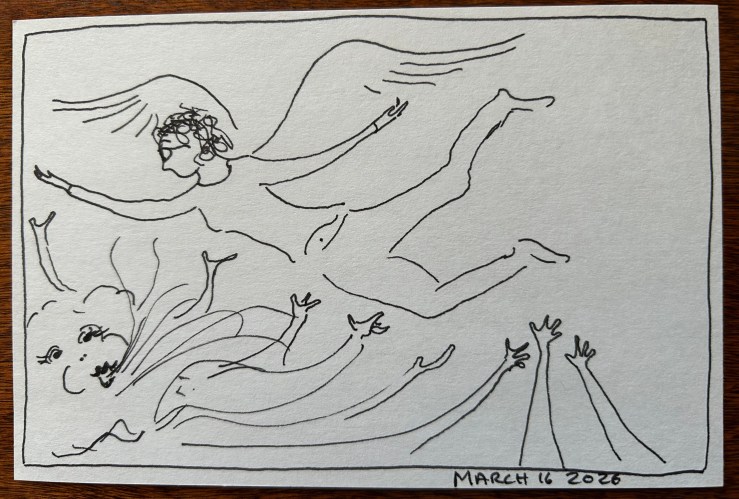
Recompos[t]ing

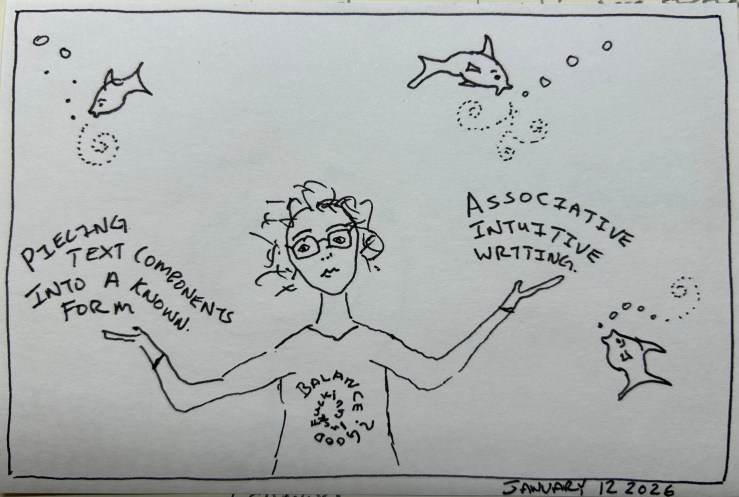
I’m struggling, trying to get back to writing about my family, about parenting, about marriage, about how we learn to love, all topics of the long project explorations. I wish I wasn’t, but I am.  I don’t know why; I’m trying to figure it out. My body and mind resist.

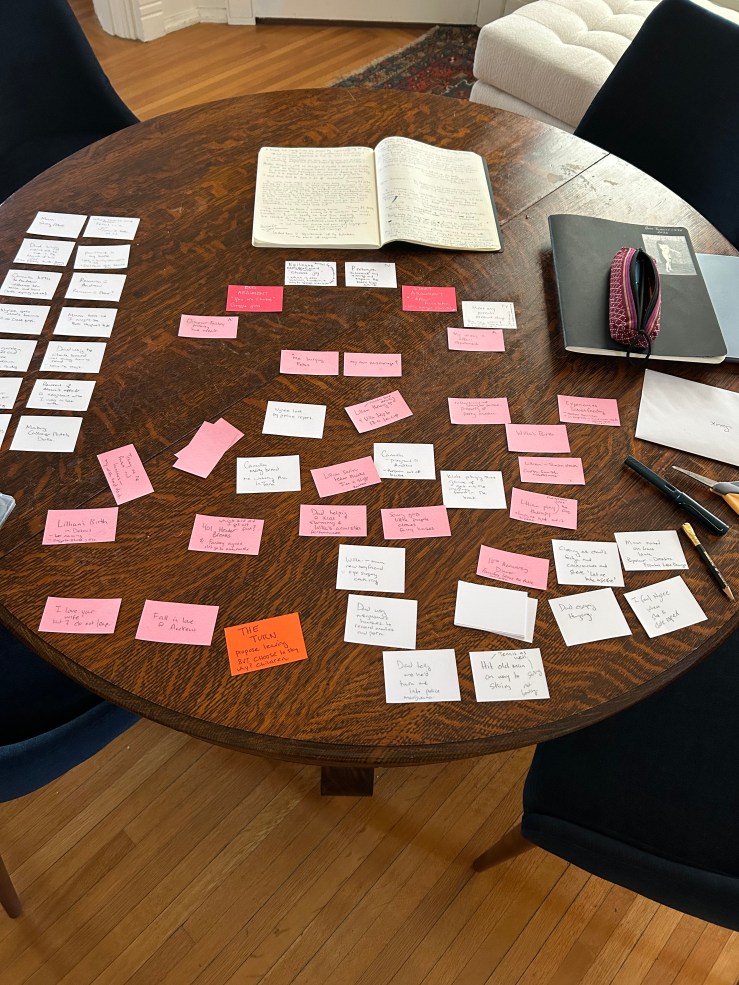
Instead, I turned toward reworking a flash fiction piece I’d drafted more than two years ago. The story felt sufficiently removed from my personal life and I felt curious and ready to explore its uncanny unfolding. The story is called The Amateur Poet Roadkill Collector’s Night Log. So yeah, that’s what it’s about. The protagonist is male and he writes poems for each of the carcasses he scrapes from the asphalt. I know, very strange.  

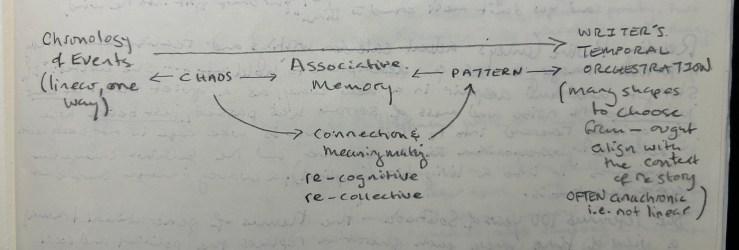
The piece arrived as a response to a prompt, a straightforward prompt, to create a hermit crab story[1]. What I love about the story is that it arrived entirely from the subconscious well of imagination. And it wasn’t until after working through its revision I recognised, with surprise, the narrative is very deeply associated with my personal life.

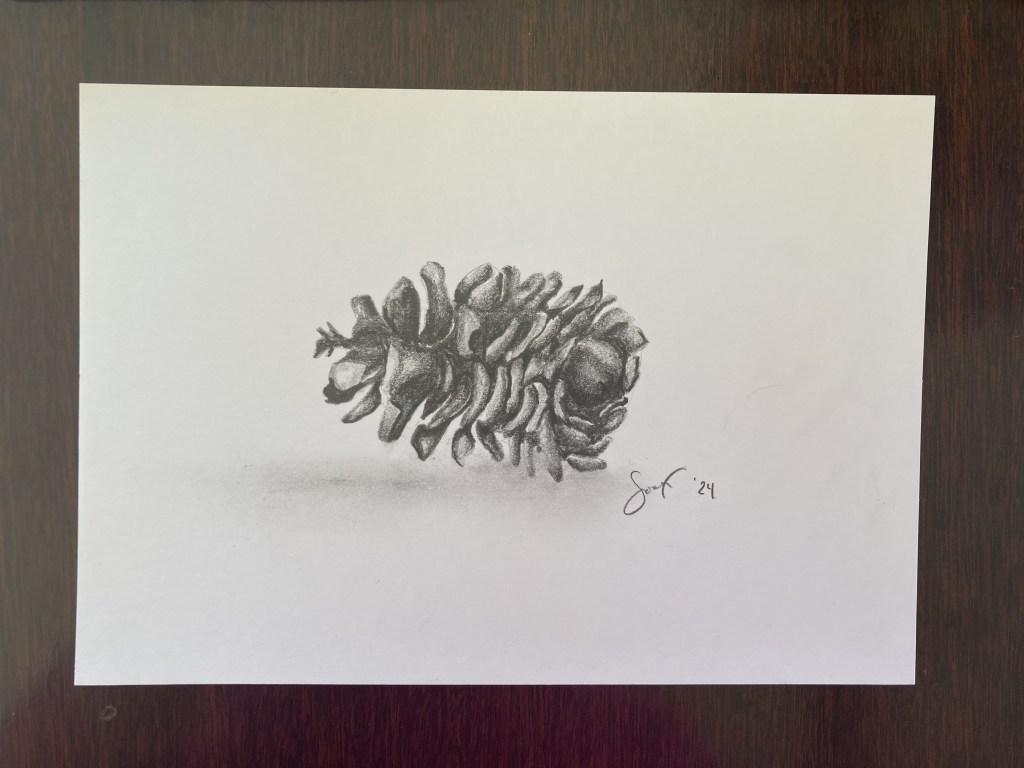
The original draft focused a lot on describing the violence inflicted on animal bodies by machinery (cars). One line in particular astonished me; it felt like it dropped to the page from the firmament.

The vibrating line in the draft referenced a mother raccoon and two babies hit and killed by a car: the curl of their little hands. So like my daughter’s.

I have trained myself, through practice, to keep writing, to never stop to question such a line or argue myself out of recording it or crossing it out or deleting it because it doesn’t “fit’ the story I think I’m working on. I’ve learned these gifts from the subconscious always “fit” the story. In fact they are, often, the story. And if I sit with the story and let it breathe with its vibrating line…well, sometimes I can figure it out[2]. I’m getting better at this.  

The character of a daughter was a complete surprise when writing about raccoons. And what did I mean about the curl of a hand? The image and the comparison felt very strong, tugging me for my attention.  I have thought about this story off and on since its first draft. It was clear the roadkill collector had lost his daughter…to death? To drugs? At one point I went too far in my thinking (thinker-tinker-tanker) and planned to write the story with the roadkill collector character—he is never named, his identity is flattened to his employment role—having been a soldier in a war zone. I imagined the character forced to watch children die by the hands of weapons he held or, at least, upheld…but I could feel this was the wrong path (a feeling not unlike the tension deliberating multiple choice options on an exam…a knowing that one particular answer, at least, is not the right one). I know it’s the wrong path when I get too analytical and conceptual (I note here, “daughter” had morphed to an abstract collective “children”)[3]. Instead, I needed to lean into the emotions I could feel from this image, emotions I often avoid. Loss. Grief. Possibly regret?  

My best friend as a young kid was my next-door neighbour Andy. We raced round the neighbourhood roads and lawns on our bikes playing cops and robbers. We competed for who could climb a tree the fastest or to its highest bending branch, for who could hold their breath the longest beneath the lake’s surface, for who could turn the most somersaults without coming up for air. We dug worms he’d use to fish off the end of the dock. We fashioned ice forts from snowbanks, piled leaves high to catch our catapults. We set up elaborate tracks for running hot wheel cars and in the sandy path we’d rubbed clean of grass with our bare feet running between our houses, we dug marble pits. I lost most of my marbles to him.  

We never spoke at school, adhering to the tacit code boys never play with girls. If I ever smiled or waved to him in the school yard, he looked through me with a cold indifferent gaze past my shoulder to a horizon beyond. I have no memory of walking to and from school with him. He showed me how ants might be laser beamed lit and charred to crumpled crisps with such a simple angling of sunlight through a magnifying glass…something I was never inclined to repeat, feeling terrible for the poor insects…though I couldn’t resist lighting bits of paper on fire. He thrilled using a hammer to detonate the percussion caps on the papery strips meant for his cap gun. Once or twice, he let me wield the hammer.  I didn’t ever cush on him …I would say I was too young for those feelings except I do remember other boys I liked that way[4].  But with Andy I never did. When he was seven and I was eight he was diagnosed with leukemia. He died two years later.

His death was not a surprise for me. It was a relief. For two years I witnessed how his medical treatments—radiation, chemotherapy, surgeries—transformed his pink skin to grey, stole the frenetic energy from his limbs and the bright spark of light from his eyes. He lost all his hair.

The hardest part was that I was no longer allowed to play with him. This was because I had not yet had chicken pox. It was explained how his immune system was compromised and that if I caught and passed chicken pox onto him, he would die.

There were times in those two years of treatments when his hair grew back in…grey…never the lustrous brown curls he’d had before. His energy returned too. We played together-apart, with the fence and our yards between us, devising games and competitions we could move through with the physical distance between us. If he lost a competition, he became petulant and agitated, and I risked losing my playmate for a day or two. So, I often let him win. For me, this trade off was better. He felt he retained his champion status, that he might conquer his illness, and I knew I could keep my friend.  

On one spring day, when I could smell the green of the grass growing thick, the green I crushed beneath my running feet and the cerulean sky cradled puff ball clouds and the sun was yellow and hot and the bright bloom of dandelions had grown into grey fuzzy seed heads that, when snapped beneath my toes, released fuzzy sails to the air, floating the breeze and winking the light, Andy and I were racing each other around the perimeter of our houses. Except, this round, he’d joined me to race around mine. As we rounded the southwest corner, the path and the space between our bodies narrowed and he reached out his hand to curl into mine. We held hands only for a moment. A few running strides. But I recall it as a moment of joy. Pure joy. Innocent joy. And I recall I knew it then too…recognised the moment in the moment. Also, I remember thinking the connection, despite violating the distance rule, could only be something pure and good, something a God would want to happen.

The following spring my mum, drying her hands with a kitchen towel, turned to me and told me to go over next door to say goodbye to Andy. She did not mince words. She said, he would die that night and that it was important I say goodbye. The distance rule no longer mattered.

When I entered the living room, Andy was propped up with pillows and blankets on their sofa. I could tell instantly my friend was …hardly there anymore. His father, sitting across the room, fiddled to put a fishing rod together, dropping the reel and picking it up and mumbling the advantages of various feathered lures and float distances. Standing there, the grey green boy with his fuzzed head webbed with blue veins I could trace with my eyes, I understood two things: that Andy’s dad did not believe his son would die and that Andy was using all his energy to prevent himself from dying so as not to hurt his parents.  A tremendous guilt washed over me then, that I knew these things. That I wished each person would let their belief go so that each might feel relief. That I would never speak my knowings, my opinions, aloud. That I recognised death when I saw it and others didn’t.

Andy died that night. I’ve always been grateful to my mum for telling me he would and telling me to say goodbye. I was ten years old.

Ever since, I’ve questioned the balance of medical technologies against quality of life. In medical research, quality of life is rarely an outcome measure. Length of life is. Mortality is. We do not measure what matters. And we believe keeping a person alive for as long as possible is the goal. I’ve never agreed with that. This is the exploration spinning round the inside of the Poet Roadkill Collector story. It amazes me, how the 750-word exploration captures my feelings. It’s my favourite story I’ve written so far. I’ve offered it for publication. I’ve received my first rejection (Bending Genres). I’m researching where I might offer it next. I wait to see if others are equally moved by it.

The other week, my ex-husband emailed to say he wanted to drop off my cooking spices, he had no use for them.  He arrived a couple of hours later and handed me a large box filled to the brim with jars and containers of spices and teas with their various mixes I’d created. The glass jars were covered in dust; I haven’t lived at the farm for two years. 

I had not seen or spoken with him since summer, when my sister, Nyree, and I went out to the farm to move the last of “my stuff”, a pickup truck’s worth (he loaned me his truck) of the remains of my mum’s things left in the barn after moving her into long term care. It was an emotional day and very hot for lifting and sorting boxes.  When I returned the truck, I suggested we might try to share thanksgiving or xmas dinners together this year, with our girls.

He laughed, a short, high bark of incredulity, marking me as I stood before him, as if I were infected with some combo of leprosy and schizophrenia, his refusal to entertain such a preposterous idea sharp between us.  On the inside, my heart shed strips of tissue and continued to split into multiple planes of our history, of my existence.

The spices I use for my cooking…I buy in tiny quantities because I prefer they’re fresh, that their taste is alive and kicking. I know there’s a metaphor here; I refuse to invite it.  But.  I now understand why I’ve resisted writing into the long project these last weeks.  The exercise I’d worked through, crafting the personal essay describing the dissolution of my relationship with my ex-husband, required I enter places of emotional pain, inhabit them, explore and sit with their incandescent teachings. I need some recovery time, need to build up my courage and stamina to re-enter those memories again to write them. This is part of process too, this patient waiting in order to sing.

And while I wait, I always read[5]. I love to read.


[1] A hermit crab story can be fiction or nonfiction. The writing is form driven—it imitates the way a hermit crab uses another creature’s discarded shell for its home—a story written following a pre-existing form, a form that is unusual for essays or short stories, like a prescription warning label, a recipe or a multiple-choice quiz.  In the story I drafted, I used what I imagined a night log might look like for a person who worked a job cleaning the roads of the animals killed. A hermit crab story is supposed to use the form as a technique to resonate with the subject of the story, for example, a prescription warning label form serves well as a container for a story about addiction, or a recipe form for how to make a kid with mild anxiety disorder (I wrote this story years ago…). In the Roadkill Poet draft, the form receded as to become almost meaningless…instead, the form became the technique to section the story with time stamps (and mile markers) a reader might follow without taking up too much narrative space as the character moves through his night shift.  It simplified, perhaps even flattened (no pun intended) the technique, but the form does its utilitarian work just as the roadkill collector trades the macabre job for a paycheck.

[2] It’s a pleasure trying to figure out what a story is about. Sometimes it’s frustrating too, because I can feel when I’m barking up the wrong tree, so to speak. Then I turn to the forest of trees and wonder, well, which tree (story) is it? This requires patience. It’s through the process of writing the story will let me know what it’s about. It moves through me, the instrument of its making.

[3] Also, I planned, like, in my mind, to write it this way….I never actually sat down to write that version. Eyeroll. Maybe one day I will…there’s another scene from a different story I’ve written, a war scene with a child, a mother and a mine field …calling to me…it would be a short story though; the character of the child needs to be fleshed out…more than a flash narrative.

[4] I recall flirting for the first time, creating an elaborate story about the “diamond” (cut glass) necklace I’d pilfered from the dress up box and clasped round my neck. I lifted it from my collarbones toward my chin so the boy I loved, Steven Chapman (fancy remembering his name?!), was induced to lean in closer for inspection, so close, so close our lips almost touched. Grade one.

[5] Recent reads: a beautifully crafted memoir by Carvell Wallace, Another Word for Love, written and structured around theme, memories related to love with all its prismatic renderings. I cried frequently, resonating with many of the scenes and feelings expressed; Hamnet and Judith, a novel written by Maggie O’Farrell which I loved for its descriptions of Elizabethan era farming as well as its connected scenes tumbling the pathway of bubonic plague bacteria across Europe. Also the making-love-in-an-apple-shed scene; two stupendous stories in recent The New Yorker issues, The Mother of Men, by Lauren Groff (also cried in this one, the paragraph where one of the Venezuelan labourers disappears, for this is the communication in this brilliant story) and The New Coast by Paul Yoon – loved the longing and disorientation I felt reading this story, also the experiences of a child rendered alongside adult reflection; Dreamtigers

by Jorge Luis Borges, translated by Mildred Boyer and Harold Morland, I love how he explores dreaming and creative writing together; and, for the fourth time, because each time I try to make my way through the essays, I come up against a passage I just can’t seem to grasp or integrate and have to put the book down, Mark Doty’s The Art of Description, World into Word. When I pick this one up, I start at the beginning again, and each time I get a little further into this tiny book (I really love The Art Of series published by Graywolf Press).  And here’s a poem I love by Mark Doty, “Brian Age Seven”.

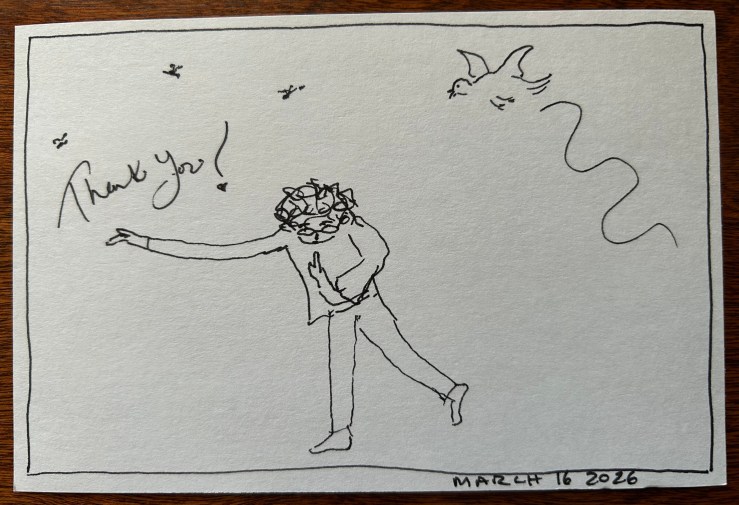
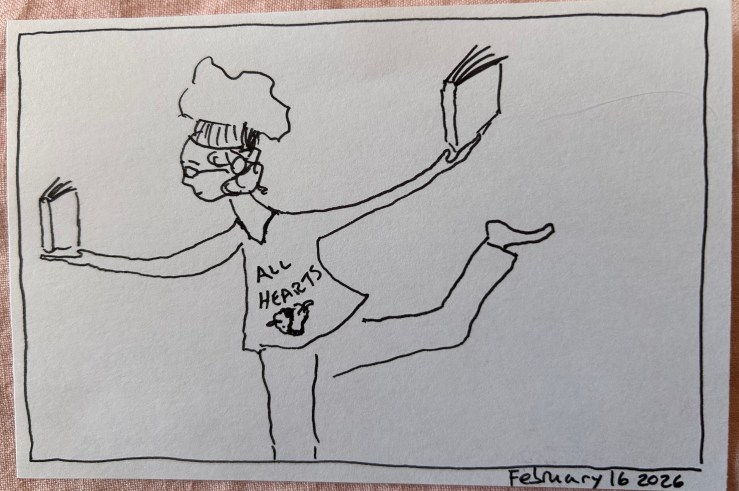
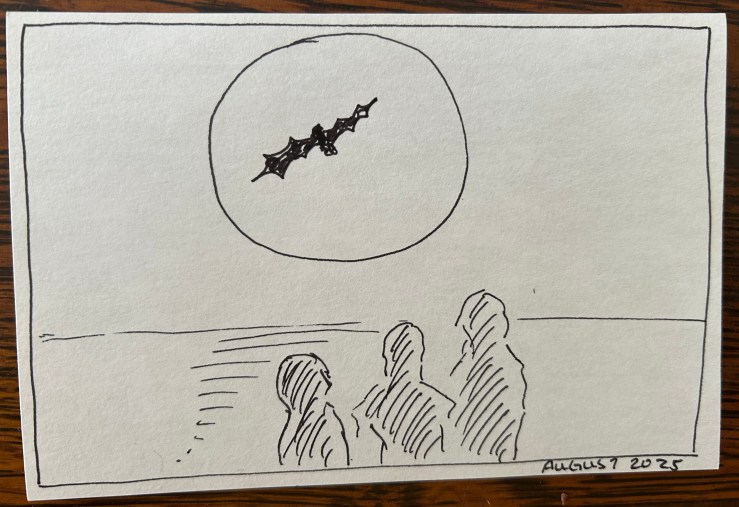
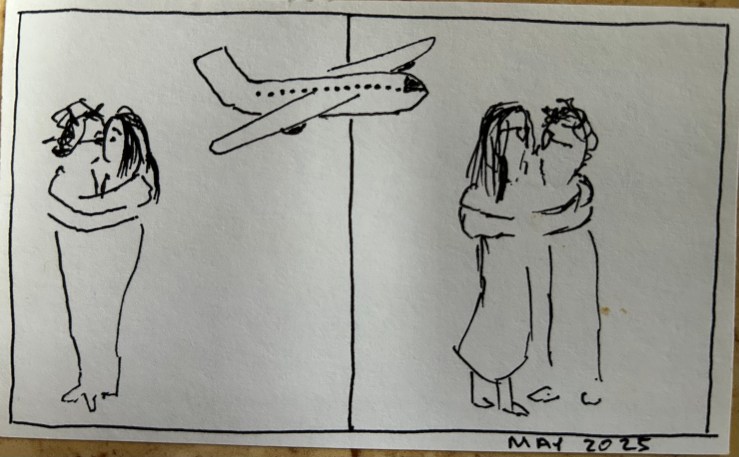
Drew these on the train so they’re more jaggedy than usual. Kinda like it.

Killing the Phantom

Okay. I’ve scrapped much of what I drafted for this post. Instead, I’m pasting in a few extracts of random jottings, conversations, and responses to writing prompts in the last month or so[1]. Some chaotic thoughts, shredded remnants of what I’d originally intended to write, follow. And this is a long post, so grab a mug of something and settle in.   

Ready?  These are drafts [she wailed loudly to cover up her delicate vulnerability ha ha]! Fuck it, here goes.

In response to a prompt to write 400 words about the origin of my name (558 words):

My name, my first name, Suzanne, means Lily or Rose, an unintentional connection when naming my own two daughters: the eldest with the name of Lillian, the younger with the middle name of Rose. All of us blossoming.

My own mother chose my name, naming me after her favourite cousin of many. I do not know what made Suzanne my mother’s favourite cousin, but I imagine it might be because Suzanne was kind, that perhaps, unlike the other twiggy branches of the family tree—even the trunk of my mum’s own mother—banished mum when she fell pregnant out of wedlock. She was forced to endure the pregnancy in secret, to endure the betrayal alone, to endure the abandonment of the man she had loved not just with her body but also her soul to create the wee soul swimming in the womb of her body.

Mum was sent to hide her pregnancy on a remote farm where the five kids who lived there threw rocks at her while the farmwife, their own mother, watched and said nothing. Perhaps she encouraged her children in the methods of this stoning. This stonewalling.  

To name is to categorize. Bastard. Whore. Slut. And the name stuck. Not on the outside of mum’s skin but worming deep in her mind, free floating the very cells of amniotic fluid the foetus hiccupped down and in, down and into their own cells. This is the way of water. It trickles incremental with the power to erode granite. Walls of stone.

Suzanne, when I met her in New Zealand, visiting when I was twenty-three, was a gentle quiet soul. She kept a canary in a cage in her kitchen who she spoke with each morning, coaxing his song. His name was Bird. He was who he was. Plain and simple and straightforward and beautiful. I marveled the amazing synchronicity of Suzanne’s movements when one day she stepped into the garden with a pair of scissors glinting the dawn. She clipped a stem with a few leaves of milkweed, brought this inside and placed it in an open mason jar. She held the jar up, a jewel in the light, to show me the chrysalis hanging the fork between leaf and stem. The chrysalis was chartreuse with a tiny necklace of gold, specks of dark between the golden granules. A monarch chrysalis, she said. But of course, I knew, for my mother too, continents and oceans and seasons and days and nights across the planet also brought monarch chrysalides inside and kept them in open mason jars to marvel the wondrous metamorphosis, the miracle of worm become butterfly.

As the butterfly formed, cocooned within, the chrysalis darkened to black. Then it cracked, splitting open from gold shoulders down to tip, the walls of the chrysalis transparent as glass, smashed open with the power of wings within. And the butterfly unfolded to hang beneath a milkweed leaf, to dry its wet wings to a powder coated blaze of fire colour. When it started exercising, fanning for flight, my mother and Suzanne stepped into their gardens with their wide-open jars to witness the transformation that is flight. That is freedom. And the flowers blossomed all round. And in this way, I learned how we and everything in this world are all connected. And not just by how we are named[2].   

One paragraph’s worth of writing toward the long project (386 words):

The condom broke. This is how I imagine it years later from the benign safety of a different generation. A generation—only a couple of decades—where, when the condom broke, sliding out from my own slippery insides to reveal its terrifying tatters dripping loosened semen on the insides of my thighs, a Sunday morning I recall, I looked up my physician’s name in the phone book and called his house and his daughter, who I knew was in grade three, answered, and he took an inordinately long time to come to the phone, probably summoned from mowing the lawn or some other mundane morning task, while I waited, dripping the vestiges of lovemaking onto the coffee table in my eighteen year-old boyfriend’s living room, the marble chess pieces strewn round my naked ass where they’d been knocked sideways to the floor, knight to queen (!), which was, I realise with hindsight, probably better categorized as fucking instead of lovemaking, fun fucking where, even when the marble bishop stabbed my spine’s base, my voice climbed the heights to climax fast and shuddering, and, when my doctor who had been my doctor since almost before memory, finally answered his telephone, I, ever polite, apologised for disturbing his personal peace and calmly, rationally, explained my situation, omitting, of course, the unnecessary details of the coffee table, the chess board, its marble pieces gone flying,  but supplying the dates of my last period, a riveting estimation of my ovulation window and talked through a risk benefit analysis of heading to the hospital emergency to request a morning after pill, a pill I knew from friends’ experiences of bleeding a hemorrhaging volume of blood down the shower drain, the running water drowning the sounds of wailing hearts and cramp pain, I really preferred to avoid, but only slightly less than an unwanted pregnancy at age nineteen (I would be entering university in the fall), my physician and I agreed, I might forego it. This time.  He reminded me I ought get back on The Pill. I’d used oral contraceptives since aged sixteen and discontinued them by aged seventeen, deciding they “made me squirrely”, and not in the sexy way. Condoms would have to do. But, alone as a contraceptive with wildly rambunctious sex (gawd that feels good!), they were risky[3].

Random lines from notebooks[4]:

  • I don’t want to be a whore; I want to be a whore and so much more. (2025)
  • If I were to create an avatar, I’d give myself a unicorn horn. I wouldn’t necessarily strap it to my forehead. (2019)
  • Internalized misogyny – IM – good nickname for a dildo. (2024)

In a coffee shop:

“Suzanne, stop flirting with the barista.”

“I’m not flirting with him; he’d know if I was flirting with him.” [Young Irish barista blushes bright pink.]

Speaking with a friend:

Me: “Well, she is a widow…”

Friend: “Yeah, but she isn’t a failure; a death is different than a divorce.[5]

Sentence practice in paragraph form, playing with narrative distance[6]:

Camilla is holding her sorrow in, squaring her shoulders, dreaming not of the lovemaking that landed her here, discussing “the solution” over tea with her mother and G’s father, his stern eyebrows, not of the electricity that sparked her lips when she first kissed G at the back of the lab, thinking not of the fetus hiccupping the amniotic fluid bubbly within her, the baby who has not yet quickened. It shouldn’t be a conversation between four people. It doesn’t matter if the fifth person, the baby, might also have a voice. She hadn’t really heard G, when he said the condom broke. He turned away. He hadn’t met her eyes. He’d reminded her of a sheep, caught in the barb wire of a fence.  The roundness of his naked shoulders, the muscles rolling beneath the heat of her palms, the dry sweet scent of crushed straw beneath, the way his body slipped so easily, becoming part of her own, his moist breath huffing the whorl of her ear, how two bodies become one, she’s not remembering it now. There are rules, love does not govern them, the laws and the systems and society’s expectations and the differences for men, for women—any notion love might prevail or triumph to hold a creation together. The baby will be born, surrendered to another family, and Camilla’s own development arrested there, at age twenty-three, the moment she’ll never forgive herself for, the pain of giving her baby away, the heart beating at the center of her liquid addiction[7].

I’m sure I’ve written this before: it often happens a particular piece of writing lands below my eyeballs at the perfect time. I mean, at the perfect time to teach me something I need to learn, at the perfect time I might finally be able to understand a work of writing or perceive it differently from a previous reading, at the perfect time to crack my eggy thinking open.

This time it was Professions for Women, an abbreviated version of a talk Virginia Woolf gave to a branch of the National Society for Women’s Service on January 21, 1931. To add a little context to this inter-war period date, two million women in the UK had replaced men in traditionally male jobs during WWI and they had only secured the right to vote in 1928, three years before Woolf delivered her speech. These facts feel like distant history, but this is not at all long ago.

A synchronicity: also read The Prime of Miss Jean Brodie with book club this month, set in the inter-war period, though, written in 1961 from a woman’s perspective and of women experiences and I laughed out loud a lot while reading it. Muriel Spark writes funny. An exploration of the fine line between nurturing and grooming; how thought and action might be manipulated. The creeping insidiousness of fascist and/or religious ideologies into malleable minds, how might it be achieved[8]?  

Why this little history lesson?  I was struck by the optimism and agency of women, the possibilities and independence, Woolf  commented on, opening to them at that time, women in their prime (!)…and struck… in a kind of devastating way, [here, I crave a distracting paragraph about waves of feminism, or better, gender and sex politics, or best, something raunchily erotic about how much I enjoy sex[9]] because I feel we’re falling—failing—backwards. [Huh, this subject is also an avoidance, a path too easily followed.]

Okay, [wince], here it is (took paras and pages to get here): because reading Woolf’s speech, I recognized how, in my own marriage, I was (am?)—embarrassingly so[10] —what Woolf named the Angel in the House. I was (am?) that selfless, sacrificial woman whose sole purpose in life is to soothe, flatter, and comfort men, but also …everyone else, other than myself, while raising a family with efficiency. And my experience of being that woman was to become invisible. It is partly what I’m exploring through the writing of the long project. A small part; I’m far more interested in how experiences of shame, betrayal, cruelty shape…not just a life, but relationships. And not just within a lifetime but crossing generations.  How legacies of pain endure and continue to shape…behaviours, choices, how and who we love. Also, thought. But wait, what “Jean Brodie” groomed me to be the Angel when I was born into a generation and country where women experience more choice and more access and more autonomy and more agency than any other historically?  These ideas are related; I’m exploring them, using my life as the sacrificial lamb (and suddenly I’m thinking of mint sauce).   

Most recent writing of the long project, evidenced by the extracted examples of writing practice above, has been attempting to write the story of how, in the 1960s, my mum “surrendered” (this is the wording used at the time) two different babies for adoption. Two different fathers. Two different countries with different sets of laws. I have two brothers in addition to the one I grew up with[11].

Each time I’ve tried to enter and write the scenes circling mum’s experiences, I slide into writing my own instead. I’ve allowed myself to drift, trusting the process of writing, following where it takes me. I’m both bewildered and grateful to report the imagery arising out of these seeming tangents bring to light very strong images to crack open my thinking about mum’s stories (the bishop!). But the writing has been very slow and very hard to sit with and real work to get it to the page. I’ve been trying to understand why[12]. And Woolf’s speech calls out and answers my pained confusion[13].

“Killing the Angel in the House was part of the occupation of a woman writer.”

Woolf ‘s speech talks about how she managed to kill The Angel. And I believed I’d killed her too[14]. But Woolf continues her thinking, naming the Angel differently, accurately, as The Phantom. And I’m going to mash up some of her sentences here, which I’m sure is a very grave sin, to elucidate my own understanding…think of it in the same way as rap sampling:

It is far harder to kill a phantom than a reality. She was always creeping back when I thought I had despatched her. Though I flatter myself that I killed her in the end, the struggle was severe; it took much time… To speak without figure she [the woman writer] had thought of something, something about the body, about the passions which it was unfitting for her as a woman to say… The consciousness of…the truth about her passions had roused her from her artist’s state of unconsciousness. She could write no more. The trance was over. Her imagination could work no longer… women writers…are impeded by the extreme conventionality… control the extreme severity with which… freedom… [is]condemn[ed] in women… telling the truth about my own experiences as a body… The obstacles against her are still immensely powerful–and yet they are very difficult to define. Outwardly, what is simpler than to write books? Outwardly, what obstacles are there for a woman rather than for a man? Inwardly, I think, the case is very different; she has still many ghosts to fight, many prejudices to overcome. Indeed it will be a long time still, I think, before a woman can sit down to write a book without finding a phantom to be slain…

So…my Writing Resistance…it’s this haunting…the phantom in my bones, it’s the air I’m breathing, it’s part of me…this belief that what I write, the experience of being a woman, a mother, a daughter, a wife, cannot be said, or is uninteresting, or has no value. As Wool says, “the aims for which we are fighting, for which we are doing battle with these formidable obstaclesmust be perpetually questioned and examined.”  I’m interested to learn how my beliefs settled into my cells, forming my selves, and influencing all the choices I make in this one precious life[15].


[1] Why? Because I think it’s important to show one another our first draft writings…it’s a nakedness to be sure …my thinking is naked and vulnerable, not to mention my writing skill level (uh, shallow) BUT I find in these first draft writings, they’re authentic, real…something from the collective subconscious has washed through my body of embedded experiences and sprinkled the page with tiny glittering tidings, the shells of ideas, memories, feelings I can pick up and pocket to explore with deeper curiosity.  I’ll try to signal these vibrations I feel from my drafty writings using footnotes.  The collection selected to post here illuminates how my thinking is circling around similar ideas as I struggle to fold them into being a part of the long project (book length work in progress).

[2] This piece was lightly edited when I transcribed it from my notebook where it was written by hand. I’m still stunned by how it unfolded to these images, these resonances, written in a fast flurry of < 30 minutes. The vibrations, for me, emanate from the words “stone” and “wall” signalled by the repetition…but also the metamorphosis …an encasement (cage), a transformation, a freedom. The metamorphosis is both literal (butterfly) and metaphoric (what is hinted at with the baby in the womb and the cells and the genetic legacies being gulped there…but also…that caged canary…what is he doing there? Random thought: canary in the coal mine…).

[3] The vibration here comes at me as if it the text flashed pink neon: the bishop chess piece, piercing the narrator’s spine. This image appeared in the quick writing, it’s not a specific memory at all…but it’s one of those glittering grains illuminating a pathway, a gift straight from the subconscious, a guide toward something brewing in the larger work.  My mum’s experience of giving two babies up for adoption in the 1960s is not the central subject or theme of the long project at all. But it’s helping to form those ideas, and her history is part of it all …this blog post reveals more to me about what it is I’m exploring. Glad you’re here along for the ride. Really.  I need hand holding. And encouragement, however tenuous it may be.

[4] I like how these lines hang together. No pun intended.

[5] This was meant as a joke; we laughed hard because many women (and not men) have made me feel like I’ve failed a most important task: marriage. And note, I have/do/trying to squash… felt/feel/feeling like a failure (IM at work).

[6] Practicing with Nina Schuyler using a paragraph and sentences from Rita Bullwinkel’s novel Headshot.

[7] With this last sentence, Nina said to be cautious here with this level of narrative distance…ask myself, have I lifted too far out of the story and summarised too much, given away too much, when this might be better as information meted out with scene and story? And I understood, in a way I hadn’t quite grasped before, how this is also another way of exploring the difference between showing and telling…and how that choice can be deliberate to move the story along, or drop into a moment of character or narrator reflection, or create authorial intrusions, or create a clue as to what might be coming later in the story  … many techniques to be employed by this method…and I think I often default doing this, pulling myself out of story to this high level bird’s eye view summary, especially when the scene or the subject matter might require sitting with emotional discomfort, getting it onto the page…and this means I cheapen the experience for a reader, when it’s much more exciting or entertaining  to get in close and personal…to experience together. Still, I love this movement, playing with psychic distance, that it can be done across sentences within the same paragraph.

[8] Monstrous recognition this pattern of history is repeating.

[9] And I must clarify something here: when I write about misogyny, sexism, the patriarchy, feminism, etc. I am NOT writing against men, and certainly not an individual or specific man. I LOVE MEN. I am writing about ideas and ideologies and I’m far more interested in how these ideas shape human lives and human relationships. It’s difficult to write and talk about these ideas because the shrill voice of the masses are salivating and ready to burn the witch at the stake or tar and feather the feminist or accuse her of becoming a raving lesbian, as if this were something bad, or a hairy man hater …we need to talk about these ideas outside the confines of categories. They’re interesting. [edited out: a long diatribe repeating the same idea and without any academic level of feminist theory because I’m a neophyte in this respect.]

[10] One of my dearest and oldest friends when I announced I’d left my marriage, said, “we couldn’t understand it, you were like some goddamned Little House on The Prairie woman out there [on the farm].”  This hurt of course….the collective “we” …how much had my life been discussed?…but also, the truth of it – I verily (ha ha) believed, stupidly, I could do it all: raise my children well and healthy; grow my own food; develop a professional career; maintain a creative art practice; be a kind and supportive partner; be a dutiful daughter-in-law; be an honourable daughter and sibling. Maybe I was able to do it all, at least for a little while. Like, three to five minutes?

[11] And our family reunited with both brothers …and the most fascinating discovery for me has been that despite being raised in three different countries, in three different families, we share the same ways of moving our arms and hands when we speak, the same way we place our bodies in space. I love that gesture is something inherited. Unfortunately, we also share the same addictive tendencies to alcohol …or perhaps this is simply a symptom of living with pain of similar origin…

[12] Skip this extra-long footnote if you don’t want to read my whining. No? Fine then. I’ve also been tired and sensitive and overwhelmed and vulnerable and weepy this last month worrying about my job. After five years of remote and hybrid working, the Secretary of Cabinet announced all public servants will be required to report to their headquarter office (a new term btw to skirt the possibility staff might satisfy their required in-office days at a ministry building closer to where they live). The decision significantly impacts people who struggle to balance raising children or caring for elderly parents with their workdays, roles more often shouldered by women. The decision unnecessarily costs the tax-payer with the sudden and inane administrative burden to, one, fit workers into offices that can’t accommodate all staff five days a week (much real estate was sold off since the pandemic), and two, adjudicate the thousands of requests for alternative work arrangements flooding managers and directors inboxes, decimating, possibly even arresting regular duties re: policy making. There are close to 70, 000 public servants in Ontario and the announcement has us all whipping a hurricane of negativity and competition (not to mention a turbid froth of distraction). On the heels of several disappointments since spring (three colleagues sparkling with intelligence, kind and dedicated mentors, have left their jobs; weathering the policy oppression tentacles from the south successfully supressing equity focused language and progress in the north (I feel this personally, as an erosion), my “professional” role feels fucking flattened.

AND (worst) my story, Measures, accepted for publication…was later declined. The editor requested confirmation the story was unpublished. I confirmed yes, the version on offer was unpublished, but, I explained, earlier drafts of the story have been posted, and broadcast on my personal blog (this one). So, they chose not to publish it.  Cue the loud whining: really what I want to do is read books and sit and think and write all day long…well, with breaks to feast and f…make love.

[13] There is much in Woolf’s speech that resonates for me; this post can’t contain it. Never mind. I’ll revisit her ideas and imagery about the unconscious in the future.

[14] The decision to end a marriage of twenty-five years, a relationship of twenty-seven, is…fucking hard. Ultimately, what gave me the courage to make the leap was a moment, a strike of lightening moment, when I understood with utmost clarity [insert the scent of burning ozone], that if I wanted to continue to grow my creative writing practice, I would have to leave. If I stayed, my writing practice would have been undermined and suppressed.  It is hard for me to reconcile but my writing was perceived as threatening and seditious.

Awake, I see, there is no way to unsee.

As Woolf explains, “I turned upon her [the Angel] and caught her by the throat. I did my best to kill her…Had I not killed her she would have killed me. She would have plucked the heart out of my writing.”

My divorce certificate arrived last week. I’m proud we managed this in just under two years following my decision to leave. I made concessions. I’m proud of this too. Money has never been my motivating factor; pleasure is (wink). Oh, and joy. Really, my lodestar is love.  

[15] It is hilarious to me how Woolf writes about what she decided to do with the money earned from her first “professional” publication: “I bought a Persian cat with the proceeds.” After much deliberation and speaking with Lillian and Willa about the possibility I might have to live in their garden sheds when I retire, I have decided to buy myself a year off work, a self-funded sabbatical, so that I can experience what it is like to focus on my own creative work. Also, with no expectations of output from the year. Simply the ability to focus without my mind divided across professional policy work and artistic practice.  My leave of absence request has yet to be approved, but the wheels are in motion. I plan for my leave to begin spring 2026. It feels absolutely right.

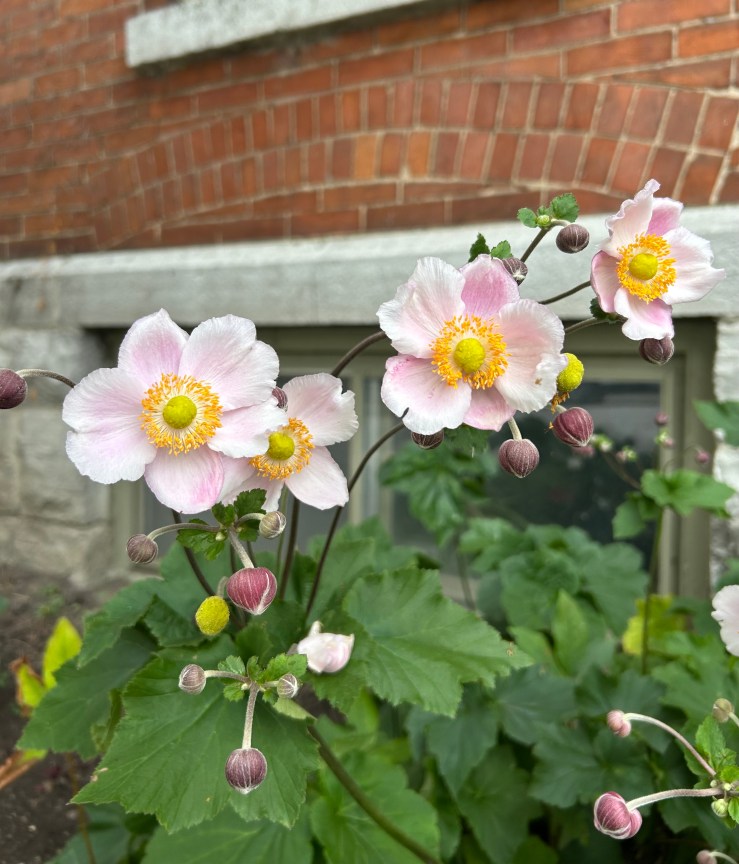
Japanese anemones outside the apartment this week.

Being Batty

Three a.m. I woke to a whispering. A rhythmic pulse of shushing fabric trawled me from dreams forgotten. The apartment was hot. I don’t have air conditioning.  I prefer not having it; I’ve always disliked the assault of hot humidity when leaving an air-conditioned building. The ceiling fan above the bed is quiet and sufficient (except when daughter #1 visits and, sharing my bed[1], whinges about hellfires and my inept ill-considered concern for guests: Just get one of those portable units you stick in the window! It’s ridiculous!). I prefer screened windows open to natural night sounds and breezes. The chords of storms. The stroll-bys of marijuana, tobacco. When I woke, I lazily surmised the beating shadow flittering round the ceiling fan was a bat. A big one[2].

My immediate concern was that the bat would eat the apricot jam I’d made earlier in the evening and left, mostly jarred, save the small bowl uncovered, to cool on the countertop. This lot of jam, made with Niagara apricots and summer clover honey, was the second batch of apricot jam I’d made. I’d fucked up the first lot and I’d done it stupidly, using a candy thermometer to tell me when the sugar reached “the right temperature” instead of relying on my senses (taste, touch, scent) to signal I should have removed the jam from the heat when it bubbled ambrosial[3]. Instead, I ended up with a stiff, dark, apricot paste and what I’m now serving as a variation of membrillo (quince “cheese”). No doubt someone Spanish made this same mistake, though probably absorbed by lovemaking in a back room instead of forcing a scientific bead to the mercury and allowing the sugar to boil past the soft state to paste. Served with great fanfare (yes, this helps with resurrections) and Manchego, it’s an impressive combination.

I’m a bit of a perfectionist. As a child, my father bought me beautiful tubes of artist acrylics so I might paint a good-sized canvas he intended to gift as a wedding present. I painted a grade five rendition of the view from our rented bungalow on the lake. And I fucked up the waves. The foamy crests were ugly little blobs of titanium white over a scraping of ultramarine and phthalo green. The figures of my siblings and I, playing on an ancient swing set, were cartoony flat renditions, garishly accented with slashes of primary colour. When I presented the painting to my father, he said it wasn’t good enough and I’d have to try again. He was also annoyed he’d need to purchase a second canvas[4].

Oh right, the bat!

I ripped the duvet from the foot of the bed and, crouching beneath it, sweated and cursed I didn’t have a partner to share this Chiroptera[5] inspired nocturnal inconvenience, and I stretched my arm out, thin-skinned, vampire vulnerable, and turned on the light. The shadow disappeared. I shone a flashlight into the dark corners of the bedroom, behind the massive wall mirror, the picture frames, the paintings, the gorgeously tiled fireplace with its stopped-up chimney—had it entered there? suddenly I was far less enchanted by the architectural beauty and romance of the fireplace—and surmised the bat had left the bedroom. I clicked the door shut and leapt back in bed, pulling the sheet over my head (I hadn’t looked under the bed or the dresser…surely bats fly higher up instead of lower down[6]) and forced myself to sleep in the sauna. The bat returned. We played peek-a-boo until dawn. It became invisible in any light.

A jazz singer, a marriage counsellor and a soon-to-be-divorcée run into a bat…

Guests for dinner that evening included Chantal who has a most marvellous singing voice, and writes songs and composes music, and Peter, who was my marriage counsellor for ten years before he retired. Since leaving my marriage, he has become a dear friend[7]. Peter is really a poet and enthralled by Dante’s Divine Comedy. Once, to my delight, as I had not heard it before, he recounted the Arthurian legend of the Green Knight. Prophetic in many ways.  

A jazz singer, a poet and a writer run into a bat…    

But wait, what did we eat[8]? This is important because pleasure is important. Pleasure feeds the soul. And the conversations that feed the mind, the threads of politics, philosophy, the meaning of dreams, the ways of creativity, the dissolution of relationships due to disability—humans in mismatched states of disempowerment, development, drive, desire, death (ha!)—weaving frustrations, a few glistening tears, giggling, sorrow, grief and laughter, ignite best over a long drawn out meal, al fresco to begin and ending with mellow flames spluttering softly in the pools of melted wax atop candle stubs in the dining room.

We ate: a block of my apricot inspired membrillo with a wedge of sharp Manchego; slick, salty olive oil preserved Italian anchovies served with sweet butter on sliced sourdough I’d baked that morning (the trick for these snacks, one I’m smitten by since discovering their salt-sea-fat combo when I travelled to Italy last year, is layering an anchovy fillet atop a voluminous smear of good sweet butter…no skimping! – must be a good sized shelf of butter, like a plank, to shuttle the fish on the bread to the pirate of your tongue); toasted almonds; salmon roasted with butter and fresh thyme; a warm salad of quinoa with market vegetables (corn, zucchini, red and yellow peppers, red onion) and, because I can’t help but gild the lily, a ball of creamy burrata torn into bite sized pieces.  

The bat reappeared during dessert[9]. It swooped through the chandelier passing back and forth between the kitchen and the living room. Earlier in the conversation, Peter explained how, for decades, he’d been tasked by his mother and aunt to rid their cottage of bats when they made their annual indoor appearance at some point in the first two weeks of August. I handed him a wastepaper basket, tasking him, at aged seventy-six, again. Of course, accompanying the meal, there had been a good amount of wine. When Peter chose the ricketiest chair in my apartment to stand on to reach the bat—it  was resting on the stained glass window in the living room after we’d exhausted it trying to catch it mid-air (Chantal was armed with a laundry basket)—the chair skittered beneath him, he lost his balance and fell, scraping a good section of skin from the top of his right arm[10].  

Turns out when you leave a marriage, a first aid kit isn’t one of things you pack. Probably because the wound, in that instance, is permanent; no amount of plaster or gauze can soak up the blood sacrificed.

Chantal, imploring me with her eyes, suggested everyone should go home and Peter should attend to his wound properly. This was sensible advice. But the bat hung upside down on a blue square of coloured glass above the sofa. There was a long moment of shifting glances sliding the triangular space between us: pleading, earnest, insisting. I retrieved the step stool from the pantry and Peter, the torn skin of his arm open and raw but no longer bleeding, trapped the bat in the wastepaper basket and handed it down to Chantal’s waiting arms (she had been steadying the step stool)[11].

We walked the bat two blocks down to the lake and released it beneath the orange light of a massive apricot moon hovering the horizon.

Speaking of “try again”, one of my creative nonfiction flash stories has been accepted for publication in Lost Balloon, date TBD. The piece accepted, titled, Measures, is one I reworked many many times. I wrote about my approach to re-drafting it as part of an earlier blog post. I also read the piece at a public reading and used the experience of reading it—what I felt from audience reactions—to re-craft it[12].

Preparing for another public reading this month, I read a short story, The Point of Departure, to Chantal, to practice, but also so that she could help me with my performance, my delivery. I’ve re-written this piece a number of times too and have written about its revision process here.

Chantal made the astute observation that an audience needs time to absorb the imagery and ideas of a written piece…pauses and silences help.  Written composition can (should?) incorporate “resting” components as a mental break for the reader, the same way music and song are composed.  After reading the piece to her, she complimented it and then expressed a good deal of frustration about the work being too short….”it needs to open out, be explored. Don’t waste it on a short art piece.” I explained the flash form …that I liked the compression and ambiguity flash pieces force. We argued back and forth (cordially). She, explaining how invested she is in the husband and wife characters, wanting to know what happens and what happened to them, saying this is only the first chapter of something longer; me, explaining that the same story is being explored in the long project, but that it can co-exist in this form, as a flash piece. We agreed to disagree. I’m pleased to know her interest in the characters is so strong.

And though Chantal provided excellent stage directions for improving my public reading, the following video confirms I’ll need to try try again.  I was nervous again and it was another very hot day and I had forgotten my water (again) and I stumbled through and my back was hurting and I’d taken some Tylenol for the pain which left me decidedly stoned and and and…  

The title is missing from the video, but it is, The Point of Departure.


[1] With its wool mattress topper? No, it’s not hot at all. Ha ha ha ha!

[2] Later, I identified the species as the ingeniously named Big Brown Bat.

[3] It seems I’m presented with this lesson over and over and over again. Sigh.

[4] My sister, Nyree, when I recount this memory over lime margaritas last week, remembers differently: YOU were the one, Suzanne, who refused to accept the first painting, wailing about how it wasn’t good enough, NOT dad! The truth, like all truths, lies somewhere along the spectrum between these two memories. I do recall it was the boy next door, five years older than me, who, with patience and kindness, sensing how I was in love with him, taught me how to blend colours directly on the canvas to great effect.  Painting two sufficed as a wedding gift.   

[5] a name of Greek origin meaning “hand-wing” – isn’t that beautiful?

[6] Logic in the wee hours of morning is…non-existent.

[7] It’s not as linear as the sentence implies. And it sounds like the punchline to a pretty good joke about Peter not being a very good marriage counsellor, but the reality is that I credit him for helping me to stay in the marriage for as long as I did, which, ultimately, was best for our daughters (my primary concern). The long project explores and unpacks my decisions, trying to understand the source of witchery that hijacked my brain. Some people call these hormones.  It’s a long story and I’m learning how to write it.

[8] I can hear Nyree’s voice, a line from the movie The Couch Trip: “DO we eat it, or DID we eat it?” in reference to a plated something that looks like vomit. The whole quote, she confirms through text, is a scene where Dan Akroyd’s unhinged character, posing as a renowned therapist (he’s really an escaped patient from a psychiatric ward), is hosting a radio call-in show. A woman caller says, “my husband comes home, no matter what it is, he says, ‘Do we eat it or did we eat it?’ I think he’s learned it in the army, I’m ready to bury an axe in his head!!!” Akroyd answers, trying to get a word in, “Ok. Well…if you…look at it like…zip it up lady! For starters…stop cooking for him!”

[9] The ingeniously named Gooseberry Fool.

[10] “Just a flesh wound!” Peter lamented his “old man skin”, calling it friable. Indeed, it bled badly and looked like it had been fried.

[11] For added entertainment, our bat trapping was not unlike this visual (though, I think with slightly less swearing. Maybe.)

[12] I have recently learned that the use of an m-dash is a dead giveaway for having used AI to generate written content. Also, the semi-colon. I don’t use AI for any of my creative writing. I do use it for professional work. I have a lot of opinions about AI …maybe one day I will write about them but presently I can’t be bothered. Basically, an essay would boil down to: AI will not become a sentient being; humans will become (already are?) machines…a far more dangerous and destructive force.  This opinion is neither unique or new.

Neuroindulgence

Quick preview: this is a long post, steering (dragging?) you, dear reader, through personal memories and thoughts related to books I’ve read, coupled with an embarrassing but brief writing draft, followed by tottering, slipshod connections toward a conclusion I’ve reached before. I can’t promise return on investment. But there’s repeating reference to naked breasts. Female ones, even. So.  

Home now after two weeks away. One week in BC moving daughter number one from Victoria to Vancouver for a summer internship, followed by a week working in Toronto, staying with daughter number two. A delightful day in the middle where I hugged one daughter in the morning and the other in the evening. Trees fluffy with spring blossom. Out west, the sweet scent of budding Black Cottonwood mingled with brine. In Toronto, Eastern Red Buds branched hot pink; spent and ragged-edged magnolias flowered the sidewalks.  Despite the beauty, spending time with the girls, the relief it’s finally spring, travel disrupted my writing routine, making me edgy and irritable. This morning I’m up at 5, determined to recoup the energy and time necessary for the task[1].

And though I didn’t write while away, I read. I’m mid-way through deep reading an essay I’ve intended to analyse for years, The Fourth State of Matter by Jo Ann Beard. It’s one of several pieces of writing I pulled for the trip, selecting a diversity of works to understand their structural elements and track emotional movements therein[2]. I’m trying to slow my reading sufficiently to understand where and why and how my water works turn on, where sentences spark to fan the embers of my humour, igniting laughter[3]. I thought I’d start with pieces that elicited obvious emotional reaction for me when I first read them.  As always, I underestimated the time such close reading requires, hence my half-way point through the analysis of Beard’s essay. The folder of works I carried across the country and back remained unopened, mostly. And as always, I picked up books along the way…

An interesting observation: I had completely forgotten Beard’s essay is about a school shooting. Like, completely forgotten!!! Instead, the lingering images and feelings I retained from the essay were how the narrator loves and cares for her dying dog. I remembered she carries the aged collie up and down stairs and endlessly washes soiled blankets to place fresh, dried ones beneath the incontinent animal. It’s the love and devotion and grief and longing captured in those images that I remembered[4].

And that got me thinking about the selective and specific memories of book length works my brain holds onto. Is there a pattern to them? Are they all images?  Are they predominantly feelings? What makes them memorable for me?

This brief sample list is poor representation of my rapacious yet superficial reading habit; I read widely but not deeply[5]. I’m working to improve deeper reading. Now, I always read with a pencil in hand, underlining passages, scribbling notes in the margins, extracting sentences, passages, into various notebooks, feathering pages with coloured post-it flags.  And, if I’m honest, it’s only when I write through analysis, i.e., not think through it, that I really get a sense of the mechanics and the magic, hence the indulgent footnote #4 (it’s more for me than for you ha ha).  

This list is the “top of mind” list …I’ve limited myself here deliberately. See? this is me not going to my bookshelf to divine more of my memories conjured off their spines.  The clumsy imprecise rendering here is also deliberate…these are the fuzzy bits retained. Sometimes the only bits. Maybe this betrays a sieve-like brain …or worse, a brain-like sieve.  

  • Like Water for Chocolate by Laura Esquivel – scene at the dinner table where the protagonist, forbade by her mother to declare her love to a young man who we know loves her back but is betrothed to her eldest sister, cooks her unrequited passion into a spectacular dinner of dishes, including rose petals (!), the whole family share. But it’s the middle sister who “eats” the cooked in love, becoming so consumed with heat and lust and passion, she rushes from the dining room, somehow loses all her clothes in the process, runs across a field in the dark and her naked body, hair streaming wildly, is hoisted by welcoming arms onto a horse ridden by a passing _______ …can’t remember this detail …soldier? Bandit?  Some kind of handsome outlaw anyway. He happens to be riding by with his gang. This scene makes me feel…envy.
  • Love in the Time of Cholera by Gabriel Garcia Marquez – the protagonist (though, maybe this is a side character?) goes out of his way to eat asparagus every day so that he may smell its telltale odorous byproducts every time he pees. Oh, and a pet parrot that blurts out inappropriate phrases (swearing?) and lives half in and half outside the house[6].
  • The World According to Garp by John Irving – Garp frying onions, building the mirepoix, to make spaghetti sauce which attracts a woman neighbour to his door, inside his house and eventually into an extra-marital affair[7].  Sigh. It always starts with an onion.
  • The Brief Wondrous Life of Oscar Wao by Junot Diaz – the mother’s sly smile, her wig askew after she fakes a fall and injury, a smile like a tiger’s smile (I likely have this detail wrong) after successfully tricking and luring her teen daughter back to her on a boardwalk in a very public place.
  • The English Patient by Michael Ondaatje – when the beautiful Sikh bomb diffuser shows the nurse a wall mural in an ancient church. Lots of candles[8].
  • All The Light We Cannot See by Anthony Doerr – spectacular book! I loved it. But I mostly retain an image of seashells sparkling on the walls of a seashore cave that is fast filling with the tide? Good grief.  
  • Anna Karenina by Leo Tolstoy – Vasilly scything the wheat fields alongside the peasants. Amazed I remember the character’s name. I love this scene…the movement of all the people, men and women, working together as they harvest their way up the hill of wheat (or is it down?). Vasilly’s satisfaction with working his body this way. Seem to recall he’s depressed a lot, how his physical exertion is a balm.
  • For Whom The Bell Tolls by Ernest Hemingway – a side character’s name, Pilar, and characters hiding out in arid, treeless, boulder strewn mountainside cliffs….waiting….waiting …waiting.
  • Industry of Souls by Martin Booth – this is my favourite novel…I’ve read it several times…I don’t know why it endures as a favourite…perhaps it’s the structure, a gentle moving back and forth in time as the protagonist, a man in his eighties, must decide whether to stay or leave Russia, whether to return to England. I love how the character moves around the small village he lives in, saying goodbye to all the friends he has made (for some reason, an image of golden light and lazy bees rises in my mind’s eye here). The visits tip the protagonist’s memories and readers follow his thoughts back in time to when he is a prisoner in the gulag, Siberian labour camps.  A few scenes stick out in memory: one where the male prisoners are found by female prisoners and they pair off in various semi-private mine shafts to make love; another when the prisoners dig a mammoth from the permafrost and eat it; and the most enduring clear image of a man who decides to take his own life by stripping down and sitting down in a snowbank to freeze to death (this happens at a train station).  
  • The Prince of Tides by Pat Conroy – the scene where the mother character takes her children to a clothing store and they’re crammed in one of the back change room stalls where they overhear the storekeeper women making fun of the mother with nasty comments about the beautiful magnolia (?) flower she wears in her hair…it’s the bit where the mother’s face falls, she’s humiliated but endures this in silence…it’s an image, I feel, connecting to the fall from innocence…this scene always makes me cry.
  • The Grapes of Wrath by John Steinbeck – travelling in cattle cars across great deserted and desert-like fields, tumble weed bumbling by yes, but the scene I remember is the one where the young woman (who lost a newborn?) unbuttons her blouse to breastfeed an old man who lays on a roadside, slowly dying[9].
  • The Good Earth by Pearl S. Buck – the scene where the wife of the landowner/farmer pauses the hard work of crop raising to breastfeed between rows of plants, her milk gushing forth and spilling all over the soil …weirdly, this memory is retained because I felt the author had no clue about breastfeeding, describing the milk letdown as happening from one breast at a time.

Okay. I remember others but I’ll resist (more) self-indulgence and stop here.

Reviewing the list I didn’t really see a pattern, in any technical sense. Sure, could boil these down to “imagery” but they don’t quite slot into that category (asparagus pee?). But yesterday, thinking about Beard’s essay and the dog who can’t help but pee inside, I suddenly connected it to a short piece of writing I drafted earlier this week in response to a writing prompt. Perhaps reading Beard’s essay was a subconscious nudge to write this response, drafted during a12 minute timed write. I’ve transcribed it here, resisting the incredible urge to edit it. The writing prompt was, “write about shame”:

Probably most of us walk around with shame ballooning inside our bodies…a water balloon weighing us down, threatening to burst and make a horrible puddled mess, one shame bursting on the next. And I don’t want to talk about my big shames tonight so maybe a simple story about a little one. I used to wet the bed when I was little. But not so little this might be acceptable. I was well into my grade two year and still failing to rise from deep sleep to get to the toilet in time. The shame would wake me though, wet and warm, gathering at the back of my thighs and knees, pooling beneath my buttocks. My mother trained me not to wake her so I changed the sheets on my bed in the dark, remembering to layer a thick bath towel folded in case it might happen again.

I went to my first sleep over in grade two. It was spring because my friend and I were allowed to sleep in the camper pop up in her driveway. Of course my mother had phoned my friend’s mother before I arrived because I could read the curiosity and the pity on my friend’s face. I’d chosen to wear my favourite pajamas, Little Dollies I think they were called, a pair of short bloomer-like shorts with an A-line tank top, frilly bits round the hem. My mother had instructed me to wear a diaper. Cloth in those days. She’d pinned it to fit me before I’d left home then folded it in my bag till I’d need it at night time. At night time I changed in the bathroom, dragging the thick diaper cloth up the length of my legs to rest at the hips. The safety pins were capped in pink and they jutted visible beneath my pajama bottoms. When I met my friend in the hallway she looked me up and down. No words passed between us but it was pity I read, again, on her face. My shame coloured my cheeks red.

The next week, when we played barbies, she and her sister stole my red barbie boots, knowing I would never argue for my rights to them, the shame a lever they now knew how to pull.   

Soooo…reviewing my remembered novel scenes after connecting my writing response with scenes from Beard’s essay, closer scrutiny does reveal a pattern…but a pattern unique to me[10]. The scenes in the list evoke an emotion (or series of emotions in relation to one another) that ties in with my own emotional experiences …and they are less literal connection, more emotional resonance, pinging off in ways also unique to me.

The process of identifying the emotional resonance between these remembered scenes and my own experiences, is analogous to reading through my own draft writings to gather fragments where I detect emotional vibration/heat, and learning to thread them together, piecing them in a way that leads a reader through the repetitive rise and cascade of my personal emotional experience.  I have come to this conclusion before, but writing through these scene memories in this post, I’ve progressed a key learning: how and what a reader connects to and remembers is as unique as a fingerprint. Before now, I’ve understood this theoretically; now I understand it practically. My job, as a writer, then, is to infuse my writing with as much emotional authenticity as I can, knowing it will touch every reader differently and never knowing, or ever being able to truly predict or guide, how or why. This eases my anxiety about connection. Somewhat.

Thank you for reading.


[1] I’m trying to make peace with my energy levels declining with age …or is it that day job work siphons too much from me?  I don’t know.  I haven’t risen for 5 am writing practice for over a year, slipping my wake up to 6, then 6:30 am, believing I’ll get to what I need to in the quiet evenings. But I don’t. I’m knackered by then and/or I continue trying to fit it all in, experiences I mean, by attending webinars, learning a language, volunteering and meeting friends…all essential to living a good life, yes, but leaving too little room for creative work. So, 5 am wake up begins again. Creative work is priority.

[2] Writing I carried across Canada and back, in addition to Beard’s essay: Report from the Bahamas by June Jordan (have done a deep dive on this one in the past, warrants another); Consider the Lobster by David Foster Wallace (I was delighted to discover his judicious-footnote-use – a compadre); The Race Goes to the Swiftest by Barry Lopez (in my packing haste I thought this was his essay about sexual abuse, but no, that essay is Sliver of Sky; The Shawl by Cynthia Ozick; Two Hearts by Brian Doyle; Onion Heart by Rupert Dastur; Triangle by Larry Brown; A Story About The Body by Robert Hass; a Substack post, American Letters 5: Swim to Shore by Alexander Chee; pages 14-18 of Midnight’s Chicken by Ella Risbridger. Listing these here, I realise my idiocy, believing I might bend time to accommodate such deep study in only a week of vacation while moving Lillian between apartments, visiting my sister and her partner in Squamish, and my uncle in long term care, not to mention the time change and travel days. Still, carrying writing around…there’s a comfort in it, a sense of optimism, of potential, the eternal hope it will just absorb through my skin.

[3] I always return to Douglas Glover’s rubrics for structural analysis, as well as his emotion writing exercise. Really, DG’s words are never far from my mind.

[4] The essay is an exploration, and I would go so far as to say “an artifact”, of the experience and impact of trauma. An essay composed of fragments, culling moments from across a swath of time, laid out non-linearly with subtle-to-the-extreme time stamps—accomplished technically using brief switches in point of view and super brief tense changes. The use of mostly present tense despite different time points, creates the sense of disorientation and disconnection for the reader. The form mimics the experience of what it feels like when life as you know it is blown to pieces. Trauma is ever-present even when it happened long ago. It’s a stunning work of art.

I burst into tears with this scene: when the narrator, post-shooting event, directs a stranger to the classroom where the chalk writing of one of the dead remains on the chalkboard. The stranger loses her composure seeing the chalkboard, but that’s not where I cry…I cry reading the subsequent scene (accomplished simply with a new sentence) when the narrator returns to the empty classroom, “an hour later”, the stranger gone, and notices the smudge of palm prints on the chalkboard, “I can see where she laid her hands carefully, where the numbers are ghostly and blurred.”. Again, the form (this time the use of an image) delivers the meaningful impact: an image of loss …a body and soul once present has been erased…the image depicts the intimacy of the relationship the stranger shared with the person who wrote on the chalkboard before being killed, now reduced to a word, “ghostly” …there was connection through touch, through relationship, and the smudge is the image of the stranger’s hands attempting to re-touch, to re-connect with the body and the relationship now disappeared. Life, joy, love: fragile, vulnerable and ephemeral as a prof’s chalk writing. An image of deadline in its most literal sense.  Devastating. Also, spectacularly beautiful and precise. When I read writing like this, I suppress the wailing urge to toss the pages to the air, collapse in a foetal position and give up. But here I am, still writing.

[5] I ought confess that for the first year and a bit after leaving…a partner of 27 years, the home we built together, a garden I loved… I had trouble reading…concentrating, focusing, was very difficult…of course I read, but in snippets…and shorter works…it’s only in the last few months I’m regaining my reading stamina.     

[6] I also remember part of the first line of this book, a handy phrase to trot out when literary types play that game at dinner parties where they test whether you are sufficiently read if you dare to suggest you might also be a creative writer.  Bitter almonds seem to satisfy them. Oh, and unrequited love. A pervasive literary (and life) theme it seems. A secret password of sorts. That parrot technique is a great idea.

[7] I first read Garp as a teenager and this scene of him cooking spaghetti sauce—my absolute and enduring favorite food, despite all the wonderful things I’ve had the opportunity to taste—fixed a desire to love a man who would cook for me and love me back the same way (but without the affairs). I’m still hoping for such a man. Like Garp, he will also have to be a writer I think, as well as a spectacular lover. An aside: last week I pilfered my copy of The World According to Garp from Willa’s bookshelf and delighted reading a good chunk of it on the train home to Kingston.  And I hadn’t appreciated at all when I first read the book way back when, how much of it is about writing and becoming a writer. Reading it again is a delight. There’s a line comparing writing a novel to long distance running which particularly resonates (like Garp, I also ran cross country in high school; it’s endurance).

[8] I adore Ondaatje’s writing …but I admit, for this specific scene, I think the movie version scores higher for the romance factor.

[9] Remembering this scene, I wonder if it also imprinted on Irving’s mind, serving as the model of a similar, though far more sexualised scene, in The World According to Garp. I think so.

[10] Thank you, Captain Obvious (eye roll). My ex-husband always complained I was slow…perhaps this is what he meant.

Mapping the Missing (Or, Italy: Reflections on Beauty, Part 2)

I didn’t quite get this post to come together the way I thought it might. I’m interested how my subconscious thoughts—thoughts that take my conscious mind so long to catch on, catch up—drive my writing[1] ….I’m learning to relax enough to draw it out, I’m learning to “see” it, and somehow, in my mind, this process puzzles together with world views…

When I visited Venice last month, top of my list was to stand in front of the Fra Mauro version of the Mappa Mundi at the Biblioteca Nazionale Marciana. This world map, completed in 1460, created using a southern orientation requiring me to flip and stretch my own perceptions of the world, is considered one of the most visionary cosmographical works of all time. I love that word, cosmographical…like, drawings guided by the stars. It’s a large hand-drawn map, almost 2 meters in diameter, of what was believed the world looked like in 1460. Belief is what I’m interested in…how it changes and shapes our thinking. What fascinates me about the Mappa Mundi, in addition to its gorgeously detailed hand-drawn beauty[2], is that Fra Mauro created his world view without ever moving beyond the shores of his Venetian island[3]. There’s heaps of fantastic information about the Mappa Mundi I won’t synthesize here, but well worth checking out; the AI project associated with the map is, in a word, dazzling[4].  

A recent Saturday I woke, galvanized myself, and emailed a friend[5] in the writing community to request one of the two open mic spots at a public reading at the library in Picton. I left volunteering almost to the last minute to decide, yes, today (today!), I have the courage to read one of my creative works. 

Then, I spent a quick hour editing the piece, changing the title and furnishing it with a deeper history. I ran out of time (is it ridiculous to think I would have that time?) and I knew the piece wasn’t “finished”. But I’m discovering no creative conversation seems to end…the writing continues to communicate beyond whenever I assume “I’m done”.

In my mind, I imagined the public library reading might attract 8 to 10 people. In my mind, they’d be milling about the stacks listening half-heartedly to the readings while they pulled random books from the shelves, splitting them open by their spines. So, imagine my surprise when I showed up, just as the event began, and discovered a far more formal arrangement: perhaps fifty people seated in rows and rows of chairs (none empty…when my daughter, Willa, and her partner, Nadine, arrived slightly after me, having parked the car, they sat on the floor against the wall), a podium, a mic, speakers and a video set up, aimed and recording.  

I have not read my work publicly in many years[6]. Certainly, it was pre-pandemic. When I moved to the podium, the adrenalin kicked up from my stomach and pummelled my heart.  The first paragraph was breathy. I lacked air to project my words. So thankful for the mic.  In my mind, I kept repeating just read what’s in front of you Suzanne, it’s right there.  Take a breath at the next period, you have time. Good. Next period, take a breath, take a deeper breath. By the time I reached the second paragraph, my breathing evened, and I managed to settle into the rhythm of inhaling and exhaling with the sentences.

And I edited on the go. I decided to drop a whole paragraph, suddenly seeing there was no need for it. I started to look up at the audience, interpreting their expressions (in my mind, this seemed like…confusion?). Three quarters of the way through, I realised I was enjoying myself, sharing my work aloud. The piece is dark, I know, but it turns toward the light by the end. But I felt when I’d finished, the audience hadn’t followed me through the turn. Ah well.

In the spirit of blind map making a la Fra Mauro style…I’m tracing the contours of subconscious thought, surfacing new meaning from those watery shorelines…this seems a translation made possible only by passing words through the chambers of the heart as opposed to catching in the net of the mind.

Here is the recording of the event. My reading begins at the 54-minute mark. Following the video, I’ve pasted the work in progress with some of my thoughts, marked using orange coloured text, that have arisen since (also during ha ha) the reading.


Measures (the original title of the piece was Just Math and the original draft focused on the mathematical aspects or logic that we [mis]apply to situations that are …less mechanical, more human…’Measures’ as a title got slapped on the piece the morning of the reading …I was thinking it might be a riff on the math aspects, but didn’t think too deeply…but now I’m discovering subconscious intentions, what this piece might be trying to communicate, exploring the choice to end one’s life, perhaps the most weighty decision one might make …so will likely keep this title)

I visit my father in hospital every Saturday. It’s not a real hospital, it’s a step-down unit, a retirement home repurposed to ease the burden of bodies (during the reading – why not before? I don’t know – I noticed how frequently the reference to “bodies” comes up in this piece…6 times…considering this because it signals some sort of corporeal versus what? spiritual? maybe…there’s a nod to religion in the piece…but no, it’s my subconscious circling the deeper meaning I am only seeing now: when is it time to depart a body, a body at odds with an ability to negotiate this world?) competing for limited hospital bed space. The patients here patiently await death. Or they wait to pass a test called Activities of Daily Living so they might score a return to former lives. It’s all about patient to nurse ratios and patient proximity to death.  Just math. 

In the lobby, plastic plants droop. A young woman sits behind a reception desk, her face blue with the glow of the computer screen. She says hello, but only when I say hello first. (during the reading, I dropped this paragraph thinking it didn’t add anything to the piece….now I’m wondering about the reference to blue here (the word shimmers for me), its multi-dimensional reference to depression…hopelessness…but also its vastness, its possibilities (open sky, open water, universe etc.).

The room my father is in, 316, is a small, one bedroom apartment designed to shelter a couple who really get along, or a solo senior citizen. Now it holds three aged men in three hospital beds and no chairs to sit on when visiting. 

A man named Victor has the bedroom. He is tiny and more and more yellow each time I visit. He is skeletal, though his stomach balloons from his body. His belly button is definitely an outie.  It probably wasn’t always.

My father smiles, caged in his hospital bed. A welcome. (when I wrote this, I intended to describe my father’s smile as a welcome one…except that word “caged” practically leaps from the sentence and grabs my throat so I notice there’s more going on ….the syntax here, laid down completely unintentionally, even an error if I compare it to what I had actually thought I had written, introduces sly ambiguity attached to the word “welcome– do I mean his smile is welcome, or that he is [safely] caged (connotations of threat)? And the ambiguity provides a subtle warning for readers (and me ha ha) that there’s something not quite right between the narrator and the father…and shunts the transition from this paragraph to the next, where, their relationship, as well as the deeper history that shapes their relationship, is revealed.)

As a kid, his smile was a peculiar twisting of his lips, holding, like a cup, cruelty and condescension about to spill forth. We distanced ourselves from the inevitable poison, his words arrowing the air to the gut. We learned to excuse his smile. He, a refugee after all. A Canadian through revolution. His 13-year-old body a witness to other bodies strung up along the boulevards of the old city. Tanks rolling in. Molotov cocktails and body parts made kites. (‘kites’ in this sentence shimmers for me….it is only now that I am seeing any link between this word and perhaps the deeper exploration of this piece….is my brain getting too involved in meaning making here? Maybe. I wonder about the associated movement in relation to the violence depicted here, an upward flying movement….could it be departure of the spirit once a life is gone?) His smile, back then, did not seem a part of him, as it does now.  Still, conversation’s an effort raised beneath such rain, beneath an umbrella of pain.  (readers of earlier drafts of this piece were confused by the relationship between the narrator and the father: why is the narrator so interested in the Vic character, why are the narrator and the father not talking to each other? So I added this in…this paragraph was originally drafted as a breezy response to a writing prompt about remembering a smile.)

In room 316 of this not hospital, a glass door opens to a fake balcony. From there, looking down on the statue of Jesus I feel benevolence drain. I can only look out the window if the man my father calls “Lump of Lard” isn’t in the hospital bed beside it. A prosthetic leg furnishes the corner beneath a TV screen angled from the wall. 

My father’s railed bed is in the kitchenette. (this was interesting, editing that morning, I did catch that several of my tweaks included variations on the word “railed”, a strange, if apt, description here…looking it up now, I discover its multiple meanings. In addition to “enclosure”, it also means “protest strongly”, “blame in violent language”, “object about something”…is this my subconscious wrestling with the idea of taking one’s life? I don’t know. Maybe.) If he wants a glass of water, he rolls to his right. Blue fabric curtains suspend from railings mounted to the ceiling. The fabric separates everything: Lump of Lard from my father’s radio tuned too loudly to the opera station, the angles of sunlight from reaching my father’s bed, the sorrows and longings of three different men.

Every week I visit there is less and less of Victor.  His yellow skin droops from the sticks of his bones. His brown pupils bulge from sunken sockets shadowing his forehead. He often cries out in pain. “I know Vic!  We’re here. We hear you!” my dad says, explaining it’s important to cheer him on. Vic is proud. He was given 4 months to live and that was 7 months ago. In my mind I wrestle with Victor’s decision to forego MAID, medical assistance in dying. His yellow death is inevitable; why wait? (this is the heart of the question this piece is exploring….I even phrased it in the form of a question…but it is only now, after the reading, that I start to piece this together...and realise the contours of this exploration need to be mapped into the piece to better guide the reader (including me!) through this question.)

Today, when I exit the stair well and enter the third floor, Vic sits in a wheelchair in the centre of the hallway. There is so little of his body. He seems only a distended stomach with a yellow head thrown back and a mouth agape at the ceiling. I’m frightened he’s dead. Closer inspection reveals his yolk-coloured bird cage chest expands and contracts round a fluttering heart.

Today, my father’s welcome smile from behind the rails. Today the opera is La Traviata conducted by Toscanini. An orderly wheels Vic past into the bedroom.  Eventually, Vic shuffles by me to the microwave. “Is that your sister’s soup?” my father asks him. It is. While it heats, my father and Vic argue over the green leaves in the soup. Vic calls it by its Portuguese name; my father insists it’s kale. Toscanini chimes in. I imagine the Maple keys on the trees outside shiver-whisper and lean against a kitchen cabinet not interjecting. I understand—now–it’s joy arguing a position.

Vic lifts the bowl of soup from the microwave then raises it to his face, closes his eyes to concentrate inhaling the steam, the spice swirls of Portuguese sausage. I hear his eyelids when they snap open. A light dances in his eyes. He raises the bowl, wafts the steam towards my face. Its gloriousness travels from the tips of his yellow fingers to grace my nostrils. I smell chicken stock and chilies, the green of leaves, the orange of coriander seeds. (here, I think, a missed opportunity, but must be executed (oohhh bad word choice in this context, ha ha), delicately – the food description here with colours, orange, green, needs to be enhanced better, after all, it is this pleasure that is highlighted here, a pleasure that keeps one tethered to a life in this world, even when the body disintegrates…so it deserves special attention, this sentence….but not go over the top. I have a habit of going over the top…so, Suzanne, don’t rush this). I think anyone would give a life to taste such cooked-in love. (a strange sentence…and only now I’m seeing it differently, changing my view of meaning …it’s a reference to the relationship between the narrator and the father ….how “cooked in love” contains multiplicities, and how sometimes, it takes one’s lifetime to learn compassion and forgive. Or maybe I have now gone far too meta here…does it matter? No. But I find this analysis fun, so continue.) Suddenly, I understand not only the pleasure of choice, but how infinity might be measured.   I pull the blue curtain (note repetition of blue curtain, not sure what it means, if anything) to the wall. Sun splashes in. My father is up and walking with the aid of a walker. His test score improves.  I reconsider MAID, its balance. I instruct my father to stand by the window. (these two sentences, “reconsidering MAID” and “instruct my father to stand by the window” come too close in proximity so their meanings get hooked together when they shouldn’t be. As they are placed now, it leads a reader to think that maybe the narrator is going to push the father out the window, save his decision to take his own life and do the deed quick….so, this needs fixing). The fake balcony door opens easily. Sunlit wind rushes in. Below, seed keys on a Maple tree twirl the grey twiggy ends of all its branches. It sparkles. It winks. Alive. So beautiful it can only be a miracle. Sweet air of outside too. Toscanini’s violins.


So, the trick to writing that connects—offering one’s hand in the dark—is to catch oneself in the act of sharing an open heart …the subconscious is not so shy of dialogue there …surprising  words (or vibrating ones…a shimmering…this is often how I experience it) or phrases, or images, offer clues of deeper emotion, deeper intelligences of the body, an energy moving through. Somehow, authenticity must be rendered on the page without a cage of words but through a window of words instead. The techniques of syntax and rhetoric …they are ways to lead a reader through a writer’s thoughts so they follow the pathway the writer has mapped to communicate…they are clever ways to amplify meaning and entertain. But, fundamentally, a writer must be authentic to themselves and express that authenticity through love, gifting one’s deepest self to the world. So, I continue this eternal pursuit for the song of myself, to quote Whitman, and share a voice that sings.

This peace making with my slow subconscious writing process, waves away all my jagged edges, the way the sea softens stone shores, crest after crest after crushing crest, until I rise, battered, sopping wet, but smiling.


[1] Subconscious thought…unquestionably the most essential tool in my own writer’s toolbox …but I wield it with juvenile dexterity, a lazy magician with performance anxiety.

[2] The ocean, lake and river waves are drawn using ultramarine ink created from crushed lapis lazuli, one of the most expensive semi-precious stones before a synthetic version was invented. Because of its value, the pigment was often reserved for painting the Virgin Mary’s robes….I love this kind of information. Colour, by Victoria Finlay, provides a comprehensive overview of pigments…it’s a dense read, but fascinating. On the Mappa Mundi, there are little drawings of fish and sea monsters and castles and dome topped turrets. The calligraphy is neat and tight. There are drawings of the heavens and the garden of Eden.

[3] He consulted ancient and contemporary sources and triangulated the information to create his own…but it still fascinates me how he mastered translating three dimensional navigational and topographical  information into a two dimensional work of art from behind a desk.

[4] This AI project mirrors the methods originally used to create the map in that it collates historical and contemporary interpretations of information to write new ones…it’s also worrying, the ease and speed new stories, gathered by machines, supplant old ones (the website name is ‘engineering historical memory’).  But then I think, isn’t this what we all do? Even the act of remembering shifts and changes an event; the actual experience is never fully recovered…I guess we try to repeat and create experiences of beauty and love and eschew painful ones…and those interpretations shape the contours of our choices…and ultimately, our own story.    

[5] Thank you, Nora-Lynn, your smile provided warmth and encouragement when most needed. I also appreciate you put my name to the task that day, thank you to both you and Jane for hosting a lovely event.

[6] I have read in virtual settings, always with smaller groups. Currently facilitating virtual writing sessions with the Writer’s Collective of Canada and we share our reading as part of each session. It has been wonderfully inspiring to listen to others’ voices. It’s also good practice for speaking my own.

Floetry [1]

Rising to the challenge of learning new tricks, I’ve taught myself to split logs with an axe. [Insert vinyl record scratch – wait…what? Connecting chopping wood with creative writing? Can it be done? Can she do it? Yes. Yes, she can.]

We’ll bounce back to the axe. First, let’s chew over energy. I’m referring to the energy[2] transferred between writer and reader via words.

But that’s not exactly what I mean, not quite right.

Pause. Think.

I mean the deeper sense (yes, that’s it) moving beneath (between?) the words, infusing the communication with vibrating vitality that travels, magically, across time and space to touch a reader right in the feels[3]. This is the goal. It’s fucking elusive.

Poetry is good at it, yes. We know it when we read it, receiving the energy as a hit to the heart, a pinch in the gut, the diaphragm kicking up an exhale, tearspill from the eyeballs, etc. Songs, and music too, deliver emotions beyond words. But to create that infusion of energy as a writer?  Well, that’s a whole different thing.

Gonna try and unpack the what/how here. Actually, I only get as far as trying to describe what this is like…I suspect the figuring out how to do it is a lifelong quest.

I’ve managed this feat of transference a handful of times. Always by accident [read: I have no idea what I’m doing…I just know when I’ve done it…some of the time]. The first time was in grade six when the teacher, Mr Pritchard[4], asked me to read my creative writing assignment aloud to the class. As I read—a passage filled to the brim with beauty and love and flowers and shell necklaces and turquoise seas and gorgeous Tahitian women with naked breasts—I felt a hush descend in the classroom. I felt every ear tuned to my voice, felt the beauty travel from within my body outwards to all the other kids who had stopped squirming at their desks and listened, captivated. It was a magical moment. But, tinged with shame I’m afraid because I’d plagiarised (ish) – I lifted the scene straight from the 1984 film, Mutiny on the Bounty, with Mel Gibson (who, yes, I swooned for in grade 6) and Anthony Hopkins (who terrified me). I’d transcribed the scene depicting the tall ship making landfall, the radiant “Natives” canoing the surf to greet the voyage weary sailors, shower them with strings of orchids, promises of paradise. Despite “stealing” the imagery, I felt the energy my writing created and its impact, and with these, the promise of its power…

Other times I’ve managed this feat: after reading my work at a poetry reading strangers approached me and I sensed they wanted to touch me, though they didn’t dare (so strange); in a message of condolence to a friend following his father’s death (a friend I have great admiration for and, at one time, was deeply attracted to…does this matter? It may); impressed in various email exchanges; sometimes in texts…actually, texts often have a lot of energy coiled within them, a kerpow sort of split and splintering humour I adore.

Some observations for when the energy transfer actually works (because yes, this is for posterity, so, be honest[5]): I have to be in the act of free writing, meaning, I can’t be directing the writing with my thinking (brain must be put on pause); I have to be relaxed; I have to be thinking about the person I’m writing to, or about, (or specific people)…not an abstract concept of “audience”; I have to be calm and unrushed but also focused; I have to “turn off” any questioning, i.e., second-guessing (the inner critic must be silenced).  The feeling, when this is all flowing—because all these conditions must be met at once, simultaneously—is that the energy moves through the body onto the page. Where does it originate?  This is a great mystery – from within? From without? Both? When it’s all flowing and the energy infuses the words…it feels… effortless.

And immensely satisfying.

Back to chopping wood. Though I have lived in at least two houses heated by woodstove, I’ve never been the person wielding the axe (or the splitter; I’m always the stacker and I’m afraid of chain saws or any loud power tools).  The woodstove at this house is not for heating, it’s more of a vanity woodstove, ha ha, but damnit I wanted a fire. The logs, beautifully stacked just outside in the breezeway, were too big to wedge in the stove. Plus, I needed kindling.  An axe lay at the ready, propped against the pile. When I first grasped the handle[6], I envisioned its blade wedged in the flesh of my foot, arterial blood spurting all over the place (I’ve cut the dickens out of my finger[7]).  Not a good way to start. I raised the blade and tried to keep my eyes from shutting when I brought it down on a propped-up log. My body was tense and that tension transferred to the wood. The bit (of the blade) bounced wildly off the log’s end. Somehow, after repeated attempts and ricochets, I bruised the shit out of my fingers (not sure how that happened but it did).  My initial swings were tentative (weak, timid). Slowly, I managed to figure out how to get the bit to bite the wood. But then I got the blade stuck and spent way too long, swearing a blue streak, extricating it.  I got increasingly frustrated and yes, I wanted to cry. Maybe I did cry.  But I wanted a fire! Frustrated and spent and not giving a shit anymore, I mustered a strength that began in the soles of my feet, travelled like a wave up my legs, through my torso, along my arms, the length of the axe’s handle. I raised that goddamned axe high above my head, creating a lever of beauty embracing momentum, gravity, tracing an arc, letting it fall to bite its mark on the log’s end, splitting it instantly, the two pieces of wood flying apart with an edifying crack.  Physics! (I shouted out loud). Once I got the movement and the attitude down, I’ve been able to split logs with ease.  Key: the energy must travel, as a wave, through the body, through the axe, to the wood. When the movement flows this way, the log splits without effort. Brute strength is unnecessary, even counterproductive; energy moves with elegance. Exactly the same way it can flow through writing.

Now all I have to do is figure out “the movement” that invites the energy to move through…

Speaking of quantum physics (we are, aren’t we?), in a recent workshop I was challenged to write a flash narrative integrating quantum physics. In workshop, my piece was one of fifteen to “win” feedback from a SmokeLong senior editor (who knows, maybe only eight of us entered). To be clear, this piece DID NOT (at all) succeed in the energy transfer thingy I’ve been writing about here, but it was fun and quick to write and, following some, ahem, contest overseer requests to change the original piece and make it more appropriate for a general reading audience[8], I submitted it, for fun, to the Quantum Shorts competition. It’s up, for a short time (till March?) on their website for reading.

Let’s end on a far more eloquent description of the energy travelling through words (gawd Suzanne, an axe?! How crude.) with the last section of a poem titled, The Other Tiger, written by Jorge Luis Borges:

We shall seek a third tiger. This
Will be like those others a shape
Of my dreaming, a system of words
A man makes and not the vertebrate tiger
That, beyond the mythologies
Is treading the earth. I know well enough
That something lays on me this quest
Undefined, senseless and ancient, and I go on
Seeking through the afternoon time
The other tiger, that which is not in verse.

[From Dreamtigers, by Jorge Luis Borges, translated by Harold Morland]


[1] Such a great song by Floetic.

[2] Do I mean emotion? The energy of emotion?   I’m still thinking about this, whether they are one and the same or whether they are similar yet texturally different…still, something that moves, that has momentum, sharing that etymological root (Latin movere “move, set in motion; Sanskrit kama-muta “moved by love”). Certainly relational, not necessarily a bidirectional relation, pluridimensional.  

[3] This is not a new idea. Not even close. Here’s Rumi’s continuing commemoration through mille-fold Instagram and FB unicorned affirmation posts, “Words are a pretext. It is the inner bond that draws one person to another, not words.”

[4] An aside: Mr. Pritchard—my mother, with kiwi candor, called him Mr. Prick Hard (Mum! You can’t say that!  Don’t worry zanny, he can’t understand my accent! But mum, you’re speaking English!)—was an evangelical Christian. I delighted asking him to explain what I postured to be a genetic impossibility, all of us descendants of Adam and Eve, I mean come on, we’d all have, like, six eyes and no legs. Or maybe six legs and no eyes, more like. I think this must have been after my reading aloud to the class, I’m sure I was never called on again…anyway, I was disappointed he didn’t oblige an argument, simply told me to take my seat.  

[5] Line from the movie The Princess Bride, a torture scene, but whatevs.  

[6] New learning: an axe has all sorts of parts to it, many named, incidentally, after parts of the body: belly, throat, shoulder, butt, cheek, beard etc. See here, but then, check out the website landing page – hilarious, depicting a stunning combination of free flowing alcohol, people weaving around wearing animal masks while winging axes at targets chalked on a plank wall.  What could go wrong?  Oh, there’s pizza too.  All good.

[7] This one’s for you Ny, a classic Saturday Night Live skit with Dan Aykroyd impersonating Julia Child – the quote comes in at the 1:50 mark but the whole skit is a great laugh. Anyway, this is how I envisioned my newbie axe wielding would go.

[8] I was asked to remove the swearing. So, I changed ‘fucking’ to ‘flaming’, removed ‘fucking’ from the footnotes, (it appears I am addicted to using footnotes – is it irritating? Let me know) and changed ‘fucker’ to ‘boneshaker’ which I like even better because of its loose allusion to oral sex. Which, incidentally, the contest people didn’t ask me to clean up for a general audience and I delight that it hangs out there to tease some unsuspecting general audience member. Ha ha.

[9] I’m trying to slow down. It’s been …an emotional few months. To help calm myself, I’m practicing drawing these small beauties, found thingies picked up on walks. Feels good. I listen to music, gorgeous song, when I draw. I have always signed artwork with Soux, a spelling I claimed as a young teen, exercising some initial sense of autonomy I lost along the way (though, high school friends still address me using this spelling).

Broken into Beauty

Within the span of weeks, society’s scaffolds have fallen away as nations kneel before the new coronavirus.  No one wants to talk or read about Covid-19, but at the same time it’s all we can talk and read about.  The sudden brokenness, for me, has cracked open a different way of thinking about my own creative writing.  

Each morning I wake there is a moment, while still suspended by sleep, I forget the new realities: isolating at home; the essentialness—and shortage—of masks and gloves; the importance of physical distances between people. As the bliss of sleep-induced amnesia evaporates, the realisation crashes in: the world we moved in no longer exists.

As a public health professional, these last weeks commanded almost all my waking hours.  Creative writing practice was impossible; there was neither time nor peace of mind to do it. Remarkably, the guilt that normally accompanies a break in practice (and eclipses better thoughts) didn’t happen. Instead, it has been a relaxed fall into inevitability; there is no controlling the uncontrollable. I feel resigned.  I feel forgiven. 

So, when I returned to my writings the other day, for solace, to begin with, I reviewed the writings of the last half year with openness and possibility.  Only in this way, was I able to see how much of my writing practice circles round a central theme. What I had taken to be sperate, disparate ideas, are really pieces of something whole… something I haven’t quite figured out yet, but clearly, I’m moving toward (or through).  It feels like an epiphany.  It feels like I’m on the right path, even though I don’t know where it’s going.  

It has also changed my world view. For the first time, I feel optimistic about how, when the virus crawling continents relaxes its grip on our communities, the world might put itself back together differently.  Perhaps in a way that is healing to the earth.  Perhaps in a way that is inclusive and fair.  It is up to us to imagine it and build it.  For the first time, in a long time, I feel it’s possible to do so.    

While dealing with the stress of sudden change, I couldn’t write or draw so one evening moulded bee’s wax into this little sculpture. The smell of honey wafts up from between your fingers working with bee’s wax, it’s lovely. I call this little piece, Horny Lady.

Exhuming Plot: Just Ask

I used to sit down and write a short story in an evening, tinker with it through the week, prepare it for submission and send it out to literary magazines.  Only one of the week-longs has been published; the rest are sticky with rejections. Some encouraging personal rejections from editors lets me know there’s possibility on the horizon. 

So, these last years (yes, years), I’ve dedicated myself to the study of creative writing craft and practice.  I’m better at the studying part. I continue to write every day, but the complexity of understanding and applying the layers of what goes into the making of a great story is daunting: word precision; grammatical sentence variation; paragraphing; elucidating the wonderful complexities of human beings through character development; the importance of setting as metaphor; tension and movement (that winding thread of impossible-not-to-follow suspense we writers gift our readers in its many guises of plot).  

So far, I suck at writing plot. Funny thing: I can tell a story verbally, stringing along my listeners through crescendos to a climactic punchline and raucous laughter, but I can’t do it on the page.  It’s not the same thing.  It reads like a limerick: I know an old man from Nantucket…

Another aspect of writing practice I’ve learned…no, I am learning: I should suspend working on craft aspects of my story until all the generative writing (read: stream of consciousness, letting it all flow out, write to explore, write to open up) is complete.  I make the mistake of thinking I am done my “first story draft”—my “generative writing”—over and over and over and over and over again.  An absence of plot is a good indication more generative writing is to be done.  Even I get bored by my characters not doing much of anything, you know, looking out the window and sighing deeply.  

Two fantastic resources (shining guiding lights) for how to exhume plot from the heavy toil soil of drafts:Alexander Chee and Elizabeth Jarrett Andrew’s book, Living Revision: A Writer’s Craft as Spiritual Practice.  

I’ve been working through Andrew’s Living Revision exercises on a short story I rewrote [again] in July. I was actually sailing through the exercises, exhuming some pretty interesting discoveries (like, my own memories and emotions—yes, I cried several times through these exercises—that are driving this story). Kudos to Andrew’s methods for helping me get that far. But I got stuck, petrified (in the stone sense), on page 101 (of 288) when tasked to write an “expansion draft”.  

I found myself rewriting the same paragraphs of the story, and I did this without any copy and paste…it seemed I couldn’t expand anything, couldn’t go any deeper.  I wondered whether I should just quit the project for a while and try something new (which feels like admitting defeat).

Then, last week, I listened to a podcast, Between The Covers and a craft talk with Alexander Chee and Tin House called, “From First Draft to Plot”.  Chee explained his own experiences, through twenty years of teaching creative writing, how emerging writers (yes, after 6 years, more?, of part-time-squeeze-writing-into-my-busy-life I am only just deserving of the title, “emerging writer”) have not developed the skills (yet) to query the scenes they have written.  

Chee explains there are many implications in student’s draft scenes that have not been dealt with…unmet implications the writer is ignoring.  His advice: ask questions of your scenes, such as, how did the character end up there? Why? Where is this character from?  What was their schooling like?  Chee says, “to build a story and a plot is the process of interrogating the scene, again and again with questions and each time you get answers, push back further and further into the story as far as you can go.”

Of course, most of this additional writing never makes it into the story, but instead becomes the skeleton, the subtext, the backstory the writer must know, know on instinct, know on a sub-conscious level, in order to puppet master their story to life.  

So….I’m writing questions.  I’m writing answers.  I’m going deeper.  Write On. 

I see you there, in the dark: thank you.

Early morning writing—this last week or so—I’ve heard an owl hooting from somewhere close in the backyard.  It’s wonderful listening to its song of wisdom calling out from the dark. 

A common cultural impression of the writing life is that it’s a lonely, solitary endeavor. I guess the hours of actual writing can be like that (though, I like the solitary time…I don’t find it isolating in the least). But this is a myth. Really, there is too much encouragement and inspiration offered from fellow creators to be discounted.  

In this same week of listening to the owl’s song, I’ve had wonderful email correspondences about creative process with a playwright, a poet, a concert pianist, and four other writers (four!).  A songwriter shared one of his songs via digital file; a film maker one of his films via FB messenger (the wonders of social media). What gifts!! I walked and talked with an artist (painter), a weekly routine that has become essential, not just for discussing artistic pursuits, but for nourishing my soul and my heart and our friendship. I’ve sat and discussed process with another dear friend while she knit a rainbow-striped heel into a wool sock the colour of an ocean in a storm.  

Also, always, inspiration and encouragement from poems I’ve stumbled across and words gleaned from others’ meanderings in books.  This week: Ross Gay’s beautiful collection of tiny essays, The Book of Delights, poems by Laura Gilpin and Bukowski, and a collection of fables edited by Rawi Hage, Lisa Moore and Madeleine Thien

Flip to the acknowledgements section of any book and you will see there are paragraphs (pages!) of people to thank for their contribution to the pages one holds in one’s hands.  The songs calling out from the dark.  

One does not glide to glory without a supportive wind.  The creators and makers (all of you – mechanics, gardeners, bread bakers, chefs etc.) I know, and continue to meet while pursuing my art, expand this glistening net[work] to enrich my life beyond the beyond.  I know I’m blessed by your words and thoughts and I’m grateful your gifts help my own writing to swoop and soar on beating wings.  

A Shaky Devotion

Sometimes, the right words of encouragement arrive at the point when you most need them. 

In writing workshops, when pressed to write (without thinking too much) in response to creative writing prompts, my writing reveals some beautiful phrases that retain spontaneous energy and emotional authenticity, the magic every writer wishes for. I believe in these small beauties…they embody a promise: I can produce good work.  

I’ve been trying to cultivate the same playfulness, the letting go, in my regular writing practice.  For the first few years, it seemed easy (easier?). But, the more I study the craft, the more I practice and revise, the more I read and read to understand the deeper aspects of literary technique…well, the harder it is, it seems for me, to echo the spirited performance on the page.   

I’ve contracted, what Philip Pullman so accurately diagnoses in his essay, Heinrich von Kleist: “On the Marionette Theatre”, subtitled, Grace Lost and Regained, a “self-consciousness” in my writing.  Through knowledge, I’ve lost the “wonderful freedom and expressiveness—the natural grace—[children] bring to such things as painting [writing]”.  I’m verklempt.

And I’ve been lamenting and grieving the loss…mourning I will never regain my original (and beautiful and spontaneous) innocence. 

I’m stuck in the gap perfectly articulated by Ira Glass

“What nobody tells people who are beginners — and I really wish someone had told this to me . . . is that all of us who do creative work, we get into it because we have good taste.

But there is this gap. For the first couple years you make stuff, and it’s just not that good. It’s trying to be good, it has potential, but it’s not. But your taste, the thing that got you into the game, is still killer. And your taste is why your work disappoints you. A lot of people never get past this phase. They quit.

Most people I know who do interesting, creative work went through years of this. We know our work doesn’t have this special thing that we want it to have. We all go through this. And if you are just starting out or you are still in this phase, you gotta know it’s normal and the most important thing you can do is do a lot of work. Put yourself on a deadline so that every week you will finish one story.

Ira Glass

It is only by going through a volume of work that you will close that gap, and your work will be as good as your ambitions. And I took longer to figure out how to do this than anyone I’ve ever met. It’s gonna take awhile. It’s normal to take awhile. You’ve just gotta fight your way through.”

Philip Pullman’s essay intensifies Glass’s gap to illuminate my short-sighted grief over the loss of childish creative abandon: “if we want the wisdom that comes with experience, we have to leave the innocence behind.”  

What is most encouraging though, and has lifted a weight from my shoulders I hadn’t realised I was carrying, Pullman explains, “ …eventually, after great study and toil…[there] will be better, deeper, truer, more aware, in every way richer than…[what one] could achieve [as] a child.”

And then this in my email inbox (there’s no mistaking serendipity), Robert McKee’s latest update about the reality of writing story:

“No matter your chosen medium, remember this: it will take you ten years to master your art…It takes many years of work, but the disciplined writer knows that given determination and study, the puzzle of story yields.” 

Robert McKee

Prescription: keep working.