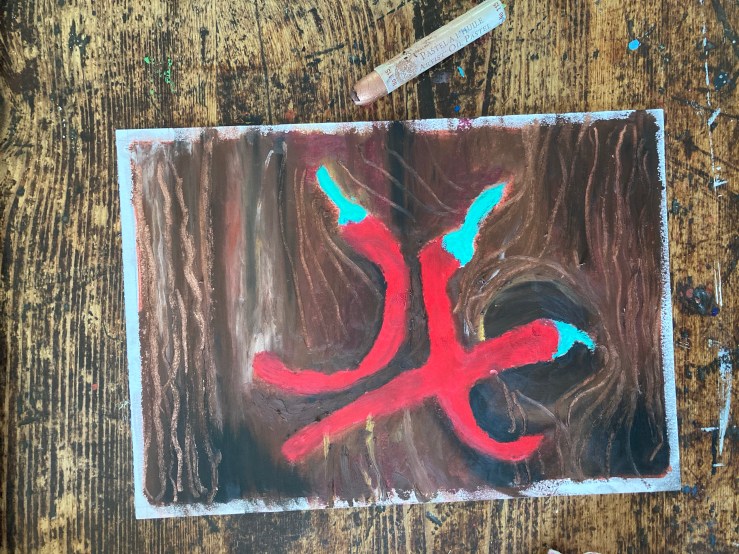
A Collaboration

“I like the way we make our dreams happen.” Lori Richards

I’m delighting in the astonishing culmination of a collaborative art venture with my friend, artist, Lori Richards. Our creative works—Lori’s paintings  and my writing—are exhibiting together for a short time at Wall Space Gallery in Ottawa. She generously invited me to write prose poem (like) pieces towards her paintings and I leapt at the opportunity[1].

The vernissage (new word for me, it means a preview of an art exhibition) was last weekend but we dreamed the idea—a wish—to combine and show our art works many many years ago. The exhibit is called Seedbed.

Lori and I walk together almost every week.  As our feet pound the leaf and petalled paths, the sidewalks, the pavement or the snow, we recount, gesturing to the winds, drawing models in the air with our fingers, the celebrations, the frustrations, the lamentations and the longings of creative process. Despite working in different mediums, our practices are very much aligned. Lori is a professional artist. She has been, and continues to be, a steady champion of my creative writing as I squeeze it in as best I can round my day job[2].

Leaping is the right description for the approach I used for Seedbed. I’ve written ad nauseum (emphasis on nausea) about how crippled I am when it comes to pushing my creative writing out into the world (submitting for publication). I didn’t have this issue in the past…it developed over the last few years …I don’t really know what it’s about, but I feel like I’m about to break through my own barriers[3]. I think I’ve been saying that for a year or so. Sigh.

For this project, writing prose poem-ish pieces for each of Lori’s seventeen different paintings, I wanted to practice less preciousness with my writing. And I wanted to experience (force myself) to let go of them as is. I created a few rules for myself to keep the creativity light and fun:

  • Gaze at the painting, but only for a short time
  • Use stream of consciousness writing (I wrote freehand for most of these in my notebook, and the pieces, as they were being written, often included arrows and connecting lines)
  • Adhere to first instincts (as in, whatever words or images pop up, write them down and don’t tinker very much or at all)
  • As soon as a piece feels finished, send it to Lori as “done”

This phase of development and creation worked relatively well, though I was surprised by the writing emerging. The pieces are whimsical and, in several cases, nonsensical. But, adhering to my own rules, I let them be.
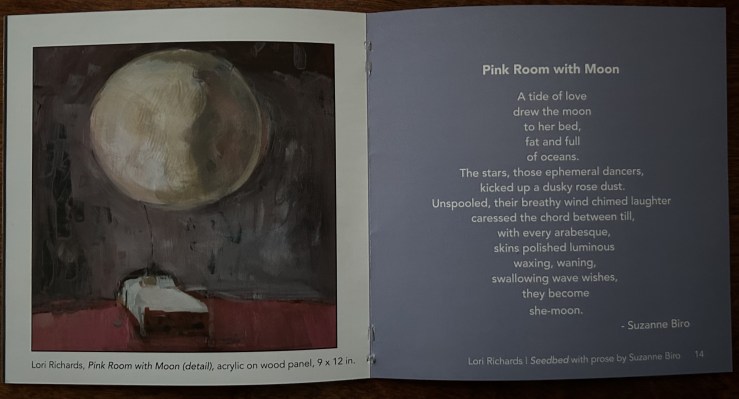
Do look at the paintings at the gallery website – my reproduction here fails (dreadfully) to capture the vibrancy of colours.

There was only one pairing of works where the process was reversed, where my writing inspired Lori’s painting. Interestingly, (or maybe the better word is fortuitously), this became the title pairing in the exhibition: Lori’s seedbed painting and a breathy paragraph of my own that floated to me the week I made the decision to leave my marriage. Though Lori thinks of the Seedbed series as beginning January 2024, I feel it began closer to the creation of that garden focused paragraph in the fall of 2023. It was then Lori created her first “bed painting” (several paintings in Seedbed include an image of a bed). This first painting felt (feels) emblematic for me, for what I was/am moving through. That painting now hangs in my bedroom.

It has been wonderful experiencing the generative iterations of the series since. There have been additional bed paintings created beyond the exhibition submissions…they continue.  I feel magically connected—in a way I can’t articulate—with each painting as they appear. The closest I can come to explaining my feelings is with the word blossoming.
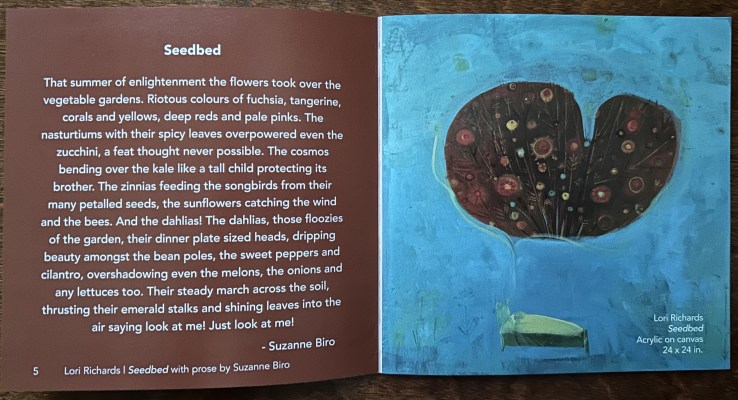
And I wasn’t nervous in the days or hours leading up to the vernissage. The gallery’s curator displayed the works beautifully. She and the staff also produced a lovely brochure of a selection of paintings with their ekphrastic accompaniments. Both Lori and I were expected to speak briefly about our process and collaboration, and I planned to read two very short pieces[4]. But when I arrived at the gallery a cold panic sloshed in my stomach[5]. The gallery space filled quickly, bodies tumbling inside from the frozen February afternoon. I’m told there were 80 people but they all sort of blurred together blobbing round while I smiled and nodded and prayed the wine I was drinking would kick in. It didn’t.

When it was my turn to speak, I accepted the microphone with grace. I stumbled on the word ekphrastic (it is very hard to say)….garbled gravel in my mouth…my heart thrashed against my rib cage and leapt the base of my throat, but then, deep breath, pause. Reading my own words, my body calmed and settled from the very first sentence. My voice steadied and held. I’m told I was poised. I wish I could say I recovered soon after the short performance, but I felt rather sick with the adrenalin hangover for the remainder of the day and into the evening.

Still, it has been an accomplishment. And a progression. In the days since, I’ve felt delighted with the experience. And (perhaps?) even a little awe for the courage it took to leap.  


[1] Ekphrasis is a written description, real or imagined, of a work of art. Another dear friend, Barbara Ponomareff, who I met years ago when I offered to carpool us to a wonderful (and remote) writer’s retreat, has published several exquisite ekphrastic works in The Ekphrastic Review.

[2] I’m blessed with continuing encouragement from so many people; you know who you are, I sing your adorations for sticking around, thank you.

[3] Intend to write about “next level writing” in the March blog post, so, stay tuned. Also, I promise to curtail the whining and actually get some pieces submitted.

[4] Another dear friend, also a weekly creative-conversation-while-walking companion, Carolyn Smart, very kindly suggested which work to read. And I’m tickled to learn that painting, Pink Room with Moon, sold to another Canadian poet on the strength of an Instagram promotional post even before the show was launched. So many collaborators throughout the whole process… why do we ever believe we work in isolation?

[5] Threatened a colonic…wholly inelegant I know. Vomiting might have  been preferable. But the body chooses its own exit strategies. I managed to keep uh everything intact (emphasis on in).

Seedbed introduction (Lori in the background and Tiffany, gallery curator, to the let).
Seedbed reading
Pink Room with Moon reading

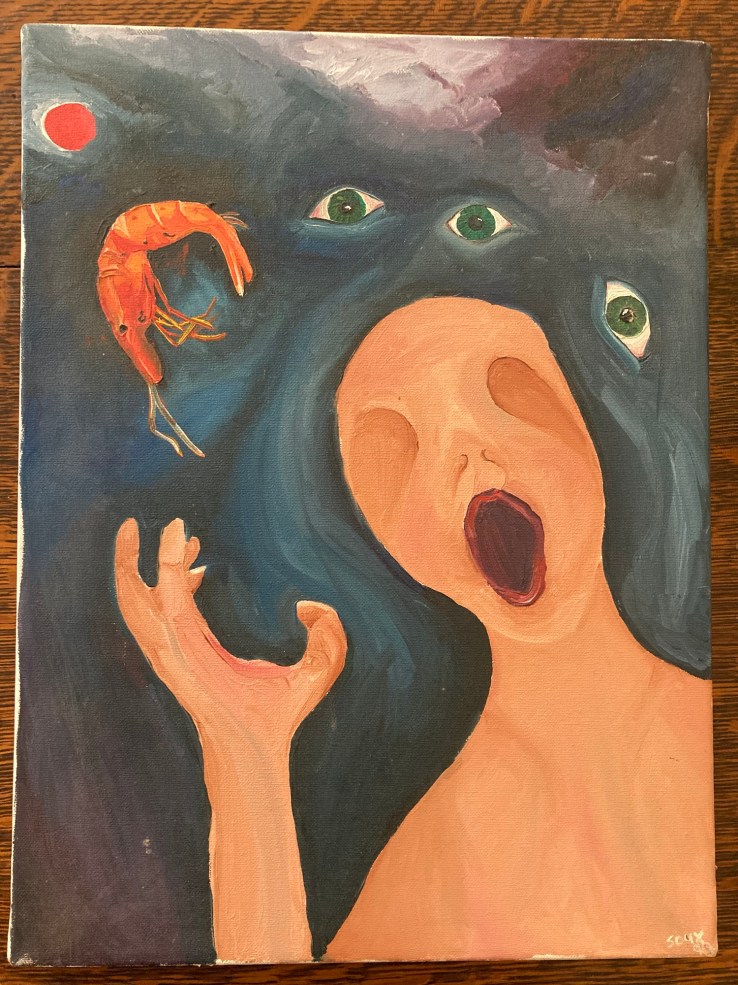
Seeing as a Way of Knowing

Oil painting ~ 1994?

Sometimes I must be dropped in the Marshall Islands to realise I’m in the middle of the Pacific Ocean. It often takes me a long time to see things.

Pencil ~ 1992

I went through a phase in my late teens and early twenties painting figures with no eyes – the two pieces here date from that era. Most of the artworks I produce are given away as gifts[1]. I can’t imagine many recipients of these screaming figures with their eyeballs floating in space might still grace their walls with my works. These two pieces might be the only ones left. They hang on the walls beside my writing desk.

I know they look scary. They aren’t meant to be. My high school art teacher disliked them. At the time of their creation, they didn’t reflect a mood I was in (I was quite happy and content, not dark or brooding). At the time of creation, I simply followed where my paintbrush or my pencils took me, delighting in the creaminess of oil paints, their tree-sap scent, and the ease with which pencil marks shadow contrasts between light and dark. Perhaps it was a way to work through an earlier terror, I don’t know. I never had an explanation for why I painted these subjects, I just did.

Decades later, hanging on new walls in a new space, staring at these works above my desk, they spark curiosity. And reflection. Looking back upon the intervening years of marriage and raising[2] a family, I can’t help but interpret their imagery as an almost wilful blindness. A warning for what it would take for me to manage my life choices diverting my path from art.

More context. I was flattened after completing my undergrad. In those days, the degree required a written thesis, complete with ethics review submission, primary data (raw) collection, analysis, interpretation and synthesis. Mine explored how child development influences a child’s ability to draw emotions. I went into three different schools and multiple classrooms of kindergarten to grade three students and collected their drawings of “a person who is ‘sad’, ‘angry’ and ‘happy’”. My supervisor, a new to the department prof, studied the tools with which child welfare court cases might be helping or hindering child testimonies. I won’t get into the Pandora’s Box of issues this research illuminates with our justice system and the rights of children. My thesis work was a departure from the neurophysiology and neurochemistry I’d focused on through the science degree, deliberately engaging with a creative and developmental approach I was craving. Conducting the thesis work on top of finishing all the other fourth year courses and working part time as a waitress was punishing[3]. I resolved never to do research again[4].

I adored those child drawings, their stick figured innocence, their genius beauty. After graduating, I pivoted my sights to art school and began to piece together a portfolio for submission. Waitressing, I couldn’t afford to apply to more than one school[5]. I chose Emily Carr. There, portfolio submissions required works using three different mediums exploring an artist chosen theme AND encased within a container constructed by the artist that expanded, or at least aligned, on that theme. Shipment costs, of course, were the responsibility of the artist.  Why am I recalling these stories?  Hindsight explorations. For the constructed container, the most challenging aspect of the portfolio package, I chose to create…wait for it…a liquor store box-sized ceramic eyeball.

At the time I was working with a friend’s mum in her pottery studio, and I explained my approach and plan for the eyeball—it would be two separate ovals (bowls), constructed using clay slabs with holes on the sides near the lip where I would attach metal hinges and a latch after the two halves were fired. This seemed simple to me, but L. refused, explaining it just wouldn’t work, it couldn’t be done. Looking back, I realise my mistake was using the word ‘eyeball’ – I should have simplified the concept to “two bowls that hinge together” or even, “two oval slab bowls, a top and a bottom”.   Full stop on the construction of a container for my portfolio submission. No eyeballs in her kiln. I spent that summer trying to puzzle other ways to make a large eyeball that would hold multiple pieces of art. I couldn’t figure it out. And the portfolio gathered dust. I laugh now, wondering why I didn’t consider a different object, a different container (even the liquor store box would have done the trick!). But I (eye) didn’t.  And that same summer I met the man who would become my husband and I shelved the idea (eye-dea) of art school[6].  

Its’s twenty-eight years later and it’s only now I’m learning to really see. And I recognise a wilful blindness with my writing too. I’ve returned to working on what I call my “long form project”[7]. I have years of writing around the same themes, writing that I have refused to re-read or explore for fear of what I will discover there, what I didn’t want to see. To raise the girls the way I wanted them to experience “family” I kept myself blind[8].

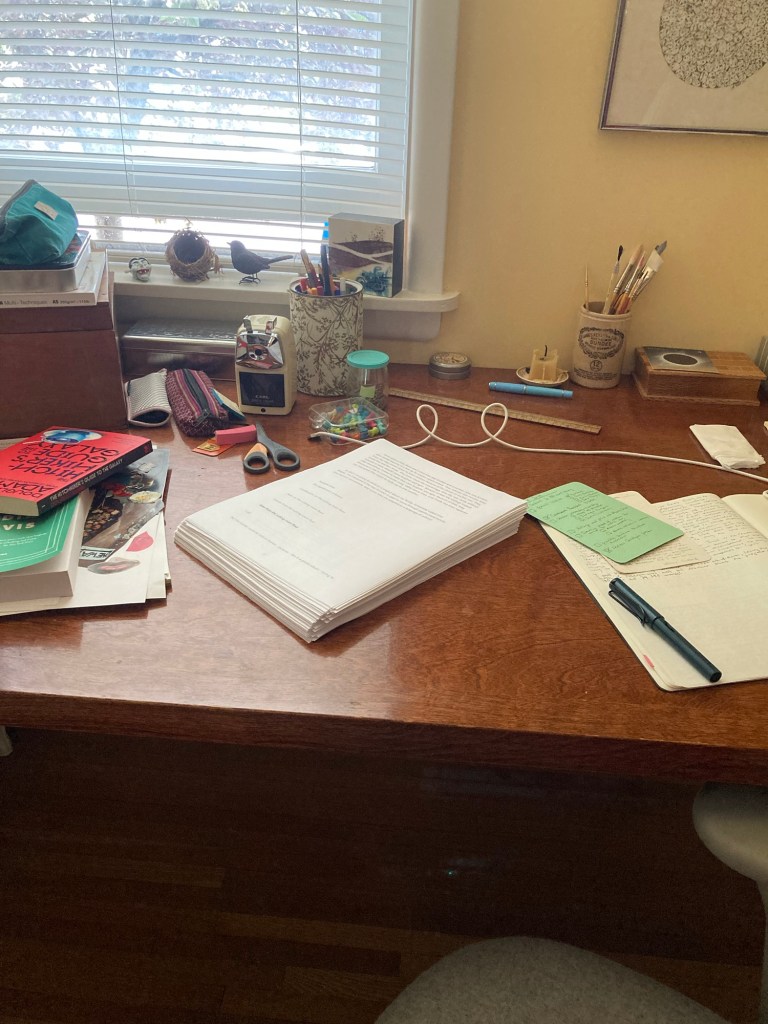
This post is too long. This month has been wretched[9]. I decided to print out the pieces I’ve written as part of the long form project, “to see” the extent of material I have. I was stunned to discover it’s 208 pages, 74, 385 words long. This doesn’t include more recent writings towards this project, nor does it include parts written into ten plus years of notebook writing. Initially, I felt proudly amazed I have so much material to work with…then I spiralled …I can’t see where it’s going, how to piece it together…I am floating blind again. Still.

But …I will read what I have written, use my hindsight and my insight, my nascent ability to see the layers and sift the meanings from my own words. I know I have returned to a path of art, following a decades long detour. I wish it was not so painful.


[1] Blue Salamander, a symbol of moving between worlds, transitions and an ability to regenerate, went to the incredibly generous couple who gifted me their riverside house for the winter after I left my marriage. A friend coined it The Glass Chalet. The couple joke, calling their place a home for wayward women. I am not their first.  

[2] Razing? This is exactly what I have done by choosing a life of independence…what I have committed through decommitment.

[3] Because my prof was new to the department, he pushed the project to a level worthy of publication, research far beyond the expectations for an undergrad. I fought with the departmental panel, assuring them I could complete the work. The panel pushed back, insisting it was PhD level, too much even for a Masters student. I ended up presenting eleven iterations of my research proposal to the departmental panel before getting the go ahead for ethics submission and beginning the project.  

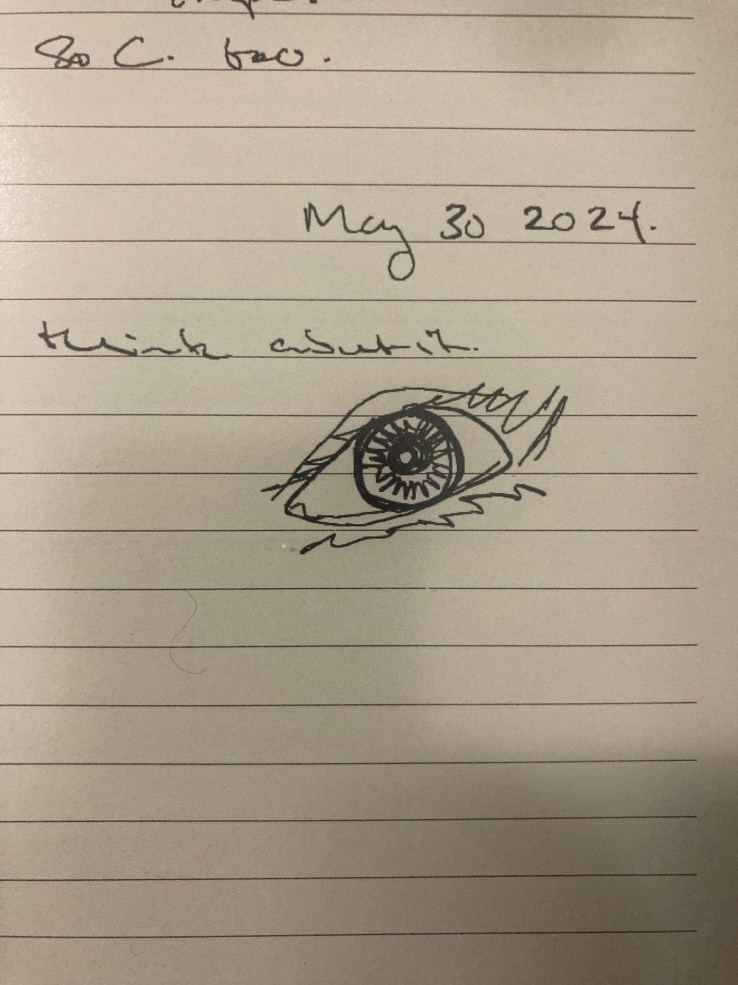
[4] Ha ha …the universe has a sense of humour doesn’t it? Research features heavy in much of my professional career. Interestingly, when I doodle in my work notes during meetings, I have always drawn…eyeballs.

[5] I made $4.25 an hour.

[6] Later that summer, L. rushed into the lobby of the restaurant during one of my shifts, her hair a zany mess and her arms waving the air with her eureka moment. She shouted at me over the din of the restaurant in full summer swing: “I know how you can do it!  It will work!!!”. I’ll never forget her despondency when I explained I’d met a man, that I wouldn’t be going to art school. I was 23, the same age my eldest daughter is now.  This horrifies me. Maybe it shouldn’t. But it does.

[7] When I referred to a “long form project” during a recent online writing session, one woman pressed me to define my project more specifically. Was it a memoir?  It must be a memoir. No, I explained, it’s creative non-fiction, collage work, a series of vignettes, but along various narrative throughlines (four), and the vignettes are kind of veering into fiction. It’s a memoir she repeated, then went on to explain she’d just finished her PhD in literary criticism. Well, that explains it, I thought, but didn’t say anything more.  Days later, when I was doing the dishes, I came up with the right category for my work: it’s a memoir with wings. Stick that up your store bookshelf.

[8] This is incredibly hard to write here, to admit. I suspect my self-suppression, the shame in that, is what my long form project explores…I don’t know. I feel lost. Untethered.

[9] My mum suffered two falls, one where I needed to take her shockingly bruised body to the hospital for a wrist x-ray (not broken); my ex-husband (first time calling him this) is dating …I am told about the women through our children, pasting an expression of impassiveness to my face to offer the support they need to process this news  (I make myself beige); I’m fielding daily tear-filled calls from my eldest daughter who broke off with her partner of three years…both of us cry on the phone…I try to be the strong and supportive mum I need to be…I fail; I visit my father in his subsidized housing apartment, taking any leftover protein from my own meals  because I know he sustains himself on honeynut cheerios; his interest in the world is fast dissolving, his memory, like my mother’s, with it; I long for the sounds of spring peepers, chorus frogs and wood frogs I no longer hear living in the city, and I weep about the loss of the garden; I refuse to attend to world news because I know it will break me; I float through my workdays, convincing my colleagues I am indeed a senior policy advisor, I’m amazed by my own performance; I have separated the muse from the man, the divine from the human, a painful yet necessary separation, for how else to cultivate different ways of knowing, practice other ways of seeing?

An Invitation

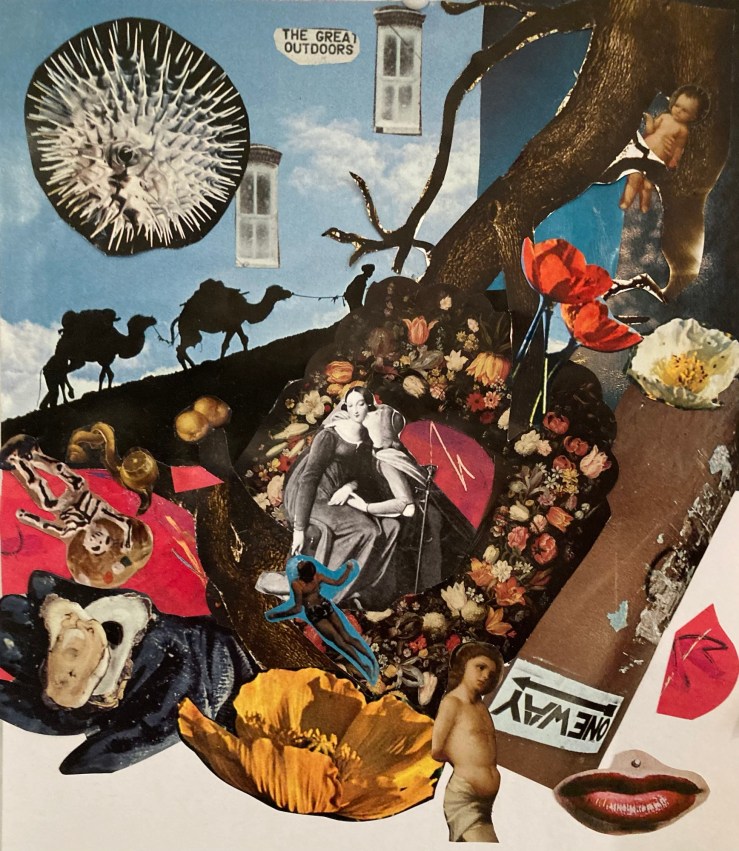
Collage I created March 16, 2024 in an art workshop facilitated by hiba ali at the Agnes Etherington Art Centre.

My favourite professor in undergrad taught neurophysiology, biological psychology and behavioural neuroscience of motivation. I have a distinct memory of his explaining how the size of the human brain is governed by the restricted size of the birth canal (technically, it’s referred to as the obstetrical dilemma) . Surprise, turns out it’s a little more complicated than that. Much neurodevelopment continues during the postnatal period and neuroplasticity is lifelong. But beyond this, our brains sufficiently evolved to invent machines with super-fast processing speeds and computational abilities. At this point, most of us have adopted palm-sized prosthetic brains in the form of cell phones, and with them, we have access to more information we could filter, sort or ever hope to synthesize, especially across diverse subjects.

This is what I was thinking about last week when I attended a webinar providing an overview of Google’s Notebook LM,  a new AI application launched in December 2023, that basically functions as a virtual research assistant. Let’s call it an(other) extra brain [1].

Yes, I’ll be one of the early adopters, especially for my day job.  But I’m also interested in how the technology could become a tool to support creative process. Though, to be sure, a tool used with caution.   

A swift summary: LM stands for language model and the application uses the conversational question functionalities of ChatGPT, BUT allows you to curate a discrete library of your own source documents for the AI to search through. So, any question you ask will draw an answer from ONLY the documents you have provided, personalizing sources to a particular project, erecting a knowledge barrier you can control and thus greatly reducing inaccuracies and hallucinations [2].

The application currently integrates Docs, PDFs, txt, and pasted text using the cut and paste function. There’s promise websites will be able to be imported soon. Likely, the import of images, PowerPoint and even Excel sheets will be functional in the not-so-distant future.

An older collage I created December 2022.

I often use the search and find function in documents to locate phrases and key words. This is especially important when reviewing legislation and evidence reports under tight timelines, but I also use the function in creative writing to locate word repetitions, check misplaced homonyms, homophones, homographs, get rid of weasel words [3] etc.  But this function has only been possible in one document at a time. I’ve used qualitative analysis software to support analyses and syntheses across interview and focus group transcripts, as well as multiple word documents.  Using qualitative software, a considerable amount of time (time in which your brain actually feels like it’s turning to mush) is used to manually “tag” words and phrases in every source transcript or document to a category in order to code the text data. This can take weeks or even months, depending on how much text makes up the project and the theoretical approach you have chosen to apply. Once all of the text data is coded, THEN you can go in and query the dataset for analysis using your coding structure. The capabilities promised by Notebook LM will (almost) eliminate the coding step, allowing a researcher to jump right into querying the data for patterns and moving forward from a super advanced starting line.

Imagine this application for:

  • summarizing systematic research reviews (practically this is very similar to conducting qualitative analysis)
  • understanding legislation changes over time or creating a bylaws database that could be posted to municipal websites to support citizen Q & A
  • referencing medical symptoms and best practice guidelines – could this replace a visit to a family physician, linking a person directly to a pharmacist or triaging a health issue to an allied health care worker for virtual assessment and confirmation, at least for common non-emergency ailments?
  • Discovering patterns across historical documents or novels or essays or groups of poems or across all these different types of documents
  • Bringing disparate subjects together to spark different ideas, say climate resilience strategies, poetry, child development, hip hop song lyrics and how long to cook an egg [4].
My daughter Willa made this collage last week procrastinating school assignments. She is much better at collage than I am and has created some truly stunning combination of images. I love the mum and child flower heads in this one. This collage inspired me to sign up for the workshop, a welcome oasis of calm following the move into my new (to me) physical space. Another one of Willa’s at the end of this post. Thanks Willa!

The collage at the top of this post is a good analogy for the possible repercussions Notebook LM threatens related to creative licensing and copyright. I pasted the collage together from bits of cut out magazines and art books as part of a fantastic afternoon workshop facilitated by hiba ali, The Studio x Open Secret: Activating Dreamscapes. The images I used came from artists’ works and photographs from books and National Geographic magazines and I’ve cut and reassembled them without any credit to create my own artwork. Where should the line of creative appropriation, cultural appropriation, or plagiarism be drawn in these new digital spaces and the “new” creative works produced using these tools? [5]

Attending this collage workshop in the same week as the webinar kind of blew my mind – an ocean of virtual playgrounds to swim in. It’s also a little frightening, the control to create frames of knowledge that might hold sway an illusion of authority for many. I’m (somewhat) comforted to learn (also this week! my goodness) the word set boasts a Guinness World Record with the most senses of meaning (430!) of any other word. Other sources award this honour to run with more than 600 senses. Perhaps the english language will retain sufficient nuance an AI might never master (wishful thinking). BUT, language combined with gesture, intonation, facial expression, raw instinct etc. may give AI a run for its money (I hope).

Once we created our collages in the art workshop, we uploaded them to a digital art exhibition “world” space where we co-created together and were able to manipulate the images, integrate a variety of additional media (sound, text, links, gifs etc.). This application is New Art City. It reminds me of the game Minecraft my kids used to play when they were younger. Here’s a link to what I created playing [6] in the New Art City application with my own collage and the virtual gallery space: https://newart.city/show/souxs-virtual-creative-space-space-1.

All this virtual creativity at your fingertips for a song. To be sure, what we create as our real world is built from layers of many worlds—perceptual, spiritual, cultural, relational, linguistic, so many others—and, of course, virtual [7]. Jouer le jeu as they say in French, play the game. But the digital space is really an out of body experience; sometimes we might just have to communicate the old-fashioned way, you know, via email or phone or (gasp!) face to face. Especially when virtual platforms are an invitation to experiment interacting multidimensionally. Like I said, you’re welcome. 


[1] Sorry Canadian peeps, the experimental version is only available to those living in the US. Canucks are still waiting to test drive the application.

[2] The information returned is less likely to be made up by the machine… hallucinations are complicated, I’m not going to try to explain them.

[3] From Matt Bell’s Substack, No failure, Only Practice, Exercise #14: Hunting Weasel Words.

[4] I know, weird, but you get what I’m suggesting.

[5] I don’t know the answer to this at all but it’s an interesting question and I would value a discussion.

[6] Other applications that I didn’t use but leave here as reference: Photopea, a free online photo editor; Free3D, free three dimensional models; Creative Commons, “an international nonprofit organization dedicated to helping build and sustain a thriving commons of shared knowledge and culture. Together with an extensive member network and multiple partners, we build capacity, we develop practical solutions, and we advocate for better open sharing of knowledge and culture that serves the public interest.” 

[7] As long as the power stays on.

Serendipitously, when I texted Willa to get her permission to insert her flower head collage in this post, she was working on this larger collage as part of a school assignment (not procrastinating this time ha ha, it’s for a final project about the mutual oppression of women and nature, although she had intended a textile applique but ran out of time). The photos in this work are from a woman’s beauty guide book from the 1980s, The Complete Beauty Book, an interesting, admittedly sexy visual commentary to be sure.

Puzzle Patience

There is a painting in the office where I work that I have walked by countless times.  It’s pleasant enough, a picture of a water-filled ditch beside a farmer’s field.  Ditch isn’t a romantic word. I suppose it could be a dyke or a channel, but it isn’t.  It’s a ditch. The farmer’s house and barn are painted small, in the upper left-hand corner, to be far away within the painting’s horizon.  Trees with full leafed boughs hang over the brown water in the ditch.  The water and the leaves and the fields of grass are painted to suggest the winking bright light, a pleasing interplay of greens and yellows layered over darker browns.  The brushstrokes are only visible in the width of the lines depicting the grass.  This is not a painterly painting, but a realistic depiction.  I stopped to have a closer look, to decide whether it is one of those paintings that’s actually a photograph printed on a canvas and stretched on a frame.  A discovery that is both disappointing and smugly satisfying when it happens. But this painting isn’t a photograph; it’s a real painting. 

Standing there, scrutinizing the detail…the layering of colour to create the interplays of shadow and light, the hundreds of tiny lines that show the movement of the wind, a thought leapt to my mind: this is why I did not become an artist.  I don’t have the patience to paint those lines, to fill a canvas with so much colour variation and the details in sufficient proportion to convey to a viewer a wide field of grasses, a moving stream, tree branches swaying.  

When I paint, or draw, I work small, in a white space I can manage.  And, I confess, when I start, I’m impatient to be done.  My favourite part of painting is finishing. I feel a keen frustration blocking in colours, I become exasperated by the restricted palette in my box of pastels.  The shade I want is always elusive. The whole of the exercise is moving towards a climax I feel I can’t get to fast enough: adding those last flecks of white to the objects depicted, the highlight that makes the subject come alive.

I don’t have the same impatience with writing. But no, this isn’t true, I lie.  I write with a longing to complete a piece (or pieces).  This must be the subtext readers of this blog intuit when they suggest I’m too hard on myself.   If I’m honest, I write with (through?) continual disappointment that I’m not there yet.  

I agree, not a good place to be working from.  I’m trying to be more open in my daily writings…to let the interplay of thoughts and ideas and exercises run wild on the page.  To let the writing be “organic” …whatever that means.  I guess it means to relinquish control. I’m not good at this either.  

When asked by a writer friend the other day how my writing is going, I gestured with both hands, conducting the air between us, to emphasize that yes, I’m writing every day, “creating content” I said.  I admitted I had no idea how it might all come together.   And silently I worried whether it ever will.  

I also wondered whether the final white glint of light, that flourish of white paint that is so satisfying to lay on the canvas—the painted finish I crave—has a writing equivalent. 

It does. It’s the thousands of choices a writer makes before a story or an essay or a poem “is done”. It is the point at which all those choices – the movement of words in sentences, phrases and paragraphs, descriptions, dialogue, narrative arc, literary devices—fit together like a completed puzzle.   

At the moment, I think I’m working with three or four different puzzles all jumbled together with a few corner pieces laid down but floating.  I suppose the frustration is justified.  But also, it makes me realise there’s only one way through, to work on each unique puzzle piece—like each blade of painted grass in the painting at my office—and find the best place for it.  Also, settle in. Put frustration aside. Instead, think of longing as commitment, dedication, discovery. This could take a while.