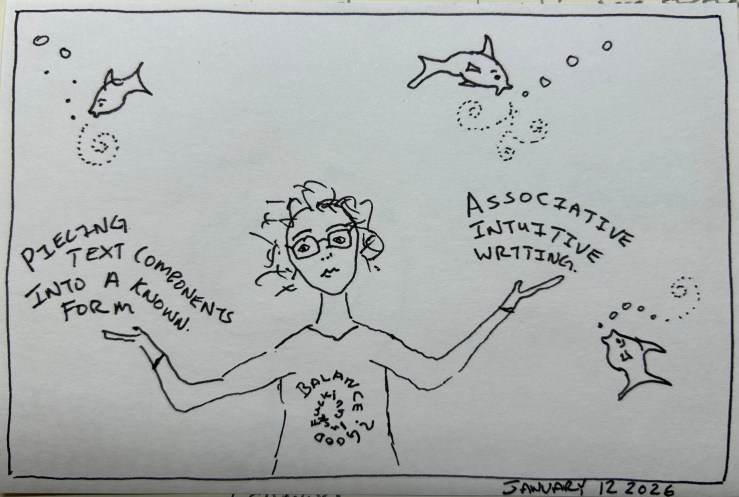
I’ve written (insufferably?) about how hard it is to wrestle my “thinking” brain into submission. Slowly, slowly I’m learning to distinguish between what it feels like when I write from an “idea” and what it feels like when I write from a deeper sense of intuition. It’s a way of knowing. It feels texturally different. Like the way it feels waking in the night to grope past familiar furnishings and doorways, skimming walls with fingertips on the way to the bathroom, eyelids heavy and sealed with sleep. It’s trusting you know what’s waiting in the dark. That when you reach out, a connection is felt. Not so much a spark as a glow. It’s a comforting heat in my gut.
And so it goes with the writing of the long project. I write—today at least—with a degree of euphoria because it progresses—it glows—forward. Unfolding tentatively. Gently. When the next section announces itself, it’s imagistic as opposed to conceptual. A few times, literally: the images are actual photographs calling…no, that’s not quite right, pulling my attention toward them for consideration, reflection, elaboration. Other times it has been a particular memory lifting itself from the body into the mind’s eye, a still, a snapshot of dream, a surprising association that feels like a…knowing. It’s the right “fit”. It’s the breezy riffle shuffle of a deck of cards settling into place.
At each of these inflection points in the writing—perhaps “at a bend” is a better description, I mean the point at which I’ve completed one section of associative writings and I’m not sure where it’s moving to next—I hear my inner voice resisting: no, don’t write about that! A few times I find myself obeying the inner voice and quickly fire off a list of scenes orbiting round an idea, a concept such as “secrets’ for example. But even as I do this, there’s a sudden tension in the body…a slight rubber band tautness in my spine. I’m learning to stop at this point and step away from the writing. Usually, it’s when I’m supposed to get going to work anyway, so the day’s relentless schedule intrudes to healthy effect at this point. At this point it’s important not to let doubt creep in. This makes me think of our culture’s perpetuation of a scarcity mindset instead of trusting the world’s relational abundance, but I digress. What I’m trying to explain is that it’s necessary for me to actively fight my fear my creativity will stop flowing. Instead, I’m nurturing a belief an ember continues to burn and will flame illumination in its own time. Believing is easier than exercising patience. I’m practicing both.
A fantastic discovery: unspooling the writings this way, deep subconscious workings reveal themselves…I suddenly see connections, surfaced through writing, between and across associations. Discovering them is a delight. It feels like there are multiple pathways and in their own way, any of them are right. And I’m keeping it light. Instead of going back and reworking those pages, I continue writing forward…practicing belief, practicing patience, practicing acknowledging and dancing past my inner voice, practicing how to recognise this knowing, this intuition. Feeling my way forward in the dark.
I wish I could share these writings with you here, but they’re nascent and…in progress…they move.
Another advancement: though much of the long project includes childhood stories, marriage, raising kids, etc., I have started to refer to the people from my life as “characters”. From the real world, through curation and composition, they’ve moved into the world of imagination and creation. They are transformed …malleable clay bits I mould and shape. It affords me a necessary distance to cultivate connection, joy (and sorrow), and entertainment for a reader. This is the first time for me this has happened. It’s a huge relief somehow.
I’ll end, for now, with a 2-minute recording of a poem in progress, Open-Air Mercado Piña Coladas. I’ve offered this poem for publication, but I recognise it continues to dwell in the thinking realm and I’m pretty sure it will boomerang back my way with rejection for that reason. Ah well. When I recorded myself reading it, I restricted myself to a single take…refusing to allow my vanity to prevail. It sounds overly performative to me…blargh…and I stumble on one of the lines, a sure sign that line needs tweaking. Ah well. Again. Fuck. One day my poems will sing. Here it is.
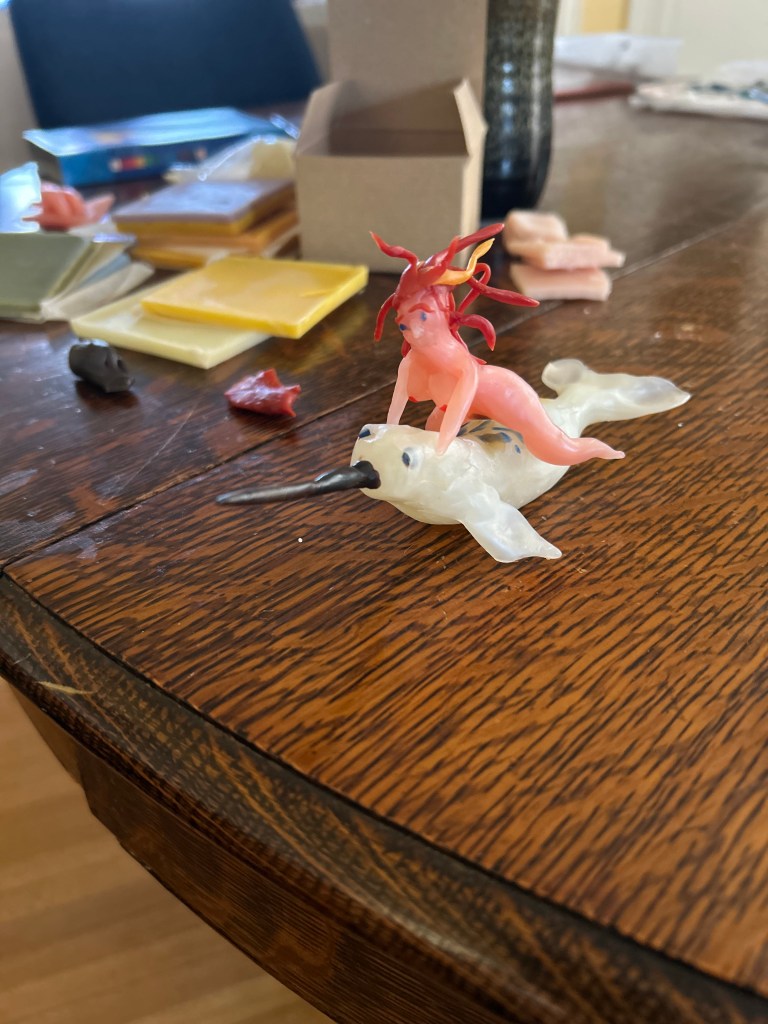
Woman riding a Narwhal. She arrived in my mind seven years ago through the invitational creative exercise of active imagination1. Swimming and flipping and delighting in a dark indigo sea dotted with chunks of luminous ice, while the “I” of me observed, the narwhal appeared. In my dreamy inner-mind dialogue with the image, the narwhal chided me (yes, less criticism, it was delivered more softly, with humour) for how I’ve forgotten how to swim and encouraged me to explore the depths. Then, some truly frightening images floated from the ink-blue dark, half rotted faces of people I love and other shadows swirled, threatening to reveal themselves. I was instantly frightened. Then, up popped the narwhal, splashing through the shadows to explain I needn’t be afraid, the water will catch me, they (?) will not let me fall2. I started to cry. Not pretendingly. In reality. Tears rolled my cheeks but I remained suspended in active imagination so I asked, can I learn to swim again? The narwhal laughed, and said, of course! The water is in you always! The water is in you! Yes, the narwal was emphatic. How? How do I learn? The narwhal flipped and turned amidst the sea ice, one coordinated muscle arcing. It’s words echoed over and over as I surfaced from dream to consciousness: Let go! Let go! It’s fun to let go!
A few days later3, the narwhal appeared again and I asked the image why it had come. It answered: To navigate the depths, to help me go deeper. The narwhal dove fast then, it’s dapple grey skin deepening to a green glowy sheen. The image shifted to show a girl riding the narwhal, holding tight as it dragged her fast and swift beneath the surface. The narwhal’s horn pierced the depths effortlessly. What else do you have to tell me? The narwhal replied, It’s fun, it’s fun to pierce the depths, don’t be afraid! I wondered if I’d be able to breathe and the narwhal actually laughed, almost scoffed and, voice deadpan, Of course you’ll be able to breathe.
I wanted to capture the image, but I didn’t feel I’d be able to render it well enough drawing or painting. Instead, I opted to model it using beeswax, investing a tiny fortune in different colours4. And when the beeswax arrived, I stuck the little packets in a box with a bunch of other art supplies where they waited, patiently, for my creative hands. Turns out, the time for that was last month, seven years (!) after the narwhal and the rider arrived in my mind’s eye. In Jung’s approach, creating a tangible representation of image–out of the subconscious dream world and into this one–is an essential part of the process5. Reflecting on the little model I created, (a little more cartoony than I’d like, also, in the original image, the rider was a young girl in a red dress, in the hand modelling she became a woman nude), it kinda aligns with last month’s post about fishing the subconscious for emotion and feelings…I think, no, I feel (that’s better), I’m finally ready to explore those depths with the curiosity and joy and play required for the task6.
Another creative practice serendipity: a friend from bookclub asked me to guest instruct her grade twelve creative writing class. She explained they were covering a unit about creating characters. She warned they were a quiet and shy bunch, a cohort having suffered crucial social development years in pandemic isolation. My goal was to get the students reading their own writing aloud–even it it was just a favourite word–by the end of the class. And to have fun.
And it was fun! We co-created characters, listing various gestures and personality quirks, super powers and pet peeves, desires and obsessions as they were called out. We wrote the list on blank sheets of paper, passing the papers round the classroom after each prompt so that no character “belonged” to any one writer. Instead, iterative dimensions of character layered upon what had been written on each paper offered to hand. We shared some of the character creations aloud. Then, lists of descriptions completed, we crumpled the papers into balls and threw them round the room, followed by a mad dash to pick one up as “an assigned character” to write about. The final writing prompt was: what does this character’s best (or) worst day look like? (Or, if a writer felt inspired to write something else, that was encouraged too.) We wrote together for ten minutes while instrumental music played7. Afterwards, we went round the room and everyone shared their favourite line they wrote, then, several students volunteered to read their drafts entire. The pieces were lovely…full of energy and humour and sensory details. We laughed a lot.
Last month I wrote a poem about being a Canadian tourist in Mexico. I visited Mexico two years ago. That poem’s been cooking since then. I’ve tucked it aside for now, to let it breathe on its own for a bit before I go back and fiddle with it. I read it to a friend who said, Just. Don’t touch it!
Turning again towards long project writing I realized I’ve spent time practicing at the sentence level with shorter pieces … and I have no idea where to begin at the story level for a longer work. I was reminded of Nina Schuyler‘s descriptive analogy of writing process. How, at the sentence level, you’re working at ground level, but then you have to climb a mountain to get a better bird’s eye view of the paragraph level, then the chapter level, then the whole story level. And in writing any creative work, you run up and down that mountain, tweaking and refining over and over and over again, until there is a synergy of sounds and symbols and patterns energizing a wholistic work of art. I feel like I just laced up a stiff new pair of hiking boots on badly blistered heels in the base camp parking lot.
Last month I received three rejections from literary magazines. Two for a short creative nonfiction piece and one for the introductory chapter/essay to the long form project. I know I’m not supposed to say so–that it’s all a part of writing practice, that I “need a thicker shell”–but the rejection breaks my heart8.
When I’m sad I always turn to reading. Pat Schneider’s Writing Alone and With Others, as well as any essay written by Ursula K. Le Guin, always offer a grounding, resetting perspective about what really matters: love of creative work. The process. Running up and down the mountain. For fun. By way of Pat Schneider, I’m introduced to this wisdom, a consolation, about submitting creative writing for publication from Marge Piercy, “Never say ‘submit’! Say offer.” Yes, absolutely right. So, let’s end here with one of her poems:
Talent is what they say you have after the novel is published and favorably reviewed. Beforehand what you have is a tedious delusion, a hobby like knitting.
Work is what you have done after the play is produced and the audience claps. Before that friends keep asking when you are planning to go out and get a job.
Genius is what they know you had after the third volume of remarkable poems. Earlier they accuse you of withdrawing, ask why you don’t have a baby, call you a bum.
The reason people want M.F.A.’s, take workshops with fancy names when all you can really learn is a few techniques, typing instructions and some- body else’s mannerisms
is that every artist lacks a license to hang on the wall like your optician, your vet proving you may be a clumsy sadist whose fillings fall into the stew but you’re certified a dentist.
The real writer is one who really writes. Talent is an invention like phlogiston after the fact of fire. Work is its own cure. You have to like it better than being loved.
That line about a tedious delusion, a hobby like knitting, makes me laugh. And though I agree with the final line, I feel you have to love the work AND you have to infuse the work with your love. This is the way love swims the Möbius loop to pierce the heart of a reader.
I try to practice active imagination semi-regularly. Here’s a quick guide to explain the Jungian technique for fishing the subconscious. A few years ago, exercising my mind this way, I found it relatively easy to descend into a floaty state, meditating somewhere between dream and wakefulness. The images, most often animals (a bluebird, a spider, like Charlotte in E. B. White’s classic, a bee, a butterfly, a tortoise, the narwhal, etc.) surfaced and I was able to dialogue with them. It has been more challenging to succeed with the exercise lately (the last year or two?). Often I fall asleep. A sure sign rest is needed. More worrying is that I can’t get past the chatter brain of thoughts being expressed in words…I can’t seem to summon the images as easily. ↩︎
I know it seems like I’ve rather lost my mind, conversing with the images therein…but, ha ha, isn’t that kind of the point? My own mind, carved and chiseled by culture, by categorization in language form, so easily manipulates, obfuscates …these exercises are meant to transcend those boundaries and restrictions as a gateway to creativity. Besides, it’s kinda fun. Except for the scary rotting face images…a risk I’m willing to take in the comfort of my home. ↩︎
10 days – I checked my dream/active imagination journal. The narwhal images appeared in June 2018. ↩︎
Beeswax is really wonderful to work with on a small scale. The wax warms in your hand to become malleable and releases a honey scent with a hint of camphor. As the wax cools to room temperature, it hardens again. ↩︎
And really, isn’t this what creative writing is too? ↩︎
The character I had was a horse thief able to communicate telepathically with horses, but alas, addicted to maple syrup and always had sticky hands. ↩︎
This, on top of continuing violence and injustice and ecological destruction…and this f’ing winter that drags on ….and that living in the city I won’t hear the spring peepers calling from the flooded fields…threatens a dark funk I won’t be able to pull myself from…finding and sharing beauty and joy and love and a fantastic funk song and love of writing in community is the only antidote. ↩︎
I’m learning to work with my subconscious[1] for creative writing. My ability to do this…no, that’s not quite right, I mean my ability to control this—with attention and technique and love—is a recent accomplishment[2]. Gonna use this post to unpack and articulate my two-phase process (and celebrate my progress to a nascent phase two, because man oh man, it’s been a long time coming. Years!).
Phase One: Fish into the subconscious to dredge its messages to consciousness
The most interesting writing** I generate arises four ways. Sometimes these methods overlap with one another. Note a couple of these approaches apply some sort of restriction/constraint to the writing process[3]:
Swiftly written stream of consciousness writing in response to a prompt (i.e., write to the line blah blah… or, write an answer to blah blah question…or, write the scene between character A and B when…). Swiftly written means timed (short, < 15 minutes, though I have stretched drafting to < 30 minutes)
Using another piece of writing, a sentence’s or a poem’s, syntax or rhetorical device or structural form, as a template with which to slot in my own words, images and thoughts.
A line or an image that floats to me when I’m relaxed and engaged in another task (e.g., walking (exercising in general actually), showering, washing dishes, staring out the window, lying in bed[4]).
For me, applying a restriction when writing provokes my brain to think sideways. By this I mean punts me off my comfortable (well-trodden) neural pathways and avoid my default “thinking/meaning making” mode. The restriction stimulates “dreaming/imagining” mode (which is the natural state for #3 and #4 in the above list[6]).
**What do I mean by interesting writing? Here are some recent examples:
Type
Generative method
Example pulled from breezy drafts written in the last month
Image
< 12 minute response to a writing prompt
A woman dragging her carcass of a body on the back of a smile, marionette strings with which her dead weights were held up
Image
Dream
A massive black bear sitting on a stony shore, calm grey lake water, catching shiny silver fish. Then it’s holding an infant, and I hear rather than watch the bear’s jaws crunch through the baby’s neck and my thought is, ‘Ah well, I guess that’s done.’
Thought or Idea
Floater while exercising
People often use water words and imagery when they talk about the subconscious (e.g., stream, flow, ocean of awareness, diving deeper, swimming below the surface)
Comparison
< 15 minute response to a writing prompt
We’re taught to read…26 letters in the English alphabet and the millions of words they generate…but we’re never taught to read each other …and though we’re never taught, we do read these betweens (facial expressions, gestures, vocal tone, etc.), read them better than words sometimes.
Tympanic (I know! I swear this word dropped from the universe onto the page…I wasn’t even sure it was a real word. I looked it up later. It is.)
Now, ideally, I should be able to write this way for longer periods with practice and without the necessary restrictions to provoke the interesting writing. But the truth is, I’m really challenged with this. Many writers can access the subconscious more easily …it’s a state that seems more natural for them.
A thought: the challenge accessing the subconscious might be the reason many artists and writers use alcohol or drugs—the inhibition substances enable—to create art. Substances lower the socio-cultural pressure gates, sanctioning a more permeable membrane between consciousness and subconsciousness. It’s a delicate balance to manage and risk of addiction is…high (no pun intended), so not an ideal pathway.
Substance use also alleviates deep emotional pain, a pain all humans endure to some degree…I’ll come back to this shortly.
So, there’s phase one. And I can confidently claim creating writing drafts that surface magical subconscious gifts. What I’ve been stumped by, until recently, is how to work with the gifted images to integrate them into a completed piece (story or poem).
Here’s my default strategy in a nutshell. The other week I was walking with a writer friend, discussing writing. Not for the first time, she said, “I have to tell you, I noticed it in your writing way back then, and you continue to do it: you overthink your writing,” we were wading a substantial snowbank and it interrupted her train of thought, “You need to….” here her voice trailed off to silence. Cliffhanger!!! Trying to keep my desperation in check, cough cough, swiping the snow from my legs, I asked, “More emotion? More feeling?” Yes, she said.
Truth is, I was flummoxed. Wasn’t I doing this already? Actually, no.[8]
Now, I’ve read enough craft essays at this point to understand there’s a chasm wide difference between applying a technical move to integrate emotion and the sublime skill of layering emotion in a piece to create a work of art. This is the same difference I can taste in dishes and desserts that are technically proficient but nevertheless lack a quality I swear to gawd I can sense on my tongue: dishes cooked without love. What does this taste like? Flat.
Here are fragments I’ve cherry picked and pasted together to serve my own understanding and purpose (is this allowed? probably not) from Jeanette Winterson’s brilliant essay, The Semiotics of Sex, from her collection, Art Objects, Essays on Ecstasy and Effrontery:
“…it is worth remembering that the conventional mind is its own prison…Literature…packs in it supplies of energy and emotion that all of us need…Learning to read is a skill that marshals the entire resources of body and mind…I mean the ability to engage with a text as you would another human being…The love between you offers an alternative paradigm; a complete and fully realised vision in a chaotic unrealized world. Art is the realisation of complex emotion.”
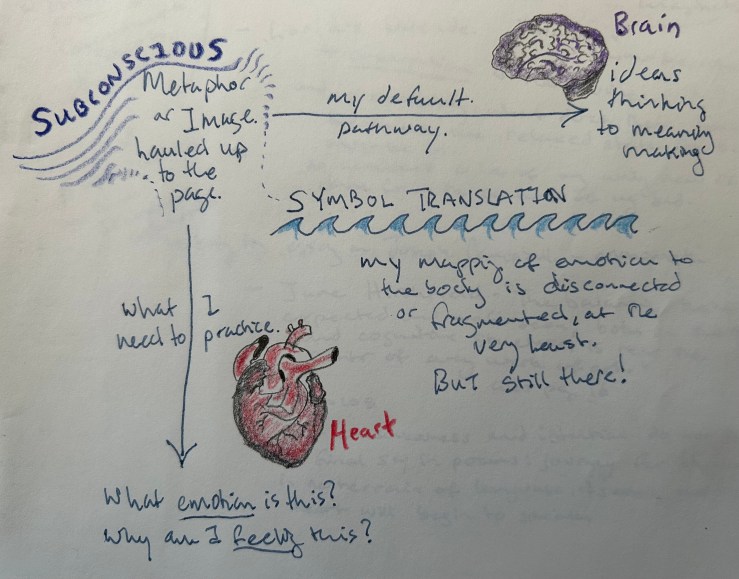
I won’t go into it here, and I’m loathe to kind of even talk about it, but I must for the sake of Phase Two. Much of the work with my therapist involves me learning to feel emotion in my body. Those deep emotions mentioned earlier that many people resort to drugs or alcohol to suppress or annihilate? Turns out I use high level thinking and analysis as a (socially acceptable) way to bypass feeling anything too deeply. Joy is acceptable and, no doubt, I’m exuberant, especially after a martini. But pain? Oh, I’ll cognitize the fuck out of it. Once I understood this, I asked my therapist, failing to mute a whiney earnest wretchedness, am I disabled?
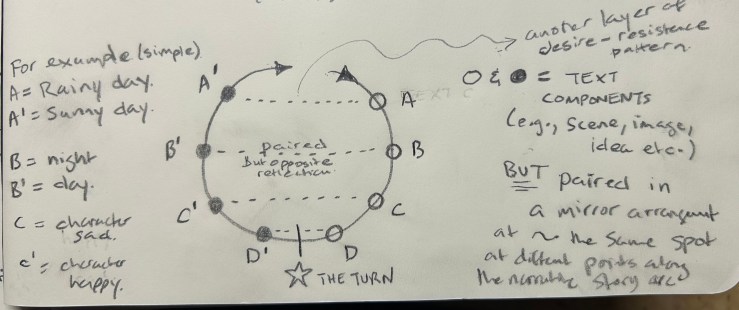
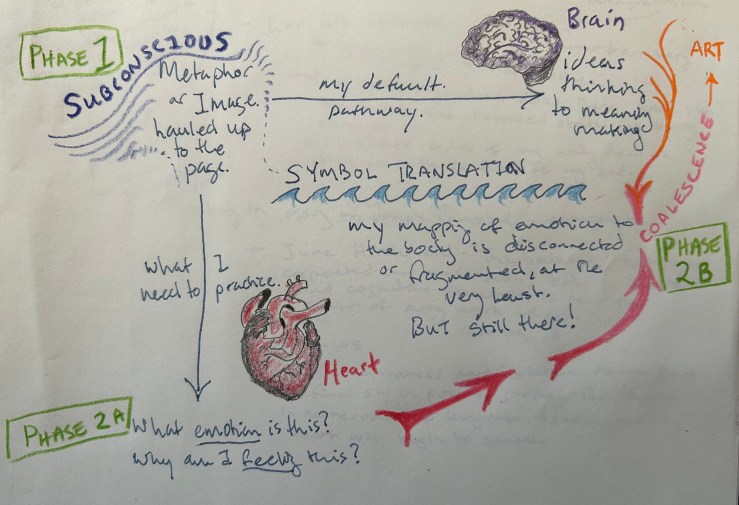
Here’s a drawing of my own creative writing issue process I figured out with my therapist[9]:
Phase Two: Switch from horizontal to vertical symbol translation and FEEL it goddamnit
This is less…concrete…than Phase One because I’m only just beginning to understand and practice writing this way. Here’s how I worked it out.
A few months ago, I posted a creative writing piece in progress, Measures, and used orange text inserts denoting my analysis and thinking about the images and surprising words that came through the breezy drafting bits (but, I note, not the ‘idea’ driven bits).
Originally, the piece was generated as a response to a writing prompt—but not timed—leaving me ample opportunity to twist a narrative around an idea. Which I did. That draft, despite the lack of constraints, held a few scarce subconscious breadcrumbs that I didn’t recognise at the time. I have many many drafts like this (soft whimper).
When I was preparing to read Measures at a public reading, I collaged the original draft together with other fragments of writing I’d done using constraints. I was rushing the edits (a self-imposed constraint). As I collaged, I could sense parts of the text vibrating some energy. I know, weird, but that’s the best way I can explain it. Those vibrating bits, I recognise now, signal subconscious missives. Maybe other people feel this differently, perhaps it’s simply noticing or a feeling of curiosity. However they’re identified, they’re the bits I have to attend to with care and devotion…a kind of nurturing love.
Phase 2 A
So, what does this look like in practice? It’s leaning into the feelings and emotions arising from the vibrating images and surprising words or metaphors. Instead of staying with surface logic, descend into the body, slow down, notice, INVITE the complex emotions swimming around my insides[10]. Name them – here’s a handy emotion wheel as reference. Map them (i.e., in the body – gut? heart? lungs? heat? cold? tension?).
For me this requires undisturbed focus best achieved comfortably propped up with pillows in bed. Because this is deeply discomforting work. Feeling sorrow, fear, shame, pain, anything deeply conflictual…it’s only with intentional effort that I sink into these feelings and pinpoint which ones adhere to the piece of creative writing I’m working with. The initial emotion identification process is much less writing and far more, well, active attention to feeling[11].
Once complex emotions are recognised, named and mapped, the task becomes layering the cascade of emotion into the piece. Because it isn’t just one emotion, it’s the movement from one (or several) emotion to the next. Emotion doesn’t just arise out of nowhere, it’s a relational reaction; it’s the energy of the between (often between people, but can also be between perception, say, a scent, and memory, or between animals and humans, or between landscape and humans…the list goes on…the important bit is that the emotion arises out of relationship). This is the experience, the relationship energy, I want my reader to feel. I’m creating an experience of complex emotion and I’m communicating, to borrow Winterson’s line, with text as I would another human being. It’s an intimacy.
Phase 2 B
How to do that? Here’s where it gets interesting. As a kid, I used to love those puzzles of what appeared to be hundreds of coloured dots on a page but when concentrated on a certain way and intentionally altering the angle of focus, the two-dimensional field of dots coalesced and popped what appeared as a three-dimensional image. Suddenly a 3D stag was running at me from the page[12]. The optical illusion puzzles are called Autostereograms (yes, I had to look this up).
The 3D puzzle is analogous to the process I used to layer complex emotional change into my working draft. Here’s an attempt to clarify my process (I’m still working on this….in a few months I might completely change my thinking, but for now, this works):
the effect of the movement of feelings in the piece is like seeing/feeling the 3D image
the subconscious missives in the form of images, metaphors, surprising words etc. are the dots
The intellectual meaning or the question the draft might be revolving around is like the 2D field of dots
the success of the story is proportional to the elegance with which a writer can layer all these aspects together, the coalescing of components – that movement from 2D to 3D….which, I suspect, is sensed and felt by the reader as opposed to through the mechanism of critical analysis.
How is this done? By blending technical aspects (don’t let them take over!) with subconscious/dream aspects (the signposts of emotional energy)
achieving the elegance of coalescing is the practice
So, this was how I approached the rewrite of Measures, a 905-word creative nonfiction piece. It’s my first intentional emotion blending attempt. When I was puzzling to layer the emotional movements in the piece, a specific line surfaced from the depths as I wrote and fiddled with the syntax (a subconscious gift!) and I burst into tears. A couple of friendly readers, though not all, experienced the same at the same paragraph in the piece. I’ve submitted the story to a few places for publication, waiting for submission windows to open at others…but really, reader reaction means, for me, the writing sings.
[1] I noticed I use the word subconscious as opposed to unconscious. I use subconscious to refer to information just below conscious awareness. But unconscious kind of means that too, though I think of unconscious information as deeper, more inaccessible. Like, my body doesn’t need to think about breathing or my heart beating to keep it upright (most of the time…falling in love or stubbing my bare toe on a concrete parking block changes all that, at least for a short moment). I admit, I took another deep dive into the differences and theories of mind conceptualizing unconscious and subconscious. Short synopsis: originally, the two words were used interchangeably as part of psychological theory. At some point, “unconscious” became synonymous with scientific rigour, while “subconscious” was significantly downgraded (ha ha, no pun intended) to parlance related to woo woo pseudoscientific pursuits, like, you know, tarot cards and ouija boards. So, there’s a classist-type interpretation of the two words. But, in other contexts, subconscious and unconscious refer to different levels of information below our conscious awareness, the former being slightly more accessible than the latter. Accessibility is thought to be achieved through intentional reflection practices, talk therapies, etc. [Here’s two whole paragraphs on this subject deleted. You’re welcome.]
[2] Okay, control is probably too strong a word here because the process of working this way, working with a subconscious (and yes, with the switch to using the indefinite article I’m proposing the subconscious is not mine alone, but rather a collective and fluid energy we all swim in…who’s woo woo now? ha ha ha) retains a high degree of mystery and hangs in dreamlike suspension (hang and suspension redundant? no, here dreamlike suspension is a thing, a state of being, maybe even a place).
[3] Though a word count cap is, technically, a restriction, I’ve found this insufficient for accessing the subconscious. Fewer words in a piece forces grammatical and syntactical discipline. Also, an efficiency of imparting information. But I can still think my way to a finished piece without layering in emotional heat (this is explored in Phase Two). This might also be why fragments written in emails and texts can sometimes fish out unexpected images, words….certainly humour bits I wouldn’t have thought of intentionally except for the challenge to provide a witty reply.
[4] Best, for me anyway, if not listening to a podcast or distracted by any visual media. Music seems to be okay, though floaty lines are heavily influenced by lyrics so this is a risk…it’s best if I’m not distracted at all. For the last year and a half or so, I’ve eschewed most media, including film, shows, news, in order to nurture and invite….access?…subconscious messaging. Also, ‘cause I just need the quiet.
[5] I keep a dream journal. I have since 2018 and kicking myself for not starting earlier. BUT – this is hard for me…I rarely remember my dreams …must apply intentional effort to remember them. When I wake, they’re dissolving very very fast. And if I wake in the night, too often I think, oh, I’ll write that down in the morning. Of course, by then, it’s long gone. Despite the dream journal an arm’s length from my pillow, I fail to reach my hand out in the dark. I remember my dreams better when I’m on vacation (I take this to mean that it’s only when I’m relaxed and rested that I’m really able to dialogue with dreams…work-life is too energy taxing. It’s a frustration for sure).
[6] Dreaming may not be “a restriction” per se – but could argue “not being awake” is.
[7] I love this line – it’s got two people in it, a narrator who is lying to themselves and colluding with the reader on this (reader senses the inclusion and also wants to know why), plus the metaphor “net” surfaces connotations of “caught in a trap” of a valid excuse. The reader senses the push-me pull-you tension of an excuse that is likely not valid or at the very least is a trap….but see? Here I have veered off into super analytical mode, ultra meaning making….I run the risk of using my usual approach and creating a “thought up” story as opposed to a “dreamed up” one. I feel the sentence would be a great first line of a story….ripe for using the timed write method to see what else will surface in a more dream-like way…get more text from the subconscious to the page before meddling with it.
[8] This blog is, I know, ultra thought concept driven. I don’t count the posts I write here as my “creative writing” work. Here, I’m exercising (exorcising?) my analytical tendencies …with the faint hope this will make space in my brain (and body) to allow the dreamwork to happen.
[9] Another friend, when I showed her this drawing explaining my thinking behind it, said, “wait, you drew a model of your analysis of your overthinking?” I erupted gales. A sense of humour is also an acceptable coping strategy for managing deep emotional pain. Subject for another post, this one is too long. Hopefully you’re still with me.
[10] You have no idea how difficult this is. I’m working on it.
[11] Am I also researching epigenetic biological embedding of experiences, relational neurobiology and the ontogenesis of shame, internalised oppression and morality? You betcha. [my gawd, she really is f-ing nutty nut bar]. Don’t worry, I do all of this half-assed.
[12] An AI generated overview of how to “see” the stag – Parallel (or wall-eyed) method: Focus your eyes as if looking at a point behind the image, not directly at the image itself; Cross-eyed method: Try to cross your eyes slightly to focus on a point beyond the image. Not gonna touch the AI grenade here…except to opine that feelings and emotions are often beyond words and language (why we need dreams and art as translation mechanisms) and I don’t believe AI will learn to fish the subconscious the way humans can hone their ability to.
“I like the way we make our dreams happen.” Lori Richards
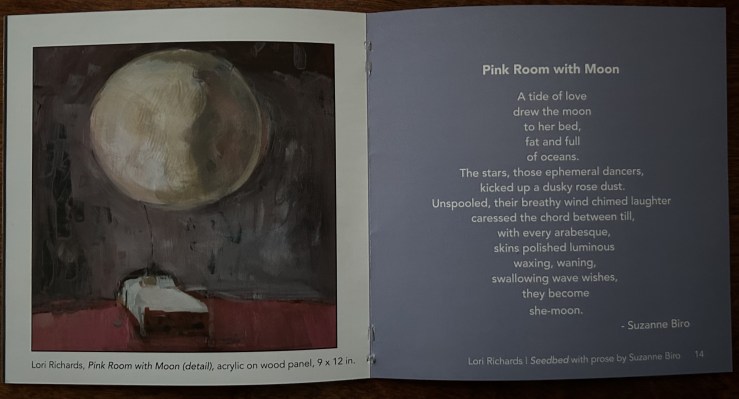
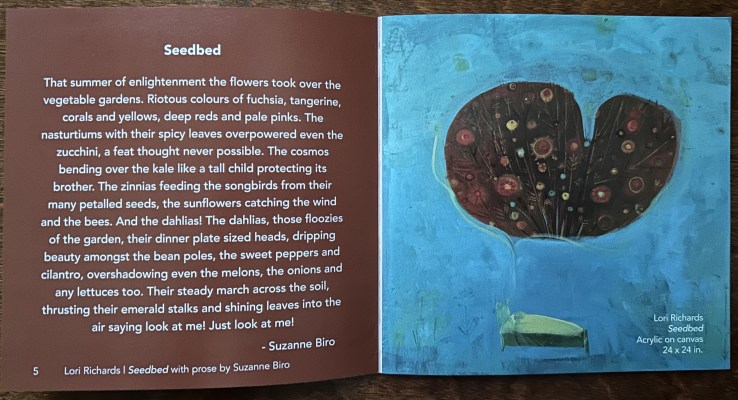
I’m delighting in the astonishing culmination of a collaborative art venture with my friend, artist, Lori Richards. Our creative works—Lori’s paintings and my writing—are exhibiting together for a short time at Wall Space Gallery in Ottawa. She generously invited me to write prose poem (like) pieces towards her paintings and I leapt at the opportunity[1].
The vernissage (new word for me, it means a preview of an art exhibition) was last weekend but we dreamed the idea—a wish—to combine and show our art works many many years ago. The exhibit is called Seedbed.
Lori and I walk together almost every week. As our feet pound the leaf and petalled paths, the sidewalks, the pavement or the snow, we recount, gesturing to the winds, drawing models in the air with our fingers, the celebrations, the frustrations, the lamentations and the longings of creative process. Despite working in different mediums, our practices are very much aligned. Lori is a professional artist. She has been, and continues to be, a steady champion of my creative writing as I squeeze it in as best I can round my day job[2].
Leaping is the right description for the approach I used for Seedbed. I’ve written ad nauseum (emphasis on nausea) about how crippled I am when it comes to pushing my creative writing out into the world (submitting for publication). I didn’t have this issue in the past…it developed over the last few years …I don’t really know what it’s about, but I feel like I’m about to break through my own barriers[3]. I think I’ve been saying that for a year or so. Sigh.
For this project, writing prose poem-ish pieces for each of Lori’s seventeen different paintings, I wanted to practice less preciousness with my writing. And I wanted to experience (force myself) to let go of themas is. I created a few rules for myself to keep the creativity light and fun:
Gaze at the painting, but only for a short time
Use stream of consciousness writing (I wrote freehand for most of these in my notebook, and the pieces, as they were being written, often included arrows and connecting lines)
Adhere to first instincts (as in, whatever words or images pop up, write them down and don’t tinker very much or at all)
As soon as a piece feels finished, send it to Lori as “done”
This phase of development and creation worked relatively well, though I was surprised by the writing emerging. The pieces are whimsical and, in several cases, nonsensical. But, adhering to my own rules, I let them be.
Do look at the paintings at the gallery website – my reproduction here fails (dreadfully) to capture the vibrancy of colours.
There was only one pairing of works where the process was reversed, where my writing inspired Lori’s painting. Interestingly, (or maybe the better word is fortuitously), this became the title pairing in the exhibition: Lori’s seedbed painting and a breathy paragraph of my own that floated to me the week I made the decision to leave my marriage. Though Lori thinks of the Seedbed series as beginning January 2024, I feel it began closer to the creation of that garden focused paragraph in the fall of 2023. It was then Lori created her first “bed painting” (several paintings in Seedbed include an image of a bed). This first painting felt (feels) emblematic for me, for what I was/am moving through. That painting now hangs in my bedroom.
It has been wonderful experiencing the generative iterations of the series since. There have been additional bed paintings created beyond the exhibition submissions…they continue. I feel magically connected—in a way I can’t articulate—with each painting as they appear. The closest I can come to explaining my feelings is with the word blossoming.
And I wasn’t nervous in the days or hours leading up to the vernissage. The gallery’s curator displayed the works beautifully. She and the staff also produced a lovely brochure of a selection of paintings with their ekphrastic accompaniments. Both Lori and I were expected to speak briefly about our process and collaboration, and I planned to read two very short pieces[4]. But when I arrived at the gallery a cold panic sloshed in my stomach[5]. The gallery space filled quickly, bodies tumbling inside from the frozen February afternoon. I’m told there were 80 people but they all sort of blurred together blobbing round while I smiled and nodded and prayed the wine I was drinking would kick in. It didn’t.
When it was my turn to speak, I accepted the microphone with grace. I stumbled on the word ekphrastic (it is very hard to say)….garbled gravel in my mouth…my heart thrashed against my rib cage and leapt the base of my throat, but then, deep breath, pause. Reading my own words, my body calmed and settled from the very first sentence. My voice steadied and held. I’m told I was poised. I wish I could say I recovered soon after the short performance, but I felt rather sick with the adrenalin hangover for the remainder of the day and into the evening.
Still, it has been an accomplishment. And a progression. In the days since, I’ve felt delighted with the experience. And (perhaps?) even a little awe for the courage it took to leap.
[1]Ekphrasis is a written description, real or imagined, of a work of art. Another dear friend, Barbara Ponomareff, who I met years ago when I offered to carpool us to a wonderful (and remote) writer’s retreat, has published several exquisite ekphrastic works in The Ekphrastic Review.
[2] I’m blessed with continuing encouragement from so many people; you know who you are, I sing your adorations for sticking around, thank you.
[3] Intend to write about “next level writing” in the March blog post, so, stay tuned. Also, I promise to curtail the whining and actually get some pieces submitted.
[4] Another dear friend, also a weekly creative-conversation-while-walking companion, Carolyn Smart, very kindly suggested which work to read. And I’m tickled to learn that painting, Pink Room with Moon, sold to another Canadian poet on the strength of an Instagram promotional post even before the show was launched. So many collaborators throughout the whole process… why do we ever believe we work in isolation?
[5] Threatened a colonic…wholly inelegant I know. Vomiting might have been preferable. But the body chooses its own exit strategies. I managed to keep uh everything intact (emphasis on in).
Seedbed introduction (Lori in the background and Tiffany, gallery curator, to the let).
Poems float to me again. This hasn’t happened in a number of years. I’ve had phrases arrive but then it’s like the valve shuts off and word flow stops. If I force a phrase toward a poem, I butcher it. Poems feel ethereal, fragile. I choose the word float intentionally…it’s as if the words butterfly by, out the corner of my eye, or rather, my ear. I think I hear them instead of see them. Perhaps this varies because sometimes I visualize an image. I’ll have to pay closer attention to this experience to describe the process accurately here. Regardless, if not caught and written to the page the poem keeps moving and leaves me behind.
So, three poems in the last two weeks or so. The relief accompanying them, that they float to me at all, is palpable; I hadn’t realised how much I miss them. These latest poems arrived when I felt most depleted, when I was most physically and emotionally exhausted…not so much in a state that I’d given up, more that I’d given in…surrendered. I worry about this. How to invite the conditions of open receiving without the physical and emotional exhaustion[1]? I don’t know.
The following poem arrived during a lunch break last week…the first lines always feel the strongest, the most tangible, then I wrote the lines spooling from there until I could tell I was twisting my own meaning into them. Instead of forcing my own thoughts into the piece, and because I needed to return to the office, I left it alone. A couple of days later, an image, tangentially related, kept entering my mind when I thought about the piece. I interpreted this as a sign the two aspects/concepts wanted to be woven together in the one poem. I completed the following draft over the weekend[2].
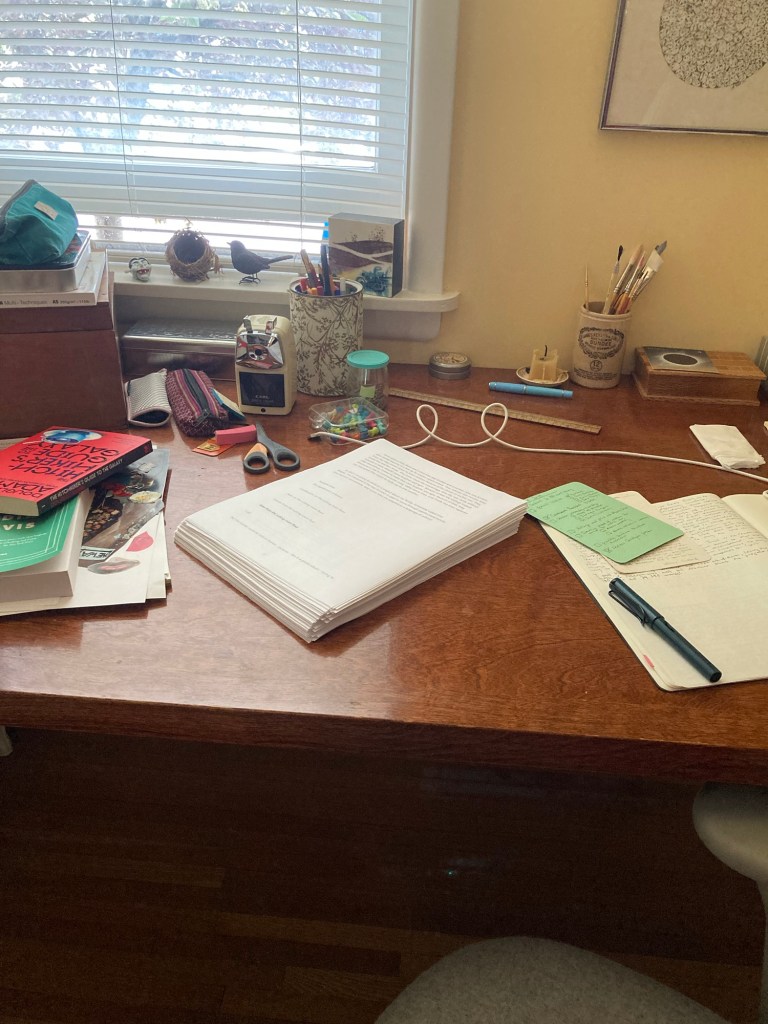
Here’s where it gets interesting. This poem, I discovered, also communicates information about my long form writing project (and process) I hadn’t quite understood prior to writing the poem. I’ll try to explain. Last month I printed out the long form project (a book length work, very much in progress) and promised myself I’d read it. I haven’t. Instead, energized by the idea of working physically with pen and highlighters and paper instead of messing around in digital files on my computer, I used index cards to list different scenes associated with different characters. One side of each card listed scenes from the distant past, the other side listed scenes from a recent past. The long form project is, for the most part, creative nonfiction with several people. Sitting there, looking at all the characters on the desk in front in me, I realised I don’t have a card for myself[3]. One could (I have) dismiss this discovery, subsume the idea I’m the persona, the narrator, in this work, so, naturally, I’ll find my way into each of the scenes…somehow. But I’m fooling myself. Sitting there with all the cards on the desk I realised (duh) two things. One, this project is more about my own experiences and thoughts and reflections, and these aspects aren’t integrated (much) in the current draft[4]. Two, the voice I wish to narrate this project requires what I refer to as my audacious voice …and that voice my friends has taken a fucking vacation. And despair, despondency, desperation—all the dis- words of negation—set in fast. I put the project aside. Again.
Then this poem floated to the page with its battle cry of a title and emphatic last line to confirm, with a flood of relief, my audacious self will revive.
[1] I’ve also received poems in states of extreme emotion.
[2] It’s important to express my gratitude here. In my last blog post I’d lamented missing the spring chorus of frogs I don’t hear living in the city. A few days after publishing that post, a friend messaged to offer me his cottage for the weekend. Serendipity. I spent the glorious gift of a solo weekend in the woods reading (The Forty Rules of Love by Eilf Shafak, a romance toggling back and forth between Rumi, a chorus of characters, multiple POVs, in the 1200s, and a current day woman who falls in love with a writer (who is writing about the relationship between Rumi and Shams of Tabriz, also Sufism) then leaves her “perfect” marriage of twenty years for true love.) It rained most of the weekend which was also a gift because it provided the excuse to lounge in the screened in porch (which felt like a treehouse) and just read (and sleep) instead of canoeing my way round the lake. Unfortunately, I only heard a single peeper and a bullfrog; mating season suspended at this point of spring becoming summer. Instead, I endured the chainsaw to the eardrum that is the “song” Waterloo by ABBA blasting from a cottage across the lake. The universe does have a sense of humour. I prefer this song. I did enjoy the loons and the whip-poor-will night calls and the rose-breasted grosbeak’s day song. I did not manage to see those birds (I really wanted to see the rose-breasted grosbeak as I haven’t before) but did trace the phoebes and vireos amidst the wet leaves.
[3] When I first wrote this sentence I inadvertently wrote “cared” instead of “card”.
[4] The crazy thing is, I know I’ve discovered this before and even written about it here…and here…and then, I guess, I just…forget? Frustrating …and embarrassing…but also, human. Process is not linear and, apparently, the learning doesn’t build upwards from any previous achieved foundation….the whole thing seems more like dancing across quicksand.
Sometimes I must be dropped in the Marshall Islands to realise I’m in the middle of the Pacific Ocean. It often takes me a long time to see things.
Pencil ~ 1992
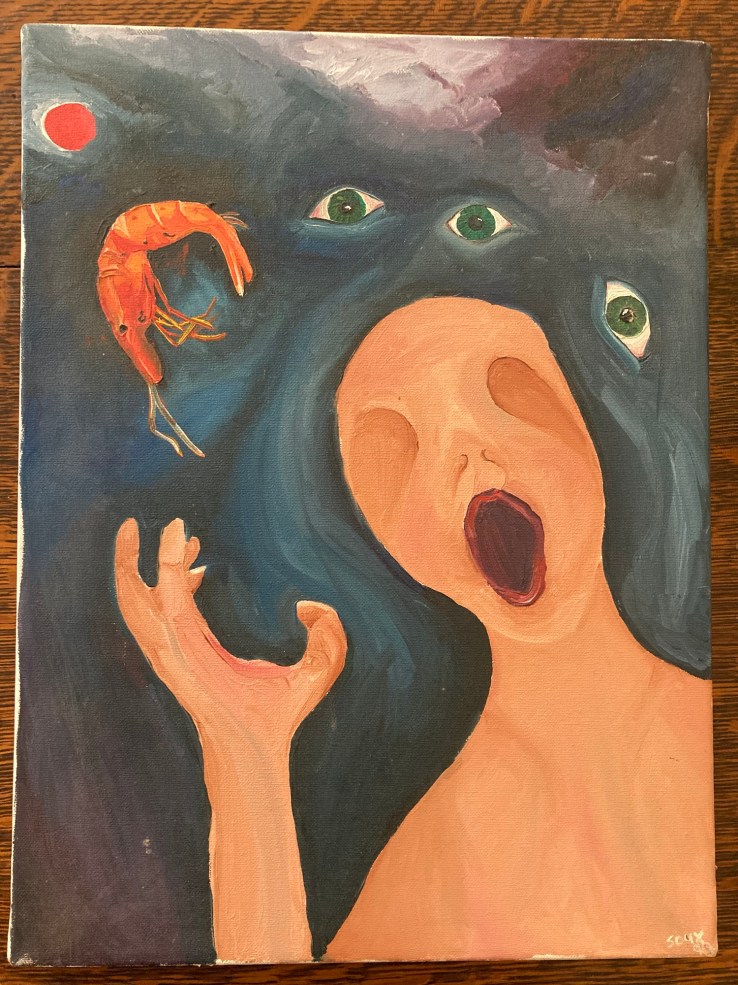
I went through a phase in my late teens and early twenties painting figures with no eyes – the two pieces here date from that era. Most of the artworks I produce are given away as gifts[1]. I can’t imagine many recipients of these screaming figures with their eyeballs floating in space might still grace their walls with my works. These two pieces might be the only ones left. They hang on the walls beside my writing desk.
I know they look scary. They aren’t meant to be. My high school art teacher disliked them. At the time of their creation, they didn’t reflect a mood I was in (I was quite happy and content, not dark or brooding). At the time of creation, I simply followed where my paintbrush or my pencils took me, delighting in the creaminess of oil paints, their tree-sap scent, and the ease with which pencil marks shadow contrasts between light and dark. Perhaps it was a way to work through an earlier terror, I don’t know. I never had an explanation for why I painted these subjects, I just did.
Decades later, hanging on new walls in a new space, staring at these works above my desk, they spark curiosity. And reflection. Looking back upon the intervening years of marriage and raising[2] a family, I can’t help but interpret their imagery as an almost wilful blindness. A warning for what it would take for me to manage my life choices diverting my path from art.
More context. I was flattened after completing my undergrad. In those days, the degree required a written thesis, complete with ethics review submission, primary data (raw) collection, analysis, interpretation and synthesis. Mine explored how child development influences a child’s ability to draw emotions. I went into three different schools and multiple classrooms of kindergarten to grade three students and collected their drawings of “a person who is ‘sad’, ‘angry’ and ‘happy’”. My supervisor, a new to the department prof, studied the tools with which child welfare court cases might be helping or hindering child testimonies. I won’t get into the Pandora’s Box of issues this research illuminates with our justice system and the rights of children. My thesis work was a departure from the neurophysiology and neurochemistry I’d focused on through the science degree, deliberately engaging with a creative and developmental approach I was craving. Conducting the thesis work on top of finishing all the other fourth year courses and working part time as a waitress was punishing[3]. I resolved never to do research again[4].
I adored those child drawings, their stick figured innocence, their genius beauty. After graduating, I pivoted my sights to art school and began to piece together a portfolio for submission. Waitressing, I couldn’t afford to apply to more than one school[5]. I chose Emily Carr. There, portfolio submissions required works using three different mediums exploring an artist chosen theme AND encased within a container constructed by the artist that expanded, or at least aligned, on that theme. Shipment costs, of course, were the responsibility of the artist. Why am I recalling these stories? Hindsight explorations. For the constructed container, the most challenging aspect of the portfolio package, I chose to create…wait for it…a liquor store box-sized ceramic eyeball.
At the time I was working with a friend’s mum in her pottery studio, and I explained my approach and plan for the eyeball—it would be two separate ovals (bowls), constructed using clay slabs with holes on the sides near the lip where I would attach metal hinges and a latch after the two halves were fired. This seemed simple to me, but L. refused, explaining it just wouldn’t work, it couldn’t be done. Looking back, I realise my mistake was using the word ‘eyeball’ – I should have simplified the concept to “two bowls that hinge together” or even, “two oval slab bowls, a top and a bottom”. Full stop on the construction of a container for my portfolio submission. No eyeballs in her kiln. I spent that summer trying to puzzle other ways to make a large eyeball that would hold multiple pieces of art. I couldn’t figure it out. And the portfolio gathered dust. I laugh now, wondering why I didn’t consider a different object, a different container (even the liquor store box would have done the trick!). But I (eye) didn’t. And that same summer I met the man who would become my husband and I shelved the idea (eye-dea) of art school[6].
Its’s twenty-eight years later and it’s only now I’m learning to really see. And I recognise a wilful blindness with my writing too. I’ve returned to working on what I call my “long form project”[7]. I have years of writing around the same themes, writing that I have refused to re-read or explore for fear of what I will discover there, what I didn’t want to see. To raise the girls the way I wanted them to experience “family” I kept myself blind[8].
This post is too long. This month has been wretched[9]. I decided to print out the pieces I’ve written as part of the long form project, “to see” the extent of material I have. I was stunned to discover it’s 208 pages, 74, 385 words long. This doesn’t include more recent writings towards this project, nor does it include parts written into ten plus years of notebook writing. Initially, I felt proudly amazed I have so much material to work with…then I spiralled …I can’t see where it’s going, how to piece it together…I am floating blind again. Still.
But …I will read what I have written, use my hindsight and my insight, my nascent ability to see the layers and sift the meanings from my own words. I know I have returned to a path of art, following a decades long detour. I wish it was not so painful.
[1]Blue Salamander, a symbol of moving between worlds, transitions and an ability to regenerate, went to the incredibly generous couple who gifted me their riverside house for the winter after I left my marriage. A friend coined it The Glass Chalet. The couple joke, calling their place a home for wayward women. I am not their first.
[2] Razing? This is exactly what I have done by choosing a life of independence…what I have committed through decommitment.
[3] Because my prof was new to the department, he pushed the project to a level worthy of publication, research far beyond the expectations for an undergrad. I fought with the departmental panel, assuring them I could complete the work. The panel pushed back, insisting it was PhD level, too much even for a Masters student. I ended up presenting eleven iterations of my research proposal to the departmental panel before getting the go ahead for ethics submission and beginning the project.
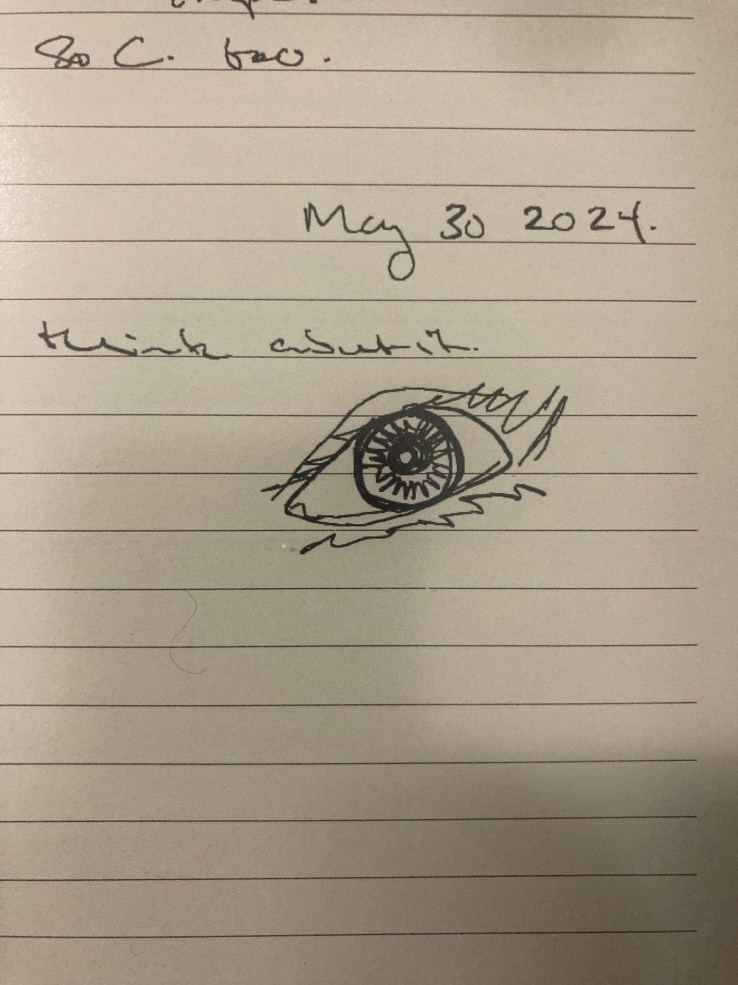
[4] Ha ha …the universe has a sense of humour doesn’t it? Research features heavy in much of my professional career. Interestingly, when I doodle in my work notes during meetings, I have always drawn…eyeballs.
[6] Later that summer, L. rushed into the lobby of the restaurant during one of my shifts, her hair a zany mess and her arms waving the air with her eureka moment. She shouted at me over the din of the restaurant in full summer swing: “I know how you can do it! It will work!!!”. I’ll never forget her despondency when I explained I’d met a man, that I wouldn’t be going to art school. I was 23, the same age my eldest daughter is now. This horrifies me. Maybe it shouldn’t. But it does.
[7] When I referred to a “long form project” during a recent online writing session, one woman pressed me to define my project more specifically. Was it a memoir? It must be a memoir. No, I explained, it’s creative non-fiction, collage work, a series of vignettes, but along various narrative throughlines (four), and the vignettes are kind of veering into fiction. It’s a memoir she repeated, then went on to explain she’d just finished her PhD in literary criticism. Well, that explains it, I thought, but didn’t say anything more. Days later, when I was doing the dishes, I came up with the right category for my work: it’s a memoir with wings. Stick that up your store bookshelf.
[8] This is incredibly hard to write here, to admit. I suspect my self-suppression, the shame in that, is what my long form project explores…I don’t know. I feel lost. Untethered.
[9] My mum suffered two falls, one where I needed to take her shockingly bruised body to the hospital for a wrist x-ray (not broken); my ex-husband (first time calling him this) is dating …I am told about the women through our children, pasting an expression of impassiveness to my face to offer the support they need to process this news (I make myself beige); I’m fielding daily tear-filled calls from my eldest daughter who broke off with her partner of three years…both of us cry on the phone…I try to be the strong and supportive mum I need to be…I fail; I visit my father in his subsidized housing apartment, taking any leftover protein from my own meals because I know he sustains himself on honeynut cheerios; his interest in the world is fast dissolving, his memory, like my mother’s, with it; I long for the sounds of spring peepers, chorus frogs and wood frogs I no longer hear living in the city, and I weep about the loss of the garden; I refuse to attend to world news because I know it will break me; I float through my workdays, convincing my colleagues I am indeed a senior policy advisor, I’m amazed by my own performance; I have separated the muse from the man, the divine from the human, a painful yet necessary separation, for how else to cultivate different ways of knowing, practice other ways of seeing?
long form project printed – a surprising pilenotebooks date back to 2012
May have blown my readership with last month’s post in terms of length and, uh, girth. So, this post promises to be synoptic. But I do appreciate the feedback readers provide, face to face, on the phone, through emails and texts, etc., thank you. The elegance and precision of a two-word response most impressive…well played.
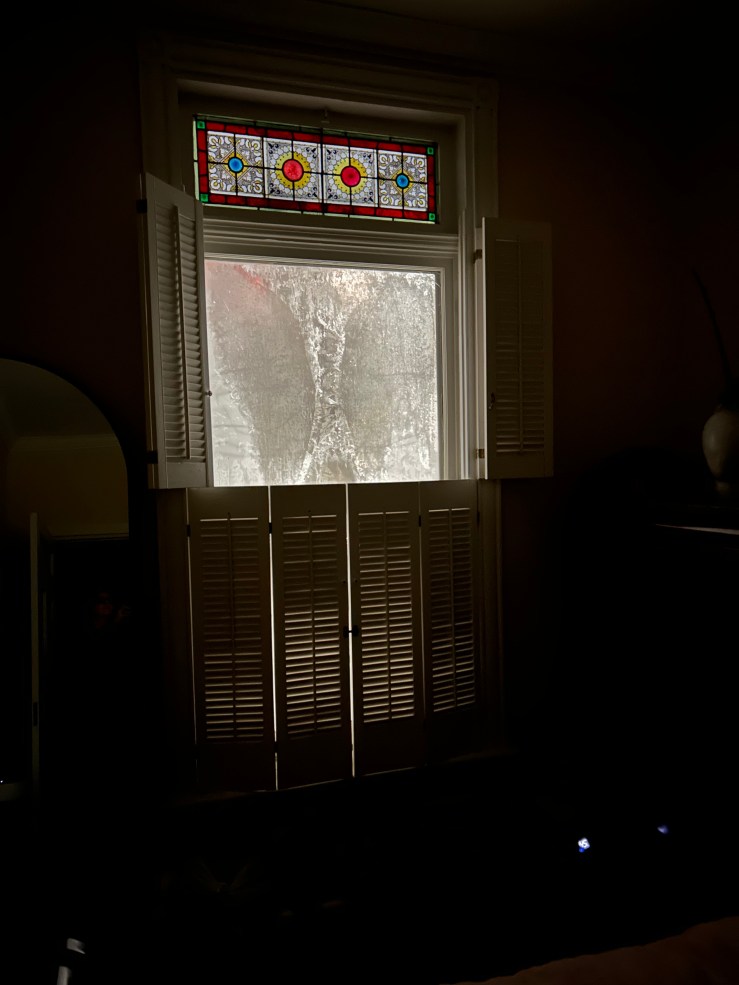
As I write this, a woolly mist smudges the St Lawrence to the sky, shifting Wolf Island’s shore and every other geographic anchor to the imagination. The chipping sound of chickadees loop the staghorn sumac, garland the cedar hedges; beloved swallow song put to winter’s bed.
Grateful too, for having vaulted the winter solstice and tumbling this season of epiphanies.
Reflecting this past year’s writings, I’m struck (and so deeply touched) seeing my words spark and stir creative pursuits for others. I’ve delighted reading my own words reflected in others’ poetry and prose, my own words transformed into paintings and artworks, my own words recited back to me in conversations. It has been (is) the most beautiful tribute to my continuing creative work. Also, a sober reminder of the responsibility to package the raw, wonder-filled gifts of the world in the best way I can, because love travels, as it should, pirouetting and somersaulting across the universe. It has been a slow learning but I’m gaining confidence in my writing and beginning to trust the whisperings of my heart, that it reaches you.
Here’s to a holiday season, the coming new year, brimming with joy, delight, forgiveness…and the timeless unspooling of love – Cin cin!
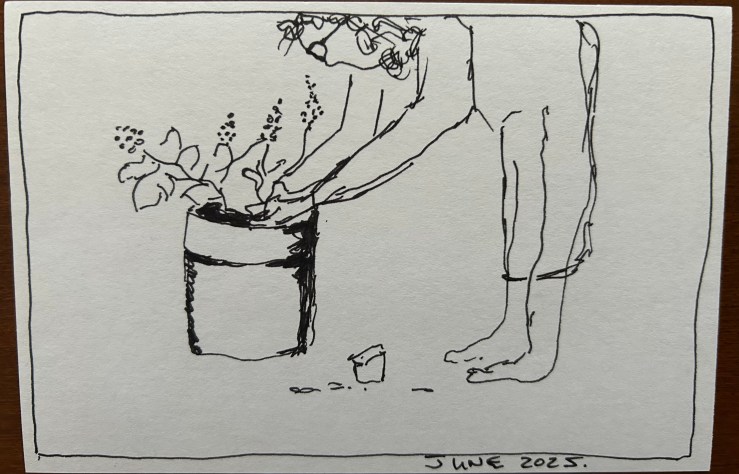
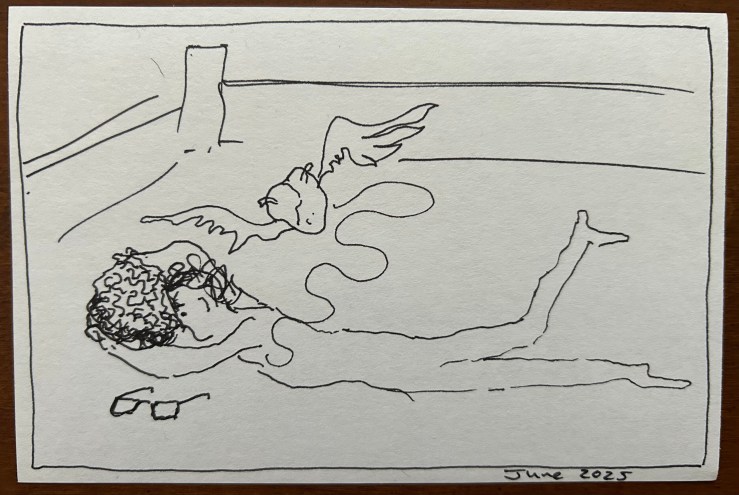
Hmmm…so many things wrong with this rendering. But I guess, also, so many things right.
On this day of (Canadian) thanksgiving, I want to acknowledge and extend my gratitude to all of you, the readers of my creative work. Especially here, on this blog, this teensy tiny corner of the digital universe, a place where I slowly work out my thoughts about creative process. You are patient and kind and giving of your time and attention. You make my writing a conversation. You are the connection I crave. Thank you.
I have been writing down glimmer dumps, a practice of attention and sensory writing advocated by writer, Pam Houston, and described in detail by Maxima Kahn here.
I leave two with you here, from the last week, small offerings of gratitude.
One:
Driving the rural roads round my place, the trees remain in full leaf but glowing yellow and red in the warm light of mid-afternoon. With all the rain we’ve had, the lawns and livestock fields shine bright green. Cows in a clumped white herd (Belgian Blues? Charolais? Murray Greys? I wish I knew) on an emerald hillside, but one cow, off in the field on its own, jumped up, rocking in the air, its tail curved up in a smile. It leapt like a young puppy dancing, and I delighted I’d caught a cow mid-joy.
Two:
As I write, the rain tinkles in the eavestroughs and a whole lot (a flock?) of starlings are singing from their perch atop the pine trees in the backyard…sometimes the song drops suddenly into silence and the whole lot of them lift off, rising through the air, each one morphing into a whole, a murmuration, and I am reminded again how magical the moments in this world can be.