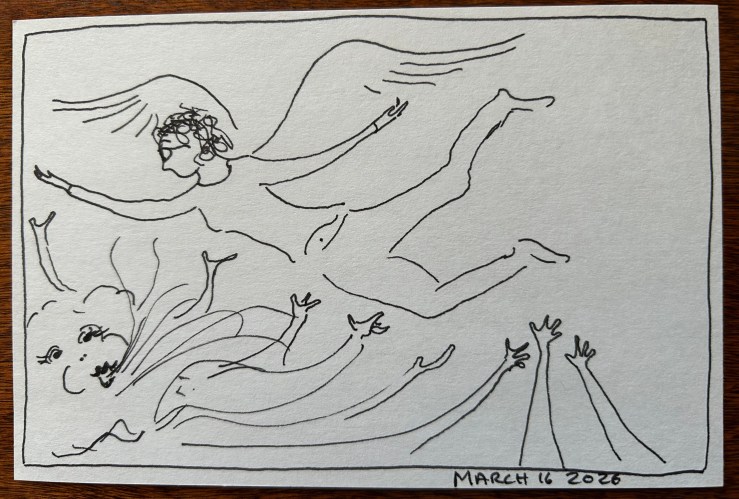
Neuroindulgence

Quick preview: this is a long post, steering (dragging?) you, dear reader, through personal memories and thoughts related to books I’ve read, coupled with an embarrassing but brief writing draft, followed by tottering, slipshod connections toward a conclusion I’ve reached before. I can’t promise return on investment. But there’s repeating reference to naked breasts. Female ones, even. So.  

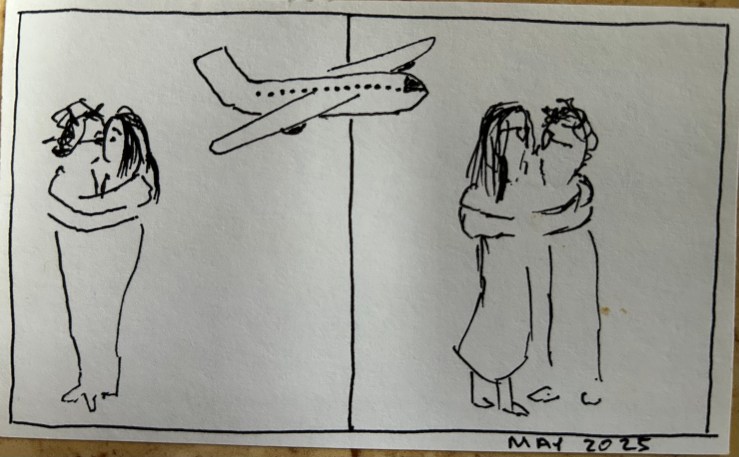
Home now after two weeks away. One week in BC moving daughter number one from Victoria to Vancouver for a summer internship, followed by a week working in Toronto, staying with daughter number two. A delightful day in the middle where I hugged one daughter in the morning and the other in the evening. Trees fluffy with spring blossom. Out west, the sweet scent of budding Black Cottonwood mingled with brine. In Toronto, Eastern Red Buds branched hot pink; spent and ragged-edged magnolias flowered the sidewalks.  Despite the beauty, spending time with the girls, the relief it’s finally spring, travel disrupted my writing routine, making me edgy and irritable. This morning I’m up at 5, determined to recoup the energy and time necessary for the task[1].

And though I didn’t write while away, I read. I’m mid-way through deep reading an essay I’ve intended to analyse for years, The Fourth State of Matter by Jo Ann Beard. It’s one of several pieces of writing I pulled for the trip, selecting a diversity of works to understand their structural elements and track emotional movements therein[2]. I’m trying to slow my reading sufficiently to understand where and why and how my water works turn on, where sentences spark to fan the embers of my humour, igniting laughter[3]. I thought I’d start with pieces that elicited obvious emotional reaction for me when I first read them.  As always, I underestimated the time such close reading requires, hence my half-way point through the analysis of Beard’s essay. The folder of works I carried across the country and back remained unopened, mostly. And as always, I picked up books along the way…

An interesting observation: I had completely forgotten Beard’s essay is about a school shooting. Like, completely forgotten!!! Instead, the lingering images and feelings I retained from the essay were how the narrator loves and cares for her dying dog. I remembered she carries the aged collie up and down stairs and endlessly washes soiled blankets to place fresh, dried ones beneath the incontinent animal. It’s the love and devotion and grief and longing captured in those images that I remembered[4].

And that got me thinking about the selective and specific memories of book length works my brain holds onto. Is there a pattern to them? Are they all images?  Are they predominantly feelings? What makes them memorable for me?

This brief sample list is poor representation of my rapacious yet superficial reading habit; I read widely but not deeply[5]. I’m working to improve deeper reading. Now, I always read with a pencil in hand, underlining passages, scribbling notes in the margins, extracting sentences, passages, into various notebooks, feathering pages with coloured post-it flags.  And, if I’m honest, it’s only when I write through analysis, i.e., not think through it, that I really get a sense of the mechanics and the magic, hence the indulgent footnote #4 (it’s more for me than for you ha ha).  

This list is the “top of mind” list …I’ve limited myself here deliberately. See? this is me not going to my bookshelf to divine more of my memories conjured off their spines.  The clumsy imprecise rendering here is also deliberate…these are the fuzzy bits retained. Sometimes the only bits. Maybe this betrays a sieve-like brain …or worse, a brain-like sieve.  

  • Like Water for Chocolate by Laura Esquivel – scene at the dinner table where the protagonist, forbade by her mother to declare her love to a young man who we know loves her back but is betrothed to her eldest sister, cooks her unrequited passion into a spectacular dinner of dishes, including rose petals (!), the whole family share. But it’s the middle sister who “eats” the cooked in love, becoming so consumed with heat and lust and passion, she rushes from the dining room, somehow loses all her clothes in the process, runs across a field in the dark and her naked body, hair streaming wildly, is hoisted by welcoming arms onto a horse ridden by a passing _______ …can’t remember this detail …soldier? Bandit?  Some kind of handsome outlaw anyway. He happens to be riding by with his gang. This scene makes me feel…envy.
  • Love in the Time of Cholera by Gabriel Garcia Marquez – the protagonist (though, maybe this is a side character?) goes out of his way to eat asparagus every day so that he may smell its telltale odorous byproducts every time he pees. Oh, and a pet parrot that blurts out inappropriate phrases (swearing?) and lives half in and half outside the house[6].
  • The World According to Garp by John Irving – Garp frying onions, building the mirepoix, to make spaghetti sauce which attracts a woman neighbour to his door, inside his house and eventually into an extra-marital affair[7].  Sigh. It always starts with an onion.
  • The Brief Wondrous Life of Oscar Wao by Junot Diaz – the mother’s sly smile, her wig askew after she fakes a fall and injury, a smile like a tiger’s smile (I likely have this detail wrong) after successfully tricking and luring her teen daughter back to her on a boardwalk in a very public place.
  • The English Patient by Michael Ondaatje – when the beautiful Sikh bomb diffuser shows the nurse a wall mural in an ancient church. Lots of candles[8].
  • All The Light We Cannot See by Anthony Doerr – spectacular book! I loved it. But I mostly retain an image of seashells sparkling on the walls of a seashore cave that is fast filling with the tide? Good grief.  
  • Anna Karenina by Leo Tolstoy – Vasilly scything the wheat fields alongside the peasants. Amazed I remember the character’s name. I love this scene…the movement of all the people, men and women, working together as they harvest their way up the hill of wheat (or is it down?). Vasilly’s satisfaction with working his body this way. Seem to recall he’s depressed a lot, how his physical exertion is a balm.
  • For Whom The Bell Tolls by Ernest Hemingway – a side character’s name, Pilar, and characters hiding out in arid, treeless, boulder strewn mountainside cliffs….waiting….waiting …waiting.
  • Industry of Souls by Martin Booth – this is my favourite novel…I’ve read it several times…I don’t know why it endures as a favourite…perhaps it’s the structure, a gentle moving back and forth in time as the protagonist, a man in his eighties, must decide whether to stay or leave Russia, whether to return to England. I love how the character moves around the small village he lives in, saying goodbye to all the friends he has made (for some reason, an image of golden light and lazy bees rises in my mind’s eye here). The visits tip the protagonist’s memories and readers follow his thoughts back in time to when he is a prisoner in the gulag, Siberian labour camps.  A few scenes stick out in memory: one where the male prisoners are found by female prisoners and they pair off in various semi-private mine shafts to make love; another when the prisoners dig a mammoth from the permafrost and eat it; and the most enduring clear image of a man who decides to take his own life by stripping down and sitting down in a snowbank to freeze to death (this happens at a train station).  
  • The Prince of Tides by Pat Conroy – the scene where the mother character takes her children to a clothing store and they’re crammed in one of the back change room stalls where they overhear the storekeeper women making fun of the mother with nasty comments about the beautiful magnolia (?) flower she wears in her hair…it’s the bit where the mother’s face falls, she’s humiliated but endures this in silence…it’s an image, I feel, connecting to the fall from innocence…this scene always makes me cry.
  • The Grapes of Wrath by John Steinbeck – travelling in cattle cars across great deserted and desert-like fields, tumble weed bumbling by yes, but the scene I remember is the one where the young woman (who lost a newborn?) unbuttons her blouse to breastfeed an old man who lays on a roadside, slowly dying[9].
  • The Good Earth by Pearl S. Buck – the scene where the wife of the landowner/farmer pauses the hard work of crop raising to breastfeed between rows of plants, her milk gushing forth and spilling all over the soil …weirdly, this memory is retained because I felt the author had no clue about breastfeeding, describing the milk letdown as happening from one breast at a time.

Okay. I remember others but I’ll resist (more) self-indulgence and stop here.

Reviewing the list I didn’t really see a pattern, in any technical sense. Sure, could boil these down to “imagery” but they don’t quite slot into that category (asparagus pee?). But yesterday, thinking about Beard’s essay and the dog who can’t help but pee inside, I suddenly connected it to a short piece of writing I drafted earlier this week in response to a writing prompt. Perhaps reading Beard’s essay was a subconscious nudge to write this response, drafted during a12 minute timed write. I’ve transcribed it here, resisting the incredible urge to edit it. The writing prompt was, “write about shame”:

Probably most of us walk around with shame ballooning inside our bodies…a water balloon weighing us down, threatening to burst and make a horrible puddled mess, one shame bursting on the next. And I don’t want to talk about my big shames tonight so maybe a simple story about a little one. I used to wet the bed when I was little. But not so little this might be acceptable. I was well into my grade two year and still failing to rise from deep sleep to get to the toilet in time. The shame would wake me though, wet and warm, gathering at the back of my thighs and knees, pooling beneath my buttocks. My mother trained me not to wake her so I changed the sheets on my bed in the dark, remembering to layer a thick bath towel folded in case it might happen again.

I went to my first sleep over in grade two. It was spring because my friend and I were allowed to sleep in the camper pop up in her driveway. Of course my mother had phoned my friend’s mother before I arrived because I could read the curiosity and the pity on my friend’s face. I’d chosen to wear my favourite pajamas, Little Dollies I think they were called, a pair of short bloomer-like shorts with an A-line tank top, frilly bits round the hem. My mother had instructed me to wear a diaper. Cloth in those days. She’d pinned it to fit me before I’d left home then folded it in my bag till I’d need it at night time. At night time I changed in the bathroom, dragging the thick diaper cloth up the length of my legs to rest at the hips. The safety pins were capped in pink and they jutted visible beneath my pajama bottoms. When I met my friend in the hallway she looked me up and down. No words passed between us but it was pity I read, again, on her face. My shame coloured my cheeks red.

The next week, when we played barbies, she and her sister stole my red barbie boots, knowing I would never argue for my rights to them, the shame a lever they now knew how to pull.   

Soooo…reviewing my remembered novel scenes after connecting my writing response with scenes from Beard’s essay, closer scrutiny does reveal a pattern…but a pattern unique to me[10]. The scenes in the list evoke an emotion (or series of emotions in relation to one another) that ties in with my own emotional experiences …and they are less literal connection, more emotional resonance, pinging off in ways also unique to me.

The process of identifying the emotional resonance between these remembered scenes and my own experiences, is analogous to reading through my own draft writings to gather fragments where I detect emotional vibration/heat, and learning to thread them together, piecing them in a way that leads a reader through the repetitive rise and cascade of my personal emotional experience.  I have come to this conclusion before, but writing through these scene memories in this post, I’ve progressed a key learning: how and what a reader connects to and remembers is as unique as a fingerprint. Before now, I’ve understood this theoretically; now I understand it practically. My job, as a writer, then, is to infuse my writing with as much emotional authenticity as I can, knowing it will touch every reader differently and never knowing, or ever being able to truly predict or guide, how or why. This eases my anxiety about connection. Somewhat.

Thank you for reading.


[1] I’m trying to make peace with my energy levels declining with age …or is it that day job work siphons too much from me?  I don’t know.  I haven’t risen for 5 am writing practice for over a year, slipping my wake up to 6, then 6:30 am, believing I’ll get to what I need to in the quiet evenings. But I don’t. I’m knackered by then and/or I continue trying to fit it all in, experiences I mean, by attending webinars, learning a language, volunteering and meeting friends…all essential to living a good life, yes, but leaving too little room for creative work. So, 5 am wake up begins again. Creative work is priority.

[2] Writing I carried across Canada and back, in addition to Beard’s essay: Report from the Bahamas by June Jordan (have done a deep dive on this one in the past, warrants another); Consider the Lobster by David Foster Wallace (I was delighted to discover his judicious-footnote-use – a compadre); The Race Goes to the Swiftest by Barry Lopez (in my packing haste I thought this was his essay about sexual abuse, but no, that essay is Sliver of Sky; The Shawl by Cynthia Ozick; Two Hearts by Brian Doyle; Onion Heart by Rupert Dastur; Triangle by Larry Brown; A Story About The Body by Robert Hass; a Substack post, American Letters 5: Swim to Shore by Alexander Chee; pages 14-18 of Midnight’s Chicken by Ella Risbridger. Listing these here, I realise my idiocy, believing I might bend time to accommodate such deep study in only a week of vacation while moving Lillian between apartments, visiting my sister and her partner in Squamish, and my uncle in long term care, not to mention the time change and travel days. Still, carrying writing around…there’s a comfort in it, a sense of optimism, of potential, the eternal hope it will just absorb through my skin.

[3] I always return to Douglas Glover’s rubrics for structural analysis, as well as his emotion writing exercise. Really, DG’s words are never far from my mind.

[4] The essay is an exploration, and I would go so far as to say “an artifact”, of the experience and impact of trauma. An essay composed of fragments, culling moments from across a swath of time, laid out non-linearly with subtle-to-the-extreme time stamps—accomplished technically using brief switches in point of view and super brief tense changes. The use of mostly present tense despite different time points, creates the sense of disorientation and disconnection for the reader. The form mimics the experience of what it feels like when life as you know it is blown to pieces. Trauma is ever-present even when it happened long ago. It’s a stunning work of art.

I burst into tears with this scene: when the narrator, post-shooting event, directs a stranger to the classroom where the chalk writing of one of the dead remains on the chalkboard. The stranger loses her composure seeing the chalkboard, but that’s not where I cry…I cry reading the subsequent scene (accomplished simply with a new sentence) when the narrator returns to the empty classroom, “an hour later”, the stranger gone, and notices the smudge of palm prints on the chalkboard, “I can see where she laid her hands carefully, where the numbers are ghostly and blurred.”. Again, the form (this time the use of an image) delivers the meaningful impact: an image of loss …a body and soul once present has been erased…the image depicts the intimacy of the relationship the stranger shared with the person who wrote on the chalkboard before being killed, now reduced to a word, “ghostly” …there was connection through touch, through relationship, and the smudge is the image of the stranger’s hands attempting to re-touch, to re-connect with the body and the relationship now disappeared. Life, joy, love: fragile, vulnerable and ephemeral as a prof’s chalk writing. An image of deadline in its most literal sense.  Devastating. Also, spectacularly beautiful and precise. When I read writing like this, I suppress the wailing urge to toss the pages to the air, collapse in a foetal position and give up. But here I am, still writing.

[5] I ought confess that for the first year and a bit after leaving…a partner of 27 years, the home we built together, a garden I loved… I had trouble reading…concentrating, focusing, was very difficult…of course I read, but in snippets…and shorter works…it’s only in the last few months I’m regaining my reading stamina.     

[6] I also remember part of the first line of this book, a handy phrase to trot out when literary types play that game at dinner parties where they test whether you are sufficiently read if you dare to suggest you might also be a creative writer.  Bitter almonds seem to satisfy them. Oh, and unrequited love. A pervasive literary (and life) theme it seems. A secret password of sorts. That parrot technique is a great idea.

[7] I first read Garp as a teenager and this scene of him cooking spaghetti sauce—my absolute and enduring favorite food, despite all the wonderful things I’ve had the opportunity to taste—fixed a desire to love a man who would cook for me and love me back the same way (but without the affairs). I’m still hoping for such a man. Like Garp, he will also have to be a writer I think, as well as a spectacular lover. An aside: last week I pilfered my copy of The World According to Garp from Willa’s bookshelf and delighted reading a good chunk of it on the train home to Kingston.  And I hadn’t appreciated at all when I first read the book way back when, how much of it is about writing and becoming a writer. Reading it again is a delight. There’s a line comparing writing a novel to long distance running which particularly resonates (like Garp, I also ran cross country in high school; it’s endurance).

[8] I adore Ondaatje’s writing …but I admit, for this specific scene, I think the movie version scores higher for the romance factor.

[9] Remembering this scene, I wonder if it also imprinted on Irving’s mind, serving as the model of a similar, though far more sexualised scene, in The World According to Garp. I think so.

[10] Thank you, Captain Obvious (eye roll). My ex-husband always complained I was slow…perhaps this is what he meant.

Mapping the Missing (Or, Italy: Reflections on Beauty, Part 2)

I didn’t quite get this post to come together the way I thought it might. I’m interested how my subconscious thoughts—thoughts that take my conscious mind so long to catch on, catch up—drive my writing[1] ….I’m learning to relax enough to draw it out, I’m learning to “see” it, and somehow, in my mind, this process puzzles together with world views…

When I visited Venice last month, top of my list was to stand in front of the Fra Mauro version of the Mappa Mundi at the Biblioteca Nazionale Marciana. This world map, completed in 1460, created using a southern orientation requiring me to flip and stretch my own perceptions of the world, is considered one of the most visionary cosmographical works of all time. I love that word, cosmographical…like, drawings guided by the stars. It’s a large hand-drawn map, almost 2 meters in diameter, of what was believed the world looked like in 1460. Belief is what I’m interested in…how it changes and shapes our thinking. What fascinates me about the Mappa Mundi, in addition to its gorgeously detailed hand-drawn beauty[2], is that Fra Mauro created his world view without ever moving beyond the shores of his Venetian island[3]. There’s heaps of fantastic information about the Mappa Mundi I won’t synthesize here, but well worth checking out; the AI project associated with the map is, in a word, dazzling[4].  

A recent Saturday I woke, galvanized myself, and emailed a friend[5] in the writing community to request one of the two open mic spots at a public reading at the library in Picton. I left volunteering almost to the last minute to decide, yes, today (today!), I have the courage to read one of my creative works. 

Then, I spent a quick hour editing the piece, changing the title and furnishing it with a deeper history. I ran out of time (is it ridiculous to think I would have that time?) and I knew the piece wasn’t “finished”. But I’m discovering no creative conversation seems to end…the writing continues to communicate beyond whenever I assume “I’m done”.

In my mind, I imagined the public library reading might attract 8 to 10 people. In my mind, they’d be milling about the stacks listening half-heartedly to the readings while they pulled random books from the shelves, splitting them open by their spines. So, imagine my surprise when I showed up, just as the event began, and discovered a far more formal arrangement: perhaps fifty people seated in rows and rows of chairs (none empty…when my daughter, Willa, and her partner, Nadine, arrived slightly after me, having parked the car, they sat on the floor against the wall), a podium, a mic, speakers and a video set up, aimed and recording.  

I have not read my work publicly in many years[6]. Certainly, it was pre-pandemic. When I moved to the podium, the adrenalin kicked up from my stomach and pummelled my heart.  The first paragraph was breathy. I lacked air to project my words. So thankful for the mic.  In my mind, I kept repeating just read what’s in front of you Suzanne, it’s right there.  Take a breath at the next period, you have time. Good. Next period, take a breath, take a deeper breath. By the time I reached the second paragraph, my breathing evened, and I managed to settle into the rhythm of inhaling and exhaling with the sentences.

And I edited on the go. I decided to drop a whole paragraph, suddenly seeing there was no need for it. I started to look up at the audience, interpreting their expressions (in my mind, this seemed like…confusion?). Three quarters of the way through, I realised I was enjoying myself, sharing my work aloud. The piece is dark, I know, but it turns toward the light by the end. But I felt when I’d finished, the audience hadn’t followed me through the turn. Ah well.

In the spirit of blind map making a la Fra Mauro style…I’m tracing the contours of subconscious thought, surfacing new meaning from those watery shorelines…this seems a translation made possible only by passing words through the chambers of the heart as opposed to catching in the net of the mind.

Here is the recording of the event. My reading begins at the 54-minute mark. Following the video, I’ve pasted the work in progress with some of my thoughts, marked using orange coloured text, that have arisen since (also during ha ha) the reading.


Measures (the original title of the piece was Just Math and the original draft focused on the mathematical aspects or logic that we [mis]apply to situations that are …less mechanical, more human…’Measures’ as a title got slapped on the piece the morning of the reading …I was thinking it might be a riff on the math aspects, but didn’t think too deeply…but now I’m discovering subconscious intentions, what this piece might be trying to communicate, exploring the choice to end one’s life, perhaps the most weighty decision one might make …so will likely keep this title)

I visit my father in hospital every Saturday. It’s not a real hospital, it’s a step-down unit, a retirement home repurposed to ease the burden of bodies (during the reading – why not before? I don’t know – I noticed how frequently the reference to “bodies” comes up in this piece…6 times…considering this because it signals some sort of corporeal versus what? spiritual? maybe…there’s a nod to religion in the piece…but no, it’s my subconscious circling the deeper meaning I am only seeing now: when is it time to depart a body, a body at odds with an ability to negotiate this world?) competing for limited hospital bed space. The patients here patiently await death. Or they wait to pass a test called Activities of Daily Living so they might score a return to former lives. It’s all about patient to nurse ratios and patient proximity to death.  Just math. 

In the lobby, plastic plants droop. A young woman sits behind a reception desk, her face blue with the glow of the computer screen. She says hello, but only when I say hello first. (during the reading, I dropped this paragraph thinking it didn’t add anything to the piece….now I’m wondering about the reference to blue here (the word shimmers for me), its multi-dimensional reference to depression…hopelessness…but also its vastness, its possibilities (open sky, open water, universe etc.).

The room my father is in, 316, is a small, one bedroom apartment designed to shelter a couple who really get along, or a solo senior citizen. Now it holds three aged men in three hospital beds and no chairs to sit on when visiting. 

A man named Victor has the bedroom. He is tiny and more and more yellow each time I visit. He is skeletal, though his stomach balloons from his body. His belly button is definitely an outie.  It probably wasn’t always.

My father smiles, caged in his hospital bed. A welcome. (when I wrote this, I intended to describe my father’s smile as a welcome one…except that word “caged” practically leaps from the sentence and grabs my throat so I notice there’s more going on ….the syntax here, laid down completely unintentionally, even an error if I compare it to what I had actually thought I had written, introduces sly ambiguity attached to the word “welcome– do I mean his smile is welcome, or that he is [safely] caged (connotations of threat)? And the ambiguity provides a subtle warning for readers (and me ha ha) that there’s something not quite right between the narrator and the father…and shunts the transition from this paragraph to the next, where, their relationship, as well as the deeper history that shapes their relationship, is revealed.)

As a kid, his smile was a peculiar twisting of his lips, holding, like a cup, cruelty and condescension about to spill forth. We distanced ourselves from the inevitable poison, his words arrowing the air to the gut. We learned to excuse his smile. He, a refugee after all. A Canadian through revolution. His 13-year-old body a witness to other bodies strung up along the boulevards of the old city. Tanks rolling in. Molotov cocktails and body parts made kites. (‘kites’ in this sentence shimmers for me….it is only now that I am seeing any link between this word and perhaps the deeper exploration of this piece….is my brain getting too involved in meaning making here? Maybe. I wonder about the associated movement in relation to the violence depicted here, an upward flying movement….could it be departure of the spirit once a life is gone?) His smile, back then, did not seem a part of him, as it does now.  Still, conversation’s an effort raised beneath such rain, beneath an umbrella of pain.  (readers of earlier drafts of this piece were confused by the relationship between the narrator and the father: why is the narrator so interested in the Vic character, why are the narrator and the father not talking to each other? So I added this in…this paragraph was originally drafted as a breezy response to a writing prompt about remembering a smile.)

In room 316 of this not hospital, a glass door opens to a fake balcony. From there, looking down on the statue of Jesus I feel benevolence drain. I can only look out the window if the man my father calls “Lump of Lard” isn’t in the hospital bed beside it. A prosthetic leg furnishes the corner beneath a TV screen angled from the wall. 

My father’s railed bed is in the kitchenette. (this was interesting, editing that morning, I did catch that several of my tweaks included variations on the word “railed”, a strange, if apt, description here…looking it up now, I discover its multiple meanings. In addition to “enclosure”, it also means “protest strongly”, “blame in violent language”, “object about something”…is this my subconscious wrestling with the idea of taking one’s life? I don’t know. Maybe.) If he wants a glass of water, he rolls to his right. Blue fabric curtains suspend from railings mounted to the ceiling. The fabric separates everything: Lump of Lard from my father’s radio tuned too loudly to the opera station, the angles of sunlight from reaching my father’s bed, the sorrows and longings of three different men.

Every week I visit there is less and less of Victor.  His yellow skin droops from the sticks of his bones. His brown pupils bulge from sunken sockets shadowing his forehead. He often cries out in pain. “I know Vic!  We’re here. We hear you!” my dad says, explaining it’s important to cheer him on. Vic is proud. He was given 4 months to live and that was 7 months ago. In my mind I wrestle with Victor’s decision to forego MAID, medical assistance in dying. His yellow death is inevitable; why wait? (this is the heart of the question this piece is exploring….I even phrased it in the form of a question…but it is only now, after the reading, that I start to piece this together...and realise the contours of this exploration need to be mapped into the piece to better guide the reader (including me!) through this question.)

Today, when I exit the stair well and enter the third floor, Vic sits in a wheelchair in the centre of the hallway. There is so little of his body. He seems only a distended stomach with a yellow head thrown back and a mouth agape at the ceiling. I’m frightened he’s dead. Closer inspection reveals his yolk-coloured bird cage chest expands and contracts round a fluttering heart.

Today, my father’s welcome smile from behind the rails. Today the opera is La Traviata conducted by Toscanini. An orderly wheels Vic past into the bedroom.  Eventually, Vic shuffles by me to the microwave. “Is that your sister’s soup?” my father asks him. It is. While it heats, my father and Vic argue over the green leaves in the soup. Vic calls it by its Portuguese name; my father insists it’s kale. Toscanini chimes in. I imagine the Maple keys on the trees outside shiver-whisper and lean against a kitchen cabinet not interjecting. I understand—now–it’s joy arguing a position.

Vic lifts the bowl of soup from the microwave then raises it to his face, closes his eyes to concentrate inhaling the steam, the spice swirls of Portuguese sausage. I hear his eyelids when they snap open. A light dances in his eyes. He raises the bowl, wafts the steam towards my face. Its gloriousness travels from the tips of his yellow fingers to grace my nostrils. I smell chicken stock and chilies, the green of leaves, the orange of coriander seeds. (here, I think, a missed opportunity, but must be executed (oohhh bad word choice in this context, ha ha), delicately – the food description here with colours, orange, green, needs to be enhanced better, after all, it is this pleasure that is highlighted here, a pleasure that keeps one tethered to a life in this world, even when the body disintegrates…so it deserves special attention, this sentence….but not go over the top. I have a habit of going over the top…so, Suzanne, don’t rush this). I think anyone would give a life to taste such cooked-in love. (a strange sentence…and only now I’m seeing it differently, changing my view of meaning …it’s a reference to the relationship between the narrator and the father ….how “cooked in love” contains multiplicities, and how sometimes, it takes one’s lifetime to learn compassion and forgive. Or maybe I have now gone far too meta here…does it matter? No. But I find this analysis fun, so continue.) Suddenly, I understand not only the pleasure of choice, but how infinity might be measured.   I pull the blue curtain (note repetition of blue curtain, not sure what it means, if anything) to the wall. Sun splashes in. My father is up and walking with the aid of a walker. His test score improves.  I reconsider MAID, its balance. I instruct my father to stand by the window. (these two sentences, “reconsidering MAID” and “instruct my father to stand by the window” come too close in proximity so their meanings get hooked together when they shouldn’t be. As they are placed now, it leads a reader to think that maybe the narrator is going to push the father out the window, save his decision to take his own life and do the deed quick….so, this needs fixing). The fake balcony door opens easily. Sunlit wind rushes in. Below, seed keys on a Maple tree twirl the grey twiggy ends of all its branches. It sparkles. It winks. Alive. So beautiful it can only be a miracle. Sweet air of outside too. Toscanini’s violins.


So, the trick to writing that connects—offering one’s hand in the dark—is to catch oneself in the act of sharing an open heart …the subconscious is not so shy of dialogue there …surprising  words (or vibrating ones…a shimmering…this is often how I experience it) or phrases, or images, offer clues of deeper emotion, deeper intelligences of the body, an energy moving through. Somehow, authenticity must be rendered on the page without a cage of words but through a window of words instead. The techniques of syntax and rhetoric …they are ways to lead a reader through a writer’s thoughts so they follow the pathway the writer has mapped to communicate…they are clever ways to amplify meaning and entertain. But, fundamentally, a writer must be authentic to themselves and express that authenticity through love, gifting one’s deepest self to the world. So, I continue this eternal pursuit for the song of myself, to quote Whitman, and share a voice that sings.

This peace making with my slow subconscious writing process, waves away all my jagged edges, the way the sea softens stone shores, crest after crest after crushing crest, until I rise, battered, sopping wet, but smiling.


[1] Subconscious thought…unquestionably the most essential tool in my own writer’s toolbox …but I wield it with juvenile dexterity, a lazy magician with performance anxiety.

[2] The ocean, lake and river waves are drawn using ultramarine ink created from crushed lapis lazuli, one of the most expensive semi-precious stones before a synthetic version was invented. Because of its value, the pigment was often reserved for painting the Virgin Mary’s robes….I love this kind of information. Colour, by Victoria Finlay, provides a comprehensive overview of pigments…it’s a dense read, but fascinating. On the Mappa Mundi, there are little drawings of fish and sea monsters and castles and dome topped turrets. The calligraphy is neat and tight. There are drawings of the heavens and the garden of Eden.

[3] He consulted ancient and contemporary sources and triangulated the information to create his own…but it still fascinates me how he mastered translating three dimensional navigational and topographical  information into a two dimensional work of art from behind a desk.

[4] This AI project mirrors the methods originally used to create the map in that it collates historical and contemporary interpretations of information to write new ones…it’s also worrying, the ease and speed new stories, gathered by machines, supplant old ones (the website name is ‘engineering historical memory’).  But then I think, isn’t this what we all do? Even the act of remembering shifts and changes an event; the actual experience is never fully recovered…I guess we try to repeat and create experiences of beauty and love and eschew painful ones…and those interpretations shape the contours of our choices…and ultimately, our own story.    

[5] Thank you, Nora-Lynn, your smile provided warmth and encouragement when most needed. I also appreciate you put my name to the task that day, thank you to both you and Jane for hosting a lovely event.

[6] I have read in virtual settings, always with smaller groups. Currently facilitating virtual writing sessions with the Writer’s Collective of Canada and we share our reading as part of each session. It has been wonderfully inspiring to listen to others’ voices. It’s also good practice for speaking my own.

Unpacking a Blush

Let’s begin with these lines from a poem by Carol Ann Duffy, “Prayer”.[1]

So, a woman will lift/her head from the sieve of her hands and stare/ at the minims sung by a tree, a sudden gift.

A friend calls these massive blooms the floozies of the garden. They are taller than me and have overtaken the tomatoes this year, which means fewer tomatoes to process (a small blessing, one I’ll curse in Feb).

I went to listen to a friend play in a band (he plays guitar). It was an afternoon event and the day was gorgeous, hot blue sky, tree leaves colouring up red and yellow. There were lots of friends there and many people who I hadn’t connected with in some time (since pre-pandemic). In one conversation, a former colleague announced his recent retirement and our talk rounded to creative writing. I admit that anecdote, erroneously attributed to Margaret Atwood, about the brain surgeon who says to a writer that when they retire, they’ll take up writing, to which the writer quips that, when they retire, they’ll take up brain surgery, popped into my mind. The guy is (well, was) a physician. But it’s important writers lift one another up.  Writing is hard enough without tearing each other down. So, I offered up some writing (and reading) resources I’ve found helpful and then we landed on the topic of workshopping. He leaned back in his chair and said he’d tried workshopping—his tone was unmistakable; the exercise was beneath him—and he’d been disappointed to discover that (his words) “99.95% of workshop participants are women”. Long pause of silence. I began to form a response, but not before he buried himself further by saying his writing needed…here, he finally noticed he was speaking to a woman and corrected the wording I could see so clearly in the thought bubble hovering atop his (inflated) head (his writing is far more important and serious – intelligent! than what women write about), to say the workshops could never sufficiently improve his writing. I turned to his wife (also a physician. Does this matter? It does. I have a chip on my shoulder when it comes to physicians…story for another time, but I acknowledge my bias) and I agreed, it’s true, the workshops and writing classes I have attended are comprised, mostly, of women. I think it must have to do with women not feeling they have a voice in other aspects of their lives. Great swaths of generalizations painted here, but this was party small talk. The physician’s unblinking wife encouraged her husband, explaining he ought to think more about the issue because women read and buy books more often, and if he hoped to publish, it’s an issue worthy of his consideration. I downed the glass of shit wine I was drinking and flitted off. But the conversation and the question (why mostly women?) gnawed at me.

Last of the summer flowers maybe, before a killing frost.

Here is where I’d like to insert paragraphs of stats and research about sex differences in literary publishing, book reading and purchasing. Also, about how men more often read books written by men. Also, about the slanted sex ratios (toward women) of students enrolling in post-secondary arts and humanities courses. And how work by female artists is still valued less than male artists, and how museums and galleries around the world are filled with far more works by men compared with women. But that would be glossing the real issue. I’d be repeating my pattern, the one I’m trying to break from, marching behind a parade of research and statistics to keep the vulnerable aspects of myself invisible.

The conversation with the physicians continued to grate because it poked (stabbed?) a few of my deepest insecurities. How I’d turned my back on pursuing an arts career in favour of science because I thought I’d be taken more seriously (as a woman) and, let’s be honest, because it paid better.  But the deeper wound is that I find myself actively resisting the writing that bubbles forth most naturally in my creative writing practice: marriage and motherhood.

This is hard to write: I silence my own voice because I don’t believe it’s valuable enough.

It’s frustrating to know I’ve allowed myself to be shaped (so effortlessly) by cultural and social norms related to traditional gender roles. It’s an embarrassment.  It begs the question: who from (and why?) am I seeking validation?  The easy answer is “the system” – but it’s a system that continues to devalue the importance (skill, patience, persistence, compassion) of raising children, a system that reduces love and relationships to sex (and shout out to my more marginalized peeps of the LGBTQ2S+, most often heteronormative sex). As part of the system—as a woman I am—we don’t do enough to support each other to write about domestic subjects or write about our friendships. Is writing about friendship without the tension of sex or attraction a downgrade?  Too boring?  A lot of cognitive dissonance here. The harder answer is that yes, I do need to push through the noise and systemic pressures to value my own writing and anchor validation from within as opposed to without. It’s hard. And I know, a harried summary of such a complex issue is short on explanations. I could sing this pearl of an offering[2], but in the spirit of bare sincerity, I’m often afraid the conversations are out of my league. I’m working on bravery. Another work in progress…

This week I wrote a poemy piece in workshop (yes, a workshop comprised of mostly women) about what it feels like to walk up to the podium to read one’s poetry. My writing inspired one of the other women in the workshop to create a collaged art piece in response to a particular phrase I had written. I won’t share it here because she would like us to try publishing our two pieces together, but the art work is beguiling and unique, and the gesture made me teary. Really, it’s the ultimate compliment.

I think this must be the goal for creating art: to make something so beautiful it inspires further beauty in the world.

So, I lift my burned gaze from the sieve of my hands to tend the lyrics of my heart.  


[1] This stunning image (that word ‘sieve’ does so much work) are lines from the poem “Prayer” by Dame Carol Ann Duffy. She is the first (and only!!) woman to hold the post of British Poet Laureate in its 400 plus-year history and was appointed in 2009 for a ten-year fixed term. You can listen to her read this poem here. Interestingly, when I read the poem for myself it sounded very different from her reading. Perhaps I interpret it differently too. Regardless, it’s a gorgeous poem. I love how the image embodies this post better than my own words could ever do.  

[2]“One Heart” is from the Leftover Cuties 2013 album “The Spark & the Fire” – http://www.leftovercuties.com – also, a striking album cover.

Being Seen

I have not written this last week or so. 

Feeling not up to it following intense preparation and performance for in interview related to my day job. 

The self-loathing that accompanies not writing creeps in fast.  And I know there will be difficulty getting back into writing practice the longer I put it off.  It’s exactly the same as working to maintain some level of physical activity…as soon as you ease off, skip a few workouts or runs, your muscles start to soften.  Getting back to the practiced level is going to hurt, there’s no way round it.  

Reading helps.  So, I am reading.  

I’ve been wrestling with writing. I’ve been trying to write a piece about marriage.  How I feel about it.  What erupts on the page is hard for me to face: grief.  Alongside love, yes. These two emotions cradle beside one another and I don’t know how to rock them. In the writing, I start to shoehorn the paragraphs (long before they are ready) into a from that shows off my humour or intelligence.  I am hiding.  A tactic that works to control and manipulate and keep my softer self from being seen. Dazzling with language and laughter, I am skimming the surface again. 

I read. 

In an essay by Chloe Caldwell, The Red Zone: A Love Story, I copy down this line about her relationship with her partner in my notebook:

“I have never felt more seen-through, more transparent…”

On Facebook a friend comments in a thread,

“Dickinson is right, being seen is the heaven of heavens…”

In an interview between Leslie Jamison and Sarah Sentilles in Orion Magazine, How to Write Love, I read,

Stranger Care [book written by Sentilles]is a tale not just of love but of grief, as if we could ever tell one of those stories without the other. That’s where I wanted to start, with the question of love and how many different strands any love holds. How do you write love? Whenever I try, it feels like staring straight at the sun.”

And I read a most beautiful essay about poppies written by Katrina Vandenberg, also in Orion [print Autumn 2021 edition] , a paragraph that steals my breath away,

“Perhaps the poppy itself is a door.  It swings open-closed, life-death, pleasure-pain, freedom-slavery, remember-forget, suffer-release, and when not swinging, it lives on its threshold, ready.  It knows how to be more than one thing at a time, even when those things contradict one another. It knows everything about living and dying that we struggle to understand.”

I love this paragraph.  I love how the second sentence is gorgeous but doesn’t quite make sense.  And yet, makes so much sense.  Reading it, on the heels of the other fragmented gifts that have floated my way, I realise I am withholding my self in my writing. I am not writing enough of my own thoughts and worries and joys on the page…I am simply trotting out the scenes and stitching them together with wit.  I am not sharing my self with my reader.  In short, I am not loving.  Too afraid of ridicule…too afraid of being seen and not being loved.  Isn’t that it?  

The reading helps me see that I must open myself up to be seen, as Leonard Cohen’s Anthem

“Forget your perfect offering
There is a crack, a crack in everything
That’s how the light gets in”

And as I practice writing and work to gift my self on the page: trying, failing, trying, failing, I am comforted knowing that reading will always hold me, rock me with the lullabied lessons I long for.  

Searching for [the] write words

“Words are the wings both intellect and imagination fly on.”

Ursula K. Le Guin, Words Are My Matter: Writings About Life and Books, 2000-2016, with a Journal of a Writer’s Week

I think about words a lot. Words are the atomic unit of writing.  I obsess about how to cram an experience, capture the essence of something, get to the elemental idea of a thought, into as few words as possible [1].  Or better, one perfect word, e.g., laconic. 

This week I stumbled upon [2] a wonderful art project, Leaning Out of Windows, a multi-year collaboration between artists at Emily Carr and physicists at the University of British Columbia “to open new pathways for the possibility of a much richer understanding of the human experience than can be attained separately”.  I was fascinated to see the words, shared by both disciplines, in a photo of a concept map (one of several products of the art project), created by Ingrid Koenig, mirror the messiness of the creation/discovery/exploratory process. 

In her latest book, Essays One, Lydia Davis counsels attentiveness to abstract words, often they disguise a real thing, such as “a herd, a seed, a rodent, a goat”. “Know what that concrete thing is.”  This is interesting, from a writing perspective for a number of obvious reasons…but also, if I were to review my own writing—notorious for tracts of conceptual thoughts and reflections, and rife with abstract words—I might discover some underlying feeling, my soul speaking through some imaginative space of authenticity that I need to divine [3].  

Winston Churchill’s essay, The Scaffolding of Rhetoric, lists “the continual employment of the best possible word” as the most important “element in the technique of rhetoric”. [A word] “must in each case absolutely express the full meaning of the speaker.  It will leave no room for alternatives.”  In this way, poets are masters of language.  

But it’s daunting, isn’t it, to find the right word?  The best I can hope for is recognition, in my own writing, for when a word is imperfect.  That my brain catches the signal there’s more to be unearthed, more digging to be done. Refinement needed.  The ripple of a misplaced word in the still waters of a sentence has the potential to wash out the larger piece.  I take heart with this quote from Philip Pullman, in Daemon Voices: On Stories and Storytelling “If you want to write something perfect, go for a haiku.” And this one too: “But you just try to do better next time.”

[1] inner critic notes: well, you failed with that loquacious sentence, didn’t you?!

[2] I read about it.  The show is on in Vancouver later this month for those of you lucky enough to be close to that city.  I will have to settle with reading about it and looking at the few pictures of the exhibition posted on the web.  

[3] might be a good exercise to try …exorcise to try? 

Read to write

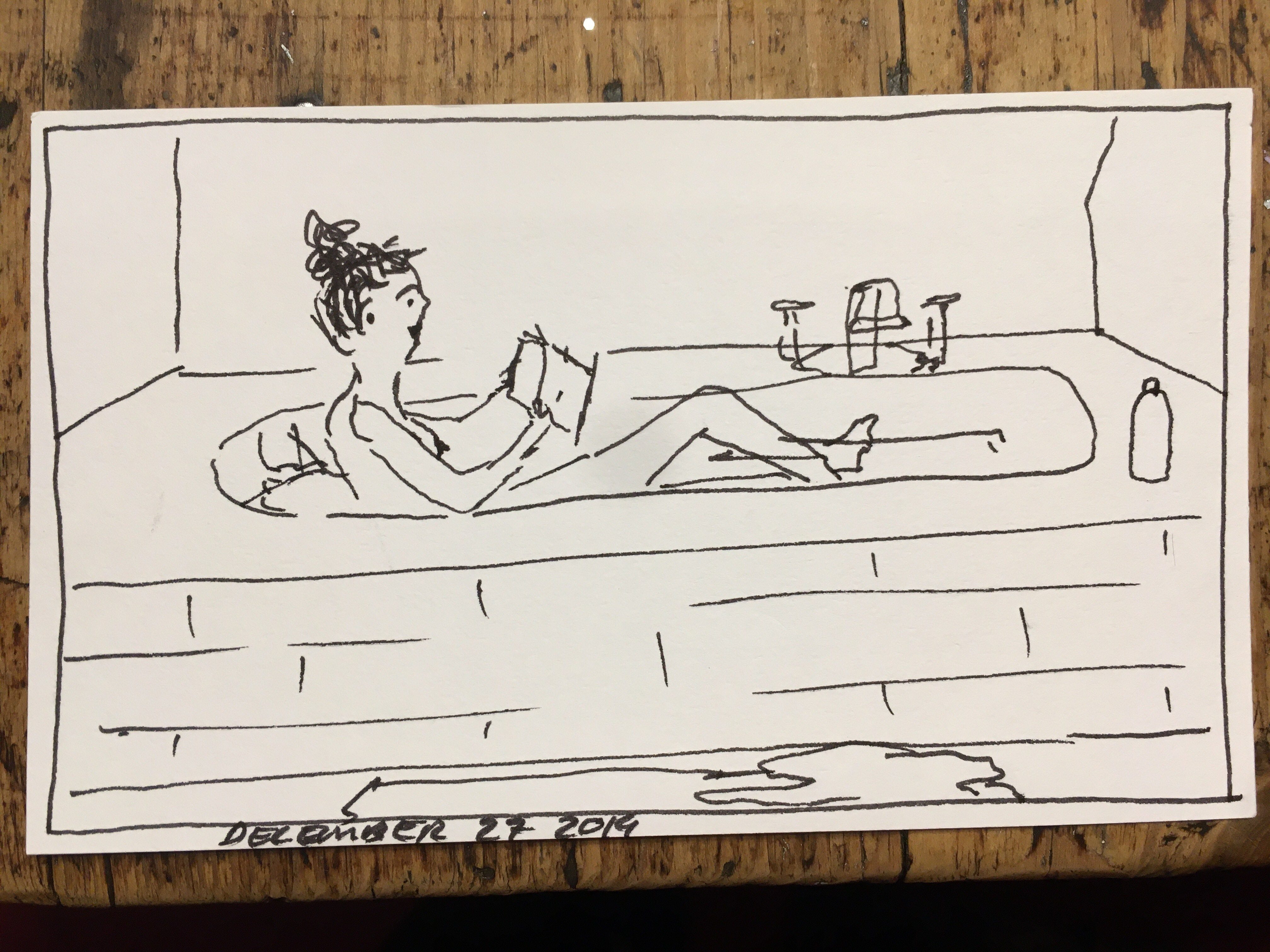
Returned to work after a week and half off over the holidays.  I had planned to paint and to draw and write and read with all that time.  I didn’t paint. I didn’t draw (with the exception of the daily index card drawings). I did some writing, but it was “thoughts jotted down in my notebook with no particular purpose” kind of writing.  Nothing serious.  But I read. I always read.

Writers of books are readers first, last and always.

Bernardine Evaristo

With the roll over into the new decade, I’ve reflected using the lens of a decade instead of my usual day or week-long filter that, too often, chalks up another failure to produce something. The ten year lens is far kinder. I’ve accomplished much in the last decade to be proud of.

I won’t list the books I have read in this time, but what is interesting is the type of reader I have become. I have become a reader who writes. A reader who writes reads differently. I read more slowly now, I savour words and sentences. I re-read paragraphs. I copy sentences out of books into my own notebooks. I admire. I read books on writing craft. I read literary magazines, discovering new ones all the time, and through that process, discover new writers. And yes, often the green eyed monster of envy enters my heart. But I am deeply inspired by writers. I want to be friends with the authors. I imagine the conversations we would share over a meal, the questions I would ask about their myriad composition choices. I read poetry, creative non-fiction and fiction, cartwheeling gleefully between genres. I read works that refuse categorization, that explode into a fireworks display of writing possibilities. I have to believe reading is making my own writing better.

I have always been a late bloomer. Slow. Methodical. Last week, a dear friend told me I’m being too hard on myself. I’m forced to hold the thought up to the light, explore its many facets. Maybe I should be measuring my progress in decades as opposed to days.

Here’s a pretty cool infographic depicting the length of time different authors took to write their books (please ignore the fact it’s an ink ad). It’s a comfort to know The Catcher in the Rye took 10 years to write; not so much comfort to learn The Lord of The Rings trilogy took 16 years to write….I would have thought longer. And of course, the shiny examples of books produced in hours or days. Shit. I will never be among their company. But it’s okay.

Cheers to the next decade! Clink clink!