

I didn’t quite get this post to come together the way I thought it might. I’m interested how my subconscious thoughts—thoughts that take my conscious mind so long to catch on, catch up—drive my writing[1] ….I’m learning to relax enough to draw it out, I’m learning to “see” it, and somehow, in my mind, this process puzzles together with world views…
When I visited Venice last month, top of my list was to stand in front of the Fra Mauro version of the Mappa Mundi at the Biblioteca Nazionale Marciana. This world map, completed in 1460, created using a southern orientation requiring me to flip and stretch my own perceptions of the world, is considered one of the most visionary cosmographical works of all time. I love that word, cosmographical…like, drawings guided by the stars. It’s a large hand-drawn map, almost 2 meters in diameter, of what was believed the world looked like in 1460. Belief is what I’m interested in…how it changes and shapes our thinking. What fascinates me about the Mappa Mundi, in addition to its gorgeously detailed hand-drawn beauty[2], is that Fra Mauro created his world view without ever moving beyond the shores of his Venetian island[3]. There’s heaps of fantastic information about the Mappa Mundi I won’t synthesize here, but well worth checking out; the AI project associated with the map is, in a word, dazzling[4].
A recent Saturday I woke, galvanized myself, and emailed a friend[5] in the writing community to request one of the two open mic spots at a public reading at the library in Picton. I left volunteering almost to the last minute to decide, yes, today (today!), I have the courage to read one of my creative works.
Then, I spent a quick hour editing the piece, changing the title and furnishing it with a deeper history. I ran out of time (is it ridiculous to think I would have that time?) and I knew the piece wasn’t “finished”. But I’m discovering no creative conversation seems to end…the writing continues to communicate beyond whenever I assume “I’m done”.
In my mind, I imagined the public library reading might attract 8 to 10 people. In my mind, they’d be milling about the stacks listening half-heartedly to the readings while they pulled random books from the shelves, splitting them open by their spines. So, imagine my surprise when I showed up, just as the event began, and discovered a far more formal arrangement: perhaps fifty people seated in rows and rows of chairs (none empty…when my daughter, Willa, and her partner, Nadine, arrived slightly after me, having parked the car, they sat on the floor against the wall), a podium, a mic, speakers and a video set up, aimed and recording.
I have not read my work publicly in many years[6]. Certainly, it was pre-pandemic. When I moved to the podium, the adrenalin kicked up from my stomach and pummelled my heart. The first paragraph was breathy. I lacked air to project my words. So thankful for the mic. In my mind, I kept repeating just read what’s in front of you Suzanne, it’s right there. Take a breath at the next period, you have time. Good. Next period, take a breath, take a deeper breath. By the time I reached the second paragraph, my breathing evened, and I managed to settle into the rhythm of inhaling and exhaling with the sentences.
And I edited on the go. I decided to drop a whole paragraph, suddenly seeing there was no need for it. I started to look up at the audience, interpreting their expressions (in my mind, this seemed like…confusion?). Three quarters of the way through, I realised I was enjoying myself, sharing my work aloud. The piece is dark, I know, but it turns toward the light by the end. But I felt when I’d finished, the audience hadn’t followed me through the turn. Ah well.
In the spirit of blind map making a la Fra Mauro style…I’m tracing the contours of subconscious thought, surfacing new meaning from those watery shorelines…this seems a translation made possible only by passing words through the chambers of the heart as opposed to catching in the net of the mind.
Here is the recording of the event. My reading begins at the 54-minute mark. Following the video, I’ve pasted the work in progress with some of my thoughts, marked using orange coloured text, that have arisen since (also during ha ha) the reading.
Measures (the original title of the piece was Just Math and the original draft focused on the mathematical aspects or logic that we [mis]apply to situations that are …less mechanical, more human…’Measures’ as a title got slapped on the piece the morning of the reading …I was thinking it might be a riff on the math aspects, but didn’t think too deeply…but now I’m discovering subconscious intentions, what this piece might be trying to communicate, exploring the choice to end one’s life, perhaps the most weighty decision one might make …so will likely keep this title)
I visit my father in hospital every Saturday. It’s not a real hospital, it’s a step-down unit, a retirement home repurposed to ease the burden of bodies (during the reading – why not before? I don’t know – I noticed how frequently the reference to “bodies” comes up in this piece…6 times…considering this because it signals some sort of corporeal versus what? spiritual? maybe…there’s a nod to religion in the piece…but no, it’s my subconscious circling the deeper meaning I am only seeing now: when is it time to depart a body, a body at odds with an ability to negotiate this world?) competing for limited hospital bed space. The patients here patiently await death. Or they wait to pass a test called Activities of Daily Living so they might score a return to former lives. It’s all about patient to nurse ratios and patient proximity to death. Just math.
In the lobby, plastic plants droop. A young woman sits behind a reception desk, her face blue with the glow of the computer screen. She says hello, but only when I say hello first. (during the reading, I dropped this paragraph thinking it didn’t add anything to the piece….now I’m wondering about the reference to blue here (the word shimmers for me), its multi-dimensional reference to depression…hopelessness…but also its vastness, its possibilities (open sky, open water, universe etc.).
The room my father is in, 316, is a small, one bedroom apartment designed to shelter a couple who really get along, or a solo senior citizen. Now it holds three aged men in three hospital beds and no chairs to sit on when visiting.
A man named Victor has the bedroom. He is tiny and more and more yellow each time I visit. He is skeletal, though his stomach balloons from his body. His belly button is definitely an outie. It probably wasn’t always.
My father smiles, caged in his hospital bed. A welcome. (when I wrote this, I intended to describe my father’s smile as a welcome one…except that word “caged” practically leaps from the sentence and grabs my throat so I notice there’s more going on ….the syntax here, laid down completely unintentionally, even an error if I compare it to what I had actually thought I had written, introduces sly ambiguity attached to the word “welcome” – do I mean his smile is welcome, or that he is [safely] caged (connotations of threat)? And the ambiguity provides a subtle warning for readers (and me ha ha) that there’s something not quite right between the narrator and the father…and shunts the transition from this paragraph to the next, where, their relationship, as well as the deeper history that shapes their relationship, is revealed.)
As a kid, his smile was a peculiar twisting of his lips, holding, like a cup, cruelty and condescension about to spill forth. We distanced ourselves from the inevitable poison, his words arrowing the air to the gut. We learned to excuse his smile. He, a refugee after all. A Canadian through revolution. His 13-year-old body a witness to other bodies strung up along the boulevards of the old city. Tanks rolling in. Molotov cocktails and body parts made kites. (‘kites’ in this sentence shimmers for me….it is only now that I am seeing any link between this word and perhaps the deeper exploration of this piece….is my brain getting too involved in meaning making here? Maybe. I wonder about the associated movement in relation to the violence depicted here, an upward flying movement….could it be departure of the spirit once a life is gone?) His smile, back then, did not seem a part of him, as it does now. Still, conversation’s an effort raised beneath such rain, beneath an umbrella of pain. (readers of earlier drafts of this piece were confused by the relationship between the narrator and the father: why is the narrator so interested in the Vic character, why are the narrator and the father not talking to each other? So I added this in…this paragraph was originally drafted as a breezy response to a writing prompt about remembering a smile.)
In room 316 of this not hospital, a glass door opens to a fake balcony. From there, looking down on the statue of Jesus I feel benevolence drain. I can only look out the window if the man my father calls “Lump of Lard” isn’t in the hospital bed beside it. A prosthetic leg furnishes the corner beneath a TV screen angled from the wall.
My father’s railed bed is in the kitchenette. (this was interesting, editing that morning, I did catch that several of my tweaks included variations on the word “railed”, a strange, if apt, description here…looking it up now, I discover its multiple meanings. In addition to “enclosure”, it also means “protest strongly”, “blame in violent language”, “object about something”…is this my subconscious wrestling with the idea of taking one’s life? I don’t know. Maybe.) If he wants a glass of water, he rolls to his right. Blue fabric curtains suspend from railings mounted to the ceiling. The fabric separates everything: Lump of Lard from my father’s radio tuned too loudly to the opera station, the angles of sunlight from reaching my father’s bed, the sorrows and longings of three different men.
Every week I visit there is less and less of Victor. His yellow skin droops from the sticks of his bones. His brown pupils bulge from sunken sockets shadowing his forehead. He often cries out in pain. “I know Vic! We’re here. We hear you!” my dad says, explaining it’s important to cheer him on. Vic is proud. He was given 4 months to live and that was 7 months ago. In my mind I wrestle with Victor’s decision to forego MAID, medical assistance in dying. His yellow death is inevitable; why wait? (this is the heart of the question this piece is exploring….I even phrased it in the form of a question…but it is only now, after the reading, that I start to piece this together...and realise the contours of this exploration need to be mapped into the piece to better guide the reader (including me!) through this question.)
Today, when I exit the stair well and enter the third floor, Vic sits in a wheelchair in the centre of the hallway. There is so little of his body. He seems only a distended stomach with a yellow head thrown back and a mouth agape at the ceiling. I’m frightened he’s dead. Closer inspection reveals his yolk-coloured bird cage chest expands and contracts round a fluttering heart.
Today, my father’s welcome smile from behind the rails. Today the opera is La Traviata conducted by Toscanini. An orderly wheels Vic past into the bedroom. Eventually, Vic shuffles by me to the microwave. “Is that your sister’s soup?” my father asks him. It is. While it heats, my father and Vic argue over the green leaves in the soup. Vic calls it by its Portuguese name; my father insists it’s kale. Toscanini chimes in. I imagine the Maple keys on the trees outside shiver-whisper and lean against a kitchen cabinet not interjecting. I understand—now–it’s joy arguing a position.
Vic lifts the bowl of soup from the microwave then raises it to his face, closes his eyes to concentrate inhaling the steam, the spice swirls of Portuguese sausage. I hear his eyelids when they snap open. A light dances in his eyes. He raises the bowl, wafts the steam towards my face. Its gloriousness travels from the tips of his yellow fingers to grace my nostrils. I smell chicken stock and chilies, the green of leaves, the orange of coriander seeds. (here, I think, a missed opportunity, but must be executed (oohhh bad word choice in this context, ha ha), delicately – the food description here with colours, orange, green, needs to be enhanced better, after all, it is this pleasure that is highlighted here, a pleasure that keeps one tethered to a life in this world, even when the body disintegrates…so it deserves special attention, this sentence….but not go over the top. I have a habit of going over the top…so, Suzanne, don’t rush this). I think anyone would give a life to taste such cooked-in love. (a strange sentence…and only now I’m seeing it differently, changing my view of meaning …it’s a reference to the relationship between the narrator and the father ….how “cooked in love” contains multiplicities, and how sometimes, it takes one’s lifetime to learn compassion and forgive. Or maybe I have now gone far too meta here…does it matter? No. But I find this analysis fun, so continue.) Suddenly, I understand not only the pleasure of choice, but how infinity might be measured. I pull the blue curtain (note repetition of blue curtain, not sure what it means, if anything) to the wall. Sun splashes in. My father is up and walking with the aid of a walker. His test score improves. I reconsider MAID, its balance. I instruct my father to stand by the window. (these two sentences, “reconsidering MAID” and “instruct my father to stand by the window” come too close in proximity so their meanings get hooked together when they shouldn’t be. As they are placed now, it leads a reader to think that maybe the narrator is going to push the father out the window, save his decision to take his own life and do the deed quick….so, this needs fixing). The fake balcony door opens easily. Sunlit wind rushes in. Below, seed keys on a Maple tree twirl the grey twiggy ends of all its branches. It sparkles. It winks. Alive. So beautiful it can only be a miracle. Sweet air of outside too. Toscanini’s violins.
So, the trick to writing that connects—offering one’s hand in the dark—is to catch oneself in the act of sharing an open heart …the subconscious is not so shy of dialogue there …surprising words (or vibrating ones…a shimmering…this is often how I experience it) or phrases, or images, offer clues of deeper emotion, deeper intelligences of the body, an energy moving through. Somehow, authenticity must be rendered on the page without a cage of words but through a window of words instead. The techniques of syntax and rhetoric …they are ways to lead a reader through a writer’s thoughts so they follow the pathway the writer has mapped to communicate…they are clever ways to amplify meaning and entertain. But, fundamentally, a writer must be authentic to themselves and express that authenticity through love, gifting one’s deepest self to the world. So, I continue this eternal pursuit for the song of myself, to quote Whitman, and share a voice that sings.
This peace making with my slow subconscious writing process, waves away all my jagged edges, the way the sea softens stone shores, crest after crest after crushing crest, until I rise, battered, sopping wet, but smiling.
[1] Subconscious thought…unquestionably the most essential tool in my own writer’s toolbox …but I wield it with juvenile dexterity, a lazy magician with performance anxiety.
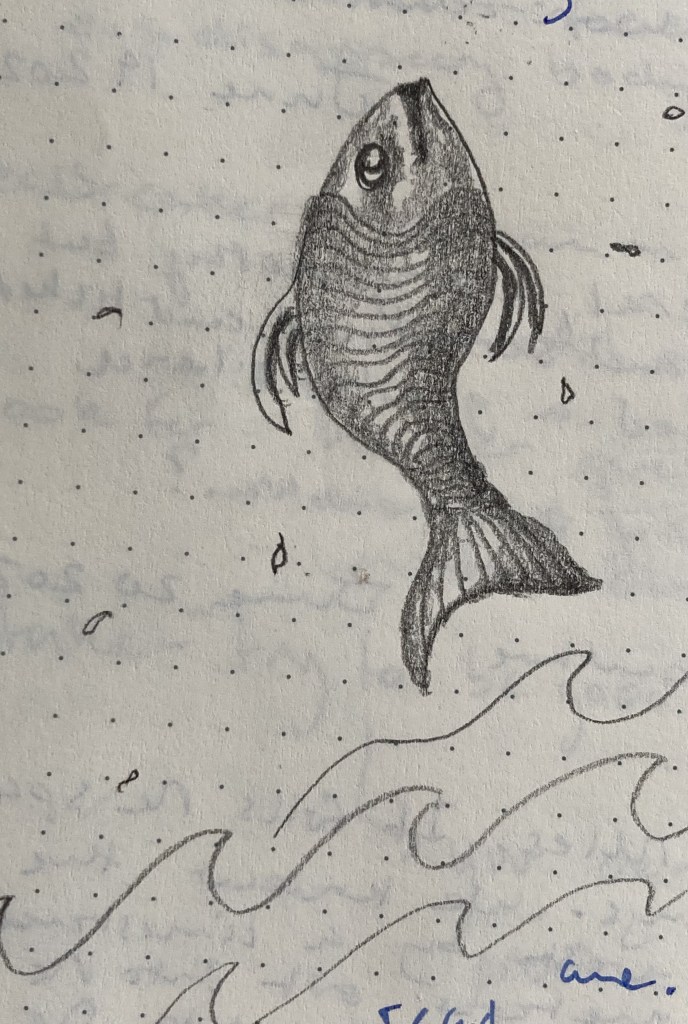
[2] The ocean, lake and river waves are drawn using ultramarine ink created from crushed lapis lazuli, one of the most expensive semi-precious stones before a synthetic version was invented. Because of its value, the pigment was often reserved for painting the Virgin Mary’s robes….I love this kind of information. Colour, by Victoria Finlay, provides a comprehensive overview of pigments…it’s a dense read, but fascinating. On the Mappa Mundi, there are little drawings of fish and sea monsters and castles and dome topped turrets. The calligraphy is neat and tight. There are drawings of the heavens and the garden of Eden.
[3] He consulted ancient and contemporary sources and triangulated the information to create his own…but it still fascinates me how he mastered translating three dimensional navigational and topographical information into a two dimensional work of art from behind a desk.
[4] This AI project mirrors the methods originally used to create the map in that it collates historical and contemporary interpretations of information to write new ones…it’s also worrying, the ease and speed new stories, gathered by machines, supplant old ones (the website name is ‘engineering historical memory’). But then I think, isn’t this what we all do? Even the act of remembering shifts and changes an event; the actual experience is never fully recovered…I guess we try to repeat and create experiences of beauty and love and eschew painful ones…and those interpretations shape the contours of our choices…and ultimately, our own story.
[5] Thank you, Nora-Lynn, your smile provided warmth and encouragement when most needed. I also appreciate you put my name to the task that day, thank you to both you and Jane for hosting a lovely event.
[6] I have read in virtual settings, always with smaller groups. Currently facilitating virtual writing sessions with the Writer’s Collective of Canada and we share our reading as part of each session. It has been wonderfully inspiring to listen to others’ voices. It’s also good practice for speaking my own.





 Process Peace