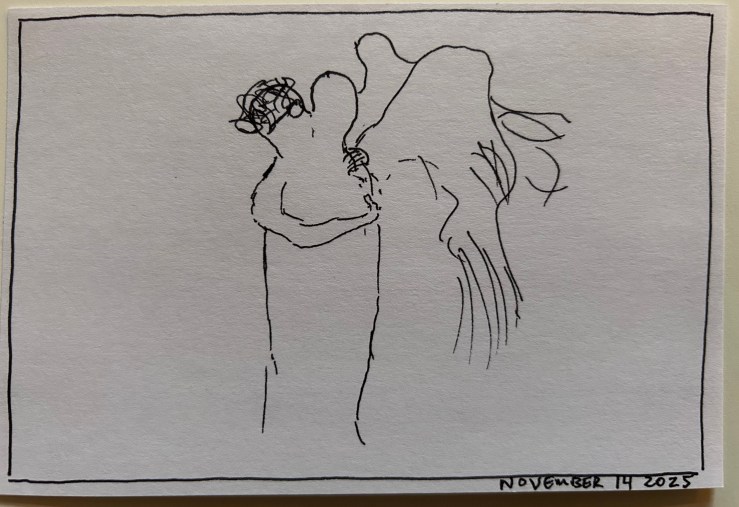
Tune(s) Up

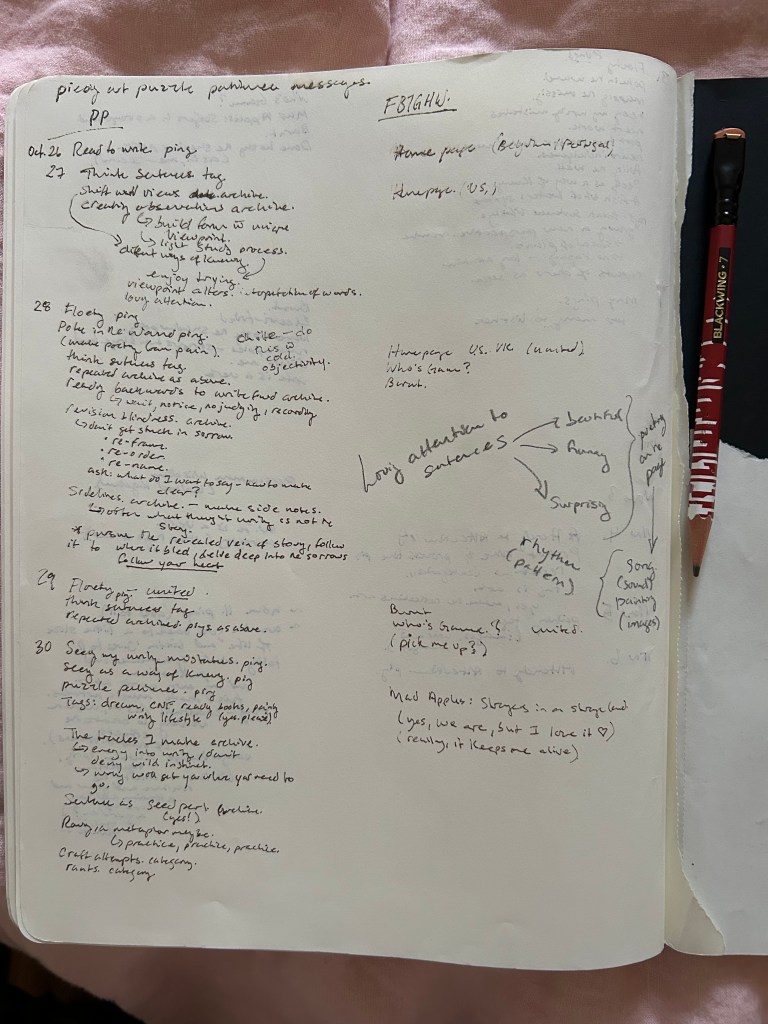
Thank you for your many messages. They guided my approach—which I’ll summarize below—revising A Marriage: Framed (CNF <2500 words) AND showed me to trust my own words and my own process. Your belief helps me believe. A blessing.

There was a lot of tinkering (ink -er-ing) trying to take this story to top level writing technique. I continue to tinker. Top level is…a dream, a ceaseless chase. And yeah, the chase really is a lot of fun [Insert: series of horn blasts and voice signals and Tally-ho! Here we go!].  

Last month, I posted my experience pruning A Marriage: Framed, taking it from 3770 to less than 2500 words. The process was fascinating because as I cut the words down, the focal point shifted, a spin that forced the painful emotions at the heart of my 27-year relationship with my ex to surface. Emotions I’d suppressed for decades.

Struggling to understand and move those emotions out of my body onto the page transformed them into “an object” (a writing piece) outside my body that I can interact with and control. I’m less “imprisoned” by my emotions, if that makes sense. I feel almost as if the rewriting of the draft I completed last month was a “therapy” draft. The story moved from being deeply subjective to objective, enabling me to turn to tackling the craft and technical aspects in the writing with a cool(er) and practiced distance[1]. This latter process, I’ve discovered, is essential to move the emotional therapy draft through a series of systematic style techniques so the artifact might approach a work of art. 

I wrote about my nascent practice and understanding for how to work with the subconscious as part of creative writing process in a post last March. Today, I want to build on that earlier exploration with some concrete examples because I’m trying to understand and practice tangible methods for working with less tangible materials. Silence. Air. Thoughts. Dreams.  I was thinking about how a musician works with the silences between notes to modulate pitch and tone, melody and harmony; how a sculptor carves a block of stone to encase a shape of air.  And my mind slid from that image to a memory of being captivated by a sculpture of Leda and the Swan when I was in Italy last fall.

I was rushing through the monumental halls on the second floor of the Library of Saint Mark in Venice in order to see the Mappa Mundi before the gallery closed. Speedwalking past innumerable marble busts, I stopped abruptly, struck by the unique portrayal of the infamous myth, an erotic story about the god Zeus, disguised as a swan, seducing the Spartan Queen Leda. The question about the nature of the seduction, whether coupling between the two was consensual or not, revolves the ages. This specific statue, its image, its energy, has stayed with me because of its beauty, yes, but also its ambiguity …for me, this sculpture is tangible object and emblem of desire-resistance all at once. Leda and the swan are carved to their moment of intercourse and Leda seems, at least to my eyes, both taken by surprise, as if she’s not quite ready to take on a god (she pushes the swan away) and surrendering to her attraction and desire at the same time.  

Roman variant of a possible Attic original of the mid 1st century BC Giovanni Grimani collection, 1587

I hadn’t appreciated why this sculpture has enchanted me for more than a year, until today, when, sifting my thoughts for something concrete (well, marble in this case), this memory surfaced. By embracing the complexity of the original myth and removing the layer of Greek mythology, I choose to think of this sculpture as a symbol of unification between spiritual and human worlds. When creative writing, I feel the spiritual world, or divine might be a better word, is a part of (or accessed via) the subconscious. The vibrating energy I can feel as I draft using stream of consciousness writing (read: writing without thinking too much) is intuition. Intuition is much like a tuning fork. I’ll try to explain this shortly.  

I’ve missed many of the signposts from the subconscious in my writing drafts—they arrive as words, resonances between words and as sensory images. I’m learning how to identify them and practice how to work with them and preserve them to create a net of story words that communicates something beyond words: feelings, energy, magic. Art.

Here’s an elegant and far more beautiful articulation for what I’m trying to say:

“Story form is an object, a translucent, shimmering thing with words tacked to the surface of its swirling involutions. The words glitter with their own reflective colouration; in them you see the momentary reflections of other words. Wires as thin as gossamer connect the words with more words on distant parts of the structure where they set up new colonies with flags, banners, replicas, and maps of the whole. Spin the form and the same words appear in flashes, the eye registers their rhythmic insistence[2]. It is wonderful and miraculous to watch.”

Excerpt from the essay, Anatomy of the Short Story, in The Erotics of Restraint, by Douglas Glover.

 Tune Up Techniques

My revision was guided by generous writers and readers who offered their love and attention and time to enhance my piece. I’ve said it before; creatives work in community. I’ll write more about that in December. My learnings I write here derive collective wisdoms of too many people to name.  Thank you.

Ideally, or shall I say, if this were easier, I might have started revising the Macro aspects of the piece—story, plot, characters, setting, points of view—then moved to the more Micro levels of paragraphs, sentences, rhetorical devices, syntax, diction.

But that’s not how it worked in practice.

There were the metaphors and the patterns and the desire-resistance tensions and the images that slid to occupy both macro and micro levels and, most important, all the space vibrating between. That’s the art object space, the space of Leda-swan. It’s an easy space to get lost in and an easy space to miss.

My tune up process was messy, not linear. Nor did it happen in steps, though describing the process here necessitates a sequential recounting. Revising was pressured by the word count cap, 2500 words max. The restriction served the writing in many ways by forcing disciplined compression (of words, sentences, images and ideas).

The process felt like persistent twisting, moving around and up and down and through the piece, working to understand my intentions and meanings, then shifting sections here and there, and tweaking here and there, and slowly, slowly, slowly, the piece contracted round an essential essence of tight emotional communication, complete with shimmery swirly resonances, into story art (ish…I’m still practicing).

Working with Vibrations

Ok, first, two indispensable applications I think I’ve failed to post on this blog, probably because my use of them is so integrated with my writing process I’ve neglected to emphasise my reliance on them[3]:

  • Word Hippo (thesaurus, word tools, etc.)
  • Online Etymology Dictionary – I love how they write on their site (my bolding),  “Etymonline aims to weave together words and the past, answer common questions, and sow seeds of serendipity. Sowing seeds of serendipity is exactly why and how I use this site. It’s a creativity generator.

Choosing the right word requires deep attention to what it is I want to say (what I intend a sentence to mean), the connotations I intend to (try to) control in readers’ minds, but also how I wish to communicate it. Choosing whether the flavour of communication should be sweet or bitter, whether the texture of communication should be hard or soft, whether the sense of communication might be cold or hot.

Here’s an example. In the original longer draft, I had an entire paragraph describing the situation where the husband explains he won’t allow his wife to attend the funeral of her friend’s dad. When I cut that paragraph down to convey its essential meaning in one sentence, I wrote, “[He] embargoed my attendance at a male friend’s dad’s funeral believing my intent was seduction.”

Ok, that word embargoed practically leaps off the page with melodrama and elevated (snobby) language. Instinctually I disliked it, but it captured the essence of meaning I was after, which was restriction or “not permitted”. The vibration of my distaste of the word (in this context), even though it had the right meaning, signalled—and I should explain, this feeling is super subtle, very easy to ignore if I’m not paying attention—there might be a deeper meaning.

I sat with the word quietly and patiently and questioned it, exploring its alternative meanings. The idea of ownership surfaced to consciousness …which is a concept I’m exploring in the larger piece. The subconscious offered “embargoed” up…but the flavour (snobby) and timing of it wasn’t right…I didn’t want to introduce the idea of ownership so early in the piece (this sentence comes in at paragraph two). I wanted “ownership” as a concept to build slowly through the piece, mimicking the way the wife experienced this revelation over time.

So, I fiddled with it. I ended up using the word “barred” because it conveys the meaning of “not permitted” and extends it into an implied image (physical bars) introducing the connotation of “prison” without it being overt. It’s also a soft, quiet word in the mouth, so a reader might glide past, carrying its meanings without tripping on them (embargoed is practically a foot stuck out in front of a running reader). The sentence became, “[He] barred me attending the funeral of my male friend’s dad believing I intended seduction.[4]

This is what I mean when I describe intuition as a tuning fork. It’s the vibrating intuition that guides which words and phrases bring the meaning and feeling and senses and sounds to coalesce in tune with the piece as a whole.

Another example, this time at the sentence level. In the therapy draft I wrote:

The kind of love that made me bump into walls, sliding glass doors and fail to recall what street to turn down to return to my own student house. The kind of love that made me forget to eat, made my skin glow, made me sing greetings to strangers.

I liked the repetition of “kind of love” because of the rhythm it introduces as well as the way it draws attention to the listed descriptions and also, the super subtle question injected by those words “kind” and “of” placed side by side, implying “sort of” …as in, this is the way the wife loved but was it a sort of love? A half in/half out love? I know, tenuous.

Also, “made my skin glow”…vibrated (intuition tuning fork struck)…what did I mean by this? I meant our lovemaking made my skin glow. An opportunity to align that idea with the larger story, which does circle and explore sex. Compression, and playing with the sound and syntax, reshaped it to:   

A colliding into walls, strike sliding glass doors kind of love, amnesiac love, missed meals, abandoned panties kind of love that made my skin glow.    

Working with energy

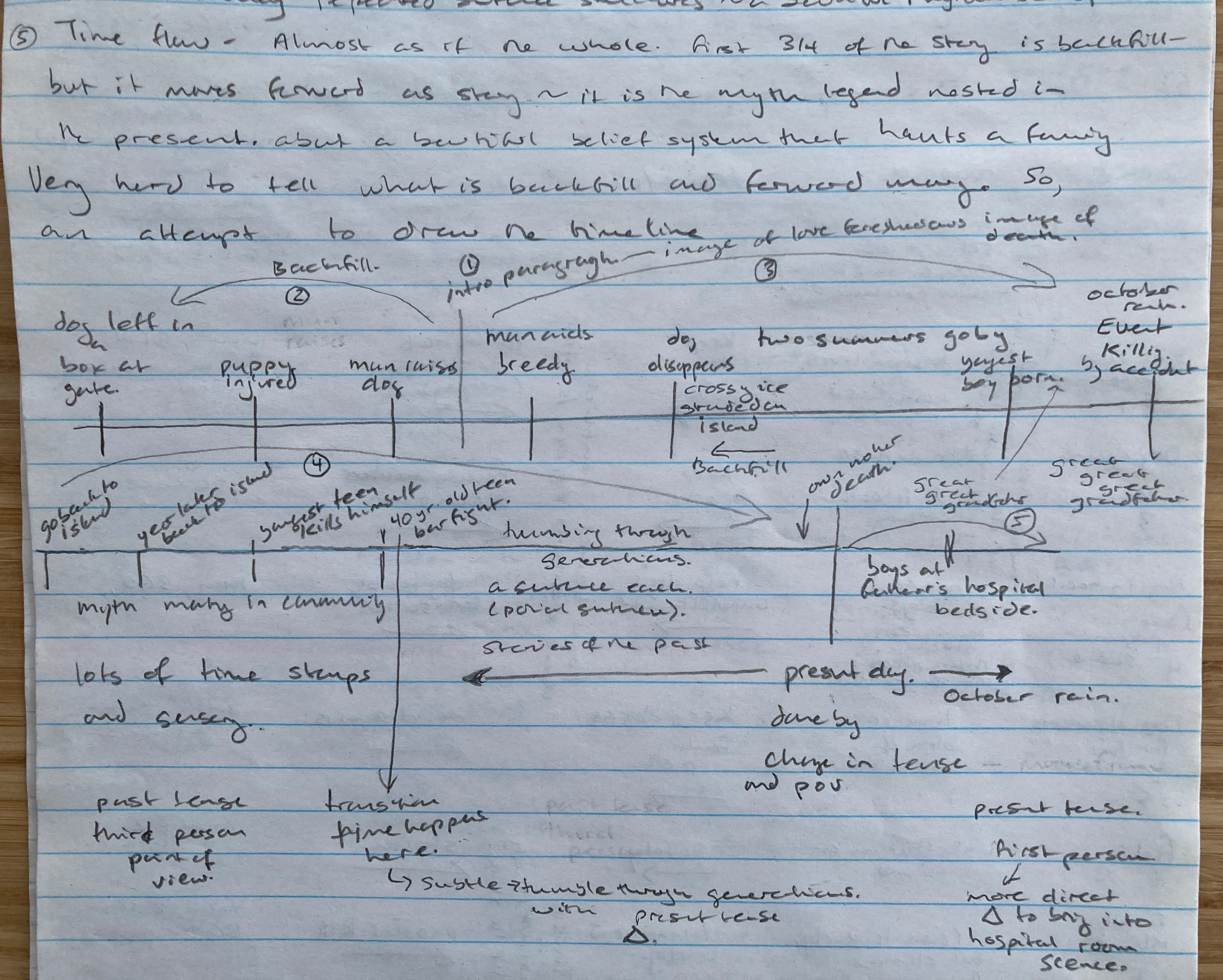
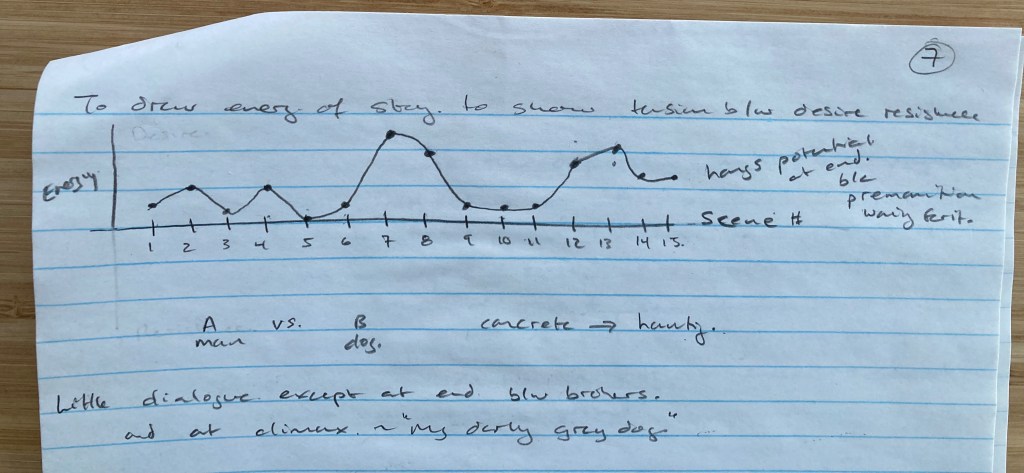
I wanted the reader to feel the same crescendo of energy and collision-like impact as I had experienced with the real event. So, I needed to recreate it. For this story, I wanted to begin with a quiet energy of curiosity that moved, incrementally, to build momentum through the piece toward a detonating end.   The best way to describe this is by comparing it with music. This tune,  You Look Like Trouble, by Lisa LeBlanc, embodies the energy arc I was after for my piece (and I’ve drawn what I mean in the graphic below).

But how did I do that? Well, I practiced what Summer Brennan refers to as the controlled release of energy by considering the way energy builds up and is released. I felt my way through this intuitively, and my attempt to describe it here is underdeveloped. Mostly, I feel, it was a conscious effort to pace story events, laying out the information that keeps a reader interested and curious and engaged, building on story events so they acquire more and more meaning, modulating sentence length and sound to align with intended meaning as I went (as described above). Layering information.

But also, this short piece is intense. More than one reader described it as a run instead of a walk. As the tension ratchets up with information layers (about who these characters are, their behaviours individually and in relationship), I deployed a technique I use often in my writing (and uh, life), the use of parentheticals and narrator intrusions to break the tension and release the energy.   

Here’s an example of this technique: This tragedy seemed particularly attractive (saviour complex? Fuck. Maybe.).[5]

Working with Metaphors and Imagery

I think of metaphor and imagery as working with dream. For me, this is the most prominent language the subconscious surfaces in my creative writings. The therapy draft revealed many. I adore working with metaphor and image and I avoid letting any go…I feel they’re a kind of magic, the spirit world made manifest with text on a page. But the therapy draft made visible, perhaps for the first time, my subconscious tendency to insert a metaphor or an image as an avoidance technique. Instead of forcing myself to move deeper into painful experiences, I throw up a metaphor and skate right past it. Once this was pointed out to me (thank you Barbara!), I could see where I’d done it, soft bodied ego protecting itself. So, I spent some quality time with my pain and worked to describe it clearly, straightforwardly, in scene.

Quite naturally, after I’d rewritten those pain sections, the imagery refined throughout the piece and miracle of miracles, the ones that remained hung together associatively. In this story it’s repeated imagery of sunlight and storm. I worked to sprinkle this imagery through the piece, augmenting associatiions with words resonating the same sounds and meanings, and tried to follow the energy arc by beginning with sunlight and ending with a lightening strike.   

And I tried to get some beautiful sentences in. There are a few I really like. Playing with sentences had me waking in the middle of the night to puzzle them through. Here’s one that didn’t make it into the piece, but I leave it here for your pleasure and song.

And what is love? Laughter donning roller skates, heedless of the hill[6].


[1] It’s important I make a distinction here. Even though I’m bandying the terms “objective” and “distanced” and “cold” and “systematic”, which raises “scientific method” connotations, the process for moving into technical tune up MUST (MUST!) retain an open heart and keen attention to the body warming when the vibrations of instinct ping. The process is slow and methodical. I know I’m on the right track when I’m delighting in the discoveries (the right words slip into the right place; the sounds; most of all, when unexpected injections of humour are revealed).

[2] I love the way the movement, “Spin the form”, resonates with the words “colonies” and “replica” and “maps” in the previous sentence to deliver an image (implied) of a spinning globe, a twirling world, disco ball like with those flashes.

[3] I used to use a visual thesaurus as well, but default to word hippo these days. Before that I used a heavy hardbacked Oxford thesaurus I “borrowed” from my housemate in second year university. Sorry Jeff, it’s still on my bookshelf.

[4] Also shifted words around to improve difficulty comprehending “male friend’s dad’s funeral”. Thanks Stacey! We decided the passive might be okay in this instance, a sacrifice for clarity.

[5] I am fretting over the punctuation here. I think this is right.

[6] I woke at 1:16 am thinking this question: and what is love? In half sleep, the words/image (as one) arrived: laughter, roller skates. After a trip to the toilet, more words: back to the hill. Later that day I played around with the words a bit to come up with this line…a line I’m happily hooked on because it feeds me, nurtures me, continues to shimmer. Sparkle. Delight.

Leda does love him. She shares his dreams.

Neuroindulgence

Quick preview: this is a long post, steering (dragging?) you, dear reader, through personal memories and thoughts related to books I’ve read, coupled with an embarrassing but brief writing draft, followed by tottering, slipshod connections toward a conclusion I’ve reached before. I can’t promise return on investment. But there’s repeating reference to naked breasts. Female ones, even. So.  

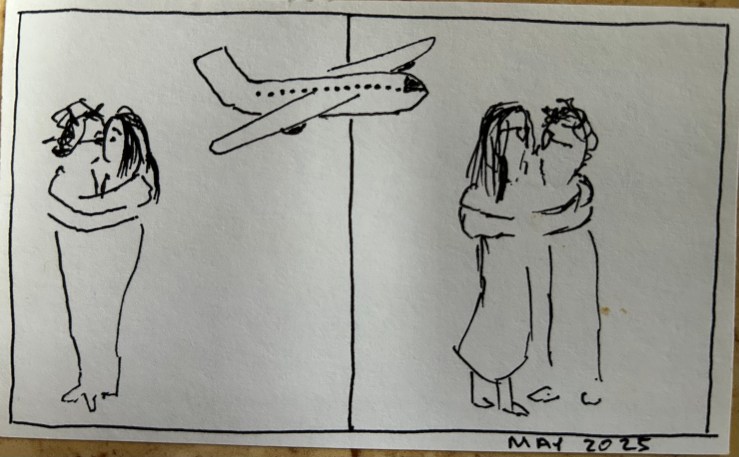
Home now after two weeks away. One week in BC moving daughter number one from Victoria to Vancouver for a summer internship, followed by a week working in Toronto, staying with daughter number two. A delightful day in the middle where I hugged one daughter in the morning and the other in the evening. Trees fluffy with spring blossom. Out west, the sweet scent of budding Black Cottonwood mingled with brine. In Toronto, Eastern Red Buds branched hot pink; spent and ragged-edged magnolias flowered the sidewalks.  Despite the beauty, spending time with the girls, the relief it’s finally spring, travel disrupted my writing routine, making me edgy and irritable. This morning I’m up at 5, determined to recoup the energy and time necessary for the task[1].

And though I didn’t write while away, I read. I’m mid-way through deep reading an essay I’ve intended to analyse for years, The Fourth State of Matter by Jo Ann Beard. It’s one of several pieces of writing I pulled for the trip, selecting a diversity of works to understand their structural elements and track emotional movements therein[2]. I’m trying to slow my reading sufficiently to understand where and why and how my water works turn on, where sentences spark to fan the embers of my humour, igniting laughter[3]. I thought I’d start with pieces that elicited obvious emotional reaction for me when I first read them.  As always, I underestimated the time such close reading requires, hence my half-way point through the analysis of Beard’s essay. The folder of works I carried across the country and back remained unopened, mostly. And as always, I picked up books along the way…

An interesting observation: I had completely forgotten Beard’s essay is about a school shooting. Like, completely forgotten!!! Instead, the lingering images and feelings I retained from the essay were how the narrator loves and cares for her dying dog. I remembered she carries the aged collie up and down stairs and endlessly washes soiled blankets to place fresh, dried ones beneath the incontinent animal. It’s the love and devotion and grief and longing captured in those images that I remembered[4].

And that got me thinking about the selective and specific memories of book length works my brain holds onto. Is there a pattern to them? Are they all images?  Are they predominantly feelings? What makes them memorable for me?

This brief sample list is poor representation of my rapacious yet superficial reading habit; I read widely but not deeply[5]. I’m working to improve deeper reading. Now, I always read with a pencil in hand, underlining passages, scribbling notes in the margins, extracting sentences, passages, into various notebooks, feathering pages with coloured post-it flags.  And, if I’m honest, it’s only when I write through analysis, i.e., not think through it, that I really get a sense of the mechanics and the magic, hence the indulgent footnote #4 (it’s more for me than for you ha ha).  

This list is the “top of mind” list …I’ve limited myself here deliberately. See? this is me not going to my bookshelf to divine more of my memories conjured off their spines.  The clumsy imprecise rendering here is also deliberate…these are the fuzzy bits retained. Sometimes the only bits. Maybe this betrays a sieve-like brain …or worse, a brain-like sieve.  

  • Like Water for Chocolate by Laura Esquivel – scene at the dinner table where the protagonist, forbade by her mother to declare her love to a young man who we know loves her back but is betrothed to her eldest sister, cooks her unrequited passion into a spectacular dinner of dishes, including rose petals (!), the whole family share. But it’s the middle sister who “eats” the cooked in love, becoming so consumed with heat and lust and passion, she rushes from the dining room, somehow loses all her clothes in the process, runs across a field in the dark and her naked body, hair streaming wildly, is hoisted by welcoming arms onto a horse ridden by a passing _______ …can’t remember this detail …soldier? Bandit?  Some kind of handsome outlaw anyway. He happens to be riding by with his gang. This scene makes me feel…envy.
  • Love in the Time of Cholera by Gabriel Garcia Marquez – the protagonist (though, maybe this is a side character?) goes out of his way to eat asparagus every day so that he may smell its telltale odorous byproducts every time he pees. Oh, and a pet parrot that blurts out inappropriate phrases (swearing?) and lives half in and half outside the house[6].
  • The World According to Garp by John Irving – Garp frying onions, building the mirepoix, to make spaghetti sauce which attracts a woman neighbour to his door, inside his house and eventually into an extra-marital affair[7].  Sigh. It always starts with an onion.
  • The Brief Wondrous Life of Oscar Wao by Junot Diaz – the mother’s sly smile, her wig askew after she fakes a fall and injury, a smile like a tiger’s smile (I likely have this detail wrong) after successfully tricking and luring her teen daughter back to her on a boardwalk in a very public place.
  • The English Patient by Michael Ondaatje – when the beautiful Sikh bomb diffuser shows the nurse a wall mural in an ancient church. Lots of candles[8].
  • All The Light We Cannot See by Anthony Doerr – spectacular book! I loved it. But I mostly retain an image of seashells sparkling on the walls of a seashore cave that is fast filling with the tide? Good grief.  
  • Anna Karenina by Leo Tolstoy – Vasilly scything the wheat fields alongside the peasants. Amazed I remember the character’s name. I love this scene…the movement of all the people, men and women, working together as they harvest their way up the hill of wheat (or is it down?). Vasilly’s satisfaction with working his body this way. Seem to recall he’s depressed a lot, how his physical exertion is a balm.
  • For Whom The Bell Tolls by Ernest Hemingway – a side character’s name, Pilar, and characters hiding out in arid, treeless, boulder strewn mountainside cliffs….waiting….waiting …waiting.
  • Industry of Souls by Martin Booth – this is my favourite novel…I’ve read it several times…I don’t know why it endures as a favourite…perhaps it’s the structure, a gentle moving back and forth in time as the protagonist, a man in his eighties, must decide whether to stay or leave Russia, whether to return to England. I love how the character moves around the small village he lives in, saying goodbye to all the friends he has made (for some reason, an image of golden light and lazy bees rises in my mind’s eye here). The visits tip the protagonist’s memories and readers follow his thoughts back in time to when he is a prisoner in the gulag, Siberian labour camps.  A few scenes stick out in memory: one where the male prisoners are found by female prisoners and they pair off in various semi-private mine shafts to make love; another when the prisoners dig a mammoth from the permafrost and eat it; and the most enduring clear image of a man who decides to take his own life by stripping down and sitting down in a snowbank to freeze to death (this happens at a train station).  
  • The Prince of Tides by Pat Conroy – the scene where the mother character takes her children to a clothing store and they’re crammed in one of the back change room stalls where they overhear the storekeeper women making fun of the mother with nasty comments about the beautiful magnolia (?) flower she wears in her hair…it’s the bit where the mother’s face falls, she’s humiliated but endures this in silence…it’s an image, I feel, connecting to the fall from innocence…this scene always makes me cry.
  • The Grapes of Wrath by John Steinbeck – travelling in cattle cars across great deserted and desert-like fields, tumble weed bumbling by yes, but the scene I remember is the one where the young woman (who lost a newborn?) unbuttons her blouse to breastfeed an old man who lays on a roadside, slowly dying[9].
  • The Good Earth by Pearl S. Buck – the scene where the wife of the landowner/farmer pauses the hard work of crop raising to breastfeed between rows of plants, her milk gushing forth and spilling all over the soil …weirdly, this memory is retained because I felt the author had no clue about breastfeeding, describing the milk letdown as happening from one breast at a time.

Okay. I remember others but I’ll resist (more) self-indulgence and stop here.

Reviewing the list I didn’t really see a pattern, in any technical sense. Sure, could boil these down to “imagery” but they don’t quite slot into that category (asparagus pee?). But yesterday, thinking about Beard’s essay and the dog who can’t help but pee inside, I suddenly connected it to a short piece of writing I drafted earlier this week in response to a writing prompt. Perhaps reading Beard’s essay was a subconscious nudge to write this response, drafted during a12 minute timed write. I’ve transcribed it here, resisting the incredible urge to edit it. The writing prompt was, “write about shame”:

Probably most of us walk around with shame ballooning inside our bodies…a water balloon weighing us down, threatening to burst and make a horrible puddled mess, one shame bursting on the next. And I don’t want to talk about my big shames tonight so maybe a simple story about a little one. I used to wet the bed when I was little. But not so little this might be acceptable. I was well into my grade two year and still failing to rise from deep sleep to get to the toilet in time. The shame would wake me though, wet and warm, gathering at the back of my thighs and knees, pooling beneath my buttocks. My mother trained me not to wake her so I changed the sheets on my bed in the dark, remembering to layer a thick bath towel folded in case it might happen again.

I went to my first sleep over in grade two. It was spring because my friend and I were allowed to sleep in the camper pop up in her driveway. Of course my mother had phoned my friend’s mother before I arrived because I could read the curiosity and the pity on my friend’s face. I’d chosen to wear my favourite pajamas, Little Dollies I think they were called, a pair of short bloomer-like shorts with an A-line tank top, frilly bits round the hem. My mother had instructed me to wear a diaper. Cloth in those days. She’d pinned it to fit me before I’d left home then folded it in my bag till I’d need it at night time. At night time I changed in the bathroom, dragging the thick diaper cloth up the length of my legs to rest at the hips. The safety pins were capped in pink and they jutted visible beneath my pajama bottoms. When I met my friend in the hallway she looked me up and down. No words passed between us but it was pity I read, again, on her face. My shame coloured my cheeks red.

The next week, when we played barbies, she and her sister stole my red barbie boots, knowing I would never argue for my rights to them, the shame a lever they now knew how to pull.   

Soooo…reviewing my remembered novel scenes after connecting my writing response with scenes from Beard’s essay, closer scrutiny does reveal a pattern…but a pattern unique to me[10]. The scenes in the list evoke an emotion (or series of emotions in relation to one another) that ties in with my own emotional experiences …and they are less literal connection, more emotional resonance, pinging off in ways also unique to me.

The process of identifying the emotional resonance between these remembered scenes and my own experiences, is analogous to reading through my own draft writings to gather fragments where I detect emotional vibration/heat, and learning to thread them together, piecing them in a way that leads a reader through the repetitive rise and cascade of my personal emotional experience.  I have come to this conclusion before, but writing through these scene memories in this post, I’ve progressed a key learning: how and what a reader connects to and remembers is as unique as a fingerprint. Before now, I’ve understood this theoretically; now I understand it practically. My job, as a writer, then, is to infuse my writing with as much emotional authenticity as I can, knowing it will touch every reader differently and never knowing, or ever being able to truly predict or guide, how or why. This eases my anxiety about connection. Somewhat.

Thank you for reading.


[1] I’m trying to make peace with my energy levels declining with age …or is it that day job work siphons too much from me?  I don’t know.  I haven’t risen for 5 am writing practice for over a year, slipping my wake up to 6, then 6:30 am, believing I’ll get to what I need to in the quiet evenings. But I don’t. I’m knackered by then and/or I continue trying to fit it all in, experiences I mean, by attending webinars, learning a language, volunteering and meeting friends…all essential to living a good life, yes, but leaving too little room for creative work. So, 5 am wake up begins again. Creative work is priority.

[2] Writing I carried across Canada and back, in addition to Beard’s essay: Report from the Bahamas by June Jordan (have done a deep dive on this one in the past, warrants another); Consider the Lobster by David Foster Wallace (I was delighted to discover his judicious-footnote-use – a compadre); The Race Goes to the Swiftest by Barry Lopez (in my packing haste I thought this was his essay about sexual abuse, but no, that essay is Sliver of Sky; The Shawl by Cynthia Ozick; Two Hearts by Brian Doyle; Onion Heart by Rupert Dastur; Triangle by Larry Brown; A Story About The Body by Robert Hass; a Substack post, American Letters 5: Swim to Shore by Alexander Chee; pages 14-18 of Midnight’s Chicken by Ella Risbridger. Listing these here, I realise my idiocy, believing I might bend time to accommodate such deep study in only a week of vacation while moving Lillian between apartments, visiting my sister and her partner in Squamish, and my uncle in long term care, not to mention the time change and travel days. Still, carrying writing around…there’s a comfort in it, a sense of optimism, of potential, the eternal hope it will just absorb through my skin.

[3] I always return to Douglas Glover’s rubrics for structural analysis, as well as his emotion writing exercise. Really, DG’s words are never far from my mind.

[4] The essay is an exploration, and I would go so far as to say “an artifact”, of the experience and impact of trauma. An essay composed of fragments, culling moments from across a swath of time, laid out non-linearly with subtle-to-the-extreme time stamps—accomplished technically using brief switches in point of view and super brief tense changes. The use of mostly present tense despite different time points, creates the sense of disorientation and disconnection for the reader. The form mimics the experience of what it feels like when life as you know it is blown to pieces. Trauma is ever-present even when it happened long ago. It’s a stunning work of art.

I burst into tears with this scene: when the narrator, post-shooting event, directs a stranger to the classroom where the chalk writing of one of the dead remains on the chalkboard. The stranger loses her composure seeing the chalkboard, but that’s not where I cry…I cry reading the subsequent scene (accomplished simply with a new sentence) when the narrator returns to the empty classroom, “an hour later”, the stranger gone, and notices the smudge of palm prints on the chalkboard, “I can see where she laid her hands carefully, where the numbers are ghostly and blurred.”. Again, the form (this time the use of an image) delivers the meaningful impact: an image of loss …a body and soul once present has been erased…the image depicts the intimacy of the relationship the stranger shared with the person who wrote on the chalkboard before being killed, now reduced to a word, “ghostly” …there was connection through touch, through relationship, and the smudge is the image of the stranger’s hands attempting to re-touch, to re-connect with the body and the relationship now disappeared. Life, joy, love: fragile, vulnerable and ephemeral as a prof’s chalk writing. An image of deadline in its most literal sense.  Devastating. Also, spectacularly beautiful and precise. When I read writing like this, I suppress the wailing urge to toss the pages to the air, collapse in a foetal position and give up. But here I am, still writing.

[5] I ought confess that for the first year and a bit after leaving…a partner of 27 years, the home we built together, a garden I loved… I had trouble reading…concentrating, focusing, was very difficult…of course I read, but in snippets…and shorter works…it’s only in the last few months I’m regaining my reading stamina.     

[6] I also remember part of the first line of this book, a handy phrase to trot out when literary types play that game at dinner parties where they test whether you are sufficiently read if you dare to suggest you might also be a creative writer.  Bitter almonds seem to satisfy them. Oh, and unrequited love. A pervasive literary (and life) theme it seems. A secret password of sorts. That parrot technique is a great idea.

[7] I first read Garp as a teenager and this scene of him cooking spaghetti sauce—my absolute and enduring favorite food, despite all the wonderful things I’ve had the opportunity to taste—fixed a desire to love a man who would cook for me and love me back the same way (but without the affairs). I’m still hoping for such a man. Like Garp, he will also have to be a writer I think, as well as a spectacular lover. An aside: last week I pilfered my copy of The World According to Garp from Willa’s bookshelf and delighted reading a good chunk of it on the train home to Kingston.  And I hadn’t appreciated at all when I first read the book way back when, how much of it is about writing and becoming a writer. Reading it again is a delight. There’s a line comparing writing a novel to long distance running which particularly resonates (like Garp, I also ran cross country in high school; it’s endurance).

[8] I adore Ondaatje’s writing …but I admit, for this specific scene, I think the movie version scores higher for the romance factor.

[9] Remembering this scene, I wonder if it also imprinted on Irving’s mind, serving as the model of a similar, though far more sexualised scene, in The World According to Garp. I think so.

[10] Thank you, Captain Obvious (eye roll). My ex-husband always complained I was slow…perhaps this is what he meant.

Greeting when the Shadow Knocks

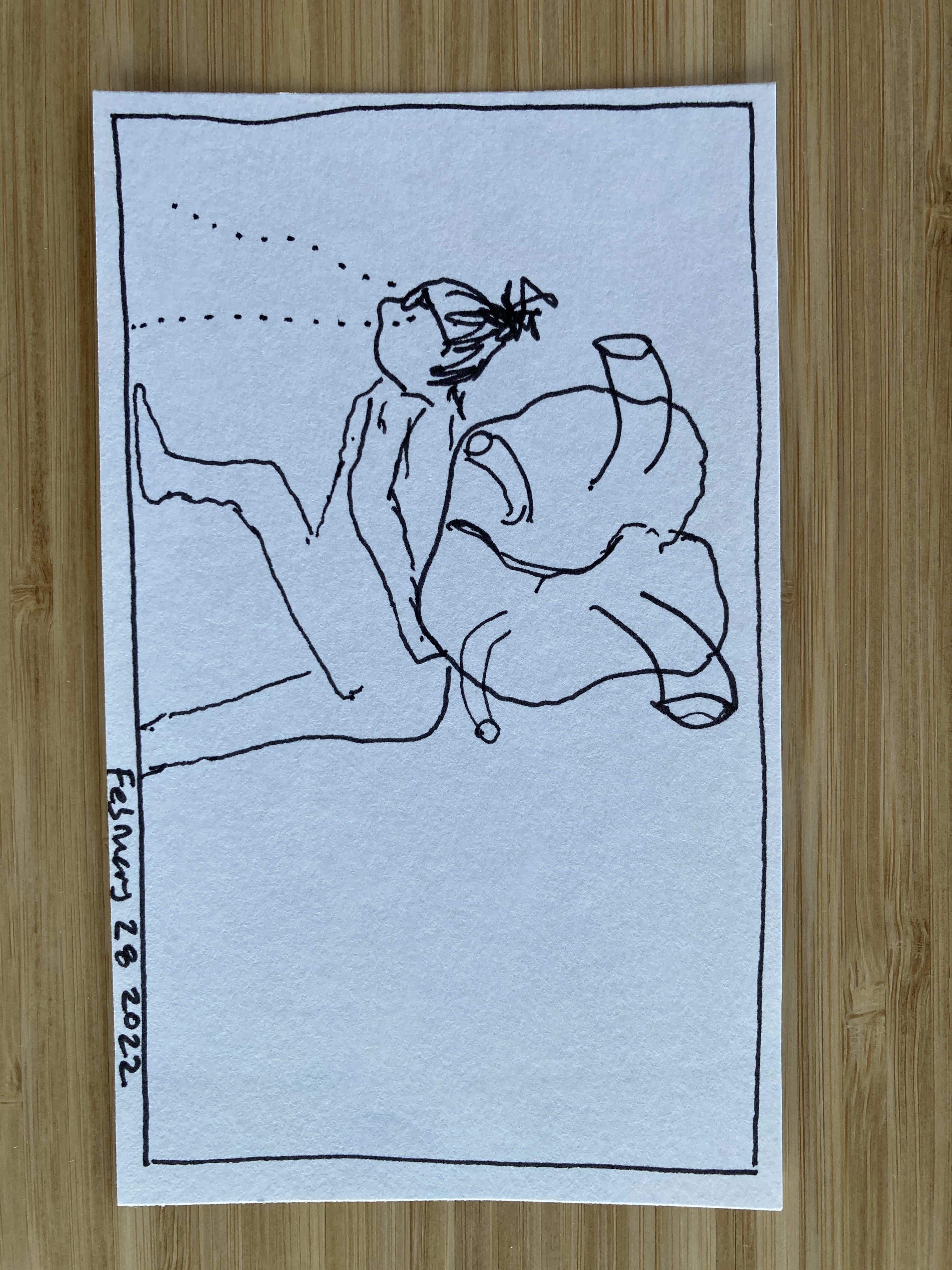
Certainly not as beautiful as Dante’s Dream , but for all that I love, drawn on my birthday.

This is a long read. Self-indulgent. I couldn’t help it. Some footnotes to keep the reader interested. Hopefully.

In 2019 I attended a writing workshop at Omega in Rhinebeck, New York (I write about that here). Several workshops ran in parallel, taking the better part of each day. The week I was there, an inordinate number of white women wore flowing, white, loose, muslin tunics with all their hair tucked up and disappeared beneath white turbans: the Kundalini yoga uniform. No one used the words “cultural appropriation”.  I didn’t either.[1] Out loud. In the evenings, round robin sessions were offered where people might try other workshop topics. Yes, I tried the Kundalini session. It’s not for me[2]. But one must remain open to new ideas, stretch the mind, (and the body), and so it was I found myself one evening in a session with a celebrity psychic medium. It was an interesting session[3], but something the facilitator said really stuck with me: “Everyone can do this [be a spirit communicator – really?], it just demands a lot of practice, and the practice is paying attention, first, of course, but also trying NOT to make meaning out of the images and senses you are receiving, just report them as you receive them”. Like, if you’re a celebrity psychic medium, don’t puzzle the images together – that’s for the detectives looking to solve cold cases or the families who are trying to communicate with deceased loved ones. Huh. Okay.

But for writing, we need to make meaning of the images and the words and phrases that flow from them.  The trick is not to solve the puzzle too soon.

With writing, I practice letting the images and even the silly ideas make it to the page. The result is that I now have a lot of blousy first drafts and half formed ideas lying around waiting for revision at some point (which feels like some distant sunrise cresting a dark horizon)[4].

It occurred to me[5], riffing off of last month’s post about writing and energy (slaps forehead), that what I need to practice more intentionally is READING the energy in my own writing. My own writings are trying to tell me something. The story is communicating through me (just as the energy to split wood effortlessly using an axe must travel through the body)…maybe I’m just the filter the story moves through to be born. I’m sure I’ve read this before…it’s only now I’m understanding it pragmatically.

So, with a spirit of nakedness, I’m using a recent response to a writing prompt[6] as a way to work through how I’m trying to read the energy in my own writing….while remaining sufficiently loose in interpretation and open to other ideas (before locking the story meaning down, aka, solving the puzzle).  This is a first stab at explaining this process…

I wrote the piece in a quick, mostly relaxed, twenty-five-minute burst before I had to go to work.  I have retained all the spelling mistakes, the lazy repetitions, the character name of Jo spelled two different ways, as well as the story’s devolution into stream of consciousness writing. I thought I would have time that week to fix it up before posting it to my workshop group. I didn’t. I posted it as is with the caveat about its devolution into imagery and all else.

And here’s the interesting thing—and why I’m choosing to write about this process here—when people responded to the piece in the workshop, each one indicated they had connected [more? best?] with the stream of consciousness sections: the writings that arrived subconsciously, those aspects of my shadow self, frolicking forth from dream territory.  Hmmm. A sign like that can’t be ignored. 

This post will necessarily be long to show my process. First, the piece unmarked, followed by the piece again with my thoughts and interjections marked in BLUE about what the writing might be trying to communicate through me.

The Red River swelled beyond its banks again, as it did every year. This year it attained new waterline records, bursting the city’s levies, its fluid tongue flicking the sand bags right and left like a prize fighter spitting chicklets in a fight to champion the world.  

Mary and Joe arrived in separate vehicles, she a canoe, he a kayak. Mary tied the canoe to a lilac; Jo roped the kayak to iron railing leading up the front steps, now submerged. Each used their own spare key, twisting the front door lock a foot above the waterline. Each shouldered the door against the heavy water to enter their daughter’s split level. The house in the chichi neighbourhood had promised a view of the river. In this respect, it had overdelivered.   

“She picked the wrong week to travel to Los Angeles.”

Mary sighed. She hadn’t wanted to start clean-up efforts with an argument. She stood in a foot of cold water that pressed against her knee-high rubber boots. Sloshing across the kitchen, her rubber pants rustled loudly as she fought to stay upright. The linoleum was slippery wavering beneath so much grey water, dotted here and there with soggy receipts and plastic bags ballooned into jelly fish. She and Jo rarely saw each other. They confined their spite to Thanksgiving and Christmas dinner tables. Without grandchildren, and now without their son-in-law (sandbagger), or their snooty daughters-in-law (good riddance), those dinners sunk before any plates graced the table.

Jo continued, “I thought she was in California.”

Not unusual, such misinterpretations.  For too many years Mary excused these oversights, chalking them up to hearing loss.  Too many rock concerts. Too many engines revved to screaming in the garage.  After the divorce, she’d faced, brutally, what she hadn’t wanted to: he just didn’t give a shit. Content if given a hot meal every evening, if potato chips were snack ready, if clean underwear stacked in the dresser drawer, Jo cruised life. He erupted a stormy passion when things didn’t go his way. The family vibrated his tensions, always on the Joe program. And his own children just hadn’t been interesting enough for him.

“No, she’s in France, Anjou. Ville-sous-Anjou, like the pear.”

Mary’s heart sunk then realising the fridge, out of power now for three days, the vegetable crisper beneath the water line, would have to be dealt with. A rotten job (inwards she laughed, bitterly).  She scanned the kitchen trying to remember where Lizzie kept the box of garbage bags, spray containers of cleaners, a mop bucket Mary might use to bail water. Where the hell could she bail the water to when the waterline lapped the window ledges, the river kept swelling? It was hopeless.

“This is hopeless,” said Jo. “Didn’t I warn her not to buy waterfront?”

Mary let his question hang, snuffing the old argument before it ignited. Doomsday prophecies, climate change, the water rising to take us all, tidbits he scraped from the internet, scrubbed, polished and hurled at listeners as if they were his own. Millionaires blasted the skin of the earth, their arcs of triumph going limp when they descended, backwards. In the end the laws of gravity, of inevitability, drown us all.

“I mean these days?” he pushed, “what the hell was she thinking?”

“Hell” said Mary.

She watched the look of confusion cloud Jo’s face. Honestly, he was so slow sometimes, she was glad she’d chosen not to see the end of the world with him. Yet here they were, sporting galoshes and yellow rain pants, knee deep in water wavering and rolling optical illusions.   

Insert distraction that momentarily reconnects this couple – Saxophone – a boy playing their favourite song perched on the roof next door  – the song they danced to at the engineering formal in fourth year – blue moon

Things floating: paper receipts, plastic bags, loose photographs (wedding?) – flood of pressure water build up – breaking banks – crashing shores, people waiting to be recused in the crooks of trees. Cars and boats and whole tree trunks, chesterfield, the deer, it’s snout bobbing above the waterline, antlers rotating with the spinning current, it’s bony legs and knees hoofing helplessly the fluidity, as if were running, running, pulling the belief of Santa’s sleigh, soaring the cold milky way vacuum, light years ahead, or behind.  

From its path, the river would always find a way, seeping up through the layers of sedimentary rock, cracking the limestone shelves, eroding the granite walls salt shaker – grains of salt, crystals messenger feels like a warning shouldn’t ignore.

Deer swept along in it torrent, spinning, the antlers whirlpool, their legs kicking, trying to find a purchase as the reindeer of santas  sleigh try to paw at the stars.  Muddy – silt that when this all drained away they would excavate the kitchen tiles as one might an archeological dig, looking for the mystery they believed buried there, but only finding shards of animal bones, and indeterminate rock.

Here it is again, with my own thought interjections in BLUE and peer feedback noted in ORANGE (with permission). I’ve focused peer attention to the subconscious elements they honed in on (they provided lots of fantastic grammar, spelling and rearrangement suggestions; I have not supplied those here).  

The Red River

swelled beyond its banks again, as it did every year. This year it attained new waterline records, bursting the city’s levies, its fluid tongue

Mary and Joe

arrived in separate vehicles, she a canoe, he a kayak. Mary tied the canoe to a lilac; Jo roped the kayak to iron railing leading up the front steps, now submerged.

Each used their own spare key, twisting the front door lock a foot above the waterline. Each shouldered

the door against the heavy water to enter their daughter’s split level. The house in the chichi neighbourhood had promised a view of the river. In this respect, it had overdelivered.

“She picked the wrong week to travel to Los Angeles.”

Mary sighed. She hadn’t wanted to start clean-up efforts with an argument. She stood in a foot of cold water that pressed against her knee-high rubber boots. Sloshing across the kitchen, her rubber pants rustled loudly as she fought to stay upright. The linoleum was slippery wavering beneath so much grey water, dotted here and there with soggy receipts and plastic bags ballooned into jelly fish. She and Jo rarely saw each other. They confined their spite to Thanksgiving and Christmas dinner tables. Without grandchildren, and now without their son-in-law (sandbagger)

or their snooty daughters-in-law (good riddance), those dinners sunk before any plates graced the table.

Jo continued, “I thought she was in California.”

Not unusual, such misinterpretations.  For too many years Mary excused these oversights, chalking them up to hearing loss.  Too many rock concerts. Too many engines revved to screaming in the garage.  After the divorce, she’d faced, brutally, what she hadn’t wanted to: he just didn’t give a shit

Content if given a hot meal every evening, if potato chips were snack ready, if clean underwear stacked in the dresser drawer, Jo cruised life  

He erupted a stormy passion when things didn’t go his way. The family vibrated his tensions, always on the Joe program. And his own children just hadn’t been interesting enough for him.

“No, she’s in France, Anjou. Ville-sous-Anjou, like the pear.”

Mary’s heart sunk then realising the fridge, out of power now for three days, the vegetable crisper beneath the water line, would have to be dealt with. A rotten job (inwards she laughed, bitterly)

She scanned the kitchen trying to remember where Lizzie kept the box of garbage bags, spray containers of cleaners, a mop bucket Mary might use to bail water. Where the hell could she bail the water to when the waterline lapped the window ledges, the river kept swelling? It was hopeless.

“This is hopeless,” said Jo. “Didn’t I warn her not to buy waterfront?”

Mary let his question hang, snuffing the old argument before it ignited.

Doomsday prophecies, climate change, the water rising to take us all, tidbits he scraped from the internet, scrubbed, polished and hurled at listeners as if they were his own. Millionaires blasted the skin of the earth

their arcs of triumph going limp when they descended, backwards. In the end the laws of gravity, of inevitability, drown us all.

“I mean these days?” he pushed, “what the hell was she thinking?”

“Hell” said Mary.

She watched the look of confusion cloud Jo’s face

Honestly, he was so slow sometimes, she was glad she’d chosen not to see the end of the world with him. Yet here they were, sporting galoshes and yellow rain pants, knee deep in water wavering and rolling optical illusions.

Insert distraction that momentarily reconnects this couple – Saxophone

– a boy playing their favourite song perched on the roof next door  – the song they danced to at the engineering formal in fourth year – blue moon

Things floating: paper receipts, plastic bags, loose photographs (wedding?)

– flood of pressure

water build up – breaking banks

– crashing shores, people waiting to be recused

in the crooks of trees

Cars and boats and whole tree trunks, chesterfield

the deer, it’s snout bobbing above the waterline, antlers rotating with the spinning current, it’s bony legs and knees hoofing helplessly the fluidity, as if were running, running,

pulling the belief of Santa’s sleigh, soaring the cold milky way vacuum, light years ahead, or behind.

From its path, the river would always find a way, seeping up through the layers of sedimentary rock, cracking the limestone shelves, eroding the granite walls

salt shaker – grains of salt, crystals messenger feels like a warning shouldn’t ignore.

Deer swept along in it torrent, spinning, the antlers whirlpool, their legs kicking, trying to find a purchase as the reindeer of santas  sleigh try to paw at the stars.  Muddy – silt that when this all drained away they would excavate the kitchen tiles as one might an archeological dig, looking for the mystery they believed buried there, but only finding shards of animal bones, and indeterminate rock.


[1] I was captivated by this and couldn’t help but wonder how many might be pocketing jade eggs up their yahoos.  Yeah, it’s a thing.

[2] I nearly fucking died trying to do all that rapid breathing while pulling “my foundation” tightly into my core. I worked up a sweat doing it too! I was far more fascinated by the English woman on stage facilitating the session (white muslin tunic, no hair, white turban). She had the poshest English accent I’d heard outside an Oxford quadrangle and she was looking daggers at her partner as her staccatoed breaths pumped the mic clipped at her breast. He was a much younger, absolutely gorgeous (and shirtless) Caribbean man with shining dark skin and dreadlocks, and he was racing after their daughter, probably six or seven years old (small white muslin tunic, wild hair, white turban an unravelling ribbon), trying to catch her as she screamed her way round all the seated hyperventilators (us) and literally crawled up the walls to run along the windowsills.  This delighted me no end.

[3] We were put in small groups and sat cross legged on the floor. We stared for a few minutes at a photograph of a well-dressed woman with haunting eyes seated on a white couch, then “reported” what we received. Having spent the whole wonderful week drawing and writing, I was feeling pretty relaxed, so I started, “I dunno, I see a baby’s rattle, a red sports car and an empty cradle.”  The curly blond-haired woman sitting across from me, wearing an I-love-NY cropped t-shirt with its neck scissored wide so that it slipped to expose one of her pudgy shoulders and a purple bra strap, goggled at me and said “Whoooooaaaaaaa!!!!”  I laughed hysterically by how easily I’d convinced her of something from my imagination. Though, it transpired the photo was of a wealthy woman whose husband had kidnapped their infant daughter, the pair never to be seen again. I didn’t think much of this at the time, more interested in getting an ice cream before the shop closed for the night.

[4] I am terribly undisciplined when it comes to revision…if I’m honest it’s because I have been afraid of the demons I’ll see there. I’m working on this.  

[5] I am a slow learner.

[6] spin three different digital “wheels of fortune”, one for setting, one for characters and one for narrative point of view, then spit out a story <800 words. I got: a flooded kitchen, a divorced couple, and close third person. I resisted drafting a story given my recent separation and walking away from a kitchen I designed and adored and fed so many wonderful people in.  I’m trying not to be materialistic, but I can’t help grieving the kitchen loss.  Of course, this comes through in the writing, the marriage breakdown, and it feels…shitty. And I kind of feel like an asshole. I’m working on this, greeting my shadow self. Next month, I’m moving to an apartment downtown Kingston, a block behind the central library and walking distance to the university libraries. Despite this fantastic access to knowledge, I’ve prioritised packing boxes and boxes of books, tearily packaging them up these February Sunday afternoons at the farm. A dreadful process. I don’t know how I’ll fit all the books in the apartment.  Maybe I’ll sleep on them, hoping to absorb their wisdom through my skin.

[7] I’ve noticed a pattern in my own thinking when I’m trying to read the vibrating word energy I feel there, and I’m wrestling with this discovery too: first, I read and respond through a “heart break” lens (unfortunately) – my interpretation is clouded by past hurts and sorrows. It usually takes me a day to work through this. Next, I’m able to flip 180 degrees on the initial interpretation and consider its opposing possibilities. Finally, after pleasurable reflection time, I settle into the relief and wonder and gratitude of multiple puzzle pieces dropping into place.

Thank you for reading.

New Playmate: Fear

Shall we start with a blowjob story? Sex always gets everyone’s attention. Pleasure: a cardinal motivation. But let’s delay that gratification, and, fair warning, this post won’t end with the orgasmic gasp you’re longing for (don’t we all?). Let’s leverage the promise though; foreplay is fun, and entertainment is, after all, the goal here.  Well, that and writing my way to understanding my writing process—the steps I’m taking—to improve my writing…at least that’s why I’m here.  Why are you here?

[And, if your immediate reaction to that question is insolence (!) (moral indignity?), that’s not my intention—please see an earlier post regarding my tendency toward blunt written communications lacking the (necessary?) subtle tonalities of delivery—here’s the signpost (pink neon!): I ask this question with a spirit of curiosity, a shy and genuine curiosity, and heaps of gratitude that you’re here reading my words (heaps! really, your continued attention is pulling me through a bunch of turmoil, so, thank you). And yes, you can put shy and blowjob together in a sentence or a paragraph, it’s an alluring combination, but I digress.]  

Another pleasure of mine, and, I realize, essential to my writing process, is to read across multiple and diverse texts in one sitting, toying to find a connection or thread of meaning between them. For fun. It helps me relax. Weirdly. I do it at work and at home and can credit (some) creative breakthroughs to this fetish – this blog post, for instance. I had a vague desire to write about metaphor this month but needed more to, you know, fluff it up.

Recently, a friend texted “Don’t cull [your] state of mind; express it in all its confusion. Put the tornado in the typewriter…” So, my favourite peeps, this post is a flavour taster, leading you through my convoluted thinking that landed on sharing a very private short story publicly.

The other evening I read:

  • an astonishing piece about the interstitium, a network of fluid-filled spaces unifying the body that we (Western scientists?) hadn’t quite appreciated (or acknowledged existed) until recently – shaped kind of like honeycomb – the hexagon, the same shape as the benzene ring structure, which, incidentally, came to German chemist August Kekulé in a dream of a snake eating its own tail
  • a web site on “warm data”, broader contextual information as opposed to the simple numbers of (disconnected) statistical information
  • Jung’s 1925 lecture #1 about developing his theory of the unconscious in which he inadvertently exposes himself as a real dick with his disparaging comments about the poor teen (his patient!) who fell in love with him. Calm down Jungian fans, I’m among you, I even practice his active imagination approach. But still, I feel for that poor girl, unrequited love, the scent of bitter almonds and all that…that lecture may have been the inspiration for David Cronenberg’s film A Dangerous Method
  • the introduction in The Situation and the Story, a book by Vivian Gornick offering a stunning distillation of the necessity of crafting a persona to relay a story about a situation… reminds me about an earlier post and a poke in my ribs to revive a larger writing project I’ve been avoiding (why have I been avoiding it? resisting it? why?)
  • my daily horoscope app: “Falling in love is good for the universe” and “Forgiving someone doesn’t make you a doormat” and “You are the most elaborate and sweet dessert” (can you tell I’m swinging by a thread here?)

Following this interstitial pathway (is this a bad habit? does this signal a lack of discipline? is this the chaotic consequence of consuming too many fickle fast-food-like-social media-servings? I’m not sure…) over the next few days, I read:

  • an excerpt from Descartes’ Dream by Phillip J. Davis and Reuben Hirsh relaying how Descartes imagined being presented with a melon (!) – a metaphor which moved him closer to developing Cartesian (mind-body) dualism somehow…what a muck of things that has led us through…(see “warm data” above)
  • A poem, Love After Love by Derek Walcott (tears, tears, tears…I need to get back to that larger writing project)
  • A book review of ‘The Poetry of Derek Walcott’ by Adam Kirsch where he discusses Walcott’s associative freedom in his application of metaphor (I know, I know, I’m trying your patience now. Stay with me. We’ll circle back to my earlier promise, and I’ll throw in a ghost to boot! Keep reading)
  • An epigraph credited to Michael Ventura in Randall Brown’s Pocket Guide to Flash Fiction that I’ll quote from shortly, but noted the reference was incorrectly cited as “The Talent in the Room” when it should be “The Talent of the Room”…perhaps a trifle, but in this context changing “of” to “in” twists the foundational communication of Ventura’s essay…
  • The lyrics to the song You Gave Me The Key by Julia Doiron

And then, wrangling myself to the task of writing a monthly blog post, I reread some earlier notes and quotes I’d taken down about metaphor and can’t help but insert these beautiful descriptions from Alicia Ostriker’s A Meditation on Metaphor in By Herself: Women Reclaim Poetry edited by Molly McQuade, “The sharp, honeyed burning point of course is that the pleasure we take in metaphor is a pleasure of consent, an agreement that the distance between two things is cancellable because of their likeness, whereby each illuminates some inner truth belonging to the other.” And “The implication of every metaphor is that the world is a multidimensional web of connections between animate and inanimate, larger and smaller, past and present, which await discovery.”

And I got to thinking, again, about my continued resistance to revisiting earlier drafts of writing. I’m pained to admit my fear here must be something deeper—far deeper—than simply failing to “write well”.  Instead, it has to do with facing what those drafts, written partly through stream of consciousness, partly through dream, partly through half sleep, exhaustion, desperation, and yes, sometimes elation, might reveal about myself, through metaphor, that I’m afraid to know or discover.

And that’s when Ventura’s essay really pierced me, articulating my anxieties with pinpoint accuracy:

“Crazy as a writer would define it: too unbalanced to work. If you can still write, then how crazy can you be?

Plenty crazy, is the answer. The room can become a hole. Your talent of the room, your ability to be there with all your soul, can overwhelm you…

The room, you see, is a dangerous place. Not in itself, but because you’re dangerous. The psyche is dangerous. Because working with words is not like working with color or sound or stone or movement. Color and sound and stone and movement are all around us, they are natural elements, they’ve always been [in] the universe, and those who work with them are servants of these timeless materials. But words are pure creations of the human psyche. Every single word is full of secrets, full of associations. Every word leads to another and another and another, down and down, through passages of dark and light. Every single word leads, in this way, to the same destination: your soul. Which is, in part, the soul of everyone. Every word has the capacity to start that journey. And once you’re on it, there is no knowing what will happen.

Locking yourself up with such things, letting them stir, using these pure psychic creations as raw material, and deciding, each time, how much or little you’re going to participate in your own act of creation, just what you’ll stake, what are the odds, just how far are you going to go – that’s called being a writer. And you do it alone in a room.”

Which rounds us (finally!) to the promised short story, a true one, lightly edited from its original 2020 draft created in a workshop with Leigh Hopkins responding to her prompt to write a 1000-word sexual scene that merges with a death scene. It’s my first, and, to date, only sex scene I’ve written (I think…will have to blow my hard drive searching for what’s beyond memory). No title.  A short commentary will follow (gawd this post is too long, with apologies).  

~

R had a reputation for the biggest cock in school.  That’s what the boys called it with a cocktail of admiration and jealousy. They teased him in locker rooms, school halls, the cafeteria.  He took it in stride, comfortable in his skin, his abilities.  He captained the football team, the soccer team and hockey.  He was good at track and math.  I’d noticed his smile three years earlier and vowed to capture and kiss his mouth. 

On a school night, the time of year when the dark descends velvet and cool and early, we lay in his bedroom in the dark with the door closed.  His parents were asleep down the hall. We were sixteen.

His penis was large. Very large. Though, at the time, I had nothing to compare it with.  His penis was my first penis.  I still dream of it today, occasionally, though, not as much as I’d like to. It wasn’t so much its length that was remarkable, but its girth, wide like the branch of a tree. That night I locked my lips around it and slid up and down its length slowly, the smooth hot hardness of it against my lips, brushing my molars.  I thought of how a snake might easily unclick the hinges of its jaw to accommodate.  My own jaw could do no such thing and the cramp of holding my mouth to receive started in.  His hips squirmed beneath me as I changed position, running my tongue up from the base to the tip, the spongey tip that squished so soft against my lips.  He moaned and caressed my hair.  He was always gentle, patient.  He worried about hurting me, but I craved the feeling of him entering me.  The insides of me ached and yearned.

I tore a little every time we made love.  It stung; a silver, piercing point of pain mixed with the pleasure of being filled. The sensation rippled from between my legs and a satisfaction, a feeling of being whole and complete, warmed my body, my soul. 

The doctor suggested, after handing me blister packs of freebie pills, he could cauterize my perineum with liquid nitrogen.  At sixteen, I asked whether scar tissue might not interfere with childbirth, you know, in the future.  The doctor looked confused. Confused enough for me to say, no thank you, not today. I love that girl at sixteen. Sometimes I wonder where she went.

In R’s bedroom my lips and tongue explored the length and width of his penis, my fingers caressed his scrotum. I pulled the moans out of him, every moment adding to my own desire, the slippery ache between my thighs. Every moment made me feel in control.  The feeling moved into me of just how powerful I could be.  How I calmed this athletic boy to complete submission beneath me.  How I’d done it with the flick of my tongue, my wet lips, my heat. The sensation of power made the hairs on the back of my neck rise. The power coursed through me, palpable.  I sat up.  We faced each other about a foot apart, and I smiled, the power shining out of me, luminous in the dark.

Suddenly, I knew I was scaring him.  And it felt good. I liked scaring him. His fear gave me power. He moved his hand to swat the air between our faces saying, Stop! Stop that! Loud and frightened.  Then, as if a switch flipped off, the power left me. I felt cold and a deep and sudden knowing moved electric through my body, a fear unlike any other quickened my heart and lifted goosebumps along my limbs. I knew with such certainty I needed to stop R from telling me what he had just felt—worse, what he had just seen. A knot of premonition hardened at the back of my throat: if he kept speaking, I’d see what he’d seen. I reached across the shadowed space between us and mashed my palm against his lips, but he said, Your smile. Your smile, stop smiling

And then it flipped and glared at me, hovering between us.  I’ll call it an apparition… a face comprised of light and dark. I never think of it as a ghost.  Only a face…no body attached…a face of shadows…radiating a terrifying expression. The depressions where its eyes should have been so dark they were hollow. It smiled horribly with a mouth full of teeth, so many pointed teeth, lips curled to convey what I can only describe as sinister.  

It played with us, whatever it was, having fun.  A fear I hadn’t known possible filled me and I squeezed my eyes tight against it.  I couldn’t speak. As I write this now, the air is light in my head and my ears feel blocked, pressured. I’m trembling over thirty years later.  

Since, I’ve believed humans exist with other planes or dimensions right round us.  That it’s possible evil exists and waits for the ready and willing.  That the dark side is there waiting, beguiling.  I’m not a religious person; this has nothing to do with all that. 

R scrambled to turn on the light. Then we woke his mother. The story pales in the retelling.  But I believe to this day if I ever see that face again, the fear will take me.  I’ll die.  I avoid shadowy twilight spaces.  I walk cautiously each day knowing the choice is there. 

For a long time, I felt terribly guilty and responsible for creating such a monster, whatever it was. For a long time, I believed I had made it with my power and blowjob proficiency.

I don’t believe that now.

Now, I think whatever that was, a spirit? An alien? It doesn’t matter. I believe it passed through me and played my emotions like a kitten with a tangle of string.

~

So, it’s not just my metaphors and it’s not just my words I’m frightened of; it’s stretching the skin of reality till I’m marooned or mad.  Did I create that demon? Does that dark capacity reside within me? Will my writing reveal—unleash—an unmanageable wickedness? I suppose some might find my fears and anxieties absurd and certainly questionable. For too long I’ve been afraid of the dark. These days I pad around this beautiful housesitting space in the gloaming, reveling the splash of waning and waxing moonlight glancing the St. Lawrence River. For the very first time since that experience at sixteen, I’m wondering whether I forejudged the apparition, and I question my fear of it all. And, for the sake of my writing, I’m ready to play.   

Unpacking a Blush

Let’s begin with these lines from a poem by Carol Ann Duffy, “Prayer”.[1]

So, a woman will lift/her head from the sieve of her hands and stare/ at the minims sung by a tree, a sudden gift.

A friend calls these massive blooms the floozies of the garden. They are taller than me and have overtaken the tomatoes this year, which means fewer tomatoes to process (a small blessing, one I’ll curse in Feb).

I went to listen to a friend play in a band (he plays guitar). It was an afternoon event and the day was gorgeous, hot blue sky, tree leaves colouring up red and yellow. There were lots of friends there and many people who I hadn’t connected with in some time (since pre-pandemic). In one conversation, a former colleague announced his recent retirement and our talk rounded to creative writing. I admit that anecdote, erroneously attributed to Margaret Atwood, about the brain surgeon who says to a writer that when they retire, they’ll take up writing, to which the writer quips that, when they retire, they’ll take up brain surgery, popped into my mind. The guy is (well, was) a physician. But it’s important writers lift one another up.  Writing is hard enough without tearing each other down. So, I offered up some writing (and reading) resources I’ve found helpful and then we landed on the topic of workshopping. He leaned back in his chair and said he’d tried workshopping—his tone was unmistakable; the exercise was beneath him—and he’d been disappointed to discover that (his words) “99.95% of workshop participants are women”. Long pause of silence. I began to form a response, but not before he buried himself further by saying his writing needed…here, he finally noticed he was speaking to a woman and corrected the wording I could see so clearly in the thought bubble hovering atop his (inflated) head (his writing is far more important and serious – intelligent! than what women write about), to say the workshops could never sufficiently improve his writing. I turned to his wife (also a physician. Does this matter? It does. I have a chip on my shoulder when it comes to physicians…story for another time, but I acknowledge my bias) and I agreed, it’s true, the workshops and writing classes I have attended are comprised, mostly, of women. I think it must have to do with women not feeling they have a voice in other aspects of their lives. Great swaths of generalizations painted here, but this was party small talk. The physician’s unblinking wife encouraged her husband, explaining he ought to think more about the issue because women read and buy books more often, and if he hoped to publish, it’s an issue worthy of his consideration. I downed the glass of shit wine I was drinking and flitted off. But the conversation and the question (why mostly women?) gnawed at me.

Last of the summer flowers maybe, before a killing frost.

Here is where I’d like to insert paragraphs of stats and research about sex differences in literary publishing, book reading and purchasing. Also, about how men more often read books written by men. Also, about the slanted sex ratios (toward women) of students enrolling in post-secondary arts and humanities courses. And how work by female artists is still valued less than male artists, and how museums and galleries around the world are filled with far more works by men compared with women. But that would be glossing the real issue. I’d be repeating my pattern, the one I’m trying to break from, marching behind a parade of research and statistics to keep the vulnerable aspects of myself invisible.

The conversation with the physicians continued to grate because it poked (stabbed?) a few of my deepest insecurities. How I’d turned my back on pursuing an arts career in favour of science because I thought I’d be taken more seriously (as a woman) and, let’s be honest, because it paid better.  But the deeper wound is that I find myself actively resisting the writing that bubbles forth most naturally in my creative writing practice: marriage and motherhood.

This is hard to write: I silence my own voice because I don’t believe it’s valuable enough.

It’s frustrating to know I’ve allowed myself to be shaped (so effortlessly) by cultural and social norms related to traditional gender roles. It’s an embarrassment.  It begs the question: who from (and why?) am I seeking validation?  The easy answer is “the system” – but it’s a system that continues to devalue the importance (skill, patience, persistence, compassion) of raising children, a system that reduces love and relationships to sex (and shout out to my more marginalized peeps of the LGBTQ2S+, most often heteronormative sex). As part of the system—as a woman I am—we don’t do enough to support each other to write about domestic subjects or write about our friendships. Is writing about friendship without the tension of sex or attraction a downgrade?  Too boring?  A lot of cognitive dissonance here. The harder answer is that yes, I do need to push through the noise and systemic pressures to value my own writing and anchor validation from within as opposed to without. It’s hard. And I know, a harried summary of such a complex issue is short on explanations. I could sing this pearl of an offering[2], but in the spirit of bare sincerity, I’m often afraid the conversations are out of my league. I’m working on bravery. Another work in progress…

This week I wrote a poemy piece in workshop (yes, a workshop comprised of mostly women) about what it feels like to walk up to the podium to read one’s poetry. My writing inspired one of the other women in the workshop to create a collaged art piece in response to a particular phrase I had written. I won’t share it here because she would like us to try publishing our two pieces together, but the art work is beguiling and unique, and the gesture made me teary. Really, it’s the ultimate compliment.

I think this must be the goal for creating art: to make something so beautiful it inspires further beauty in the world.

So, I lift my burned gaze from the sieve of my hands to tend the lyrics of my heart.  


[1] This stunning image (that word ‘sieve’ does so much work) are lines from the poem “Prayer” by Dame Carol Ann Duffy. She is the first (and only!!) woman to hold the post of British Poet Laureate in its 400 plus-year history and was appointed in 2009 for a ten-year fixed term. You can listen to her read this poem here. Interestingly, when I read the poem for myself it sounded very different from her reading. Perhaps I interpret it differently too. Regardless, it’s a gorgeous poem. I love how the image embodies this post better than my own words could ever do.  

[2]“One Heart” is from the Leftover Cuties 2013 album “The Spark & the Fire” – http://www.leftovercuties.com – also, a striking album cover.

Oh, there you are…

I pulled out a piece of creative nonfiction I submitted for publication a few months ago and scanned the first few paragraphs. I was horrified by what I had written.  More accurately, I was appalled at what I had left out and embarrassed by how I had written what I had written.

To be specific, because abstractions really are the issue here, what I had not written were (and here’s a list – insert eye roll- and, I think this is becoming repetitive – a theme of these posts?):

  • my inner thoughts
  • a lot (all?) of my emotions
  • how I felt about the experiences when they happened in the past
  • how I feel about the experiences, looking back on them now, from my current vantage point (a point of missed wisdom, learning and reflection? Evidently).  

Actually, it’s not really a list is it?  It’s deepening layers of specificity of the same thing. 

And the way I had written that CNF piece: with a lot of poetic flourishes (think feather boas, purple lipstick and high scissor kicks) as well as insertions of scientific facts harvested from an eclectic shelf of show off curiosities I seem to trot out when I feel cornered. The vocabulary I used was high and abstract; the syntactical maneuvers a bit somersault-roundoff-backflip-like, or, at least attempting to be….more of a trip and fall on my ass performance. [btw: click that David Lee Roth scissor kick compilation link, it’s hilarious.]

But here’s a positive discovery: I suddenly “see” this in my own writing (at least, tentatively…I remain a neophyte in this regard, but one must acknowledge even the smallest of progressions on this writing journey…there I go again, the inner scientist taking over with her mastered objective distance). 

The thing is, for quite a while now, I’ve thought my lack of depth and insight in my writing has been a technical issue. So, I’ve busied myself studying sentence structure, syntax, hybrid compositions, and I’ve practiced with a super focused commitment to the craft of writing and my work just kept getting worse. I’ve been frustrated …bordering on hopeless (is it that I can’t do this writing thing?) and I wondered whether to quit.

I did quit for a month or two or three over the summer. I was miserable. 

Sure, I could quit. 

But then what?   

So, not a technical issue. 

I have other writers (alive and dead) (and artists) (and, in the spirit of full transparency, my therapist) to thank for gently nudging and supporting me to progress my learning these recent weeks to discover (and be able to “see” in my own writing what I haven’t been able to before): I’ve been withholding my self from the page (my thoughts, my feelings, my reflections, my values, my beliefs, my opinions…). The painful truth is that I haven’t believed what I have to offer is of value….so I play dress up instead.  

It’s my own voice I must nurture. And accept.  

In a truly wonderful November workshop, facilitated by Steve Edwards, through Larksong Writer’s Place, I wrote the following words in response to a prompt about what knowledge I would want to impart to my younger writer self (or a writer just starting out): 

“…write with abandon. That is, not to censor yourself and to let the inner critic hold sway. And give yourself permission to question—interrogate—the reasons you think a certain way. And if the inner critic remains too loud—ask the inner critic what it needs to be quiet? What nurturing is it missing? What voice is it afraid of? Can you work together instead of pulling one another apart?”

Recently, Steve Edwards tweeted “Reminder to my fellow teachers who already know this but tend to forget: learning doesn’t always look like learning; growth doesn’t always look like growth. Your attention & care is a powerful force.”  Thank you, Steve. This is exactly how I felt in your class: held and seen and cared for.  I also sent this quote to my sister, also a teacher, who lives and works in a small Indigenous community north of the arctic circle. 

And to my many friends and writer friends and loved ones (for I am blessed with so many of you), thank you for continuing to read me, lifting me up when I am down, and waiting, patiently, for my own words…in my own emerging voice.  

Facts into Fiction

In the fall, I was writing personal essays.  Well…they were less essays and more fragments of thought, ideas, fits and starts recorded on paper.  But I strung them together. Discordantly. I forced the paragraphs to conform. To what?  I wasn’t sure.  Never a good sign.

The deep questioning I was trying to work through (thought I was working through?)…the essaying…wasn’t working.  The process was deeply frustrating. I forced myself to the writing and it resisted by clenching up. I couldn’t figure out what lay at the heart of my exploration.  Again, I’d fallen into my habit of going at the writing with my head instead of my heart. I thought…instead of felt. 

Then the holidays and the requisite relaxing of routine, reinforced with another public health lockdown as Omicron rapidly spread.  And New Year’s Eve I became symptomatic. It was two days before my scheduled booster (which I cancelled) and 6 months post vaccine number two when immunity wanes. It hit me hard.  Not dire, but unpleasant and uncomfortable. I released the writing routine to reading. And healing. And then, after stumbling across Douglas Glover’s (DG) essays (I write about that here), I worked through some intense studying of the craft of writing mirroring his methods. This was healing too. 

DG posted an exercise on writing emotions, and I challenged myself to write a fictional scene following his prompt. It flowed easily and felt fun.  And here’s the weird part…when I studied what I had written in those 1-2 paragraphs, I recognised the seeds of exploration I had wrestled with in the fall.  I still didn’t understand them…but I could see the concepts there. 

I flipped back to writing fiction.    

The writing progresses differently compared with how I have written in the past. Instead of sitting down to a timed write (30 minutes is my usual go to), and writing scenes from beginning to end, I’m writing in fragments untethered from a narrative timeline. 

I’ll try to explain how these arise.  I seem to be toggling through two different approaches. And they complement one another. 

First, as inspiration, I read other writers – stories, novels, poems or essays – I choose a book from my shelf almost randomly and thumb through the pages letting my eyes rest where they get caught. I pay close attention to how the words pile up there on the page and then I work to copy the syntax or concept or the work a line or paragraph is doing (techniques) for myself, using my own words for my own emerging story. This gets the engine of writing going.

Second, I let myself sit and relax and try to let my mind go blank…and the images that move with the story appear. I write them down.  Sometimes it’s a phrase or a word, often it is a picture. Sometimes it is a mood or feeling…these are harder to write down.  Sometimes I write most of a scene and what I think I’m going to write about I never get to.  Instead, it’s something related but tangential. 

I toggle back and forth between these methods (I stop to wonder here…perhaps this is how other writers write and I’m only discovering this now because I’m so dogmatic and literal I’ve never relaxed enough to do this? Maybe. Probably. Ugh. But the ability to do this relies on gaining an understanding of how to read for specific craft techniques instead of reading for meaning (symbolism) and I have DG to thank for pointing this path in way I can finally understand).   

There is a lot less knowing about how it will unfold (gasp! I have to release control!)…and I flip back and forth between liking what I have written and extreme anxiety about whether it’s working. Sigh. But fragments and phrases float to me throughout the day and I jot them down in my notebook, feeling them, receiving them as the precious gifts they are. 

And here’s the thing, writing through fiction this way I have come to understand what I was exploring through essay in the fall—but didn’t quite get there—coming at it slant has illuminated meaning and a story line to tell it. For the first time I feel how it ought to come together to share the experience with a reader.  This is a huge step forward for me.   

Once the material and the order of it is fully drafted, I’ll shift into a similar but third approach, which is to study what I have written, try to understand the work each paragraph/section is doing for a reader ( in service of the story), then turn back to my bookshelf to study techniques again for how to do it better. Feels good to follow a path.    

A poke in the wound

WordPress will not allow this image to be the right way up…perhaps it’s better posted this way …moving against gravity.

Making art when there is war. It feels wrong. Or useless. Selfish. I spiral into guilt and shame about my privilege, my luck. In the boundaries of my skin, my brain, the sorrow seeps. 

There are mountains of sorrow at the heart of all conflicts. The fired heat of hurts hoisted through generations, coded, we now know, in our DNA, and patterned far too comfortably in memory. 

Russia and the Ukraine, China and Taiwan, the continued killing in the Middle East, too many countries in Africa, we speak of warring geographies as if they are sentient beings themselves rather than the individual people, plants, animals, collected and hurting beneath? Behind? Within? the skins of borders. 

Bodies of power in the shape of countries, in the shape of cities, in lake shaped wounds, in fist shaped educations, in the curved shape of a parent’s spine twisting from a child’s longing for love. 

This is a habit of mine: to speak in abstractions, to hide behind the illusions of words, to climb my mountain of sorrow instead of burying deep within it to try and understand. 

What is it I’m trying to say? 

That I feel so very sad.  That I wish humans could be better. That I wish I would do better. That I could truly believe that making art, which is to say making love, creating love, holding love, sharing love, could save us.    

Even if it is so hard to believe when fire rains down from the skies, I must.

Ta-da! I can read [to write]!

I have always had an incredibly difficult time trying to slow myself down when I read (or even re-read), to try to understand how a writer composes a work. I’m swept up in the magic of narrative, tumbling through the telling with joyful abandon and left feathering metaphors and symbols — those precious darts of meaning making — like I’m playing pin the tail on the donkey instead of aiming for a bull’s eye.  I had sort of given up on trying to teach myself to read as a writer.  I figured I just couldn’t do it…I couldn’t slow myself down enough.  And I told myself if I understood the magic, I wouldn’t be able to create any of my own.   

Over the holiday, I stumbled across Douglas Glover’s (DG) essays and lectures about reading at Numéro Cinq, a discontinued but still available online literary magazine. He applies a systematic approach to reading [to understand writing composition], whereby one suspends meaning making (just parking interpretation for a wee while) and analyzes the text as static data…and only using the text on the page…no lifting off into wonderment (bewilderment?) as to what the author might have thought or meant.  Instead, stick to the words (and most importantly, the order with which they are placed) on the page.  

For example, in his reading rubric, the first step is to “start by simply looking at the physical story, see how long it is” and he means, count the words, the pages and the paragraphs and the line breaks.  “see if it is divided into sections and how that division is accomplished technically (simple line breaks, numbers, chapter heads, etc.)”. In fact, there is a lot of counting in his approach to reading.  There is also a lot of bird’s eye view assessment of a story, whereby one zooms out from the work and tries to understand how much text might be devoted to back story, where aspects of a story command a greater amount of text, at what point—half-way through? A paragraph at the very end?—the climax of the story is revealed.  Do lines of dialogue permeate the piece or are they confined to one section?  How much dialogue in relation to other aspects? Using different coloured pens and highlighters helps me to see how chunks of different parts of text are placed on the page. I started to be able to tease the technical aspects of a story apart.  By analysing them I started to “see” the writer’s choices; the gossamer of the magical whole is pulled away and slowly revealed. 

DG also uses diagrams and graphs…something I do in my day job all the time but had never thought to apply to analyzing stories.  George Saunders also does this for story analysis.   I love drawing diagrams and suddenly I’m able to understand composition from a different perspective.  Here’s a few of my recent messy assessment diagrams: 

A time flow analysis – depiction of the time flow of actual story events along timeline compared with the series of events relayed in the narrative timeline (not the same!). The circled numbers represent the narrative timeline; the line represents the historical timeline.
A little graph to illustrate the energy in the story by scene.
A desire and resistance analysis to understand the dynamics of the story.

I have used DG’s reading rubric to work through three short stories. I have chosen stories just by picking ones I love and by picking ones I think might be very different:

I have started to record examples of things in a technical notebook. I have learned more working through these analyses than through any other craft exercise. It’s fun! I plan to allow myself the joy of working through a few more story analyses and then (gulp) I’m going to try applying different forms in my own writing. Scary, but these learnings have provided new writing confidence…at least, a method I might use to attack my shitty drafts and revise them to be better.   For those of you working with creative nonfiction/essay, there’s a reading rubric for this too.  

Because I am a researcher in my day job, this method…this systematic approach… specifically suspending meaning making to analyze text the same way one approaches research data (quantitative and qualitative), brought the whole thing home for me.  

Sentence as Seed Pearl

Recently, I was asked to provide an example of one of my favourite sentences I have written (to date).  It was part of an exercise: use one of my own sentences as an anchor to return to when feeling desperate or lost in my writing projects. An anchor to remind myself of why I write and what I’m capable of writing by plucking pearls from a sea of words.  

This isn’t something I drop in casual conversations, but in the last wee while (I don’t know how long this is, half a year? A year?), I’ve started studying sentences.  I feel I ought to learn how to build sentences.  I’m not referring to grammatical construction though, I mean I want to learn how to craft a sentence (read: a sentiment…this is what I’m really talking about) that is so beautiful, so true, it stops a reader in their tracks.  

I’m lucky.  Twice I’ve witnessed this effect of my words on readers/listeners.  Once in a poem, once in a letter to a friend following his father’s death. This experience of connecting through a sentence is addictive….it’s what I chase in my writing. For a writer, it is rare one discovers whether a reader connects this way.  It is only confirmed through reader response, something no reader is obligated the provide, even if they are so moved. I have had readers quote my own sentences back to me and it is one of the more pleasurable experiences I can think of.  I am lucky.

Writing transforms thinking into something externally concrete, shapes what is felt, intuited, onto a page for better scrutiny. And sharing. 

But, two times in ten years of writing?  Slim odds and a lot of writing.  And dedication to the craft.

Let’s see if I can articulate what it is I’m chasing.  

Qualities of sentences that I love:

  • Reading, images burst forth in my mind’s eye like a waking dream.
  • The content moves …in time or space or, better, with the palpable energy of shifting emotions. 
  • There are layers of meaning, but the layers are connected, and the connection is meaningful, not random. 
  • The content deepens understanding, expands ways of knowing and being in the world.  
  • The words are playful.  Joyful.  Intellectual if the subject is horrific.  
  • The words are placed in an order to curate an experience for the reader. 

Learning how to do this is very very slow…it happens at the same speed (maybe slower?) as watching plants grow.  

And here’s the hardest part: I must write and write and write, pretending all these qualities don’t matter. Because it’s only when I’m not paying attention, letting my body take over the writing, free from my mind’s controlling, that the sentiments emerge just so, their lustre barely visible, easily missed beneath the tidal wave of word count.  Too often my impatience prevents me from discovering what it is my body and subconscious yearns to communicate.  

Learning to write beautiful sentences is about retracing my steps, peering into the crevices, picking out the tiny grains and questioning what it is that really lies in the palm of my hand.  Questioning what the ink of my fountain pen has pulled from my darker recesses. Slowing down.  Paying attention.  Listening.  Feeling. 

When I went searching for my favourite sentence I have written, one that would serve as an anchor, I couldn’t pick one out that satisfied. But instead of thinking of a favourite sentence as a completed thing, it is better if I think of it as a speck of sand that niggles and won’t be forgotten, a grain that irritates the mind to expansion and moves and grows through long formation/formulation to the pearl it promises to be.

Here is the sentence I chose as my anchor, for now anyway: We leave signatures of ourselves in flakes.

Some references I have found helpful: 

Several Short Sentences About Writing by Verlyn Klinkenborg 

Building Great Sentences by Brooks Landon

How to Write a Sentence and How to Read One by Stanley Fish 

Chapters on point of view from Ursula K LeGuin’s Steering The Craft and David Jauss’s On Writing Fiction.  

Essay: The Sentence is a Lonely Place by Garielle Lutz in Believer Magazine