Tune(s) Up

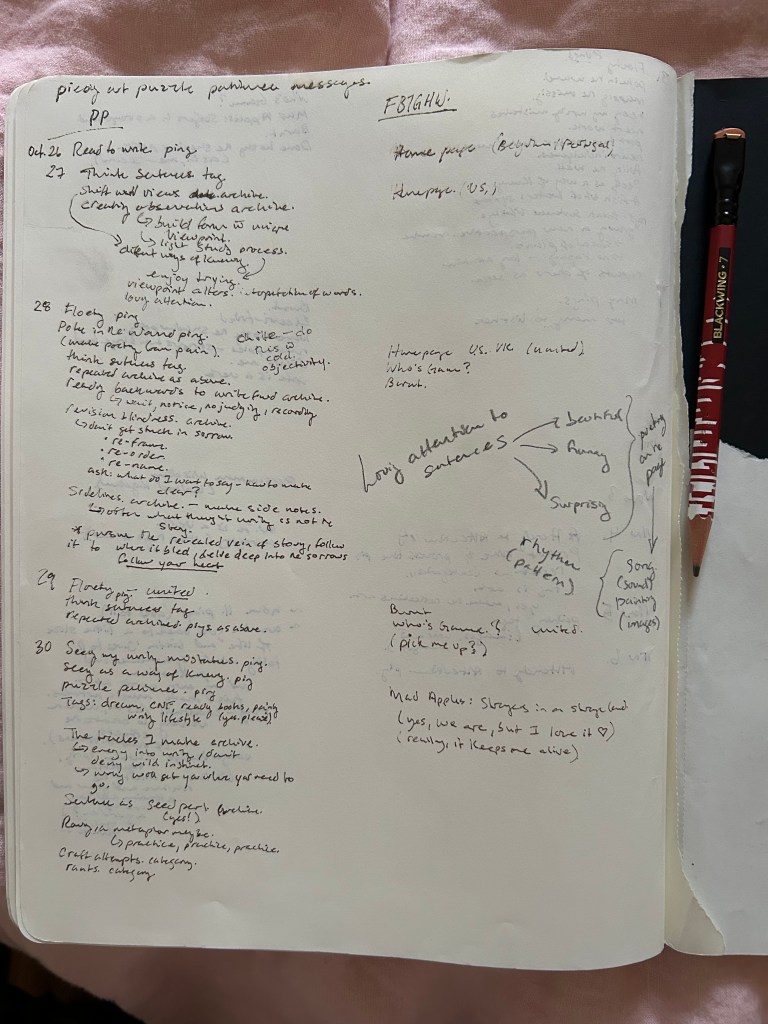
Thank you for your many messages. They guided my approach—which I’ll summarize below—revising A Marriage: Framed (CNF <2500 words) AND showed me to trust my own words and my own process. Your belief helps me believe. A blessing.

There was a lot of tinkering (ink -er-ing) trying to take this story to top level writing technique. I continue to tinker. Top level is…a dream, a ceaseless chase. And yeah, the chase really is a lot of fun [Insert: series of horn blasts and voice signals and Tally-ho! Here we go!].  

Last month, I posted my experience pruning A Marriage: Framed, taking it from 3770 to less than 2500 words. The process was fascinating because as I cut the words down, the focal point shifted, a spin that forced the painful emotions at the heart of my 27-year relationship with my ex to surface. Emotions I’d suppressed for decades.

Struggling to understand and move those emotions out of my body onto the page transformed them into “an object” (a writing piece) outside my body that I can interact with and control. I’m less “imprisoned” by my emotions, if that makes sense. I feel almost as if the rewriting of the draft I completed last month was a “therapy” draft. The story moved from being deeply subjective to objective, enabling me to turn to tackling the craft and technical aspects in the writing with a cool(er) and practiced distance[1]. This latter process, I’ve discovered, is essential to move the emotional therapy draft through a series of systematic style techniques so the artifact might approach a work of art. 

I wrote about my nascent practice and understanding for how to work with the subconscious as part of creative writing process in a post last March. Today, I want to build on that earlier exploration with some concrete examples because I’m trying to understand and practice tangible methods for working with less tangible materials. Silence. Air. Thoughts. Dreams.  I was thinking about how a musician works with the silences between notes to modulate pitch and tone, melody and harmony; how a sculptor carves a block of stone to encase a shape of air.  And my mind slid from that image to a memory of being captivated by a sculpture of Leda and the Swan when I was in Italy last fall.

I was rushing through the monumental halls on the second floor of the Library of Saint Mark in Venice in order to see the Mappa Mundi before the gallery closed. Speedwalking past innumerable marble busts, I stopped abruptly, struck by the unique portrayal of the infamous myth, an erotic story about the god Zeus, disguised as a swan, seducing the Spartan Queen Leda. The question about the nature of the seduction, whether coupling between the two was consensual or not, revolves the ages. This specific statue, its image, its energy, has stayed with me because of its beauty, yes, but also its ambiguity …for me, this sculpture is tangible object and emblem of desire-resistance all at once. Leda and the swan are carved to their moment of intercourse and Leda seems, at least to my eyes, both taken by surprise, as if she’s not quite ready to take on a god (she pushes the swan away) and surrendering to her attraction and desire at the same time.  

Roman variant of a possible Attic original of the mid 1st century BC Giovanni Grimani collection, 1587

I hadn’t appreciated why this sculpture has enchanted me for more than a year, until today, when, sifting my thoughts for something concrete (well, marble in this case), this memory surfaced. By embracing the complexity of the original myth and removing the layer of Greek mythology, I choose to think of this sculpture as a symbol of unification between spiritual and human worlds. When creative writing, I feel the spiritual world, or divine might be a better word, is a part of (or accessed via) the subconscious. The vibrating energy I can feel as I draft using stream of consciousness writing (read: writing without thinking too much) is intuition. Intuition is much like a tuning fork. I’ll try to explain this shortly.  

I’ve missed many of the signposts from the subconscious in my writing drafts—they arrive as words, resonances between words and as sensory images. I’m learning how to identify them and practice how to work with them and preserve them to create a net of story words that communicates something beyond words: feelings, energy, magic. Art.

Here’s an elegant and far more beautiful articulation for what I’m trying to say:

“Story form is an object, a translucent, shimmering thing with words tacked to the surface of its swirling involutions. The words glitter with their own reflective colouration; in them you see the momentary reflections of other words. Wires as thin as gossamer connect the words with more words on distant parts of the structure where they set up new colonies with flags, banners, replicas, and maps of the whole. Spin the form and the same words appear in flashes, the eye registers their rhythmic insistence[2]. It is wonderful and miraculous to watch.”

Excerpt from the essay, Anatomy of the Short Story, in The Erotics of Restraint, by Douglas Glover.

 Tune Up Techniques

My revision was guided by generous writers and readers who offered their love and attention and time to enhance my piece. I’ve said it before; creatives work in community. I’ll write more about that in December. My learnings I write here derive collective wisdoms of too many people to name.  Thank you.

Ideally, or shall I say, if this were easier, I might have started revising the Macro aspects of the piece—story, plot, characters, setting, points of view—then moved to the more Micro levels of paragraphs, sentences, rhetorical devices, syntax, diction.

But that’s not how it worked in practice.

There were the metaphors and the patterns and the desire-resistance tensions and the images that slid to occupy both macro and micro levels and, most important, all the space vibrating between. That’s the art object space, the space of Leda-swan. It’s an easy space to get lost in and an easy space to miss.

My tune up process was messy, not linear. Nor did it happen in steps, though describing the process here necessitates a sequential recounting. Revising was pressured by the word count cap, 2500 words max. The restriction served the writing in many ways by forcing disciplined compression (of words, sentences, images and ideas).

The process felt like persistent twisting, moving around and up and down and through the piece, working to understand my intentions and meanings, then shifting sections here and there, and tweaking here and there, and slowly, slowly, slowly, the piece contracted round an essential essence of tight emotional communication, complete with shimmery swirly resonances, into story art (ish…I’m still practicing).

Working with Vibrations

Ok, first, two indispensable applications I think I’ve failed to post on this blog, probably because my use of them is so integrated with my writing process I’ve neglected to emphasise my reliance on them[3]:

  • Word Hippo (thesaurus, word tools, etc.)
  • Online Etymology Dictionary – I love how they write on their site (my bolding),  “Etymonline aims to weave together words and the past, answer common questions, and sow seeds of serendipity. Sowing seeds of serendipity is exactly why and how I use this site. It’s a creativity generator.

Choosing the right word requires deep attention to what it is I want to say (what I intend a sentence to mean), the connotations I intend to (try to) control in readers’ minds, but also how I wish to communicate it. Choosing whether the flavour of communication should be sweet or bitter, whether the texture of communication should be hard or soft, whether the sense of communication might be cold or hot.

Here’s an example. In the original longer draft, I had an entire paragraph describing the situation where the husband explains he won’t allow his wife to attend the funeral of her friend’s dad. When I cut that paragraph down to convey its essential meaning in one sentence, I wrote, “[He] embargoed my attendance at a male friend’s dad’s funeral believing my intent was seduction.”

Ok, that word embargoed practically leaps off the page with melodrama and elevated (snobby) language. Instinctually I disliked it, but it captured the essence of meaning I was after, which was restriction or “not permitted”. The vibration of my distaste of the word (in this context), even though it had the right meaning, signalled—and I should explain, this feeling is super subtle, very easy to ignore if I’m not paying attention—there might be a deeper meaning.

I sat with the word quietly and patiently and questioned it, exploring its alternative meanings. The idea of ownership surfaced to consciousness …which is a concept I’m exploring in the larger piece. The subconscious offered “embargoed” up…but the flavour (snobby) and timing of it wasn’t right…I didn’t want to introduce the idea of ownership so early in the piece (this sentence comes in at paragraph two). I wanted “ownership” as a concept to build slowly through the piece, mimicking the way the wife experienced this revelation over time.

So, I fiddled with it. I ended up using the word “barred” because it conveys the meaning of “not permitted” and extends it into an implied image (physical bars) introducing the connotation of “prison” without it being overt. It’s also a soft, quiet word in the mouth, so a reader might glide past, carrying its meanings without tripping on them (embargoed is practically a foot stuck out in front of a running reader). The sentence became, “[He] barred me attending the funeral of my male friend’s dad believing I intended seduction.[4]

This is what I mean when I describe intuition as a tuning fork. It’s the vibrating intuition that guides which words and phrases bring the meaning and feeling and senses and sounds to coalesce in tune with the piece as a whole.

Another example, this time at the sentence level. In the therapy draft I wrote:

The kind of love that made me bump into walls, sliding glass doors and fail to recall what street to turn down to return to my own student house. The kind of love that made me forget to eat, made my skin glow, made me sing greetings to strangers.

I liked the repetition of “kind of love” because of the rhythm it introduces as well as the way it draws attention to the listed descriptions and also, the super subtle question injected by those words “kind” and “of” placed side by side, implying “sort of” …as in, this is the way the wife loved but was it a sort of love? A half in/half out love? I know, tenuous.

Also, “made my skin glow”…vibrated (intuition tuning fork struck)…what did I mean by this? I meant our lovemaking made my skin glow. An opportunity to align that idea with the larger story, which does circle and explore sex. Compression, and playing with the sound and syntax, reshaped it to:   

A colliding into walls, strike sliding glass doors kind of love, amnesiac love, missed meals, abandoned panties kind of love that made my skin glow.    

Working with energy

I wanted the reader to feel the same crescendo of energy and collision-like impact as I had experienced with the real event. So, I needed to recreate it. For this story, I wanted to begin with a quiet energy of curiosity that moved, incrementally, to build momentum through the piece toward a detonating end.   The best way to describe this is by comparing it with music. This tune,  You Look Like Trouble, by Lisa LeBlanc, embodies the energy arc I was after for my piece (and I’ve drawn what I mean in the graphic below).

But how did I do that? Well, I practiced what Summer Brennan refers to as the controlled release of energy by considering the way energy builds up and is released. I felt my way through this intuitively, and my attempt to describe it here is underdeveloped. Mostly, I feel, it was a conscious effort to pace story events, laying out the information that keeps a reader interested and curious and engaged, building on story events so they acquire more and more meaning, modulating sentence length and sound to align with intended meaning as I went (as described above). Layering information.

But also, this short piece is intense. More than one reader described it as a run instead of a walk. As the tension ratchets up with information layers (about who these characters are, their behaviours individually and in relationship), I deployed a technique I use often in my writing (and uh, life), the use of parentheticals and narrator intrusions to break the tension and release the energy.   

Here’s an example of this technique: This tragedy seemed particularly attractive (saviour complex? Fuck. Maybe.).[5]

Working with Metaphors and Imagery

I think of metaphor and imagery as working with dream. For me, this is the most prominent language the subconscious surfaces in my creative writings. The therapy draft revealed many. I adore working with metaphor and image and I avoid letting any go…I feel they’re a kind of magic, the spirit world made manifest with text on a page. But the therapy draft made visible, perhaps for the first time, my subconscious tendency to insert a metaphor or an image as an avoidance technique. Instead of forcing myself to move deeper into painful experiences, I throw up a metaphor and skate right past it. Once this was pointed out to me (thank you Barbara!), I could see where I’d done it, soft bodied ego protecting itself. So, I spent some quality time with my pain and worked to describe it clearly, straightforwardly, in scene.

Quite naturally, after I’d rewritten those pain sections, the imagery refined throughout the piece and miracle of miracles, the ones that remained hung together associatively. In this story it’s repeated imagery of sunlight and storm. I worked to sprinkle this imagery through the piece, augmenting associatiions with words resonating the same sounds and meanings, and tried to follow the energy arc by beginning with sunlight and ending with a lightening strike.   

And I tried to get some beautiful sentences in. There are a few I really like. Playing with sentences had me waking in the middle of the night to puzzle them through. Here’s one that didn’t make it into the piece, but I leave it here for your pleasure and song.

And what is love? Laughter donning roller skates, heedless of the hill[6].


[1] It’s important I make a distinction here. Even though I’m bandying the terms “objective” and “distanced” and “cold” and “systematic”, which raises “scientific method” connotations, the process for moving into technical tune up MUST (MUST!) retain an open heart and keen attention to the body warming when the vibrations of instinct ping. The process is slow and methodical. I know I’m on the right track when I’m delighting in the discoveries (the right words slip into the right place; the sounds; most of all, when unexpected injections of humour are revealed).

[2] I love the way the movement, “Spin the form”, resonates with the words “colonies” and “replica” and “maps” in the previous sentence to deliver an image (implied) of a spinning globe, a twirling world, disco ball like with those flashes.

[3] I used to use a visual thesaurus as well, but default to word hippo these days. Before that I used a heavy hardbacked Oxford thesaurus I “borrowed” from my housemate in second year university. Sorry Jeff, it’s still on my bookshelf.

[4] Also shifted words around to improve difficulty comprehending “male friend’s dad’s funeral”. Thanks Stacey! We decided the passive might be okay in this instance, a sacrifice for clarity.

[5] I am fretting over the punctuation here. I think this is right.

[6] I woke at 1:16 am thinking this question: and what is love? In half sleep, the words/image (as one) arrived: laughter, roller skates. After a trip to the toilet, more words: back to the hill. Later that day I played around with the words a bit to come up with this line…a line I’m happily hooked on because it feeds me, nurtures me, continues to shimmer. Sparkle. Delight.

Leda does love him. She shares his dreams.

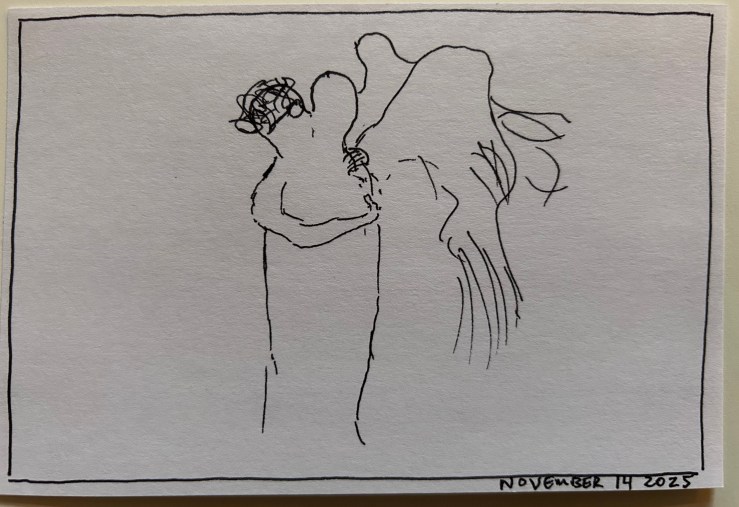
Loving Attention

Pencil crayon, 6×8″

This fear of the blank page, this fear of not having the skill to translate one’s communications between inner world to outward presentation, this fear of lacking creative ability to express beauty, this fear, this paralyzing fear of inadequacy, does it ever go away?  

It doesn’t. At least for me.

I was going to erase that first sentence/paragraph…it wasn’t what I intended to write about today. The whining, it’s tiresome, no? But I would be leaving out one of the more difficult aspects of my writing practice if I did. And here, with these posts, I’ve promised authenticity.

So, my writing process becomes a matter of forcing myself through the exercises of creativity, forcing myself to the habit. The routine feels the same way one feels dressing for the gym: snapping spandex to the waist (a paradox of constriction and freedom of movement), flattening my breasts with a sports bar (not giving in to the inevitable rise of claustrophobia), rooting round for a sweat wicking tank (a clean one), short socks slipped over the toes, the heel, to hug the ankles, bending, crouching, gathering then looping the laces on my sneakers, and finally, the deep (resigned) inhale, then exhale, stepping onto the gym’s rubberized floor, heading toward the weights beneath the coach’s patient gaze. And after the workout? Euphoria.

All that to say, it takes a lot of energy (and time fiddling round “getting dressed”) to do creative work. I think this is why I dance round so many different creative projects…to keep my head in the creative game. When one project seems insurmountable, another can feel feasible. The dangling addiction to euphoria (in writing, it’s when things—words, metaphors, ideas, images, sounds, etc.—come together, surprise me; in drawing or painting or sculpting, it’s when forms, colours, lights, shadows, etc., come together, create something beautiful)[1].

But there’s also an issue of commitment…it seems I have one[2]. Fear of inadequacy is one thing; fear of sharing my creative work with the wider world is something different. (Though, I suspect, related.) I know I’m resisting. I know I’m avoiding. I haven’t been sending my work out for publication[3]. What I don’t understand (yet) is why[4].

So, I’m studying my fear. Not just to understand its origins but to understand how the development of belief systems shade behaviours to come[5]. I suppose we could call belief systems the stories we tell ourselves. I’m studying how those belief systems move, crossing space and time, forming our lives.

I know it’s my own thinking holding me back. Knowing the issue doesn’t solve the issue. I’m working on it. Working through it is going to take more than spandex. Love helps. Love, really, is the answer to all of it. Loving attention and a devotion to loving attention. Love bends belief systems to become better, beautiful. I’m not being trite here…love is what shapes…art, yes, but also, us. Love shapes humans. And, I imagine, the more than human world too[6]. The betweenness, the relationality, the reciprocity, is important.  

                  And this put to mind a thought I had recently, a floaty thought, connecting the actions of drawing/colouring with recent paragraph development work with Nina Schuyler.  One of the things (of many) that I love about Nina’s breakdown and discussion of sentences is her systematic illumination of how the techniques achieve emotional impact for the reader. I realized the layering approach of sentence structures, both within a sentence, and sentences in relation to one another in a paragraph, is akin to the layering of colours, light and shade, when painting or drawing. The idea brought home for me how a paragraph creates an emotional resonance …a translation of complex emotion(s) layered and transferred to the page. Words, as symbols, representations of “things”, are inadequate in and of themselves to render the emotion… “joy” for example, is too abstract, too far removed from the body-mind sensations and experiences, disconnected from the cascade of memories, desires, wishes, instincts associated with the word, but the sentences and the paragraphs build in tandem to create that wonderful harmonious effect and impact with text.

This is the same way a song is layered with longing or love and attained through tempo, melody, harmony, lyrics, tone, volume, instrument variety etc. Art, including literary art with its intentional, architecturally constructed intercourse, I’m only now appreciating, enables exploration and expression of interiority and exteriority when language might so easily lead us astray.  The foundation of such architecture is loving attention to the heart’s desires, the heart’s revelations…whether that be focusing the beauty of a pomegranate or a pear, or a surprising word, metaphor, or image generated using stream of consciousness writing. Some thoughts anyway…


[1] Cooking, while also creative, follows a shorter, more predictably satisfying arc. At least I get to savour the efforts. Also, sharing them with others remains, despite years of practice and repetition, a magical joy.

[2] A little about me [and married]; I will never allow myself to be owned again.

[3] I have one piece, the introduction section of my longer project, submitted at one literary magazine…I am working to WILL an acceptance there.

[4] I read today, an inspirational maxim (normally I’d eschew), attributed to William Ward (though, chasing these quotes from social media proves an erratic, enigmatic, time swallowing quest), “To place your ideas and dreams before a crowd is to risk their loss” …is this what I’m afraid of, losing my dream?  No longer having a dream? An interesting thought…

[5] This study, which, thankfully, dovetails day job research, integrates stunning intersections across disciplines: epigenetics, early childhood development, neurochemistry, physics, philosophy, psychology, history, anthropology, biology, sociology…

[6] This time last year I read Bruce Chatwin’s The Songlines. It had been part of my sister’s Indigenous Studies curriculum, and I stumbled across it while packing up my own books preparing to move. An interesting read as a window into the sociocultural attitudes re: women and First Nations peoples in the 1980s, an aspect which, unfortunately, may prevent a contemporary reader diving in…I think, all the more reason to read it, but that’s not what I want to highlight.  What sticks with me is the belief system described in the book, how Aboriginal Australians maintain songlines, pathways of knowledge crisscrossing Australia, the sky and the water, also called dreaming tracks, that link stories with features in the environment, by continuing to sing the world into existence through loving attention. (I am paraphrasing a super complex and fascinating world view.)  Here’s a short video describing songlines and the links on the subject beneath the video are excellent.

Pencil crayon, 9×12″

Mapping the Missing (Or, Italy: Reflections on Beauty, Part 2)

I didn’t quite get this post to come together the way I thought it might. I’m interested how my subconscious thoughts—thoughts that take my conscious mind so long to catch on, catch up—drive my writing[1] ….I’m learning to relax enough to draw it out, I’m learning to “see” it, and somehow, in my mind, this process puzzles together with world views…

When I visited Venice last month, top of my list was to stand in front of the Fra Mauro version of the Mappa Mundi at the Biblioteca Nazionale Marciana. This world map, completed in 1460, created using a southern orientation requiring me to flip and stretch my own perceptions of the world, is considered one of the most visionary cosmographical works of all time. I love that word, cosmographical…like, drawings guided by the stars. It’s a large hand-drawn map, almost 2 meters in diameter, of what was believed the world looked like in 1460. Belief is what I’m interested in…how it changes and shapes our thinking. What fascinates me about the Mappa Mundi, in addition to its gorgeously detailed hand-drawn beauty[2], is that Fra Mauro created his world view without ever moving beyond the shores of his Venetian island[3]. There’s heaps of fantastic information about the Mappa Mundi I won’t synthesize here, but well worth checking out; the AI project associated with the map is, in a word, dazzling[4].  

A recent Saturday I woke, galvanized myself, and emailed a friend[5] in the writing community to request one of the two open mic spots at a public reading at the library in Picton. I left volunteering almost to the last minute to decide, yes, today (today!), I have the courage to read one of my creative works. 

Then, I spent a quick hour editing the piece, changing the title and furnishing it with a deeper history. I ran out of time (is it ridiculous to think I would have that time?) and I knew the piece wasn’t “finished”. But I’m discovering no creative conversation seems to end…the writing continues to communicate beyond whenever I assume “I’m done”.

In my mind, I imagined the public library reading might attract 8 to 10 people. In my mind, they’d be milling about the stacks listening half-heartedly to the readings while they pulled random books from the shelves, splitting them open by their spines. So, imagine my surprise when I showed up, just as the event began, and discovered a far more formal arrangement: perhaps fifty people seated in rows and rows of chairs (none empty…when my daughter, Willa, and her partner, Nadine, arrived slightly after me, having parked the car, they sat on the floor against the wall), a podium, a mic, speakers and a video set up, aimed and recording.  

I have not read my work publicly in many years[6]. Certainly, it was pre-pandemic. When I moved to the podium, the adrenalin kicked up from my stomach and pummelled my heart.  The first paragraph was breathy. I lacked air to project my words. So thankful for the mic.  In my mind, I kept repeating just read what’s in front of you Suzanne, it’s right there.  Take a breath at the next period, you have time. Good. Next period, take a breath, take a deeper breath. By the time I reached the second paragraph, my breathing evened, and I managed to settle into the rhythm of inhaling and exhaling with the sentences.

And I edited on the go. I decided to drop a whole paragraph, suddenly seeing there was no need for it. I started to look up at the audience, interpreting their expressions (in my mind, this seemed like…confusion?). Three quarters of the way through, I realised I was enjoying myself, sharing my work aloud. The piece is dark, I know, but it turns toward the light by the end. But I felt when I’d finished, the audience hadn’t followed me through the turn. Ah well.

In the spirit of blind map making a la Fra Mauro style…I’m tracing the contours of subconscious thought, surfacing new meaning from those watery shorelines…this seems a translation made possible only by passing words through the chambers of the heart as opposed to catching in the net of the mind.

Here is the recording of the event. My reading begins at the 54-minute mark. Following the video, I’ve pasted the work in progress with some of my thoughts, marked using orange coloured text, that have arisen since (also during ha ha) the reading.


Measures (the original title of the piece was Just Math and the original draft focused on the mathematical aspects or logic that we [mis]apply to situations that are …less mechanical, more human…’Measures’ as a title got slapped on the piece the morning of the reading …I was thinking it might be a riff on the math aspects, but didn’t think too deeply…but now I’m discovering subconscious intentions, what this piece might be trying to communicate, exploring the choice to end one’s life, perhaps the most weighty decision one might make …so will likely keep this title)

I visit my father in hospital every Saturday. It’s not a real hospital, it’s a step-down unit, a retirement home repurposed to ease the burden of bodies (during the reading – why not before? I don’t know – I noticed how frequently the reference to “bodies” comes up in this piece…6 times…considering this because it signals some sort of corporeal versus what? spiritual? maybe…there’s a nod to religion in the piece…but no, it’s my subconscious circling the deeper meaning I am only seeing now: when is it time to depart a body, a body at odds with an ability to negotiate this world?) competing for limited hospital bed space. The patients here patiently await death. Or they wait to pass a test called Activities of Daily Living so they might score a return to former lives. It’s all about patient to nurse ratios and patient proximity to death.  Just math. 

In the lobby, plastic plants droop. A young woman sits behind a reception desk, her face blue with the glow of the computer screen. She says hello, but only when I say hello first. (during the reading, I dropped this paragraph thinking it didn’t add anything to the piece….now I’m wondering about the reference to blue here (the word shimmers for me), its multi-dimensional reference to depression…hopelessness…but also its vastness, its possibilities (open sky, open water, universe etc.).

The room my father is in, 316, is a small, one bedroom apartment designed to shelter a couple who really get along, or a solo senior citizen. Now it holds three aged men in three hospital beds and no chairs to sit on when visiting. 

A man named Victor has the bedroom. He is tiny and more and more yellow each time I visit. He is skeletal, though his stomach balloons from his body. His belly button is definitely an outie.  It probably wasn’t always.

My father smiles, caged in his hospital bed. A welcome. (when I wrote this, I intended to describe my father’s smile as a welcome one…except that word “caged” practically leaps from the sentence and grabs my throat so I notice there’s more going on ….the syntax here, laid down completely unintentionally, even an error if I compare it to what I had actually thought I had written, introduces sly ambiguity attached to the word “welcome– do I mean his smile is welcome, or that he is [safely] caged (connotations of threat)? And the ambiguity provides a subtle warning for readers (and me ha ha) that there’s something not quite right between the narrator and the father…and shunts the transition from this paragraph to the next, where, their relationship, as well as the deeper history that shapes their relationship, is revealed.)

As a kid, his smile was a peculiar twisting of his lips, holding, like a cup, cruelty and condescension about to spill forth. We distanced ourselves from the inevitable poison, his words arrowing the air to the gut. We learned to excuse his smile. He, a refugee after all. A Canadian through revolution. His 13-year-old body a witness to other bodies strung up along the boulevards of the old city. Tanks rolling in. Molotov cocktails and body parts made kites. (‘kites’ in this sentence shimmers for me….it is only now that I am seeing any link between this word and perhaps the deeper exploration of this piece….is my brain getting too involved in meaning making here? Maybe. I wonder about the associated movement in relation to the violence depicted here, an upward flying movement….could it be departure of the spirit once a life is gone?) His smile, back then, did not seem a part of him, as it does now.  Still, conversation’s an effort raised beneath such rain, beneath an umbrella of pain.  (readers of earlier drafts of this piece were confused by the relationship between the narrator and the father: why is the narrator so interested in the Vic character, why are the narrator and the father not talking to each other? So I added this in…this paragraph was originally drafted as a breezy response to a writing prompt about remembering a smile.)

In room 316 of this not hospital, a glass door opens to a fake balcony. From there, looking down on the statue of Jesus I feel benevolence drain. I can only look out the window if the man my father calls “Lump of Lard” isn’t in the hospital bed beside it. A prosthetic leg furnishes the corner beneath a TV screen angled from the wall. 

My father’s railed bed is in the kitchenette. (this was interesting, editing that morning, I did catch that several of my tweaks included variations on the word “railed”, a strange, if apt, description here…looking it up now, I discover its multiple meanings. In addition to “enclosure”, it also means “protest strongly”, “blame in violent language”, “object about something”…is this my subconscious wrestling with the idea of taking one’s life? I don’t know. Maybe.) If he wants a glass of water, he rolls to his right. Blue fabric curtains suspend from railings mounted to the ceiling. The fabric separates everything: Lump of Lard from my father’s radio tuned too loudly to the opera station, the angles of sunlight from reaching my father’s bed, the sorrows and longings of three different men.

Every week I visit there is less and less of Victor.  His yellow skin droops from the sticks of his bones. His brown pupils bulge from sunken sockets shadowing his forehead. He often cries out in pain. “I know Vic!  We’re here. We hear you!” my dad says, explaining it’s important to cheer him on. Vic is proud. He was given 4 months to live and that was 7 months ago. In my mind I wrestle with Victor’s decision to forego MAID, medical assistance in dying. His yellow death is inevitable; why wait? (this is the heart of the question this piece is exploring….I even phrased it in the form of a question…but it is only now, after the reading, that I start to piece this together...and realise the contours of this exploration need to be mapped into the piece to better guide the reader (including me!) through this question.)

Today, when I exit the stair well and enter the third floor, Vic sits in a wheelchair in the centre of the hallway. There is so little of his body. He seems only a distended stomach with a yellow head thrown back and a mouth agape at the ceiling. I’m frightened he’s dead. Closer inspection reveals his yolk-coloured bird cage chest expands and contracts round a fluttering heart.

Today, my father’s welcome smile from behind the rails. Today the opera is La Traviata conducted by Toscanini. An orderly wheels Vic past into the bedroom.  Eventually, Vic shuffles by me to the microwave. “Is that your sister’s soup?” my father asks him. It is. While it heats, my father and Vic argue over the green leaves in the soup. Vic calls it by its Portuguese name; my father insists it’s kale. Toscanini chimes in. I imagine the Maple keys on the trees outside shiver-whisper and lean against a kitchen cabinet not interjecting. I understand—now–it’s joy arguing a position.

Vic lifts the bowl of soup from the microwave then raises it to his face, closes his eyes to concentrate inhaling the steam, the spice swirls of Portuguese sausage. I hear his eyelids when they snap open. A light dances in his eyes. He raises the bowl, wafts the steam towards my face. Its gloriousness travels from the tips of his yellow fingers to grace my nostrils. I smell chicken stock and chilies, the green of leaves, the orange of coriander seeds. (here, I think, a missed opportunity, but must be executed (oohhh bad word choice in this context, ha ha), delicately – the food description here with colours, orange, green, needs to be enhanced better, after all, it is this pleasure that is highlighted here, a pleasure that keeps one tethered to a life in this world, even when the body disintegrates…so it deserves special attention, this sentence….but not go over the top. I have a habit of going over the top…so, Suzanne, don’t rush this). I think anyone would give a life to taste such cooked-in love. (a strange sentence…and only now I’m seeing it differently, changing my view of meaning …it’s a reference to the relationship between the narrator and the father ….how “cooked in love” contains multiplicities, and how sometimes, it takes one’s lifetime to learn compassion and forgive. Or maybe I have now gone far too meta here…does it matter? No. But I find this analysis fun, so continue.) Suddenly, I understand not only the pleasure of choice, but how infinity might be measured.   I pull the blue curtain (note repetition of blue curtain, not sure what it means, if anything) to the wall. Sun splashes in. My father is up and walking with the aid of a walker. His test score improves.  I reconsider MAID, its balance. I instruct my father to stand by the window. (these two sentences, “reconsidering MAID” and “instruct my father to stand by the window” come too close in proximity so their meanings get hooked together when they shouldn’t be. As they are placed now, it leads a reader to think that maybe the narrator is going to push the father out the window, save his decision to take his own life and do the deed quick….so, this needs fixing). The fake balcony door opens easily. Sunlit wind rushes in. Below, seed keys on a Maple tree twirl the grey twiggy ends of all its branches. It sparkles. It winks. Alive. So beautiful it can only be a miracle. Sweet air of outside too. Toscanini’s violins.


So, the trick to writing that connects—offering one’s hand in the dark—is to catch oneself in the act of sharing an open heart …the subconscious is not so shy of dialogue there …surprising  words (or vibrating ones…a shimmering…this is often how I experience it) or phrases, or images, offer clues of deeper emotion, deeper intelligences of the body, an energy moving through. Somehow, authenticity must be rendered on the page without a cage of words but through a window of words instead. The techniques of syntax and rhetoric …they are ways to lead a reader through a writer’s thoughts so they follow the pathway the writer has mapped to communicate…they are clever ways to amplify meaning and entertain. But, fundamentally, a writer must be authentic to themselves and express that authenticity through love, gifting one’s deepest self to the world. So, I continue this eternal pursuit for the song of myself, to quote Whitman, and share a voice that sings.

This peace making with my slow subconscious writing process, waves away all my jagged edges, the way the sea softens stone shores, crest after crest after crushing crest, until I rise, battered, sopping wet, but smiling.


[1] Subconscious thought…unquestionably the most essential tool in my own writer’s toolbox …but I wield it with juvenile dexterity, a lazy magician with performance anxiety.

[2] The ocean, lake and river waves are drawn using ultramarine ink created from crushed lapis lazuli, one of the most expensive semi-precious stones before a synthetic version was invented. Because of its value, the pigment was often reserved for painting the Virgin Mary’s robes….I love this kind of information. Colour, by Victoria Finlay, provides a comprehensive overview of pigments…it’s a dense read, but fascinating. On the Mappa Mundi, there are little drawings of fish and sea monsters and castles and dome topped turrets. The calligraphy is neat and tight. There are drawings of the heavens and the garden of Eden.

[3] He consulted ancient and contemporary sources and triangulated the information to create his own…but it still fascinates me how he mastered translating three dimensional navigational and topographical  information into a two dimensional work of art from behind a desk.

[4] This AI project mirrors the methods originally used to create the map in that it collates historical and contemporary interpretations of information to write new ones…it’s also worrying, the ease and speed new stories, gathered by machines, supplant old ones (the website name is ‘engineering historical memory’).  But then I think, isn’t this what we all do? Even the act of remembering shifts and changes an event; the actual experience is never fully recovered…I guess we try to repeat and create experiences of beauty and love and eschew painful ones…and those interpretations shape the contours of our choices…and ultimately, our own story.    

[5] Thank you, Nora-Lynn, your smile provided warmth and encouragement when most needed. I also appreciate you put my name to the task that day, thank you to both you and Jane for hosting a lovely event.

[6] I have read in virtual settings, always with smaller groups. Currently facilitating virtual writing sessions with the Writer’s Collective of Canada and we share our reading as part of each session. It has been wonderfully inspiring to listen to others’ voices. It’s also good practice for speaking my own.