A Collaboration

“I like the way we make our dreams happen.” Lori Richards

I’m delighting in the astonishing culmination of a collaborative art venture with my friend, artist, Lori Richards. Our creative works—Lori’s paintings  and my writing—are exhibiting together for a short time at Wall Space Gallery in Ottawa. She generously invited me to write prose poem (like) pieces towards her paintings and I leapt at the opportunity[1].

The vernissage (new word for me, it means a preview of an art exhibition) was last weekend but we dreamed the idea—a wish—to combine and show our art works many many years ago. The exhibit is called Seedbed.

Lori and I walk together almost every week.  As our feet pound the leaf and petalled paths, the sidewalks, the pavement or the snow, we recount, gesturing to the winds, drawing models in the air with our fingers, the celebrations, the frustrations, the lamentations and the longings of creative process. Despite working in different mediums, our practices are very much aligned. Lori is a professional artist. She has been, and continues to be, a steady champion of my creative writing as I squeeze it in as best I can round my day job[2].

Leaping is the right description for the approach I used for Seedbed. I’ve written ad nauseum (emphasis on nausea) about how crippled I am when it comes to pushing my creative writing out into the world (submitting for publication). I didn’t have this issue in the past…it developed over the last few years …I don’t really know what it’s about, but I feel like I’m about to break through my own barriers[3]. I think I’ve been saying that for a year or so. Sigh.

For this project, writing prose poem-ish pieces for each of Lori’s seventeen different paintings, I wanted to practice less preciousness with my writing. And I wanted to experience (force myself) to let go of them as is. I created a few rules for myself to keep the creativity light and fun:

  • Gaze at the painting, but only for a short time
  • Use stream of consciousness writing (I wrote freehand for most of these in my notebook, and the pieces, as they were being written, often included arrows and connecting lines)
  • Adhere to first instincts (as in, whatever words or images pop up, write them down and don’t tinker very much or at all)
  • As soon as a piece feels finished, send it to Lori as “done”

This phase of development and creation worked relatively well, though I was surprised by the writing emerging. The pieces are whimsical and, in several cases, nonsensical. But, adhering to my own rules, I let them be.

Do look at the paintings at the gallery website – my reproduction here fails (dreadfully) to capture the vibrancy of colours.

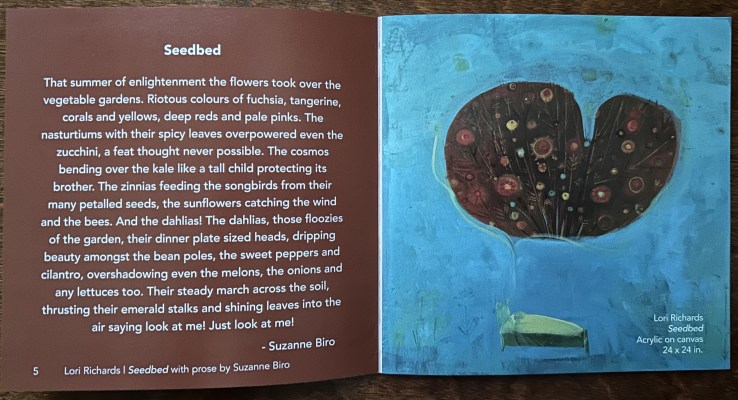
There was only one pairing of works where the process was reversed, where my writing inspired Lori’s painting. Interestingly, (or maybe the better word is fortuitously), this became the title pairing in the exhibition: Lori’s seedbed painting and a breathy paragraph of my own that floated to me the week I made the decision to leave my marriage. Though Lori thinks of the Seedbed series as beginning January 2024, I feel it began closer to the creation of that garden focused paragraph in the fall of 2023. It was then Lori created her first “bed painting” (several paintings in Seedbed include an image of a bed). This first painting felt (feels) emblematic for me, for what I was/am moving through. That painting now hangs in my bedroom.

It has been wonderful experiencing the generative iterations of the series since. There have been additional bed paintings created beyond the exhibition submissions…they continue.  I feel magically connected—in a way I can’t articulate—with each painting as they appear. The closest I can come to explaining my feelings is with the word blossoming.

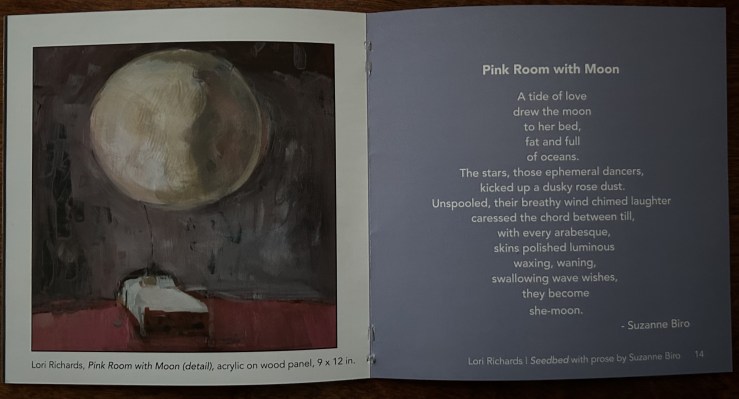
And I wasn’t nervous in the days or hours leading up to the vernissage. The gallery’s curator displayed the works beautifully. She and the staff also produced a lovely brochure of a selection of paintings with their ekphrastic accompaniments. Both Lori and I were expected to speak briefly about our process and collaboration, and I planned to read two very short pieces[4]. But when I arrived at the gallery a cold panic sloshed in my stomach[5]. The gallery space filled quickly, bodies tumbling inside from the frozen February afternoon. I’m told there were 80 people but they all sort of blurred together blobbing round while I smiled and nodded and prayed the wine I was drinking would kick in. It didn’t.

When it was my turn to speak, I accepted the microphone with grace. I stumbled on the word ekphrastic (it is very hard to say)….garbled gravel in my mouth…my heart thrashed against my rib cage and leapt the base of my throat, but then, deep breath, pause. Reading my own words, my body calmed and settled from the very first sentence. My voice steadied and held. I’m told I was poised. I wish I could say I recovered soon after the short performance, but I felt rather sick with the adrenalin hangover for the remainder of the day and into the evening.

Still, it has been an accomplishment. And a progression. In the days since, I’ve felt delighted with the experience. And (perhaps?) even a little awe for the courage it took to leap.  


[1] Ekphrasis is a written description, real or imagined, of a work of art. Another dear friend, Barbara Ponomareff, who I met years ago when I offered to carpool us to a wonderful (and remote) writer’s retreat, has published several exquisite ekphrastic works in The Ekphrastic Review.

[2] I’m blessed with continuing encouragement from so many people; you know who you are, I sing your adorations for sticking around, thank you.

[3] Intend to write about “next level writing” in the March blog post, so, stay tuned. Also, I promise to curtail the whining and actually get some pieces submitted.

[4] Another dear friend, also a weekly creative-conversation-while-walking companion, Carolyn Smart, very kindly suggested which work to read. And I’m tickled to learn that painting, Pink Room with Moon, sold to another Canadian poet on the strength of an Instagram promotional post even before the show was launched. So many collaborators throughout the whole process… why do we ever believe we work in isolation?

[5] Threatened a colonic…wholly inelegant I know. Vomiting might have  been preferable. But the body chooses its own exit strategies. I managed to keep uh everything intact (emphasis on in).

Seedbed introduction (Lori in the background and Tiffany, gallery curator, to the let).
Seedbed reading
Pink Room with Moon reading

Heart Work

I worked really hard to get 52% in first year physics and even celebrated that pass with gusto (meant I could keep my bursary). But it seems I missed the lesson on momentum – looking after my friend’s two labs last week, I was launched from a standing position, cartoon-like, when they lunged at a passer by. They even dragged me two feet. I must weigh the same as they do, I think that’s how it works. Ego more bruised than my body.

I don’t know where to begin. With the pain or with the love?

We are born to love[1]; pain shapes the way we do.

The long form writing project I continue to work on (slowly, oh so slowly) has become an exploration of how pain and love develop over a lifetime to shape…well, decisions, behaviours…everything of human being.

The subject of my exploration is me, an N of 1. But nested in my family because the twisted strands of DNA encode a legacy of pain and love across and through generations. Also, my own children, the ongoing experience of raising them. We forget this, thinking of ourselves as separated bodies encased in skin, as individuals in isolation, ignoring how we bathe in oceans of influence from lives and cultures past and present, as well as the speculations of futures.

My long form creative writing project explores questions like, how the fuck did I get here? Why the fuck did I choose to do that? And weaves the territories of my parents’ lives through my own with questions like, fuck, how could they have done that differently? What the fuck happened to them to make them act like that? (Note: technically this is referred to as “reflection[2]”, writing from the point of view of “I” now, having gained (some?) wisdom).

Pain and love are not opposite ends of a spectrum; I understand them better as points of radiation. The rays of light, the spears of dark, overlap, intersect, bend and shape, illuminate and shade our experiences, our beliefs, our behaviours, our choices. And not just our own. This would make it simpler. Our love and our pain shape the vibrating energy between us, in all our relationships. All relationships, with the non-human animal and natural beings in the world as well (I include landscapes, rivers and rocks and sky and trees and more, as part of this comprehensive definition). And relationships are ever moving and changing, breaking apart and reforming.  Writing is one way to explore and understand the dynamic process, the influences and impacts, of love and pain[3].  

Shakespeare does not begin the play Romeo and Juliet with a focus on the passion between the lovers. Even before the first scene, the prologue hints the pain dooming the lovers to an early (and dramatic) death (with a scientifically prescient nod to trans generational trauma epigenetics!), “From forth the fatal loins of these two foes/ A pair of star-cross’d lovers take their life”. And it ought be noted[4] Shakespeare’s very first scene, in a story about love, is set in “a public place” where conflict erupts in violence. In this work of art, love is sandwiched between violence and death. A more general question: does it have to be? Or, is it always? And that got me thinking about other novels and stories …I’ll get to this shortly.

The long project I’m working on continues to reveal its underbelly as I work with it.  There was a lot of love in the house I grew up in. And there was a lot of pain. And it’s essential the writing capture both. It’s an audacious research question to ask, even gutsier to explore as a theme in writing: how do we learn to love? 

Okay, okay, let’s be clear, I’m not asking how romance develops, how we fall in love with each other. I’m interested in the hypothetical, launching into the imaginary, can we learn to love with an ability to transcend our pain?

At the root of it all, when we “teach” love to our children as we raise them, how do we do it? In order to love (in its highest compassionate, empathetic, unconditional form) do we need to have experienced pain? To this last question…my gut says yes. Absolutely necessary. But why?  Is there a love world I could imagine where pain is an unnecessary precondition[5]?

Then I remembered Dune, the 1965 science fiction novel by Frank Herbert, and the Bene Gesserit Litany Against Fear repeated throughout the novel:

I must not fear.

Fear is the mind-killer.

Fear is the little-death that brings total obliteration[6].

I will face my fear.

I will permit it to pass over me and through me.

And when it has gone past, I will turn the inner eye to see its path.

Where the fear has gone there will be nothing. Only I will remain.”

In the novel, the litany is called upon when the protagonist Paul is made to endure torture as a test of his presence of mind.  The litany and story doesn’t exactly transcend pain in the name of love …it remains quagmired in imperialism and an extraction economy[7]…BUT, the litany hints at the necessary discomfort and mind work one must endeavor to move through (or work with) pain, become calm, and progress with clearer (inner eye) sight “to see its path” (i.e., a learning has taken place, in short, mental growth).

A better audacious research question: as humans, as beings vibrating with the emotional between, how do we learn love can be bent through our pain and made brighter, deeper, even more true or real on the other side of it? Working with our pain, perhaps, is how we learn to love better.  Perhaps the only way[8].

Of course, my long project won’t answer these questions. But exploring how love develops out of childhood is the first step on the path.  

Off the top of my head, I can think of a few short stories illuminating moments of pain experienced in childhood—betrayal, shame, and fear—where the stories leave the reader with the sense of reverberating impact on the child’s subsequent lives.

Betrayal

Anton Chekhov’s <2000-word short story, “A Trifle from Real Life” focuses its moment of illumination on a conversation between a child, Aliosha, and an adult, Nikolai Belayeff. Nikolai, the boy’s mother’s boyfriend, persuades Aliosha to trust him with a secret (the boy visits his father regularly, against his mother’s wishes). Then, Nikolai, using the information as a point of leverage in his own relationship, reveals the secret to the boy’s mother. Aliosha stands there, stupefied and traumatized (the boy is described as being unable to hear his mother’s words) his trust trampled. I was amazed when I went back to read the story for this post how overtly Chekhov writes the boy’s painful lesson, “This was the first time in his life that he had come roughly face to face with deceit; he had never imagined till now that there were things in this world besides pastries and watches and sweet pears, things for which no name could be found in the vocabulary of childhood.”

The story’s title with the words “a trifle”, signals the teaching: how little consequence adults place on the small moments of teaching during a child’s development. I would not have noticed the subtleness of this illumination myself; I read about the technical move[9] Chekhov uses, a deft point of view switch, to lead the reader through the assumption an adult’s experience supersedes a child’s experience. Have lots more to say here but this post is getting waaaayyyy too long and I have more stories to get through.  

Shame (specifically, sex shame)

“A North American Education” by Clark Blaise is a story about the sexual awakenings of a thirteen-year-old boy, Frankie Thibidault. Importantly, the story is a reminiscence from an adult Frankie point of view. It relays a series of attempts to “educate” himself about, and satisfy, his body’s physiological longings. Through each scene, the reader is close witness to Frankie’s crescendoing exposure to sex (yes, the scenes do play out like this, gradually building upon one another to the story’s climax), and how his exposures are (repeatedly) shaped by secrecy and shame.

The enjoyment of sex, making love with a person you love, is one of the most glorious (and natural) experiences a human can share. This story, which, incidentally, begins with several paragraphs of family histories going back generations (a nod to influential experiences, including genetic, familial and cultural inheritances), layer moments where normal sexual development becomes twisted through the actions and beliefs of the people we love. In this story, it’s Frankie’s father who shames him while also providing an education about how women might be treated (in this story, no surprise, not great).

I’ve written about Lauren Groff’s “The Wind” in a previous post. It is a stunning, perfectly executed short story exploring the way violence in childhood ripples across time, affecting generations to come. Using a deft and subtle point in time switch, the story happens in the past but moves swiftly at the end to current time, signalling how pain spikes and spirals not just one life, but lifetimes. The narrator is a granddaughter, relaying her mother’s brutal exposure to intimate partner violence and how that exposure causes a misremembering (or selective remembering), the episode too painful to endure.  The first word of the story is “pretend” and it is the granddaughter who is coming to terms with the violence her mother witnessed but cannot hold.

This story powerfully shows how violence (and here, I broaden the definition to include wars and conflict, forced displacement, etc.) might REQUIRE generations to shoulder the burden and dull the pain to pass through a prism of love. And of course….any disruption of that process toward love (compassion, empathy, forgiveness etc.) spears the wound again…[10]

So, this got me wondering whether there are any stories (I’m sure there are lots, I just can’t harvest them from my brain at the moment) of developing love, teaching love to our children. And whether there are any marrying pain and love, the interaction between the two. And bingo: Grace Paley’s flash fiction (less than 1000 words!) “Justice – A Beginning” came to mind.

In this story, the protagonist, Faith (note the hopeful name – believe!), is returning from jury duty. She describes the courtroom, watching as the mother of the convicted “leaned on the witness bar, her face like a dying flower in its late-season, lank leafage of yellow hair, turning one way then the other in the breeze and blast of justice.” I love that description, breeze and blast of justice. Not just the alliteration but the conceptual connotations: how easily, breezily, the sentence of guilty is handed down; how utterly devastating, like a bomb’s blast, to the family of the convicted. The narrator continues, completing the image, “Like a sunflower maybe in mid-autumn, having given up on the sun.” (Note the homonym with “son”). I imagine Paley selected the image intentionally. Sunflowers, because they grow by tracking the movement of the sun, can symbolize God’s divine light guiding believers on their spiritual journey. This, coupled with the protagonist’s name, is an intentional layering of meaning in the writing. It’s also an image of something beautiful and hopeful dying.

It’s clear, on my own reading anyway, Faith doesn’t agree with the guilty verdict, “She probably said Oh shit or even Fuck.” In a few sentences, Paley paints a picture of the world of ambiguity (injustice) we live in: yes, the convicted held a gun to rob a grocer, but he was hungry (I assume because it is a grocer and not a bank he robs, a leap maybe)…demonstrating with story how the motivations are never so simple, but justice is served in binary, guilty/not guilty.

The final paragraphs of this short story move to domestic scene and exchange of love and humour between Faith, her adult son and his girlfriend Judy. The camaraderie and the humour are a beautiful counterpoint to the devastation Faith felt earlier as a juror. But she wants to be alone, “She needed to think more about the jury system, mainly her companion jurors. Also the way that capitalism was getting to be a pain in the world’s neck. She thought she might try to make a poem out of that opposition.”

In the end, her son’s attentive love coaxes her from her bedroom: with humour and a deep understanding of each other’s moods. That line, about making a poem out of opposition…it’s the key isn’t it.

With my own writing, exploring how I learned to love and how I work to transcend my pain …this is the block of marble I’m chipping away at, carving into book length sculpture, something, at least, I can view and hold and circle slowly, in the round. And maybe, just maybe, illuminate a way along the darker path of understanding. Pain is a gift…shaping me to love differently, in different ways. And better.


[1] Even when other physiological needs are met with food , water, shelter, human infants fail to thrive (and risk death) without physical contact and touch  (loving attention).

[2] Some reflection techniques via Judith Kitchen, written text chunks or weavings such as: retrospection (looking back assessment); intrusion (stepping in narrator commentary…I notice, I employ this technique regularly…like, um, even here, now); meditation (rumination, kicking a dead horse etc.); thinking around (finding a different perspective or a different viewpoint or opinion or even a different description i.e., wide panoramic view versus close up); imaginative alternatives to what did happen (even wishes?); speculation (imaginative alternatives to what could happen, again, wishes?); self-interrogation (asking questions on the page); projection (ascribing a feeling/thought/impulse to someone else…a good way to describe characters as well as the narrator through judgements and opinions, as one example); digressions (wander and wonder lift offs…v. guilty of these and a reader might not be so forgiving, hence all this information couched in a footnote).

[3] I’m most curious, in professional work as well as creative work, exploring the energy, the communication, of what I’m starting to refer to as “the between” …that our concept of “individual” confined in a single body, might occupy and steer too much of our attention. Instead, we could be attending to the “in relationship” forces as the necessary conditions impacting health, wellness, creativity and, most importantly, love. Community forces. Come Unity.

[4] Here, I am deliberately eschewing the palpable grief, despondency, even apathy, colleagues stateside, and here in Canada, expressed these last weeks regarding the recent US inauguration, as well as the upcoming provincial and federal elections here in Canada, as well as wars and deaths and conflicts and legacies of violence happening in different places across the globe. Also, the climate crisis. There is much written and spoken and viewed on these subjects; here, I want to approach them from the perspective of understanding the root causes of pain (that shape such disruptions and destructions), how they might be illuminated and explored through art…with my eternal hope and belief art will propose (and draw) solutions.

[5] And wouldn’t this world be Hallmark card syrupy and one dimensional?  I mean, humour alone would wither and die… An addendum: mere hours after hitting the publish button on this post, I pluck from my “to read” pile of books The Evolved Nest, written by Darcia Narvaez and G. A. Bradshaw, and right there, in chapter 1, read how Indigenous groups “lived with Nature’s gift economy, where food and care are shared in response to another’s need rather than being withheld as a means of control.” Followed by the crazy synchronicity (with my own musings in this post) of these lines: “Biologist Humberto Maturana suggests that humans originated and evolved as…a species shaped by a biology of love…With the rise of anthropocentric civilization, however, two other forms of humans emerged from the violation of the biology of love: an aggressive form, …and an arrogant form…The result is today’s dominant trauma-based culture.” Let’s skid past my lack of imagination then and seize this hope: we’ve had a society of balance and reciprocity with the land and one another before, it is possible to recreate it.

[6] Can’t help but see la petite mort in this line. Also, should note, Dune is also set within a foundation of warring noble families and the Litany, according to a wiki fan page, is a nod to another Shakespeare play, Julius Ceasar.

[7] You’re losing your thesis Biro, pull out, pull out!

[8] It’s only in the writing of this blog post that I’m realising the necessity of rendering “learning to love through pain” in my writing. And I continue to run from the pain (metaphorically and pragmatically). It’s stopping me from finishing pieces and stopping me from sending pieces out for publication.  Which feeds a vicious cycle of shame and inadequacy and hopelessness. I am very very fortunate that my process is buoyed by people who believe and support and continue to promote my work. The idea a writer works in isolation perpetuates a fallacy. We need community to lift us up.  When I write to touch someone, what I’m really asking for is to be touched in return, aren’t I? Or, having been touched by so many artist and writers’ works, I am moved to gift something of myself in return. Fear of pain bends my loving attention. Got. To. Get. Over. That. (Or through. Or with.)

[9] Long Shots to X-Rays: Distance & Point of View in Fiction Writing by David Jauss – this was a post on the AWP website. Unfortunately, the link is now broken – it’s a stupendous craft essay.

[10] Dark Biro. Just. Don’t.

Text exchange with a friend today. Couldn’t help but share. I’m afraid of heights so no bungee jumping or zip-lining. Burning Man…maybe. South America? Definitely.

Loving Attention

Pencil crayon, 6×8″

This fear of the blank page, this fear of not having the skill to translate one’s communications between inner world to outward presentation, this fear of lacking creative ability to express beauty, this fear, this paralyzing fear of inadequacy, does it ever go away?  

It doesn’t. At least for me.

I was going to erase that first sentence/paragraph…it wasn’t what I intended to write about today. The whining, it’s tiresome, no? But I would be leaving out one of the more difficult aspects of my writing practice if I did. And here, with these posts, I’ve promised authenticity.

So, my writing process becomes a matter of forcing myself through the exercises of creativity, forcing myself to the habit. The routine feels the same way one feels dressing for the gym: snapping spandex to the waist (a paradox of constriction and freedom of movement), flattening my breasts with a sports bar (not giving in to the inevitable rise of claustrophobia), rooting round for a sweat wicking tank (a clean one), short socks slipped over the toes, the heel, to hug the ankles, bending, crouching, gathering then looping the laces on my sneakers, and finally, the deep (resigned) inhale, then exhale, stepping onto the gym’s rubberized floor, heading toward the weights beneath the coach’s patient gaze. And after the workout? Euphoria.

All that to say, it takes a lot of energy (and time fiddling round “getting dressed”) to do creative work. I think this is why I dance round so many different creative projects…to keep my head in the creative game. When one project seems insurmountable, another can feel feasible. The dangling addiction to euphoria (in writing, it’s when things—words, metaphors, ideas, images, sounds, etc.—come together, surprise me; in drawing or painting or sculpting, it’s when forms, colours, lights, shadows, etc., come together, create something beautiful)[1].

But there’s also an issue of commitment…it seems I have one[2]. Fear of inadequacy is one thing; fear of sharing my creative work with the wider world is something different. (Though, I suspect, related.) I know I’m resisting. I know I’m avoiding. I haven’t been sending my work out for publication[3]. What I don’t understand (yet) is why[4].

So, I’m studying my fear. Not just to understand its origins but to understand how the development of belief systems shade behaviours to come[5]. I suppose we could call belief systems the stories we tell ourselves. I’m studying how those belief systems move, crossing space and time, forming our lives.

I know it’s my own thinking holding me back. Knowing the issue doesn’t solve the issue. I’m working on it. Working through it is going to take more than spandex. Love helps. Love, really, is the answer to all of it. Loving attention and a devotion to loving attention. Love bends belief systems to become better, beautiful. I’m not being trite here…love is what shapes…art, yes, but also, us. Love shapes humans. And, I imagine, the more than human world too[6]. The betweenness, the relationality, the reciprocity, is important.  

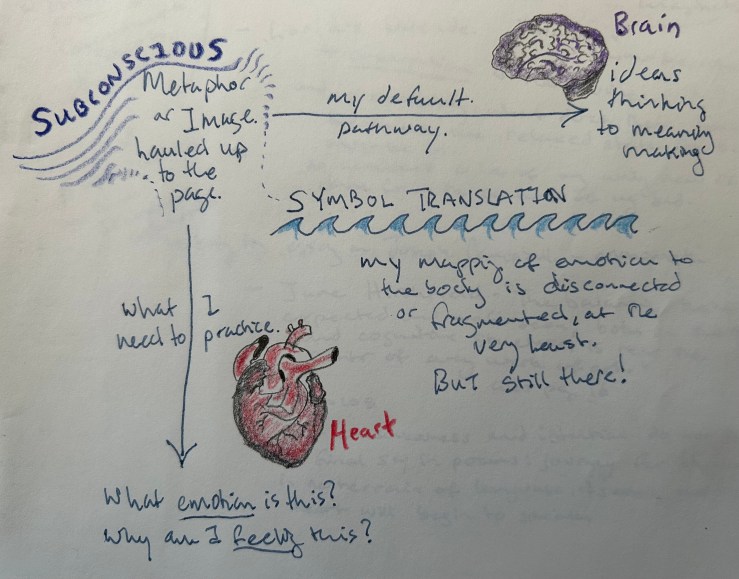
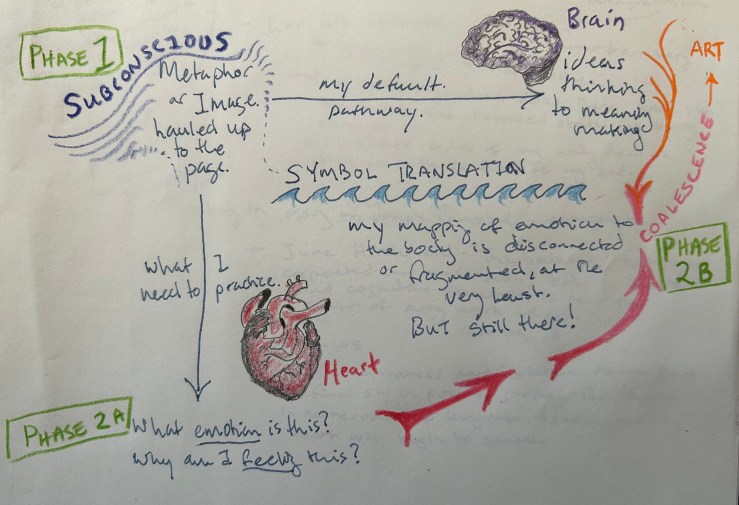
                  And this put to mind a thought I had recently, a floaty thought, connecting the actions of drawing/colouring with recent paragraph development work with Nina Schuyler.  One of the things (of many) that I love about Nina’s breakdown and discussion of sentences is her systematic illumination of how the techniques achieve emotional impact for the reader. I realized the layering approach of sentence structures, both within a sentence, and sentences in relation to one another in a paragraph, is akin to the layering of colours, light and shade, when painting or drawing. The idea brought home for me how a paragraph creates an emotional resonance …a translation of complex emotion(s) layered and transferred to the page. Words, as symbols, representations of “things”, are inadequate in and of themselves to render the emotion… “joy” for example, is too abstract, too far removed from the body-mind sensations and experiences, disconnected from the cascade of memories, desires, wishes, instincts associated with the word, but the sentences and the paragraphs build in tandem to create that wonderful harmonious effect and impact with text.

This is the same way a song is layered with longing or love and attained through tempo, melody, harmony, lyrics, tone, volume, instrument variety etc. Art, including literary art with its intentional, architecturally constructed intercourse, I’m only now appreciating, enables exploration and expression of interiority and exteriority when language might so easily lead us astray.  The foundation of such architecture is loving attention to the heart’s desires, the heart’s revelations…whether that be focusing the beauty of a pomegranate or a pear, or a surprising word, metaphor, or image generated using stream of consciousness writing. Some thoughts anyway…


[1] Cooking, while also creative, follows a shorter, more predictably satisfying arc. At least I get to savour the efforts. Also, sharing them with others remains, despite years of practice and repetition, a magical joy.

[2] A little about me [and married]; I will never allow myself to be owned again.

[3] I have one piece, the introduction section of my longer project, submitted at one literary magazine…I am working to WILL an acceptance there.

[4] I read today, an inspirational maxim (normally I’d eschew), attributed to William Ward (though, chasing these quotes from social media proves an erratic, enigmatic, time swallowing quest), “To place your ideas and dreams before a crowd is to risk their loss” …is this what I’m afraid of, losing my dream?  No longer having a dream? An interesting thought…

[5] This study, which, thankfully, dovetails day job research, integrates stunning intersections across disciplines: epigenetics, early childhood development, neurochemistry, physics, philosophy, psychology, history, anthropology, biology, sociology…

[6] This time last year I read Bruce Chatwin’s The Songlines. It had been part of my sister’s Indigenous Studies curriculum, and I stumbled across it while packing up my own books preparing to move. An interesting read as a window into the sociocultural attitudes re: women and First Nations peoples in the 1980s, an aspect which, unfortunately, may prevent a contemporary reader diving in…I think, all the more reason to read it, but that’s not what I want to highlight.  What sticks with me is the belief system described in the book, how Aboriginal Australians maintain songlines, pathways of knowledge crisscrossing Australia, the sky and the water, also called dreaming tracks, that link stories with features in the environment, by continuing to sing the world into existence through loving attention. (I am paraphrasing a super complex and fascinating world view.)  Here’s a short video describing songlines and the links on the subject beneath the video are excellent.

Pencil crayon, 9×12″

Mapping the Missing (Or, Italy: Reflections on Beauty, Part 2)

I didn’t quite get this post to come together the way I thought it might. I’m interested how my subconscious thoughts—thoughts that take my conscious mind so long to catch on, catch up—drive my writing[1] ….I’m learning to relax enough to draw it out, I’m learning to “see” it, and somehow, in my mind, this process puzzles together with world views…

When I visited Venice last month, top of my list was to stand in front of the Fra Mauro version of the Mappa Mundi at the Biblioteca Nazionale Marciana. This world map, completed in 1460, created using a southern orientation requiring me to flip and stretch my own perceptions of the world, is considered one of the most visionary cosmographical works of all time. I love that word, cosmographical…like, drawings guided by the stars. It’s a large hand-drawn map, almost 2 meters in diameter, of what was believed the world looked like in 1460. Belief is what I’m interested in…how it changes and shapes our thinking. What fascinates me about the Mappa Mundi, in addition to its gorgeously detailed hand-drawn beauty[2], is that Fra Mauro created his world view without ever moving beyond the shores of his Venetian island[3]. There’s heaps of fantastic information about the Mappa Mundi I won’t synthesize here, but well worth checking out; the AI project associated with the map is, in a word, dazzling[4].  

A recent Saturday I woke, galvanized myself, and emailed a friend[5] in the writing community to request one of the two open mic spots at a public reading at the library in Picton. I left volunteering almost to the last minute to decide, yes, today (today!), I have the courage to read one of my creative works. 

Then, I spent a quick hour editing the piece, changing the title and furnishing it with a deeper history. I ran out of time (is it ridiculous to think I would have that time?) and I knew the piece wasn’t “finished”. But I’m discovering no creative conversation seems to end…the writing continues to communicate beyond whenever I assume “I’m done”.

In my mind, I imagined the public library reading might attract 8 to 10 people. In my mind, they’d be milling about the stacks listening half-heartedly to the readings while they pulled random books from the shelves, splitting them open by their spines. So, imagine my surprise when I showed up, just as the event began, and discovered a far more formal arrangement: perhaps fifty people seated in rows and rows of chairs (none empty…when my daughter, Willa, and her partner, Nadine, arrived slightly after me, having parked the car, they sat on the floor against the wall), a podium, a mic, speakers and a video set up, aimed and recording.  

I have not read my work publicly in many years[6]. Certainly, it was pre-pandemic. When I moved to the podium, the adrenalin kicked up from my stomach and pummelled my heart.  The first paragraph was breathy. I lacked air to project my words. So thankful for the mic.  In my mind, I kept repeating just read what’s in front of you Suzanne, it’s right there.  Take a breath at the next period, you have time. Good. Next period, take a breath, take a deeper breath. By the time I reached the second paragraph, my breathing evened, and I managed to settle into the rhythm of inhaling and exhaling with the sentences.

And I edited on the go. I decided to drop a whole paragraph, suddenly seeing there was no need for it. I started to look up at the audience, interpreting their expressions (in my mind, this seemed like…confusion?). Three quarters of the way through, I realised I was enjoying myself, sharing my work aloud. The piece is dark, I know, but it turns toward the light by the end. But I felt when I’d finished, the audience hadn’t followed me through the turn. Ah well.

In the spirit of blind map making a la Fra Mauro style…I’m tracing the contours of subconscious thought, surfacing new meaning from those watery shorelines…this seems a translation made possible only by passing words through the chambers of the heart as opposed to catching in the net of the mind.

Here is the recording of the event. My reading begins at the 54-minute mark. Following the video, I’ve pasted the work in progress with some of my thoughts, marked using orange coloured text, that have arisen since (also during ha ha) the reading.


Measures (the original title of the piece was Just Math and the original draft focused on the mathematical aspects or logic that we [mis]apply to situations that are …less mechanical, more human…’Measures’ as a title got slapped on the piece the morning of the reading …I was thinking it might be a riff on the math aspects, but didn’t think too deeply…but now I’m discovering subconscious intentions, what this piece might be trying to communicate, exploring the choice to end one’s life, perhaps the most weighty decision one might make …so will likely keep this title)

I visit my father in hospital every Saturday. It’s not a real hospital, it’s a step-down unit, a retirement home repurposed to ease the burden of bodies (during the reading – why not before? I don’t know – I noticed how frequently the reference to “bodies” comes up in this piece…6 times…considering this because it signals some sort of corporeal versus what? spiritual? maybe…there’s a nod to religion in the piece…but no, it’s my subconscious circling the deeper meaning I am only seeing now: when is it time to depart a body, a body at odds with an ability to negotiate this world?) competing for limited hospital bed space. The patients here patiently await death. Or they wait to pass a test called Activities of Daily Living so they might score a return to former lives. It’s all about patient to nurse ratios and patient proximity to death.  Just math. 

In the lobby, plastic plants droop. A young woman sits behind a reception desk, her face blue with the glow of the computer screen. She says hello, but only when I say hello first. (during the reading, I dropped this paragraph thinking it didn’t add anything to the piece….now I’m wondering about the reference to blue here (the word shimmers for me), its multi-dimensional reference to depression…hopelessness…but also its vastness, its possibilities (open sky, open water, universe etc.).

The room my father is in, 316, is a small, one bedroom apartment designed to shelter a couple who really get along, or a solo senior citizen. Now it holds three aged men in three hospital beds and no chairs to sit on when visiting. 

A man named Victor has the bedroom. He is tiny and more and more yellow each time I visit. He is skeletal, though his stomach balloons from his body. His belly button is definitely an outie.  It probably wasn’t always.

My father smiles, caged in his hospital bed. A welcome. (when I wrote this, I intended to describe my father’s smile as a welcome one…except that word “caged” practically leaps from the sentence and grabs my throat so I notice there’s more going on ….the syntax here, laid down completely unintentionally, even an error if I compare it to what I had actually thought I had written, introduces sly ambiguity attached to the word “welcome– do I mean his smile is welcome, or that he is [safely] caged (connotations of threat)? And the ambiguity provides a subtle warning for readers (and me ha ha) that there’s something not quite right between the narrator and the father…and shunts the transition from this paragraph to the next, where, their relationship, as well as the deeper history that shapes their relationship, is revealed.)

As a kid, his smile was a peculiar twisting of his lips, holding, like a cup, cruelty and condescension about to spill forth. We distanced ourselves from the inevitable poison, his words arrowing the air to the gut. We learned to excuse his smile. He, a refugee after all. A Canadian through revolution. His 13-year-old body a witness to other bodies strung up along the boulevards of the old city. Tanks rolling in. Molotov cocktails and body parts made kites. (‘kites’ in this sentence shimmers for me….it is only now that I am seeing any link between this word and perhaps the deeper exploration of this piece….is my brain getting too involved in meaning making here? Maybe. I wonder about the associated movement in relation to the violence depicted here, an upward flying movement….could it be departure of the spirit once a life is gone?) His smile, back then, did not seem a part of him, as it does now.  Still, conversation’s an effort raised beneath such rain, beneath an umbrella of pain.  (readers of earlier drafts of this piece were confused by the relationship between the narrator and the father: why is the narrator so interested in the Vic character, why are the narrator and the father not talking to each other? So I added this in…this paragraph was originally drafted as a breezy response to a writing prompt about remembering a smile.)

In room 316 of this not hospital, a glass door opens to a fake balcony. From there, looking down on the statue of Jesus I feel benevolence drain. I can only look out the window if the man my father calls “Lump of Lard” isn’t in the hospital bed beside it. A prosthetic leg furnishes the corner beneath a TV screen angled from the wall. 

My father’s railed bed is in the kitchenette. (this was interesting, editing that morning, I did catch that several of my tweaks included variations on the word “railed”, a strange, if apt, description here…looking it up now, I discover its multiple meanings. In addition to “enclosure”, it also means “protest strongly”, “blame in violent language”, “object about something”…is this my subconscious wrestling with the idea of taking one’s life? I don’t know. Maybe.) If he wants a glass of water, he rolls to his right. Blue fabric curtains suspend from railings mounted to the ceiling. The fabric separates everything: Lump of Lard from my father’s radio tuned too loudly to the opera station, the angles of sunlight from reaching my father’s bed, the sorrows and longings of three different men.

Every week I visit there is less and less of Victor.  His yellow skin droops from the sticks of his bones. His brown pupils bulge from sunken sockets shadowing his forehead. He often cries out in pain. “I know Vic!  We’re here. We hear you!” my dad says, explaining it’s important to cheer him on. Vic is proud. He was given 4 months to live and that was 7 months ago. In my mind I wrestle with Victor’s decision to forego MAID, medical assistance in dying. His yellow death is inevitable; why wait? (this is the heart of the question this piece is exploring….I even phrased it in the form of a question…but it is only now, after the reading, that I start to piece this together...and realise the contours of this exploration need to be mapped into the piece to better guide the reader (including me!) through this question.)

Today, when I exit the stair well and enter the third floor, Vic sits in a wheelchair in the centre of the hallway. There is so little of his body. He seems only a distended stomach with a yellow head thrown back and a mouth agape at the ceiling. I’m frightened he’s dead. Closer inspection reveals his yolk-coloured bird cage chest expands and contracts round a fluttering heart.

Today, my father’s welcome smile from behind the rails. Today the opera is La Traviata conducted by Toscanini. An orderly wheels Vic past into the bedroom.  Eventually, Vic shuffles by me to the microwave. “Is that your sister’s soup?” my father asks him. It is. While it heats, my father and Vic argue over the green leaves in the soup. Vic calls it by its Portuguese name; my father insists it’s kale. Toscanini chimes in. I imagine the Maple keys on the trees outside shiver-whisper and lean against a kitchen cabinet not interjecting. I understand—now–it’s joy arguing a position.

Vic lifts the bowl of soup from the microwave then raises it to his face, closes his eyes to concentrate inhaling the steam, the spice swirls of Portuguese sausage. I hear his eyelids when they snap open. A light dances in his eyes. He raises the bowl, wafts the steam towards my face. Its gloriousness travels from the tips of his yellow fingers to grace my nostrils. I smell chicken stock and chilies, the green of leaves, the orange of coriander seeds. (here, I think, a missed opportunity, but must be executed (oohhh bad word choice in this context, ha ha), delicately – the food description here with colours, orange, green, needs to be enhanced better, after all, it is this pleasure that is highlighted here, a pleasure that keeps one tethered to a life in this world, even when the body disintegrates…so it deserves special attention, this sentence….but not go over the top. I have a habit of going over the top…so, Suzanne, don’t rush this). I think anyone would give a life to taste such cooked-in love. (a strange sentence…and only now I’m seeing it differently, changing my view of meaning …it’s a reference to the relationship between the narrator and the father ….how “cooked in love” contains multiplicities, and how sometimes, it takes one’s lifetime to learn compassion and forgive. Or maybe I have now gone far too meta here…does it matter? No. But I find this analysis fun, so continue.) Suddenly, I understand not only the pleasure of choice, but how infinity might be measured.   I pull the blue curtain (note repetition of blue curtain, not sure what it means, if anything) to the wall. Sun splashes in. My father is up and walking with the aid of a walker. His test score improves.  I reconsider MAID, its balance. I instruct my father to stand by the window. (these two sentences, “reconsidering MAID” and “instruct my father to stand by the window” come too close in proximity so their meanings get hooked together when they shouldn’t be. As they are placed now, it leads a reader to think that maybe the narrator is going to push the father out the window, save his decision to take his own life and do the deed quick….so, this needs fixing). The fake balcony door opens easily. Sunlit wind rushes in. Below, seed keys on a Maple tree twirl the grey twiggy ends of all its branches. It sparkles. It winks. Alive. So beautiful it can only be a miracle. Sweet air of outside too. Toscanini’s violins.


So, the trick to writing that connects—offering one’s hand in the dark—is to catch oneself in the act of sharing an open heart …the subconscious is not so shy of dialogue there …surprising  words (or vibrating ones…a shimmering…this is often how I experience it) or phrases, or images, offer clues of deeper emotion, deeper intelligences of the body, an energy moving through. Somehow, authenticity must be rendered on the page without a cage of words but through a window of words instead. The techniques of syntax and rhetoric …they are ways to lead a reader through a writer’s thoughts so they follow the pathway the writer has mapped to communicate…they are clever ways to amplify meaning and entertain. But, fundamentally, a writer must be authentic to themselves and express that authenticity through love, gifting one’s deepest self to the world. So, I continue this eternal pursuit for the song of myself, to quote Whitman, and share a voice that sings.

This peace making with my slow subconscious writing process, waves away all my jagged edges, the way the sea softens stone shores, crest after crest after crushing crest, until I rise, battered, sopping wet, but smiling.


[1] Subconscious thought…unquestionably the most essential tool in my own writer’s toolbox …but I wield it with juvenile dexterity, a lazy magician with performance anxiety.

[2] The ocean, lake and river waves are drawn using ultramarine ink created from crushed lapis lazuli, one of the most expensive semi-precious stones before a synthetic version was invented. Because of its value, the pigment was often reserved for painting the Virgin Mary’s robes….I love this kind of information. Colour, by Victoria Finlay, provides a comprehensive overview of pigments…it’s a dense read, but fascinating. On the Mappa Mundi, there are little drawings of fish and sea monsters and castles and dome topped turrets. The calligraphy is neat and tight. There are drawings of the heavens and the garden of Eden.

[3] He consulted ancient and contemporary sources and triangulated the information to create his own…but it still fascinates me how he mastered translating three dimensional navigational and topographical  information into a two dimensional work of art from behind a desk.

[4] This AI project mirrors the methods originally used to create the map in that it collates historical and contemporary interpretations of information to write new ones…it’s also worrying, the ease and speed new stories, gathered by machines, supplant old ones (the website name is ‘engineering historical memory’).  But then I think, isn’t this what we all do? Even the act of remembering shifts and changes an event; the actual experience is never fully recovered…I guess we try to repeat and create experiences of beauty and love and eschew painful ones…and those interpretations shape the contours of our choices…and ultimately, our own story.    

[5] Thank you, Nora-Lynn, your smile provided warmth and encouragement when most needed. I also appreciate you put my name to the task that day, thank you to both you and Jane for hosting a lovely event.

[6] I have read in virtual settings, always with smaller groups. Currently facilitating virtual writing sessions with the Writer’s Collective of Canada and we share our reading as part of each session. It has been wonderfully inspiring to listen to others’ voices. It’s also good practice for speaking my own.

Feedback Balancing Act

I’ve been working on a particular short story for a little over a year[1]. The generative draft, written last June, was in response to a prompt to create a flash work[2] centered around a haunting without mentioning the haunting itself. The haunting was not to be an entity but a manifestation of a pain.

My first draft was 449 words. I was delighted with it, despite a threatening tension, a shadow I could feel but not quite understand. The story was, and continues to be, set on a cold beach point where a stranger died by suicide (the haunting, a driver who launched his car into the winter lake), and where, two days later, a couple stand. It’s the couple’s anniversary yet the wife decides it’s the time and place to end their strained marriage. The story’s initial title was Eagle-Eyed[3].

Before I launch into the exploration of the most recent feedback for this evolving short story, I thought it might be interesting to provide a breakdown of the various iterations it has moved through since[4].  This, I hope, will provide readers (and remind myself!)  a sense of how a story might be shaped and reshaped towards a state where it may enter the world of publications[5].  It also serves as a pathway I’m following into self-confidence with my own writing. I won’t share the actual work in progress here because it negates publication elsewhere…hopefully this won’t stultify this post; I’d loath to be thought of as boring.

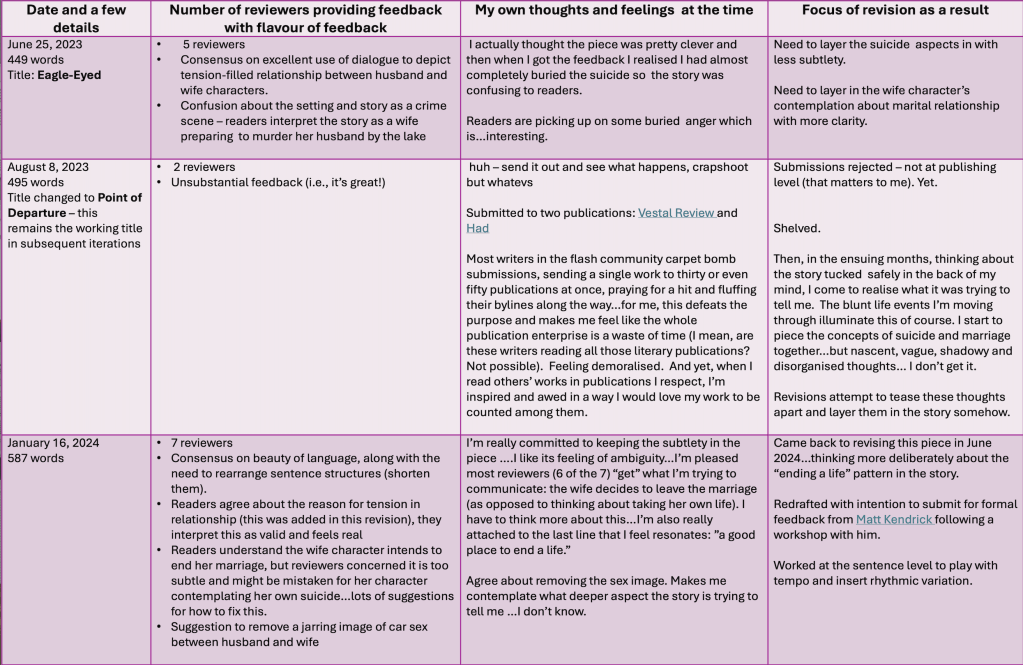
I know, the chart is tiny tiny. Formatting is an issue. I’ve reposted the same chart below with the ugly formatting at the very end of this post for easier reading if clicking on this pic doesn’t enlarge the text sufficiently.

The most recent draft of this story was completed earlier this month, July 2nd. It has lengthened to 741-words. I felt good about the piece. What I mean when I say this is that I felt my way through understanding what the story was trying to tell me it was about, waiting for meaning to reveal itself instead of shoehorning it into “an idea”.  I also worked (and played) to apply technical devices to illuminate the layers of meaning as I came to understand them. More often than not, the writing already held these hints, I just hadn’t “seen” it…it really has been a process of feeling my way as opposed to knowing or thinking my way through the crafting. I’m following instinct more than anything else.

I shared the story with a dear writer friend of mine, B, requesting she let me know what feelings came up for her when she read the piece. Also, whether there were any points in the story she found confusing or made her lift out of reading. The same morning, I submitted the story for formal post-workshop feedback with a writer/editor, Matt, in the UK.   

I received generous feedback from both writers. Both indulged line by line attention and considerations. Both suggested places to cut (B, always sharp, pinpoints my rococo tendencies and gently asks whether they are needed). Both were encouraging. But here’s the thing…each interpreted the story differently: B understood the story as I had intended, reading the layered resonance in the piece, and most importantly, feeling it (she described the story as a bomb about to go off); Matt responded to the surface level of the piece.

A few observations upon receiving discordant feedback. Instead of descending into the pits of despair and not knowing what steps to take next (a year ago, I would have crumpled), I received the feedback with genuine curiosity. This alone is massive progress in my own creative development. I’m confident in this particular story and I’m comfortable knowing it isn’t quite there yet[6]. Also, I’m better at accepting the idea that I don’t have control about how others read my work. It’s likely a good thing there are multiple interpretations. It keeps it interesting. I know my writing won’t appeal to everybody. Nor should it. It’s enough to know it succeeds touching even just one person.

All feedback is helpful for stretching the brain and provoking multiplicities. It’s probably best to remove my pretension: words like inveiglement, my grammar gaffs, my chicken-livered metaphors[7].

I respect honesty above all else. Even when it confirms one’s greatest fears about character (or any other aspects of story: dialogue, silent spaces, conflict, emotional resonance, imagery, setting, sensory elements…the list is endless. Magical-fantasy-surrealistic-dream. Endless!). And, you know, for one who reads me so deeply, intimately, I’d jump into the burning lava throat of a volcano[8]. I’ll take what I can get.


[1] I’m sure these posts confirm my shambolic writing practice, but in case they don’t, I admit I’m usually working on several pieces in parallel, flip flopping between them the way a hook landed fish jumps to stay alive.

[2] A fiction or nonfiction narrative under 1000 words.

[3] Sometimes I feel like marching up to my past self, gripping her by the shoulders and shaking her violently to wake up!  For the benefit of readers who don’t know details of my personal life, I left my own marriage last October, the week of our twenty-fifth wedding anniversary (note: this story was written 4-5 months before then). Instead of being angry with my past self, I’m learning to be kinder, gentler. Learning takes so many forms, and I don’t know how to read them all. All I can be is committed to learning, operating from the point I am, in any moment, with the limited toolbox I carry and an open heart. I’m stunned to discover my body’s prescient talents …and how long it takes my mind to catch up…this is only one instance of many.  I think about this a lot…

[4] May 2023-May 2024 I participated in the SmokeLong community workshop, generating 64 unique flash pieces. I’ve attempted to revise only a few of the pieces due to lack of time and yes, personal resistance-to-revision issues I continue to wrestle with.  I made the difficult decision to withdraw from the community because I need to focus time on the writings I’ve already created, the works awaiting my attention (and devotion).

[5] And the state of publication is simply one point in time, catching a flying fluttering work and nailing the specimen to a velvety spot to keep it still (or dead)…I’m beginning to sense that all works continue in dynamic states and might be changed or altered or built upon over and over and over again…interpretation alone splinters the smashed glass casing of any publication and the work travels on and on through the hearts and minds of others…wow, a little too artsy Biro, reel it in.

[6] In answer to my request for points of confusion, B was curious about this question and hadn’t considered it before, but once posed she entered the work with this lens.  And yes, she pointed out the story was quite confusing with time, shifting back and forth (through 5 shifts in time!). In a 750-word work this demands (taxes?) a lot of cognitive effort for the reader. So, the questions I’m now working through: is this expectation for the reader to follow the complex time shifts worth it? Does the time shift add another level of meaning to the story? If yes, what is that meaning? I don’t know…still thinking. If no, I need to rework the piece and remove some time shifts and support a smoother reading.

[7] Almost resisted the urge to write chicken liveried, but, alas, there it is, coddled in a footnote because the image of chickens dressed up in royal red and gold uniforms makes me laugh. I’m a cheap thrill.

[8] As long as I have a Mai Tai in my hand.

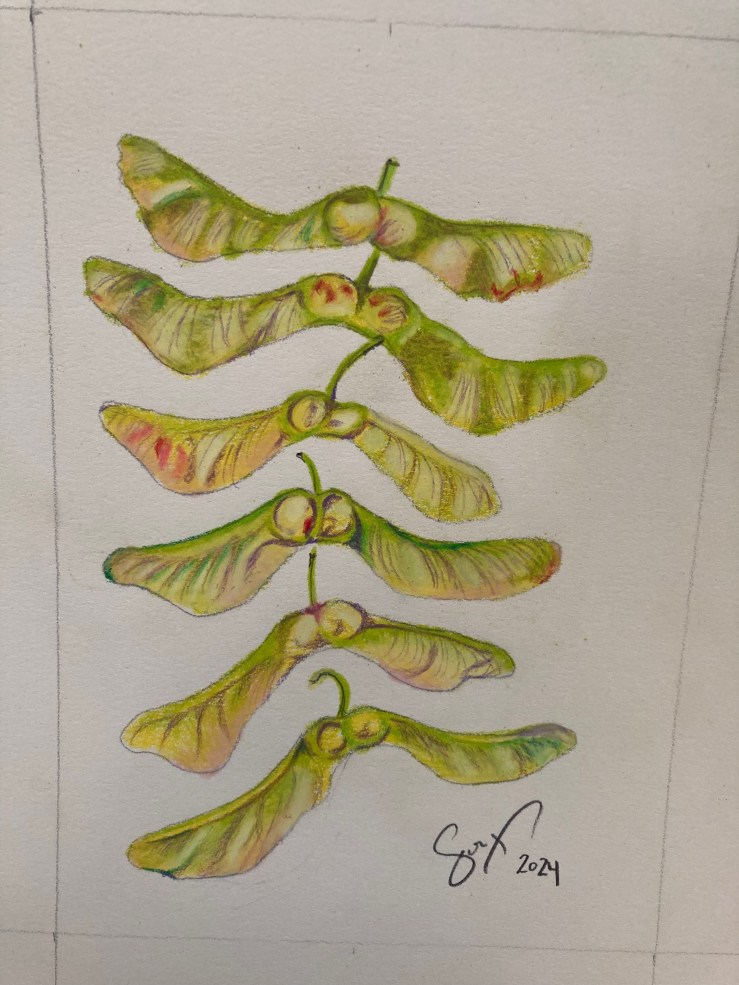
In drawing this series of maple seeds, I coloured in from top to bottom and the same process of moving from thinking to feeling can be seen here. The colouring of the top seed is more clunky, more self-conscious…by the time I got to colouring the bottom seed, I’d moved through the (somewhat ineffective) attempt to copy what I was looking at and instead coloured in the way I was feeling, with the result that the final seed looks (to me) to be more relaxed and natural. And representative of its subject. Maybe I’m overthinking this. Wouldn’t be the first time.
Date and a few detailsNumber of reviewers providing feedback with flavour of feedbackMy own thoughts and feelings  at the timeFocus of revision as a result
June 25, 2023 449 words Title: Eagle-Eyed• 5 reviewers •Consensus on excellent use of dialogue to depict tension-filled relationship between husband and wife characters.
•Confusion about the setting and story as a crime scene – readers interpret the story as a wife preparing  to murder her husband by the lake
 I actually thought the piece was pretty clever and then when I got the feedback I realised I had almost completely buried the suicide so  the story was confusing to readers. Readers are picking up on some buried  anger which is…interesting.Need to layer the suicide  aspects in with less subtlety. Need to layer in the wife character’s contemplation about marital relationship with more clarity.
August 8, 2023 495 words Title changed to Point of Departure – this remains the working title in subsequent iterations• 2 reviewers •Unsubstantial feedback (i.e., it’s great!) huh – send it out and see what happens, crapshoot but whatevs Submitted to two publications: Vestal Review and Had Most writers in the flash community carpet bomb submissions, sending a single work to thirty or even fifty publications at once, praying for a hit and fluffing their bylines along the way…for me, this defeats the purpose and makes me feel like the whole publication enterprise is a waste of time (I mean, are these writers reading all those literary publications? Not possible).  Feeling demoralised.  And yet, when I read others’ works in publications I respect, I’m inspired and awed in a way I would love my work to be counted among them.Submissions rejected – not at publishing level (that matters to me). Yet. Shelved. Then, in the ensuing months, thinking about the story tucked  safely in the back of my mind, I come to realise what it was trying to tell me.  The blunt life events I’m moving through illuminate this of course. I start to piece the concepts of suicide and marriage together…but nascent, vague, shadowy and disorganised thoughts… I don’t get it. Revisions attempt to tease these thoughts apart and layer them in the story somehow.
January 16, 2024 587 words•7 reviewers
•Consensus on beauty of language, along with the need to rearrange sentence structures (shorten them).
•Readers agree about the reason for tension in relationship (this was added in this revision), they interpret this as valid and feels real •Readers understand the wife character intends to end her marriage, but reviewers concerned it is too  subtle and might be mistaken for her character contemplating her own suicide…lots of suggestions for how to fix this. •Suggestion to remove a jarring image of car sex between husband and wife •
I’m really committed to keeping the subtlety in the piece ….I like its feeling of ambiguity…I’m pleased most reviewers (6 of the 7) “get” what I’m trying to communicate: the wife decides to leave the marriage (as opposed to thinking about taking her own life). I have to think more about this…I’m also really attached to the last line that I feel resonates: ”a good place to end a life.” Agree about removing the sex image. Makes me contemplate what deeper aspect the story is trying to tell me …I don’t know.Came back to revising this piece in June 2024…thinking more deliberately about the “ending a life” pattern in the story. Redrafted with intention to submit for formal feedback from Matt Kendrick following a workshop with him. Worked at the sentence level to play with tempo and insert rhythmic variation.

A Kiss of Life

Poems float to me again. This hasn’t happened in a number of years. I’ve had phrases arrive but then it’s like the valve shuts off and word flow stops. If I force a phrase toward a poem, I butcher it. Poems feel ethereal, fragile. I choose the word float intentionally…it’s as if the words butterfly by, out the corner of my eye, or rather, my ear. I think I hear them instead of see them. Perhaps this varies because sometimes I visualize an image. I’ll have to pay closer attention to this experience to describe the process accurately here. Regardless, if not caught and written to the page the poem keeps moving and leaves me behind. 

So, three poems in the last two weeks or so. The relief accompanying them, that they float to me at all, is palpable; I hadn’t realised how much I miss them. These latest poems arrived when I felt most depleted, when I was most physically and emotionally exhausted…not so much in a state that I’d given up, more that I’d given in…surrendered. I worry about this. How to invite the conditions of open receiving without the physical and emotional exhaustion[1]? I don’t know.

The following poem arrived during a lunch break last week…the first lines always feel the strongest, the most tangible, then I wrote the lines spooling from there until I could tell I was twisting my own meaning into them.  Instead of forcing my own thoughts into the piece, and because I needed to return to the office, I left it alone. A couple of days later, an image, tangentially related, kept entering my mind when I thought about the piece. I interpreted this as a sign the two aspects/concepts wanted to be woven together in the one poem.  I completed the following draft over the weekend[2].

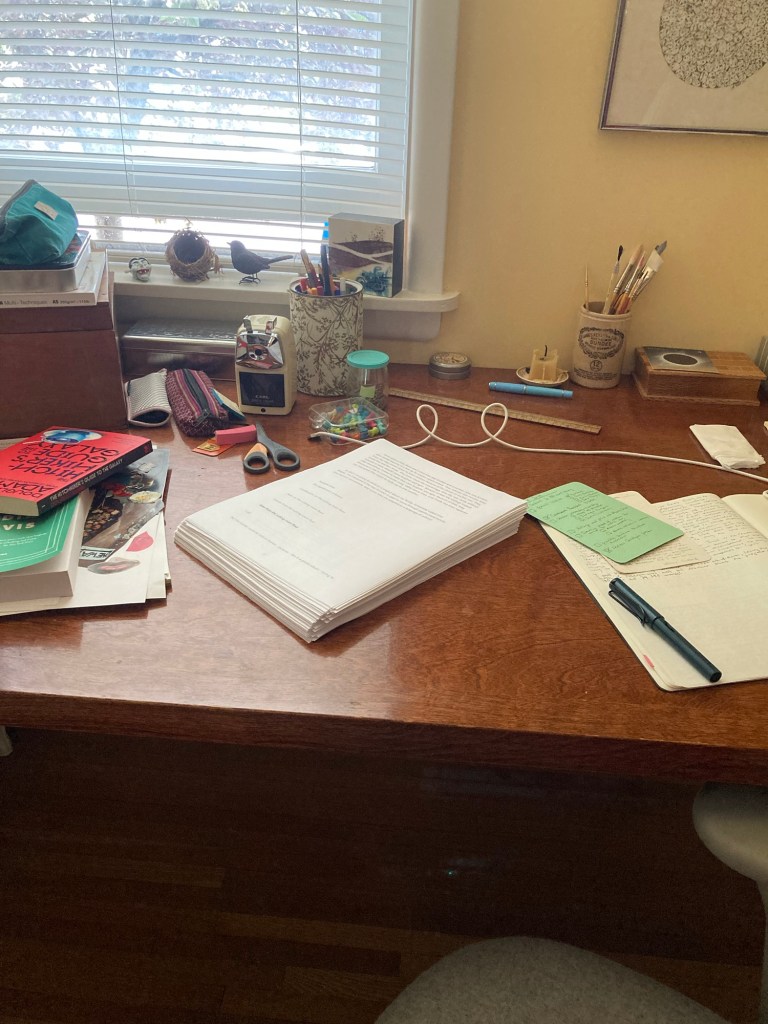
Here’s where it gets interesting. This poem, I discovered, also communicates information about my long form writing project (and process) I hadn’t quite understood prior to writing the poem. I’ll try to explain.  Last month I printed out the long form project (a book length work, very much in progress) and promised myself I’d read it. I haven’t. Instead, energized by the idea of working physically with pen and highlighters and paper instead of messing around in digital files on my computer, I used index cards to list different scenes associated with different characters. One side of each card listed scenes from the distant past, the other side listed scenes from a recent past. The long form project is, for the most part, creative nonfiction with several people. Sitting there, looking at all the characters on the desk in front in me, I realised I don’t have a card for myself[3]. One could (I have) dismiss this discovery, subsume the idea I’m the persona, the narrator, in this work, so, naturally, I’ll find my way into each of the scenes…somehow.  But I’m fooling myself. Sitting there with all the cards on the desk I realised (duh) two things. One, this project is more about my own experiences and thoughts and reflections, and these aspects aren’t integrated (much) in the current draft[4].  Two, the voice I wish to narrate this project requires what I refer to as my audacious voice …and that voice my friends has taken a fucking vacation.  And despair, despondency, desperation—all the dis- words of negation—set in fast. I put the project aside. Again.

Then this poem floated to the page with its battle cry of a title and emphatic last line to confirm, with a flood of relief, my audacious self will revive.


[1] I’ve also received poems in states of extreme emotion.

[2] It’s important to express my gratitude here. In my last blog post I’d lamented missing the spring chorus of frogs I don’t hear living in the city. A few days after publishing that post, a friend messaged to offer me his cottage for the weekend. Serendipity. I spent the glorious gift of a solo weekend in the woods reading (The Forty Rules of Love by Eilf Shafak, a romance toggling back and forth between Rumi, a chorus of characters, multiple POVs, in the 1200s, and a current day woman who falls in love with a writer (who is writing about the relationship between Rumi and Shams of Tabriz, also Sufism) then leaves her “perfect” marriage of twenty years for true love.) It rained most of the weekend which was also a gift because it provided the excuse to lounge in the screened in porch (which felt like a treehouse) and just read (and sleep) instead of canoeing my way round the lake. Unfortunately, I only heard a single peeper and a bullfrog; mating season suspended at this point of spring becoming summer. Instead, I endured the chainsaw to the eardrum that is the “song” Waterloo by ABBA blasting from a cottage across the lake. The universe does have a sense of humour. I prefer this song. I did enjoy the loons and the whip-poor-will night calls and the rose-breasted grosbeak’s day song. I did not manage to see those birds (I really wanted to see the rose-breasted grosbeak as I haven’t before) but did trace the phoebes and vireos amidst the wet leaves.  

[3] When I first wrote this sentence I inadvertently wrote “cared” instead of “card”.  

[4] The crazy thing is, I know I’ve discovered this before and even written about it here…and here…and then, I guess, I just…forget?  Frustrating …and embarrassing…but also, human. Process is not linear and, apparently, the learning doesn’t build upwards from any previous achieved foundation….the whole thing seems more like dancing across quicksand.

Seeing as a Way of Knowing

Oil painting ~ 1994?

Sometimes I must be dropped in the Marshall Islands to realise I’m in the middle of the Pacific Ocean. It often takes me a long time to see things.

Pencil ~ 1992

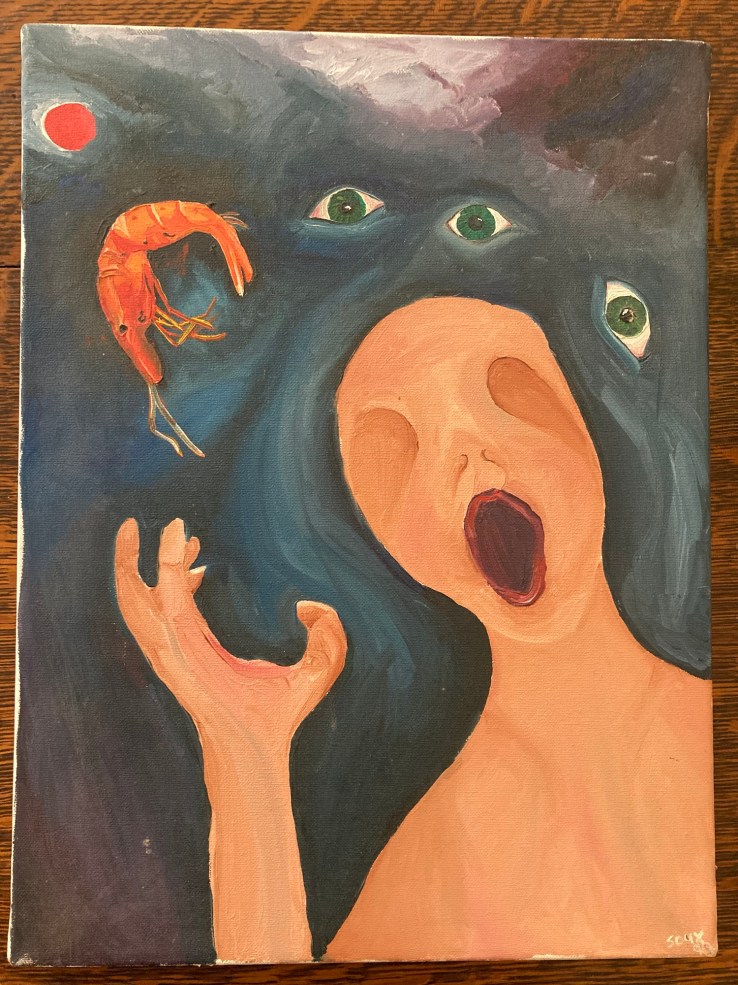
I went through a phase in my late teens and early twenties painting figures with no eyes – the two pieces here date from that era. Most of the artworks I produce are given away as gifts[1]. I can’t imagine many recipients of these screaming figures with their eyeballs floating in space might still grace their walls with my works. These two pieces might be the only ones left. They hang on the walls beside my writing desk.

I know they look scary. They aren’t meant to be. My high school art teacher disliked them. At the time of their creation, they didn’t reflect a mood I was in (I was quite happy and content, not dark or brooding). At the time of creation, I simply followed where my paintbrush or my pencils took me, delighting in the creaminess of oil paints, their tree-sap scent, and the ease with which pencil marks shadow contrasts between light and dark. Perhaps it was a way to work through an earlier terror, I don’t know. I never had an explanation for why I painted these subjects, I just did.

Decades later, hanging on new walls in a new space, staring at these works above my desk, they spark curiosity. And reflection. Looking back upon the intervening years of marriage and raising[2] a family, I can’t help but interpret their imagery as an almost wilful blindness. A warning for what it would take for me to manage my life choices diverting my path from art.

More context. I was flattened after completing my undergrad. In those days, the degree required a written thesis, complete with ethics review submission, primary data (raw) collection, analysis, interpretation and synthesis. Mine explored how child development influences a child’s ability to draw emotions. I went into three different schools and multiple classrooms of kindergarten to grade three students and collected their drawings of “a person who is ‘sad’, ‘angry’ and ‘happy’”. My supervisor, a new to the department prof, studied the tools with which child welfare court cases might be helping or hindering child testimonies. I won’t get into the Pandora’s Box of issues this research illuminates with our justice system and the rights of children. My thesis work was a departure from the neurophysiology and neurochemistry I’d focused on through the science degree, deliberately engaging with a creative and developmental approach I was craving. Conducting the thesis work on top of finishing all the other fourth year courses and working part time as a waitress was punishing[3]. I resolved never to do research again[4].

I adored those child drawings, their stick figured innocence, their genius beauty. After graduating, I pivoted my sights to art school and began to piece together a portfolio for submission. Waitressing, I couldn’t afford to apply to more than one school[5]. I chose Emily Carr. There, portfolio submissions required works using three different mediums exploring an artist chosen theme AND encased within a container constructed by the artist that expanded, or at least aligned, on that theme. Shipment costs, of course, were the responsibility of the artist.  Why am I recalling these stories?  Hindsight explorations. For the constructed container, the most challenging aspect of the portfolio package, I chose to create…wait for it…a liquor store box-sized ceramic eyeball.

At the time I was working with a friend’s mum in her pottery studio, and I explained my approach and plan for the eyeball—it would be two separate ovals (bowls), constructed using clay slabs with holes on the sides near the lip where I would attach metal hinges and a latch after the two halves were fired. This seemed simple to me, but L. refused, explaining it just wouldn’t work, it couldn’t be done. Looking back, I realise my mistake was using the word ‘eyeball’ – I should have simplified the concept to “two bowls that hinge together” or even, “two oval slab bowls, a top and a bottom”.   Full stop on the construction of a container for my portfolio submission. No eyeballs in her kiln. I spent that summer trying to puzzle other ways to make a large eyeball that would hold multiple pieces of art. I couldn’t figure it out. And the portfolio gathered dust. I laugh now, wondering why I didn’t consider a different object, a different container (even the liquor store box would have done the trick!). But I (eye) didn’t.  And that same summer I met the man who would become my husband and I shelved the idea (eye-dea) of art school[6].  

Its’s twenty-eight years later and it’s only now I’m learning to really see. And I recognise a wilful blindness with my writing too. I’ve returned to working on what I call my “long form project”[7]. I have years of writing around the same themes, writing that I have refused to re-read or explore for fear of what I will discover there, what I didn’t want to see. To raise the girls the way I wanted them to experience “family” I kept myself blind[8].

This post is too long. This month has been wretched[9]. I decided to print out the pieces I’ve written as part of the long form project, “to see” the extent of material I have. I was stunned to discover it’s 208 pages, 74, 385 words long. This doesn’t include more recent writings towards this project, nor does it include parts written into ten plus years of notebook writing. Initially, I felt proudly amazed I have so much material to work with…then I spiralled …I can’t see where it’s going, how to piece it together…I am floating blind again. Still.

But …I will read what I have written, use my hindsight and my insight, my nascent ability to see the layers and sift the meanings from my own words. I know I have returned to a path of art, following a decades long detour. I wish it was not so painful.


[1] Blue Salamander, a symbol of moving between worlds, transitions and an ability to regenerate, went to the incredibly generous couple who gifted me their riverside house for the winter after I left my marriage. A friend coined it The Glass Chalet. The couple joke, calling their place a home for wayward women. I am not their first.  

[2] Razing? This is exactly what I have done by choosing a life of independence…what I have committed through decommitment.

[3] Because my prof was new to the department, he pushed the project to a level worthy of publication, research far beyond the expectations for an undergrad. I fought with the departmental panel, assuring them I could complete the work. The panel pushed back, insisting it was PhD level, too much even for a Masters student. I ended up presenting eleven iterations of my research proposal to the departmental panel before getting the go ahead for ethics submission and beginning the project.  

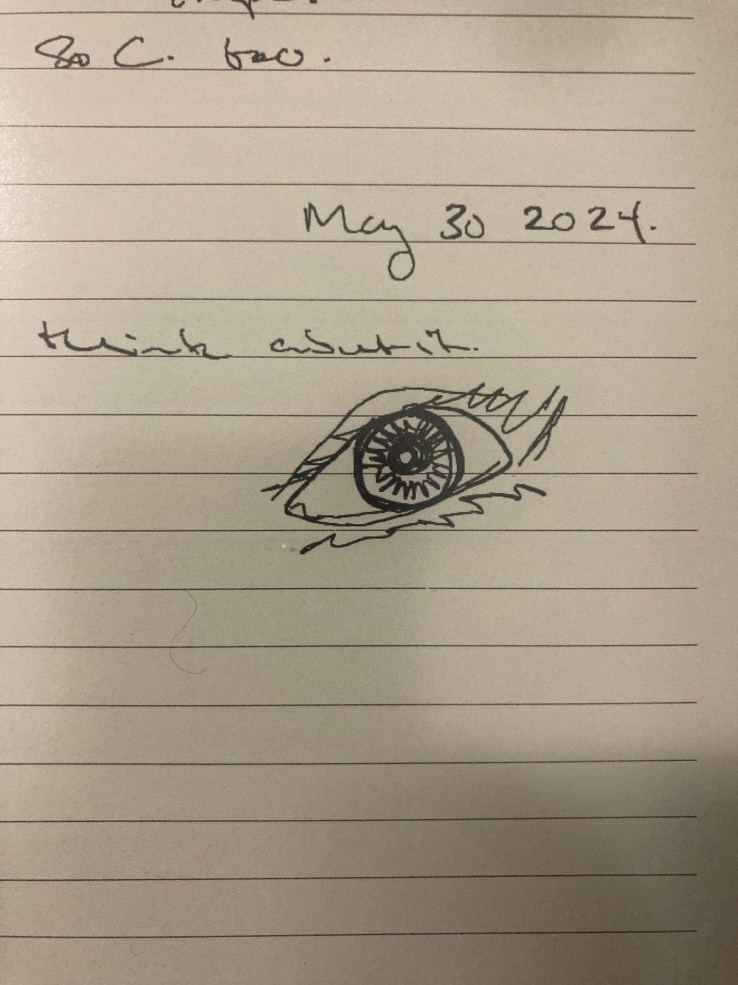
[4] Ha ha …the universe has a sense of humour doesn’t it? Research features heavy in much of my professional career. Interestingly, when I doodle in my work notes during meetings, I have always drawn…eyeballs.

[5] I made $4.25 an hour.

[6] Later that summer, L. rushed into the lobby of the restaurant during one of my shifts, her hair a zany mess and her arms waving the air with her eureka moment. She shouted at me over the din of the restaurant in full summer swing: “I know how you can do it!  It will work!!!”. I’ll never forget her despondency when I explained I’d met a man, that I wouldn’t be going to art school. I was 23, the same age my eldest daughter is now.  This horrifies me. Maybe it shouldn’t. But it does.

[7] When I referred to a “long form project” during a recent online writing session, one woman pressed me to define my project more specifically. Was it a memoir?  It must be a memoir. No, I explained, it’s creative non-fiction, collage work, a series of vignettes, but along various narrative throughlines (four), and the vignettes are kind of veering into fiction. It’s a memoir she repeated, then went on to explain she’d just finished her PhD in literary criticism. Well, that explains it, I thought, but didn’t say anything more.  Days later, when I was doing the dishes, I came up with the right category for my work: it’s a memoir with wings. Stick that up your store bookshelf.

[8] This is incredibly hard to write here, to admit. I suspect my self-suppression, the shame in that, is what my long form project explores…I don’t know. I feel lost. Untethered.

[9] My mum suffered two falls, one where I needed to take her shockingly bruised body to the hospital for a wrist x-ray (not broken); my ex-husband (first time calling him this) is dating …I am told about the women through our children, pasting an expression of impassiveness to my face to offer the support they need to process this news  (I make myself beige); I’m fielding daily tear-filled calls from my eldest daughter who broke off with her partner of three years…both of us cry on the phone…I try to be the strong and supportive mum I need to be…I fail; I visit my father in his subsidized housing apartment, taking any leftover protein from my own meals  because I know he sustains himself on honeynut cheerios; his interest in the world is fast dissolving, his memory, like my mother’s, with it; I long for the sounds of spring peepers, chorus frogs and wood frogs I no longer hear living in the city, and I weep about the loss of the garden; I refuse to attend to world news because I know it will break me; I float through my workdays, convincing my colleagues I am indeed a senior policy advisor, I’m amazed by my own performance; I have separated the muse from the man, the divine from the human, a painful yet necessary separation, for how else to cultivate different ways of knowing, practice other ways of seeing?

Like Miss Stress

Up and down. Up and down.

I think the best sound in the whole wide world is laughter. I was going to narrow down to toddler laughter which bubbles up and out of little people bodies as the best of champagnes, but really, it’s any laughter expressing unreserved joy.   

I’ve been crying a lot.  I used to worry that if I ever started crying, I wouldn’t be able to stop. If I opened the sluice gate, an ocean of tears might wash me away. So, I didn’t cry. At least, not often and never deeply. But now I do. Grief feels soggy. Heavy. The way a body feels waterlogged after a full day of lake swimming, skin sponging the tang of seaweed, fish scales. I’ve felt, at times, as I move through these days, that I’m sunk beneath a wobbly surface. Laughter pulls me up splashing. Up and down; the way life moves.

Grief, like creativity, is a process. Six months post leaving my marriage I’m …still processing. But the grief—which doesn’t erupt a monstrous geyser in the way I feared, instead[1], it’s discreet weepings I indulge then pack up and away, get on with the day—has illuminated my writings.  Allowing myself to cry has also allowed myself to see and understand some of the reasons I’ve resisted revising my own pieces…I wasn’t ready to see the pain I (unknowingly) layered there. By pain I guess I mean sorrow…regret…shame. Seeing it now feels…embarrassing. It’s so obvious. Like, decades of obvious.

Crying improved my (re)vision; laughter, goddammit, is gonna help me process embarrassment. Kind of feels like answering the front door in the nude. Would I do this? Maybe. It’s important to push my creative practice from its pillowed comfort towards the perilous shadows. The only way I’ll learn and grow.

A recent Saturday afternoon found me staring down the barrel of a good cry. I was going to write too…I seem to be able to do both these things at the same time, a curious dexterity that won’t earn me any trophies.  A friend texted she was running a creativity workshop, something to do with comedy. Few people showed up, would I join her?  I read the text through watery shimmers and worked to compose a polite decline. But my hands refused to send the message. My fingers deleted my crafted decline three times before I twigged I wasn’t entering the right response. So, I typed I’d put a game face on and be there.

The workshop included drama and improv games, the kind of theatrical exercises that involve the whole body and breath work and screaming out your chosen name[2]. The kind of exercises that, had the bartender offered to give me a public enema instead, I would have enthusiastically accepted[3]. I will say that I traded an afternoon of crying for laughter (and embarrassment) and I had a lot of fun. Unfortunately, some of this was caught on camera, which I leave here for your enjoyment with the caveat that I look much better when I let my hair down and sport moonbeams. I even ended the afternoon singing a karaoke song[4]. Invitations: can’t fault an old broad for sounding boundaries[5][6].

It started as a low laugh, skipped stones tingling my throat, expanding rings with every exhalation, a laughter that brought the rain clouds down, had me surfing the troughs to the crests[7].

Keen eyes will note I am the ONLY one laughing in this most bizarre of situations. For context: the woman with the tambourine is performing interpretive dance while the woman on stage sings a parody of Snow White’s (in Snow White’s voice) feelings of oppression from society just because she leads a polyamorous life living with seven very short men. The workshop was in the Royal Tavern, one of Ontario’s oldest bars, dating back to before Confederation, once owned, for a short time, by Canada’s first Prime Minister, John A. Macdonald, a man purported to drink from a water glass filled with spirits when he stood to speak in Parliament. Having stood on the stage, I kinda get his methods.

[1] Ok. Not entirely true. I did experience some epic wailing sessions. Interestingly, the worst of them brought on by reading a most beautiful passage in the novel Foster, written by Claire Keegan, where the little girl protagonist gazes across a field topped with dozens of flitting white butterflies. The scene hauled up an image of my own (no longer) vegetable garden, the golden light of late August lighting up the cabbage moths like confetti, hovering the flower blossoms, circling the globes of fire red tomatoes. The grief took me then, a clenched fist to the stomach that had me gasping for breath and buckled my body. I mourn losing the garden.

[2] Aloura. I have no idea why that one popped from my mouth. Desperation I assume.

[3] Probably exactly what you need Biro, such a tight ass.

[4] Yes, of course this was after two IPAs, the only way to really get the pickle out of Miss Stress’s bum. I sang Journey’s song, Lovin’, Touchin’, Squeezin’, which I must assure you retains only surface significance with its glancing reference to crying. This was the first time I sang karaoke…I hit a few flat notes in the first phrases (dreadful, but the show must go on) and managed to warm up and belt out the sense of revenge the song requires to really hit it home.  I dislike the too many na-na-na-na-nas at the end and left the stage long before those were completed.  People had more patience in the 70s.

[5] Come on Super Man, put those old phone booths to use; Kérd a számomat.

[6] This is a sure-to-make-you-laugh piece, Who The Hell Was Mr. Saxobeat Anyway?, written by Josh Baines.

[7] I’ve returned to working on my longer form project, pulling out old sections of writings, collaging them together, stitching in some humour and even exploring my dark. Feels good to be moving again. Recent epiphany: I’m actually living the life I’ve always dreamed of …like, right now. So, resolve to stop crying and get on with shit. Embrace joy.

An Invitation

Collage I created March 16, 2024 in an art workshop facilitated by hiba ali at the Agnes Etherington Art Centre.

My favourite professor in undergrad taught neurophysiology, biological psychology and behavioural neuroscience of motivation. I have a distinct memory of his explaining how the size of the human brain is governed by the restricted size of the birth canal (technically, it’s referred to as the obstetrical dilemma) . Surprise, turns out it’s a little more complicated than that. Much neurodevelopment continues during the postnatal period and neuroplasticity is lifelong. But beyond this, our brains sufficiently evolved to invent machines with super-fast processing speeds and computational abilities. At this point, most of us have adopted palm-sized prosthetic brains in the form of cell phones, and with them, we have access to more information we could filter, sort or ever hope to synthesize, especially across diverse subjects.

This is what I was thinking about last week when I attended a webinar providing an overview of Google’s Notebook LM,  a new AI application launched in December 2023, that basically functions as a virtual research assistant. Let’s call it an(other) extra brain [1].

Yes, I’ll be one of the early adopters, especially for my day job.  But I’m also interested in how the technology could become a tool to support creative process. Though, to be sure, a tool used with caution.   

A swift summary: LM stands for language model and the application uses the conversational question functionalities of ChatGPT, BUT allows you to curate a discrete library of your own source documents for the AI to search through. So, any question you ask will draw an answer from ONLY the documents you have provided, personalizing sources to a particular project, erecting a knowledge barrier you can control and thus greatly reducing inaccuracies and hallucinations [2].

The application currently integrates Docs, PDFs, txt, and pasted text using the cut and paste function. There’s promise websites will be able to be imported soon. Likely, the import of images, PowerPoint and even Excel sheets will be functional in the not-so-distant future.

An older collage I created December 2022.

I often use the search and find function in documents to locate phrases and key words. This is especially important when reviewing legislation and evidence reports under tight timelines, but I also use the function in creative writing to locate word repetitions, check misplaced homonyms, homophones, homographs, get rid of weasel words [3] etc.  But this function has only been possible in one document at a time. I’ve used qualitative analysis software to support analyses and syntheses across interview and focus group transcripts, as well as multiple word documents.  Using qualitative software, a considerable amount of time (time in which your brain actually feels like it’s turning to mush) is used to manually “tag” words and phrases in every source transcript or document to a category in order to code the text data. This can take weeks or even months, depending on how much text makes up the project and the theoretical approach you have chosen to apply. Once all of the text data is coded, THEN you can go in and query the dataset for analysis using your coding structure. The capabilities promised by Notebook LM will (almost) eliminate the coding step, allowing a researcher to jump right into querying the data for patterns and moving forward from a super advanced starting line.

Imagine this application for:

  • summarizing systematic research reviews (practically this is very similar to conducting qualitative analysis)
  • understanding legislation changes over time or creating a bylaws database that could be posted to municipal websites to support citizen Q & A
  • referencing medical symptoms and best practice guidelines – could this replace a visit to a family physician, linking a person directly to a pharmacist or triaging a health issue to an allied health care worker for virtual assessment and confirmation, at least for common non-emergency ailments?
  • Discovering patterns across historical documents or novels or essays or groups of poems or across all these different types of documents
  • Bringing disparate subjects together to spark different ideas, say climate resilience strategies, poetry, child development, hip hop song lyrics and how long to cook an egg [4].
My daughter Willa made this collage last week procrastinating school assignments. She is much better at collage than I am and has created some truly stunning combination of images. I love the mum and child flower heads in this one. This collage inspired me to sign up for the workshop, a welcome oasis of calm following the move into my new (to me) physical space. Another one of Willa’s at the end of this post. Thanks Willa!

The collage at the top of this post is a good analogy for the possible repercussions Notebook LM threatens related to creative licensing and copyright. I pasted the collage together from bits of cut out magazines and art books as part of a fantastic afternoon workshop facilitated by hiba ali, The Studio x Open Secret: Activating Dreamscapes. The images I used came from artists’ works and photographs from books and National Geographic magazines and I’ve cut and reassembled them without any credit to create my own artwork. Where should the line of creative appropriation, cultural appropriation, or plagiarism be drawn in these new digital spaces and the “new” creative works produced using these tools? [5]

Attending this collage workshop in the same week as the webinar kind of blew my mind – an ocean of virtual playgrounds to swim in. It’s also a little frightening, the control to create frames of knowledge that might hold sway an illusion of authority for many. I’m (somewhat) comforted to learn (also this week! my goodness) the word set boasts a Guinness World Record with the most senses of meaning (430!) of any other word. Other sources award this honour to run with more than 600 senses. Perhaps the english language will retain sufficient nuance an AI might never master (wishful thinking). BUT, language combined with gesture, intonation, facial expression, raw instinct etc. may give AI a run for its money (I hope).

Once we created our collages in the art workshop, we uploaded them to a digital art exhibition “world” space where we co-created together and were able to manipulate the images, integrate a variety of additional media (sound, text, links, gifs etc.). This application is New Art City. It reminds me of the game Minecraft my kids used to play when they were younger. Here’s a link to what I created playing [6] in the New Art City application with my own collage and the virtual gallery space: https://newart.city/show/souxs-virtual-creative-space-space-1.

All this virtual creativity at your fingertips for a song. To be sure, what we create as our real world is built from layers of many worlds—perceptual, spiritual, cultural, relational, linguistic, so many others—and, of course, virtual [7]. Jouer le jeu as they say in French, play the game. But the digital space is really an out of body experience; sometimes we might just have to communicate the old-fashioned way, you know, via email or phone or (gasp!) face to face. Especially when virtual platforms are an invitation to experiment interacting multidimensionally. Like I said, you’re welcome. 


[1] Sorry Canadian peeps, the experimental version is only available to those living in the US. Canucks are still waiting to test drive the application.

[2] The information returned is less likely to be made up by the machine… hallucinations are complicated, I’m not going to try to explain them.

[3] From Matt Bell’s Substack, No failure, Only Practice, Exercise #14: Hunting Weasel Words.

[4] I know, weird, but you get what I’m suggesting.

[5] I don’t know the answer to this at all but it’s an interesting question and I would value a discussion.

[6] Other applications that I didn’t use but leave here as reference: Photopea, a free online photo editor; Free3D, free three dimensional models; Creative Commons, “an international nonprofit organization dedicated to helping build and sustain a thriving commons of shared knowledge and culture. Together with an extensive member network and multiple partners, we build capacity, we develop practical solutions, and we advocate for better open sharing of knowledge and culture that serves the public interest.” 

[7] As long as the power stays on.

Serendipitously, when I texted Willa to get her permission to insert her flower head collage in this post, she was working on this larger collage as part of a school assignment (not procrastinating this time ha ha, it’s for a final project about the mutual oppression of women and nature, although she had intended a textile applique but ran out of time). The photos in this work are from a woman’s beauty guide book from the 1980s, The Complete Beauty Book, an interesting, admittedly sexy visual commentary to be sure.

Floetry [1]

Rising to the challenge of learning new tricks, I’ve taught myself to split logs with an axe. [Insert vinyl record scratch – wait…what? Connecting chopping wood with creative writing? Can it be done? Can she do it? Yes. Yes, she can.]

We’ll bounce back to the axe. First, let’s chew over energy. I’m referring to the energy[2] transferred between writer and reader via words.

But that’s not exactly what I mean, not quite right.

Pause. Think.

I mean the deeper sense (yes, that’s it) moving beneath (between?) the words, infusing the communication with vibrating vitality that travels, magically, across time and space to touch a reader right in the feels[3]. This is the goal. It’s fucking elusive.

Poetry is good at it, yes. We know it when we read it, receiving the energy as a hit to the heart, a pinch in the gut, the diaphragm kicking up an exhale, tearspill from the eyeballs, etc. Songs, and music too, deliver emotions beyond words. But to create that infusion of energy as a writer?  Well, that’s a whole different thing.

Gonna try and unpack the what/how here. Actually, I only get as far as trying to describe what this is like…I suspect the figuring out how to do it is a lifelong quest.

I’ve managed this feat of transference a handful of times. Always by accident [read: I have no idea what I’m doing…I just know when I’ve done it…some of the time]. The first time was in grade six when the teacher, Mr Pritchard[4], asked me to read my creative writing assignment aloud to the class. As I read—a passage filled to the brim with beauty and love and flowers and shell necklaces and turquoise seas and gorgeous Tahitian women with naked breasts—I felt a hush descend in the classroom. I felt every ear tuned to my voice, felt the beauty travel from within my body outwards to all the other kids who had stopped squirming at their desks and listened, captivated. It was a magical moment. But, tinged with shame I’m afraid because I’d plagiarised (ish) – I lifted the scene straight from the 1984 film, Mutiny on the Bounty, with Mel Gibson (who, yes, I swooned for in grade 6) and Anthony Hopkins (who terrified me). I’d transcribed the scene depicting the tall ship making landfall, the radiant “Natives” canoing the surf to greet the voyage weary sailors, shower them with strings of orchids, promises of paradise. Despite “stealing” the imagery, I felt the energy my writing created and its impact, and with these, the promise of its power…

Other times I’ve managed this feat: after reading my work at a poetry reading strangers approached me and I sensed they wanted to touch me, though they didn’t dare (so strange); in a message of condolence to a friend following his father’s death (a friend I have great admiration for and, at one time, was deeply attracted to…does this matter? It may); impressed in various email exchanges; sometimes in texts…actually, texts often have a lot of energy coiled within them, a kerpow sort of split and splintering humour I adore.

Some observations for when the energy transfer actually works (because yes, this is for posterity, so, be honest[5]): I have to be in the act of free writing, meaning, I can’t be directing the writing with my thinking (brain must be put on pause); I have to be relaxed; I have to be thinking about the person I’m writing to, or about, (or specific people)…not an abstract concept of “audience”; I have to be calm and unrushed but also focused; I have to “turn off” any questioning, i.e., second-guessing (the inner critic must be silenced).  The feeling, when this is all flowing—because all these conditions must be met at once, simultaneously—is that the energy moves through the body onto the page. Where does it originate?  This is a great mystery – from within? From without? Both? When it’s all flowing and the energy infuses the words…it feels… effortless.

And immensely satisfying.

Back to chopping wood. Though I have lived in at least two houses heated by woodstove, I’ve never been the person wielding the axe (or the splitter; I’m always the stacker and I’m afraid of chain saws or any loud power tools).  The woodstove at this house is not for heating, it’s more of a vanity woodstove, ha ha, but damnit I wanted a fire. The logs, beautifully stacked just outside in the breezeway, were too big to wedge in the stove. Plus, I needed kindling.  An axe lay at the ready, propped against the pile. When I first grasped the handle[6], I envisioned its blade wedged in the flesh of my foot, arterial blood spurting all over the place (I’ve cut the dickens out of my finger[7]).  Not a good way to start. I raised the blade and tried to keep my eyes from shutting when I brought it down on a propped-up log. My body was tense and that tension transferred to the wood. The bit (of the blade) bounced wildly off the log’s end. Somehow, after repeated attempts and ricochets, I bruised the shit out of my fingers (not sure how that happened but it did).  My initial swings were tentative (weak, timid). Slowly, I managed to figure out how to get the bit to bite the wood. But then I got the blade stuck and spent way too long, swearing a blue streak, extricating it.  I got increasingly frustrated and yes, I wanted to cry. Maybe I did cry.  But I wanted a fire! Frustrated and spent and not giving a shit anymore, I mustered a strength that began in the soles of my feet, travelled like a wave up my legs, through my torso, along my arms, the length of the axe’s handle. I raised that goddamned axe high above my head, creating a lever of beauty embracing momentum, gravity, tracing an arc, letting it fall to bite its mark on the log’s end, splitting it instantly, the two pieces of wood flying apart with an edifying crack.  Physics! (I shouted out loud). Once I got the movement and the attitude down, I’ve been able to split logs with ease.  Key: the energy must travel, as a wave, through the body, through the axe, to the wood. When the movement flows this way, the log splits without effort. Brute strength is unnecessary, even counterproductive; energy moves with elegance. Exactly the same way it can flow through writing.

Now all I have to do is figure out “the movement” that invites the energy to move through…

Speaking of quantum physics (we are, aren’t we?), in a recent workshop I was challenged to write a flash narrative integrating quantum physics. In workshop, my piece was one of fifteen to “win” feedback from a SmokeLong senior editor (who knows, maybe only eight of us entered). To be clear, this piece DID NOT (at all) succeed in the energy transfer thingy I’ve been writing about here, but it was fun and quick to write and, following some, ahem, contest overseer requests to change the original piece and make it more appropriate for a general reading audience[8], I submitted it, for fun, to the Quantum Shorts competition. It’s up, for a short time (till March?) on their website for reading.

Let’s end on a far more eloquent description of the energy travelling through words (gawd Suzanne, an axe?! How crude.) with the last section of a poem titled, The Other Tiger, written by Jorge Luis Borges:

We shall seek a third tiger. This
Will be like those others a shape
Of my dreaming, a system of words
A man makes and not the vertebrate tiger
That, beyond the mythologies
Is treading the earth. I know well enough
That something lays on me this quest
Undefined, senseless and ancient, and I go on
Seeking through the afternoon time
The other tiger, that which is not in verse.

[From Dreamtigers, by Jorge Luis Borges, translated by Harold Morland]


[1] Such a great song by Floetic.

[2] Do I mean emotion? The energy of emotion?   I’m still thinking about this, whether they are one and the same or whether they are similar yet texturally different…still, something that moves, that has momentum, sharing that etymological root (Latin movere “move, set in motion; Sanskrit kama-muta “moved by love”). Certainly relational, not necessarily a bidirectional relation, pluridimensional.  

[3] This is not a new idea. Not even close. Here’s Rumi’s continuing commemoration through mille-fold Instagram and FB unicorned affirmation posts, “Words are a pretext. It is the inner bond that draws one person to another, not words.”

[4] An aside: Mr. Pritchard—my mother, with kiwi candor, called him Mr. Prick Hard (Mum! You can’t say that!  Don’t worry zanny, he can’t understand my accent! But mum, you’re speaking English!)—was an evangelical Christian. I delighted asking him to explain what I postured to be a genetic impossibility, all of us descendants of Adam and Eve, I mean come on, we’d all have, like, six eyes and no legs. Or maybe six legs and no eyes, more like. I think this must have been after my reading aloud to the class, I’m sure I was never called on again…anyway, I was disappointed he didn’t oblige an argument, simply told me to take my seat.  

[5] Line from the movie The Princess Bride, a torture scene, but whatevs.  

[6] New learning: an axe has all sorts of parts to it, many named, incidentally, after parts of the body: belly, throat, shoulder, butt, cheek, beard etc. See here, but then, check out the website landing page – hilarious, depicting a stunning combination of free flowing alcohol, people weaving around wearing animal masks while winging axes at targets chalked on a plank wall.  What could go wrong?  Oh, there’s pizza too.  All good.

[7] This one’s for you Ny, a classic Saturday Night Live skit with Dan Aykroyd impersonating Julia Child – the quote comes in at the 1:50 mark but the whole skit is a great laugh. Anyway, this is how I envisioned my newbie axe wielding would go.

[8] I was asked to remove the swearing. So, I changed ‘fucking’ to ‘flaming’, removed ‘fucking’ from the footnotes, (it appears I am addicted to using footnotes – is it irritating? Let me know) and changed ‘fucker’ to ‘boneshaker’ which I like even better because of its loose allusion to oral sex. Which, incidentally, the contest people didn’t ask me to clean up for a general audience and I delight that it hangs out there to tease some unsuspecting general audience member. Ha ha.

[9] I’m trying to slow down. It’s been …an emotional few months. To help calm myself, I’m practicing drawing these small beauties, found thingies picked up on walks. Feels good. I listen to music, gorgeous song, when I draw. I have always signed artwork with Soux, a spelling I claimed as a young teen, exercising some initial sense of autonomy I lost along the way (though, high school friends still address me using this spelling).