May have blown my readership with last month’s post in terms of length and, uh, girth. So, this post promises to be synoptic. But I do appreciate the feedback readers provide, face to face, on the phone, through emails and texts, etc., thank you. The elegance and precision of a two-word response most impressive…well played.
As I write this, a woolly mist smudges the St Lawrence to the sky, shifting Wolf Island’s shore and every other geographic anchor to the imagination. The chipping sound of chickadees loop the staghorn sumac, garland the cedar hedges; beloved swallow song put to winter’s bed.
Grateful too, for having vaulted the winter solstice and tumbling this season of epiphanies.
Reflecting this past year’s writings, I’m struck (and so deeply touched) seeing my words spark and stir creative pursuits for others. I’ve delighted reading my own words reflected in others’ poetry and prose, my own words transformed into paintings and artworks, my own words recited back to me in conversations. It has been (is) the most beautiful tribute to my continuing creative work. Also, a sober reminder of the responsibility to package the raw, wonder-filled gifts of the world in the best way I can, because love travels, as it should, pirouetting and somersaulting across the universe. It has been a slow learning but I’m gaining confidence in my writing and beginning to trust the whisperings of my heart, that it reaches you.
Here’s to a holiday season, the coming new year, brimming with joy, delight, forgiveness…and the timeless unspooling of love – Cin cin!
Let’s begin with these lines from a poem by Carol Ann Duffy, “Prayer”.[1]
So, a woman will lift/her head from the sieve of her hands and stare/ at the minims sung by a tree, a sudden gift.
A friend calls these massive blooms the floozies of the garden. They are taller than me and have overtaken the tomatoes this year, which means fewer tomatoes to process (a small blessing, one I’ll curse in Feb).
I went to listen to a friend play in a band (he plays guitar). It was an afternoon event and the day was gorgeous, hot blue sky, tree leaves colouring up red and yellow. There were lots of friends there and many people who I hadn’t connected with in some time (since pre-pandemic). In one conversation, a former colleague announced his recent retirement and our talk rounded to creative writing. I admit that anecdote, erroneously attributed to Margaret Atwood, about the brain surgeon who says to a writer that when they retire, they’ll take up writing, to which the writer quips that, when they retire, they’ll take up brain surgery, popped into my mind. The guy is (well, was) a physician. But it’s important writers lift one another up. Writing is hard enough without tearing each other down. So, I offered up some writing (and reading) resources I’ve found helpful and then we landed on the topic of workshopping. He leaned back in his chair and said he’d tried workshopping—his tone was unmistakable; the exercise was beneath him—and he’d been disappointed to discover that (his words) “99.95% of workshop participants are women”. Long pause of silence. I began to form a response, but not before he buried himself further by saying his writing needed…here, he finally noticed he was speaking to a woman and corrected the wording I could see so clearly in the thought bubble hovering atop his (inflated) head (his writing is far more important and serious – intelligent! than what women write about), to say the workshops could never sufficiently improve his writing. I turned to his wife (also a physician. Does this matter? It does. I have a chip on my shoulder when it comes to physicians…story for another time, but I acknowledge my bias) and I agreed, it’s true, the workshops and writing classes I have attended are comprised, mostly, of women. I think it must have to do with women not feeling they have a voice in other aspects of their lives. Great swaths of generalizations painted here, but this was party small talk. The physician’s unblinking wife encouraged her husband, explaining he ought to think more about the issue because women read and buy books more often, and if he hoped to publish, it’s an issue worthy of his consideration. I downed the glass of shit wine I was drinking and flitted off. But the conversation and the question (why mostly women?) gnawed at me.
Last of the summer flowers maybe, before a killing frost.
The conversation with the physicians continued to grate because it poked (stabbed?) a few of my deepest insecurities. How I’d turned my back on pursuing an arts career in favour of science because I thought I’d be taken more seriously (as a woman) and, let’s be honest, because it paid better. But the deeper wound is that I find myself actively resisting the writing that bubbles forth most naturally in my creative writing practice: marriage and motherhood.
This is hard to write: I silence my own voice because I don’t believe it’s valuable enough.
It’s frustrating to know I’ve allowed myself to be shaped (so effortlessly) by cultural and social norms related to traditional gender roles. It’s an embarrassment. It begs the question: who from (and why?) am I seeking validation? The easy answer is “the system” – but it’s a system that continues to devalue the importance (skill, patience, persistence, compassion) of raising children, a system that reduces love and relationships to sex (and shout out to my more marginalized peeps of the LGBTQ2S+, most often heteronormative sex). As part of the system—as a woman I am—we don’t do enough to support each other to write about domestic subjects or write about our friendships. Is writing about friendship without the tension of sex or attraction a downgrade? Too boring? A lot of cognitive dissonance here. The harder answer is that yes, I do need to push through the noise and systemic pressures to value my own writing and anchor validation from within as opposed to without. It’s hard. And I know, a harried summary of such a complex issue is short on explanations. I could sing this pearl of an offering[2], but in the spirit of bare sincerity, I’m often afraid the conversations are out of my league. I’m working on bravery. Another work in progress…
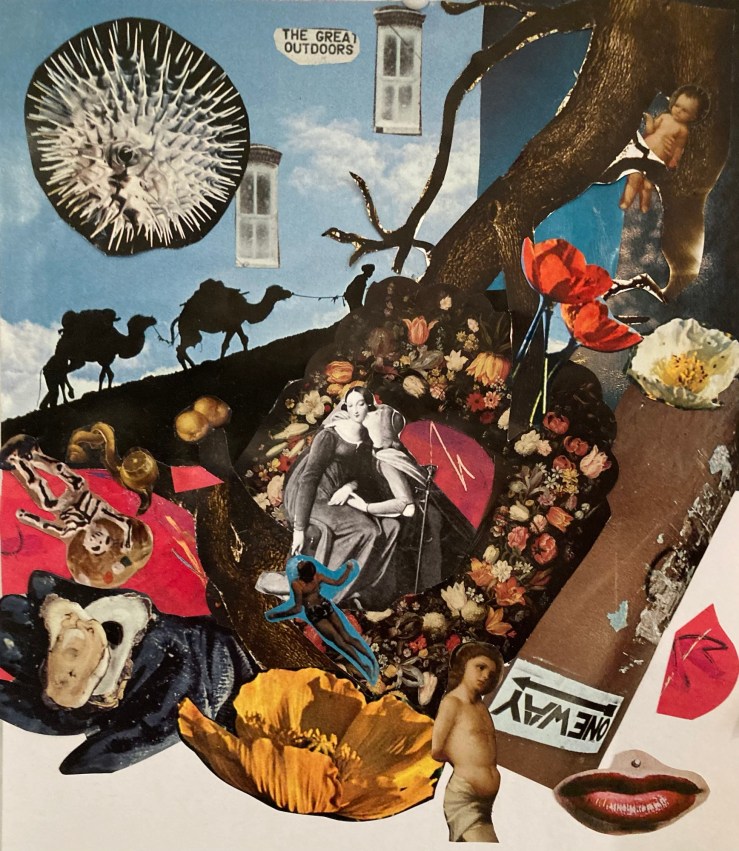
This week I wrote a poemy piece in workshop (yes, a workshop comprised of mostly women) about what it feels like to walk up to the podium to read one’s poetry. My writing inspired one of the other women in the workshop to create a collaged art piece in response to a particular phrase I had written. I won’t share it here because she would like us to try publishing our two pieces together, but the art work is beguiling and unique, and the gesture made me teary. Really, it’s the ultimate compliment.
I think this must be the goal for creating art: to make something so beautiful it inspires further beauty in the world.
So, I lift my burned gaze from the sieve of my hands to tend the lyrics of my heart.
[1] This stunning image (that word ‘sieve’ does so much work) are lines from the poem “Prayer” by Dame Carol Ann Duffy. She is the first (and only!!) woman to hold the post of British Poet Laureate in its 400 plus-year history and was appointed in 2009 for a ten-year fixed term. You can listen to her read this poem here. Interestingly, when I read the poem for myself it sounded very different from her reading. Perhaps I interpret it differently too. Regardless, it’s a gorgeous poem. I love how the image embodies this post better than my own words could ever do.
[2]“One Heart” is from the Leftover Cuties 2013 album “The Spark & the Fire” – http://www.leftovercuties.com – also, a striking album cover.
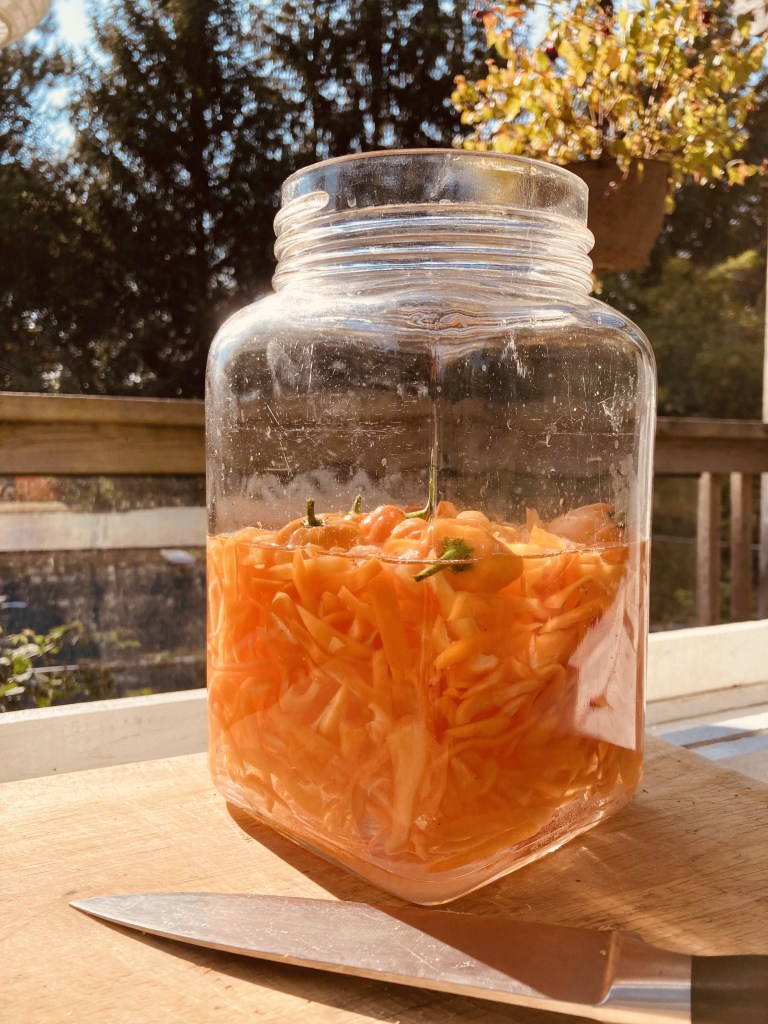
Super spicy Habaneros harvested need to be handled with care (the mask and gloves and slicing outdoors depicted in the drawing above) when preserving.
I very nearly botched the possibility of any relationship with my now husband the first time he asked me out, replying to his tentative request to take me to dinner with an audible exasperation—I’m embarrassed to say it, but an almost-admonishment— “What took you so long?!”
Much later he told me how, in the dead seconds of silence that followed my blurt, he very nearly turned heel and walked away (a fuck that, if there ever was one). My reaction stopped him cold. I can only think he must have caught the note of elation in my voice, noticed the sparkle of mischief in my eyes, the play blossoming my grin.
Some context for my blunder: Months earlier he’d attempted to ask me out but our conversation was interrupted, and, despite an alluring notoriety with women, he was timid with me. His notoriety prevented me from asking him out. Not only that, but his notoriety also made me mistrust him…he was too attractive, too confident. I resorted to using a tactic I’ve come to refer to as ‘the mixed barb’, an unexpected, lightly teasing, droll divulgence, testing him against himself. Communicating this way—a skill sharpened in a childhood home where moods shifted precipitously from rainbows to menace—has served me well, personally and professionally. Quick jabs shaded with humour fast reveal the contours of people’s personalities, offer a glimpse of their shadow selves, delineate boundaries, expose what they’re willing to put up with – and what I really mean when I say that is, testing whether they’ll put up with me.
Though this works well face-to-face where intonation and gesture, pitch, and facial expressions shoulder the palanquin carrying my royal intentions, I’ve discovered the strategy collapses in my writing. For example, my royal intentions from that last sentence was meant to be read with layered notes of self-deprecation, irony and superciliousness. Did I fail there? Likely.
George Orwell suggested, “A thing is funny when—in some way that is not actually offensive or frightening—it upsets the established order. Every joke is a tiny revolution.”[1] For speaking and writing more information is needed to furnish a joke, but also, words in general. “An alteration in tone or pitch can be the difference between …fighting words and a statement of love, using the identical phrase, such as “You’re really something,” a completely meaningless statement without a tone or context to support it.”[2]
Peter Elbow explains vocal variety thoroughly when asking us to “Consider how many musical resources of intonation or prosody we can use when we talk. There is pitch (low to high); volume (soft to loud); speed (slow to fast); accent (yes or no); intensity (relaxed to tense); timbre (breathy, shrill, nasal, and many more); pausing (long and short). Note that these are not binary items, for in each case there is a full continuum between extremes (e.g., between low and height, slow and fast). There are glides and jumps. Also, there are patterned sequences. For example, tune is a pattern of pitches; rhythm is a pattern of slow and fast and accent. We change meanings by using subtle or not so subtle pauses or small intensifications or lengthenings of a syllable. Combinations of all of these make a rich palate we all use to paint meaning.”[3]
Robert Pinsky simplifies this beautifully: “It is almost as if we sing to each other all day.”[4]
But how to get the audible features of speech to the written page? I suspect the answer to this question requires a lifetime of exploration. Perhaps it’s even THE ANSWER to writing well (musically, entertainingly, clearly, compassionately, provocatively, etc.). Robert Frost thought so, “The tone-of-voice element is the unbroken flow on which the others are carried along like sticks and leaves and flowers.”[5] So, today’s post is simply this quest’s beginning.
More Frost: “What we do get in life and miss so often in literature is the sentence sounds that underlie the words. Words in themselves do not convey meaning, and to [prove] this… take the example of two people who are talking on the other side of a closed door, whose voices can be heard but whose words cannot be distinguished. Even though the words do not carry, the sound of them does, and the listener can catch the meaning of the conversation. This is because every meaning has a particular sound-posture; or, to put it in another way, the sense of every meaning has a particular sound which each individual is instinctively familiar with and without at all being conscious of the exact words that are being used is able to understand the thought, idea, or emotion that is being conveyed.”[5]
One way to get audible intonations to the page is to write in directions for how the reader ought interpret the words.
In Longshore Drift, a short story published in Granta, Julia Armfield employs this directing technique two ways: in text direction and by cueing the reader using italics. Here are three examples excerpted from the story (colour coding mine):
“There are warning flags along the wrack line: sharks – swim at your own risk. The threat is actually minimal, basking sharks being liable to give you little more than a bump on the knee, but the effect of the signs is still an odd one. There are no barriers, the water is open, creating the sense of a curiously lackadaisical approach to public safety. Danger, but do what you want, we’re not the police.”
‘Fair enough,’ she nods, and while her tone is light Alice feels she can detect the faintest note of mockery. ‘Mustn’t be bitter with my litter.’ ‘Fair enough’, this stock phrase, its cringing detachment. The sudden removal of camaraderie and Alice clawing after it.”
“The boys cluster like geese. One of them, wet-lipped with a tongue piercing, asks Min what she’s doing selling ice cream on such a chilly day. What’s a nice girl like you doing in a truck like this.“
A whole story might revolve around the differences between what is said and what is meant. Here’s the first paragraph of a micro story written by SJ Sindum, Mother, published in The Cincinnati Review (again, colour coding mine):
“My mother tells me to be careful. I’m twelve years old, and we’ve just moved to a city outside of Boston. We live in an apartment complex that my white fiancé, twenty years later when we visit, will call “shit housing.” I walk to school every day, a two-mile stroll along a busy road, and my mother tells me to be careful. What she means is, keep your head down, keep walking, don’t talk to anyone, I’m sorry.”
Each paragraph of Sindum’s story ends with similarly directed subtext, stretching implied intonation with deeper emotional resonance. A good example of Charles Baxter’s comparison of subtext to “the ghosts moaning from beneath the floor.”
“Reading is telepathy (literally “feeling from afar”). A writer’s magical transference of thoughts, ideas, and emotions—the context, text, and subtext— to the reader across space and time.”[6]
And I want to slide that observation (riffed from a more beautifully written version by Terrance Hayes (see the footnote)), alongside another stunner: “Meanings are not in words, they are in people.”[7]
So, another (ongoing) lesson for me: lavish sprinkling of humour in my writing, without judicious written expansion to convey my specific thoughts, ideas or emotions, fails to cue and direct the reader to my intended meaning, whether a playful poke in the ribs, the softening of a chiding remark, or taking the piss out (as my mum used to say, meaning, to bring someone down from their [self-perceived] lofty position). Unless the reader is intimately familiar with my quirky (snarky, often cynical, occasionally lewd) sense of humour voiced in person, my written inflection is flipped on its back. Wrestler style.
[2] Baxter, Charles. The Art of Subtext: Beyond Plot. Graywolf Press, 2007.
[3] Elbow, Peter, “5. Intonation: A Virtue for Writing Found at the Root of Everyday Speech” (2010). Emeritus Faculty Author Gallery. 34. Retrieved from https://scholarworks.umass.edu/emeritus_sw/34
[4] Pinsky, Robert. The Sounds of Poetry: A Brief Guide. Farrar, Straus and Giroux, 1998.
[6] I love these beautiful lines by Terrance Hayes from the preface of his book, Watch Your Language, “Reading is a mix of telepathy and time travel. It’s a magical transference of information, knowledge, and mystery: the context, text, and subtext of a reader’s life.” But I’ve stolen those sentences, fiddled the words and ideas and repurposed them to my own ends here. Not as elegant as Haye’s sentences, to be sure, but landing a slightly different meaning.
Hayes, Terrance. Watch Your Language: Visual and Literary Reflections on a Century of American Poetry. Penguin Books, an Imprint of Penguin Random House LLC, 2023.
[7] Elbow, Peter, ‘Intonation: A Virtue for Writing at the Root of Everyday Speech’, Vernacular Eloquence: What Speech Can Bring to Writing. New York, 2012.
It is always useful to try to trick my thinking out of usual habits and patterns of thought. My brain is lazy and too often follows the path of least resistance to finish a task. When writing, this laziness leads to cliches and shallow (one dimensional) observations that do nothing to pique the interest of a reader (or me, the writer, for that matter). Also, I prevent wider interpretations, deeper meanings, messages from the subconscious, before they have a chance to arise. Mind maps are a quick and (relatively) easy way to provoke (and see) expansions of meaning and the connections between them.
It is best, when creating a mind map, to relax and clear your mind…think meditation or yoga practice here. Sometimes it is good to set a timer for these exercises – 10 minutes tops – otherwise it could keep unfolding. That’s okay too…just follow your intuition on this one.
On a blank piece of paper, in the middle of the page, write a word or phrase you are wrestling with (or select one at random from the middle of a book, a dictionary, a cereal box, it really doesn’t matter…sometimes the most banal source will yield the richest ideas). Circle the word or phrase. Relax (yes, I keep having to tell myself this). Look at that word/phrase and allow your mind to drift and dream. Write down the images and associations as they come, anywhere on the page…as the associations are written down, they spark additional thoughts and images. Write these down too. Enjoy it. When the images start to wind down or the timer goes off, stop. It’s good to get up and walk away from the desk for a minute or two: make a cup of tea or gaze out the window. I’m usually too impatient though and dive into the next step, which is to look at what has been rendered on the page and start to draw lines of connections between them (often I do these steps simultaneously too). Very soon, the lines become tangled and cross each other. This is okay. At this point I realise there’s a lot more to think about than I had originally thought but I can now see avenues of exploration I might move through.
Mind maps are good to use as a writing prompt when facing an intimidating blank page. But they are also great tools for deepening existing writing: maybe an interesting image, or a provocative object, or a weird description or phrase has surfaced in a draft…but it doesn’t feel right—it nags—it doesn’t quite hang together with the sentiments (paragraph) around it. Trust the nagging/curiosity feeling. Copy the image/object/phrase onto a blank piece of paper to use as the starting node in a mind map.
Mind maps might also be used as art making device, subbing in a sort of shorthand thinking for how a work of art might be built. Theo Anthony, an American film maker, uses mind maps to work through generating ideas and connections, but then takes this one step further by planning his shots (camera type, lighting, angle, sequencing etc.) according to the nodes on his developing, evolving, project-based mind maps. In a way, this allows a lot of technical planning (to be on location, to select film equipment, etc.) without the creative constraint of a complete storyboard. His process, using mind maps this way, retains a flexibility, and enables resonances and surprises to illuminate organically. In a way, it’s as if he provides the operational support for the art, image, and beauty to reveal itself through the making.
Reading a book earlier this month, I failed to get past the third chapter. To me, the writing…well, sucked.
The book, a national bestseller, nominated to a national “must read” list, was published by one of “the big three” publishers. A work of creative nonfiction, a memoir, I wanted to like the book, I wanted to learn from it. I was fascinated by the book’s subject. I wanted to follow the narrator’s journey, proclaimed and promised on the cover. I wanted to experience the narrator’s challenges surmounted, the accomplishments reached, but every time I tried to read the sentences, my mind lifted from the page. I couldn’t connect.
Recognising I was going to give up on the book (always a sad moment of relinquishment, disappointment, even a sense of failure on my part, I know, dramatic, but true), instead of tossing it aside, I thought, why can’t I connect? What is it about the writing—specifically—that prevents me, the reader, from following the narrator on their journey?
Reading with these questions in mind I discovered a few issues:
The scenes were rendered swiftly – yes, with sensory details (check), but significant events were introduced but never elaborated, never opened or expanded. As a reader, I craved knowing more. How could I relate without being given the opportunity to experience those events?
The story felt one-dimensional. The scenes, the events, the descriptions, the temporal and geographic aspects of the writing, were all there. The grammar was sound. The language was logical. Missing were the narrator’s thoughts and reflections. I couldn’t feel or know the narrator on the page because they weren’t there. It was as if the narrator stood off to the side and, like a zombie, or a robot, recounted the events without feelings or emotion.
The worst and best ah ha moment: I make these mistakes in my own writing.
Reading bad (okay bad isn’t the right word – shallow? simple?) writing I recognized:
I summarise instead of expand action. This deprives a reader from moving through the experience with the writer. I realise too, that this type of writing is exactly the opposite of what I’m required to do in my day job. I’ve been trained to remove myself from reports, research papers, briefing notes, etc. to focus the scientific evidence and let “it” speak from a perspective of unquestioned authority. Note the disembodied sense of that approach to writing (objective, not subjective).
When I write “myself” onto the page, I’m like a paper cut-out of myself – my thoughts, reflections, ideas, interpretations are often omitted – there is a lot of action and description and even dialogue of others, but I am missing myself – why can’t I drag myself into my creative writing? Aside: – interestingly, I presented my thoughts and scathing reflections when I used to write an earlier blog complaining about marriage. So….I can do it, but, why don’t I?
Answer: I’m trapped in the “seriousness” [mis] conception of art making. I’m working to develop confidence to express myself freely in “real” creative writing.
Serendipitously, I read a craft essay written by Karen Babine in Craft Literary Magazine this week that elegantly explains why some nonfiction writing fails to connect and how a writer might work to engage their reader better. I find books or essays or podcasts land in my lap exactly when I need them, or, as with Karen Babine’s essay, I can absorb them for the wisdom they convey. I recommend reading her whole essay (it is excellent!!), with fantastic links for further reading. Karen Babine also edits Assay: A Journal of Nonfiction Studies, another excellent learning resource.
Here is a sketch I made for myself, words copied from Karen Babine’s essay, to help me “see” and guide my own writing.
This summer has been a difficult one for me. We moved my mum into a long-term care home. She didn’t want to go. Mum has followed a slow cognitive decline over several years but a fall early in the spring of 2020 broke a couple of her ribs. The subsequent pain medications prescribed, coupled with the social isolation of the pandemic, contributed to a rapid decline. When she walked out her front door this past spring, snow still on the ground, wearing slippers and no coat, she was lost before she reached the end of her own driveway.
With reluctance, I enforced my power of attorney, signing the papers committing her to long-term care.
It felt—no, it feels—like I’ve served her a terrible injustice.
There is a heavy pain in my chest, something that feels ancient. Some mornings I wake from dreams with my cheeks wet with tears, my lips contorted to a grimace. I realised ‘ve been grieving mum’s loss—the person she used to be who is no longer—for years, but without the ritualistic significance of a funeral. Corporeally she survives. But mum is gone.
It’s hard to talk about mum with people who do not know her. She was not the mom you might have conjured between the first paragraph and this one. She was plagued by sorrows and suffered severe self-doubt. She was incredibly funny but also unbelievably cruel. She weathered storms of emotion from the bottom of emptied liquor bottles; on, then off, then on, then off the wagon in the years I was growing up.
I will write about these complications one day. How painful this love is. But not today. Composing these lines I feel a tightening round my forehead, my ears feel stuffed, and the call through the dusk from the crickets is muffled, far off. It’s like I’m underwater. There’s a pressure in my body alerting me to stop writing.
Writing has been incredibly difficult this summer.
This wasn’t what I was going to write here today.
I have written other posts, one for June, one for July, that, thankfully, I postponed publishing. Age provides some wisdom, I guess. And patience. So, I broke the promise I made to myself to publish here once a month. It’s better this way.
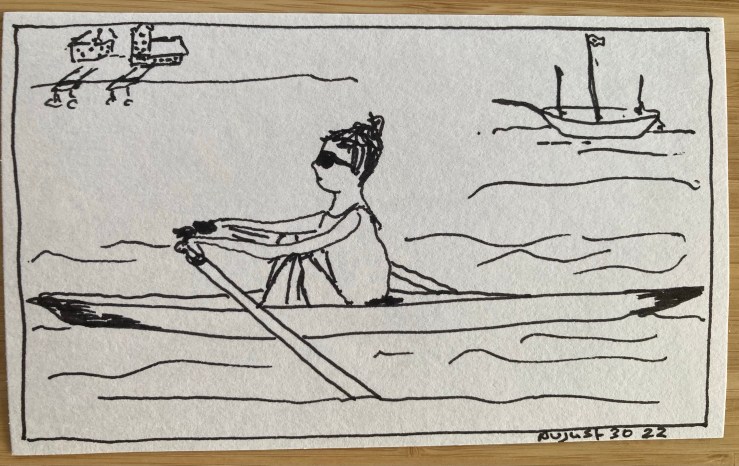
I was going to write about how I decided to take up recreational rowing this summer. How I hadn’t been in a rowing shell since I was in high school, over thirty years ago. How I used to love it. How the opportunity to learn to scull (two oars instead of one, which is called sweep…yeah, I didn’t know that either) summer evenings on the lake sounded like a great idea. And it has been. In many ways. How the single racing shells are light and fast, only millimeters thick, slicing the water’s surface, skimming above the weeds.
The hardest part is balancing the boat when you move your body from the top of the stroke, “the catch”, through the stroke, keeping the blades on the oars square when you pull through the water, your bum scooting backwards on a wheeled seat atop runners, then, feathering the blade fast at the end of the stroke when you lift it from the water by pushing down. Repeat, repeat, repeat.
The boats tip frequently, but I’ve managed to keep mine from flipping so far. I have had a few close calls, performing truly inelegant air punches and contorting my body into stiff shapes to counterbalance the slippery tipping point. I was going to write about how I command myself, out loud, out there on the lake, to keep it the fuck together, to keep my wrists even and my stomach tight, to breathe out when I pull the lake water with the force of my oars.
I was going to write about the spectacular silence of the boat’s glide when the oars clear the water and the boat remains poised, perfectly balanced, and my body moves without my thinking. It happens so infrequently and only improves with practice.
I was going to write how the coaches, young people, motor up beside me, nod at my technique, say, just keep doing what you’re doing. I was going to write that there’s a metaphor about writing somewhere in here, but I won’t. And yeah, so what if I tip? But the bay where we practice is shallow and the weeds sub-surface are thick and million fingered and the water snakes nose along among the geese and ducks and, sometimes, a bevy of swans.
I stay stiff and tight and fucking serious in my rowing scull, muscling myself against tipping.
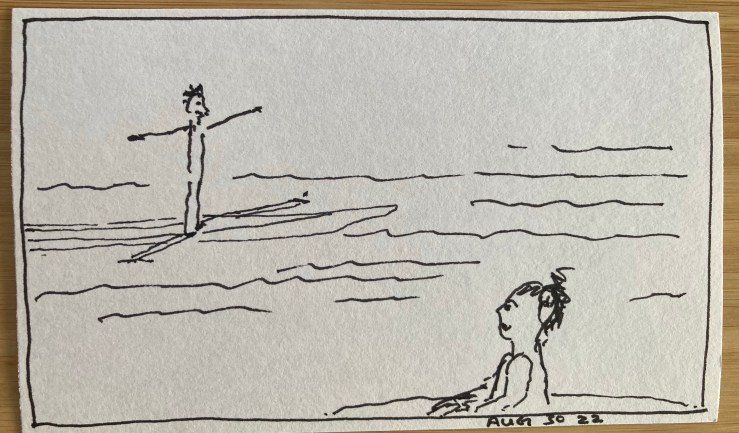
The youth rowers practice a short distance off. The sun pools the horizon streaking ribbons of mauve and peach across the sky. And one young boy removes his feet from the foot stops, unfurls his body from sitting and stands up tall on his seat rails, his toes holding his oars in place while he laughs and wobbles with complete control.
And I laugh at the stupidity of myself. How I’ve lost my sense of play. How stiff and tight and fucking serious I’ve been about my mum. And my writing.
How I shouldn’t be so afraid of swimming with water snakes. Or crying.
It seems ridiculous I am only discovering now, closing in on 50 years of age, that my thoughts—how I am thinking/feeling, what I am thinking/feeling, speculating why I might think/feel this or that way—are not entirely well-defined, even to me, before I render them in words and sentences on the page. What results are sentences that are unclear, and worse, the sentiments propping up the words are completely elusive for a reader.
Let’s move from the abstract to the concrete…a place I am wholly uncomfortable in, it seems, given the frequency I dwell and wallow in the abstract.
Here’s a short paragraph I wrote recently in response to a writing prompt:
The promise of bread. All the flour and nuts and seeds were dumped in while the cries and thuds of my siblings wrestling for the swing floated from the back yard. The honeyed water splashed my chin. And then we added time. That most crucial ingredient for growth.
When I wrote these sentences, I let my mind wander freely and captured the thoughts that bubbled up and, loyally, doggedly, transcribed them to the page, moving swiftly from one sentence to the next.
And I think this is a good way to generate material. But it’s not enough.
There are too many ideas or emotions crammed into the same space, tangled into the same sentence, instead of a deliberate, focused rendering of singular ideas or emotions, one after the other to guide myself and a reader along a path of discovery through my mind.
My mistake with that paragraph, well, mistakes, there are a few:
that I thought the paragraph was finished
that I imagined the paragraph communicated my thoughts, when really, my words simply list the images and actions, presenting them as some dreamlike sequence without attaching my thoughts and feelings
that I didn’t question what I mean by “time being the most crucial ingredient for growth”…that sounds really interesting but I just kind of plop it there on the page as if I’m tossing scraps over my should to a begging dog. What do I really mean when I write that? Am I so condescending/inconsiderate of my readers that I just leave that hanging there, a completely ambiguous, no, amorphous phrase? Ugh abstraction again. What I mean is, am I treating readers like a begging dog with these half-assed declarations, expecting them to “get it” and hang on my every word?
I haven’t worked through this paragraph to even know what it is I mean, what there is “to get”, let alone communicate that “idea/sentiment/feeling” clearly and effectively to readers
Too often I believe beauty is sufficient in creative writing and understanding only secondary …except, shit, that’s not what I believe at all. Understanding, a shared understanding between writer and reader is paramount, it’s the whole point.
This is where revision starts. Re vision. Writing a first draft, I’ve cast out into the ocean of my subconscious, and I’ve hooked something, these sentences, these words, but I can’t land them as they are. They must be studied, queried, and then, once I have a sense of what it is I am trying to say, I need to craft a sentence that is true and clear, in addition to beautiful, to communicate that thought to a reader.
I’ve been studying sentences. Not so much the grammatical construction of sentences, though syntax is definitely part of it, but more the conceptual constructions, how thoughts are layered, one after the other, using the form of a sentence, to communicate ideas or emotions to a reader.
Take the first part of that second sentence above:
All the flour and nuts and seeds were dumped in…
Some questions and additions for clarification:
All the flour? All the flour for the bread or all the flour in the house, and does it matter? It does, depending on the effect I want to create. In this writing piece I don’t want to imply it was the last of the flour in the house, this is not a story about want…well, maybe it is, but it is not about hunger in that sense. Be specific:
My mother fisted whole wheat flour into a yellow plastic bowl big enough to bathe a new baby in. She added a small handful of white flour—to make sure the loaves would rise above the status of a brick in the oven—walnut, sunflower and poppy seeds were dumped in…
Taking the time to add these clarifying details, I’m both delighted and horrified to discover more subconscious imagery bubbling to the surface. Where did that new baby come from? And what about that riff, obviously related, that riff on “a bun in the oven” with the addition of brick in the oven (a word that won’t make the final cut but has surfaced to provide more here, in the discovery and writing process). And what the hell is the word “status” doing there?
And that was the easy part of one sentence in that paragraph.
What do I mean when I state, The promise of bread? How do bread and promises come together? Or, why have I put them together here? Do I mean that baking always holds a promise? I like how the sentence (or is it a fragment?) sounds, but what the hell do I mean?
This blog post is too long already, but I hope you get the idea of how I’m working to make my writing…well, my thinking (my sloppy thinking!!!) better. And my writing too.
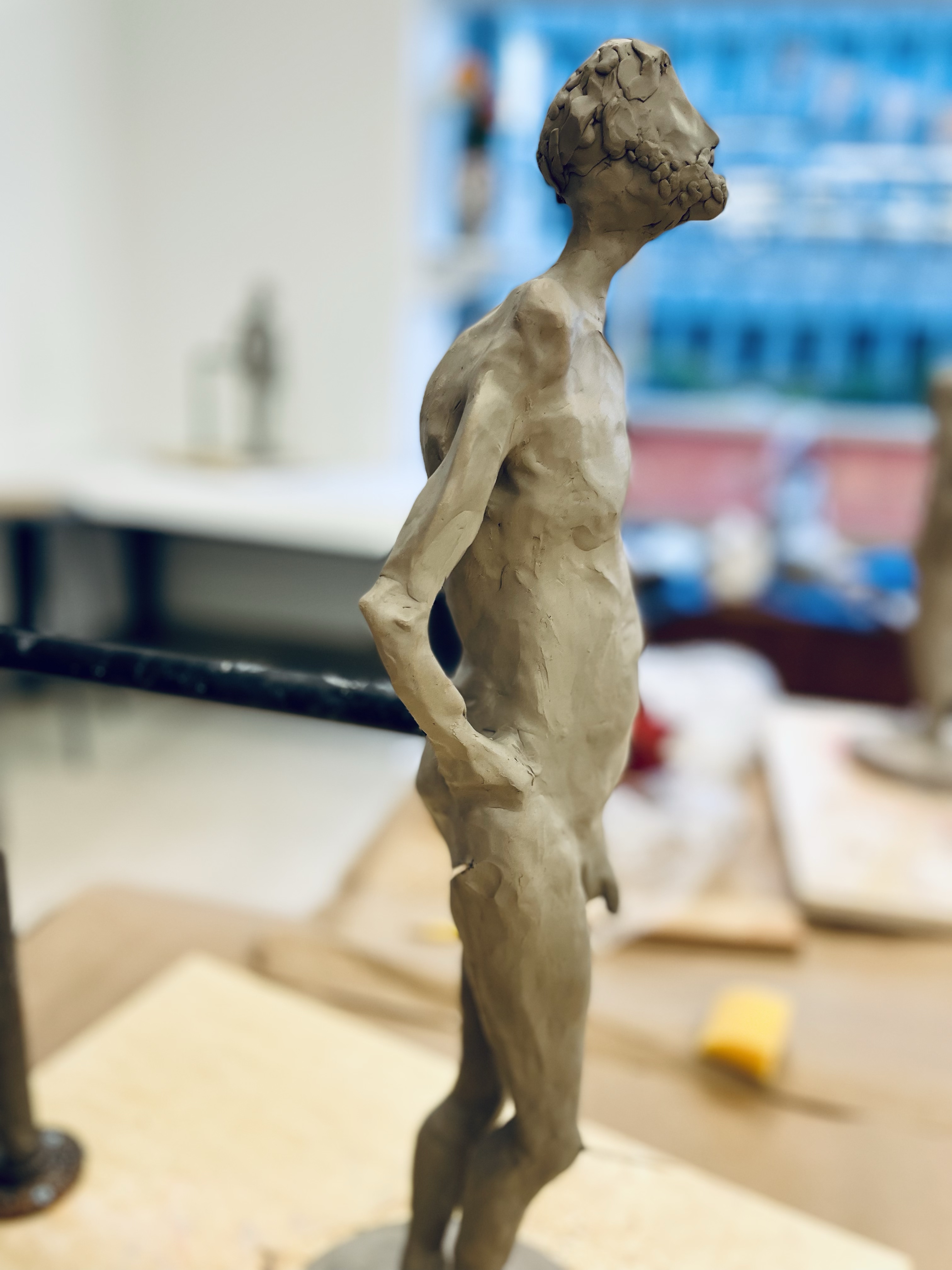
Here are some images of my completed sculpture right before the form was destroyed, the clay pulled from the support and returned to the plastic bag to be used to make something entirely different another day. It was a good lesson and a lot of fun. Thank you and credit to my good friend and colleague, JB, for the photographs.
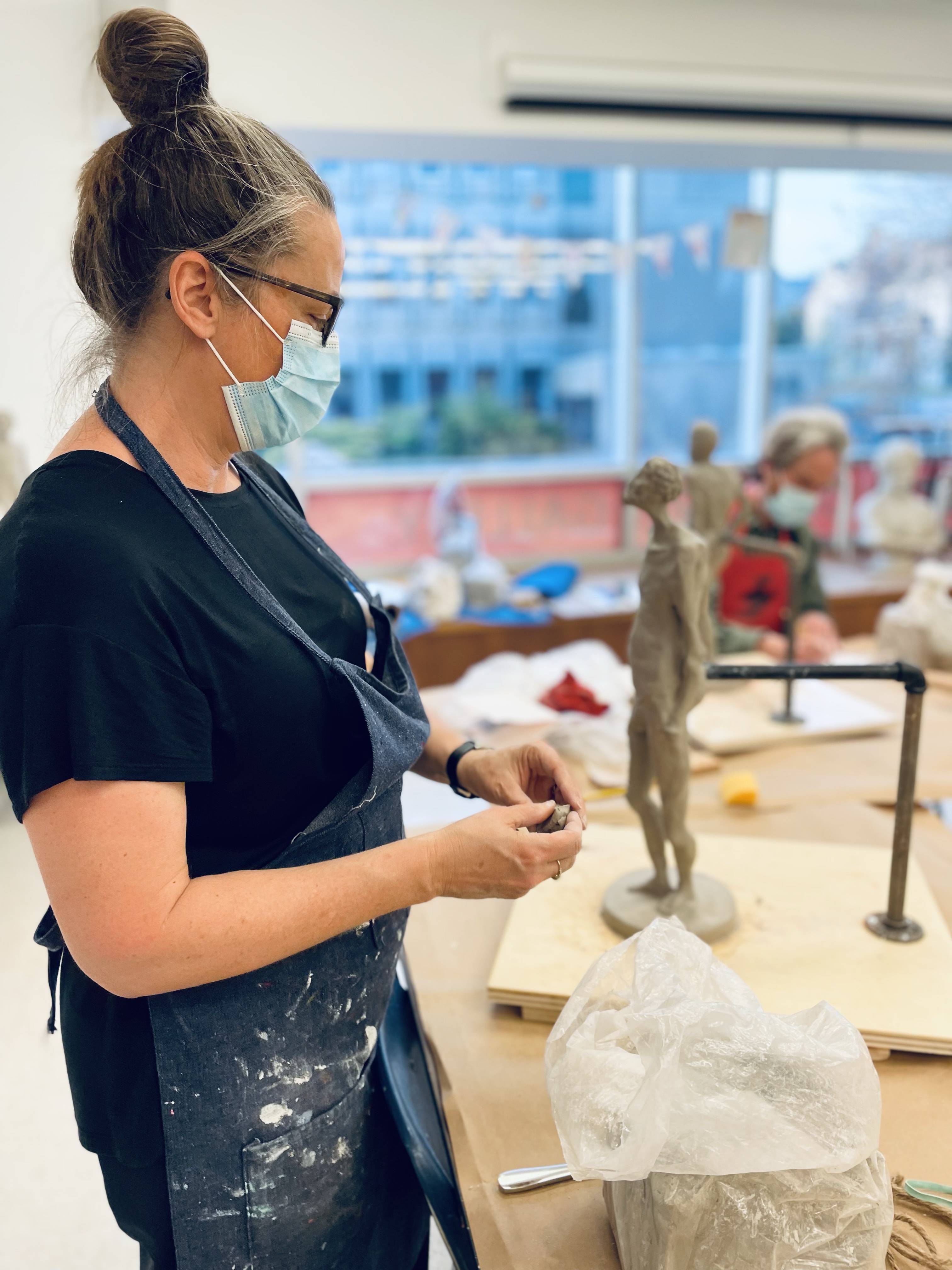
I’m in the middle of a 4-week human figure sculpture class. I love the way the cool clay yields to my fingers, the weight of it. I love the way it feels wet, but dries to a chalky powder on my hands, leaving prints against my thighs when I accidentally wipe them there. I like to challenge my creativity using different mediums; I always discover deeper awareness for my writing practice this way.
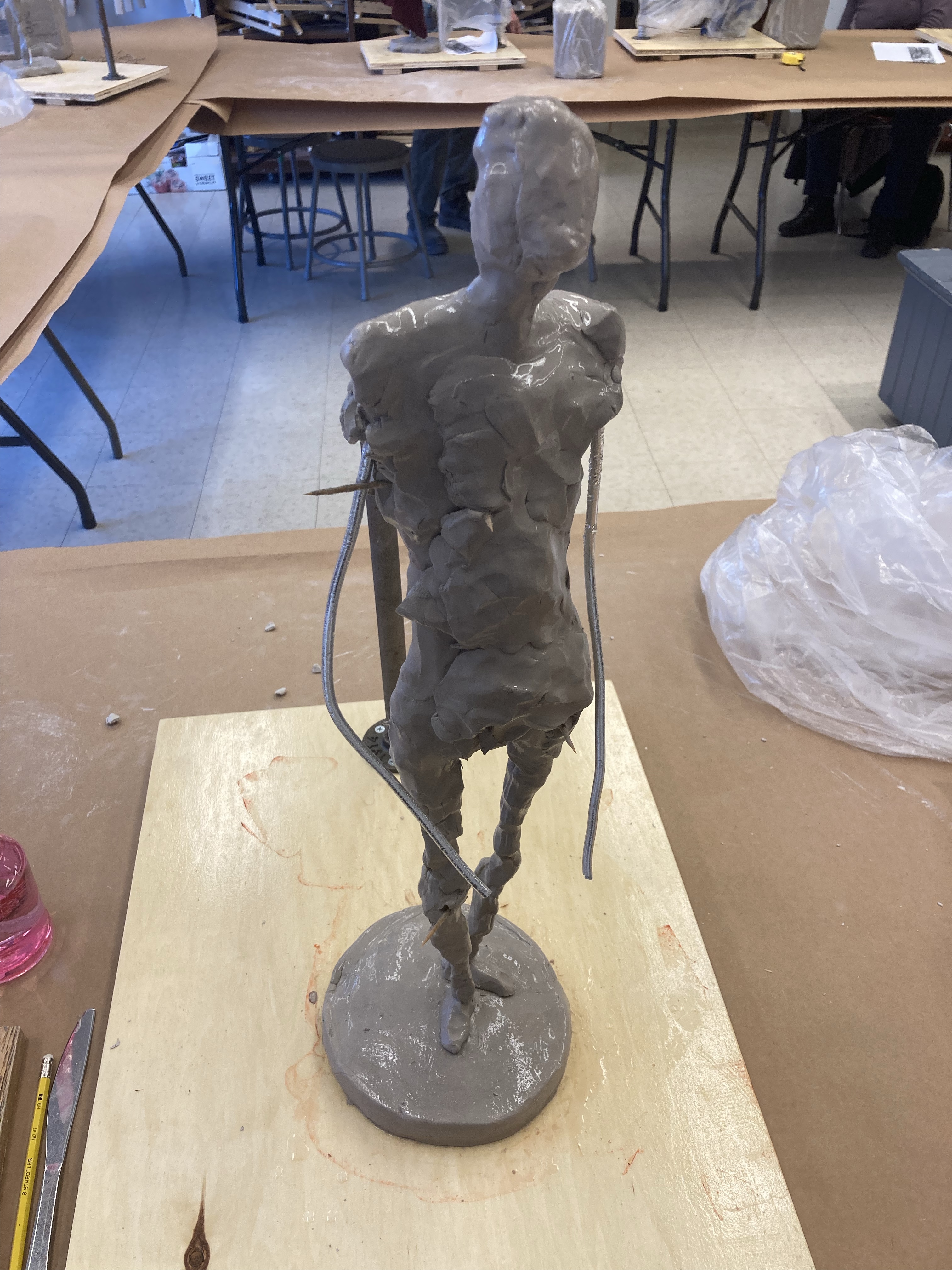
This is a class in observation. We are creating “a study” of the human figure, in clay, using an armature (a stick like human figure made of bendy wires). There is a nude model instructed to maintain the “study posture”, but to rotate every 7-10 minutes. The study pose is a contrapposto, or counterpose, where the body appears to be in mid-step with a slight twist of the torso that signals a certain vitality to a finished sculpture. The model’s timed rotations mean students never stick to rendering one view but must rotate armatures to match the model’s stance, building out only the three-dimensional form from their unique viewpoint in the room.
At the end of this class (which, due to covid-19 has been a bit bumpy with some classes cancelled and rescheduled), we will destroy our works by pulling the clay from the armature to be stored in a plastic bagged blob. The forced breaks, shifting viewpoints, and the fact that the finished product is nothing more than the end of a “study” process, has made me feel a light creative freedom.
I’m delighted working in the small class, listening to the murmurings of conversation, the shushing hiss of spray bottles and overplayed classical tunes. To be in the moment of “trying” for no other joy but to try. It is a focused peace.
In sculpting, I’m working to render gesture, observing the live, three-dimensional form, and attempting to replicate a scaled down version with my hands. I’m assessing volume and shape, curves and hollows, the points of bones and how the softness of body, muscles, skin, drapes over them. Expression is captured in the stance and gesture of how the body stands in place.
In drawings, gesture is captured in the line. A move from rendering “the study” from three-dimensions to two. A line can capture energy, a subject’s vitality, by how it is it rendered on paper – thin and fast, thick and slow, etc.
But the experience of observation captured on the page through writing transfers the three-dimensional world (even four or five dimensional if we start to add things like emotion and interior thoughts) into flat words on a blank page. Words are abstract symbols of representation. Each word sparks connotations and connections unique to our own experiences and interpretations. I guess this is why reading another’s words can feel so magically transportive. Just as my viewpoint of the art class model rotates on a platform in the middle of the sculpture class, my experiential viewpoint alters the interpretation of words. I witness – eyewitness – the object or the sensory experience – I interpret it (my own way) and render it into words to be able to convey my interpretative experience through writing. And if that sensory experience, imagery, or idea is understood and resonates with the reader, there is a frisson of recognition and pleasure in sharing these experiences and thoughts across time and space.
But getting the words to come through…not so easy.
Some observations from the last week:
I saw a porcupine. I thought it was a beaver at first because the animal was so round with a paddle like tail but as I passed (quickly – I was road cycling) – I realised the tail was not so big but rather narrow and flat– the animal was approaching the base of a large old oak with, I believed, an intention to climb it. It was mid-day. The sun was high and bright but the wind, blowing east, blew strong against my direction of travel, stole the warm huffing of my exhalations fast past my ears. But how to describe the porcupine’s unrushed perambulation? Its roly-poly demeanor? The animal wobbled.
And a swan, bending its neck, s-like, to its back, its wings, still folded, raised and what? Trembling? Quivering? Shivering…yes, shivered and fluffed.
A friend’s high-pitched reaction to one of my questions. A squeak.
The dairy farm’s manure and powdered milk smell that makes me want to gag.
The scent of pine sap needling the shade when I passed beneath their feathery boughs.
The friendly waves from motorcyclists as they passed me cycling. Is this a thing? Are we in solidarity somehow, riding through the fresh air with bodies exposed to the spring? Not just one, but three different motorcyclists at different points along my route. One even when they must have seen me gagging for breath on a long uphill. Maybe that is why they waved. For encouragement? I waved back regardless.
This is the process of art making: observing the world with loving attention, transferring that loving view as a gift for the viewer/reader to share in that joy and delight.
In the fall, I was writing personal essays. Well…they were less essays and more fragments of thought, ideas, fits and starts recorded on paper. But I strung them together. Discordantly. I forced the paragraphs to conform. To what? I wasn’t sure. Never a good sign.
The deep questioning I was trying to work through (thought I was working through?)…the essaying…wasn’t working. The process was deeply frustrating. I forced myself to the writing and it resisted by clenching up. I couldn’t figure out what lay at the heart of my exploration. Again, I’d fallen into my habit of going at the writing with my head instead of my heart. I thought…instead of felt.
Then the holidays and the requisite relaxing of routine, reinforced with another public health lockdown as Omicron rapidly spread. And New Year’s Eve I became symptomatic. It was two days before my scheduled booster (which I cancelled) and 6 months post vaccine number two when immunity wanes. It hit me hard. Not dire, but unpleasant and uncomfortable. I released the writing routine to reading. And healing. And then, after stumbling across Douglas Glover’s (DG) essays (I write about that here), I worked through some intense studying of the craft of writing mirroring his methods. This was healing too.
DG posted an exercise on writing emotions, and I challenged myself to write a fictional scene following his prompt. It flowed easily and felt fun. And here’s the weird part…when I studied what I had written in those 1-2 paragraphs, I recognised the seeds of exploration I had wrestled with in the fall. I still didn’t understand them…but I could see the concepts there.
I flipped back to writing fiction.
The writing progresses differently compared with how I have written in the past. Instead of sitting down to a timed write (30 minutes is my usual go to), and writing scenes from beginning to end, I’m writing in fragments untethered from a narrative timeline.
I’ll try to explain how these arise. I seem to be toggling through two different approaches. And they complement one another.
First, as inspiration, I read other writers – stories, novels, poems or essays – I choose a book from my shelf almost randomly and thumb through the pages letting my eyes rest where they get caught. I pay close attention to how the words pile up there on the page and then I work to copy the syntax or concept or the work a line or paragraph is doing (techniques) for myself, using my own words for my own emerging story. This gets the engine of writing going.
Second, I let myself sit and relax and try to let my mind go blank…and the images that move with the story appear. I write them down. Sometimes it’s a phrase or a word, often it is a picture. Sometimes it is a mood or feeling…these are harder to write down. Sometimes I write most of a scene and what I think I’m going to write about I never get to. Instead, it’s something related but tangential.
I toggle back and forth between these methods (I stop to wonder here…perhaps this is how other writers write and I’m only discovering this now because I’m so dogmatic and literal I’ve never relaxed enough to do this? Maybe. Probably. Ugh. But the ability to do this relies on gaining an understanding of how to read for specific craft techniques instead of reading for meaning (symbolism) and I have DG to thank for pointing this path in way I can finally understand).
There is a lot less knowing about how it will unfold (gasp! I have to release control!)…and I flip back and forth between liking what I have written and extreme anxiety about whether it’s working. Sigh. But fragments and phrases float to me throughout the day and I jot them down in my notebook, feeling them, receiving them as the precious gifts they are.
And here’s the thing, writing through fiction this way I have come to understand what I was exploring through essay in the fall—but didn’t quite get there—coming at it slant has illuminated meaning and a story line to tell it. For the first time I feel how it ought to come together to share the experience with a reader. This is a huge step forward for me.
Once the material and the order of it is fully drafted, I’ll shift into a similar but third approach, which is to study what I have written, try to understand the work each paragraph/section is doing for a reader ( in service of the story), then turn back to my bookshelf to study techniques again for how to do it better. Feels good to follow a path.
WordPress will not allow this image to be the right way up…perhaps it’s better posted this way …moving against gravity.
Making art when there is war. It feels wrong. Or useless. Selfish. I spiral into guilt and shame about my privilege, my luck. In the boundaries of my skin, my brain, the sorrow seeps.
There are mountains of sorrow at the heart of all conflicts. The fired heat of hurts hoisted through generations, coded, we now know, in our DNA, and patterned far too comfortably in memory.
Russia and the Ukraine, China and Taiwan, the continued killing in the Middle East, too many countries in Africa, we speak of warring geographies as if they are sentient beings themselves rather than the individual people, plants, animals, collected and hurting beneath? Behind? Within? the skins of borders.
Bodies of power in the shape of countries, in the shape of cities, in lake shaped wounds, in fist shaped educations, in the curved shape of a parent’s spine twisting from a child’s longing for love.
This is a habit of mine: to speak in abstractions, to hide behind the illusions of words, to climb my mountain of sorrow instead of burying deep within it to try and understand.
What is it I’m trying to say?
That I feel so very sad. That I wish humans could be better. That I wish I would do better. That I could truly believe that making art, which is to say making love, creating love, holding love, sharing love, could save us.
Even if it is so hard to believe when fire rains down from the skies, I must.