Sometimes I must be dropped in the Marshall Islands to realise I’m in the middle of the Pacific Ocean. It often takes me a long time to see things.
Pencil ~ 1992
I went through a phase in my late teens and early twenties painting figures with no eyes – the two pieces here date from that era. Most of the artworks I produce are given away as gifts[1]. I can’t imagine many recipients of these screaming figures with their eyeballs floating in space might still grace their walls with my works. These two pieces might be the only ones left. They hang on the walls beside my writing desk.
I know they look scary. They aren’t meant to be. My high school art teacher disliked them. At the time of their creation, they didn’t reflect a mood I was in (I was quite happy and content, not dark or brooding). At the time of creation, I simply followed where my paintbrush or my pencils took me, delighting in the creaminess of oil paints, their tree-sap scent, and the ease with which pencil marks shadow contrasts between light and dark. Perhaps it was a way to work through an earlier terror, I don’t know. I never had an explanation for why I painted these subjects, I just did.
Decades later, hanging on new walls in a new space, staring at these works above my desk, they spark curiosity. And reflection. Looking back upon the intervening years of marriage and raising[2] a family, I can’t help but interpret their imagery as an almost wilful blindness. A warning for what it would take for me to manage my life choices diverting my path from art.
More context. I was flattened after completing my undergrad. In those days, the degree required a written thesis, complete with ethics review submission, primary data (raw) collection, analysis, interpretation and synthesis. Mine explored how child development influences a child’s ability to draw emotions. I went into three different schools and multiple classrooms of kindergarten to grade three students and collected their drawings of “a person who is ‘sad’, ‘angry’ and ‘happy’”. My supervisor, a new to the department prof, studied the tools with which child welfare court cases might be helping or hindering child testimonies. I won’t get into the Pandora’s Box of issues this research illuminates with our justice system and the rights of children. My thesis work was a departure from the neurophysiology and neurochemistry I’d focused on through the science degree, deliberately engaging with a creative and developmental approach I was craving. Conducting the thesis work on top of finishing all the other fourth year courses and working part time as a waitress was punishing[3]. I resolved never to do research again[4].
I adored those child drawings, their stick figured innocence, their genius beauty. After graduating, I pivoted my sights to art school and began to piece together a portfolio for submission. Waitressing, I couldn’t afford to apply to more than one school[5]. I chose Emily Carr. There, portfolio submissions required works using three different mediums exploring an artist chosen theme AND encased within a container constructed by the artist that expanded, or at least aligned, on that theme. Shipment costs, of course, were the responsibility of the artist. Why am I recalling these stories? Hindsight explorations. For the constructed container, the most challenging aspect of the portfolio package, I chose to create…wait for it…a liquor store box-sized ceramic eyeball.
At the time I was working with a friend’s mum in her pottery studio, and I explained my approach and plan for the eyeball—it would be two separate ovals (bowls), constructed using clay slabs with holes on the sides near the lip where I would attach metal hinges and a latch after the two halves were fired. This seemed simple to me, but L. refused, explaining it just wouldn’t work, it couldn’t be done. Looking back, I realise my mistake was using the word ‘eyeball’ – I should have simplified the concept to “two bowls that hinge together” or even, “two oval slab bowls, a top and a bottom”. Full stop on the construction of a container for my portfolio submission. No eyeballs in her kiln. I spent that summer trying to puzzle other ways to make a large eyeball that would hold multiple pieces of art. I couldn’t figure it out. And the portfolio gathered dust. I laugh now, wondering why I didn’t consider a different object, a different container (even the liquor store box would have done the trick!). But I (eye) didn’t. And that same summer I met the man who would become my husband and I shelved the idea (eye-dea) of art school[6].
Its’s twenty-eight years later and it’s only now I’m learning to really see. And I recognise a wilful blindness with my writing too. I’ve returned to working on what I call my “long form project”[7]. I have years of writing around the same themes, writing that I have refused to re-read or explore for fear of what I will discover there, what I didn’t want to see. To raise the girls the way I wanted them to experience “family” I kept myself blind[8].
This post is too long. This month has been wretched[9]. I decided to print out the pieces I’ve written as part of the long form project, “to see” the extent of material I have. I was stunned to discover it’s 208 pages, 74, 385 words long. This doesn’t include more recent writings towards this project, nor does it include parts written into ten plus years of notebook writing. Initially, I felt proudly amazed I have so much material to work with…then I spiralled …I can’t see where it’s going, how to piece it together…I am floating blind again. Still.
But …I will read what I have written, use my hindsight and my insight, my nascent ability to see the layers and sift the meanings from my own words. I know I have returned to a path of art, following a decades long detour. I wish it was not so painful.
[1]Blue Salamander, a symbol of moving between worlds, transitions and an ability to regenerate, went to the incredibly generous couple who gifted me their riverside house for the winter after I left my marriage. A friend coined it The Glass Chalet. The couple joke, calling their place a home for wayward women. I am not their first.
[2] Razing? This is exactly what I have done by choosing a life of independence…what I have committed through decommitment.
[3] Because my prof was new to the department, he pushed the project to a level worthy of publication, research far beyond the expectations for an undergrad. I fought with the departmental panel, assuring them I could complete the work. The panel pushed back, insisting it was PhD level, too much even for a Masters student. I ended up presenting eleven iterations of my research proposal to the departmental panel before getting the go ahead for ethics submission and beginning the project.
[4] Ha ha …the universe has a sense of humour doesn’t it? Research features heavy in much of my professional career. Interestingly, when I doodle in my work notes during meetings, I have always drawn…eyeballs.
[6] Later that summer, L. rushed into the lobby of the restaurant during one of my shifts, her hair a zany mess and her arms waving the air with her eureka moment. She shouted at me over the din of the restaurant in full summer swing: “I know how you can do it! It will work!!!”. I’ll never forget her despondency when I explained I’d met a man, that I wouldn’t be going to art school. I was 23, the same age my eldest daughter is now. This horrifies me. Maybe it shouldn’t. But it does.
[7] When I referred to a “long form project” during a recent online writing session, one woman pressed me to define my project more specifically. Was it a memoir? It must be a memoir. No, I explained, it’s creative non-fiction, collage work, a series of vignettes, but along various narrative throughlines (four), and the vignettes are kind of veering into fiction. It’s a memoir she repeated, then went on to explain she’d just finished her PhD in literary criticism. Well, that explains it, I thought, but didn’t say anything more. Days later, when I was doing the dishes, I came up with the right category for my work: it’s a memoir with wings. Stick that up your store bookshelf.
[8] This is incredibly hard to write here, to admit. I suspect my self-suppression, the shame in that, is what my long form project explores…I don’t know. I feel lost. Untethered.
[9] My mum suffered two falls, one where I needed to take her shockingly bruised body to the hospital for a wrist x-ray (not broken); my ex-husband (first time calling him this) is dating …I am told about the women through our children, pasting an expression of impassiveness to my face to offer the support they need to process this news (I make myself beige); I’m fielding daily tear-filled calls from my eldest daughter who broke off with her partner of three years…both of us cry on the phone…I try to be the strong and supportive mum I need to be…I fail; I visit my father in his subsidized housing apartment, taking any leftover protein from my own meals because I know he sustains himself on honeynut cheerios; his interest in the world is fast dissolving, his memory, like my mother’s, with it; I long for the sounds of spring peepers, chorus frogs and wood frogs I no longer hear living in the city, and I weep about the loss of the garden; I refuse to attend to world news because I know it will break me; I float through my workdays, convincing my colleagues I am indeed a senior policy advisor, I’m amazed by my own performance; I have separated the muse from the man, the divine from the human, a painful yet necessary separation, for how else to cultivate different ways of knowing, practice other ways of seeing?
long form project printed – a surprising pilenotebooks date back to 2012
Collage I created March 16, 2024 in an art workshop facilitated by hiba ali at the Agnes Etherington Art Centre.
My favourite professor in undergrad taught neurophysiology, biological psychology and behavioural neuroscience of motivation. I have a distinct memory of his explaining how the size of the human brain is governed by the restricted size of the birth canal (technically, it’s referred to as the obstetrical dilemma) . Surprise, turns out it’s a little more complicated than that. Much neurodevelopment continues during the postnatal period and neuroplasticity is lifelong. But beyond this, our brains sufficiently evolved to invent machines with super-fast processing speeds and computational abilities. At this point, most of us have adopted palm-sized prosthetic brains in the form of cell phones, and with them, we have access to more information we could filter, sort or ever hope to synthesize, especially across diverse subjects.
This is what I was thinking about last week when I attended a webinar providing an overview of Google’s Notebook LM, a new AI application launched in December 2023, that basically functions as a virtual research assistant. Let’s call it an(other) extra brain [1].
Yes, I’ll be one of the early adopters, especially for my day job. But I’m also interested in how the technology could become a tool to support creative process. Though, to be sure, a tool used with caution.
A swift summary: LM stands for language model and the application uses the conversational question functionalities of ChatGPT, BUT allows you to curate a discrete library of your own source documents for the AI to search through. So, any question you ask will draw an answer from ONLY the documents you have provided, personalizing sources to a particular project, erecting a knowledge barrier you can control and thus greatly reducing inaccuracies and hallucinations [2].
The application currently integrates Docs, PDFs, txt, and pasted text using the cut and paste function. There’s promise websites will be able to be imported soon. Likely, the import of images, PowerPoint and even Excel sheets will be functional in the not-so-distant future.
An older collage I created December 2022.
I often use the search and find function in documents to locate phrases and key words. This is especially important when reviewing legislation and evidence reports under tight timelines, but I also use the function in creative writing to locate word repetitions, check misplaced homonyms, homophones, homographs, get rid of weasel words[3] etc. But this function has only been possible in one document at a time. I’ve used qualitative analysis software to support analyses and syntheses across interview and focus group transcripts, as well as multiple word documents. Using qualitative software, a considerable amount of time (time in which your brain actually feels like it’s turning to mush) is used to manually “tag” words and phrases in every source transcript or document to a category in order to code the text data. This can take weeks or even months, depending on how much text makes up the project and the theoretical approach you have chosen to apply. Once all of the text data is coded, THEN you can go in and query the dataset for analysis using your coding structure. The capabilities promised by Notebook LM will (almost) eliminate the coding step, allowing a researcher to jump right into querying the data for patterns and moving forward from a super advanced starting line.
Imagine this application for:
summarizing systematic research reviews (practically this is very similar to conducting qualitative analysis)
understanding legislation changes over time or creating a bylaws database that could be posted to municipal websites to support citizen Q & A
referencing medical symptoms and best practice guidelines – could this replace a visit to a family physician, linking a person directly to a pharmacist or triaging a health issue to an allied health care worker for virtual assessment and confirmation, at least for common non-emergency ailments?
Discovering patterns across historical documents or novels or essays or groups of poems or across all these different types of documents
Bringing disparate subjects together to spark different ideas, say climate resilience strategies, poetry, child development, hip hop song lyrics and how long to cook an egg [4].
My daughter Willa made this collage last week procrastinating school assignments. She is much better at collage than I am and has created some truly stunning combination of images. I love the mum and child flower heads in this one. This collage inspired me to sign up for the workshop, a welcome oasis of calm following the move into my new (to me) physical space. Another one of Willa’s at the end of this post. Thanks Willa!
The collage at the top of this post is a good analogy for the possible repercussions Notebook LM threatens related to creative licensing and copyright. I pasted the collage together from bits of cut out magazines and art books as part of a fantastic afternoon workshop facilitated by hiba ali, The Studio x Open Secret: Activating Dreamscapes. The images I used came from artists’ works and photographs from books and National Geographic magazines and I’ve cut and reassembled them without any credit to create my own artwork. Where should the line of creative appropriation, cultural appropriation, or plagiarism be drawn in these new digital spaces and the “new” creative works produced using these tools? [5]
Attending this collage workshop in the same week as the webinar kind of blew my mind – an ocean of virtual playgrounds to swim in. It’s also a little frightening, the control to create frames of knowledge that might hold sway an illusion of authority for many. I’m (somewhat) comforted to learn (also this week! my goodness) the word set boasts a Guinness World Record with the most senses of meaning (430!) of any other word. Other sources award this honour to run with more than 600 senses. Perhaps the english language will retain sufficient nuance an AI might never master (wishful thinking). BUT, language combined with gesture, intonation, facial expression, raw instinct etc. may give AI a run for its money (I hope).
Once we created our collages in the art workshop, we uploaded them to a digital art exhibition “world” space where we co-created together and were able to manipulate the images, integrate a variety of additional media (sound, text, links, gifs etc.). This application is New Art City. It reminds me of the game Minecraft my kids used to play when they were younger. Here’s a link to what I created playing [6] in the New Art City application with my own collage and the virtual gallery space: https://newart.city/show/souxs-virtual-creative-space-space-1.
All this virtual creativity at your fingertips for a song. To be sure, what we create as our real world is built from layers of many worlds—perceptual, spiritual, cultural, relational, linguistic, so many others—and, of course, virtual [7]. Jouer le jeu as they say in French, play the game. But the digital space is really an out of body experience; sometimes we might just have to communicate the old-fashioned way, you know, via email or phone or (gasp!) face to face. Especially when virtual platforms are an invitation to experiment interacting multidimensionally. Like I said, you’re welcome.
[1] Sorry Canadian peeps, the experimental version is only available to those living in the US. Canucks are still waiting to test drive the application.
[2] The information returned is less likely to be made up by the machine… hallucinations are complicated, I’m not going to try to explain them.
[3] From Matt Bell’s Substack, No failure, Only Practice, Exercise #14: Hunting Weasel Words.
[4] I know, weird, but you get what I’m suggesting.
[5] I don’t know the answer to this at all but it’s an interesting question and I would value a discussion.
[6] Other applications that I didn’t use but leave here as reference: Photopea, a free online photo editor; Free3D, free three dimensional models; Creative Commons, “an international nonprofit organization dedicated to helping build and sustain a thriving commons of shared knowledge and culture. Together with an extensive member network and multiple partners, we build capacity, we develop practical solutions, and we advocate for better open sharing of knowledge and culture that serves the public interest.”
Serendipitously, when I texted Willa to get her permission to insert her flower head collage in this post, she was working on this larger collage as part of a school assignment (not procrastinating this time ha ha, it’s for a final project about the mutual oppression of women and nature, although she had intended a textile applique but ran out of time). The photos in this work are from a woman’s beauty guide book from the 1980s, The Complete Beauty Book, an interesting, admittedly sexy visual commentary to be sure.
Certainly not as beautiful as Dante’s Dream , but for all that I love, drawn on my birthday.
This is a long read. Self-indulgent. I couldn’t help it. Some footnotes to keep the reader interested. Hopefully.
In 2019 I attended a writing workshop at Omega in Rhinebeck, New York (I write about that here). Several workshops ran in parallel, taking the better part of each day. The week I was there, an inordinate number of white women wore flowing, white, loose, muslin tunics with all their hair tucked up and disappeared beneath white turbans: the Kundalini yoga uniform. No one used the words “cultural appropriation”. I didn’t either.[1] Out loud. In the evenings, round robin sessions were offered where people might try other workshop topics. Yes, I tried the Kundalini session. It’s not for me[2]. But one must remain open to new ideas, stretch the mind, (and the body), and so it was I found myself one evening in a session with a celebrity psychic medium. It was an interesting session[3], but something the facilitator said really stuck with me: “Everyone can do this [be a spirit communicator – really?], it just demands a lot of practice, and the practice is paying attention, first, of course, but also trying NOT to make meaning out of the images and senses you are receiving, just report them as you receive them”. Like, if you’re a celebrity psychic medium, don’t puzzle the images together – that’s for the detectives looking to solve cold cases or the families who are trying to communicate with deceased loved ones. Huh. Okay.
But for writing, we need to make meaning of the images and the words and phrases that flow from them. The trick is not to solve the puzzle too soon.
With writing, I practice letting the images and even the silly ideas make it to the page. The result is that I now have a lot of blousy first drafts and half formed ideas lying around waiting for revision at some point (which feels like some distant sunrise cresting a dark horizon)[4].
It occurred to me[5], riffing off of last month’s post about writing and energy (slaps forehead), that what I need to practice more intentionally is READING the energy in my own writing. My own writings are trying to tell me something. The story is communicating through me (just as the energy to split wood effortlessly using an axe must travel through the body)…maybe I’m just the filter the story moves through to be born. I’m sure I’ve read this before…it’s only now I’m understanding it pragmatically.
So, with a spirit of nakedness, I’m using a recent response to a writing prompt[6] as a way to work through how I’m trying to read the energy in my own writing….while remaining sufficiently loose in interpretation and open to other ideas (before locking the story meaning down, aka, solving the puzzle). This is a first stab at explaining this process…
I wrote the piece in a quick, mostly relaxed, twenty-five-minute burst before I had to go to work. I have retained all the spelling mistakes, the lazy repetitions, the character name of Jo spelled two different ways, as well as the story’s devolution into stream of consciousness writing. I thought I would have time that week to fix it up before posting it to my workshop group. I didn’t. I posted it as is with the caveat about its devolution into imagery and all else.
And here’s the interesting thing—and why I’m choosing to write about this process here—when people responded to the piece in the workshop, each one indicated they had connected [more? best?] with the stream of consciousness sections: the writings that arrived subconsciously, those aspects of my shadow self, frolicking forth from dream territory. Hmmm. A sign like that can’t be ignored.
This post will necessarily be long to show my process. First, the piece unmarked, followed by the piece again with my thoughts and interjections marked in BLUE about what the writing might be trying to communicate through me.
The Red River swelled beyond its banks again, as it did every year. This year it attained new waterline records, bursting the city’s levies, its fluid tongue flicking the sand bags right and left like a prize fighter spitting chicklets in a fight to champion the world.
Mary and Joe arrived in separate vehicles, she a canoe, he a kayak. Mary tied the canoe to a lilac; Jo roped the kayak to iron railing leading up the front steps, now submerged. Each used their own spare key, twisting the front door lock a foot above the waterline. Each shouldered the door against the heavy water to enter their daughter’s split level. The house in the chichi neighbourhood had promised a view of the river. In this respect, it had overdelivered.
“She picked the wrong week to travel to Los Angeles.”
Mary sighed. She hadn’t wanted to start clean-up efforts with an argument. She stood in a foot of cold water that pressed against her knee-high rubber boots. Sloshing across the kitchen, her rubber pants rustled loudly as she fought to stay upright. The linoleum was slippery wavering beneath so much grey water, dotted here and there with soggy receipts and plastic bags ballooned into jelly fish. She and Jo rarely saw each other. They confined their spite to Thanksgiving and Christmas dinner tables. Without grandchildren, and now without their son-in-law (sandbagger), or their snooty daughters-in-law (good riddance), those dinners sunk before any plates graced the table.
Jo continued, “I thought she was in California.”
Not unusual, such misinterpretations. For too many years Mary excused these oversights, chalking them up to hearing loss. Too many rock concerts. Too many engines revved to screaming in the garage. After the divorce, she’d faced, brutally, what she hadn’t wanted to: he just didn’t give a shit. Content if given a hot meal every evening, if potato chips were snack ready, if clean underwear stacked in the dresser drawer, Jo cruised life. He erupted a stormy passion when things didn’t go his way. The family vibrated his tensions, always on the Joe program. And his own children just hadn’t been interesting enough for him.
“No, she’s in France, Anjou. Ville-sous-Anjou, like the pear.”
Mary’s heart sunk then realising the fridge, out of power now for three days, the vegetable crisper beneath the water line, would have to be dealt with. A rotten job (inwards she laughed, bitterly). She scanned the kitchen trying to remember where Lizzie kept the box of garbage bags, spray containers of cleaners, a mop bucket Mary might use to bail water. Where the hell could she bail the water to when the waterline lapped the window ledges, the river kept swelling? It was hopeless.
“This is hopeless,” said Jo. “Didn’t I warn her not to buy waterfront?”
Mary let his question hang, snuffing the old argument before it ignited. Doomsday prophecies, climate change, the water rising to take us all, tidbits he scraped from the internet, scrubbed, polished and hurled at listeners as if they were his own. Millionaires blasted the skin of the earth, their arcs of triumph going limp when they descended, backwards. In the end the laws of gravity, of inevitability, drown us all.
“I mean these days?” he pushed, “what the hell was she thinking?”
“Hell” said Mary.
She watched the look of confusion cloud Jo’s face. Honestly, he was so slow sometimes, she was glad she’d chosen not to see the end of the world with him. Yet here they were, sporting galoshes and yellow rain pants, knee deep in water wavering and rolling optical illusions.
Insert distraction that momentarily reconnects this couple – Saxophone – a boy playing their favourite song perched on the roof next door – the song they danced to at the engineering formal in fourth year – blue moon
Things floating: paper receipts, plastic bags, loose photographs (wedding?) – flood of pressure water build up – breaking banks – crashing shores, people waiting to be recused in the crooks of trees. Cars and boats and whole tree trunks, chesterfield, the deer, it’s snout bobbing above the waterline, antlers rotating with the spinning current, it’s bony legs and knees hoofing helplessly the fluidity, as if were running, running, pulling the belief of Santa’s sleigh, soaring the cold milky way vacuum, light years ahead, or behind.
From its path, the river would always find a way, seeping up through the layers of sedimentary rock, cracking the limestone shelves, eroding the granite walls salt shaker – grains of salt, crystals messenger feels like a warning shouldn’t ignore.
Deer swept along in it torrent, spinning, the antlers whirlpool, their legs kicking, trying to find a purchase as the reindeer of santas sleigh try to paw at the stars. Muddy – silt that when this all drained away they would excavate the kitchen tiles as one might an archeological dig, looking for the mystery they believed buried there, but only finding shards of animal bones, and indeterminate rock.
Here it is again, with my own thought interjections in BLUE and peer feedback noted in ORANGE (with permission). I’ve focused peer attention to the subconscious elements they honed in on (they provided lots of fantastic grammar, spelling and rearrangement suggestions; I have not supplied those here).
The Red River
[I was thinking of the Red River in Manitoba which, I discovered, had a flood warning in early January…but the word “red” kind of vibrates here (shimmers? it’s like my body shimmers) when I read it, so I know there’s something else there to be discovered. I don’t know what that something else is in this case (sometimes it takes me ages to figure these things out[7]). Red is my favourite colour…also the colour of blood and poppies…so, noted, and left to sit. For now.]
swelled beyond its banks again, as it did every year. This year it attained new waterline records, bursting the city’s levies, its fluid tongue
[I liked this combination of words to depict that imagery]
flicking the sand bags right and left like a prize fighter spitting chicklets in a fight to champion the world.
[here, the river is personified…and it’s fighting to “champion the world”…this resonates with the phrase later in the story re: the end of the world, and words such as “inevitable” and “drowning”]
Mary and Joe
[usually when drafting I just choose the first names that come to me as placeholders…the story, in later development, when I understand what it is trying to tell me, will warrant research for specific names that fit and shape the story on multiple levels. Another little puzzle I love. But, can’t help but notice the completely unintentional biblical reference to Jesus’s parents here.]
arrived in separate vehicles, she a canoe, he a kayak. Mary tied the canoe to a lilac; Jo roped the kayak to iron railing leading up the front steps, now submerged.
[Just seeing this now, as I work through this exercise – Mary’s boat is tied to a flower while Joe’s boat is tied to an iron railing, sunk cement steps – something living versus something non-living and immovable – a good comparison of opposites to exploit maybe…and as I reread this reflection again, deeper darker personal feelings]
Each used their own spare key, twisting the front door lock a foot above the waterline. Each shouldered
[“shouldered” vibrates for me, I don’t know why]
the door against the heavy water to enter their daughter’s split level. The house in the chichi neighbourhood had promised a view of the river. In this respect, it had overdelivered.
[noted: humour that twists, subtly, the house into kind of a character…weird].
“She picked the wrong week to travel to Los Angeles.”
Mary sighed. She hadn’t wanted to start clean-up efforts with an argument. She stood in a foot of cold water that pressed against her knee-high rubber boots. Sloshing across the kitchen, her rubber pants rustled loudly as she fought to stay upright. The linoleum was slippery wavering beneath so much grey water, dotted here and there with soggy receipts and plastic bags ballooned into jelly fish. She and Jo rarely saw each other. They confined their spite to Thanksgiving and Christmas dinner tables. Without grandchildren, and now without their son-in-law (sandbagger)
[this word, sandbagger, is an example of trying too hard to make meaning in the story too soon; I feel this as a niggling annoyance, one I too often bypass, thinking I know better than the story does],
or their snooty daughters-in-law (good riddance), those dinners sunk before any plates graced the table.
[ugh all this has to go]
Jo continued, “I thought she was in California.”
Not unusual, such misinterpretations. For too many years Mary excused these oversights, chalking them up to hearing loss. Too many rock concerts. Too many engines revved to screaming in the garage. After the divorce, she’d faced, brutally, what she hadn’t wanted to: he just didn’t give a shit
[uh, there’s more here – and a strong feeling of avoidance, even disgust? – need to crack this open – put my head into the jaws of this lion].
Content if given a hot meal every evening, if potato chips were snack ready, if clean underwear stacked in the dresser drawer, Jo cruised life
[interesting word choice, “cruised” in the context of a flood – pay attention].
He erupted a stormy passion when things didn’t go his way. The family vibrated his tensions, always on the Joe program. And his own children just hadn’t been interesting enough for him.
“No, she’s in France, Anjou. Ville-sous-Anjou, like the pear.”
Mary’s heart sunk then realising the fridge, out of power now for three days, the vegetable crisper beneath the water line, would have to be dealt with. A rotten job (inwards she laughed, bitterly)
[there’s me inserting myself – and I might be quick to hit the delete button here but must reflect my own behavioural patterns before I do: I often make a joke when I’m uncomfortable – an effective avoidance or distraction technique – so, what am I avoiding here? I do know, in this case, and it has nothing to do with this story, so it will be chucked in revision – probably the whole fridge bit. Not all my jokes are avoidance driven].
She scanned the kitchen trying to remember where Lizzie kept the box of garbage bags, spray containers of cleaners, a mop bucket Mary might use to bail water. Where the hell could she bail the water to when the waterline lapped the window ledges, the river kept swelling? It was hopeless.
“This is hopeless,” said Jo. “Didn’t I warn her not to buy waterfront?”
[the repetition of thought between these two characters, one internal, one external, and the way they follow one after another, illuminates a connection between them, even if they don’t want to see it].
Mary let his question hang, snuffing the old argument before it ignited.
[fire references noted – may be a good counterpoint to flood – fire and flood – disasters, apocalypse, possibly another biblical reference].
Doomsday prophecies, climate change, the water rising to take us all, tidbits he scraped from the internet, scrubbed, polished and hurled at listeners as if they were his own. Millionaires blasted the skin of the earth
[wound, violence, heat],
their arcs of triumph going limp when they descended, backwards. In the end the laws of gravity, of inevitability, drown us all.
“I mean these days?” he pushed, “what the hell was she thinking?”
“Hell” said Mary.
[Hell used twice, no, three times – another biblical reference? WTF?! When I was drafting, it was at this point I understood I had no idea where this story was heading, and I wouldn’t be able to wrestle it into a story shape before work]
She watched the look of confusion cloud Jo’s face
[maybe this is my story’s way of letting me know I’m confused. I don’t need the story to tell me that, I know already].
Honestly, he was so slow sometimes, she was glad she’d chosen not to see the end of the world with him. Yet here they were, sporting galoshes and yellow rain pants, knee deep in water wavering and rolling optical illusions.
[I’m drawn to the words “cloud” and “end of the world” and “water wavering optical illusions” – it feels like the natural world asserting itself …not just background, not invisible, but a living, breathing character in this story… a largesse the couple remain oblivious to, even when they attend to the deluge of information (note: deluge is another word for flood) they miss seeing the world for what it is, even when they’re knee deep in it]
[I was struck by this…Is this marking a change in Mary?]
[here is where I allow myself to record the images that arise, without trying to puzzle them in place]
Insert distraction that momentarily reconnects this couple – Saxophone
[Weird. Specific. Can’t be ignored. No idea what it means. Yet. But I like the image and opportunity to introduce sound]
– a boy playing their favourite song perched on the roof next door – the song they danced to at the engineering formal in fourth year – blue moon
[again that niggling feeling that blue moon is a cheap first attempt at something deeper….at the very least a different song (first impulse), but still, don’t dismiss too quickly because blue moon is synonymous with “rare” and should not ignore the connotations of sadness with “blue” and the moon, well, the moon…what can I say? There’s too much…].
Things floating: paper receipts, plastic bags, loose photographs (wedding?)
[interesting that level of specificity inserted here, a wedding photo…feels important…but maybe not for this specific story…my own feelings bleeding in here. Note, instead, an opportunity to place a subtle symbol of the meaning of this story (once I figure it out) as an image floating by the couple’s rubber boots. But maybe a wedding photo does fit…remain open!]
– flood of pressure
[feel a heat with the word pressure]
water build up – breaking banks
[note the double meaning of banks – river and money – and how these two meanings rhyme, conceptually – capitalism and destroying the earth to support it]
– crashing shores, people waiting to be recused
[love this inadvertent spelling mistake of “rescued” – a Freudian slip perhaps that warrants attention and questioning, especially in a context of climate change and an earth battling to be acknowledged and restored, perhaps once humans have been purged from its skin (as referenced earlier with millionaires) makes me think of excusing oneself from apocalyptic judgement…biblical reference again…so weird]
in the crooks of trees
[crooks – connotation with thieves but also I love how it describes the elbows of trees…that’s not quite right, I’m tired, but I kinda like the thought of trees having elbows].
Cars and boats and whole tree trunks, chesterfield
[I just love the word chesterfield],
the deer, it’s snout bobbing above the waterline, antlers rotating with the spinning current, it’s bony legs and knees hoofing helplessly the fluidity, as if were running, running,
[ah, the deer. The deer motif shows up for me along multiple planes: the page, over and over, in dreams, and at least once a week I see them out the window, often in a cluster of three. Of course I looked this up.]
pulling the belief of Santa’s sleigh, soaring the cold milky way vacuum, light years ahead, or behind.
[Santa’s sleigh?! good grief …flying deer …more like silly beliefs, suspension of disbelief….why light years ahead or behind…I don’t know].
From its path, the river would always find a way, seeping up through the layers of sedimentary rock, cracking the limestone shelves, eroding the granite walls
[river as character again]
salt shaker – grains of salt, crystals messenger feels like a warning shouldn’t ignore.
[something …probably not salt related…maybe just trying too hard …superstition of throwing salt over left shoulder…again, don’t know].
Deer swept along in it torrent, spinning, the antlers whirlpool, their legs kicking, trying to find a purchase as the reindeer of santas sleigh try to paw at the stars. Muddy – silt that when this all drained away they would excavate the kitchen tiles as one might an archeological dig, looking for the mystery they believed buried there, but only finding shards of animal bones, and indeterminate rock.
[like the imagery here of the deer spinning and swimming legs not being able to touch the ground, feels disorienting.]
[…really uncomfortable with the deer running helplessly in the water so I think there is some pay dirt there–not sure about Santa–but perhaps there is something there in the connection between a childhood belief and the beliefs (in marrying Jo)]
[ there is some real magic in the stream of consciousness paragraphs towards the end and the imagery is unsettling and just fits the situation so well that I wonder if it makes sense to sew some of that in as part of Mary’s observations of the problem.]
[As I read this, i had a sense of Jo floating by the main character in their marriage and never seeing her let alone becoming invested in her emotions or feelings. I think this is the heart of this flash.]
[Whoooooaaaaaaa!!!!]
[1] I was captivated by this and couldn’t help but wonder how many might be pocketing jade eggs up their yahoos. Yeah, it’s a thing.
[2] I nearly fucking died trying to do all that rapid breathing while pulling “my foundation” tightly into my core. I worked up a sweat doing it too! I was far more fascinated by the English woman on stage facilitating the session (white muslin tunic, no hair, white turban). She had the poshest English accent I’d heard outside an Oxford quadrangle and she was looking daggers at her partner as her staccatoed breaths pumped the mic clipped at her breast. He was a much younger, absolutely gorgeous (and shirtless) Caribbean man with shining dark skin and dreadlocks, and he was racing after their daughter, probably six or seven years old (small white muslin tunic, wild hair, white turban an unravelling ribbon), trying to catch her as she screamed her way round all the seated hyperventilators (us) and literally crawled up the walls to run along the windowsills. This delighted me no end.
[3] We were put in small groups and sat cross legged on the floor. We stared for a few minutes at a photograph of a well-dressed woman with haunting eyes seated on a white couch, then “reported” what we received. Having spent the whole wonderful week drawing and writing, I was feeling pretty relaxed, so I started, “I dunno, I see a baby’s rattle, a red sports car and an empty cradle.” The curly blond-haired woman sitting across from me, wearing an I-love-NY cropped t-shirt with its neck scissored wide so that it slipped to expose one of her pudgy shoulders and a purple bra strap, goggled at me and said “Whoooooaaaaaaa!!!!” I laughed hysterically by how easily I’d convinced her of something from my imagination. Though, it transpired the photo was of a wealthy woman whose husband had kidnapped their infant daughter, the pair never to be seen again. I didn’t think much of this at the time, more interested in getting an ice cream before the shop closed for the night.
[4] I am terribly undisciplined when it comes to revision…if I’m honest it’s because I have been afraid of the demons I’ll see there. I’m working on this.
[6] spin three different digital “wheels of fortune”, one for setting, one for characters and one for narrative point of view, then spit out a story <800 words. I got: a flooded kitchen, a divorced couple, and close third person. I resisted drafting a story given my recent separation and walking away from a kitchen I designed and adored and fed so many wonderful people in. I’m trying not to be materialistic, but I can’t help grieving the kitchen loss. Of course, this comes through in the writing, the marriage breakdown, and it feels…shitty. And I kind of feel like an asshole. I’m working on this, greeting my shadow self. Next month, I’m moving to an apartment downtown Kingston, a block behind the central library and walking distance to the university libraries. Despite this fantastic access to knowledge, I’ve prioritised packing boxes and boxes of books, tearily packaging them up these February Sunday afternoons at the farm. A dreadful process. I don’t know how I’ll fit all the books in the apartment. Maybe I’ll sleep on them, hoping to absorb their wisdom through my skin.
[7] I’ve noticed a pattern in my own thinking when I’m trying to read the vibrating word energy I feel there, and I’m wrestling with this discovery too: first, I read and respond through a “heart break” lens (unfortunately) – my interpretation is clouded by past hurts and sorrows. It usually takes me a day to work through this. Next, I’m able to flip 180 degrees on the initial interpretation and consider its opposing possibilities. Finally, after pleasurable reflection time, I settle into the relief and wonder and gratitude of multiple puzzle pieces dropping into place.
May have blown my readership with last month’s post in terms of length and, uh, girth. So, this post promises to be synoptic. But I do appreciate the feedback readers provide, face to face, on the phone, through emails and texts, etc., thank you. The elegance and precision of a two-word response most impressive…well played.
As I write this, a woolly mist smudges the St Lawrence to the sky, shifting Wolf Island’s shore and every other geographic anchor to the imagination. The chipping sound of chickadees loop the staghorn sumac, garland the cedar hedges; beloved swallow song put to winter’s bed.
Grateful too, for having vaulted the winter solstice and tumbling this season of epiphanies.
Reflecting this past year’s writings, I’m struck (and so deeply touched) seeing my words spark and stir creative pursuits for others. I’ve delighted reading my own words reflected in others’ poetry and prose, my own words transformed into paintings and artworks, my own words recited back to me in conversations. It has been (is) the most beautiful tribute to my continuing creative work. Also, a sober reminder of the responsibility to package the raw, wonder-filled gifts of the world in the best way I can, because love travels, as it should, pirouetting and somersaulting across the universe. It has been a slow learning but I’m gaining confidence in my writing and beginning to trust the whisperings of my heart, that it reaches you.
Here’s to a holiday season, the coming new year, brimming with joy, delight, forgiveness…and the timeless unspooling of love – Cin cin!
In the past, a shift in how I viewed the world happened quite literally. I travelled to New Zealand over twenty-five years ago and discovered a large world map with New Zealand at its centre. Up until that point, my education and experiences about what the earth looked like and where the continents were located in relation to one another was depicted with two views (remember, this is before Google maps). The first was on a globe whose axis tilted away from my body and fastened to a stand. The attached points of axis bisected the north and southern poles, focusing spinning attention to the northern hemisphere (Europe, Russia (USSR), North America, half the world’s oceans). If I had to find New Zealand, the country where my mother was born, I needed to bend upside down to see it.
The other world view was a flat, two-dimensional map, the sort that gets tacked up on bedroom walls or ceremonially unrolled to obscure the chalkboard at the front of classrooms. On these maps the Americas (North and South) are rendered on the left-hand side and Europe, Africa, Russia, Asia, Australia (and New Zealand) on the right-hand side. The Pacific Ocean is split (so one doesn’t quite appreciate how vast it is) and the Atlantic Ocean takes over the middle ground.
On the map I discovered in New Zealand so many years ago, the two tiny islands commanded the middle space and suddenly I appreciated how far away the country really is from most of the other continents, floating there in a large blue pool (the Pacific Ocean). In the NZ maps I was stunned to discover how close Russia and Alaska are to each other (the western tip of Cape Prince of Wales in Alaska is 88.5 kilometers (55 miles) from the Southern point of Cape Dezhnev in Russia – if I were driving this distance across the Bering Strait, it would take me less than an hour!). And with this realization my mind moved through a reshuffling of Cold War history and Canada’s shared responsibility with the US for continental air defense through NORAD (North American Air Defense Command).
Of course, with Google maps available at our fingertips these days, my naive view of geography and related epiphany is outdated. My point is that I had accepted these two views of the world “presented” to me without questioning the perspective (and possible motives) of their presentations. I’ll get back to this thought shortly.
Another map and another example. This time focusing on the north-east region of North America (Ontario, Quebec, the Atlantic provinces, the states along the eastern seaboard, the southern shores of the great lakes, lining the Mississippi River and other confluences and tributaries – the water here is important). This map, a map free of border lines (province, state, or country), depicted the diversity of Indigenous languages with coloured circles of concentration. Sometimes the colours overlapped, indicating mixed languages in regions, but on that map (a simplified version from the picture below), it was instantly clear how Indigenous languages mirrored waterways (water being an essential human resource). Again, I experienced a mind-bending reshuffling to appreciate how cultures depend and thrive in relation to land and water. But also, how superficial country (province and state) borders are. Crayon lines drawn by Kings and Queens, heads of state. Crayon lines our loved ones fight for and die on. Crayon lines that shift and move, depending on which resource they’re circling, gold, uranium, olive groves, copper, waterfalls, coal, legislation, policy, justice, freedom, the list goes on.
What does this have to do with creative writing practice? Well, a lot actually. It’s a bit of a conceptual leap, yes, but bear with me. The way we carve categories in the world around us, be they continents, countries, or the way we name the world with words, impacts the way we “see” the world, how our perceptions are influenced. Words matter – they determine how we think.
“Culture shapes language because what matters to a culture often becomes embedded in its language, sometimes as words and sometimes codified in its grammar. Yet it is also true that in varying ways a language may shape the attention and thoughts of its speakers. Language and culture form a feedback loop, or rather they form many, many feedback loops.”
“…the more we ask empirical questions about language and its many loops in all the world’s languages, the more we will know about the diverse ways there are to think like a human.”
“When our ways of thinking and knowing are rooted in the actual soil of our actual communities…we are called out into the world where we meet, in every bodily sense, the consequences of our own actions. Non-human nature becomes present, aware, vocal, integral to our being. We find ourselves living not in the midst of our abstractions – nation-states, linguistic group, political party – but as members of a living, breathing, often suffering, body of relations.”
For these reasons (and others – this post is too long already), I have started to learn Anishinaabemowin with the Kingston Indigenous Language Nest. I would like to better understand how Indigenous Peoples of the land on which I learn and live name and view the world. I want to expand my worldview.
I would be remiss if I failed to name an additional world view shift I am making. This month, I made the very difficult but courageous decision to leave my marriage. Quite simply, I want to be independent. This is the language I have been using. I do not feel I am leaving my husband…we are bound to one another through our children and the life we have created together, both in the past and the one we create in the future. Our relationship shifts – it is my hope we remain friends who love each other. It is a painful separation. I am blessed to be surrounded by people who love and hold me, keep me floating. Writing my way through is helping. Also art. And songs. And lifting the Dahlias from the soil to overwinter. I’m not sure what garden they will be planted in next year, but they are waiting in the dark. Kind of like me.
I have been learning names of animals in the Anishinaabemowin classes I began. We learn as children do, with songs and games. It’s fun. The other night, I discovered a gray tree frog in my kitchen. It’s the first time in close to twenty years of living in this house that I have found a frog within. Agoozimakakii is the Ojibway (a dialect of Anishinaabemowin) word for tree frog. Phonetically it is pronounced: ah-goh-say-mah-kah-ki. Today I am leaving this house, this home…when I looked up the spiritual meaning of finding a tree frog in one’s house, I discover it’s “a symbol of transformation…In some Native American traditions, the frog is seen as a guide who can help individuals transition between different stages of life.”
I had a hard time catching the poor wee thing, the heart shaped tree frog slightly smaller than the palm of my hand. She was fast and strong, and she hopped from my hands several times, landing with splats on the linoleum. Finally, I cupped her in my palms and placed her back outside under our exquisite moon, its light making our skins glow.
Be brave – Aakode’ewin. In the Anishinaabe language, this word literally means “state of having a fearless heart.” So, this is how I step into this new-to-me kaleidoscopic landscape and learn to name the world.
Let’s begin with these lines from a poem by Carol Ann Duffy, “Prayer”.[1]
So, a woman will lift/her head from the sieve of her hands and stare/ at the minims sung by a tree, a sudden gift.
A friend calls these massive blooms the floozies of the garden. They are taller than me and have overtaken the tomatoes this year, which means fewer tomatoes to process (a small blessing, one I’ll curse in Feb).
I went to listen to a friend play in a band (he plays guitar). It was an afternoon event and the day was gorgeous, hot blue sky, tree leaves colouring up red and yellow. There were lots of friends there and many people who I hadn’t connected with in some time (since pre-pandemic). In one conversation, a former colleague announced his recent retirement and our talk rounded to creative writing. I admit that anecdote, erroneously attributed to Margaret Atwood, about the brain surgeon who says to a writer that when they retire, they’ll take up writing, to which the writer quips that, when they retire, they’ll take up brain surgery, popped into my mind. The guy is (well, was) a physician. But it’s important writers lift one another up. Writing is hard enough without tearing each other down. So, I offered up some writing (and reading) resources I’ve found helpful and then we landed on the topic of workshopping. He leaned back in his chair and said he’d tried workshopping—his tone was unmistakable; the exercise was beneath him—and he’d been disappointed to discover that (his words) “99.95% of workshop participants are women”. Long pause of silence. I began to form a response, but not before he buried himself further by saying his writing needed…here, he finally noticed he was speaking to a woman and corrected the wording I could see so clearly in the thought bubble hovering atop his (inflated) head (his writing is far more important and serious – intelligent! than what women write about), to say the workshops could never sufficiently improve his writing. I turned to his wife (also a physician. Does this matter? It does. I have a chip on my shoulder when it comes to physicians…story for another time, but I acknowledge my bias) and I agreed, it’s true, the workshops and writing classes I have attended are comprised, mostly, of women. I think it must have to do with women not feeling they have a voice in other aspects of their lives. Great swaths of generalizations painted here, but this was party small talk. The physician’s unblinking wife encouraged her husband, explaining he ought to think more about the issue because women read and buy books more often, and if he hoped to publish, it’s an issue worthy of his consideration. I downed the glass of shit wine I was drinking and flitted off. But the conversation and the question (why mostly women?) gnawed at me.
Last of the summer flowers maybe, before a killing frost.
The conversation with the physicians continued to grate because it poked (stabbed?) a few of my deepest insecurities. How I’d turned my back on pursuing an arts career in favour of science because I thought I’d be taken more seriously (as a woman) and, let’s be honest, because it paid better. But the deeper wound is that I find myself actively resisting the writing that bubbles forth most naturally in my creative writing practice: marriage and motherhood.
This is hard to write: I silence my own voice because I don’t believe it’s valuable enough.
It’s frustrating to know I’ve allowed myself to be shaped (so effortlessly) by cultural and social norms related to traditional gender roles. It’s an embarrassment. It begs the question: who from (and why?) am I seeking validation? The easy answer is “the system” – but it’s a system that continues to devalue the importance (skill, patience, persistence, compassion) of raising children, a system that reduces love and relationships to sex (and shout out to my more marginalized peeps of the LGBTQ2S+, most often heteronormative sex). As part of the system—as a woman I am—we don’t do enough to support each other to write about domestic subjects or write about our friendships. Is writing about friendship without the tension of sex or attraction a downgrade? Too boring? A lot of cognitive dissonance here. The harder answer is that yes, I do need to push through the noise and systemic pressures to value my own writing and anchor validation from within as opposed to without. It’s hard. And I know, a harried summary of such a complex issue is short on explanations. I could sing this pearl of an offering[2], but in the spirit of bare sincerity, I’m often afraid the conversations are out of my league. I’m working on bravery. Another work in progress…
This week I wrote a poemy piece in workshop (yes, a workshop comprised of mostly women) about what it feels like to walk up to the podium to read one’s poetry. My writing inspired one of the other women in the workshop to create a collaged art piece in response to a particular phrase I had written. I won’t share it here because she would like us to try publishing our two pieces together, but the art work is beguiling and unique, and the gesture made me teary. Really, it’s the ultimate compliment.
I think this must be the goal for creating art: to make something so beautiful it inspires further beauty in the world.
So, I lift my burned gaze from the sieve of my hands to tend the lyrics of my heart.
[1] This stunning image (that word ‘sieve’ does so much work) are lines from the poem “Prayer” by Dame Carol Ann Duffy. She is the first (and only!!) woman to hold the post of British Poet Laureate in its 400 plus-year history and was appointed in 2009 for a ten-year fixed term. You can listen to her read this poem here. Interestingly, when I read the poem for myself it sounded very different from her reading. Perhaps I interpret it differently too. Regardless, it’s a gorgeous poem. I love how the image embodies this post better than my own words could ever do.
[2]“One Heart” is from the Leftover Cuties 2013 album “The Spark & the Fire” – http://www.leftovercuties.com – also, a striking album cover.
Super spicy Habaneros harvested need to be handled with care (the mask and gloves and slicing outdoors depicted in the drawing above) when preserving.
I very nearly botched the possibility of any relationship with my now husband the first time he asked me out, replying to his tentative request to take me to dinner with an audible exasperation—I’m embarrassed to say it, but an almost-admonishment— “What took you so long?!”
Much later he told me how, in the dead seconds of silence that followed my blurt, he very nearly turned heel and walked away (a fuck that, if there ever was one). My reaction stopped him cold. I can only think he must have caught the note of elation in my voice, noticed the sparkle of mischief in my eyes, the play blossoming my grin.
Some context for my blunder: Months earlier he’d attempted to ask me out but our conversation was interrupted, and, despite an alluring notoriety with women, he was timid with me. His notoriety prevented me from asking him out. Not only that, but his notoriety also made me mistrust him…he was too attractive, too confident. I resorted to using a tactic I’ve come to refer to as ‘the mixed barb’, an unexpected, lightly teasing, droll divulgence, testing him against himself. Communicating this way—a skill sharpened in a childhood home where moods shifted precipitously from rainbows to menace—has served me well, personally and professionally. Quick jabs shaded with humour fast reveal the contours of people’s personalities, offer a glimpse of their shadow selves, delineate boundaries, expose what they’re willing to put up with – and what I really mean when I say that is, testing whether they’ll put up with me.
Though this works well face-to-face where intonation and gesture, pitch, and facial expressions shoulder the palanquin carrying my royal intentions, I’ve discovered the strategy collapses in my writing. For example, my royal intentions from that last sentence was meant to be read with layered notes of self-deprecation, irony and superciliousness. Did I fail there? Likely.
George Orwell suggested, “A thing is funny when—in some way that is not actually offensive or frightening—it upsets the established order. Every joke is a tiny revolution.”[1] For speaking and writing more information is needed to furnish a joke, but also, words in general. “An alteration in tone or pitch can be the difference between …fighting words and a statement of love, using the identical phrase, such as “You’re really something,” a completely meaningless statement without a tone or context to support it.”[2]
Peter Elbow explains vocal variety thoroughly when asking us to “Consider how many musical resources of intonation or prosody we can use when we talk. There is pitch (low to high); volume (soft to loud); speed (slow to fast); accent (yes or no); intensity (relaxed to tense); timbre (breathy, shrill, nasal, and many more); pausing (long and short). Note that these are not binary items, for in each case there is a full continuum between extremes (e.g., between low and height, slow and fast). There are glides and jumps. Also, there are patterned sequences. For example, tune is a pattern of pitches; rhythm is a pattern of slow and fast and accent. We change meanings by using subtle or not so subtle pauses or small intensifications or lengthenings of a syllable. Combinations of all of these make a rich palate we all use to paint meaning.”[3]
Robert Pinsky simplifies this beautifully: “It is almost as if we sing to each other all day.”[4]
But how to get the audible features of speech to the written page? I suspect the answer to this question requires a lifetime of exploration. Perhaps it’s even THE ANSWER to writing well (musically, entertainingly, clearly, compassionately, provocatively, etc.). Robert Frost thought so, “The tone-of-voice element is the unbroken flow on which the others are carried along like sticks and leaves and flowers.”[5] So, today’s post is simply this quest’s beginning.
More Frost: “What we do get in life and miss so often in literature is the sentence sounds that underlie the words. Words in themselves do not convey meaning, and to [prove] this… take the example of two people who are talking on the other side of a closed door, whose voices can be heard but whose words cannot be distinguished. Even though the words do not carry, the sound of them does, and the listener can catch the meaning of the conversation. This is because every meaning has a particular sound-posture; or, to put it in another way, the sense of every meaning has a particular sound which each individual is instinctively familiar with and without at all being conscious of the exact words that are being used is able to understand the thought, idea, or emotion that is being conveyed.”[5]
One way to get audible intonations to the page is to write in directions for how the reader ought interpret the words.
In Longshore Drift, a short story published in Granta, Julia Armfield employs this directing technique two ways: in text direction and by cueing the reader using italics. Here are three examples excerpted from the story (colour coding mine):
“There are warning flags along the wrack line: sharks – swim at your own risk. The threat is actually minimal, basking sharks being liable to give you little more than a bump on the knee, but the effect of the signs is still an odd one. There are no barriers, the water is open, creating the sense of a curiously lackadaisical approach to public safety. Danger, but do what you want, we’re not the police.”
‘Fair enough,’ she nods, and while her tone is light Alice feels she can detect the faintest note of mockery. ‘Mustn’t be bitter with my litter.’ ‘Fair enough’, this stock phrase, its cringing detachment. The sudden removal of camaraderie and Alice clawing after it.”
“The boys cluster like geese. One of them, wet-lipped with a tongue piercing, asks Min what she’s doing selling ice cream on such a chilly day. What’s a nice girl like you doing in a truck like this.“
A whole story might revolve around the differences between what is said and what is meant. Here’s the first paragraph of a micro story written by SJ Sindum, Mother, published in The Cincinnati Review (again, colour coding mine):
“My mother tells me to be careful. I’m twelve years old, and we’ve just moved to a city outside of Boston. We live in an apartment complex that my white fiancé, twenty years later when we visit, will call “shit housing.” I walk to school every day, a two-mile stroll along a busy road, and my mother tells me to be careful. What she means is, keep your head down, keep walking, don’t talk to anyone, I’m sorry.”
Each paragraph of Sindum’s story ends with similarly directed subtext, stretching implied intonation with deeper emotional resonance. A good example of Charles Baxter’s comparison of subtext to “the ghosts moaning from beneath the floor.”
“Reading is telepathy (literally “feeling from afar”). A writer’s magical transference of thoughts, ideas, and emotions—the context, text, and subtext— to the reader across space and time.”[6]
And I want to slide that observation (riffed from a more beautifully written version by Terrance Hayes (see the footnote)), alongside another stunner: “Meanings are not in words, they are in people.”[7]
So, another (ongoing) lesson for me: lavish sprinkling of humour in my writing, without judicious written expansion to convey my specific thoughts, ideas or emotions, fails to cue and direct the reader to my intended meaning, whether a playful poke in the ribs, the softening of a chiding remark, or taking the piss out (as my mum used to say, meaning, to bring someone down from their [self-perceived] lofty position). Unless the reader is intimately familiar with my quirky (snarky, often cynical, occasionally lewd) sense of humour voiced in person, my written inflection is flipped on its back. Wrestler style.
[2] Baxter, Charles. The Art of Subtext: Beyond Plot. Graywolf Press, 2007.
[3] Elbow, Peter, “5. Intonation: A Virtue for Writing Found at the Root of Everyday Speech” (2010). Emeritus Faculty Author Gallery. 34. Retrieved from https://scholarworks.umass.edu/emeritus_sw/34
[4] Pinsky, Robert. The Sounds of Poetry: A Brief Guide. Farrar, Straus and Giroux, 1998.
[6] I love these beautiful lines by Terrance Hayes from the preface of his book, Watch Your Language, “Reading is a mix of telepathy and time travel. It’s a magical transference of information, knowledge, and mystery: the context, text, and subtext of a reader’s life.” But I’ve stolen those sentences, fiddled the words and ideas and repurposed them to my own ends here. Not as elegant as Haye’s sentences, to be sure, but landing a slightly different meaning.
Hayes, Terrance. Watch Your Language: Visual and Literary Reflections on a Century of American Poetry. Penguin Books, an Imprint of Penguin Random House LLC, 2023.
[7] Elbow, Peter, ‘Intonation: A Virtue for Writing at the Root of Everyday Speech’, Vernacular Eloquence: What Speech Can Bring to Writing. New York, 2012.
When I went to elementary school in the 70s and 80s, it was vogue, fashioned after curriculum direction in the UK, lessons on grammar and syntax be removed from the curriculum with the belief (not proven with time) the lessons would simply assimilate through reading, exercises in comprehension (meaning making), and natural conversation.
And a science focused career further limited my exposure to language construction (blunted it more like. Punted any raw, sensual subjectivity, the glorious immersion of being human in a living world, to a cold field of disconnection and distanced objectivity, but I digress). The result: I must always look up the definitions for parts of sentences (adverb (?! yes, it’s true), gerund, participle), the application of verb tenses and rhetorical terms (these never stay in my head, it’s a completely foreign language). I’m only recently (last couple years) conscious of the conceptual gymnastics syntax enables one to perform.
But my lack of education is not what I want to write about here today. Instead, in the way of shimmery near-rhymes, I want to describe my process learning to use syntax as a way to mine my intuition. This practice (nascent) is cultivating my writing, slowly, slowly, so slowly, making it, if not more beautiful, certainly more textured, possibly (hopefully?) more complex.
Importantly, the practice disciplines thinking. Alters perspectives. Allows the mind to become supple. Open.
There’s a June Jordan quote tacked on the corkboard in front of my writing desk that captures this sentiment so much better, “The syntax of a sentence equals the structure of your consciousness.”
By intuition in this context, I mean what the subconscious mind is telling you, learning to trust it knows so much more before your conscious mind does. Responding to writing prompts, I put my pen to paper and let the words fly. In this way, something surprising, often beautiful—an image, a metaphor, a sensory cue—always rises to the surface (usually only at the very end of the exercise). Often, I’m left with a slightly baffling fragment and no clue as to how I might proceed or stick it together with another section of text (and attempts to force it really botch the whole thing up). This is when applying syntactical techniques may be used to open a window for creativity (and intuition) to breeze in.
Here’s what I mean (so floaty in the abstract mind space, my apologies, let’s get grounded). Syntax is simply the arrangement of words and phrases to create [a] well-formed sentence1. I’ve been practicing how to write sentences, gratefully working through exercises posted so generously by Nina Schuyler on her Substack Stunning Sentences.
Nina’s exercises break sentences into their component parts, grammatical and syntactical, and she sequences and names the parts so they may be followed as a template to slot in your own words and thoughts. I work through Nina’s exercises each week (well, I try to keep up). I’m too shy to post them there (and I don’t always succeed in my attempts, often capturing only 3/4 of the layered pieces that make the whole), but the practice is so helpful to me.
Start with a base clause: grind the meaning of the sentence down to its essentialness, who is this about (subject), where is it taking place (setting) or what is happening (action). And then, by erecting layers of structure (syntax, grammar, rhetorical techniques), complexity of meaning, depth, a resonance imbued with life and rhythm is, architecturally, revealed.
The layers of structure move a reader through the writer’s thinking and meanings using, as Francis Christensen’s 1963 essay, A Generative Rhetoric of the Sentence explains, levels of abstraction or generality, movement (directing the reader’s eye to earlier or later parts in the sentence). Christensen’s theories enriched John Erskine’s. Here’s a quote of Erskine’s that I love, from a 1946 essay, The Craft of Writing, quoted in Building Great Sentences by Brooks Landon:
“What you wish to say is found not in the noun but in what you add to qualify the noun. The noun is only a grappling iron to hitch your mind to the reader’s…The noun, the verb, and the main clause serve merely as a base on which meaning will rise. The modifier is the essential part of any sentence.”
Circling back to intuition and tying it in with Nina’s exercises, working through the sentence templates (grammatical, syntactical, rhetorical) I am forced to feel my way through the possibilities of how the original thought (could be the stripped down base clause) might expand. From my own free writing, I can select an image, a metaphor, a sensory cue, an action, extract it from my draft and let my intuition, carried through the templates, show me what my mind senses before I really even know.
In a recent post to The Red Hand Files, Nick Cave responded to a question about creativity, being stuck, and art making, which again, explains this better than I can:
“As a songwriter, I have come to understand that the more I try to make art that somehow reflects what I perceive myself to be, or the identity I wish to project upon the world, the more my art resists. Art doesn’t like being told what to do. It doesn’t like me getting in the way. When I attempt to impose my will upon it, the work becomes diminished and art takes its better ideas elsewhere…[Art] insists that we retract our ego, our sense of self, the cosmetics of identity and let it do its thing. We are in service to art, not the other way round.”
Practicing this way is very slow. I sit and think a lot more (imagining) before attempting to fill each sentence component on the page. I switch to pencil for these exercises – there’s a lot of rubbing out, a lot of cross outs too. It feels a lot more like how I feel when I write poetry…the process of intentional writing I apply to poetry. It taxes the brain, but in a good way, a way that alerts you, wakes you to deeper meanings on offer.
But there is a richness of material being laid down. Suddenly every word (or component) opens so much more potential for something larger, more meaningful, more complex. It shows me what I’m thinking, before I even know myself. And this feels exciting. And pleasurable.
How classes on reading comprehension were ever severed from syntax instruction I will never fathom. Subject for a different rant.
Slowly, slowly, slowly I am learning. No longer gasping for breath, a fish out of water, just a process of learning to swim. And the education, though painful at times, is a joy.
Small beauties culled from a pre-pandemic notebook – I was drawing instead of writing when attending a writing retreat. Small beauties, simply because I love them.
1 Discovered syntax etymology is from the late 16th century, via French or late Latin from Greek suntaxis, from sun- ‘together’ + tassein ‘arrange’. What a delightful riff on the warmth of a sun.
My passport was declined the maximum three times at the new scanning kiosks at Canada customs. I left the wave of Canadians passing with ease through the machines to find a customs officer in the flesh, “Where are you coming from?” Looking me up and down, a middle-aged woman travelling alone, he was confused. “Mexico City” I handed him my passport. “And you didn’t travel in Mexico?” “Yes, I did, but not by plane. By bus. And taxis.” “It’s unusual for a Canadian (he paused here but did not say ‘woman’) to travel like that, from Mexico City.” Given the circumstances (trying to re-enter my country with as little friction as possible), I opted for the simplest, also the most honest, response, I said, “I’m glad to be back.” “I bet” he said.
I hadn’t travelled alone; I met my sister in Mexico City. She had flown from the Yukon. We travelled the two weeks together, visiting her favourite places—Mexico City, Tepoztlan, Acapulco. She’d lived and worked a whole decade in Mexico and returned to Canada five years ago. Her Spanish returned fluid, fluent, the moment she landed. She had asked me to visit so many times when she lived there, but my kids were small, I didn’t have the money, couldn’t secure the time away from work…so many excuses. Even when her partner died suddenly, in a dangerous town just north of the Belizean border where baggies of cocaine wash up on the beach and the people carry machetes and several sport missing limbs, I couldn’t go down there, to help her through that horror. My husband outright forbade it. With good reason, really. This trip was long overdue. And we didn’t have any epic blowouts or even anything more than mild disagreements. Maturity counts for some things. Acquiescing my movements to the pace of a cigarette smoker helped: walk a little ways, smoke break, walk a little further, smoke break.
Dropping into another culture, another climate (several climates really, because with every move we made the temperature, the way the air moved and touched my skin, the scents on the wind, changed), surrounded by a language I didn’t understand, kickstarted my mind. Thoughts, sensory experiences, sparked and fizzed. Released from the demands of work, of family, of regular life, I settled into being, allowing my tongue to bend around the new language, a different grammar, novel tastes.
I didn’t write much. Jotted a few fragments, impressions. I collected flowers—Jacarandas from the purple blossoming trees, bougainvillea, frangipani, others I didn’t recognise—pressed them between the pages of my notebook. I carried my pencil crayons but never drew anything. I didn’t quite feel settled enough. We were on the move. There was too much to look at, take in, make meaning of. Everything was fantastically loud: competing car radios, shop front music blasts, horns, bells, the screeching of brakes, the barking of dogs, the crows of roosters, birdsong, people yelling, begging, singing, whistling, babies crying, children laughing, and Mexican style fireworks which really sound just like cannon blasts. They made me jump. Every. Time. One expat suggested the fireworks—long baton-like sticks held in front of a person as if carrying a flag, gun powder stuffed in the top end and lit—as Mexicans reclaiming the fear they’d felt when colonial conquerors landed with their real cannons in centuries passed. Maybe.
It felt good to get my brain buzzed. To slow down. To simply feel.
I read four books, two by Mexican author Elena Poniatowska (an émigré from France). Her writing is gorgeous and, I imagine, even better in their original Spanish (the short story collections I read were translated by George Henson and Elizabeth Coonrod Martínez). Here is a good and very recent overview of her life as a writer, from The Washington Post, written by Kevin Sieff.
Amidst the concrete, the gates, the walls frothing barbed wire, shards of glass, the flowered vines spilled forth, the flowers rioted, the birds swooped and sang. In a place where even the laundry hung to dry on the rooftops is caged, there is art on the walls and parades of people celebrating. I spent my time ingesting it all. Feeling full.

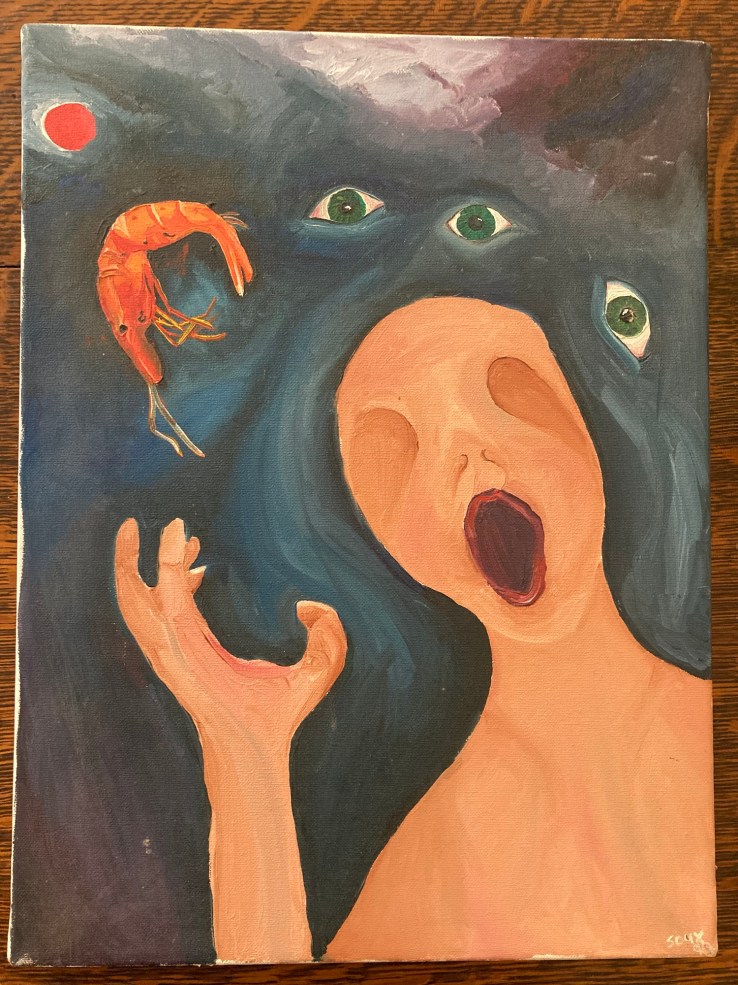

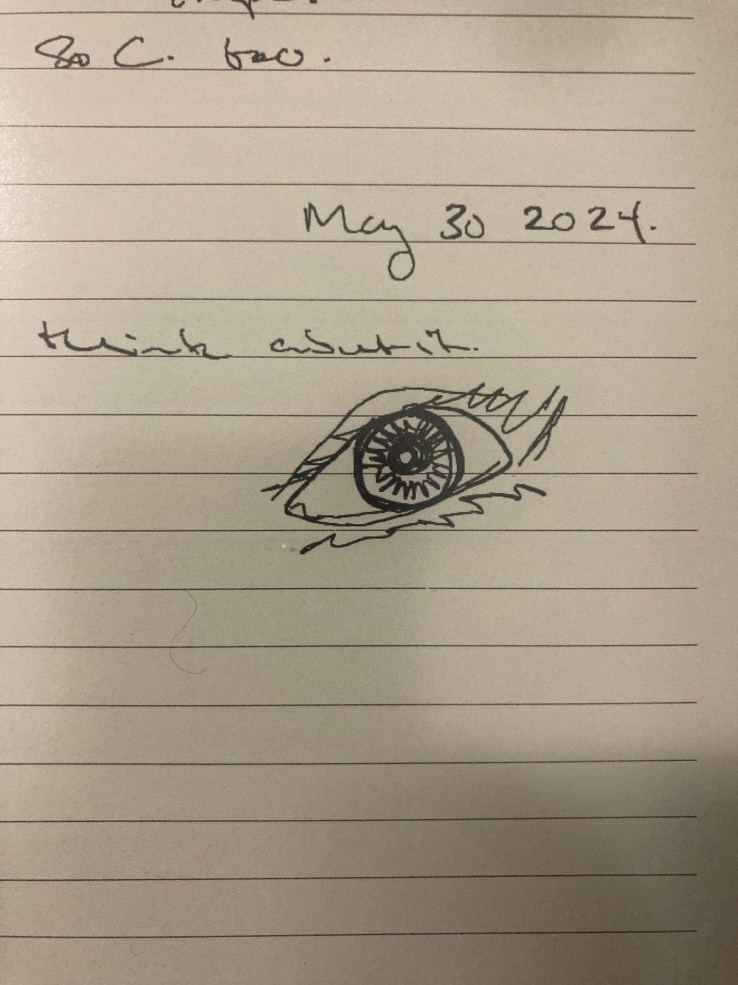
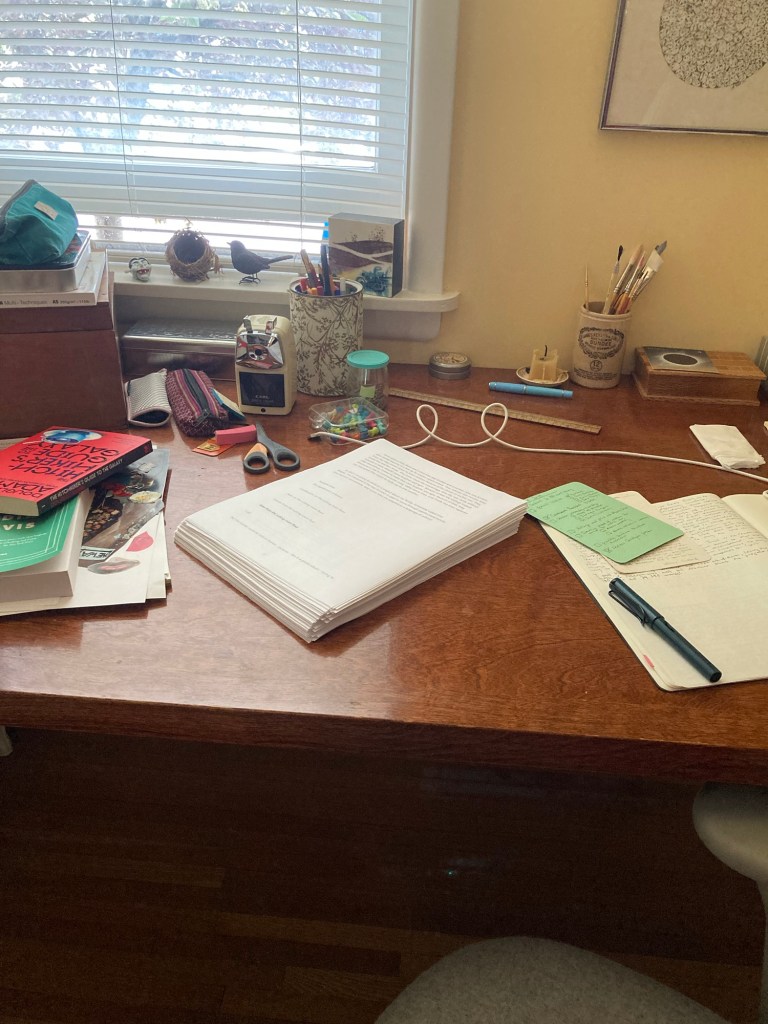


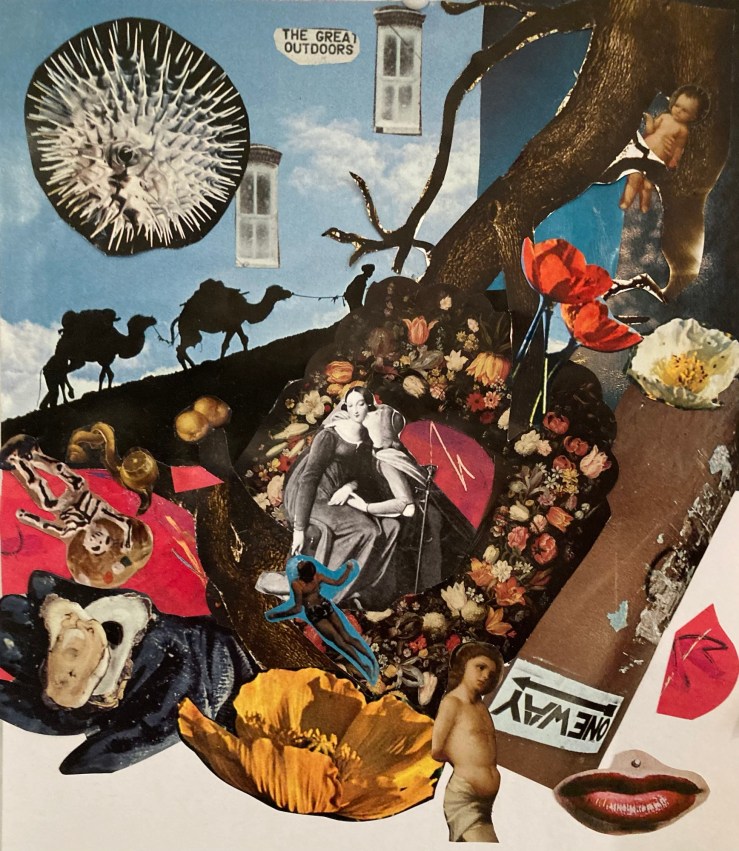


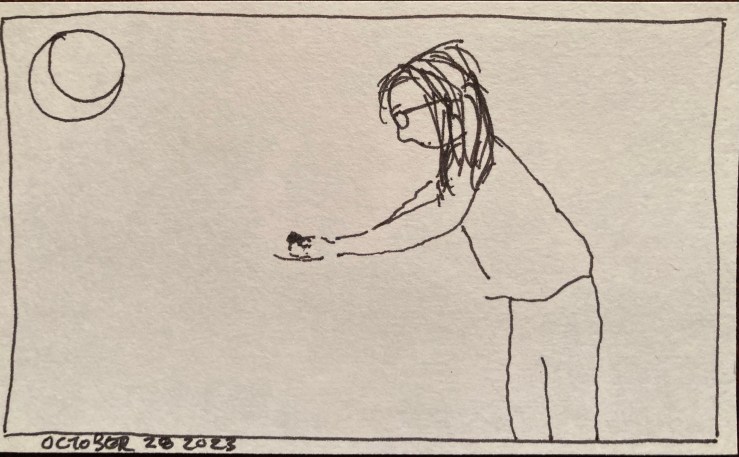


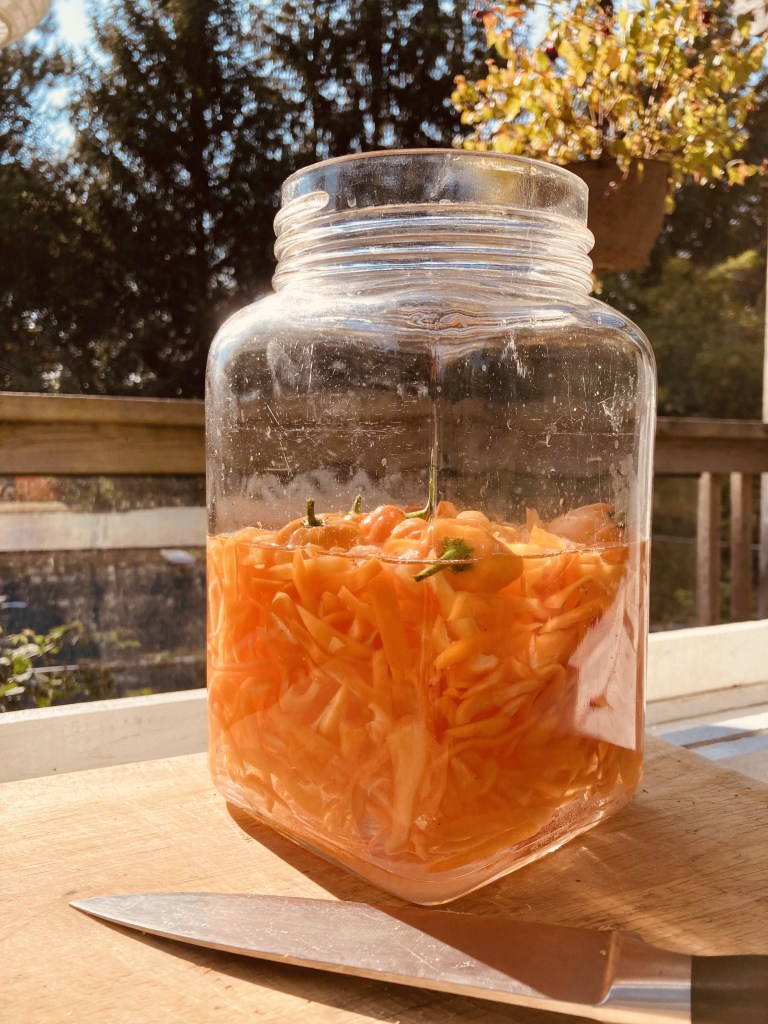

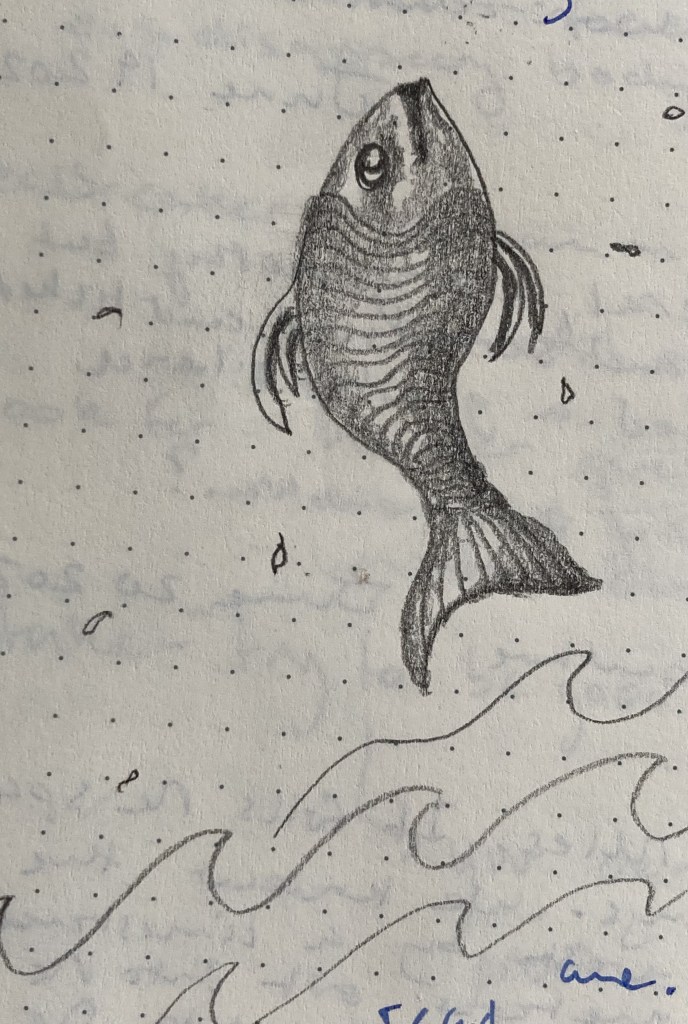

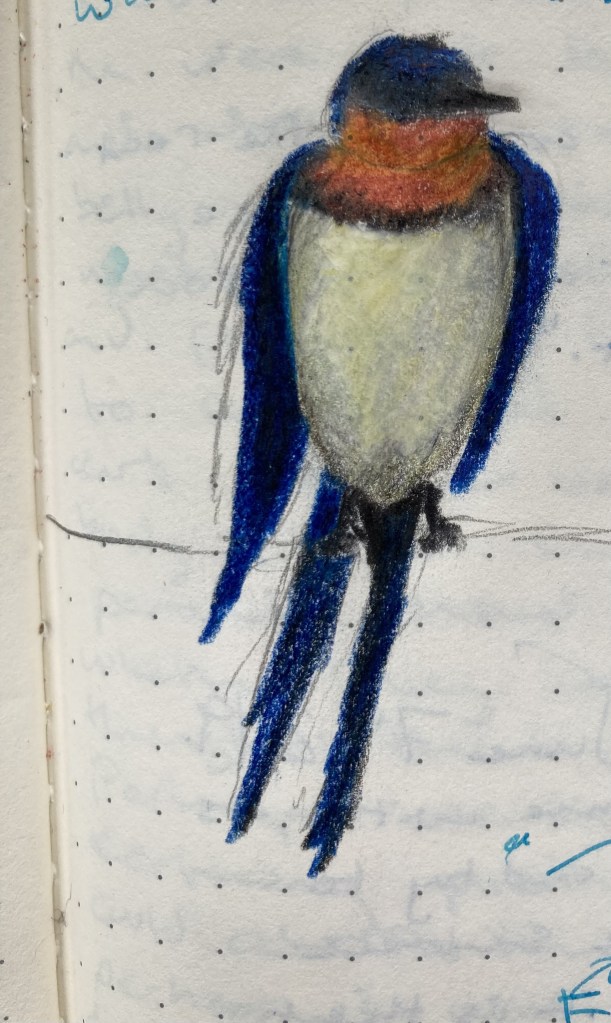
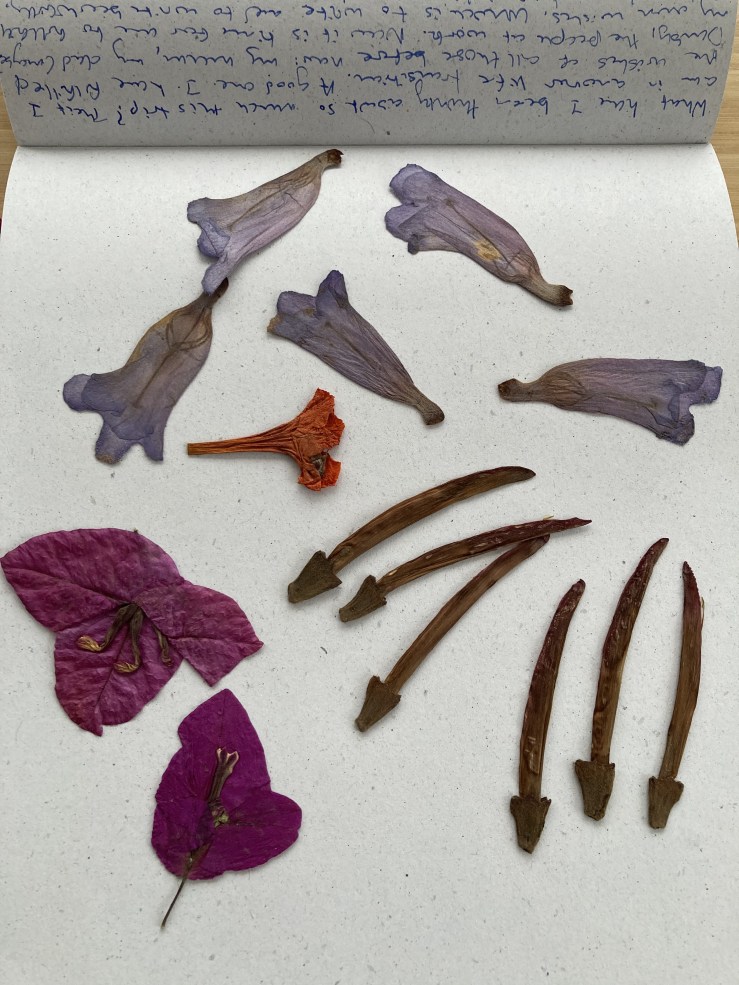
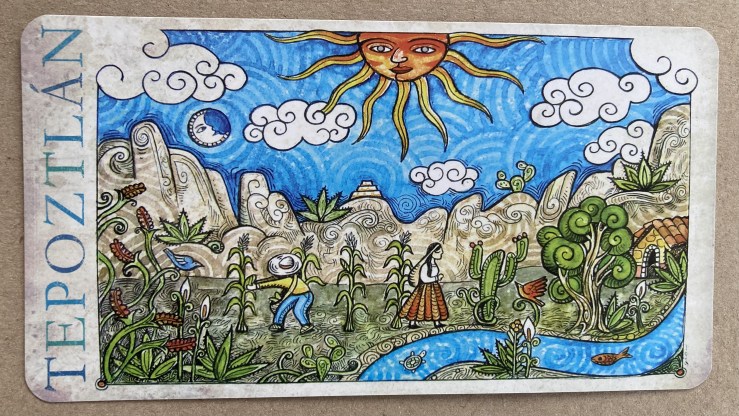
 Process Peace