Sounds Off

I very nearly botched the possibility of any relationship with my now husband the first time he asked me out, replying to his tentative request to take me to dinner with an audible exasperation—I’m embarrassed to say it, but an almost-admonishment— “What took you so long?!”

Much later he told me how, in the dead seconds of silence that followed my blurt, he very nearly turned heel and walked away (a fuck that, if there ever was one). My reaction stopped him cold.  I can only think he must have caught the note of elation in my voice, noticed the sparkle of mischief in my eyes, the play blossoming my grin.

Some context for my blunder: Months earlier he’d attempted to ask me out but our conversation was interrupted, and, despite an alluring notoriety with women, he was timid with me. His notoriety prevented me from asking him out. Not only that, but his notoriety also made me mistrust him…he was too attractive, too confident. I resorted to using a tactic I’ve come to refer to as ‘the mixed barb’, an unexpected, lightly teasing, droll divulgence, testing him against himself.  Communicating this way—a skill sharpened in a childhood home where moods shifted precipitously from rainbows to menace—has served me well, personally and professionally. Quick jabs shaded with humour fast reveal the contours of people’s personalities, offer a glimpse of their shadow selves, delineate boundaries, expose what they’re willing to put up with – and what I really mean when I say that is, testing whether they’ll put up with me.

Though this works well face-to-face where intonation and gesture, pitch, and facial expressions shoulder the palanquin carrying my royal intentions, I’ve discovered the strategy collapses in my writing. For example, my royal intentions from that last sentence was meant to be read with layered notes of self-deprecation, irony and superciliousness. Did I fail there?  Likely.

George Orwell suggested, “A thing is funny when—in some way that is not actually offensive or frightening—it upsets the established order. Every joke is a tiny revolution.”[1] For speaking and writing more information is needed to furnish a joke, but also, words in general. “An alteration in tone or pitch can be the difference between …fighting words and a statement of love, using the identical phrase, such as “You’re really something,” a completely meaningless statement without a tone or context to support it.”[2]

Peter Elbow explains vocal variety thoroughly when asking us to “Consider how many musical resources of intonation or prosody we can use when we talk. There is pitch (low to high); volume (soft to loud); speed (slow to fast); accent (yes or no); intensity (relaxed to tense); timbre (breathy, shrill, nasal, and many more); pausing (long and short). Note that these are not binary items, for in each case there is a full continuum between extremes (e.g., between low and height, slow and fast). There are glides and jumps. Also, there are patterned sequences. For example, tune is a pattern of pitches; rhythm is a pattern of slow and fast and accent. We change meanings by using subtle or not so subtle pauses or small intensifications or lengthenings of a syllable. Combinations of all of these make a rich palate we all use to paint meaning.”[3]

Robert Pinsky simplifies this beautifully: “It is almost as if we sing to each other all day.”[4]

But how to get the audible features of speech to the written page?  I suspect the answer to this question requires a lifetime of exploration. Perhaps it’s even THE ANSWER to writing well (musically, entertainingly, clearly, compassionately, provocatively, etc.). Robert Frost thought so, “The tone-of-voice element is the unbroken flow on which the others are carried along like sticks and leaves and flowers.”[5] So, today’s post is simply this quest’s beginning.   

More Frost: “What we do get in life and miss so often in literature is the sentence sounds that underlie the words. Words in themselves do not convey meaning, and to [prove] this… take the example of two people who are talking on the other side of a closed door, whose voices can be heard but whose words cannot be distinguished. Even though the words do not carry, the sound of them does, and the listener can catch the meaning of the conversation. This is because every meaning has a particular sound-posture; or, to put it in another way, the sense of every meaning has a particular sound which each individual is instinctively familiar with and without at all being conscious of the exact words that are being used is able to understand the thought, idea, or emotion that is being conveyed.”[5]

One way to get audible intonations to the page is to write in directions for how the reader ought interpret the words. 

  1. “There are warning flags along the wrack line: sharks – swim at your own risk. The threat is actually minimal, basking sharks being liable to give you little more than a bump on the knee, but the effect of the signs is still an odd one. There are no barriers, the water is open, creating the sense of a curiously lackadaisical approach to public safety. Danger, but do what you want, we’re not the police.”
  2. ‘Fair enough,’ she nods, and while her tone is light Alice feels she can detect the faintest note of mockery. ‘Mustn’t be bitter with my litter.’ ‘Fair enough’, this stock phrase, its cringing detachment. The sudden removal of camaraderie and Alice clawing after it.”
  3. “The boys cluster like geese. One of them, wet-lipped with a tongue piercing, asks Min what she’s doing selling ice cream on such a chilly day. What’s a nice girl like you doing in a truck like this.“

A whole story might revolve around the differences between what is said and what is meant. Here’s the first paragraph of a micro story written by SJ Sindum, Mother, published in The Cincinnati Review (again, colour coding mine):

“My mother tells me to be careful. I’m twelve years old, and we’ve just moved to a city outside of Boston. We live in an apartment complex that my white fiancé, twenty years later when we visit, will call “shit housing.” I walk to school every day, a two-mile stroll along a busy road, and my mother tells me to be careful. What she means is, keep your head down, keep walking, don’t talk to anyone, I’m sorry.”

Each paragraph of Sindum’s story ends with similarly directed subtext, stretching implied intonation with deeper emotional resonance. A good example of Charles Baxter’s comparison of subtext to “the ghosts moaning from beneath the floor.”

“Reading is telepathy (literally “feeling from afar”). A writer’s magical transference of thoughts, ideas, and emotions—the context, text, and subtext— to the reader across space and time.”[6]

And I want to slide that observation (riffed from a more beautifully written version by Terrance Hayes (see the footnote)), alongside another stunner: “Meanings are not in words, they are in people.”[7]

So, another (ongoing) lesson for me: lavish sprinkling of humour in my writing, without judicious written expansion to convey my specific thoughts, ideas or emotions, fails to cue and direct the reader to my intended meaning, whether a playful poke in the ribs, the softening of a chiding remark, or taking the piss out (as my mum used to say, meaning, to bring someone down from their [self-perceived] lofty position). Unless the reader is intimately familiar with my quirky (snarky, often cynical, occasionally lewd) sense of humour voiced in person, my written inflection is flipped on its back. Wrestler style.


[1] George Orwell: ‘Funny, but not Vulgar’ First published: Leader. — GB, London. — July 28, 1945.

[2] Baxter, Charles. The Art of Subtext: Beyond Plot. Graywolf Press, 2007.

[3] Elbow, Peter, “5. Intonation: A Virtue for Writing Found at the Root of Everyday Speech” (2010). Emeritus Faculty Author Gallery. 34. Retrieved from https://scholarworks.umass.edu/emeritus_sw/34

[4] Pinsky, Robert. The Sounds of Poetry: A Brief Guide. Farrar, Straus and Giroux, 1998.

[5] Robert Frost on ‘The Sound of Sense’ and on ‘Sentence Sounds’ https://udallasclassics.org/wp-content/uploads/maurer_files/Frost.pdf

[6] I love these beautiful lines by Terrance Hayes from the preface of his book, Watch Your Language, “Reading is a mix of telepathy and time travel. It’s a magical transference of information, knowledge, and mystery: the context, text, and subtext of a reader’s life.”  But I’ve stolen those sentences, fiddled the words and ideas and repurposed them to my own ends here. Not as elegant as Haye’s sentences, to be sure, but landing a slightly different meaning.

Hayes, Terrance. Watch Your Language: Visual and Literary Reflections on a Century of American Poetry. Penguin Books, an Imprint of Penguin Random House LLC, 2023. 

[7] Elbow, Peter, ‘Intonation: A Virtue for Writing at the Root of Everyday Speech’, Vernacular Eloquence: What Speech Can Bring to Writing. New York, 2012.

A Fish Out of Water: Syntax

When I went to elementary school in the 70s and 80s, it was vogue, fashioned after curriculum direction in the UK, lessons on grammar and syntax be removed from the curriculum with the belief (not proven with time) the lessons would simply assimilate through reading, exercises in comprehension (meaning making), and natural conversation. 

And a science focused career further limited my exposure to language construction (blunted it more like. Punted any raw, sensual subjectivity, the glorious immersion of being human in a living world, to a cold field of disconnection and distanced objectivity, but I digress). The result: I must always look up the definitions for parts of sentences (adverb (?! yes, it’s true), gerund, participle), the application of verb tenses and rhetorical terms (these never stay in my head, it’s a completely foreign language). I’m only recently (last couple years) conscious of the conceptual gymnastics syntax enables one to perform. 

But my lack of education is not what I want to write about here today. Instead, in the way of shimmery near-rhymes, I want to describe my process learning to use syntax as a way to mine my intuition. This practice (nascent) is cultivating my writing, slowly, slowly, so slowly, making it, if not more beautiful, certainly more textured, possibly (hopefully?) more complex.

Importantly, the practice disciplines thinking. Alters perspectives. Allows the mind to become supple. Open.

There’s a June Jordan quote tacked on the corkboard in front of my writing desk that captures this sentiment so much better, “The syntax of a sentence equals the structure of your consciousness.”

By intuition in this context, I mean what the subconscious mind is telling you, learning to trust it knows so much more before your conscious mind does. Responding to writing prompts, I put my pen to paper and let the words fly. In this way, something surprising, often beautiful—an image, a metaphor, a sensory cue—always rises to the surface (usually only at the very end of the exercise). Often, I’m left with a slightly baffling fragment and no clue as to how I might proceed or stick it together with another section of text (and attempts to force it really botch the whole thing up). This is when applying syntactical techniques may be used to open a window for creativity (and intuition) to breeze in.

Here’s what I mean (so floaty in the abstract mind space, my apologies, let’s get grounded). Syntax is simply the arrangement of words and phrases to create [a] well-formed sentence1. I’ve been practicing how to write sentences, gratefully working through exercises posted so generously by Nina Schuyler on her Substack Stunning Sentences.

Nina’s exercises break sentences into their component parts, grammatical and syntactical, and she sequences and names the parts so they may be followed as a template to slot in your own words and thoughts.  I work through Nina’s exercises each week (well, I try to keep up). I’m too shy to post them there (and I don’t always succeed in my attempts, often capturing only 3/4 of the layered pieces that make the whole), but the practice is so helpful to me.

Start with a base clause: grind the meaning of the sentence down to its essentialness, who is this about (subject), where is it taking place (setting) or what is happening (action). And then, by erecting layers of structure (syntax, grammar, rhetorical techniques), complexity of meaning, depth, a resonance imbued with life and rhythm is, architecturally, revealed.

The layers of structure move a reader through the writer’s thinking and meanings using, as Francis Christensen’s 1963 essay, A Generative Rhetoric of the Sentence explains, levels of abstraction or generality, movement (directing the reader’s eye to earlier or later parts in the sentence). Christensen’s theories enriched John Erskine’s. Here’s a quote of Erskine’s that I love, from a 1946 essay, The Craft of Writing, quoted in Building Great Sentences by Brooks Landon:

“What you wish to say is found not in the noun but in what you add to qualify the noun. The noun is only a grappling iron to hitch your mind to the reader’s…The noun, the verb, and the main clause serve merely as a base on which meaning will rise. The modifier is the essential part of any sentence.”  

Circling back to intuition and tying it in with Nina’s exercises, working through the sentence templates (grammatical, syntactical, rhetorical) I am forced to feel my way through the possibilities of how the original thought (could be the stripped down base clause) might expand. From my own free writing, I can select an image, a metaphor, a sensory cue, an action, extract it from my draft and let my intuition, carried through the templates, show me what my mind senses before I really even know.

In a recent post to The Red Hand Files, Nick Cave responded to a question about creativity, being stuck, and art making, which again, explains this better than I can:

“As a songwriter, I have come to understand that the more I try to make art that somehow reflects what I perceive myself to be, or the identity I wish to project upon the world, the more my art resists. Art doesn’t like being told what to do. It doesn’t like me getting in the way. When I attempt to impose my will upon it, the work becomes diminished and art takes its better ideas elsewhere…[Art] insists that we retract our ego, our sense of self, the cosmetics of identity and let it do its thing. We are in service to art, not the other way round.”

Practicing this way is very slow. I sit and think a lot more (imagining) before attempting to fill each sentence component on the page. I switch to pencil for these exercises – there’s a lot of rubbing out, a lot of cross outs too.  It feels a lot more like how I feel when I write poetry…the process of intentional writing I apply to poetry. It taxes the brain, but in a good way, a way that alerts you, wakes you to deeper meanings on offer.

But there is a richness of material being laid down. Suddenly every word (or component) opens so much more potential for something larger, more meaningful, more complex. It shows me what I’m thinking, before I even know myself. And this feels exciting. And pleasurable.  

How classes on reading comprehension were ever severed from syntax instruction I will never fathom. Subject for a different rant.

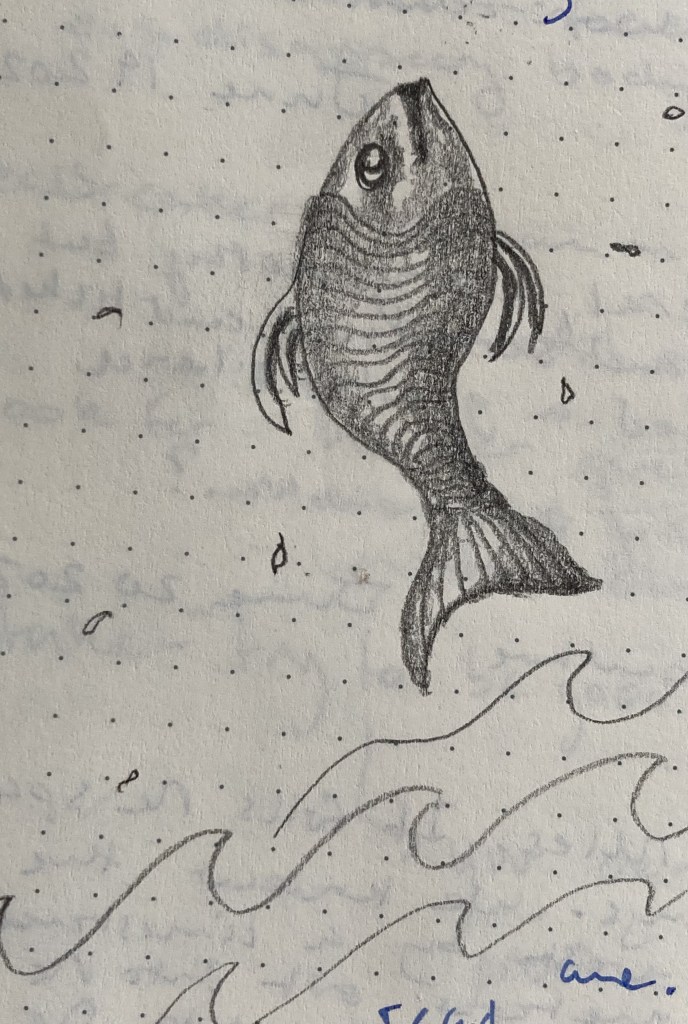
Slowly, slowly, slowly I am learning. No longer gasping for breath, a fish out of water, just a process of learning to swim. And the education, though painful at times, is a joy.

1 Discovered syntax etymology is from the late 16th century, via French or late Latin from Greek suntaxis, from sun- ‘together’ + tassein ‘arrange’. What a delightful riff on the warmth of a sun.  

Filling the Well

My passport was declined the maximum three times at the new scanning kiosks at Canada customs. I left the wave of Canadians passing with ease through the machines to find a customs officer in the flesh, “Where are you coming from?” Looking me up and down, a middle-aged woman travelling alone, he was confused. “Mexico City” I handed him my passport. “And you didn’t travel in Mexico?” “Yes, I did, but not by plane. By bus. And taxis.” “It’s unusual for a Canadian (he paused here but did not say ‘woman’) to travel like that, from Mexico City.”  Given the circumstances (trying to re-enter my country with as little friction as possible), I opted for the simplest, also the most honest, response, I said, “I’m glad to be back.” “I bet” he said.  

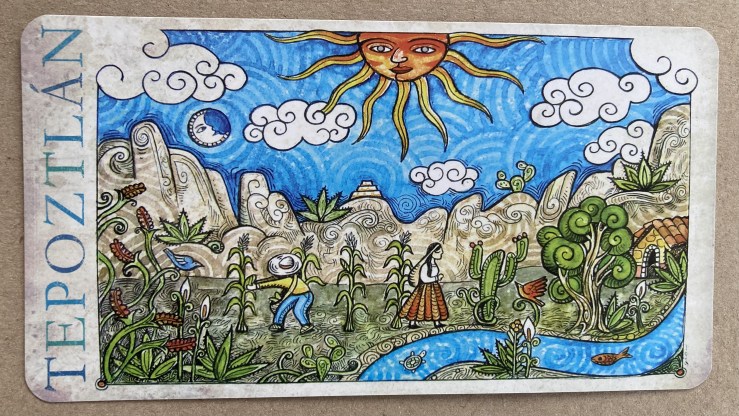
I hadn’t travelled alone; I met my sister in Mexico City. She had flown from the Yukon. We travelled the two weeks together, visiting her favourite places—Mexico City, Tepoztlan, Acapulco. She’d lived and worked a whole decade in Mexico and returned to Canada five years ago. Her Spanish returned fluid, fluent, the moment she landed.  She had asked me to visit so many times when she lived there, but my kids were small, I didn’t have the money, couldn’t secure the time away from work…so many excuses. Even when her partner died suddenly, in a dangerous town just north of the Belizean border where baggies of cocaine wash up on the beach and the people carry machetes and several sport missing limbs, I couldn’t go down there, to help her through that horror. My husband outright forbade it. With good reason, really. This trip was long overdue. And we didn’t have any epic blowouts or even anything more than mild disagreements. Maturity counts for some things.  Acquiescing my movements to the pace of a cigarette smoker helped: walk a little ways, smoke break, walk a little further, smoke break.

Dropping into another culture, another climate (several climates really, because with every move we made the temperature, the way the air moved and touched my skin, the scents on the wind, changed), surrounded by a language I didn’t understand, kickstarted my mind. Thoughts, sensory experiences, sparked and fizzed. Released from the demands of work, of family, of regular life, I settled into being, allowing my tongue to bend around the new language, a different grammar, novel tastes.

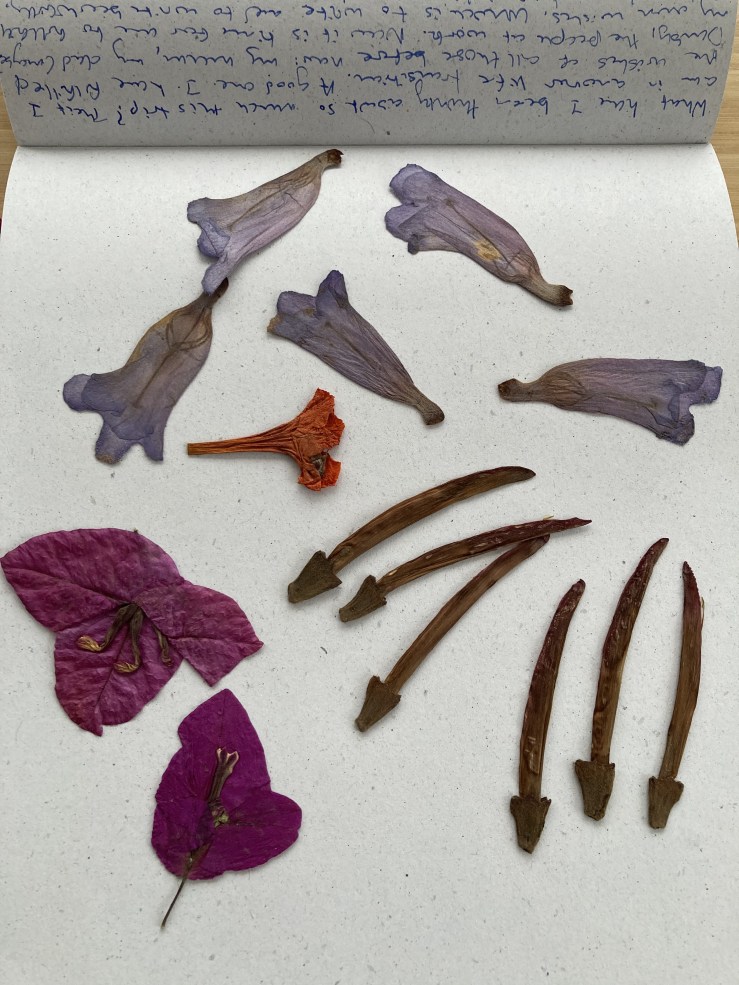
I didn’t write much. Jotted a few fragments, impressions. I collected flowers—Jacarandas from the purple blossoming trees, bougainvillea, frangipani, others I didn’t recognise—pressed them between the pages of my notebook. I carried my pencil crayons but never drew anything. I didn’t quite feel settled enough. We were on the move. There was too much to look at, take in, make meaning of. Everything was fantastically loud: competing car radios, shop front music blasts, horns, bells, the screeching of brakes, the barking of dogs, the crows of roosters, birdsong, people yelling, begging, singing, whistling, babies crying, children laughing, and Mexican style fireworks which really sound just like cannon blasts. They made me jump. Every. Time. One expat suggested the fireworks—long baton-like sticks held in front of a person as if carrying a flag, gun powder stuffed in the top end and lit—as Mexicans reclaiming the fear they’d felt when colonial conquerors landed with their real cannons in centuries passed.  Maybe.   

It felt good to get my brain buzzed. To slow down. To simply feel.

I read four books, two by Mexican author Elena Poniatowska (an émigré from France). Her writing is gorgeous and, I imagine, even better in their original Spanish (the short story collections I read were translated by George Henson and Elizabeth Coonrod Martínez). Here is a good and very recent overview of her life as a writer, from The Washington Post, written by Kevin Sieff.

Amidst the concrete, the gates, the walls frothing barbed wire, shards of glass, the flowered vines spilled forth, the flowers rioted, the birds swooped and sang. In a place where even the laundry hung to dry on the rooftops is caged, there is art on the walls and parades of people celebrating. I spent my time ingesting it all. Feeling full.  

Part One: non-writing (ish) tools for a writer’s toolbox

I read a lot of scientific papers for my day job. I also keep up (read: try to keep up, it’s impossible) with a mish mash of related current events (politics, economics, social issues, social media, etc.).  It’s a lot of information to synthesize; bits and pieces overlap and often contradict one another. I use drawing to help me see patterns and connections better. Drawing also helps me untangle processes or ideas.

When I say drawing, I mean I’m creating a picture, a figure, a graphic (or a combination of all three) to simplify a complex concept as a snapshot. When you’re given five minutes and four slides in a PowerPoint presentation to explain a sweeping history, a body of conflicting evidence, and a suite of recommendations for how to move forward, you get pretty good at honing essentials.

But I’ve oversimplified how this is done.

Getting to essentials is a process of creating a lot of different graphical (and text) forms so that each time I work through it, I’m understanding my material differently, more deeply…and, I think, most importantly, for me, I begin to understand the material enough to communicate it to another person (an audience, a reader).

 I have found similar methods helpful for creative writing projects, assisting me to see patterns and connections, but also, generating new ideas, connections, or images when I’m stuck.

I’m still in the beginning phase of creative writing, so my skill level remains stubbornly low—the raw materials and meanings I’ve generated in my own writings…well, I haven’t developed an ability to understand what it is I want to say, well enough, to be able to communicate it clearly to a reader. Practice. Practice.

But the following “drawing” methods help…drawing as in drawing out (of chaos, a fog, or confusion).

Here is the first in a series of posts outlining non-writer (ish) methods to see and arrange text differently (for deeper meaning making, understanding, to provoke variations in perspective, draw connections from disparate elements, and generate new thinking about your own writing or another’s).

  1. Colour-coding

One way to do this is by highlighting, using a variety of colours, different aspects of written text to chunk out various elements of craft: dialogue, emotions or mood, word repetitions, abstract words, metaphors, back story, etc.  I was introduced to this technique in a workshop with Rachel Thompson and I have also written about how Douglas Glover applies this technique to analyze craft styles. When you hold the text away from you, squinting your eyes to blur the words and looking only at the splotches of colour and how they hang together (or not), you can see how the various components relate to one another in a piece, whether any patterns are illuminated, or any other resonances. 

I’m still at the stage of learning to do this in other writers’ texts so I can teach myself how to do this better in my own work. It is a slow, but gratifying, endeavour.  

To take this idea into a less two-dimensional space and enable working with aspects of text more physically, consider using coloured index cards on which to jot down quick summaries of different structural elements of a larger work, for example: cultural references; reflections; speculative projections; historical references; theme elements, etc. These are examples of higher-level structural elements; of course, one could drill down to more detailed craft levels like those listed above, especially in a shorter work.  The idea here is to arrange the coloured cards on a wall (I use the floor) in the order they have been created or written (or the order you think they should go in), and then start to shift them around. Arrange and rearrange and ask yourself these questions:

  • How does meaning change when the patterns of coloured index cards change? 
  • What vibrations start to hum when certain elements are placed side by side – does a different meaning emerge from the space between?
  • When does a repeated pattern start to become boring? When does predictable become uninteresting? Or, at what point will a reader drop this and go find something more exciting to do?

…one must be able to find a plot, a route, a “solution”.

Italo Calvino on Invisible Cities, Columbia: A Journal of Literature and Art No. 8 (Spring/Summer 1983), pp. 37-42.

This method helps “see” a path, a solution. Or it can open a door into creating something else.

I started this latter technique for a writing project, a longer form CNF work I’m working on now, thinking it would help me to uncover a structure or a pattern I could use to write into (ha ha fast track my writing, no dice).  But I implemented it too soon (always jumping ahead of myself).  Instead, I’m challenging myself to generate more foundational material before I launch into this bird’s eye view and structural playfulness.

Next up in this series (next month): Mind Maps

Oh, there you are…

I pulled out a piece of creative nonfiction I submitted for publication a few months ago and scanned the first few paragraphs. I was horrified by what I had written.  More accurately, I was appalled at what I had left out and embarrassed by how I had written what I had written.

To be specific, because abstractions really are the issue here, what I had not written were (and here’s a list – insert eye roll- and, I think this is becoming repetitive – a theme of these posts?):

  • my inner thoughts
  • a lot (all?) of my emotions
  • how I felt about the experiences when they happened in the past
  • how I feel about the experiences, looking back on them now, from my current vantage point (a point of missed wisdom, learning and reflection? Evidently).  

Actually, it’s not really a list is it?  It’s deepening layers of specificity of the same thing. 

And the way I had written that CNF piece: with a lot of poetic flourishes (think feather boas, purple lipstick and high scissor kicks) as well as insertions of scientific facts harvested from an eclectic shelf of show off curiosities I seem to trot out when I feel cornered. The vocabulary I used was high and abstract; the syntactical maneuvers a bit somersault-roundoff-backflip-like, or, at least attempting to be….more of a trip and fall on my ass performance. [btw: click that David Lee Roth scissor kick compilation link, it’s hilarious.]

But here’s a positive discovery: I suddenly “see” this in my own writing (at least, tentatively…I remain a neophyte in this regard, but one must acknowledge even the smallest of progressions on this writing journey…there I go again, the inner scientist taking over with her mastered objective distance). 

The thing is, for quite a while now, I’ve thought my lack of depth and insight in my writing has been a technical issue. So, I’ve busied myself studying sentence structure, syntax, hybrid compositions, and I’ve practiced with a super focused commitment to the craft of writing and my work just kept getting worse. I’ve been frustrated …bordering on hopeless (is it that I can’t do this writing thing?) and I wondered whether to quit.

I did quit for a month or two or three over the summer. I was miserable. 

Sure, I could quit. 

But then what?   

So, not a technical issue. 

I have other writers (alive and dead) (and artists) (and, in the spirit of full transparency, my therapist) to thank for gently nudging and supporting me to progress my learning these recent weeks to discover (and be able to “see” in my own writing what I haven’t been able to before): I’ve been withholding my self from the page (my thoughts, my feelings, my reflections, my values, my beliefs, my opinions…). The painful truth is that I haven’t believed what I have to offer is of value….so I play dress up instead.  

It’s my own voice I must nurture. And accept.  

In a truly wonderful November workshop, facilitated by Steve Edwards, through Larksong Writer’s Place, I wrote the following words in response to a prompt about what knowledge I would want to impart to my younger writer self (or a writer just starting out): 

“…write with abandon. That is, not to censor yourself and to let the inner critic hold sway. And give yourself permission to question—interrogate—the reasons you think a certain way. And if the inner critic remains too loud—ask the inner critic what it needs to be quiet? What nurturing is it missing? What voice is it afraid of? Can you work together instead of pulling one another apart?”

Recently, Steve Edwards tweeted “Reminder to my fellow teachers who already know this but tend to forget: learning doesn’t always look like learning; growth doesn’t always look like growth. Your attention & care is a powerful force.”  Thank you, Steve. This is exactly how I felt in your class: held and seen and cared for.  I also sent this quote to my sister, also a teacher, who lives and works in a small Indigenous community north of the arctic circle. 

And to my many friends and writer friends and loved ones (for I am blessed with so many of you), thank you for continuing to read me, lifting me up when I am down, and waiting, patiently, for my own words…in my own emerging voice.  

Seeing my Writing Mistakes

Reading a book earlier this month, I failed to get past the third chapter. To me, the writing…well, sucked.  

The book, a national bestseller, nominated to a national “must read” list, was published by one of “the big three” publishers. A work of creative nonfiction, a memoir, I wanted to like the book, I wanted to learn from it. I was fascinated by the book’s subject. I wanted to follow the narrator’s journey, proclaimed and promised on the cover. I wanted to experience the narrator’s challenges surmounted, the accomplishments reached, but every time I tried to read the sentences, my mind lifted from the page. I couldn’t connect. 

Recognising I was going to give up on the book (always a sad moment of relinquishment, disappointment, even a sense of failure on my part, I know, dramatic, but true), instead of tossing it aside, I thought, why can’t I connect? What is it about the writing—specifically—that prevents me, the reader, from following the narrator on their journey?

Reading with these questions in mind I discovered a few issues:

  • The scenes were rendered swiftly – yes, with sensory details (check), but significant events were introduced but never elaborated, never opened or expanded.  As a reader, I craved knowing more. How could I relate without being given the opportunity to experience those events?
  • The story felt one-dimensional. The scenes, the events, the descriptions, the temporal and geographic aspects of the writing, were all there. The grammar was sound. The language was logical. Missing were the narrator’s thoughts and reflections.  I couldn’t feel or know the narrator on the page because they weren’t there.  It was as if the narrator stood off to the side and, like a zombie, or a robot, recounted the events without feelings or emotion.
  • The worst and best ah ha moment: I make these mistakes in my own writing.  

Reading bad (okay bad isn’t the right word – shallow? simple?) writing I recognized: 

  1. I summarise instead of expand action. This deprives a reader from moving through the experience with the writer. I realise too, that this type of writing is exactly the opposite of what I’m required to do in my day job. I’ve been trained to remove myself from reports, research papers, briefing notes, etc. to focus the scientific evidence and let “it” speak from a perspective of unquestioned authority. Note the disembodied sense of that approach to writing (objective, not subjective). 
  2. When I write “myself” onto the page, I’m like a paper cut-out of myself – my thoughts, reflections, ideas, interpretations are often omitted – there is a lot of action and description and even dialogue of others, but I am missing myself – why can’t I drag myself into my creative writing? Aside: – interestingly, I presented my thoughts and scathing reflections when I used to write an earlier blog complaining about marriage. So….I can do it, but, why don’t I?
  3. Answer: I’m trapped in the “seriousness” [mis] conception of art making. I’m working to develop confidence to express myself freely in “real” creative writing.

Serendipitously, I read a craft essay written by Karen Babine in Craft Literary Magazine this week that elegantly explains why some nonfiction writing fails to connect and how a writer might work to engage their reader better. I find books or essays or podcasts land in my lap exactly when I need them, or, as with Karen Babine’s essay, I can absorb them for the wisdom they convey. I recommend reading her whole essay (it is excellent!!), with fantastic links for further reading. Karen Babine also edits Assay: A Journal of Nonfiction Studies, another excellent learning resource.

Here is a sketch I made for myself, words copied from Karen Babine’s essay, to help me “see” and guide my own writing. 

Creating Observations

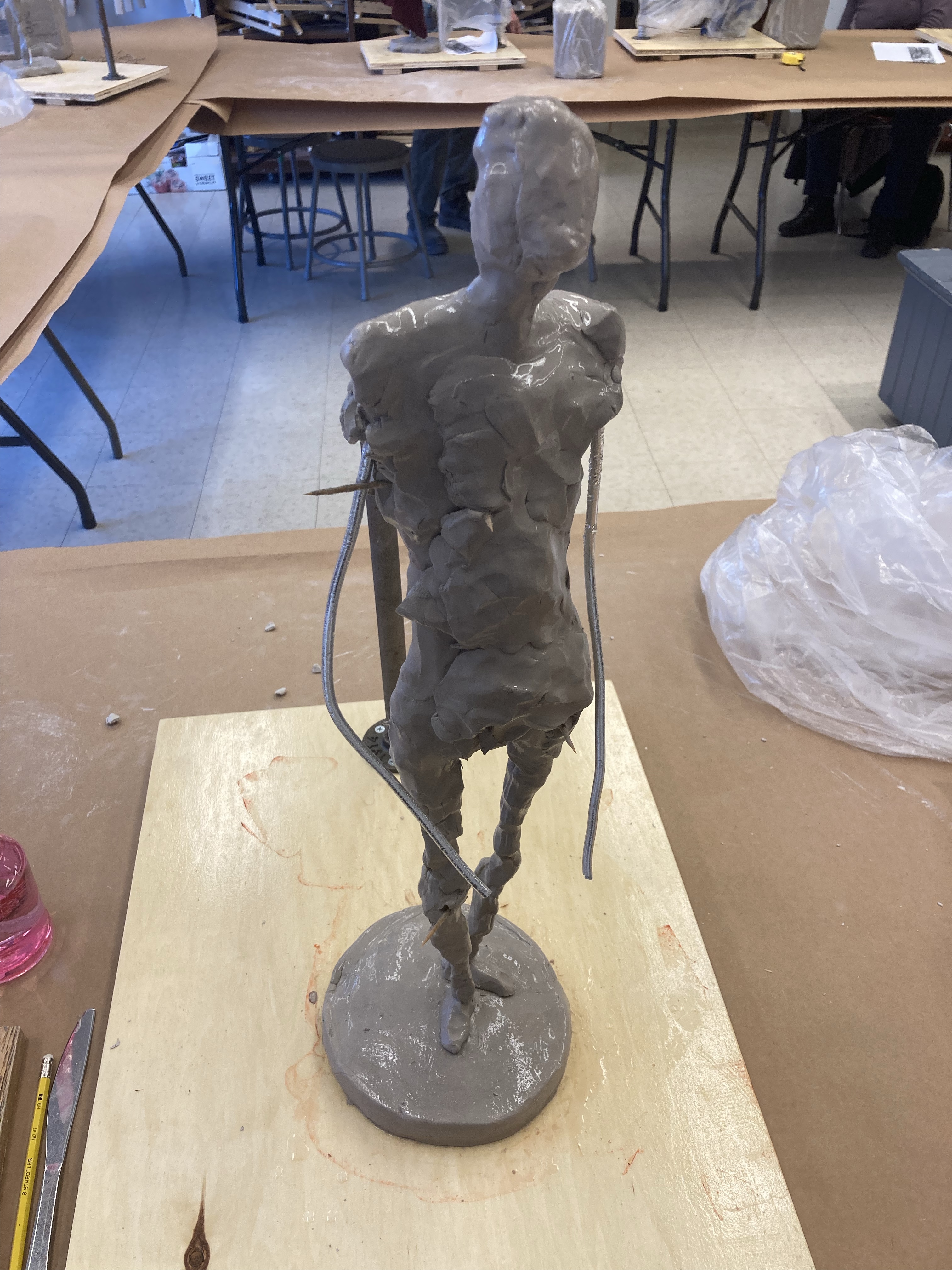
I’m in the middle of a 4-week human figure sculpture class. I love the way the cool clay yields to my fingers, the weight of it.  I love the way it feels wet, but dries to a chalky powder on my hands, leaving prints against my thighs when I accidentally wipe them there. I like to challenge my creativity using different mediums; I always discover deeper awareness for my writing practice this way. 

This is a class in observation.  We are creating “a study” of the human figure, in clay, using an armature (a stick like human figure made of bendy wires). There is a nude model instructed to maintain the “study posture”, but to rotate every 7-10 minutes.  The study pose is a contrapposto, or counterpose, where the body appears to be in mid-step with a slight twist of the torso that signals a certain vitality to a finished sculpture. The model’s timed rotations mean students never stick to rendering one view but must rotate armatures to match the model’s stance, building out only the three-dimensional form from their unique viewpoint in the room.  

At the end of this class (which, due to covid-19 has been a bit bumpy with some classes cancelled and rescheduled), we will destroy our works by pulling the clay from the armature to be stored in a plastic bagged blob. The forced breaks, shifting viewpoints, and the fact that the finished product is nothing more than the end of a “study” process, has made me feel a light creative freedom.  

I’m delighted working in the small class, listening to the murmurings of conversation, the shushing hiss of spray bottles and overplayed classical tunes.  To be in the moment of “trying” for no other joy but to try. It is a focused peace.    

In sculpting, I’m working to render gesture, observing the live, three-dimensional form, and attempting to replicate a scaled down version with my hands. I’m assessing volume and shape, curves and hollows, the points of bones and how the softness of body, muscles, skin, drapes over them. Expression is captured in the stance and gesture of how the body stands in place. 

In drawings, gesture is captured in the line. A move from rendering “the study” from three-dimensions to two. A line can capture energy, a subject’s vitality, by how it is it rendered on paper – thin and fast, thick and slow, etc. 

But the experience of observation captured on the page through writing transfers the three-dimensional world (even four or five dimensional if we start to add things like emotion and interior thoughts) into flat words on a blank page. Words are abstract symbols of representation.  Each word sparks connotations and connections unique to our own experiences and interpretations.  I guess this is why reading another’s words can feel so magically transportive. Just as my viewpoint of the art class model rotates on a platform in the middle of the sculpture class, my experiential viewpoint alters the interpretation of words. I witness – eyewitness – the object or the sensory experience – I interpret it (my own way) and render it into words to be able to convey my interpretative experience through writing.  And if that sensory experience, imagery, or idea is understood and resonates with the reader, there is a frisson of recognition and pleasure in sharing these experiences and thoughts across time and space. 

But getting the words to come through…not so easy.

Some observations from the last week:

I saw a porcupine. I thought it was a beaver at first because the animal was so round with a paddle like tail but as I passed (quickly – I was road cycling) – I realised the tail was not so big but rather narrow and flat– the animal was approaching the base of a large old oak with, I believed, an intention to climb it.  It was mid-day. The sun was high and bright but the wind, blowing east, blew strong against my direction of travel, stole the warm huffing of my exhalations fast past my ears. But how to describe the porcupine’s unrushed perambulation?  Its roly-poly demeanor? The animal wobbled. 

And a swan, bending its neck, s-like, to its back, its wings, still folded, raised and what?  Trembling? Quivering?  Shivering…yes, shivered and fluffed. 

A friend’s high-pitched reaction to one of my questions. A squeak. 

The dairy farm’s manure and powdered milk smell that makes me want to gag. 

The scent of pine sap needling the shade when I passed beneath their feathery boughs. 

The friendly waves from motorcyclists as they passed me cycling.  Is this a thing?  Are we in solidarity somehow, riding through the fresh air with bodies exposed to the spring? Not just one, but three different motorcyclists at different points along my route. One even when they must have seen me gagging for breath on a long uphill. Maybe that is why they waved.  For encouragement?  I waved back regardless.

This is the process of art making: observing the world with loving attention, transferring that loving view as a gift for the viewer/reader to share in that joy and delight.   

A poke in the wound

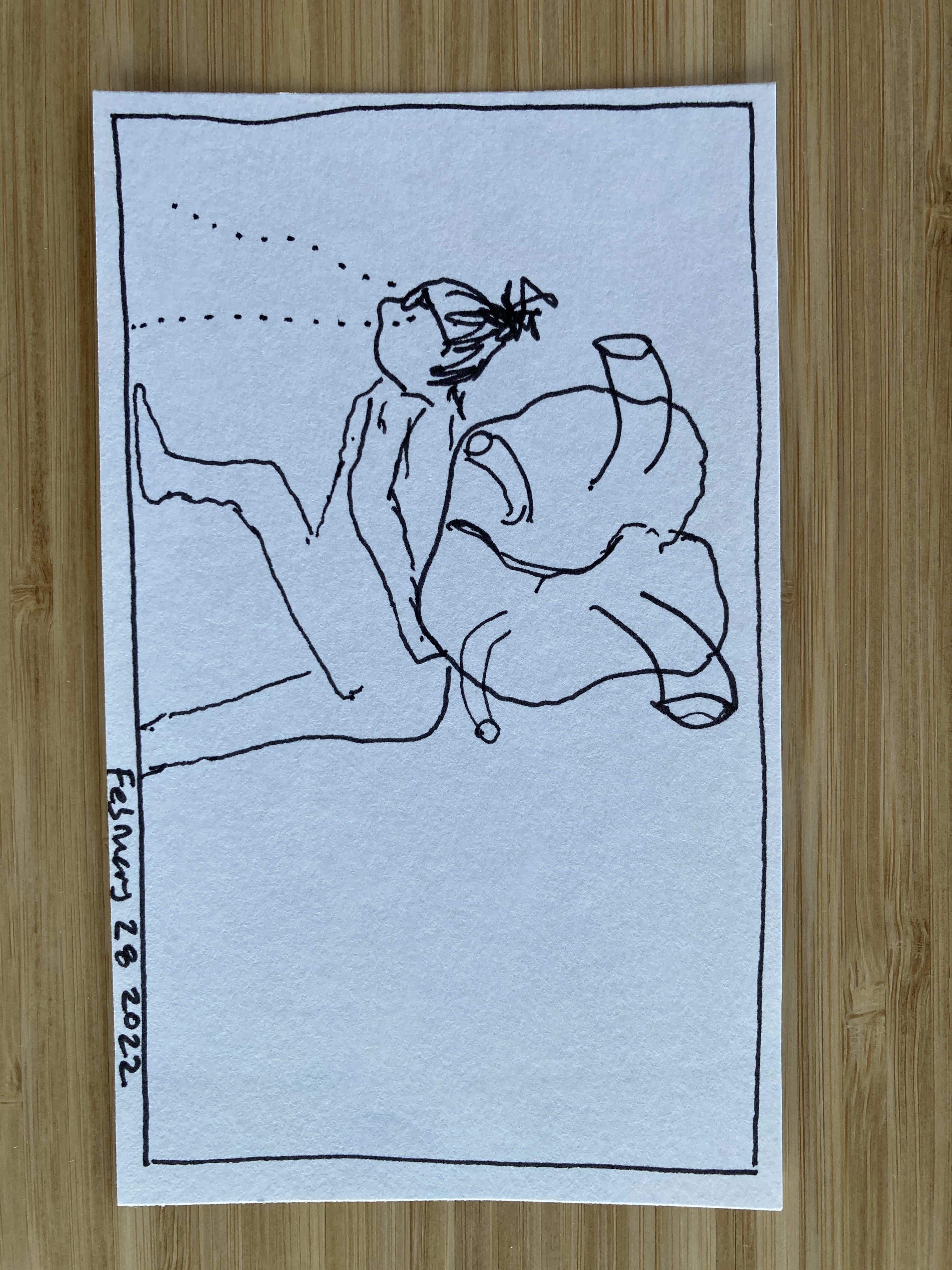
WordPress will not allow this image to be the right way up…perhaps it’s better posted this way …moving against gravity.

Making art when there is war. It feels wrong. Or useless. Selfish. I spiral into guilt and shame about my privilege, my luck. In the boundaries of my skin, my brain, the sorrow seeps. 

There are mountains of sorrow at the heart of all conflicts. The fired heat of hurts hoisted through generations, coded, we now know, in our DNA, and patterned far too comfortably in memory. 

Russia and the Ukraine, China and Taiwan, the continued killing in the Middle East, too many countries in Africa, we speak of warring geographies as if they are sentient beings themselves rather than the individual people, plants, animals, collected and hurting beneath? Behind? Within? the skins of borders. 

Bodies of power in the shape of countries, in the shape of cities, in lake shaped wounds, in fist shaped educations, in the curved shape of a parent’s spine twisting from a child’s longing for love. 

This is a habit of mine: to speak in abstractions, to hide behind the illusions of words, to climb my mountain of sorrow instead of burying deep within it to try and understand. 

What is it I’m trying to say? 

That I feel so very sad.  That I wish humans could be better. That I wish I would do better. That I could truly believe that making art, which is to say making love, creating love, holding love, sharing love, could save us.    

Even if it is so hard to believe when fire rains down from the skies, I must.

Being Seen

I have not written this last week or so. 

Feeling not up to it following intense preparation and performance for in interview related to my day job. 

The self-loathing that accompanies not writing creeps in fast.  And I know there will be difficulty getting back into writing practice the longer I put it off.  It’s exactly the same as working to maintain some level of physical activity…as soon as you ease off, skip a few workouts or runs, your muscles start to soften.  Getting back to the practiced level is going to hurt, there’s no way round it.  

Reading helps.  So, I am reading.  

I’ve been wrestling with writing. I’ve been trying to write a piece about marriage.  How I feel about it.  What erupts on the page is hard for me to face: grief.  Alongside love, yes. These two emotions cradle beside one another and I don’t know how to rock them. In the writing, I start to shoehorn the paragraphs (long before they are ready) into a from that shows off my humour or intelligence.  I am hiding.  A tactic that works to control and manipulate and keep my softer self from being seen. Dazzling with language and laughter, I am skimming the surface again. 

I read. 

In an essay by Chloe Caldwell, The Red Zone: A Love Story, I copy down this line about her relationship with her partner in my notebook:

“I have never felt more seen-through, more transparent…”

On Facebook a friend comments in a thread,

“Dickinson is right, being seen is the heaven of heavens…”

In an interview between Leslie Jamison and Sarah Sentilles in Orion Magazine, How to Write Love, I read,

“Stranger Care [book written by Sentilles]is a tale not just of love but of grief, as if we could ever tell one of those stories without the other. That’s where I wanted to start, with the question of love and how many different strands any love holds. How do you write love? Whenever I try, it feels like staring straight at the sun.”

And I read a most beautiful essay about poppies written by Katrina Vandenberg, also in Orion [print Autumn 2021 edition] , a paragraph that steals my breath away,

“Perhaps the poppy itself is a door.  It swings open-closed, life-death, pleasure-pain, freedom-slavery, remember-forget, suffer-release, and when not swinging, it lives on its threshold, ready.  It knows how to be more than one thing at a time, even when those things contradict one another. It knows everything about living and dying that we struggle to understand.”

I love this paragraph.  I love how the second sentence is gorgeous but doesn’t quite make sense.  And yet, makes so much sense.  Reading it, on the heels of the other fragmented gifts that have floated my way, I realise I am withholding my self in my writing. I am not writing enough of my own thoughts and worries and joys on the page…I am simply trotting out the scenes and stitching them together with wit.  I am not sharing my self with my reader.  In short, I am not loving.  Too afraid of ridicule…too afraid of being seen and not being loved.  Isn’t that it?  

The reading helps me see that I must open myself up to be seen, as Leonard Cohen’s Anthem: 

“Forget your perfect offering
There is a crack, a crack in everything
That’s how the light gets in”

And as I practice writing and work to gift my self on the page: trying, failing, trying, failing, I am comforted knowing that reading will always hold me, rock me with the lullabied lessons I long for.  

With Gratitude

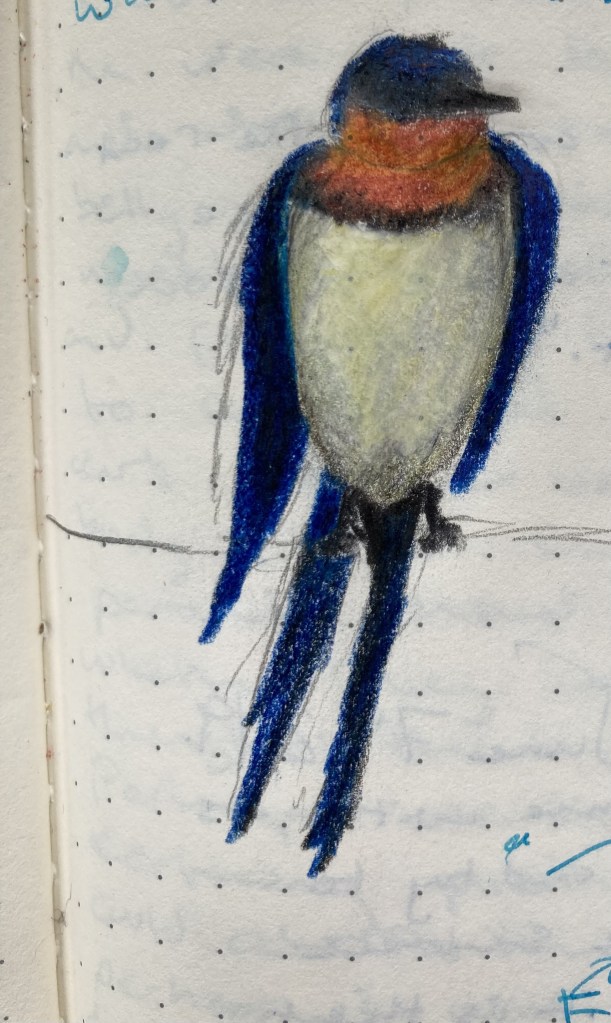
Hmmm…so many things wrong with this rendering. But I guess, also, so many things right.

On this day of (Canadian) thanksgiving, I want to acknowledge and extend my gratitude to all of you, the readers of my creative work.  Especially here, on this blog, this teensy tiny corner of the digital universe, a place where I slowly work out my thoughts about creative process. You are patient and kind and giving of your time and attention.  You make my writing a conversation. You are the connection I crave. Thank you. 

I have been writing down glimmer dumps, a practice of attention and sensory writing advocated by writer, Pam Houston, and described in detail by Maxima Kahn here.    

I leave two with you here, from the last week, small offerings of gratitude.  

One: 

Driving the rural roads round my place, the trees remain in full leaf but glowing yellow and red in the warm light of mid-afternoon.  With all the rain we’ve had, the lawns and livestock fields shine bright green. Cows in a clumped white herd (Belgian Blues? Charolais? Murray Greys? I wish I knew) on an emerald hillside, but one cow, off in the field on its own, jumped up, rocking in the air, its tail curved up in a smile. It leapt like a young puppy dancing, and I delighted I’d caught a cow mid-joy. 

Two:

As I write, the rain tinkles in the eavestroughs and a whole lot (a flock?) of starlings are singing from their perch atop the pine trees in the backyard…sometimes the song drops suddenly into silence and the whole lot of them lift off, rising through the air, each one morphing into a whole, a murmuration, and I am reminded again how magical the moments in this world can be. 

Celebrating you and your reading!  Cin-cin!