Looking, Seeing

I know that if I’m to make any sort of progress with any of my creativity projects, I have to push myself to get uncomfortable.  Last week, I went to a life drawing class.  It was terrifying.  The last time I tried to draw a figure from a live model was in high school, thirty years ago.  
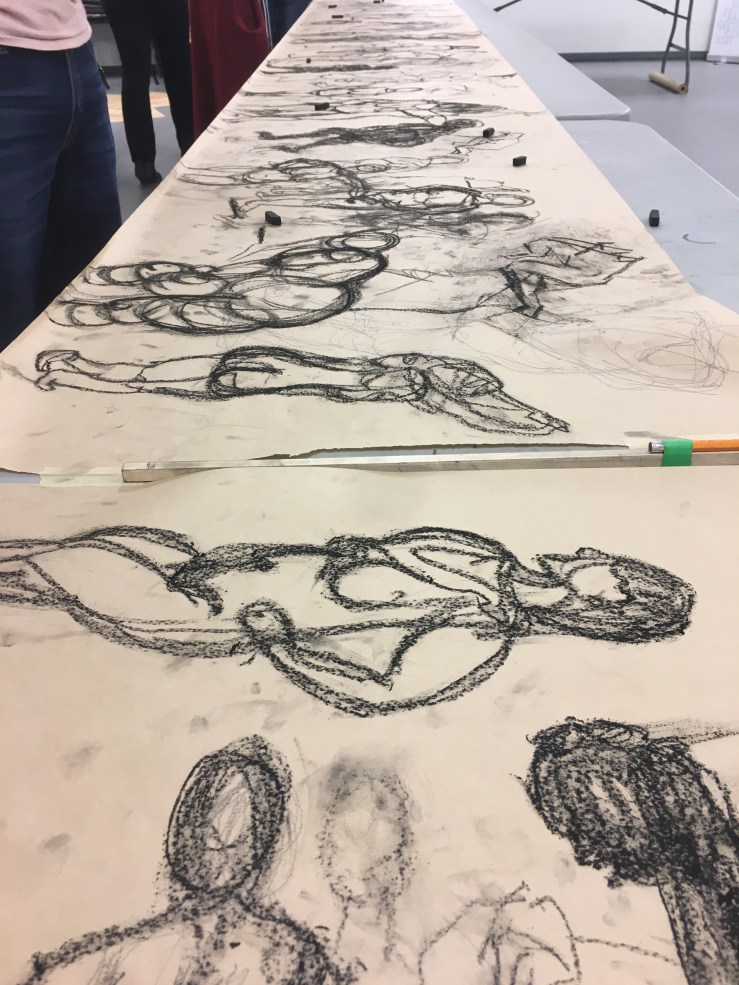
There was a piece in Narrative Magazine recently, written by Kirsten Valdez Quade, reflecting about the best way to approach drawing from still life or model: “Draw what you see, not what you think you see.”  

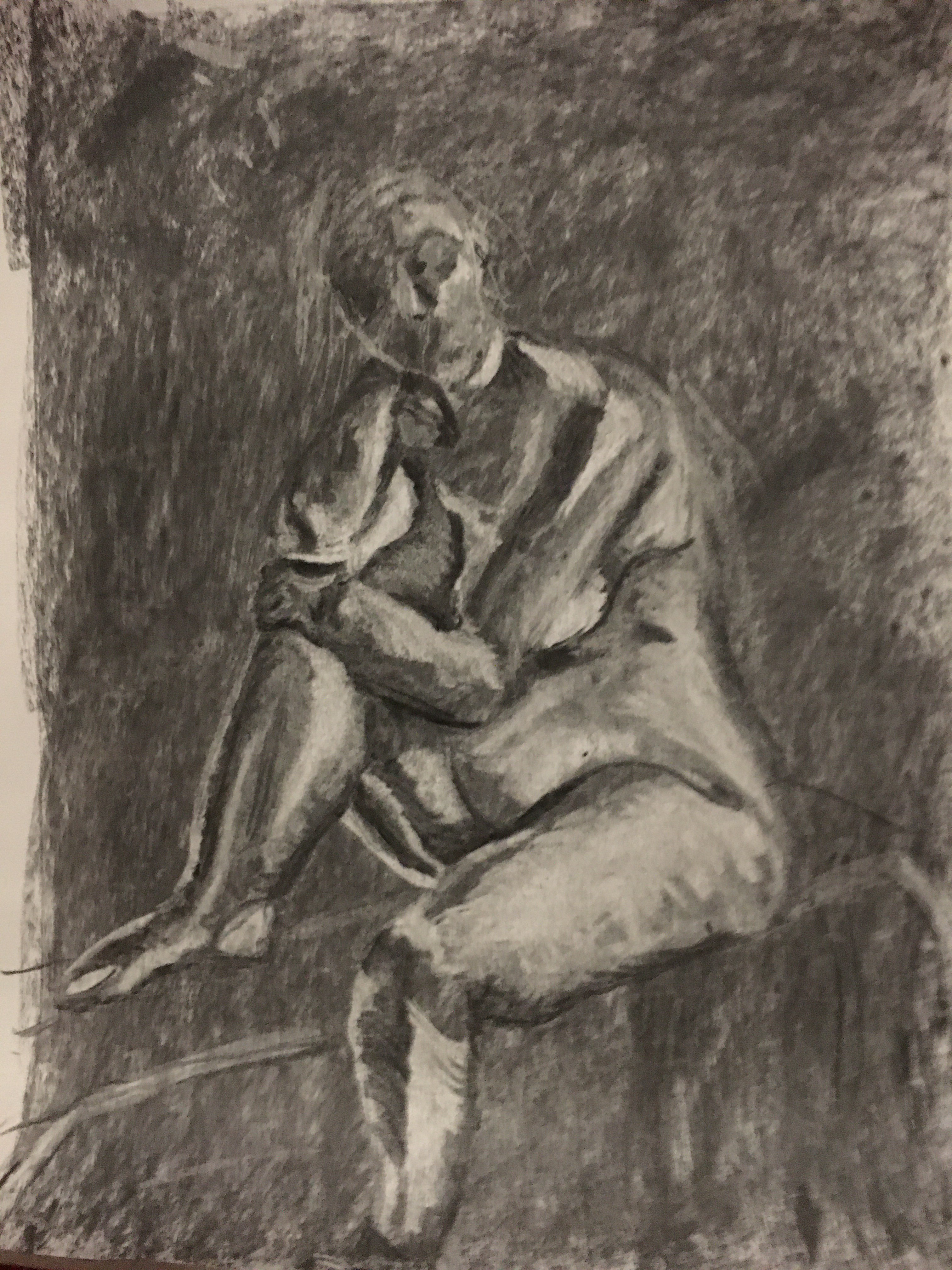
This is much harder than I had thought it would be.  Throughout the three-hour class I kept reminding myself to look at the nude model not as “a person”, but a series of connected shapes, a composite of lights and shadows, lines and angles stringing together, a build-up of spaces between limbs and body. But I kept having to remind myself to lift my chin, consciously, intentionally, to look at the shapes and spaces of the figure in front of me and try to transcribe them to paper.  Often, I found I was relying on my own internal representation of what I was seeing, on memory that was miserably inaccurate.  And also, idealised.  My mind kept thinking about the person, wondering about personality, character, wondering at the courage of a person who will remove all clothing and strike a pose while fifteen pairs of eyes rove along their curves.  Slowly, slowly, by really “looking”, I began to see muscles and the angles bones make at the knees, the elbows. I began to see the beautiful wing-shapes at the base of the neck, the stunning ridged curve of the spine. 

The instructor used several fantastic exercises to get the class to “draw what we see, not what we think we see”:  we drew with a stick (a participant was sent outside to retrieve them!) and black ink; we drew with our non-dominant hands; we drew with both hands at once; we drew the figure in under a minute; we built our own drawings on top of what other participants had already sketched out; we used a variety of different drawing materials; we dusted our faces and hands with charcoal.  It was fun.  

And I thought about how these lessons transfer to writing. Too often I’m thinking about the whole of “a story” or “a poem”.  So, just like refraining from looking at “the figure”, I can practice slowing down and honing the pieces of a story or poem—the words, the sentences, the actions in a scene, the emotions in a character, how the story moves, the arc and shape of that movement from beginning to end—these things will come together to make a whole. And there are plenty of exercises to practice each of these.  Part of the practice is just letting go.  Letting the pieces of a story or poem speak for themselves instead of trying to control them.  

“To see—and to see properly, without interference of preconceived ideas…is the writer’s central responsibility.”

Kirsten Valdez Quade

Kirsten Valdez Quade explains the value of this drawing lesson to writing: “To see—and to see properly, without interference of preconceived ideas…is the writer’s central responsibility.” And perfection is not to be strived for, because there is so much beauty in the roughly sketched (both drawing and writing). How much gesture can be summed up in a minimal line? How much “personality” captured in the angle of the head? How much weight of the body is conveyed through a juxtaposition of shadows and highlights?

Writing is another form of still life, one that moves from internal to external, through time, through imagination, through space…as writers we have to question ourselves all the time: how am I seeing? how am I looking? Let the mind’s eye loose…and see, really look, at what materializes out of the dark spaces of not knowing.
Attending to Attention

I’m not very good at noticing things. Paying attention.  Observing [1].  Too much in my own head. Many writing books suggest journaling to capture observations [2]. I’ve practiced using a technique proposed by Lynda Barry: the 6-minute diary. It’s fast and illuminating.

Take a piece of paper (or page of a notebook), draw a vertical line to divide it in half, then, a second, horizontal line across the page, about a third or a quarter of the way from the bottom (see the picture below).  In the top left quadrant, list 7 things that “happened” today. In the top right quadrant, list 7 things you “saw”.  In the lower left quadrant, list one thing you “overheard”, and in the lower right quadrant, list one “question” you came up with.  So, 2 minutes for each list in the “happened” and “saw” quadrants, and a minute each for the bottom “hear” and “question” quadrants.  Boom.  Done. 

Practicing this I confirmed my attention is heavily loaded towards what I “see”.  In fact, when it comes to filling in just one teensy tiny sentence I overheard, my mind draws a complete blank.  This, despite the highly entertaining daily trip(s) to the water cooler in a buzzing workplace with upwards of two hundred employees!  For the question section? Well…I have so many. They require more than a minute of concentration to remember them.   

I kind of fell off the wagon practicing this diary technique these last few weeks… and it shows: drawing this morning (see picture above), I captured a meeting I had with a director, a person I have worked with for…shit, 9 years, and I couldn’t remember what type of hair he has?! Is he bald? Does a band of hair ring his ears?  In the picture I’ve left him bald.  The drawing also reveals a power dynamic I felt powerfully in the meeting but couldn’t articulate…but the drawing answers why: I’m sitting and he is standing and gesticulating at me with an open palm (pushing me away).  Interesting. 

But I have to practice…just like playing a musical instrument or running, the skills deteriorate quickly if one doesn’t exercise them. It’s a dual exercise: first, noticing things, second, translating what I see into words on a page. 

There’s a beautiful excerpt from Lydia Davis’s newest book, Essays One, on Literary Hub this week about practicing observing.  Following Davis’s recording of a variety of types of observations, I’m thinking of adapting Barry’s 6-minute method to this:

If I get my shit together and actually practice this, I’ll write about it…no promises though, keep’n it light. 

[1] annoying analyst notes: Actually, it’s that you notice too much.  You rely a lot on interpreting emotions through body language and tone, taking a barometer reading of the dynamics and interactions between people.  It’s a survival technique honed from quite a young age. 

[ancillary] inner critic notes: It’s very simple stupid, you need to practice remembering what you observe.  Slow down.  And write it down. 

[2] I keep a notebook.  Actually, I keep several notebooks…worthy of a post in itself, so will write about this next week.  But when I have “journaled”, the writing seems only to capture my whining…abstract emotional thoughts and ideas and reflections…archeologists of the future unearthing my notebooks will be relieved to know they’ve found a reliable source of fuel for a fire. It would burn for days…

[ancillary] annoying analyst notes: That’s a bit harsh; you sell yourself short.  Archeologists of the future may be very interested in your complaints about marriage and raising kids and the hamster wheel of a 9 to 5 job.  Heck, even your angst and self-loathing may be a crucial clue for…something…I’m sure…

[ancillary] inner critic notes: They’ll fucking burn it.