
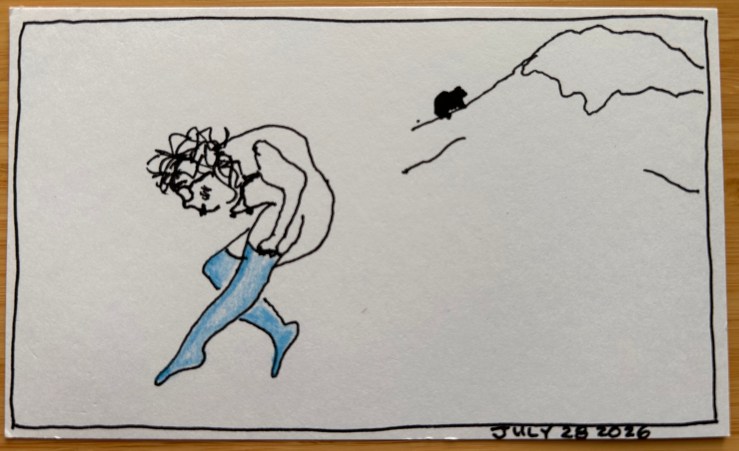
Walking the other day, I noticed the children’s song, The Bear Went Over the Mountain, was looping my mind. I laughed when my attention turned to listen and name it; it was communicating a valuable message. Before that I’d simply endured its irritating, repetitive, background noise while thinking (trying to think) More Meaningful Thoughts about this long form writing project (MMTs…always in pursuit of these…but my brain tosses in a distracting salad of grilled cheese sandwiches, an itchy elbow, whether it might rain, taxes, etc.).
The bear went over the mountain (repeat, repeat, repeat), to see what she could see (repeat, repeat, repeat), and all that she could see (repeat, repeat, repeat), was the other side of the mountain (repeat, repeat, repeat).
Yes. Exactly. Summitting (aka, completing the long form project) might only provide a different view of the exact same thing…though, of course, I’m moving in my learning journey, physically and emotionally. (Remember this, Suzanne.)
I’ve been spending (wasting) too much energy worrying about “the end product” of this long form writing project. I find it’s a continuous practice to keep myself calm and to just settle into the process of making without wondering if the creative decisions I’ve made (and continue to make) are…quel est le mot?… there are lots of mots: crazy, loco, cracked, barking, batty, barmy…
“You’re writing a novel then?” someone asked me recently after I’d bored them with an inordinately long diatribe about what I’m creating, this chaos of stories collected into a circling container that is “book length”.
“Yeeaahheesssss….I think so?” For some reason I have a lot of trouble naming and speaking about my long project writings as a novel. I don’t know why. It’s a description I can’t quite embody. But ho ho ho-boy-oh-boy I can embody crazy! So…here goes, a long project progress update baring the details of my current creative insanity.
(Note: if you’re looking to watch the video of the public reading I participated in on Sunday, feel free to skip the Micro/Meso/Macro level mountain of details and scroll to the bottom of this post.)
Micro Level (sentence)
This project uses a lot of different registers: a loquacious (and uh, sometimes pretentious) intellectual formality, lyrical elegance (I hope) combined with slapstick and potty humour; elements of research (so far (my gawd): social factors affecting methylation patterns impacting gene expression; combat fatigue following WWII; history of the pee-on-a-stick pregnancy test; labour and birth protocols; policy and legislation related to adoption; history of Formula One motorsport engine design and racing…don’t worry, these aren’t integrated with a heavy hand…I hope…more light brushstrokes of interest, contextual textures…I hope); literary references (yes, these are sneaking their way in, I can’t help it); and pop-culture references, mostly movie lines.
“You’re so conceited Claire.[1]”
In the process of writing, I’ve discovered that a few characters, namely the protagonist Claire’s sibling characters (Nyree, Mohan and The Wailing Baby) often intrude with lines of dialogue inside Claire’s mind. I resisted this for a few weeks of writing and then, when I surrendered to instinct (swift kick in the bum of my intuition), allowing those voices to speak in the way they were revealing themselves on the page, I struggled with how to signal the interjections in a way that is clear for a reader to follow. I mean, these are characters who are part of actual story scenes but then they also come in during scenes where they are not part of the action as “the voices in Claire’s head”. That’s confusing.
In a blog I used to write about cooking and marriage, the voice of my then-husband (the Gearhead) was so strong in my own mind I depicted his—though, I imagined them— interjections (dialogue and observations) using square brackets to signal them, here’s an example:
“Wife as a noun is simply the tacky plastic figurine that tops the wedding cake; it’s not even the icing. [Gearhead edits: wow, someone got up on the wall side of the bed today. I’m feeling so loved]. [Wife edits: you should, love is a verb. I work really hard at it. I’m a love athlete, an Olympic level lover.]”
But in my current project, the combination of italicized movie lines popping in willy nilly amidst the text and square brackets for “sibling in the mind” lines and the use of square brackets in a way that is not usually applied, made me worry it was too confusing for a reader to follow. Also, when the “sibling in the mind” lines plopped down following a paragraph of scene, even with a bit of white space or a paragraph break, it made the interjection feel too abrupt.
I also wanted to include brief descriptions of what the “sibling in the mind” might be doing, to provide an image of the character the reader can “see”. Nyree, for example, is always smoking a cigarette or a joint (love that a spliff is also called a “dog walker”); Mohan, most often the mouth of potty humour, uses gestures and facial expressions that I feel enhance the line of dialogue. So….how to do this technically? How to achieve this signal to the reader more smoothly? I struggled, trying different things and making a right mess of different approaches in different chapters and not settling on one strategy.
This problem was solved when I rediscovered a saved short story, written by Rivka Galchen, How I Became A Vet. The protagonist in Galchen’s story has the figure of her father speaking to her in her mind, as follows:
“I spoke to the father in my mind. In reality, my father was in Kansas and I was in Colorado and I strongly dislike speaking on the phone, but this father in my mind is kind and useful and a good listener, too. I told him that people are often unhappy in our waiting room, and that was an immutable truth. He said, Do you like working there, with all those sad people? I often pictured you working more with the worried well, you know? Maybe on a farm. Remember when we met that sheep who was very sociable and not afraid, not like the other sheep? I often think of that sheep, he said.”
And:
“To the small puppet of my father that I keep in my mind, I said, So many well-meaning people and small-minded people, too, told me nothing would come of me, and yet here I am, replete with skills.[2]”
Meso Level (compositional elements)
Good grief this post is already far too long, and I haven’t quite revealed the depth of my cocoloco. So, briefly, Meso alterations to date may be summed up as follows: I have a lot of characters, so I’ve started to collapse a few of them into each other. They serve the fiction better this way (and oddly, introduce more tension as they weave cameos in and out along the narratives unfolding, also providing levels of additional meaning…it seems…early days still, so TBD).
Macro Level (Structure)
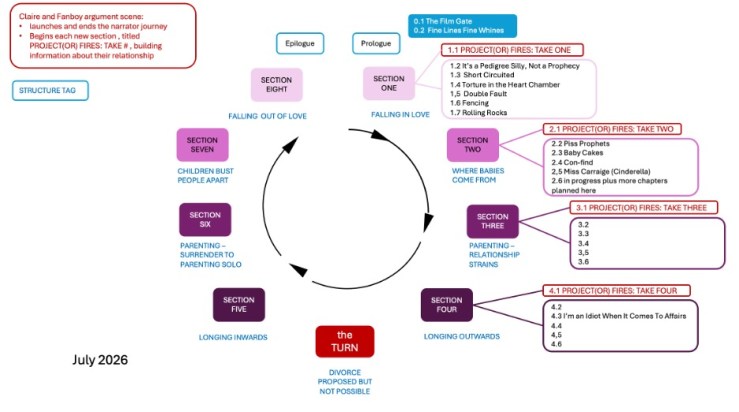
This project is committed (read: I’m committed[3]) to a compositional ring structure. Some orientation for the ring structure diagram to date (it has been updated from earlier versions) pictured below. It’s meant to be read clockwise, beginning at noon and moving around the circle from there. The pink/purple toned boxes indicate (at this point) eight different sections. Each section is made up of chapters (number varies, no set pattern) hanging (loosely) around a theme. The theme is depicted in blue block letters beneath each pink/purple section box. The different pink/purple toned boxes round the circle show how different sections “mirror” each other across the ring, the second half in mirror opposite to the first (i.e., the light pink section one (theme: falling in love) is mirrored by the light pink section eight (theme; falling out of love). The turn (sometimes referred to as the story climax, though, in this structure it’s more about when things turn around to head back to the beginning) is at the six o’clock position (at present anyway…I suspect sections 4, the turn, and section 5 will blend into each other as I get there). Each section is anchored with a return to the same scene. Here’s the diagram:
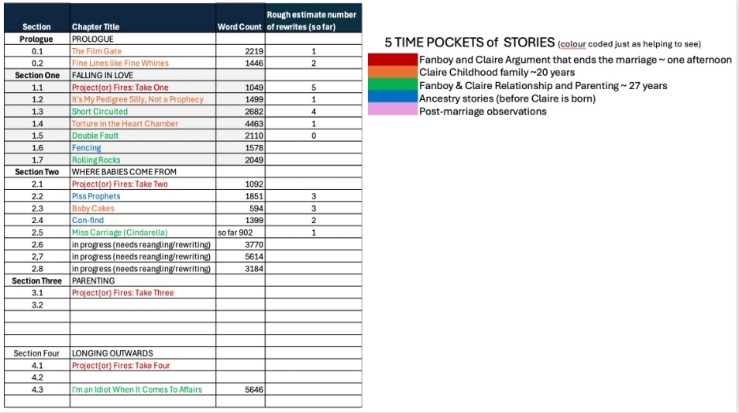
I also needed another way of seeing how the stories, drawn from different times in the protagonist’s life, are integrating together to form a wholistic ..what? book? Novel? Thing. There are five different time periods that story components are derived from. I call them “time pockets”. In order to make sure I don’t get too far afield from any set of character interactions, I colour coded the time pockets to ensure that within each section, the chapters (which are set within distinct time pockets) are balanced. I don’t expect the reader will tune into this (or be signalled to do so), but (I hope) it will create a sort of rhythm that is entertaining to read, more felt than known. I also like the associative hanging together resonances the time periods, placed side by side, create. I am not dictating a distinct pattern here, I’m simply gesturing toward a sense of balance[4]. Here’s the colour coded list of sections and chapters and their respective word counts:
Some personal observations about long form creative writing compared with shorter forms:
- It’s exhausting. I feel sooooo tired at the end of writing days.
- There is a lot (a lot!) of administrative organisation work that is separate and distinct from creative work. I imagine this is where a lot of creatives struggle. Including me. I’m messy. Admin work includes file organisation, version control, project oversight to keep content and story timelines aligned (i.e., change one detail in chapter 20 and you need to go back and update chapters 1-3, 6, 17 and 19 where you may have mentioned that detail ….and a search and find and replace button just can’t level up to the task, it just can’t, it requires rewriting to fit the new angle).
- The process of writing long is not done in discreet “whole story” steps— “first draft”, “second draft”, “nthdraft”—as it’s often referred to in creative writing craft essays and books. It is ITERATIVE[5]. So, for the word count and chapters chart pictured above, many (all?) of those chapters have been touched and re-touched a few times already …and they will continue to be rewritten and refined, over and over and over and over …the mountain [of this work[6]].
- Reading an extract of a longer work at a public reading doesn’t achieve the same transaction of energy with an audience…the reading hangs and the audience can’t quite connect to the story in the same satisfying way that sharing a short story or a poem can achieve. Here’s the video of me reading in the Prince Edward County Dime Stories event last weekend[7].
I’m humming a different song in my head today as opposed to my mountain laid bare. Thank you for reading. Vraiment merci.
[1] This is a line from the 1985 movie The Breakfast Club. It’s a line my siblings (IRL) toss my way all the time, to bring me down a peg when I become too condescending. It serves in the long form project the same way, a text-based interjection interrupting other blocks of text that focus elsewhere but, when placed side by side, the two elements create a resonance with additional meaning…almost like a second language. This example here, in this blog post, is also the method I’m using to incorporate the movie lines, italicizing the line, inserting a hyperlink to the scene (to keep track of its source), and embedding information about the line in a footnote.
[2] It is only now, in the writing of this post, that I discover two aspects of Galchen’s technique I want to apply in my own writing (and missed in my initial applications…ugh…go back over my chapters again and integrate this change). First, the protagonist doesn’t just hear the voice of her father in her head, she also talks back to it! Two-way conversation, which, yes, it’s what we all experience I think, talking to ourselves, hearing the voices of others…this is the salient point I want to integrate into my project to acknowledge the impact of various levels of environmental influences on human behaviours. Second, the lines of dialogue here don’t use quotations to signal the dialogue. I’ve always liked this, but I rarely feel confident integrating the technique in my own writing. So…an opportunity to practice AND a subtle way to distinguish different “types/occasions” of speaking, i.e., inside the protagonist mind versus outside in story scene.
[3] Should I be committed? Maybe. There are much simpler ways to write a book. I don’t know why I’ve chosen this most difficult of structures with which to pin the pieces of my story to. Except I do…I like that the shape echoes the shapes of living/lives. Cycles (seasonal, developmental, relational, rhythmic) and mirrors (the tension of holding oppositions at once, comparisons, juxtapositions, the structure of chromosomes, patterns, memory, socio-cultural influences and impacts on self and identity). “You’re so conceited Claire!! “ Yeah, thanks Ny. I don’t know if working with this structure will succeed. But I feel I gotta try it. My intuition bum tells me to. So. It works until it doesn’t. The bear went over the mountain…
[4] The other thing too is that I don’t anticipate trying to repeat the time pocket pattern in the second half of the ring structure….that feels too…meta (and I want this whole project to feel organic as opposed to mechanical ….in fact, that’s a major symbolic exploration in this work: Claire’s character is all about life and nourishment and flesh and joy and Fanboy (the character of Claire’s husband) is all about metal, inert objects, mechanical technologies, surfaces that rust and decay.
[5] And feels very similar to conducting qualitative research projects. And I can hear the masses of creative people say: Well duh?! Of course it’s iterative. But for people who are more rule bound or comfortable with a clear protocol or following a recipe, the loose description category of ‘numbered drafts’ can be misleading. The process is more of an immersion in the stream of making as opposed to jumping from rock to rock to cross it. Maybe the process is different for everybody, maybe even for every project…this is the way it is feeling for me and this project.
[6] It is rewarding. I’m not complaining. Not really. Kinda sorta …but ha ha ha it’s fun to complain sometimes.
[7] It is not visible in the video (unlike my linebacker shoulders), but when the woman before me was reading my heart started to crash in my chest and I felt really panicky but I breathed slowly, practicing the slow inhale, the slow exhale and told my heart it was okay and safe and by the time I got up the podium it had calmed enough that my breath was even and steady (and controllable).
Discover more from Process Peace
Subscribe to get the latest posts sent to your email.


