
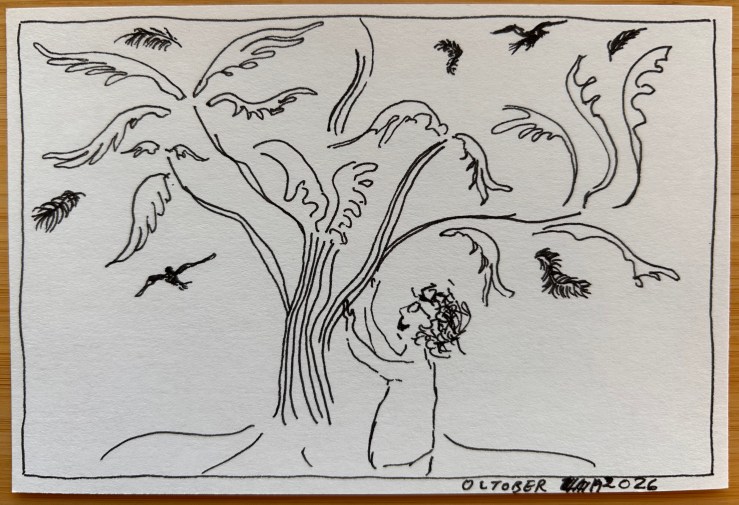
I’m smitten by the complicated mask[1]. These last weeks I’ve written my way through what I feel was my greatest point of resistance for the novel in progress[2]. I’ll use this post to list four observations that unpack the resistance—perhaps it ought be resistances plural because it’s not one resistance but many; interrelated, complex, dynamic—and the process I used to write through it/them. Heavily footnoted …whatevs.
I want to begin with this wisdom, packaged so beautifully, from Alexander Chee, related to writing through the pain parts:
“Also must it be a struggle. Can you leave treats out for this thing you are wrestling with, can you seduce it, or even just get it to sit down and tell you a story? Have you turned what should be a conversation into a struggle for dominance?”
Ah yes. I’m practicing conversations.
First observation (and I think this is important to declare): what I thought my resistance was about was only tangentially related. I discovered—and only through writing—a different avoidance[3]. And it surprised me. I can’t help but quote Joan Didion here because for me it’s the same, “I write entirely to find out what I’m thinking, what I’m looking at, what I see and what it means.[4]”
In an earlier post, I wrote about what I thought would be the most difficult section of the novel for me to write and why: the labour and delivery of my first daughter. I believed my resistance writing that experience was due to how my daughter’s birth impacted my marital relationship[5]. Instead—no, in addition—I resisted writing how I felt being “cared for” by the hospital clinical staff. Once I figured this out (through writing) I made myself lean into those memories and the associated emotions and try to report them as authentically as I could in the writing. I’ll come back to this shortly in observations #3 and #4.
Second observation. My resistance was also related to writing against the tidal current of socialised ideas about writing childbirth: it’s navel gazing; no one wants to read it; serious literature eschews it; get over it, women give birth every day, it’s no big deal. Relatedly, I’ve written a previous post about the necessity of killing this phantom, what Virginia Woolf described (though, to be clear, she was not referring to childbirth, she was referring to the experiences of women) as the internalised blocks women writers must learn to write through, “impeded by the extreme conventionality…telling the truth about my own experiences as a body”.
Writers like Sylvia Plath and Dorris Lessing wrote childbirth scenes…but through a disconnected, third person revulsion of a bestial act[6]. In researching the writing of childbirth in literature, I came across Alice Braun’s fantastic writings and research. Braun’s academic interest focused following her own experiences becoming a mother to “looking for the ways female authors who wrote about themselves had dealt with the immense shock of becoming a mother.”
It’s her description, “immense shock” that resonates with me. It was/is exactly that. The reverberating effects and affects continue to ripple and splash more than a quarter century later.
Anyway, writing through my own experience of childbirth and shaping it into a piece of creative writing …well, I basically wrestled the sharp thorns and gagged the toothy mouth and bound the claws of that persistent phantom each morning I wrote. I worked with its heaving and spluttering shadow in the corner where I’d forced it, beyond my desk, and I ignored its howls each time its muzzle slipped free (which was like, several times each morning).
The reality is there’s a dearth of childbirth details—and here I’m not just referring to the physical gut and gore of it that seems to be the point of disdain for so many readers, I’m talking about how few renderings exist of the emotional experiences of it, the interior cascade and intertwining of physiology and psychology before, during, and after giving birth—in art and literature[7]. But also, in conversations in real life. The emotional experiences are barely visible. Glossed over. Summarised and squashed. Sanitised. It’s uncanny, I think, for an experience that all humans have been a part of since the dawn of human time[8].
Here’s a quote from artist Heather Spears who drew gorgeous scenes of childbirth with pencil and paper:
“For me a great part of the joy I have in drawing is that it has been private, I have gotten into places I never would have experienced otherwise, come close to and witnessed human experience that is secret and fleeting, that takes close observation and sometimes was so difficult that my attention was all that was left; in the words of Rilke, the work absorbed every feeling, everything personal “so there was no residue.”‘
Observation number three: writing this section of the novel (several chapters), I needed to switch methods to be able to render the scenes. I’ve drafted most chapters so far using keyboard and computer. When I began writing the pregnancy and birth scenes I fell into my old avoidance pattern: reporting rather than creative writing, leveraging a distanced, disembodied narrator. I needed to immerse into the sensual and psychological experience and memories, as well as imagination. So, I began timed writes (30 minutes) using notebook and pencil. Over the years, using this method, I’ve successfully trained myself to let go and write using stream of consciousness. I also force myself to practice this method through regular volunteer work, facilitating writing sessions with the Writer’s Collective of Canada[9]. Interestingly, the writing that came out when writing about pregnancy and childbirth by hand included strong and surprising imagery of giant octopuses and whales.
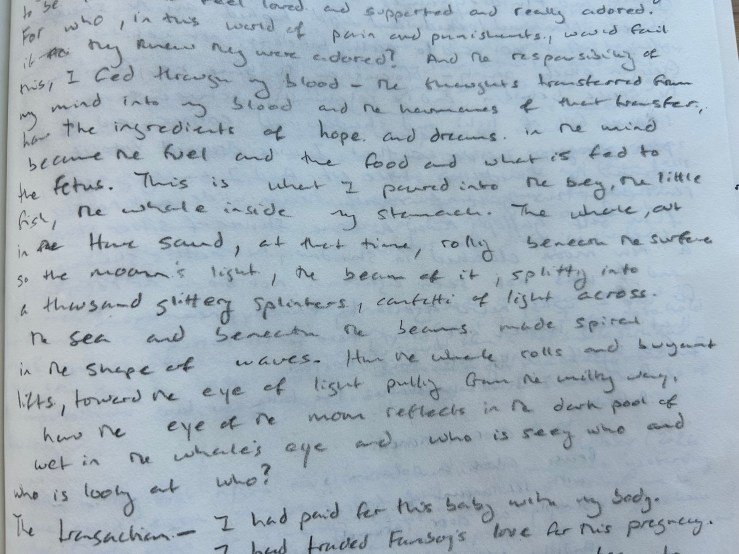
Here’s an extract, unedited:
“…how the ingredients of hope and dreams in the mind become the fuel and the food what is fed the fetus. This is what I poured into the being, the little fish, the whale inside my stomach. The whale, out in Howe Sound, at that time, rolling beneath the surface so the moon’s light, the beam of it, splitting into a thousand glittering splinters, confetti of light across the sea and beneath the beams made spiral by the shape of waves. How the whale rolls and buoyant lifts, toward the eye of light pulling from the milky way, how th eye of the moon reflects in the dark pool of wet in the whale’s eye and who is seeing who and who is looking at who?”
Instead of assuming this image (which arrived in more than one free write, dreaming its way present) to be irrelevant to my writing of labour and birth, I leaned into it as metaphor. When I transcribed the pencil writings to the computer, the image of the octopus became the mechanism by which I could describe the pains of labour. Not surprisingly, the image of the whale did the same. Marine metaphor felt entirely …inevitable. It was only later, when reading poems about birth in Jess-Cooke’s anthology Writing Motherhood, I was astonished several different poets applied ocean and marine life metaphors and imagery in their creative works.
Final observation, number four, this should not have been a surprise, but it was: the painful emotional memories arrive on the page fractured. What do I mean by this? I mean the images and scenes written by hand with pencil and paper are scattered…not hooked to a timeline. They are like puzzle pieces thrown into disorder, or that silly card pack game where someone asks if you know how to play 52 pick up before tossing the cards to the air. A strong narrative line provides the illusion the images and scenes are fitting together along a storyline, but because I know what I am trying to write as part of the novel, I could see how I needed to extract sections and sequence them differently to serve the story better. This makes me wonder about the use of creative practices for healing emotional pain ….it seems a viable…useful…helpful way to pull splintered pain out of the human body into the body of an artifact. There’s lots of research on this…I won’t go into it now. It’s just interesting to be experiencing it first-hand.
Thank you for reading, holding my hand, as I write.
[1] Wary. Intrigued. Wing-tree-ed.
[2] I felt euphoric writing through and past this resistance…it opens me up, confirms I’m able to move forward (not be stuck). I considered buying champagne but felt somehow the gesture premature…I have a lot of work to move through still. A lot. Like, years. Instead, I made a fabulous dinner: five-spiced duck breasts, honeyed cranberry ketchup with a chili kick, celeriac puree, roast carrots, lentils with an astringent vinaigrette (the Lillian in my mind interjects: why do you insist on feeding people lentils?! It’s polarizing! People hate them), saffron and honey poached pears with bars of sugared shortbread. Wine was a Cabernet Franc from France…I would have preferred a Pinot Noir from the Russian River Valley in Oregon, but Canada has boycotted stateside liquor and I can’t justify the cost of a good French Burgandy…I might as well buy champagne …there, how was that little seesaw trip through my thinking, and uh, my stomach?
[3] There is something to do with the physical act of writing…the fine motor coordination of the fingers moving across a keyboard, or better, the soft whisper of pencil or pen across paper that enables …let’s call it enriched communication from the body. This has always interested me, and I may have written it before, but there is a deep interconnection between manual dexterity and cognitive development. Rudolph Steiner, the founder of Waldorf education, had his students (all boys back then, eyeroll) knitting, as well as other ‘hand work’ during lessons to improve learning and thinking.
[4] Although, I disagree with Didion’s position about writing being an aggressive, bullying act. My own take on this, and I’ve written it before, is that the communication between writer and reader is an intimate one, also one of consent. I offer you, as much as I am able, my authentic voice and really, my love; you, as reader, gifts me time and attention. And, when I’m very lucky, also love.
[5] This is a broader exploration in the whole novel…one of a few it seems. When I tell Lillian about the difficulty writing a fictionalised(ish) version of her birth she says, It’s not surprising, it was the beginning of the end. And she’s right. Who knew an ending could be stretched across twenty-five years?
[6] See Alice Braun’s 2022 post, Representing Childbirth in Literature: From Third to First Person. Also, I’ve pulled The Bell Jar off my shelf and intend to read through it from this different angle, birth filtered through a third person narrator illuminating clinician opinions related to medical interventions. Also intend to read Rachel Cusk’s first person rendering of childbirth in A Life’s Work: On Becoming a Mother. I have a large reading pile on this specific subject to be honest, some I have read through already but many others lie in waiting…and I recognise my tendency to sink into the pleasure of reading instead of continuing to write forward in this novel project….so…trying to balance this. I did find reading the poems and interviews in Writing Motherhood: A Creative Anthology, edited by Carolyn Jess-Cooke, to be particularly edifying …a kind of cheerleading on the sidelines to KEEP WRITING! AND I am trying to read through the spectacular translation of Olga Ravin’s My Work without weeping uncontrollably (translated by Sophia Hersi Smith and Jennifer Russell).
[7] It’s interesting how so much (western) art through the ages depicts “the birth of Jesus”. Mary is often painted kneeling, wearing the precious blue pigmented painted dress, pristine and clean…but the imagery is depicted as a serene, divine post-birth event as opposed to any realistic, naked, bleeding, raw rendering. Mary is winsome not wild. It’s a potent communication of how a mother should look/behave immediately following birth…completely idealistic and utterly impossible. Artists who focused a lifetime to develop the technical skills to render life as it really is …I mean, take a look at the miraculous detail of the light captured on folded fabric! Not a drop of blood or hint of pain. Talk about false advertising! The message is displayed all over the globe on national gallery walls. Natalie Lennard, also known as Miss Aniela, is a fine-art and commercial photographer who created ‘Birth Undisturbed’ , an award-winning fictional narrative series – here is a fantastic short video of Lennard describing her process to create her real and raw photograph of the Virgin Mary giving birth. Here is Lennan’s personal story about giving birth to Evan, a baby who was stillborn.
[8] A thought, not backed up by any research so hefty grain of salt here…but I wonder, no, I assume, that historically the conversations and experiences of giving birth trace an oral retelling as opposed to a written or artistically rendered one. And perhaps passed through the mouths of women only…As we in the western world have shifted over the last century to a medicalised model of childbirth (which, yes, of course, has drastically reduced mortality rates for mothers and infants, there is no denying this proven fact), we have (I mean women) surrendered the communal emotional supports and knowledge which would have been such a part of any birth in the past. I missed this. I wanted this. I think my own experience would have been less terrorizing and my recovery, I’m referring to my psychological recovery, would have been better supported and swifter.
[9] It’s a very simple and empowering method: a writing prompt is provided (e.g., write about burning a bridge), often taking inspiration from poems or images; everyone writes together in silence for 10 minutes; we take turns reading what we wrote aloud; people respond to the writing by saying what stood out for them, what they loved in the piece; there is no critique or suggestion for improvement. The writing I have been fortunate to hear in these sessions is absolutely beautiful and authentic. Facilitators write and read too.
Discover more from Process Peace
Subscribe to get the latest posts sent to your email.


